
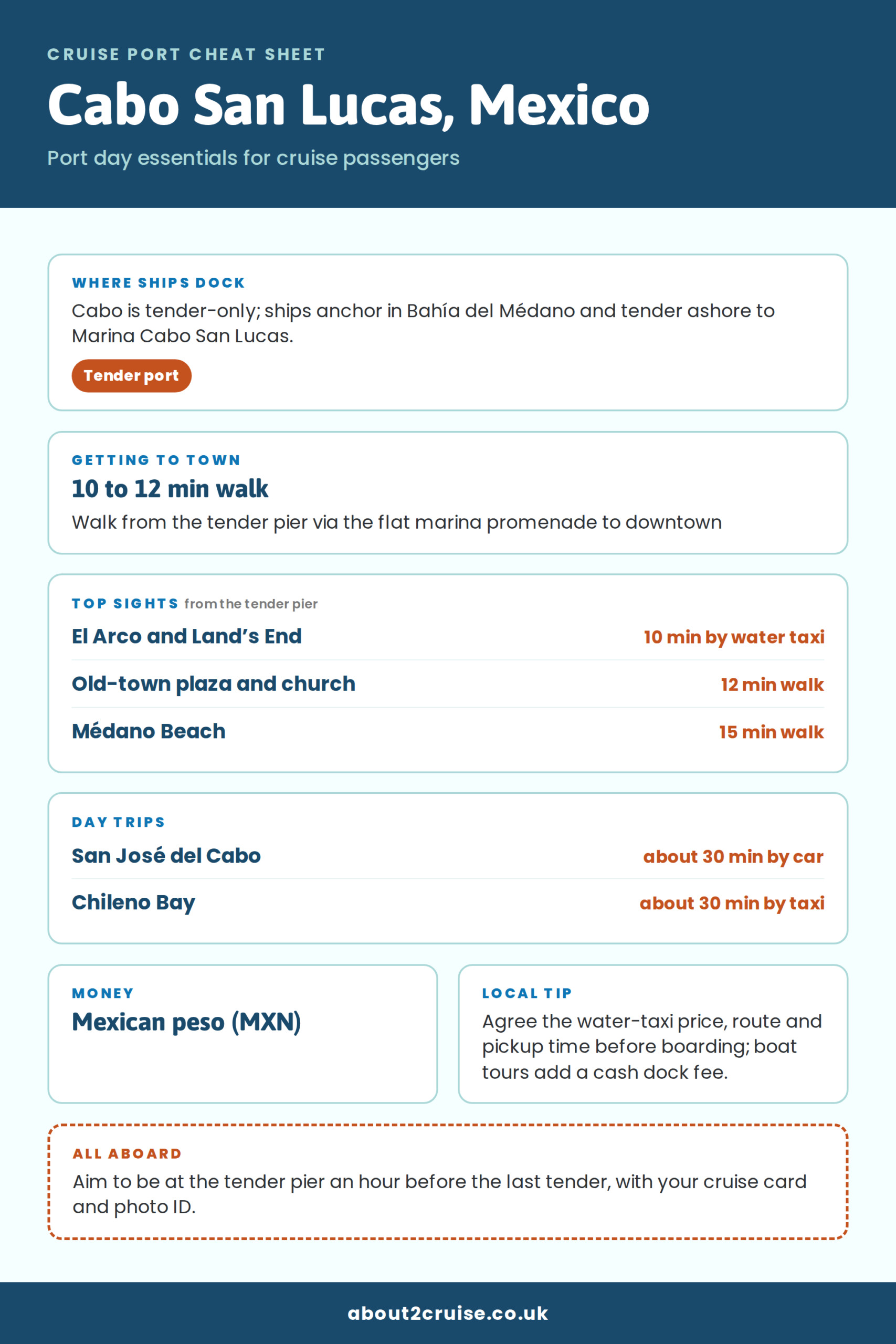
Cabo San Lucas is a tender-only port on Mexico’s Baja California Sur peninsula. Cruise ships anchor in Bahía del Médano and send you ashore by tender to the marina. The one thing you must do is a short boat trip to El Arco at Land’s End. Médano Beach is a 15-minute walk from the tender pier, and the compact, safe tourist zone makes this one of the easiest Mexican Riviera ports for independent cruisers.
Cabo San Lucas at a glance: what to know before you go
- Port type: Tender only: there’s no cruise pier and no terminal building for luggage or check-in.
- Tender ride: Usually 10–15 minutes from the ship to the marina.
- Walk to a beach: Yes, Médano Beach is about 0.8 miles / 1.3 km and roughly 15 minutes on foot.
- Must-do: Boat trip to El Arco and Land’s End.
- Currency: Mexican peso (MXN). US dollars are widely accepted in the tourist zone, but you’ll get a better rate with pesos.
- Time zone: Mountain Standard Time all year, no daylight saving. Ship time may differ, so always go by the time your ship publishes.
- Best cruise months: November to mid-June for dry, comfortable weather; December to April for whales.
- Safety: The tourist zone and marina are well patrolled and generally safe. Just use the same street smarts you would anywhere busy.
Cabo San Lucas cruise port map
Tenders bring you ashore at Marina Cabo San Lucas (tender pier). From the tender pier, Plaza Bonita is about a 7-minute walk, Puerto Paraíso about 9 minutes and Lover’s Beach about 26 minutes. Tap a pin for directions.
- Marina Cabo San Lucas (tender pier)Where tenders land
- Plaza BonitaShopping area · About 7 min walk from the tender pier
- Puerto ParaísoShopping centre · About 9 min walk from the tender pier
- Lover’s BeachBeach · About 26 min walk from the tender pier
- Old-town plaza and churchTown square and church · About 28 min walk from the tender pier
- El Arco and Land’s EndNatural arch · About 2 km from the tender pier
- Médano BeachSwimmable beach · About 2 km from the tender pier
- Chileno BaySnorkelling bay · About 13 km from the tender pier
- Santa Maria BaySnorkelling bay · About 11 km from the tender pier
- Cerro del VigíaLookout hill · About 4 km from the tender pier
- San José del CaboTown · About 29 km from the tender pier
How tendering in Cabo actually works
There’s no deep-water pier in Cabo San Lucas. Instead, ships anchor in Bahía del Médano about 1 km from the lighthouse at the marina entrance. Up to four ships can sit at anchor at once, each running its own tender boats. The ride usually takes about 10 minutes, sometimes 15 if your ship is anchored further out or the water is a little lumpy.
You’ll step ashore on the south side of Marina Cabo San Lucas at a public floating dock near Finisterra A1, Centro. This isn’t a traditional cruise terminal, there are no luggage halls, car hire desks or parking areas. You simply leave the tender and walk into the marina complex.
If you’re not on a ship-sponsored excursion, you’ll usually get a tender ticket or group number on the morning you arrive. Ship excursions leave first, and suite guests, top loyalty tiers and Carnival’s Faster to the Fun often get priority boarding. The longest tender queues happen in the first hour or two after clearance, often 15–30 minutes, and they ease off by mid-morning.
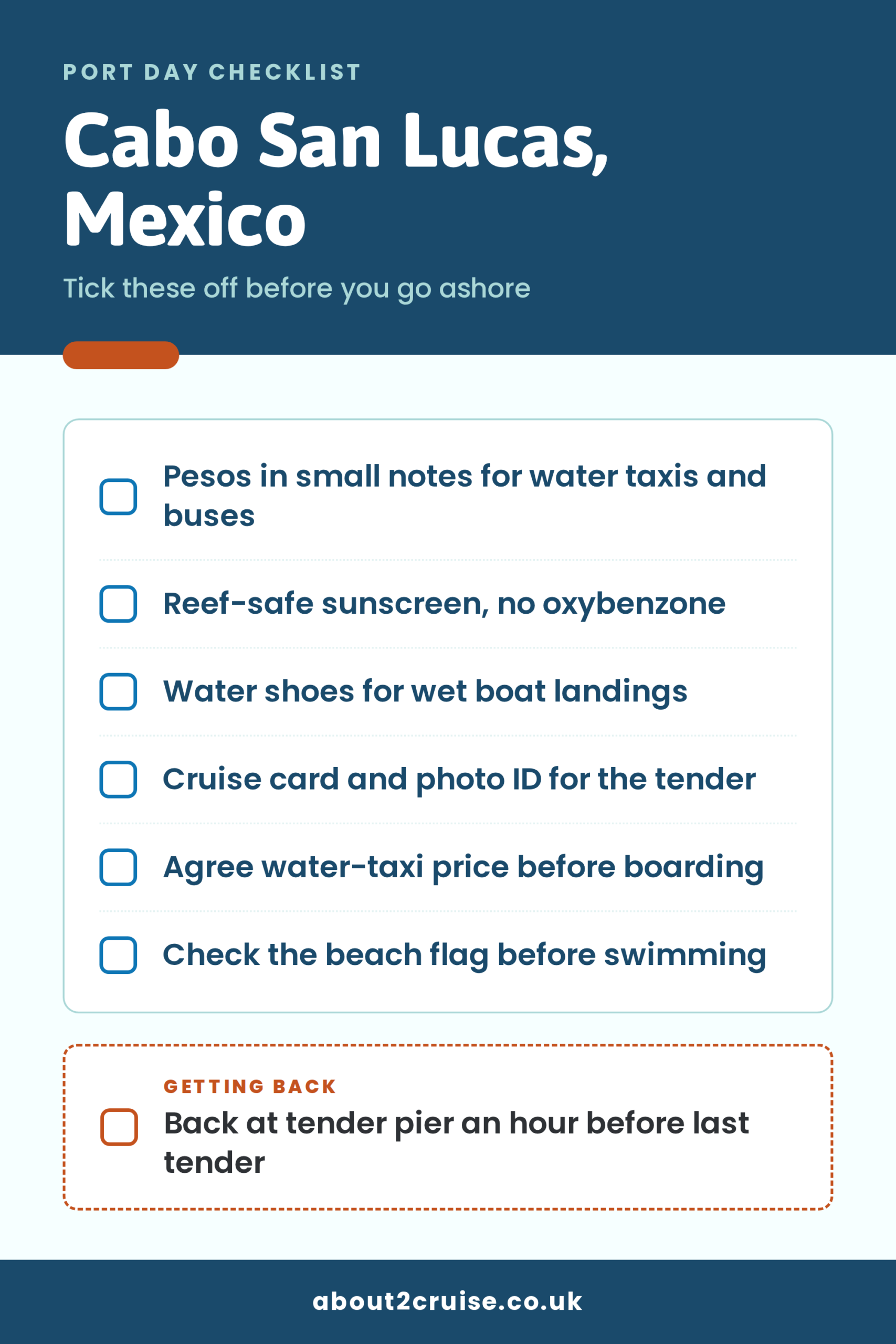
The only time that truly matters is the last tender time printed in your ship’s daily programme. It’s always earlier than the sailing time, often by 45–60 minutes. Aim to be back at the tender pier at least an hour before the last tender, with your cruise card and a photo ID. Cabo stays on Mountain Standard Time all year, and ship time may not match local time, so always follow the time your ship publishes.
Rough seas can slow or suspend tendering. In stronger wind or swell, the captain may cancel the port call altogether, this is more common in late summer and early autumn. Accessible tendering is limited: guests who use scooters may not be able to board, and crew are not allowed to carry anyone across the gap between the ship and the tender. If you have mobility concerns, talk to the shore excursions desk before you arrive.

From the tender pier to downtown: the marina walk
From the tender landing, you have three ways out. The easiest is the north exit straight onto the marina promenade, a flat waterfront path that reaches downtown in about 10–12 minutes. The west exit takes you through a small terminal building with toilets and an information kiosk, while the south exit leads into Plaza Bonita, the first of several shopping areas around the marina.
There’s no security checkpoint, no port entry fee and no departure fee. You can walk the whole marina boardwalk end to end in about 30–40 minutes. Yacht docks, sportfishing boats and water-taxi stands line the route, with restaurants, tour desks and souvenir shops behind them. The marina itself is flat and has curb cuts, but side streets and older pavements can be narrow and uneven.
If you like having a mental map, picture the marina as a U-shape. You come ashore near the bottom of the U. The right-hand side curves round to Puerto Paraíso shopping centre, the beach and the main road. The left-hand side follows the yacht slips toward the old town plaza and the church. Either way, you stay in the busy, well-lit tourist zone.
Can you walk to a beach in Cabo?
Yes, you can. Médano Beach, the main swimmable beach inside the bay, is about a 15-minute walk from the tender pier. Just follow the marina promenade round to the beach side of the bay. The path is flat and passes Puerto Paraíso shopping centre and several beach clubs.
Médano is sheltered by Land’s End and is really the only long beach in town where swimming is consistently safe for cruise passengers. It has Blue Flag certification, which means lifeguards, marked swimming areas and accessible facilities in the club zones. Beach clubs along Médano typically work on a minimum spend of about US$30–60 for a lounger and umbrella rather than a fixed entry fee.
Steer clear of Divorce Beach and any other Pacific-facing beach west of the marina. The surf, rip currents and rogue waves on the open Pacific side make even wading dangerous. Lover’s Beach, near the Arch, has a calm Sea of Cortez side, but you can only reach it by water taxi and it has no facilities.
The one thing you shouldn’t miss: El Arco and Land’s End
The single thing you should not skip in Cabo San Lucas is the short boat ride out to El Arco, the natural arch at Land’s End where the Pacific meets the Sea of Cortez. You can’t walk there, but from the marina where your tender lands it’s only about 10 minutes by water taxi or glass-bottom boat.
A shared, licensed water taxi loop around the Arch takes about 30–45 minutes and costs roughly 200 Mexican pesos per person, plus a small cash dock fee of about US$4–5 per person. That dock fee is nearly always charged separately at the dock, so don’t be surprised if it’s not included in the quoted ticket price. Glass-bottom boat tours run about 45 minutes and are usually quoted at US$20–25 per adult and US$10 per child. Touts near the marina gate often start at US$40–60, so ask for the shared or licensed fare and agree the price before you get on board.
Morning light between 08:00 and 10:00 is best for photos of the Arch. The rock itself is the easiest photo stop, but you’ll also pass the sea lion colony and, if the sea is calm, Lover’s Beach in the cove beyond. This area is part of the Cabo San Lucas marine park, and sunscreens containing oxybenzone and octinoxate are restricted, so check your sunscreen label before you go.
How to make the most of a short Cabo port day
Most cruises give you around seven to nine hours in Cabo, and tender time eats into that. Having a flexible plan helps a lot.
- If you have about three hours ashore: Tender in, walk the marina, take a 45-minute glass-bottom or water-taxi loop to the Arch and back, then grab fish tacos near the plaza.
- If you have about five hours: Do the Arch boat loop first, then walk to Médano Beach and rent a lounger at a beach club for a swim and a drink.
- If you have a full eight hours: In winter, add a whale-watching trip. In late spring or summer, join a snorkel or catamaran sail to the Corridor beaches. You’ll still be back on the ship well before the last tender.
If this is your first visit and you only remember one plan, make it this: do the Arch boat trip first, then walk to Médano. That gives you the iconic sight, the desert-meets-sea landscape and the beach in the shortest possible time.
Whale watching in Cabo: season and practical tips
Whale watching in Cabo runs from about 15 December to 15 April each year, with January and February the peak for breaching humpbacks and mothers with calves. Humpbacks are the main species, but you might also spot grey whales, orcas, dolphins and mobula rays on the same trip.
Shared tours booked locally tend to run US$60–85 per person, while the same kind of trip through the cruise line often costs US$120 or more. A 2-hour speedboat tour from the marina is roughly US$108 plus 16% IVA and the cash dock fee; a 2.5-hour catamaran is about US$138 plus the same extras. Most operators run morning and early afternoon departures, and early morning trips usually have smoother water and fewer boats.
Whale watching in Los Cabos is regulated by SEMARNAT. Only permit-holding operators may approach whales, and no tour can guarantee a sighting. If you book independently, choose a boat that clearly displays its permit and season dates.
Snorkelling and diving near Cabo’s Land’s End
Pelican Rock, right next to the Arch, is the closest snorkel site to the marina and can only be reached by boat. The water there is usually calm and protected. Santa Maria and Chileno bays on the Tourist Corridor are the other two main snorkel spots, and both are Blue Flag certified.
A 3-hour Arch-and-snorkel trip from the marina runs about US$98 per person. A 4-hour two-bay trip to Chileno and Santa Maria is roughly US$149. Most trips include gear, a life jacket and basic instruction. Some add wetsuits in winter, when water temperatures drop to around 21–23°C. Cruise-sold catamaran snorkel trips are shorter, often around 2 hours, from US$83.99 per adult.
Santa Maria is generally rated the best snorkel with fewer crowds, while Chileno is better for families and easy access. If you want to snorkel independently, the Corridor beaches are reachable by local bus or taxi, but on a port day the easiest option is a boat trip that includes transport and gear.
Sportfishing and the marina culture in Cabo
Cabo San Lucas is one of the world’s great sportfishing ports, and the marina is the working base for the local fleet, water taxis and private yachts. Charter boats usually leave very early, often around 06:30, so if you want to fish, you’d need to be on one of the first tenders and have a boat pre-booked. That’s rarely possible on a standard port day, but it’s worth knowing if your ship has an early arrival.
If your cruise calls in October, the Bisbee’s Black & Blue marlin tournament brings the marina to life. Boats leave at 07:00, and the weigh-ins happen at Puerto Paraíso mall scales from 14:00 to 21:00. The tournament draws around 170 boats and more than 1,200 anglers each year, with purses above US$7 million. The marina boardwalk and weigh-in area are a lively free spectacle.
Sunset cruises and Cabo nightlife
Sunset cruises leave from the marina, pass the Arch, Lover’s Beach and Pelican Rock, and usually last about 2 hours with an open bar. Prices range from about US$79 to US$149 per person, plus the US$4–5 cash dock fee at check-in. Most check in at the marina docks around 17:00.
For most day-cruise passengers, the reality is that the last tender leaves well before the clubs open. Cabo’s nightlife is concentrated in a few walkable blocks around Boulevard Lázaro Cárdenas and the marina. Clubs generally open around 21:00–22:00, peak after midnight and close between 03:00 and 05:00. El Squid Roe and Cabo Wabo Cantina are the famous names, but you’ll only see them if your ship has an overnight stay or a very late departure, which is uncommon.
If you do end up with a late night, the downtown strip is well lit and heavily patrolled, and Cabo is considered one of the safer nightlife scenes in Mexico. Drinks downtown run roughly 150–280 MXN (US$8–15), and club covers range from free to about US$30.
Shopping, local food and drink near the marina
The marina boardwalk rings the harbour where you land and is lined with restaurants, tour desks and souvenir shops. Waterfront prices are tourist rates. Walk a few blocks inland behind the marina and you’ll find taco stands and small family-run places at a fraction of the cost.
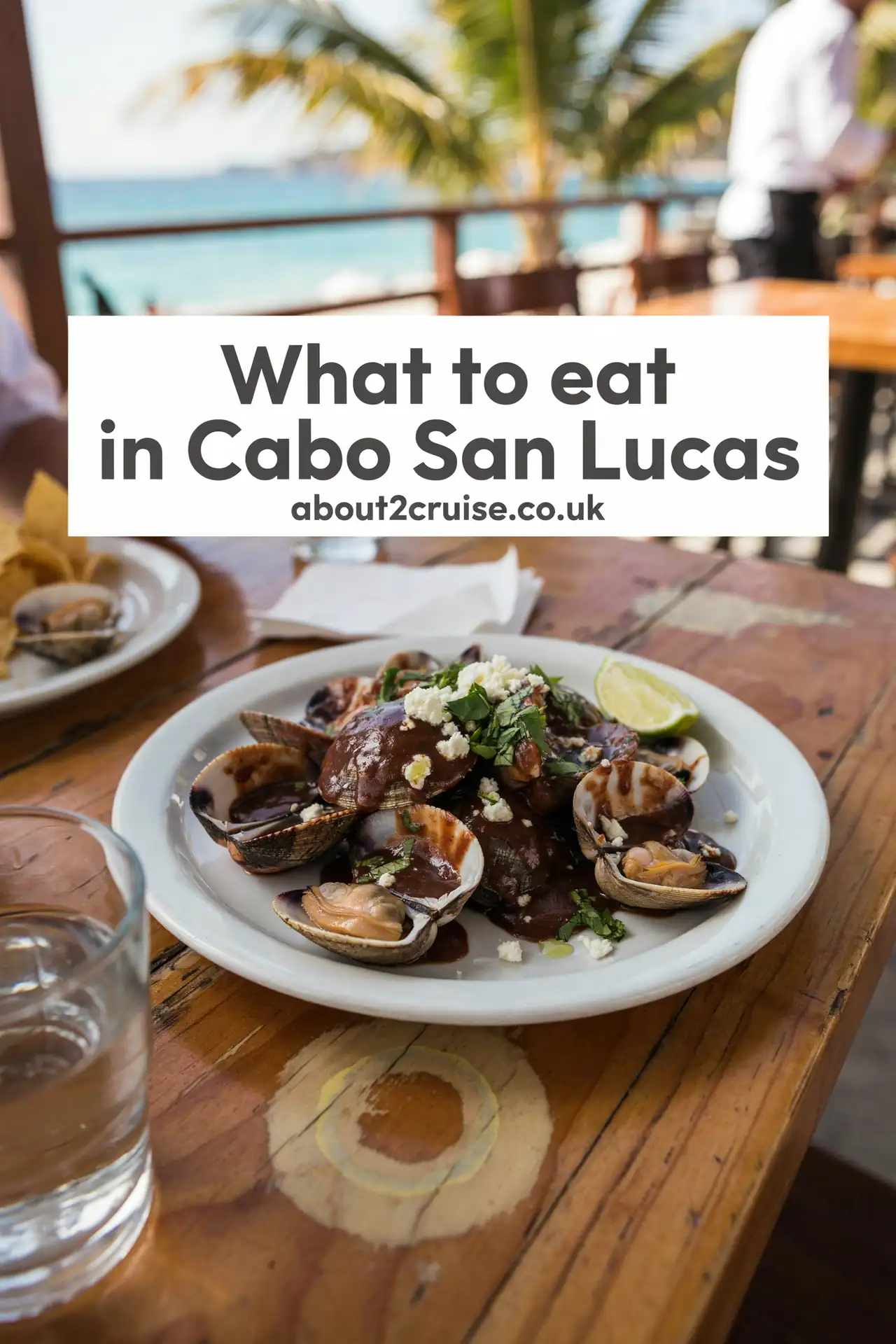
Chocolate clams are the signature local dish, large clams named for their brown shell, traditionally cooked on hot stones or embers in the shell. Other everyday plates include battered fish tacos, aguachile, ceviche, tuna tostadas and smoked marlin. Baja wine from Valle de Guadalupe is poured in the region’s wine bars, and Cabo is known for excellent margaritas.
Tap water is not for drinking. Bottled water is sold everywhere, and established restaurants and bars in the tourist zones use purified water for ice and drinks. If you want to try local food without paying marina prices, head for the streets behind the old town plaza or ask a crew member where they eat in port.
Money in Cabo: pesos, cards, ATMs and tipping
The local currency is the Mexican peso (MXN). US dollars are widely accepted in the tourist zone, but each business sets its own exchange rate and it rarely works in your favour, so carry pesos if you can. When a card terminal asks whether you want to be charged in pesos or dollars, always choose pesos, your bank will almost always give you a better rate than the local conversion.
Cards are accepted at nearly every sit-down restaurant, bar and hotel. Small taco stands, beach vendors, water taxis and some taxis are cash only. Use bank-affiliated ATMs rather than standalone machines on the marina walk. Withdraw in pesos and decline the machine’s conversion offer. Mexican bank ATM fees run about 35–100 MXN per withdrawal.
Carry small notes, 20, 50 and 100 peso bills, because big notes are hard to break at street stands. Tipping follows US norms: 15–20% in restaurants and bars, rounding up for taxis, and cash tips to boat crews and guides. Boat tours typically add a US$4–5 per person dock fee in cash that isn’t included in the advertised price.
Staying safe in Cabo and common scams to avoid
English is spoken almost everywhere in the Cabo tourist zone, often more than Spanish in restaurants, bars and tour desks. A few polite words of Spanish will still help in smaller local places.
The UK FCDO says Baja California Sur, where Los Cabos sits, is unaffected by its warnings for other parts of Mexico. The US advisory for Baja California Sur is Level 2, the same level as France and the UK. Tourist areas are well policed, and Los Cabos operates a dedicated Tourist Assistance Centre on +52 624 105 0551.
Most hassles in Cabo are not violent. Taxis have no meters, so agree the fare and currency before you get in. Water-taxi and glass-bottom touts near the marina gate are persistent; a polite “no, gracias” usually works. Before stepping aboard any small boat, agree the price, whether it’s a round trip, and the beach pick-up time. Don’t swim at Divorce Beach or any Pacific-facing beach. Check the beach flag on Médano: green means calm, yellow moderate, red stay out, black closed. Watch your drink and use official taxis or app cars rather than unmarked vehicles.
What to wear and carry for a Cabo cruise day
Cabo has a hot desert climate. The sun is stronger than it feels with the sea breeze, so reapply sunscreen often, wear a hat and drink more water than you think you need. For anything in the water, use reef-safe sunscreen. Oxybenzone and octinoxate are restricted inside the Cabo San Lucas marine park, and operators and rangers do check at the dock.


Water shoes or sandals help on beach and snorkel trips where you step into shallow water getting on and off boats. The marina promenade is flat, but downtown sidewalks can be narrow and uneven. If you plan to climb the rocky, unshaded path up Cerro del Vigía for the view over the Arch and both seas, you’ll need sturdy shoes, water, sunscreen and a cap. If you want to go into a club after 22:00, bring a real government photo ID, a phone photo will not be accepted.
Getting around Cabo: taxis, Uber and public transport
Taxis in town cost about US$8–15 for a short hop, US$25–40 to the Corridor beaches, and US$35–55 between Cabo San Lucas and San José del Cabo. There are no meters, so agree the fare and currency before you get in. Uber operates in both towns with waits of 5–15 minutes in central areas, but coverage thins outside the town centres. Never request an Uber from the taxi line or the cruise pier, walk clear of the rank first.
Local buses run along Highway 1 toward San José del Cabo and the Corridor beaches. Pay the driver in pesos with small bills. Water taxis run from the marina to Lover’s Beach and Médano for about US$10 each way, with the same advice: agree the price, route and pick-up time before you board.
Los Cabos International Airport (SJD) is about 30–45 minutes from Cabo San Lucas by road. There is no passenger railway in Baja California Sur and no city bus system designed for tourists. For a day port call, you’ll rarely need to go beyond the marina, Médano or a pre-booked tour.
Day trips from Cabo: San José del Cabo and the Tourist Corridor
San José del Cabo is about 20 miles / 32 km from Cabo San Lucas, roughly 30 minutes by car. Its gallery district runs a free Art Walk every Thursday from 17:00 to 21:00, November to June, around Calle Obregón and Plaza Mijares. A one-way Uber costs about 550–650 pesos (around US$30).
For most cruise passengers, a round trip to San José only fits if your ship has a long port day or an evening departure. The Tourist Corridor, the 33 km of coast between the two towns, holds the resort strip and Corridor beaches like Santa Maria and Chileno. These are best reached by pre-booked snorkel tour or taxi, not by public transport on a tight schedule.
Ship excursion or independent water taxi? How to decide
Booking a ship excursion in Cabo buys you two things: priority tender boarding and the guarantee that the ship waits if the tour runs late. Independent tours are cheaper and often smaller, but if they run late the ship will not wait.
A ship-sold Land’s End boat trip typically costs about US$45 per person for an hour. The same loop bought at the marina as a shared water taxi or glass-bottom boat costs US$20–25 per person. Carnival sells a 4-hour Arch, beach, shopping and taco lunch tour at US$121.99 per adult, while a 2-hour catamaran snorkel is US$83.99. Local tour cancellation rules are usually 72 hours for 75% back, 48–72 hours for 50%, and nothing under 48 hours, with a full refund only if the port closes.
If your priority is maximising time ashore, a ship excursion may be worth it for the early tender. If your priority is value and flexibility, the marina water taxis and small independent operators are hard to beat.
Which cruise lines call at Cabo and how long you get
Carnival, Celebrity, Disney, Holland America, Norwegian, Princess and Royal Caribbean all call at Cabo on Mexican Riviera routes. Azamara, Cunard, Oceania, P&O, Seabourn, Silversea, Regent, Viking Ocean, Virgin Voyages, Costa and MSC also appear on Cabo schedules. Cabo is a standard stop on Mexican Riviera cruises round-trip from Los Angeles, Long Beach, San Diego and San Francisco. For more on those homeports, see our guides to Los Angeles, Long Beach and San Diego, or browse the wider US West Coast cruise ports guide.
Typical port time is 7 to 9 hours. Cabo is a port of call, not a turnaround port, and some itineraries spend a night at anchor there. The busiest day on the forward schedule can bring four ships, with about 835,000 passengers across the year. If your ship is one of several in port, the marina and tender dock will be noticeably busier.
Royal Caribbean and Carnival Cabo tender tips
On Royal Caribbean, priority tender boarding goes to suite guests, Diamond and higher Crown & Anchor members, and passengers on Royal excursions. If you’re exploring independently on a busy day, avoid the first tender rush by waiting an hour or so after clearance. The Arch, Médano and the marina are all easy to do without a shore excursion.
Carnival also runs priority water shuttles for suite guests, Platinum and Diamond levels, and anyone buying a shore excursion or Faster to the Fun. Carnival’s website notes that Cabo has limited availability of accessible water shuttles. The captain decides whether a guest with mobility limitations can board a tender, and crew are not permitted to carry anyone on or off. If you use a scooter or heavy wheelchair, check with Guest Services before arrival.
How Cabo compares to Puerto Vallarta and Mazatlán
On a Mexican Riviera itinerary, Puerto Vallarta and Mazatlán are both docking ports with colonial old towns and longer port times. Cabo is different: a tender port built around one famous rock formation, a marina and desert-meets-sea scenery. Mazatlán is known for its historic centre and malecón, Puerto Vallarta for its old town and beach culture. Cabo is the most compact and water-focused of the three, and it’s the one where you can realistically see the headline sight in under an hour from the tender landing.
Further south on the Pacific coast, Puerto Quetzal is Guatemala’s cruise port, with excursions to colonial Antigua rather than Cabo’s boat trips to the Arch.
Where to take the best Cabo cruise port photos
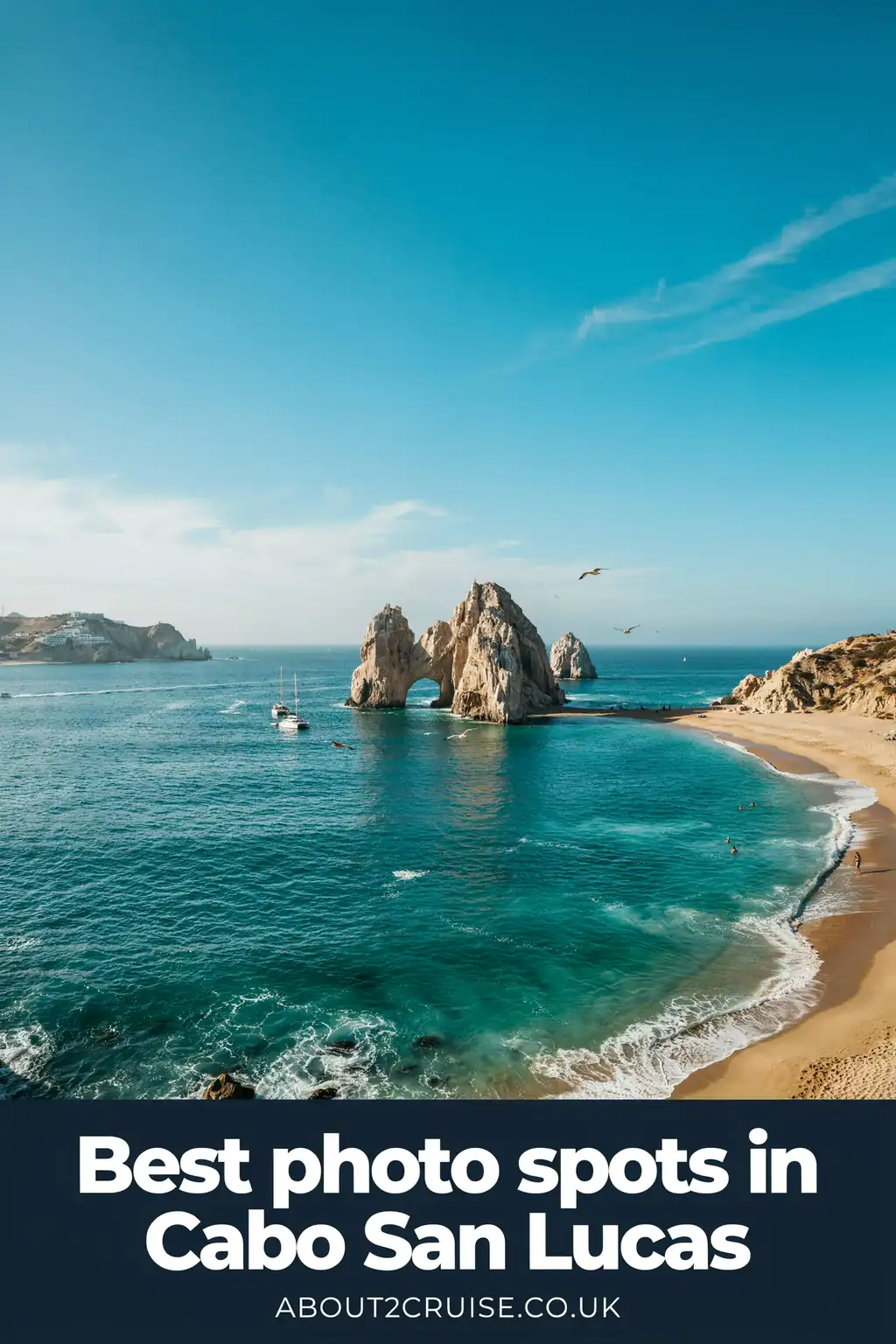
The best photo spots in Cabo are easy to find. Shoot the Arch from the water in morning light between 08:00 and 10:00. On Médano Beach, look back across the bay for a shot of Land’s End with your ship at anchor. The marina boardwalk and the line of yachts make a colourful frame, and the old-town plaza with the church gives a town-side shot. For a bigger view, the short but rocky walk up Cerro del Vigía offers a 360-degree panorama over the Arch, the town and both seas. Pacific-side photos at Solmar are best at golden hour, and only from a safe distance.
Cabo for families and cruisers with mobility concerns
Tender ports are always harder for anyone with mobility limitations. Once ashore, Cabo’s marina promenade is flat with curb cuts, but the beaches are soft sand and water-taxi landings are wet. Ship excursions in Cabo are commonly marked as not accessible for guests using wheelchairs, canes or rollators.
For families, Médano Beach is the easiest option because it’s walkable, has clubs with facilities and is the safest swimming beach near the port. The Arch boat loop is short enough for most children, and glass-bottom boats add a bit of novelty. Chileno Beach has the best infrastructure of the Corridor beaches for families, but it requires a taxi or tour.
Port facilities: toilets, luggage, parking and Wi-Fi
The tender landing has toilets and an information kiosk in the small terminal building. There is no luggage storage at the port, the marina or the airport, so plan to go bag-free unless you book a third-party storage service such as Stasher, which has a shop about a five-minute walk from Centro. Prices start around US$1.49 per bag per day.
Because there’s no cruise terminal building and no cruise pier, there’s no port parking to book and no drop-off point for luggage. If you stay before or after a cruise, hotels in the marina and Médano area have their own parking and bag storage.
Wi-Fi is good at the marina and patchy on the beaches. Cell coverage is strong in town and close inshore, including the Arch, snorkel coves and whale-watching areas. A local Telcel prepaid SIM costs about 150–250 MXN for a 30-day package, and eSIM plans start around US$5–10 for 1 GB over a week.
How to spend a port day in Cabo San Lucas
A port day in Cabo San Lucas works best if you pick one: a short water-taxi loop to El Arco and a beach swim, or a longer day with whale watching or a Corridor snorkel trip.
Before you sail
- Book whale-watching or snorkel trips online for December to April.
- Bring pesos in small notes for water taxis and cash-only stands.
- Check your cruise line's tender priority and accessible-tender policy.
Short port day: under 6 hours
- On dockingTender into the marinaGo earlyTender ride takes about 10 to 15 minutes to the marina landing. Carry your cruise card and photo ID.
- +30 minWalk the marina to the water-taxi standTake the flat marina promenade to the water-taxi and glass-bottom boat stands. Agree the shared fare before boarding.
- +45 minEl Arco by water taxiCash for dock feeA shared water taxi or glass-bottom boat reaches the Arch in about 10 minutes. The loop takes 30 to 45 minutes and passes the sea lion colony.
- +1 hr 45 minLunch near the old-town plazaTry fish tacosWalk a few blocks inland from the marina for battered fish tacos or chocolate clams away from tourist prices.
- +2 hrs 45 minMédano BeachA 15 minute walk from the marina. Swim in the marked areas, check the beach flag, and rent a lounger at a beach club.
- All-aboard minus 1 hrBack at the tender dockReturn to the marina tender pier an hour before the last tender. Lines can build late in the day.
The time on the map is the whole walk, every stop added together.
Open this walking route in Google Maps
If plans change: If water-taxi touts are chaotic or boats are full, skip the Arch and walk the marina promenade to Médano Beach for a swim.
This is one of Mexico’s Pacific coast cruise ports. Our Mexico cruise ports guide covers the others on the Pacific and the Caribbean.
FAQs
Can you walk to El Arco?
No. El Arco is reachable only by boat. You’ll need a water taxi, glass-bottom boat or tour from the marina.
Is there a beach with facilities near the Cabo cruise port?
Yes. Médano Beach is a 15-minute walk and has beach clubs with loungers, umbrellas, food and drink. Most work on a minimum spend of about US$30–60 per chair.
Do I need my passport in Cabo?
Usually not. Carry your cruise card and a photo ID. The ship will tell you if a passport is required for any reason, but for a standard port day in Cabo it isn’t needed.
Are there lockers at the Cabo marina?
No. There’s no left-luggage office at the marina, the terminal building or the airport. Only third-party booking services offer bag storage nearby.
What happens if I miss the last tender?
You would need to arrange and pay for your own transport to the next port. The ship will not wait. Always go by the last-tender time in the daily programme, not the sailing time, and aim to be at the tender dock an hour before it.
Last Updated: 21 November 2026