
Classic Greek moussaka is a bake of roasted aubergine, a thick cinnamon-spiced lamb and tomato ragu, and an egg-enriched béchamel that sets to a custard in the oven. The béchamel lid is what makes it Greek: the Turkish dish of the same name isn’t layered like this at all.
What makes a moussaka the classic Greek one
What makes it the classic Greek one is the béchamel: poured over the top and baked until it sets into a lid you can cut through. Under that sit two more layers, oiled aubergine and a ragu of minced lamb with tomato, onion, garlic, and just enough cinnamon, allspice and black pepper to notice.
The Greek method cooks all three layers separately before they meet in the dish. Nothing goes in raw, and the final bake is only there to set the custard and let the flavours settle, not to cook the meat.
The béchamel is a twentieth-century addition, credited to Nikolaos Tselementes, a Greek chef who trained in France. Before him, Greek moussaka was fried aubergine under a meat and tomato sauce, sometimes with cheese scattered on top. It looked nothing like the dish people queue for in tavernas now.
Turkish musakka isn’t the same thing. It isn’t layered: it’s thinly sliced fried aubergine in a tomato-based meat sauce with green peppers, garlic and onion, eaten with pilav and cacık.
In Lebanon and Syria the same word means a cold tomato and aubergine salad served as mezze. Across the rest of the Balkans the topping is often a plain custard, and that’s the version that reached British kitchens first.
A real Greek moussaka has these markers:
- A thick béchamel on top, enriched with egg and cheese, not a pastry lid and not just grated cheese.
- Aubergine and meat cooked as separate layers before assembly.
- Cinnamon, allspice or black pepper used with a light hand, one note rather than a spice-cake mix.
- A meat sauce reduced to a thick ragu with almost no free liquid.
Where to eat moussaka on a Greek or Cypriot port day
Order moussaka in a taverna on a Greek island and you get the béchamel version, served warm rather than piping hot, usually with bread and a village salad. You’ll find it on menus in Mykonos and Santorini as reliably as in Rhodes or Corfu.

Head to Cyprus and the dish changes. Cypriot moussaka layers potato in with the aubergine, often leans on pork, sometimes uses grilled halloumi instead of meat, and goes lighter on the béchamel than the Athenian version. In Limassol and Paphos you’ll also see it baked as individual portions in earthenware pots, gratinéed with halloumi.
Which islands your itinerary calls at decides which version you end up eating, so before you book, have a look at the Greek islands worth choosing for a cruise.
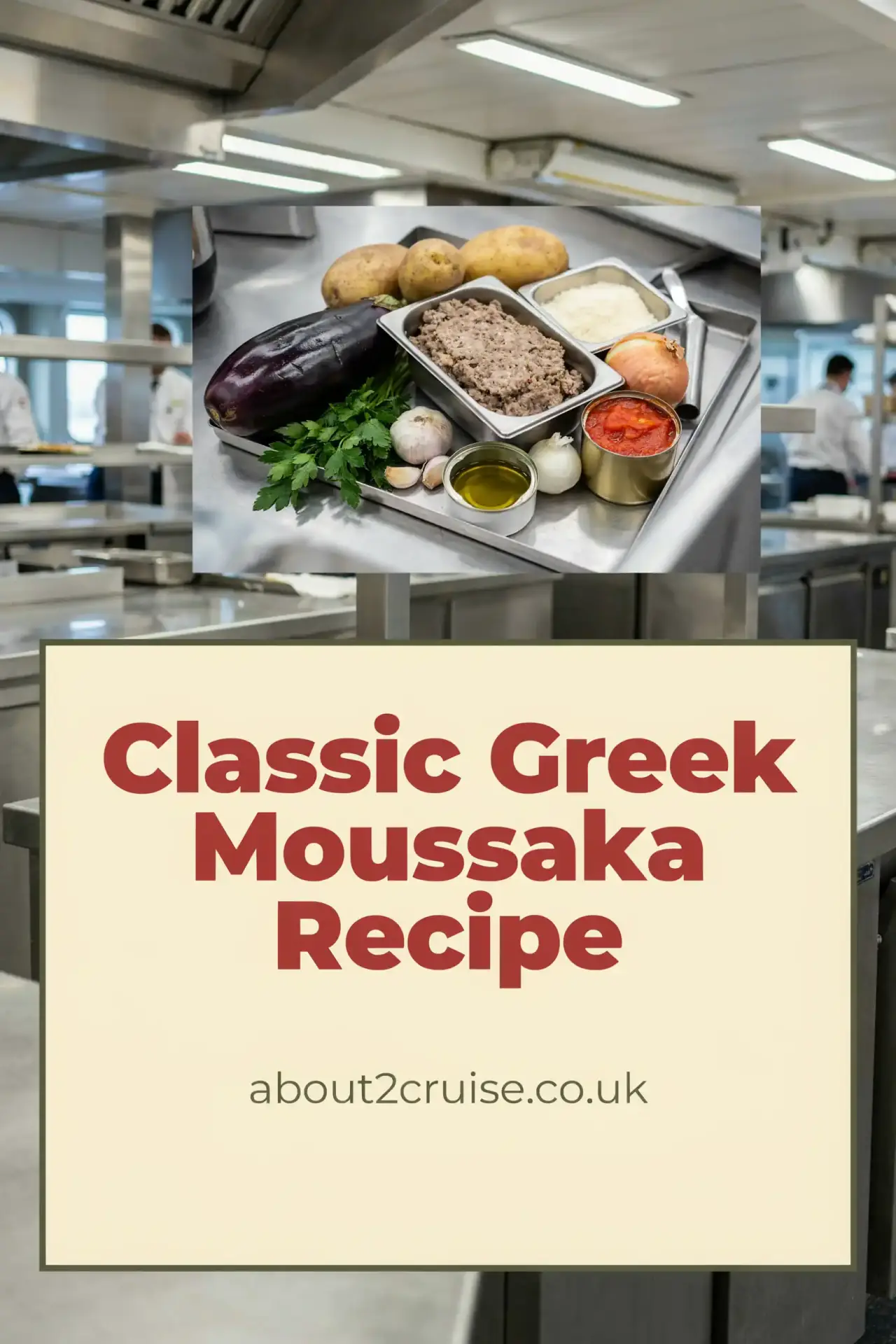
Ingredients for a classic Greek moussaka (serves eight)
| Component | What you need |
|---|---|
| Aubergine | 6 aubergines, olive oil for brushing; optional 5 potatoes, peeled and sliced |
| Mince sauce | 750g lamb or beef mince, 2 red onions, 2 garlic cloves, 400g tin chopped tomatoes, 2 tbsp tomato purée, 1 tsp sugar, 175ml red wine, 1 bay leaf, a pinch of ground cinnamon or 1 stick, ¼ cup olive oil, salt and pepper |
| Béchamel | 900ml milk, 120g butter, 120g plain flour, 2 egg yolks, 100g kefalotyri or Parmigiano-Reggiano, whole nutmeg, salt |
| To finish | A handful of breadcrumbs or a few extra potato slices for the base, plus the reserved grated cheese |
Everything’s metric, so there’s no converting from cups or guessing at an American tin size. A 400g tin of chopped tomatoes is the standard UK one.
Look for kefalotyri: a hard, salty white cheese made from sheep’s or goat’s milk in Greece and Cyprus, and built for grating. Kefalograviera sometimes gets sold under the same name abroad, and Parmigiano-Reggiano or pecorino both stand in well. Hold back a handful of whatever you use for the top.
Lamb or beef is an argument, not a settled rule. Greek cooks who call lamb the authentic choice are matched by Greeks who use beef, and Greek Cypriot family versions often mix beef and pork. Buy either: 750g of mince to six aubergines is the ratio that fills the dish described below.
Aubergines: 1cm slices, salted for 30 minutes, then baked rather than fried
Cut six aubergines into 1cm rounds, or lengthways if you prefer longer slabs, and salt them. You’ll see slices from 5mm to 1cm and salting times from 20 to 30 minutes; 1cm and half an hour gives you slices sturdy enough to layer and dry enough not to flood the tray.
Salting is where cooks and food scientists stop agreeing. Modern aubergines are bred without the bitterness salting was meant to cure, so bitterness isn’t the reason to do it.
Water is: salt draws moisture out of the flesh, so the slices turn less spongy, absorb less oil if you fry them, and release less liquid into the bake. You’ll find recipes that call salting obsolete for a long oven bake, but unsalted slices do weep into the dish, and a wet tray is the most common way this recipe fails.
So salt them in a colander, leave for 30 minutes, rinse, then pat thoroughly dry and brush off most of the salt. Lay the slices in a single layer on baking trays, brush both sides with olive oil, and roast at 200°C (180°C fan) for 25 to 30 minutes, turning once, until deeply golden and completely tender. Pale slices go into the dish undercooked and stay that way.
Frying gives you a richer result and a greasier one, because aubergine behaves like a sponge in oil. A hot griddle pan, brushed with oil and worked in batches, lands somewhere between the two.
The mince sauce: browned hard, spiced lightly, reduced until it is a ragu
Brown 750g of mince in a dry pan over a high heat for 15 to 20 minutes, until its liquid has bubbled away and it sizzles in its own fat and starts to caramelise. That step, not the simmer, is where the flavour comes from. Mince added to a pan of soft onions steams instead.
Then add two chopped red onions, two crushed garlic cloves, the sugar, the tomato purée and the cinnamon, cook for a couple of minutes, and pour in the wine to deglaze. Let the alcohol smell bubble off, add the tin of tomatoes and the bay leaf, and simmer uncovered for 30 to 40 minutes, until almost no free liquid is left.
A restaurant version simmers the same sauce for an hour and a half to two hours and calls the target moist, not liquid. Either timing works; the test is the pan, not the clock. If sauce pools around the mince, keep going.
Season it hard at the end and taste it. Then stir a ladleful of the finished béchamel into the meat, which binds the layers and stops the filling sliding when you cut.
The béchamel: equal weights of butter and flour, warm milk, yolks off the heat
A béchamel for moussaka is thicker than a lasagne sauce. It should pour like thick custard and hold a trail from the whisk for a second before it closes. One that’s too slack sinks through the mince instead of sitting on top, and the tray comes out wet.
Melt 120g butter, whisk in 120g plain flour and cook the two together for a couple of minutes, until the raw flour smell goes and the roux just starts to colour. Add 900ml of warm milk a little at a time, whisking constantly. Cold milk hitting a hot roux is what makes the flour seize into lumps; hot milk into hot roux gives you a smooth sauce.
When it’s thick, take the pan off the heat and stir in 100g of grated kefalotyri or Parmigiano-Reggiano, a good grating of nutmeg (half a teaspoon at least, more than feels wise) and salt. Season it now, because a bland béchamel flattens the whole dish.
The two egg yolks go in last, and off the heat. Dump them into hot sauce and they scramble.
Ladle a little of the hot béchamel into the yolks, whisk, then return the lot to the pan and stir. The eggs set during the bake and give the top its creamy, sliceable texture.
Assembly: a 20 x 30cm dish at least 8cm deep, packed in this order
This is where the guessing starts. Portion counts swing from four to ten and dishes from a 20 x 30cm pan to an 11 x 15 inch one, so nothing warns you that your tray is too small until the béchamel runs over the side.
The quantities above need a 20 x 30cm dish about 8cm deep, buttered. If yours is shallower or narrower, use a wider one rather than heaping the layers.
Scatter a thin layer of breadcrumbs or overlapping potato slices over the base to catch juices, then build it like this:
- Half the aubergine slices, overlapped and pressed down flat so the layers do not slide.
- All the meat sauce, spread evenly to the edges.
- The rest of the aubergine, again pressed flat.
- The whole béchamel, spread right to the edges so the surface is completely covered.
- The reserved cheese scattered over the top.
If you’re using potatoes, put them in first, under the aubergine, and keep everything else in the same order. Press each layer down with a spatula or the flat of your hand as you go. A loose pack slides apart on the plate even after it has rested.
Bake at 180°C for about an hour, until the top is light golden and set. Other versions go hotter and shorter: 200°C (180°C fan) for 50 minutes, or 180°C for 45. Judge by the crust rather than the clock.
Resting and slicing: 30 minutes before the first cut
Take it out and leave it. Moussaka cut straight from the oven slides apart on the plate, because the béchamel hasn’t set and the layers have nothing holding them.
Thirty minutes on the side is the difference between a slice and a slump. It’s served warm in Greece, not piping hot, and this is why.
Rests run from 5 minutes to an hour, and the long ones are the ones written for clean squares. Half an hour is the practical minimum, and if you have 45 minutes, use them. While it sits there’s time to boil a pan of pasta, and an authentic Roman cacio e pepe takes roughly the same half hour.
Timings and making it ahead: a two-and-a-half-hour dish that is better on day two
Prep is quick and the cooking isn’t. One timetable is 20 minutes of preparation, 2 hours of cooking and 2 hours 20 minutes in total; another gives 2 hours of prep and an hour in the oven. Budget about two and a half hours from the first aubergine slice to the first cut, and don’t plan it for a weeknight after work.
You can make every component ahead. The meat sauce improves over a day or two in the fridge as the cinnamon settles, the béchamel can be made several hours ahead and loosened with a splash of milk when you reheat it, and the aubergine and potato slices keep a day or two cooked.
An assembled, unbaked tray keeps chilled for two days, which makes it a good dinner-party dish: build it the day before and bake it while people arrive. To freeze, take it to the point before baking, cool it completely, wrap it well and freeze for up to three months, then defrost overnight in the fridge and bake as normal.
Cooking it a day ahead and reheating isn’t a compromise. The flavours meld overnight, which is why so many cooks say the second day is the better one.
Troubleshooting: watery tray, oil pooling, split béchamel and collapsing slices
| What went wrong | Why | The fix |
|---|---|---|
| The tray is watery | A béchamel too thin to sit on top, aubergine still holding water, or a ragu with free liquid | Cook the béchamel to thick custard, salt and dry the aubergine thoroughly, reduce the ragu until almost nothing runs |
| Oil pooling in the dish | Fried aubergine sponging up oil | Bake oiled slices on trays instead of frying |
| Lumpy béchamel | Cold milk poured into a hot roux | Warm the milk, add it gradually, whisk constantly |
| Split or grainy béchamel | Egg yolks dumped into hot sauce | Off the heat, temper the yolks with a ladle of hot sauce first |
| It tastes of raw flour | The roux was not cooked out | Whisk butter and flour together for two minutes before the milk goes in |
| The slices collapse | Cut too hot | Rest 30 minutes, or longer |
| It tastes bland | The ragu and béchamel were under-seasoned | Taste and season each separately before assembly |
| It is too salty | The aubergine was not rinsed | Rinse it and brush off most of the salt after salting |
| It overflows the dish | The dish is too small or shallow for the quantity | Use one wide enough to take the layers with the béchamel on top |
Swaps that hold the structure and swaps that do not
Beef for lamb is the safest swap: it changes the flavour and nothing else, and plenty of Greek home cooks use it. Anything that keeps three set layers, with something thick on top, will work.
- Vegetarian: green lentils, sweet potato and aubergine under a yoghurt, flour, egg yolk and cheddar topping is one tested route. The older Greek fast-day version drops meat and dairy altogether and uses ground aubergine, tomato sauce and breadcrumbs.
- Potato: a layer of sliced potato under the aubergine is traditional rather than a shortcut, and catches the juices that would otherwise wet the base. Potato-only versions exist and are the most common form in Norway.
- Chicken or turkey: minced chicken or turkey with a yoghurt-and-egg topping instead of a flour béchamel lightens the dish considerably.
- Gluten-free: swap the plain flour for cornflour in the béchamel and the breadcrumbs for gluten-free ones. Dairy-free needs the butter, milk and cheese replaced too, not just the mince.
- Mushrooms: chop them into the ragu to bulk it out and add flavour.
What doesn’t work is anything that adds water: unsalted aubergine, an under-reduced ragu, a slack béchamel. Those break the structure rather than varying it.
What to serve with moussaka, Greek-taverna style
In Greece it comes with a horiatiki, the village salad of tomatoes, cucumber, onion, feta and Kalamata olives dressed with salt, dried oregano and olive oil, and pointedly no lettuce. Crusty bread and a plain green salad are the other standard pairing, and both are there to cut the richness.
To drink, a Xinomavro has the acidity and tannin to handle lamb and béchamel; an oak-aged Agiorgitiko from Nemea is the other classic match, with a younger Xinomavro working if you want something lighter.
If someone at the table doesn’t eat lamb, a Mediterranean chicken with lemon rice recipe makes an easy second main that sits happily beside the same salad.
For a starter, something fried at the last minute suits a dish that needs half an hour to rest. Sicilian arancini rice balls can be shaped and crumbed in advance and dropped in the oil once the moussaka is out of the oven.
Dessert is easier cold, and cannoli with a citrus twist work best with the shells filled at the last moment so they stay crisp.
Leftovers keep three to four days in the fridge and reheat best as individual slices, covered with foil, in a low oven; they freeze for up to three months.
Nutrition and allergens, with the portion count stated
This recipe serves eight, and the count matters: versions serve four, six, eight or ten, so a calorie figure without its portion count means nothing. For scale, a six-portion UK version works out at 504 kcal a serving with 29g protein and 30g fat, and another six-portion version at 583 kcal with 44g fat and 1.1g salt.
The gap is mince leanness, semi-skimmed rather than whole milk, and how much cheese goes in.
Allergens are built into the dish rather than optional: milk and cheese, plain flour and breadcrumbs, and egg yolks in the topping. Contains: milk, gluten, egg. A gluten-free version needs the flour and breadcrumbs swapped, and a dairy-free one needs the butter, milk and cheese replaced as well.
Classic Greek moussaka FAQs
What is the main ingredient in a traditional moussaka?
Aubergine is the ingredient that defines a traditional moussaka, and it’s the biggest part by volume: six aubergines against 750g of mince, with the béchamel on top. Take the aubergine out and you’re making a different bake.
Is it moussaka, mousaka or mousakka?
Moussaka is the standard spelling, from the Arabic musaqqa’a. Mousaka and mousakka are the same dish spelled differently, so a recipe under either name is still worth reading.
Can I leave the wine out of moussaka?
You can leave the wine out of moussaka. The wine is deglazed and bubbled until the alcohol smell has gone, so it’s there for acidity rather than alcohol; use the same volume of stock or water with an extra spoon of tomato purée instead.
How many people does this recipe serve?
This recipe serves eight, from a 20 x 30cm dish about 8cm deep. Cut it into eight rectangles once it has rested and you get taverna-sized portions rather than the generous slabs a six-portion version gives.
Last Updated: 14 November 2026