
Cotonou is Benin’s economic capital and the cruise gateway to West Africa’s Vodun heartland. Ships berth inside a working commercial port with no dedicated terminal, and the day comes down to one choice: the stilt village of Ganvié, the slave history of Ouidah, or Cotonou’s own markets and street life.
So, What Is Cotonou Actually Like?
Cotonou is Benin’s largest city, its economic capital and its seat of government, although the official capital remains Porto-Novo about 38 km to the northeast. For cruise passengers it works as a single port-day window into a country that most visitors never see: a place where Vodun is a living religion rather than a stereotype, where the biggest lake village in West Africa floats on stilts, and where one of the continent’s great open-air markets operates at full volume every day of the week.
The cruise trade here is still young and relatively small. Calls are dominated by expedition ships and small luxury lines: Silversea, Seabourn, Oceania, Regent, Crystal and Hapag-Lloyd’s expedition vessels are the ones you are most likely to arrive on. There are no mass-market resort ships of 3,000+ passengers, and no cruise begins or ends in Cotonou. Every call is a transit visit, usually a full working day alongside, and nearly all of them fall between January and April with a smaller cluster in September and October.
What this means for you is practical: nothing here has been smoothed over for mass tourism. The port is a working cargo facility, the taxi supply is limited, and the two headline excursions both require real travel time. If you are comfortable with that, Cotonou rewards you with one of the most genuinely different port days on the West African coast.
The Big Decision: Ganvié, Ouidah, or the City?
Before you worry about taxis, visas or lunch, you need to settle the one choice that shapes the entire day. There are three realistic options from the port of Cotonou:
- Ganvié stilt village: the signature Benin experience, a full day of road and boat travel to visit a town built on Lake Nokoué.
- Ouidah and the Door of No Return: the moving historical route of the enslaved, about an hour west of the city.
- Central Cotonou: Dantokpa Market, the Amazon monument, the graffiti wall and craft markets, all within a short drive of the port.
You cannot comfortably do all three. Ganvié needs four to five hours door to door. Ouidah needs five to six. A central Cotonou circuit can work in three to four. On a normal ship call, pick one main destination and treat anything else as a bonus stop on the way back if time allows.
The majority of cruise passengers on recent calls have gone on organised ship excursions, and that is not an accident. The port logistics are unfamiliar, independent taxis need to be pre-arranged, and the two marquee sights are far enough away that getting back late has real consequences.
Where Your Ship Docks (Spoiler: No Terminal)
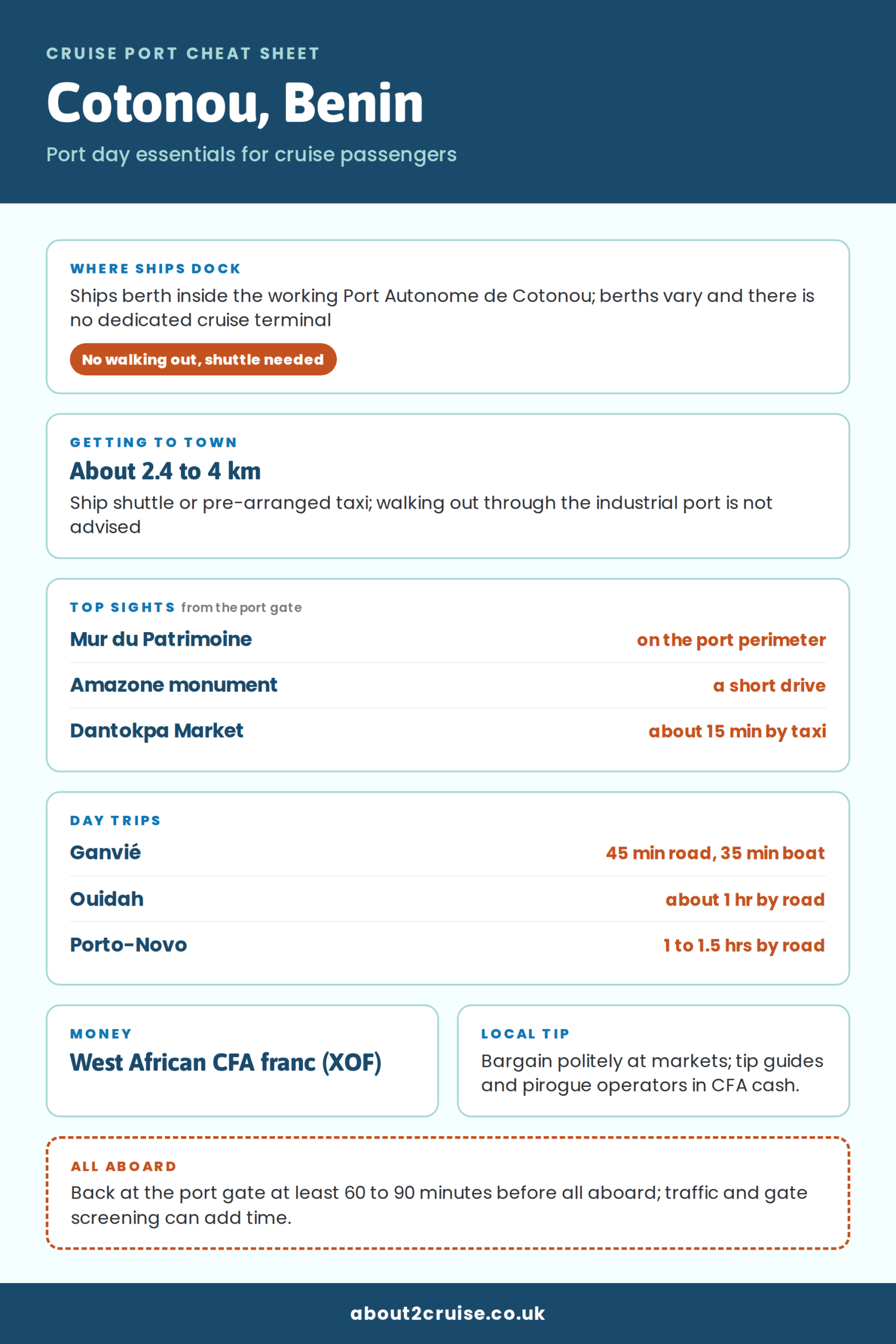
There is no cruise terminal here. Cruise ships berth inside the Port Autonome de Cotonou, the country’s main commercial port, on the strip of land between Lake Nokoué and the Atlantic Ocean. The port has a north wharf with eight berths for breakbulk, bulk, ro-ro and container traffic, plus a cross breakwater and a south wharf for containers and tankers. Your ship’s berth assignment will depend on cargo movements that week, not on passenger convenience.
Recent calls have varied. A 180 m, 575-passenger ship docked at quai 8. An earlier luxury call was alongside at a different berth. The point is simple: do not expect a passenger facility, a terminal building or a comfortable air-conditioned welcome lounge. You may be processed dockside or in a temporary setup, and the entire area is an active ISPS-secured port, UN/LOCODE BJCOO, at roughly 6°21’2″N 2°26’3″E.
There is one genuinely useful development: a mobile welcome desk operated through a partnership between the port authority and the national tourism agency sometimes appears at disembarkation, with tourist information and souvenir sales. If it is there when you arrive, take a minute to use it. It is the closest thing to a tourist office at the berth.
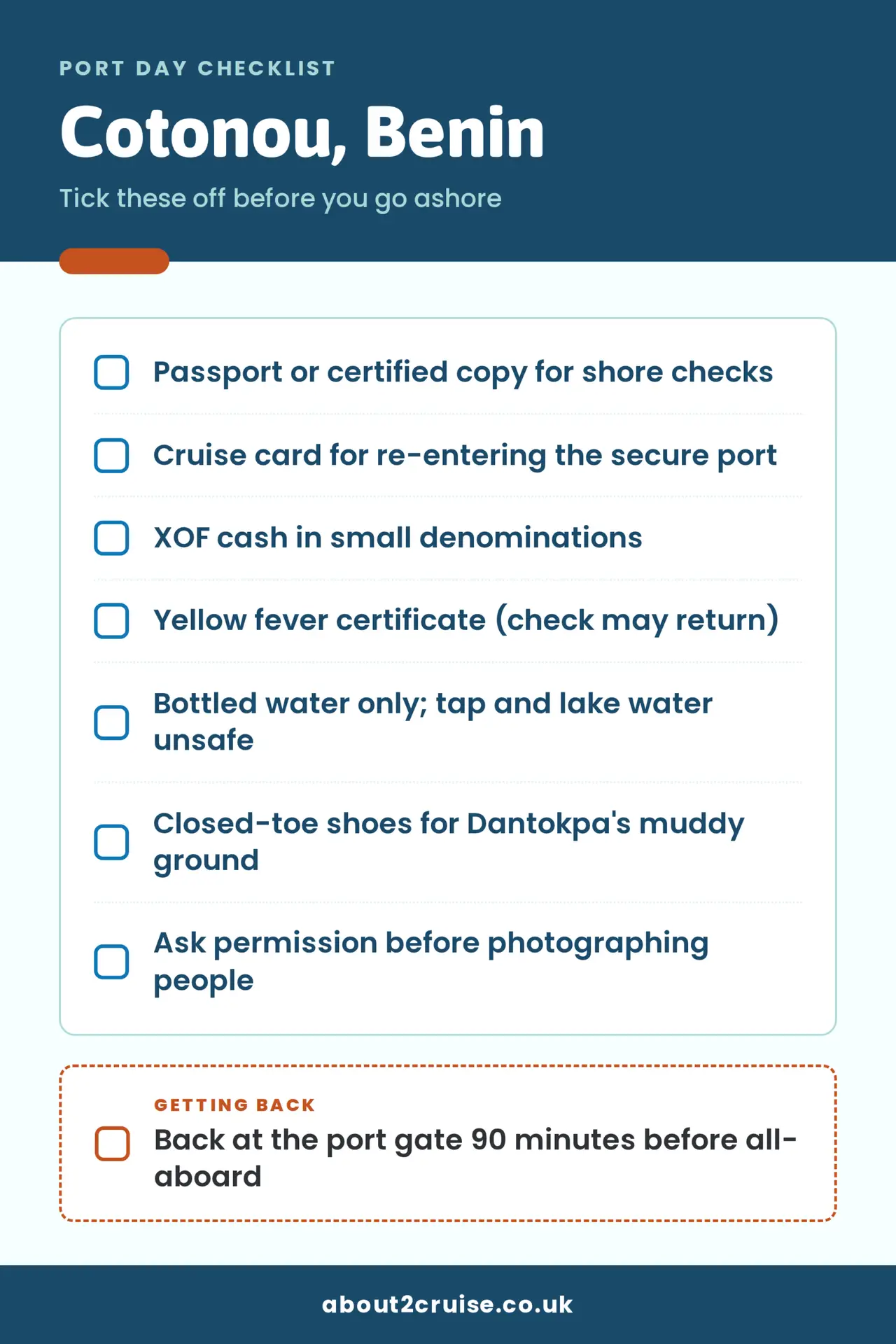
Facilities at the dock are what you would expect from a cargo port, which is to say minimal. Do not rely on clean public toilets, free Wi-Fi or step-free accessibility at the berth. Use the ship’s facilities before you disembark. The port entrance is on Boulevard de la Marina, and it is guarded. You will need your cruise card to re-enter the secure perimeter and reboard, so keep it with you at all times.
Cotonou cruise port map
Ships dock at Port Autonome de Cotonou. Tap a pin for directions.
- Port Autonome de CotonouWhere ships dock
- craft market (ship shuttle drop off)Handicraft market · About 2 km from Port Autonome de Cotonou
- Dantokpa MarketOpen-air market · About 4 km from Port Autonome de Cotonou
- Marché des ArtsArts market · About 2 km from Port Autonome de Cotonou
- Fidjrossè beachBeach · About 6 km from Port Autonome de Cotonou
- Ganvié stilt villageStilt village · About 14 km from Port Autonome de Cotonou
- Temple of PythonsPython temple · About 37 km from Port Autonome de Cotonou
- Sacred Forest of KpassèSacred forest · About 36 km from Port Autonome de Cotonou
- Abomey-Calavi JettyBoat jetty · About 14 km from Port Autonome de Cotonou
Getting Out of the Port: Don’t Try to Walk
The single most common mistake new arrivals make is assuming they can walk into town. Technically, downtown Cotonou and Dantokpa Market are only about 2.4 to 4 km from the port. In practice, the walk is through an active industrial port with heavy truck traffic, no pedestrian paths and gates that exist to control people, not to welcome them. The gangway-to-gate distance inside the port itself can be several hundred metres. Walking out is not recommended in any guide written for cruise passengers, and for good reason.
Check before you go ashore whether your ship is running a shuttle. Several lines run buses between the port and the craft market or a city drop-off, with permits that let them drive through the security area right up to the gangway. Passenger reports describe shuttles running every half hour from the dock and back. If your sailing offers one, take it. It solves the most awkward part of the day.
If there is no shuttle, independent taxis are the practical way out. The problem is supply: there is no formal taxi rank, no metered system and no rideshare pickup point at the gangway. Taxis that do appear at the port exit are unregulated. Fares are always agreed in advance, in French, in CFA francs. For a short trip to central sights, budget roughly 5,000 to 10,000 FCFA. A 30-minute trip runs about 3,000 FCFA, and hiring a cab for several hours typically costs 10,000 to 15,000 FCFA. An app-booked car, where available, can be as little as 1,700 FCFA for a ten-minute ride.
The realistic advice for this port is to pre-arrange your driver. If you book an independent tour, agree in advance exactly where the driver can meet you and how they will return you inside the port perimeter. Do not leave this to chance at the gangway.
When you come back, allow a real buffer. From the city centre to the port gate is a 30 to 45 minute drive on a normal day, but traffic around Dantokpa and the port access roads can add time unpredictably. Add gate screening and internal port transit, and you should be back at the port gate at least 60 to 90 minutes before all-aboard. From Ganvié or Ouidah, give yourself more.
Visas, Passports, and the Yellow Fever Question
For most cruise calls, the paperwork question is now simpler than it once was. Benin has introduced a free 72-hour visa exemption for cruise passengers, granted on the condition that the shore visit is supervised and organised by an approved travel agency, with the Republican Police and port authorities coordinating the process. If you are on a ship excursion or a tour arranged through an approved operator, the normal e-visa requirement may not apply to you for the day.
The exemption is specific and worth understanding before you book anything. It is free and cannot be upgraded to a standard e-visa. If your time ashore is longer than 72 hours, or if you are not covered by the organised shore visit scheme, you need a full e-visa instead. Those cost €50 for a 30-day single entry, €75 for 30 days multiple entry, or €100 for 90 days multiple entry, paid by Visa or Mastercard through the official portal, with processing quoted from one hour to 96 hours. UK government advice is that you should apply for the visa online at least four working days before arrival if one is required for your situation.
Passport requirements are straightforward: your passport should be valid for the duration of your stay. Some e-visa guidance asks for more than six months of validity from the application date, so if there is any doubt, carry a passport with six months left on it. Always carry your passport or a certified copy ashore in Cotonou, because a ship card alone may not satisfy a street-level document check.
Yellow fever is the one piece of paperwork that confuses people because the rules have shifted. UK guidance still says you must have a certificate to prove yellow fever vaccination to enter Benin, and the vaccine is recommended for all travellers aged nine months and over. But the Beninese health ministry has stated that vaccination cards, including yellow fever, are no longer checked at any point of entry, airports, ports or land borders, while vaccination remains recommended under International Health Regulations and the check can be reinstated in a public health emergency.
The practical rule for a cruise call: get the yellow fever vaccine if your doctor advises it, and carry the certificate. It may not be checked today, but it is still the smart thing to have, and the requirement can return without warning.
Safety in Cotonou: The Honest Picture
Street crime does exist in Cotonou, and UK travel advice is realistic about it. Theft and mugging are common in the city, and pickpockets often work in places visited by international travellers. Crowded areas are the main risk zone, and you should avoid walking alone at night or in isolated areas. Specific warnings apply to the Grand Marché de Dantokpa, where you should be alert and where you should not be after dark. Beaches are another flagged risk: do not walk on the beach alone at any time.
None of this means Cotonou is off-limits. The serious UK travel warnings for Benin concern the far north and border areas, Parc du W and parts of the east, Alibori and Atacora, not the Cotonou/Ouidah/Ganvié day-trip corridor. The tourism agency markets Benin as a safe destination, and cruise passengers do visit Cotonou regularly on organised excursions. The difference is how you move: the port corridor is not a place to test independent wandering, but a ship shuttle, pre-arranged driver or small-group tour largely removes the risk.
Carjacking is a known risk on roads outside towns, and the guidance is blunt: keep doors locked and windows closed, avoid driving after dark, and do not slow down or stop if people signal you to pull over. On a cruise day, this mainly affects long independent drives, so keep any road trip to daylight hours and use a driver you have booked through a reputable operator.
Photography at or near sensitive government sites such as military installations or the airport is illegal. Politely and firmly decline any request from an official for a “gift” to facilitate an administrative matter. And do not swim: ocean currents along the entire Benin coast are very strong, many drownings occur every year, and lifeguards are not on permanent duty.
Money, Cards, and Tipping
The currency is the West African CFA franc, written XOF, pegged to the euro at a fixed rate of 655.957 FCFA to one euro. This is a cash economy. Cards work in about half of formal businesses in Cotonou, and almost nowhere outside the city. ATMs in the Haie Vive and Fidjrossè neighbourhoods are relatively plentiful, with Ecobank, Société Générale, Bank of Africa and BRS machines mostly accepting Visa and Mastercard, but withdrawal limits are typically 100,000 to 200,000 FCFA and fees run 2,000 to 5,000 FCFA per withdrawal. Do not expect an ATM or tourist kiosk within walking distance of the port gate.
Carry small-denomination CFA cash for the market, taxi fares, bottled water, entry fees and tips. US dollars and euros are not widely accepted outside major hotels, although some ship excursion notes say cash in those currencies is acceptable at Ganvié and the craft market. CFA is the safe default everywhere else.
Tipping is appreciated but not mandatory. In restaurants where no service charge appears, 5 to 10 percent is appropriate; in small maquis, leave small change. Guides on a day tour typically receive 2,000 to 5,000 FCFA per day, porters 500 to 1,000 FCFA per bag. At Ganvié, a pirogue operator is generally tipped 1,000 to 3,000 FCFA and a guide 2,000 to 5,000 FCFA, in CFA cash only.
Language and Bargaining: A Little French Goes a Long Way
French is the official language and the one used in government offices, hotels, restaurants and major tourist sites. English is used in business but its general level on the street is limited, so a few French phrases genuinely help. A polite “Bonjour, madame” or “Bonjour, monsieur” before starting any transaction is standard courtesy and will get you better treatment than launching straight into English.
Bargaining is the norm in markets. At Dantokpa, offer roughly half the asking price and reach agreement gradually and courteously. At the craft market, polite haggling is expected, and cash in FCFA or mobile money is the normal form of payment. If you are not comfortable negotiating, the craft market is a calmer alternative to Dantokpa.
Ask permission before photographing a person, a ceremony or a place of worship. This is not just advice at Dantokpa; it applies at Ganvié, in Ouidah and anywhere else people are going about their lives. At Vodun sites, some areas are traditionally off-limits and some objects must not be touched without a local guide’s permission. When in doubt, ask.
Staying Healthy: Heat, Malaria, and Water
Benin is a high-risk malaria country, predominantly P. falciparum. You should discuss antimalarial tablets with a travel health professional before you travel, and take mosquito-bite avoidance seriously from dusk to dawn: repellent with DEET or icaridin, long sleeves at dusk and nets where appropriate. Any fever during or after travel needs a prompt malaria test.
Dengue and chikungunya are also present, spread by day-biting mosquitoes, so bite avoidance matters in daylight too. Hepatitis A, typhoid and tetanus vaccination are recommended for most travellers, and hepatitis B may be considered. A travel health appointment ideally happens four to six weeks before departure, but even a last-minute consultation is worth having.
Heat and humidity are the immediate physical challenge. Daytime maxima run 31 to 32°C in the drier months and drop only to about 28°C in the coolest, wettest stretch. Hydration is non-negotiable. Drink sealed bottled water, not tap water, and use it for brushing your teeth. Avoid ice unless you are sure it was made from filtered water. Bottled water costs about 300 to 500 FCFA per 1.5-litre bottle. Water from Lake Nokoué is never safe, so carry drinking water from Cotonou if you visit Ganvié.
Stomach safety follows the usual rules for West Africa: eat hot, freshly cooked food, be cautious with raw salads and unpeeled fruit, and prefer bottled or sealed drinks. Street skewers are a local institution and generally fine when the meat is cooked in front of you over charcoal. The best-value meals are in the maquis of Haie Vive, Fidjrossè and Cadjèhoun, where a plate of pâte, sauce and fish costs a few thousand FCFA.
Ganvié: Spending the Day on Water
Ganvié is the largest lake village in West Africa, a settlement built on stilts on Lake Nokoué, reached not by road but by motorised or paddled pirogue. It is the signature excursion from Cotonou, the image on the brochures, and for good reason. But it is not a quick trip.
Before you sail
- Check with your cruise line whether your call falls under the free 72-hour visa waiver, or apply for an e-visa
- Discuss malaria prophylaxis and hepatitis A, typhoid and tetanus vaccinations at a travel clinic.
- Carry your yellow fever certificate even though checks are currently suspended.
Short port day: under 5 hours
- On dockingLeave the port by shuttle or taxiNo walking outThere is no pedestrian route from the berth. Use the ship shuttle or a pre-arranged taxi and confirm the pickup point.
- +15 minDantokpa MarketCash onlyAbout 15 min by taxi from the port. One of West Africa's great open-air markets; cover the fabric and spice sections.
- +1 hr 15 minLunch near DantokpaHot cooked foodOrder atassi, rice and beans cooked in tomato oil with grilled fish, from a neighbourhood restaurant near the market.
- +2 hr 15 minAmazone monumentReturn along Boulevard de la Marina to the 30 m bronze on Esplanade des Amazones. Free and open at all hours.
- +2 hr 45 minMur du PatrimoineWalk or drive a short way to the 940 m graffiti wall along the port perimeter, Africa's longest.
- +3 hr 30 minMarché des Arts for souvenirsBargain politelyThe craft market near the Bourse du Travail is calmer than Dantokpa and good for masks, bronzes and wax prints.
- All-aboard minus 90 minBack at the port gatePre-arranged driver returns you through the gate. Afternoon traffic around Dantokpa and port access roads can be slow.
This map shows the taxi ride from the ship. The time is the drive only, not your time ashore.
Open the taxi route in Google Maps
If plans change: If Dantokpa is too crowded or closed, spend the time at the Marché des Arts and the seafront monuments instead.
Long port day: 8 hours or more
- On dockingMeet your organised Ganvié transferBook aheadNo pedestrian exit from the port. Use the ship excursion or a private driver booked before you dock, with the return leg agreed.
- +30 minDrive to Abomey-Calavi jettyTraffic can be slowAbout 18 km, 30 to 45 minutes by road. Confirm the driver will wait and know the pick-up point for your return.
- +1 hr 15 minBoat across Lake NokouéLife jackets requiredA motorised pirogue takes 20 to 35 minutes to Ganvié. Wear the life jacket for the whole crossing.
- +1 hr 45 minExplore Ganvié stilt villageAsk before photosWalk the narrow wooden planks between stilt houses and see daily life in the lake village.
- +2 hr 45 minFloat through the marketVisit the lake market by pirogue; ask before photographing vendors and residents.
- +3 hr 45 minLunch in GanviéLake water is unsafeOrder grilled fish with amiwo, the red corn porridge, if lunch is served in the village. Ship excursions include it.
- +4 hr 45 minBoat back to the jettyReturn across Lake Nokoué, then meet your driver at Abomey-Calavi.
This map shows the taxi ride from the ship. The time is the drive only, not your time ashore.
Open the taxi route in Google Maps
If plans change: If the Ganvié boat service is suspended, switch to an Ouidah or central Cotonou circuit with your pre-arranged driver rather than waiting at the jetty.
The journey has two legs. First, about 18 km of road from Cotonou to the Abomey-Calavi jetty, which takes 30 to 45 minutes. Then 20 to 35 minutes by boat across Lake Nokoué to the village itself. Life jackets are provided and required for the whole crossing. The recommended time on site is two to three hours, which makes the whole excursion four to five hours door to door from the port.
Costs vary with how you do it. The ship excursion is the benchmark: a recent Seabourn “Ganvié Stilt Village” tour ran approximately six hours and cost from $320, including the motorised boat, a cultural troupe welcome, the floating market, lunch and a craft market stop. Independent costs are much lower but require more organising. At the jetty, the municipality charges an official tourist tax of 1,000 FCFA per foreign visitor, paid separately even on some all-in tours, and you should keep the receipt because it can be checked on arrival at Ganvié.
Jetty pirogue rates are quoted per group: roughly 50,000 FCFA for one to two passengers, 40,000 for three to four, and 30,000 for five to eight, with the boatman waiting during your visit. Other published figures put standard visits at 7,000 to 12,000 FCFA per person for a two-hour trip, and some operators sell a half-day Ganvié tour from about £150. If you book independently, a dedicated day tour operator is safer than trying to piece it together at the jetty on a tight port schedule.
The physical demands are real. Boarding a pirogue without assistance, uneven surfaces, narrow wooden planks in the village, and the possibility of getting your feet wet are all part of the experience. The ship excursion notes about 50 steps and uneven surfaces, and is not wheelchair accessible. If you have limited mobility, Ganvié is the hardest of the three main options.
Photography etiquette matters here more than almost anywhere on a Benin cruise. Ganvié is a place where people live, not a backdrop. Ask before photographing residents. The same goes for the floating market, where a polite question in French usually gets a warmer response than a camera raised without warning.
Is Ganvié worth it? For most passengers, yes. It is unlike almost anything else you will see on a cruise itinerary, and the sense of arriving somewhere genuinely distinct is the whole point of a port day in Benin. But it is a long, physically active excursion, not a gentle panorama. If you want the iconic Benin experience and can manage the boat transfer, do it. If you need an easier day, central Cotonou or a shorter Ouidah-focused tour is the better call.
Ouidah and the Door of No Return
Ouidah is about 40 km west of Cotonou, roughly an hour by road, allowing 1 to 1.5 hours each way from the port. The visit centres on the Route of the Enslaved, a 4 km memorial route from Ouidah town to the beach that ends at the Door of No Return, the monumental arch on the sand where enslaved Africans were shipped across the Atlantic. The route is public space, free to access, and open around the clock. You can walk it, cycle it or drive it with a guide, and the recommended time is 1.5 to 2 hours. A private guide costs about 5,000 FCFA.
The other key sites are the Temple of Pythons, where entry runs about 1,000 FCFA plus a 1,000 FCFA photo fee and you can pose with a python around your neck; the Ouidah history museum in the old Portuguese fort, where photo and video are prohibited inside and foreign entrance is roughly 1,000 to 2,000 FCFA; and the Sacred Forest of Kpassè, where part of the grounds is off-limits to visitors and the Vodun convent beyond the dividing wall must not be entered. A day pass covering the temple, forest and museum typically runs 4,000 to 6,000 FCFA.
A focused Ouidah visit needs about five to six hours with a vehicle and guide. Doing Ouidah and Ganvié in a single normal port day is theoretically possible but makes the return schedule tight, especially in traffic. Pick one.
Can Ouidah be done independently? Yes, with a pre-arranged car and driver, and it is one of the easier independent days because the sites are on a known route. Have your driver meet you at the port, agree the full-day price in advance, and keep the driver for the return leg. If your ship offers an Ouidah excursion, it will usually be more expensive but removes the return-timing risk, which on a one-hour-each-way day out is genuinely valuable.
Cotonou Itself: Dantokpa and the City Streets
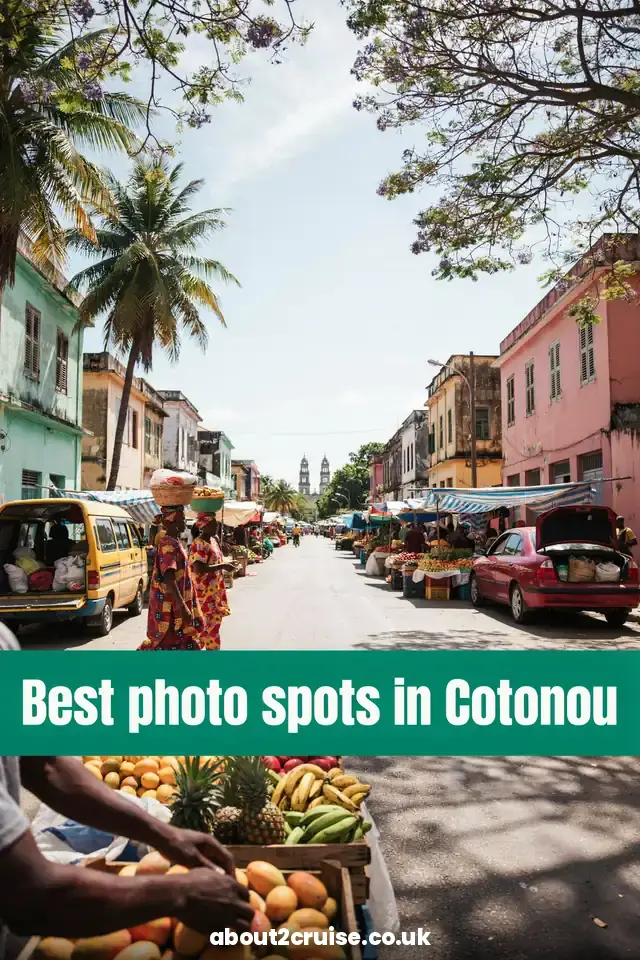
Dantokpa Market is one of West Africa’s great open-air markets, more than 20 hectares on the lagoon in the Akpakpa area east of the bridge. It is open daily from 07:00 to 19:00 and entry is free. Its zones cover wax prints and pagnes, spices and medicinal plants, hardware, fresh produce, second-hand clothing and a Vodun fetish section with animal remains and ritual objects. The Fon name refers to the lagoon of Dan, a divinity represented as a serpent and linked with prosperity, and an altar to Dan stands within the market.
Allow two to three hours if you want more than a quick walk-through. Ground is uneven and sometimes muddy, so closed-toe shoes are sensible. Early morning on a weekday is quieter and better lit. Photography rules are firm in the fetish section, where some vendors refuse outright and flash should be avoided. Ask before photographing any vendor.
For a shorter central circuit with a driver, the Mur du Patrimoine is worth a stop. This graffiti wall along Boulevard de la Marina and the port perimeter is about 940 m, roughly 2,000 m², and is the longest in Africa and the third longest in the world. It depicts Béhanzin, the Amazones, Guèlèdè masks and Angélique Kidjo, and runs from the Zongo crossroads toward the Konrad Adenauer bridge.
Close by, the Amazone monument is a 30 m bronze on the Esplanade des Amazones between Boulevard de la Marina and the ocean. It is free, open at all hours, takes 30 to 45 minutes, and is lit at night, so late afternoon and dusk give two different pictures. Both sights work without a guide and can be reached easily by taxi or ship shuttle.
The craft market is the calmer alternative to Dantokpa for souvenir buying. The historic craft centre on Boulevard Saint-Michel has been cleared and the artisans regrouped along the railway tracks facing the Bourse du Travail, toward Camp Ghezo, now called the Marché des Arts, with a permanent site under construction at Gbégamey. Around a hundred artisans and traders work there from Abomey, Porto-Novo and Parakou. For wax prints and fetish items, Dantokpa is the cheapest source; for a calmer, fixed-ambience browse, the Marché des Arts is easier.

Fidjrossè and the Beach Road
Fidjrossè is Cotonou’s best-known public beach, free to access and lively on weekend afternoons, with thatched paillotes selling grilled fish. It is the starting point of the Route des Pêches, the beach road that runs west from the city. The area is a genuine leisure draw for locals and increasingly for visitors, but the one thing you must absorb is the swimming warning.
Do not swim. The ocean here has a powerful shore break and rip currents, swimming is officially discouraged and at times banned, and lifeguards are not on permanent duty. Many drownings occur along this coast every year. Enjoy the beach for its food, its music and its sunset, but stay out of the water beyond your knees, and even then only where local conditions are clearly calm.
Food is the main event at Fidjrossè. Grilled capitaine, grouper or sole with aloko, fried plantain, or amiwo, a red corn porridge cooked with tomato and palm oil, is the signature beach meal, sold at the paillotes for about 5,000 to 10,000 FCFA per person. Beach eating runs roughly 4,000 to 8,000 FCFA per person at the rustic paillotes and 10,000 to 20,000 FCFA at the upscale beach clubs. Local beer, La Béninoise, is the standard accompaniment.
Early morning before 09:00 is calmer and has good light for photographs. Late afternoon gives the sunset shot that the tourism agency itself promotes. Getting there takes 10 to 20 minutes from downtown by zémidjan or ride-hailing car; places further along the Route des Pêches take 30 to 45 minutes. Tell a driver “Plage de Fidjrossè” and you will end up at the right place.
Those Yellow-Shirted Motorcycle Taxis (Zémidjans)
They are the most visible icon of Cotonou: the zémidjans, motorcycle taxis recognised by numbered yellow shirts or vests, with fares negotiated before boarding and helmets required by law for driver and passenger. Indicative fares run 200 to 300 FCFA for a short neighbourhood hop, 400 to 700 FCFA across town, and 1,000 to 1,500 FCFA to the Abomey-Calavi ferry landing. Night fares rise 20 to 30 percent. Apps including Gozem and Yango also book motorcycle taxis, tricycles and air-conditioned cars with fixed prices shown before booking.
The local tradition holds that the deity Gou, protector of metalworkers and warriors, is now the patron of the yellow-shirted zémidjan riders: a piece of the city’s living culture more than a reason to ride.
For cruise passengers, the honest guidance is simple: zémidjans are not recommended. They are unsuitable with luggage, inappropriate for families, and generally a poor choice for anyone with mobility limitations. The dominant risk is road accidents rather than crime, in a city with dense traffic and inconsistently observed right of way. Ride-hailing cars are the safer app alternative if you need one.
What to Bring Home
Benin’s craft specialities are genuinely distinctive: lost-wax bronzes from Abomey, teak, iroko and ebony carvings, Guèlèdè and Vodun masks, Abomey appliqué wall hangings, bead and bronze jewellery, leatherwork, basketry and pottery. The Marché des Arts on Boulevard Saint-Michel is now the main craft destination in central Cotonou, with about a hundred artisans and traders working there.
Dantokpa is the cheapest source for two particular things: wax prints, the vibrant cotton fabrics that are a west African staple, and fetish items associated with Vodun practice. The latter are not for everyone, and you should think carefully about what you are comfortable buying and what you can legally export. Exporting cultural antiquities or historical artefacts requires formal government clearance.
Bargaining is expected at both Dantokpa and the craft market. A polite, unhurried negotiation starting at about half the asking price works well. Bring CFA cash in small denominations. If a ship excursion ends at a craft market, prices will be firmer and the experience more curated, but the selection is often good and the setting is more comfortable than the market.
Photography and Vodun Etiquette: Read This Before You Snap
Photography at or near sensitive or government sites such as military installations or the airport is illegal, and this is enforced. Beyond that, the etiquette rules are consistent across city and country: ask permission before photographing a person, a ceremony or a place of worship. This is not a legal formality; it is how you get better photographs and how you avoid genuinely uncomfortable moments.
In the Vodun fetish section of Dantokpa, some vendors refuse photography outright and flash should be avoided. At the Sacred Forest of Kpassè near Ouidah, part of the grounds is off-limits and the Vodun convent beyond the dividing wall must not be entered; a raised platform there has drawn immediate reprimands for visitors who stepped onto it. At the Ouidah history museum, photo and video are prohibited inside.
At Ganvié, the entire village is a private space in practical terms. Ask before photographing residents, including children. A named, polite request in French usually works better than a silent telephoto lens. Remove shoes where required at Vodun sites, and never touch sacred objects without a local guide’s permission. Benin is one of the main centres of Vodun practice, and Vodun culture is a living tradition, not a performance for visitors.
Accessibility: What You Should Know Before Booking
Cotonou is a difficult port for reduced-mobility passengers. The port itself has no pedestrian infrastructure linking the berth to the city, and independent walking from the port gate is challenging for older travellers, families with strollers and mobility-assisted passengers. The ship-run Ganvié and Ouidah excursions are explicitly not suitable for guests with limited mobility or wheelchair users.
Ganvié is the hardest single challenge: boarding a pirogue without assistance, narrow wooden planks in the village, uneven surfaces and the possibility of wet feet. If you use a wheelchair or walker, this excursion is effectively off the table, and even the Ouidah day involves a 4 km sandy route if you choose to walk part of it.
Within central Cotonou, the Zinsou Foundation’s space is ground-level and rated highly accessible, while the Ouidah museum has some steps at the entrance. For passengers with mobility limitations, the most practical port day is a ship shuttle to the craft market and a short drive past the Mur du Patrimoine and the Amazone monument, with minimal walking. Discuss your specific needs with the shore excursion staff before booking anything, because vehicles, equipment and guides on these routes may not meet Western standards.
Weather and the Best Time to Visit
Cotonou runs hot and humid all year. Long-term monthly averages put daytime maxima at 31.6°C in January, 32.3°C in March, 32.0°C in April and 31.9°C in December. Even the coolest months sit around 28°C to 29°C with high humidity. Rain is the real seasonal variable, not temperature.
The south has two rainy seasons: April to mid-July, when monthly rainfall climbs from 126 mm in April to 333 mm in June, and mid-September to October, with about 165 mm in October. The drier stretch from December to February brings the harmattan, a dust-laden wind that can cut visibility. There is no hurricane season to plan around on this coast; the constraints are the two rainy seasons, humidity and the harmattan haze.
Cruise calls cluster in the drier months from January to April, with a smaller September to October window. Rainy-season downpours can make rural roads impassable and disrupt services, so if your call falls in October, build extra time into any road-based plan. For a January to April call, expect hot, humid days with occasional rain and plan water, sunscreen and a hat accordingly.
Short Call or Long Day: How to Play It
If your ship gives you a full working day, the choice above applies: Ganvié if you want the iconic experience and can handle it, Ouidah if the history moves you, central Cotonou if you want a shorter, more flexible day. Pick one main destination.
If you have only three to four hours, stay in the city. A driver can take you past the Mur du Patrimoine, stop at the Amazone esplanade, and give you an hour at Dantokpa or the Marché des Arts. This works as a genuinely satisfying short call without the travel pressure of Ganvié or Ouidah.
One statistic shows how strongly the balance tips: on a recent call with 575 passengers, 373 went ashore on organised tours, the majority of the whole ship. That is not because the city is unsafe or uninteresting; it is because the port logistics and the travel distances make ship-organised transport the natural default. If you do go independent, pre-book, confirm the pickup point, and keep an eye on the clock from mid-afternoon onward. Congestion around Dantokpa and the port access roads can extend vehicle return times unpredictably, and gate screening adds more on top.
Practical Stuff: Time, Power, Internet, and Food
Benin runs one hour ahead of GMT all year, which means one hour behind the UK in British Summer Time and the same time in UK winter. Ships on West African itineraries often change time zones unexpectedly, so verify the ship’s time against local time before you leave the gangway.
Power is 220 V, 50 Hz, with type C and E sockets, the French-style round-pin plugs. UK travellers need a standard two-pin continental adaptor, the same one you would pack for France.
For connectivity, local SIMs are sold at the airport and around town from MTN and Moov for about 1,000 to 2,000 FCFA with initial credit, and require passport registration. Mobile money from both operators is widely used, which is useful if you want to pay at the craft market without carrying large amounts of cash. If you do not want a SIM, check whether your cruise line offers a shuttle with Wi-Fi or wait until you are back on the ship.
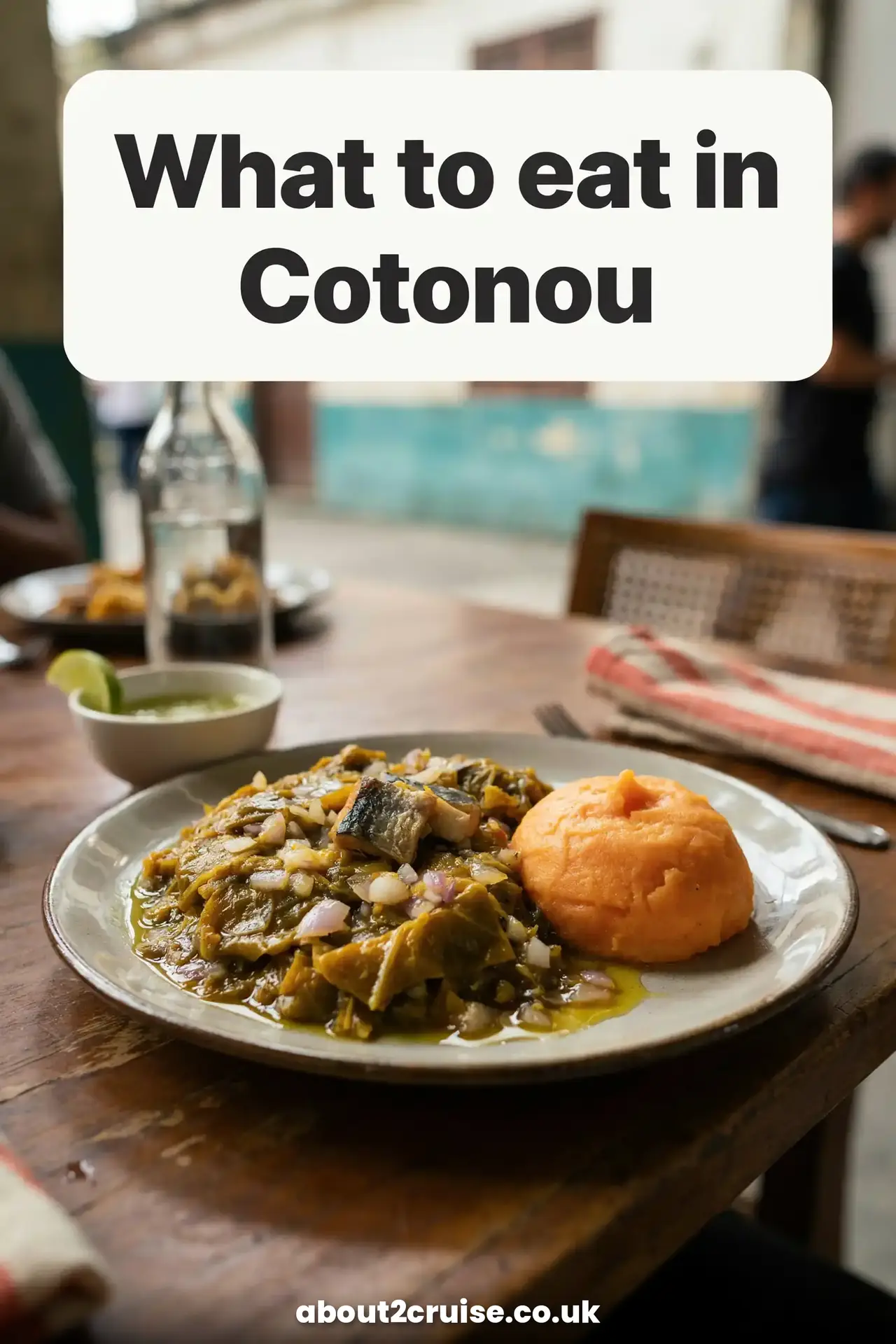
Food and drink are a genuine highlight of a Cotonou port day. The best-value eating is in the maquis of Haie Vive, Fidjrossè and Cadjèhoun, where a plate of pâte, sauce and fish costs a few thousand FCFA. Street food staples worth trying include atassi, rice and beans cooked with tomato oil served with grilled fish or meat at about 1,000 to 2,000 FCFA, and tchachanga, charcoal-grilled skewers of mutton, beef or chicken, best around Mont Sinaï and Missebo at 100 to 500 FCFA a skewer. Wheat-based dishes are in short supply, but you will find grilled fish almost everywhere. Bottled water is essential, and the local beer, La Béninoise, is a safe sealed alternative.
What People Get Wrong About Cotonou
Several widely repeated pieces of advice need a reality check for cruise passengers. The first is the walking claim. You will find online advice that the city centre is a 20 to 25 minute walk from the terminal. Technically the distance is only a few kilometres, but the route is through a restricted industrial port with no pedestrian path, and the gangway-to-gate leg alone can be several hundred metres. In practice, you will be transported out, whether by ship shuttle or pre-arranged vehicle. Do not plan on walking.
The second is yellow fever. Older advice still says a certificate is mandatory for entry, and UK guidance repeats that. The Beninese health ministry has since stated that cards are not checked at ports, airports or land borders. Vaccination remains recommended and the check can be reinstated, so the sensible move is to have the vaccine and carry the certificate. But if someone tells you with certainty that you will be turned away without one, that advice is out of date.
The third is the e-visa. Some sources still say every visitor needs one. The 72-hour cruise visa exemption now covers organised shore visits, which means many cruise passengers do not need an e-visa at all. Check what applies to your specific sailing and tour operator before applying.
The fourth is swimming. A quick search of Cotonou tourist tips sometimes lists Fidjrossè as a beach destination where you can swim. That is wrong. The currents are dangerous, swimming is discouraged and at times banned, and lifeguards are not permanently on duty. Enjoy the beach for food and atmosphere, but stay out of the water.
The fifth is taxis. Advice that taxis in Cotonou are cheap and easy understates the problem at this specific port. There is no rank at the gate, no metered system and no confirmed rideshare pickup at the berth. Supply is thin. Pre-booking is the safe default for cruise passengers.
What has genuinely changed since 2016: cruise calls have started in volume, the 72-hour visa waiver exists, a port-and-tourism-agency partnership has put a welcome desk and souvenir sales at disembarkation, the e-visa is fully online, the Mur du Patrimoine and the 30 m Amazone monument have been added to the city, the Route des Pêches and Fidjrossè seafront have been redeveloped, Vodun Days has become a large early-January event in Ouidah, and the Abomey-Calavi jetty for Ganvié has been scheduled for rehabilitation.
Hotels Near the Port
Cotonou is not a turnaround port, so there is no established pre-cruise hotel cluster at the Port Autonome itself. But if you are arriving the night before or staying on after a call, several hotels along the Boulevard de la Marina corridor between the airport and the city work well.
The Sofitel Cotonou Marina Hotel & Spa is the five-star option, with 198 rooms, two pools, three restaurants, tennis courts and a spa, about 4 km from the port and 1.7 km from the airport. The Novotel Cotonou Orisha, also on Boulevard de la Marina, is four-star with 110 rooms and six suites after renovation, set in gardens with a pool, restaurant and bar. The Azalaï Hôtel Cotonou in Quartier Ganhi has 120 rooms, a private beach, outdoor pool and three restaurants, with breakfast from 06:00 on weekdays, useful before a morning tour. The Riviera Hotel Benin is the closest named option at about 1.5 km from the port, with 40 rooms and a free airport shuttle. Even the closest of these is not a practical walk to a ship: the port is a working cargo facility and independent walking from the gate is not advised.
Ports That Pair With Cotonou
Cotonou sits in the middle of the West African coastal itinerary, and the ports around it give you a sense of where the cruise is going. Recent sailings have linked Cotonou with São Tomé and Takoradi in Ghana, and Regent’s route into the city ran from Cape Town via Namibia, Angola and São Tomé before continuing to Ghana. A current westbound pattern runs São Tomé to Cotonou to Takoradi, and longer West African itineraries pair Cotonou with Tema (Accra), the port for Ghana’s capital, and with Abidjan in Côte d’Ivoire.
If your cruise is threading through the region, our guide to West Africa’s cruise ports is the broader orientation, and the individual guides to Takoradi, Tema (Accra) and Abidjan cover the neighbouring port days in the same level of practical detail as this page. Sailings that call at Cotonou are concentrated from January to April plus September and October, so these are generally winter or autumn cruise seasons for UK passengers.
Our West Africa cruise port guide covers yellow fever rules and what to expect at each port along the coast.
Our Abidjan cruise port guide describes the modern facilities along the Ébrié Lagoon and what a call there involves.
Our Takoradi cruise port guide explains local transport, currency and the maritime heritage you can see on a call.
Our Tema and Accra cruise port guide sets out the practicalities of reaching Accra from the port and what to expect there.
Our Dakar cruise port guide explains the berth, the walk to Plateau, and how Gorée Island ferry times and tickets fit your day.
Frequently Asked Questions
Do UK citizens need a Benin visa for a cruise stop?
Not necessarily. Benin has introduced a free 72-hour visa exemption for cruise passengers whose shore visit is supervised and organised by an approved travel agency. If you are covered by that scheme and stay within the time limit, you may not need an e-visa. Passengers not covered by the exemption need an e-visa applied for through the official portal before arrival. Check with your cruise line what applies to your specific call.
Can you walk from the Cotonou cruise port into town?
No, not in practice. The distance to the city centre is only a few kilometres, but the only route runs through an active industrial port with heavy truck traffic, no pedestrian paths and controlled gates. Ship shuttles, pre-arranged taxis or organised tours are the realistic ways out.
Is Ganvié worth visiting on a cruise call?
For most passengers, yes. Ganvié is the largest stilt village in West Africa and genuinely unlike almost any other excursion on a cruise itinerary. But it requires a road transfer and a boat crossing, takes four to five hours door to door, and is not suitable for reduced-mobility passengers. Weigh those costs before booking.
Can Ouidah’s Door of No Return be done independently?
Yes, with a pre-arranged car and driver. The route is well known, the sites are in a logical sequence, and the whole visit takes about five to six hours including the drive from Cotonou. Keep your driver for the return leg and agree the full-day price in advance.
How much do taxis and tours cost in Cotonou?
Short taxi trips from the port to central sights run about 5,000 to 10,000 FCFA. Hiring a car for several hours typically costs 10,000 to 15,000 FCFA. An organised half-day Ganvié tour can start from about £150 per person, while the equivalent ship excursion can run over $300 for a longer version with lunch and a boat.
What should I wear in Cotonou?
Lightweight, breathable clothing, flat closed-toe walking shoes, a wide-brimmed hat, high-SPF sunscreen and sunglasses. Expect heat and humidity even in the dry season, and pack a light rain layer if your call falls in a rainy month. Dress at cultural sites is generally relaxed, but modest clothing is respected at Vodun sites and in markets.
Is English widely spoken in Cotonou?
Not on the street. French is the official language and the one you will hear in taxis, markets, restaurants and most shops. English is used in some business settings, but a few words of French, especially polite greetings, make a real difference in how your day goes.
What’s the worst mistake cruise passengers make in Cotonou?
Assuming they can walk out of the port, or leaving their return to the last minute. The port-to-city leg is industrial, and afternoon congestion around Dantokpa and the port access roads can add unpredictable time. Plan your exit, pre-book your driver, and aim to be back at the port gate at least 60 to 90 minutes before all-aboard.
Last Updated: 24 November 2026