
Ships calling at Molde tie up at Storkaia, a quay so close to the town centre you could be in a shop before your legs have properly adjusted to solid ground. From that same pier, the Varden viewpoint, the Atlantic Road and the Romsdal Museum are all within striking distance for a few hours ashore.
Molde sits on one of Norway’s best-looking fjords, ringed by snow-capped peaks, and it punches well above its size as a cruise stop. You can walk the whole town in a single call, but there’s enough packed in that working out what fits in a few hours takes a bit of thought, especially if you’re eyeing up a longer trip out of town too. This guide sticks to what matters on a limited port day: the walk off the ship, the bus timetable for the Atlantic Road, and the practical stuff around cash, weather and what happens when more than one ship turns up at once.
Molde Cruise Terminal: Where Ships Dock in Molde, Norway
The port authority, Molde og Romsdal Havn IKS, lists Storkaia as the main cruise quay, and that’s where nearly everyone ties up. A smaller number of calls use the Moldegård quay, a bit further round the harbour. Both are proper alongside berths, so tendering barely happens here, which makes life easier for everyone on a short call.
Quick facts for planning your day:
| Detail | What to expect |
|---|---|
| Main cruise quay | Storkaia, directly by the town centre |
| Secondary quay | Moldegård, a longer walk from the centre |
| Cruise quays | Two, plus designated anchorage points for busy days |
| Ships alongside at once | Usually two to four, on a first-come, first-served basis |
| Tendering | Very rare, most ships dock directly at the pier |
The port authority’s own figures put annual cruise calls at around 70 for Molde, part of a wider total of well over 120 across the twin ports of Molde and Åndalsnes in a season. The berths are fitted for shore power too, so a docked ship can switch off its diesel engines and plug into the local grid instead of idling away in the harbour.
Why the Distance to Town Figures Do Not Agree
Read a few guides before your trip and you’ll notice the numbers don’t match up. The port authority says the walk from Storkaia to the town centre is around 100 metres, several operator guides put it closer to 300, and others just call it right in town.
It matters less than it sounds. Every source agrees the walk is short, flat and over before you’ve properly warmed up, so whichever figure is right for your berth, you’ll be among the shops and cafes of Storgata within minutes of the gangway. Moldegård is the exception, at roughly 1.2 kilometres, so allow fifteen minutes on foot, or catch one of the buses that pass close by.
Getting Around Molde: On Foot, By Bus, Taxi or Bike
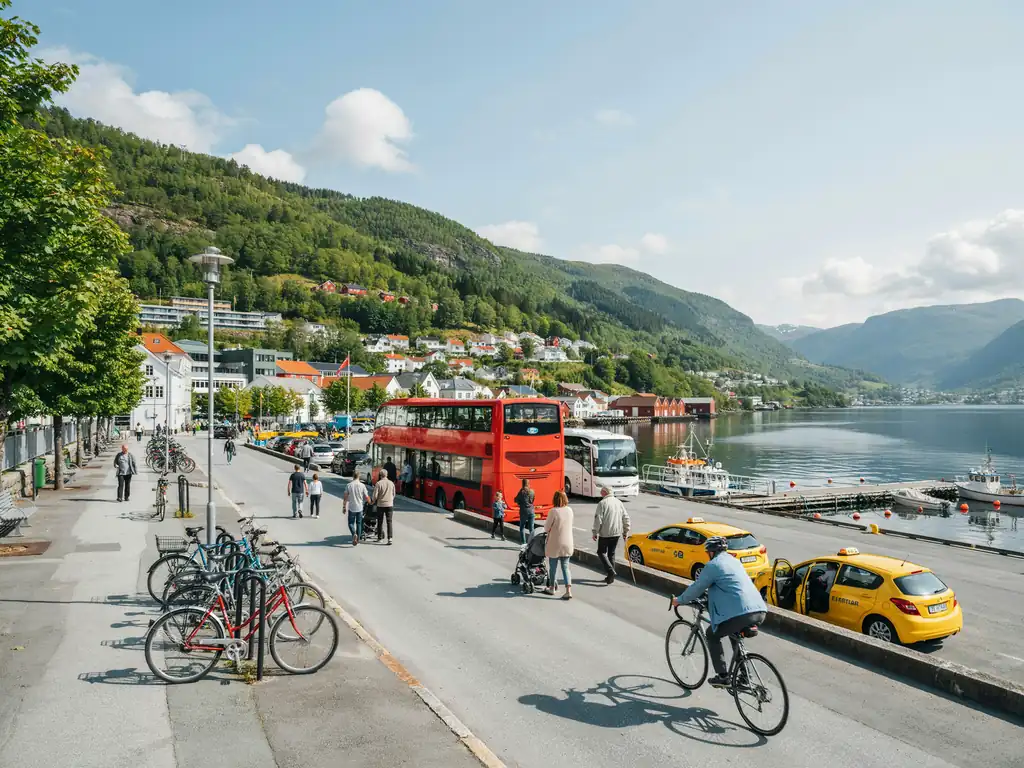
Molde is a walker’s town. The main square, ATMs, bike hire, car hire desks and the bus terminal all sit within about five minutes of the pier, and the train station isn’t much further.
- Public buses cover the town and the wider region, handy for reaching Varden or heading further out.
- Taxis wait at the port and they’re fine for a quick hop, but Norwegian taxi fares aren’t for the faint-hearted, so agree the price before you get in, not after.
- Bikes can be hired through the tourist information point in town, but there aren’t many to go round, so ask early if you want one.
- Car hire desks sit at the airport rather than the port, so this one’s really only for passengers staying longer than a single call.
One thing catches out first-timers: you can’t pay cash on Molde’s city buses any more. It all runs through the FRAM app, the ticketing system for Møre og Romsdal’s public transport, which handles journey planning too. Download it and set up payment while you’ve still got ship wifi or a data connection, ideally before you leave home, rather than fumbling with it at a bus stop with no signal.
If Your Ship Anchors Instead of Docking at Storkaia
Molde has designated anchorage points on top of its two quays, and the port authority hands out berths on a first-come, first-served basis. On a day with several ships booked in together, a later arrival could in theory end up at anchor instead of alongside.
In practice tendering is very rare here, and larger ships sometimes use an outer quay rather than the main pier, but you’re still landing centrally either way. Nobody publishes figures on how often anchorage actually gets used in a season, so if your date has multiple ships scheduled, it’s worth asking your cruise line beforehand whether you’re confirmed for a quay berth.
Cruise Lines and Itineraries Calling at Molde
Molde turns up on itineraries from several major lines, usually as one stop within a wider Norwegian fjords or coastal voyage rather than a destination in its own right. The largest ship on record here is MSC Meraviglia, the largest cruise ship by passenger numbers ever to arrive on the Norwegian coast, with room for 5,714 people aboard, and Molde was the first Norwegian port it called at on that voyage.
| Cruise line | Typical style |
|---|---|
| Hurtigruten | Norwegian coastal voyages, frequent calls |
| Viking Cruises | Ocean itineraries around the Norwegian fjords |
| Holland America Line | Ocean itineraries around the Norwegian fjords |
| Cunard and other larger lines | Occasional calls on longer European or Arctic voyages |
Cunard sums it up neatly, calling it a small port with a compact terminal and basic facilities, where the short walk into town still gets you near shops, restaurants and everything else worth seeing. We haven’t found a single, current, official schedule of calls published by the port authority, only third-party lists that go stale fast, so check exact sailing dates with your cruise line rather than trusting a generic port list.
What we can say is that demand keeps climbing. Cruise traffic to Norwegian ports overall has roughly doubled over the past decade or so, according to Kystverket, the Norwegian Coastal Administration.
For the wider picture of Norway’s coastal calls, our Norway cruise ship ports guide covers how Molde sits alongside neighbours such as the Port of Ålesund, Norway and Olden, Norway, both regulars on the same fjord itineraries. If the Arctic coast further north appeals more than a single afternoon in Molde, let us find the right polar expedition cruise for you.
Visiting Molde: A Simple Half-Day Plan
Short on time and just want a sensible run of things to do? This order works well for most passengers ashore for four to six hours.
- Walk off the pier at Storkaia and head straight into Storgata for a browse of the shops and cafes.
- Continue to the waterfront Seafront promenade for fjord views, then loop past Molde Cathedral.
- If your legs and your schedule are both up for it, tackle the hour-long climb to the Varden viewpoint for the panorama over the town and fjord.
- Or skip the climb and take the short boat crossing to Hjertøya for the Fisheries Museum instead.
- Head back towards the ship with time to spare, since Norwegian ports keep firmly to their sailing times.
A Few Hours in the City of Roses
Molde goes by the City of Roses, thanks to the rose gardens scattered across town, and a short stroll from the pier tells you why straight away. Storgata, the main shopping street, is lined with cafes and shops and sits an easy walk from Storkaia.
A ten to fifteen minute walk through Reknes Park brings you to the Romsdal Museum, an open-air collection of buildings dating from the 1600s to the early 1900s, and one of the biggest folk museums in Norway.
The waterfront promenade, known locally as the Seafront, opens the town right out to the fjord and mountains, with restaurants, public art, a playground and plenty of benches for sitting and staring at the harbour. Molde Cathedral, designed by the Norwegian architect Finn Bryn and built after the Second World War, is a short walk from the centre and worth a look even if you don’t go in.
If your call lands in July, don’t expect a quiet town: Molde hosts the Molde International Jazz Festival, said to be the world’s oldest jazz festival still running, and it pulls in around 100,000 visitors during its run.
Climbing to the Varden Viewpoint
The view everyone comes for is from Varden, a viewpoint at 407 metres above sea level looking out over the town, the fjord, its islands and the mountains beyond. It’s around six kilometres from the pier, mostly uphill, and the hike takes about an hour each way.
There’s a café at the top and a pleasant path once you’re up there, so build in time to actually enjoy the view rather than turning straight round. Proper footwear earns its keep on the uphill gravel sections, and a decent pair of walking shoes beats trainers if you’re doing this on a port day. If the climb isn’t for you, Masta Skybar in the Rica Seilet hotel, Molde’s tallest building, gives you the panorama without the legwork.
The Molde Panorama: 222 Peaks or 87?
Tourism material widely repeats that the view from Varden takes in 222 named peaks across the fjord, a figure often quoted as the official count. At least one recent guide instead says 87 snowcapped peaks line up across the fjord, and we haven’t found anything authoritative that settles the argument.
Either way, the practical point is the same: it’s a properly wide, mountain-ringed panorama, and counting peaks was never really the point of the climb.
Hjertøya Island and the Fisheries Museum
A short boat crossing from the centre of Molde takes you to Hjertøya, home to a small Fisheries Museum set up as a replica fishing village, with buildings, boats and equipment showing local life from the mid-1800s onwards. The guided tour ticket includes the boat crossing, which makes it a fairly low-effort way to see something quite different from the town.
It’s a decent change of pace from walking round Molde, though as with any trip involving a fixed crossing time, check it against your ship’s all-aboard time before you commit.
Beyond Molde: The Atlantic Road and Trollstigen
Given enough time in port, two well-known drives are within reach. The Atlantic Road is an 8.3 kilometre stretch of highway linking islands across the open Atlantic, with bridges arching over the sea, often ranked among the world’s best drives. Estimates of the distance from Molde vary between roughly 52 and 60 kilometres depending who you ask, which in practice means somewhere around an hour each way.
Roughly at the midpoint sits Eldhusøya, a small islet with a café for coffee and a local pastry, and a newly built path that loops the whole thing in about ten minutes, with open views out over the Atlantic.
Trollstigen, the mountain road with its hairpin bends, is about 85 kilometres away, roughly an hour and a half’s drive, and works as a half-day trip if your ship’s in port for seven hours or more. It’s a seasonal road, typically open from late spring to autumn, so it’s simply off the table on early or late-season sailings.
Booking the Bus to the Atlantic Road
Eide Auto AS is the regional bus operator running the Atlantic Road route from Molde’s bus terminal, with a one-day return ticket typically covering the trip, and around six departures on weekdays dropping to one or two a day at weekends. We haven’t been able to confirm a current official timetable directly from the operator, only older third-party guides, so treat anything you find online as a starting point rather than gospel.
The safest move on a port day is to confirm the current timetable at the tourist information point by the pier as soon as you arrive, or book a ship-organised excursion instead if you need the timing guaranteed against your sailing time.
Terminal Facilities, Cash and Practical Notes
The pier itself doesn’t offer much, but a tourist information point is usually set up on docking days, and that’s your best source for maps, bus times and local advice. We haven’t found official confirmation from the port authority of exactly what’s on offer at the terminal in terms of toilets, wifi or a fixed ATM, so ask at the information point rather than assuming anything’s there on arrival.
The Norwegian Krone is the official currency, and while some shops will take euros, US dollars generally won’t get you anywhere. Visa and Mastercard are accepted almost everywhere, so there’s little need to carry much cash beyond bus fares and small purchases. Tipping isn’t expected in Norway, which is one less thing to work out on a port day.
Fjord weather turns on a whim even on a bright morning, so a packable rain jacket in your daypack beats trusting the forecast to hold.
Why Trust About2Cruise
This guide draws on published information from Molde og Romsdal Havn IKS, the port authority for Molde and the wider Romsdal region, along with cruise line port descriptions, regional transport operators and Norwegian tourism sources. Where sources disagreed, such as the exact walking distance to town or the number of peaks in the panorama, we’ve said so rather than guessing at a single figure. You can read more about how we research and write our port guides on our about us page.
Common Questions
Where do cruise ships dock in Molde, Norway?
Nearly all ships dock alongside at Storkaia, a quay right by the town centre. A smaller number use the nearby Moldegård quay, and tendering is very rare.
How far is it to walk into town from the ship?
From Storkaia it’s a short walk, put at anywhere from 100 to 300 metres depending who you ask. From Moldegård, allow about fifteen minutes on foot.
Is Molde a tender port?
No. Tendering is very rare here, ships almost always dock directly at Storkaia or, occasionally, at the Moldegård quay.
Can I visit the Atlantic Road without booking a ship excursion?
Yes, in theory, on the Eide Auto regional bus from Molde’s bus terminal, though we couldn’t confirm a current official timetable, so check locally on the day.
Is Trollstigen open all year?
No. It’s a seasonal mountain road, typically open from late spring to autumn, so it’s off limits on early or late-season sailings.
Do I need cash in Molde?
Not much. Cards are widely accepted, buses run on the FRAM app rather than cash, and tipping isn’t expected in Norway.
What’s a good free activity near the pier?
Walking Storgata and the waterfront promenade costs nothing and covers the town’s shops, cafes and rose gardens within a short stroll of Storkaia.
What happens if several ships are in port at once?
Berths go out first come, first served, with usually two to four ships alongside at a time, so a later arrival could occasionally be sent to anchor instead.
How many peaks are in the Molde panorama?
Tourism sources usually say 222, though at least one guide cites 87. Nothing authoritative settles the difference, but the view itself is the real draw.
Last Updated: 19 October 2026