
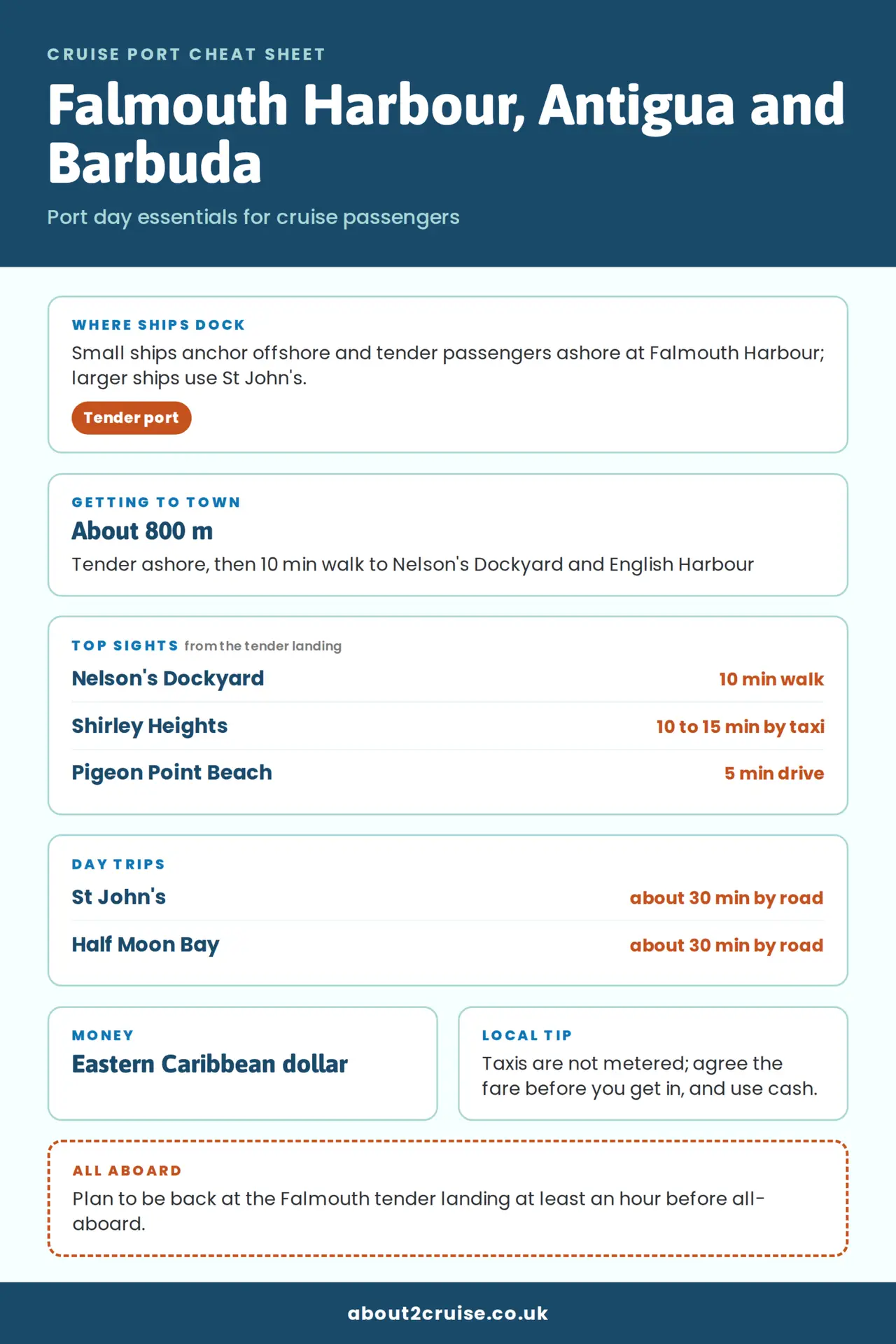
Falmouth Harbour is a small, yacht-focused tender port on Antigua’s south coast, right beside English Harbour and Nelson’s Dockyard. Most cruise ships anchor offshore and send passengers ashore by tender, not by a fixed pier. The headline sight is the Georgian Nelson’s Dockyard, an easy walk from the landing. You can also climb or taxi to Shirley Heights, swim at Pigeon Point or Galleon Beach, and use taxis or buses to reach St John’s.
Where Is Falmouth, Antigua? Yes, the Name Confuses People
Falmouth Harbour is a south-coast anchorage on Antigua, in the Leeward Islands of the West Indies. It isn’t the capital, and it isn’t the St John’s cruise terminal where most large ships dock.
The name creates genuine confusion. This is not Falmouth in Cornwall, and it’s not Falmouth in Jamaica. If you were searching for sailings from the Cornish port, see our Ambassador Cruises Falmouth page. Some booking sites also throw up the word “Mediterranean” because of the shared name or because ships reposition. The Falmouth in this guide is always the one in Antigua & Barbuda.
Falmouth Harbour vs St John’s Cruise Terminal: Don’t Get Caught Out
Antigua’s main cruise gateway is St John’s, Antigua, on the northwest coast. That’s where you’ll find the five-berth terminal, Heritage Quay, taxi dispatch, shops and turnaround facilities.
Falmouth Harbour, at the far southern end of the island, is a much smaller call used by yacht-style ships and some luxury vessels. There’s no large terminal, no rows of shops and no long pier. If your itinerary says Falmouth, Antigua, you are tendering or docking into a marina and yacht harbour rather than the main cruise port.
The two are about 16 km apart, roughly 30 minutes by road without traffic. That changes your day. From Falmouth you’re already beside Nelson’s Dockyard and English Harbour. From St John’s you’d need a transfer to reach the same sights. If you were hoping for a terminal and shopping day, Falmouth isn’t that kind of port.
The Port Layout Without a Map: How the Harbours Fit Together
Tenders bring you ashore at Falmouth Harbour tender landing. From the tender landing, Pigeon Point Beach is about a 16-minute walk and Nelson’s Dockyard about 23 minutes. Tap a pin for directions.
- Falmouth Harbour tender landingWhere tenders land
- Pigeon Point BeachBeach · About 16 min walk from the tender landing
- Nelson’s DockyardRestored Georgian dockyard · About 23 min walk from the tender landing
- Shirley Heights LookoutMilitary lookout · About 3 km from the tender landing
- Galleon BeachSnorkelling beach · About 2 km from the tender landing
- Fort BerkeleyHistoric fort · About 2 km from the tender landing
- Dow’s Hill Interpretation CentreHistory visitor centre · About 2 km from the tender landing
- St John’s CathedralCathedral · About 14 km from the tender landing
What to Do in Falmouth, Antigua: A Quick Shortlist
Before you sail
- Book Rum in the Ruins or Clarence House tours ahead with the National Parks Authority.
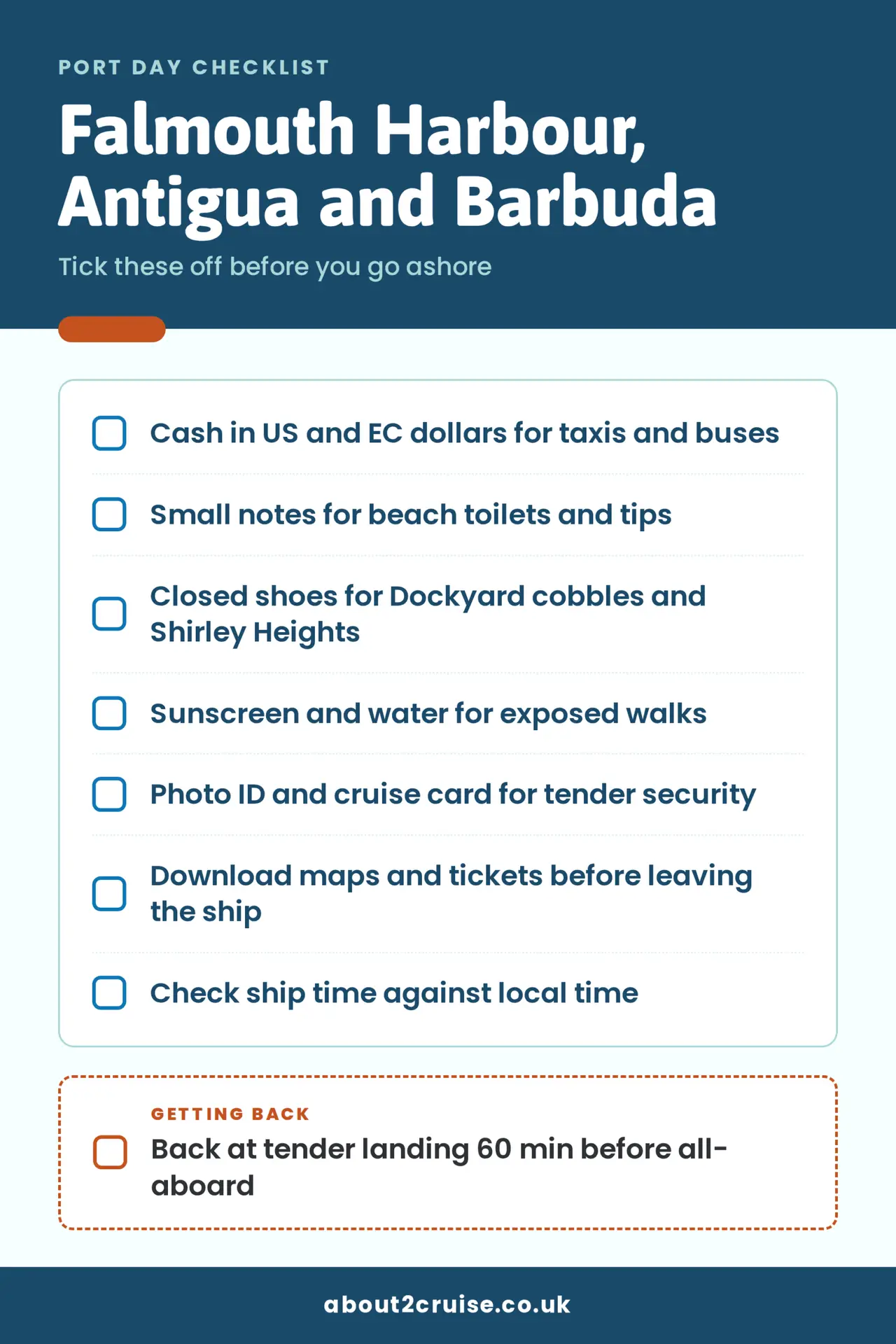
- Bring US dollars and EC dollars in cash for taxis, buses and beach bars.
- Set a watch to ship time and note the last tender time from the daily programme.
Short port day: under 6 hours
- On dockingTender ashore at Falmouth HarbourExpect a tenderShips anchor offshore and tenders land among the yachts. Check the daily programme for the jetty.
- +15 minWalk to Nelson's Dockyard10 minutes on footAbout 800 m, roughly 10 minutes on foot from the landing. Bring water and wear sun protection.
- +45 minExplore Nelson's Dockyard and museumClosed shoesBuy the day ticket at the entrance; it covers the Dockyard Museum, Dow's Hill and Shirley Heights.
- +1 hr 45 minLunch near the DockyardTry local foodLook for the national dish, fungie and pepperpot, or ducana, at waterfront restaurants between Falmouth and English Harbours.
- +3 hrsWalk to Pigeon Point BeachCalm and shadedA short hot walk over the hill from English Harbour, or a quick drive. No lifeguard; small charge for toilets.
- All-aboard minus 1 hrBack at the tender landingShip timeReturn tenders get busy. Aim to be at the Falmouth landing at least an hour before all-aboard.
The time on the map is the whole walk, every stop added together.
Open this walking route in Google Maps
If plans change: If Nelson's Dockyard is closed or the tender is delayed, take a taxi to Shirley Heights and Pigeon Point instead, leaving the Dockyard for another call.
Long port day: 8 hours or more
- On dockingTender ashore at Falmouth HarbourGo earlyTake an early tender to beat queues and heat. The landing is among the yachts, not a terminal.
- +30 minTaxi to Shirley HeightsAgree fare firstAbout 10 to 15 minutes by taxi from the Falmouth side. Taxis are unmetered; agree the fare in EC or US dollars before you get in.
- +1 hrShirley Heights Lookout and viewpointGreat harbour viewThe lookout sits above both harbours and can see Montserrat on a clear day. Ask if the lookout entry is included in the taxi price.
- +2 hr 30 minTaxi down to Nelson's DockyardUse ship timeA short ride back down, or a hot walk. The day ticket you bought at Shirley Heights should also cover the Dockyard.
- +3 hrExplore Nelson's Dockyard and museumClosed shoesThe Georgian dockyard, Dockyard Museum and old fortifications are within a short walk inside the walls.
- +4 hr 30 minLunch near the harbourTry local foodOrder fungie and pepperpot or grilled fish with rum punch along the waterfront between Falmouth Marina and the Dockyard.
- +5 hr 30 minRelax at Pigeon Point BeachCalm and shadedA quick drive or a hot walk over the hill. Swim, rest and use the beach bars before heading back.
This map shows the taxi ride from the ship. The time is the drive only, not your time ashore.
Open the taxi route in Google Maps
If plans change: If Shirley Heights is closed or the road is jammed on a party day, swap it for Fort Berkeley and Pigeon Point, then take a taxi back to the tender landing.
- Walk about 10 minutes to Nelson’s Dockyard and spend an hour or two in the restored Georgian dockyard and museum.
- Taxi or hike to Shirley Heights for the view over English Harbour and Falmouth Harbour. If your ship has a late departure, the Sunday or Thursday party is the island’s big social event.
- Swim or snorkel at Pigeon Point or Galleon Beach.
- Take a small-group island tour up to St John’s, the west-coast beaches or the east coast’s Half Moon Bay.
- Do a catamaran or sail-and-snorkel trip, especially if your ship offers one from the Falmouth Bay anchorage.
- Eat local food around English Harbour: fungie and pepperpot, ducana and saltfish, or charcoal-grilled fish with a rum punch.

Do You Dock or Tender in Falmouth? What to Expect
Falmouth Harbour is overwhelmingly a tender port. Ships anchor offshore in Falmouth Bay, and passengers are taken ashore by the ship’s tender or a locally operated tender to a small landing among the yachts. Some small luxury or expedition vessels may come alongside a marina berth, but on a typical cruise day you should expect a tender.
There is no single official public map of the tender jetty. The ship’s daily programme is the only reliable source for which landing is in use that day. The cruise port operator holds the right to run tendering at Falmouth Harbour, but in practice the ship’s crew and local tender drivers coordinate the operation.
Tender landings here are simple, not a big terminal. There may be a photographer, a security check and little else. If you use a mobility aid, be aware that the tender and gangway may not be accessible, and permission to board is at the master’s or tender crew’s discretion.
Nelson’s Dockyard: Why Your Ship Is Stopping Here
The main reason to call at Falmouth is proximity to Nelson’s Dockyard. The dockyard is part of a UNESCO World Heritage Site and the only continuously working Georgian-era dockyard in the world.
Walking from the Falmouth Harbour marina area to the Dockyard takes about 10 minutes, roughly 800 metres, though the route can be hot and uneven. Inside you’ll find restored naval buildings, the Dockyard Museum with Nelson’s telescope and tea caddy, a working marina, restaurants, shops and the old stone walls of the Georgian enclosure.
Visitor entry is normally US$15 for a day ticket, which also covers the national park sites such as Shirley Heights and Dow’s Hill. The park is open Monday to Saturday, 08:00–17:00. The Dockyard involves cobblestones and uneven paths, so closed shoes beat flip-flops.
If you want something beyond the general entry, you can book the ranger-led Rum in the Ruins tour on Fridays at 5pm for US$25, or the Clarence House tour on Wednesdays for US$20, limited to 10 people, through the National Parks Authority.
On the point between English Harbour and Falmouth Harbour is Fort Berkeley, the oldest fortification in English Harbour, dating to 1704. You can walk out to the point for harbour views and photos. Also here is the Dow’s Hill Interpretation Centre, which runs a short history presentation that gives useful context for the island’s colonial and enslaved-labour history.
Shirley Heights Lookout and the Party Nights
Shirley Heights is the restored military lookout and gun battery high above English Harbour, about 3 km from the Dockyard area. The view takes in both English Harbour and Falmouth Harbour, and on a clear day you can see Montserrat and Guadeloupe.
You can reach it by taxi in about 10–15 minutes from the Falmouth side, or hike up from Galleon Beach on a steep half-mile trail. The trail is challenging and hot, so go early if you plan to walk.
The lookout’s regular hours are broadly 9am–5pm on Tuesday, Wednesday, Friday and Saturday, with late opening on Thursday and Sunday. The Sunday Afternoon BBQ is the island’s famous party: steel band, barbecue and rum punch, and the busiest crowd of the week. Thursday has reggae night.
A party only works if your ship has a late departure. Do not trust the party’s reputation over your all-aboard time. Some excursions quote a separate lookout or party admission of US$10–15 on top of transport, so confirm what’s included before you book.
Beaches Near Falmouth Harbour: Pigeon Point, Galleon Beach and Half Moon Bay
Pigeon Point is the easiest beach from a Falmouth call. It’s a short drive or a hot 10-minute walk over the hill from English Harbour. The water is calm and shallow, there’s natural shade, two beach bars and a small children’s playground. The beach is free to use, but there is a small charge for toilets and showers, and there’s no lifeguard. It’s the best simple swim-and-lunch option.
Galleon Beach sits at the entrance to English Harbour on Freeman’s Bay and is the area’s snorkelling beach. The water is sheltered, reef sits close in, and turtles and rays are often seen. Some shore excursions run guided snorkelling trips from the Falmouth Bay anchorage, typically around 3.5 hours and US$169 per person, with swimming ability and weight limits.
Half Moon Bay is a national park beach on the east coast, about 30 minutes east of English Harbour. It has a reef offshore and limited facilities, so it’s better for a longer taxi trip than a quick dip. If your ship is calling at St John’s instead, the west-coast resort beach you want is Jolly Beach, Antigua, but from Falmouth that’s a long transfer.
Food, Rum Punch and Local Flavour Near Falmouth
The restaurants and bars nearest to a Falmouth landing are along the waterfront strip between Falmouth Harbour Marina and Nelson’s Dockyard, and inside the Dockyard itself.
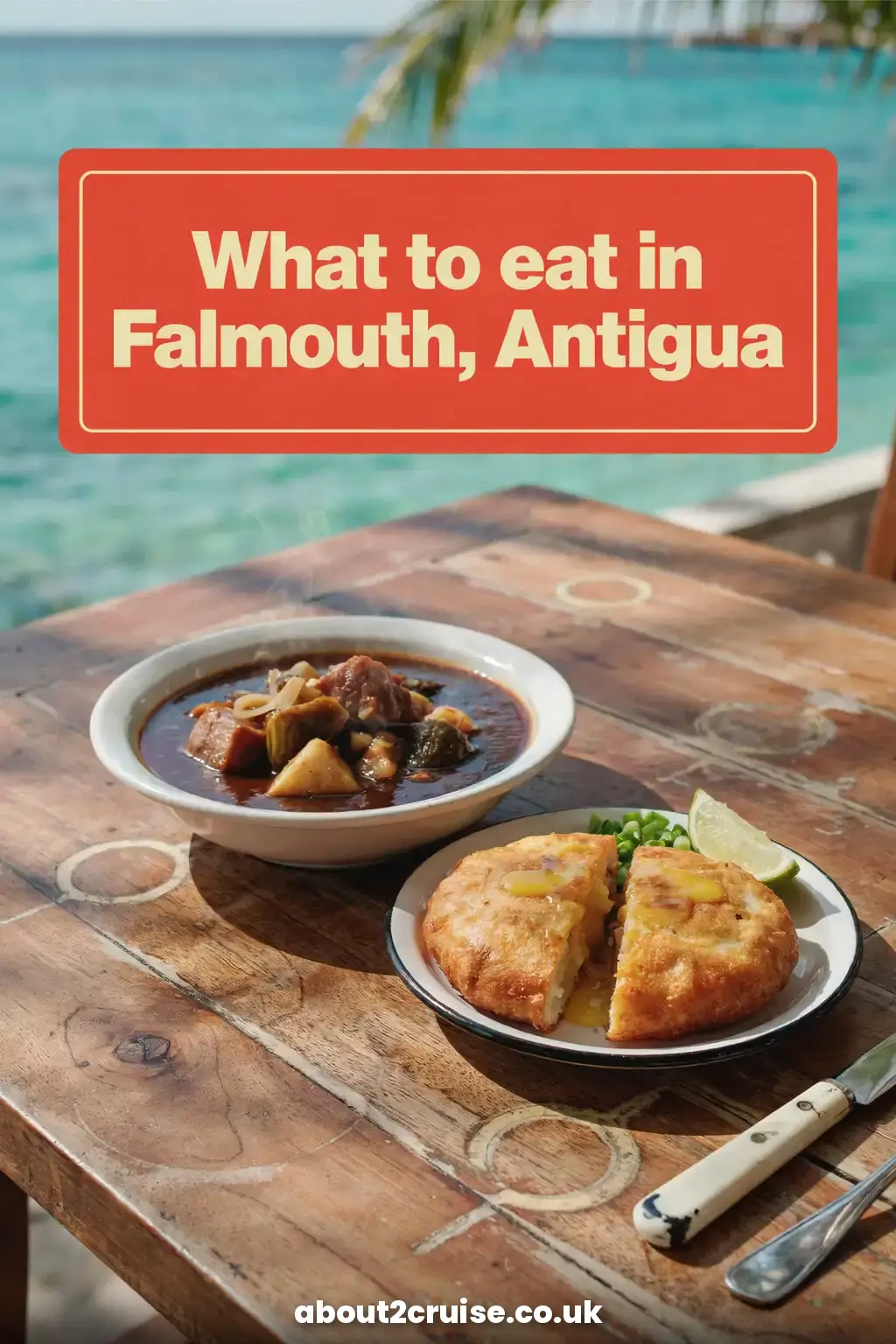
The local food to look for is fungie and pepperpot, Antigua’s national dish: cornmeal with a slow-cooked stew of greens, pumpkin, okra and salted meat. Ducana is grated sweet potato with coconut and spices, steamed in banana leaves and served with saltfish. Cook-shops and market stalls in St John’s are the most authentic places for these, though some English Harbour restaurants serve their own versions.
Antigua’s flagship beer is Wadadli lager, and the island black pineapple is famously sweet. Rum punch is the drink associated with Shirley Heights parties and beach bars, but it’s stronger than it tastes, especially in the sun. Drink water, eat something, and keep an eye on the time if you have a tender to catch.
Yachting and Sailing Culture in Falmouth Harbour
Falmouth Harbour is Antigua’s yachting and superyacht centre, not a typical beach-port pier. The Antigua Yacht Club is based here, and the surrounding marinas host or support Antigua Sailing Week, the Antigua Classic Yacht Regatta, the RORC Caribbean 600 and the Superyacht Cup. Falmouth Harbour Marina takes yachts up to 535 feet.
During the charter yacht show in early winter the harbour is full of crew and yachts, but casual cruise visitors aren’t really the audience. For a cruise passenger the yachting culture is mostly part of the scenery: you’ll see rigging, racing marks and marina traffic as you walk between Falmouth and the Dockyard.
Cricket and Local Sport
Cricket is the national sport in Antigua. The main venue is the Sir Vivian Richards Stadium at North Sound, about 20 minutes from St John’s and around 30 minutes from Falmouth by road. You’re unlikely to catch a match on a cruise day unless a regional West Indies fixture coincides with your call, but cricket grounds and sports bars are a natural conversation starter with taxi drivers and guides. Around Falmouth, local sport is otherwise dominated by yachting and sailing.
St John’s from Falmouth: Worth the Taxi?
St John’s is the capital and the place for a shopping-and-history run if your ship is at Falmouth and you want a change of scene. The route is about 16 km, roughly 30 minutes. St John’s has the cathedral, market, Heritage Quay and the main cruise terminal with actual shops, taxi dispatch, currency exchange and pharmacy.
From Falmouth, you would visit St John’s as an excursion or taxi trip, not as a walk. For more detail on what to do there, see our St John’s, Antigua guide.
Key Distances and Transfer Times
| Journey | Approx distance | Approx time |
|---|---|---|
| Falmouth tender landing to Nelson’s Dockyard | 800 m | 10 min walk |
| Falmouth to Shirley Heights | 3 km | 10–15 min by taxi |
| Falmouth to Pigeon Point | short | 5 min drive / 10 min walk from English Harbour |
| Falmouth to Galleon Beach | short | 5–7 min drive |
| Falmouth to St John’s | 16 km / 10 miles | 20–30 min by road |
| Falmouth to Half Moon Bay | east coast | 30 min |
Times assume no traffic and a taxi waiting. Antigua roads are not fast, and the last mile around English Harbour can be congested when regattas or parties are on.
Getting Around: Taxis, Guides and What to Expect to Pay
Taxis in Antigua are not metered. Fares are set by zone, so agree the price before you get in. Many drivers accept US dollars or Eastern Caribbean dollars, but taxis are generally cash only.
From the Falmouth area there is no big taxi rank like St John’s. Drivers usually wait near the tender landing or can be arranged by the ship. A licensed guide can add historical context, especially for Shirley Heights and Nelson’s Dockyard, but you can also walk to the Dockyard and hire a car for the day for an island loop.
Expect a private round-trip to Shirley Heights or Pigeon Point to be quoted per vehicle or per person depending on the driver, so ask clearly. A day island tour is often the best value if you want several stops. Ship-operated excursions are priced per person and usually include transport and sometimes entry. Independent taxis often charge per vehicle, which can be cheaper for a family but less structured.
Local Buses and Route 17
Route 17 runs between St John’s and English Harbour, so it can be used to reach the Dockyard from the Falmouth area or to go into St John’s. Fares are about EC$3.75 per adult. Buses are minivans, not big coaches, and they run best before about 6pm. They have little luggage space and drivers prefer cash in Eastern Caribbean dollars. If you miss the last reliable bus, you’ll need a taxi. For a cruise day, buses work for a one-way adventure but aren’t ideal for a firm all-aboard deadline.
Walking from the Falmouth Tender Landing
Yes, you can walk to Nelson’s Dockyard and the English Harbour restaurants from a Falmouth landing, but the walk is not a shaded promenade. Pavements are uncommon outside central St John’s, and the short distance on a map can be hot, hilly and alongside traffic.
The walk from the marina area to the Dockyard is about 10 minutes. Continuing over the hill to Pigeon Point is tougher and not advisable for anyone with knee or mobility problems. Bring water, wear sun protection, and remember the return walk may be uphill in full sun.
Ship Excursions vs Independent Exploring at Falmouth
From Falmouth, the independent default is easy: tender ashore and walk to Nelson’s Dockyard, then taxi to Shirley Heights or Pigeon Point. You don’t need a ship excursion for the Dockyard.
A ship excursion is more useful for trips with tight timing, such as the Shirley Heights party, a catamaran snorkel, a helicopter over Montserrat, or a St John’s shopping and sightseeing tour. If you go independent, build in the tender queue and a return buffer. If you book through the ship, the operator is responsible for getting you back on time, which is worth more on a late-day or distant trip.
Tender Port Timing: Build in a Real Buffer
At a tender port, the all-aboard time is not the same as the last tender time. Plan to be back at the Falmouth landing at least an hour before the ship’s all-aboard, and earlier if the last tender is crowded or the sea is lumpy. If you take a taxi from St John’s or the east coast, allow extra for traffic.
A missed tender at Falmouth is expensive and miserable. You are not at a terminal with a hotel desk and a line of backup options.
Port Facilities at Falmouth and St John’s
Falmouth has little fixed cruise infrastructure. There is no large terminal, no left luggage, no currency exchange and no pharmacy at the tender landing. You may find a pop-up information point or a ship’s representative, but don’t count on Wi-Fi at the pier. Toilets are more likely in a nearby marina restaurant or inside Nelson’s Dockyard after you pay entry.
For full terminal facilities, including luggage storage inside the Customs and Immigration Hall, you need St John’s. The only ATM in the English Harbour area is at Nelson’s Dockyard, and it frequently runs out of cash or is out of service, so bring enough money from the ship.
Money, Cards and Tipping in Antigua
The currency is the Eastern Caribbean dollar, fixed at EC$2.70 to US$1. US dollars are widely accepted in tourist areas, and taxi fares can usually be paid in US or EC dollars. Cash is king for taxis, buses and small beach bars. Bring small notes and spare change for beach toilets and tips.
Tipping is generally 10–15%, but check the bill: some restaurants add a 10% gratuity, and taxes are separate. Banks open Monday to Thursday 8am–2pm and Friday 8am–4pm, which is little use on a one-day call.
Passports, Entry Formalities and Cruise Card Checks
British passport holders need a passport valid for at least six months after arrival, plus a return or onward ticket. Most cruise passengers are processed under the cruise line’s shore protocols, and you’ll need your cruise card and a photo ID to get back through the tender security point. Passports can usually stay in the safe unless the ship tells you otherwise.
If you go ashore independently, carry a copy or a photo of your passport data page, your cruise card and the port agent’s number from the daily programme.
Accessibility and Mobility at the Port
Falmouth is not an easy tender port for wheelchairs, walkers or anyone unsteady on gangways. The tender ride requires steps and a transfer that depends on sea conditions. The Dockyard has cobblestones, and Shirley Heights has uneven ground and steep paths.
If you have limited mobility, look for a ship excursion with seated transport and minimal walking, or stay on board if tendering looks risky. There is no guarantee of level access at the small marina landings.
Sun, Heat and Hydration
Antigua is hot. Daytime highs run 28–29°C in the December-to-April cruise season and 30–31°C from May onward. The sun is strong, and humidity is high, especially July to September. Use high-factor sunscreen, a hat, sunglasses and water.
The walk from Falmouth to Nelson’s Dockyard is short but exposed. Alcohol and sun at Shirley Heights parties are a bad combination if you still have a tender and a sea passage ahead.
Swimming and Beach Safety
Not all Antiguan beaches have lifeguards or warning flags, and currents can be deceptively strong. Pigeon Point is calm and sheltered, but Galleon Beach and Half Moon Bay require more care.
If you snorkel, know your ability and stay with a buddy. Don’t swim alone at an empty beach, and don’t leave valuables unattended while you’re in the water. If the sea is rough, the tender ride itself may be wet or cancelled, so listen to the captain’s briefing.
Safety, Crime and Common Scams in Antigua
Antigua is generally safe for cruise passengers in the main tourist areas, but the UK Foreign, Commonwealth & Development Office warns of incidents of violent crime including armed robbery and sexual assault. Avoid isolated areas, including isolated beaches, particularly after dark.
Use only licensed taxis, agree the fare before setting off, and do not resist a robbery. Keep phones and cameras out of sight on the road, and don’t leave bags on the beach while swimming.
Two specific rules matter: it is illegal for anyone, including children, to wear camouflage clothing, and drug offences carry severe penalties. Smoking is also illegal in public places. In practice, your biggest risks on a Falmouth call are sun, sea, road traffic and missing the tender, not crime.
Ship Time vs Local Time
Antigua stays on Atlantic Standard Time, UTC−4, all year, with no daylight saving. Your ship may or may not change its clocks to match. Always follow ship time for the all-aboard deadline, not your phone and not the clock in a beach bar. Set a watch or phone alarm to ship time before you leave the tender landing.
Weather, Hurricane Season and Cruise Season
The dry, cooler cruise season runs roughly December to April. Rain days are fewer in February to April and higher from August to December. Sea temperature is around 26°C in January and up to 29°C in September and October. The hurricane season runs June to November, with peak exposure from August to October. A cruise call in hurricane season is still possible, but itineraries can change at short notice. Bring a light rain layer and a dry bag for the tender in summer and autumn.
Rainy-Day and Non-Beach Options at Falmouth
If it rains, Nelson’s Dockyard and its museum are your best nearby bet, though you still need to walk or taxi there. Shirley Heights is poor in cloud and rain, so save it for a clear day. A taxi loop to St John’s gives you the market, cathedral and shops, and the drive itself is an island tour. A long lunch at a restaurant inside or near the Dockyard is the simplest wet-weather plan. There is no big indoor mall or multiplex at Falmouth.
How Long Do You Need at Falmouth Antigua Port?
A short call of four to five hours is enough to tender ashore, walk to Nelson’s Dockyard, spend an hour or two, and return. To add Shirley Heights and a beach swim, plan at least seven or eight hours ashore. If you want an island tour to St John’s or Half Moon Bay, or a party at Shirley Heights, you need a full port day with a late departure. Don’t try to do St John’s, Shirley Heights, Nelson’s Dockyard and a beach all in one morning.
Falmouth Harbour and English Harbour are adjacent natural harbours on the south coast, separated by the Middle Ground peninsula. Most tender landings are on the Falmouth side among the yachts. Nelson’s Dockyard sits on the English Harbour side, and Shirley Heights is above it. Pigeon Point is around the corner on the north side of the peninsula. Once you know that triangle, the place is geographically simple even if the actual tender jetty isn’t published in advance.
For a wider regional view of how this call fits with other Caribbean islands, see our Leeward Islands cruise port guide. If your itinerary also includes St Kitts, the next likely call is covered in our Basseterre, St Kitts guide.
Frequently Asked Questions
Do cruise ships dock at Falmouth or St John’s?
Most large cruise ships dock at St John’s. Falmouth is mainly an anchorage and tender port for smaller or luxury ships. If your itinerary says Falmouth, Antigua, expect a tender, not a cruise pier.
Can you walk from the cruise ship to a beach at Falmouth?
Not directly from the ship. You tender ashore first. Once ashore, Pigeon Point is a short drive or a hot 10-minute walk over the hill from English Harbour. Galleon Beach is also close by taxi.
Is there Wi-Fi at the Falmouth tender landing?
Don’t count on it. Some marina restaurants and Nelson’s Dockyard may have Wi-Fi for customers, but the landing itself is a simple tender point. Download maps and tickets before leaving the ship.
Can I use US dollars in Antigua?
Yes, US dollars are widely accepted in tourist areas and for taxis. Buses and small shops may prefer Eastern Caribbean dollars. Prices in EC dollars are fixed at EC$2.70 to US$1.
Is there left luggage at Falmouth Harbour?
No. There is no cruise terminal and no luggage storage at Falmouth. The only documented luggage facility is inside the St John’s cruise terminal, about 30 minutes away by road.
How long is the tender ride at Falmouth, Antigua?
It depends on where the ship anchors and which landing is used, but tender rides are typically short, around 5–15 minutes. It’s the waiting and boarding that eat time, not the crossing.