
Fukuoka cruise ships dock at Chuo Wharf, sometimes called the Hakata Port International Terminal, about 4km from Hakata Station and Tenjin with no station at the pier. A taxi or shuttle gets you into town in 15 to 20 minutes, and a few hours ashore is plenty for Ohori Park, Kushida Shrine or the harbourside Hakata Port Tower.
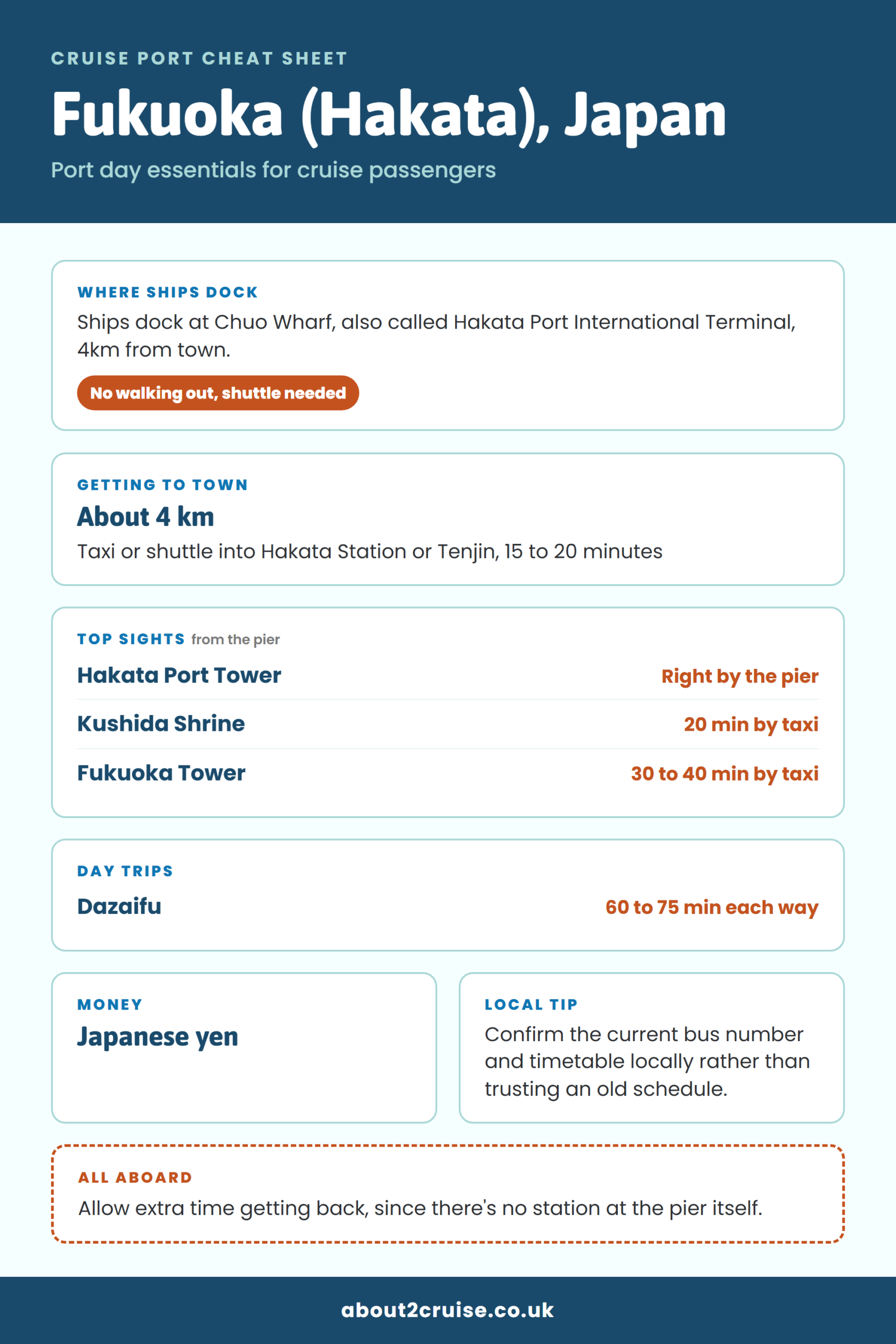
Fukuoka cruise terminal: Chuo Wharf and Hakata Port International Terminal explained
Fukuoka’s main cruise berth is Chuo Wharf, built to take ships up to around 228,000 GT, and it’s been able to handle two ships at once since a lengthening project finished a few years back. To make things more confusing, the name Hakata Port International Terminal gets used for two completely different places: this pier, and a separate building at Bayside Place that deals with Tsushima ferries, harbour tour boats and a small aquarium.
If your cruise documents just say Hakata Port International Terminal, check which pier they actually mean. A secondary berth, Hakozaki Wharf, takes the overflow or the bigger ships; it sits in an industrial stretch with nothing much for visitors, and the shuttle ride into town takes longer from there. The Chuo Wharf passenger building itself has free wifi, washrooms, currency exchange and ATMs.
Fukuoka usually turns up as one stop among several Kyushu calls on a Japan itinerary. The Japan cruise ports guide covers how it fits alongside calls like the Nagasaki cruise port guide and Kagoshima cruise port guide.
Fukuoka cruise port to city centre
Fukuoka cruise port to city centre means a taxi, shuttle or bus. A taxi gets you there for a flat fare that won’t dent your budget.
- Cruise shuttle: when one’s running, it leaves roughly every 15 minutes on call days and takes 15 to 20 minutes into central Fukuoka.
- Taxi: there are plenty at the pier, most take cards.
- Public bus: there are routes that serve Chuo Wharf, but check the current number and timetable once you’re there rather than trusting an old schedule.
Hakata Station is also the terminus of the Shinkansen bullet train, handy if you’re connecting onward after your cruise.

Things to do near Fukuoka cruise port
The best use of your time near Fukuoka cruise port depends on how many hours you’ve got, since some sights sit a short hop from Hakata Station and others eat up most of a day.
Before you sail
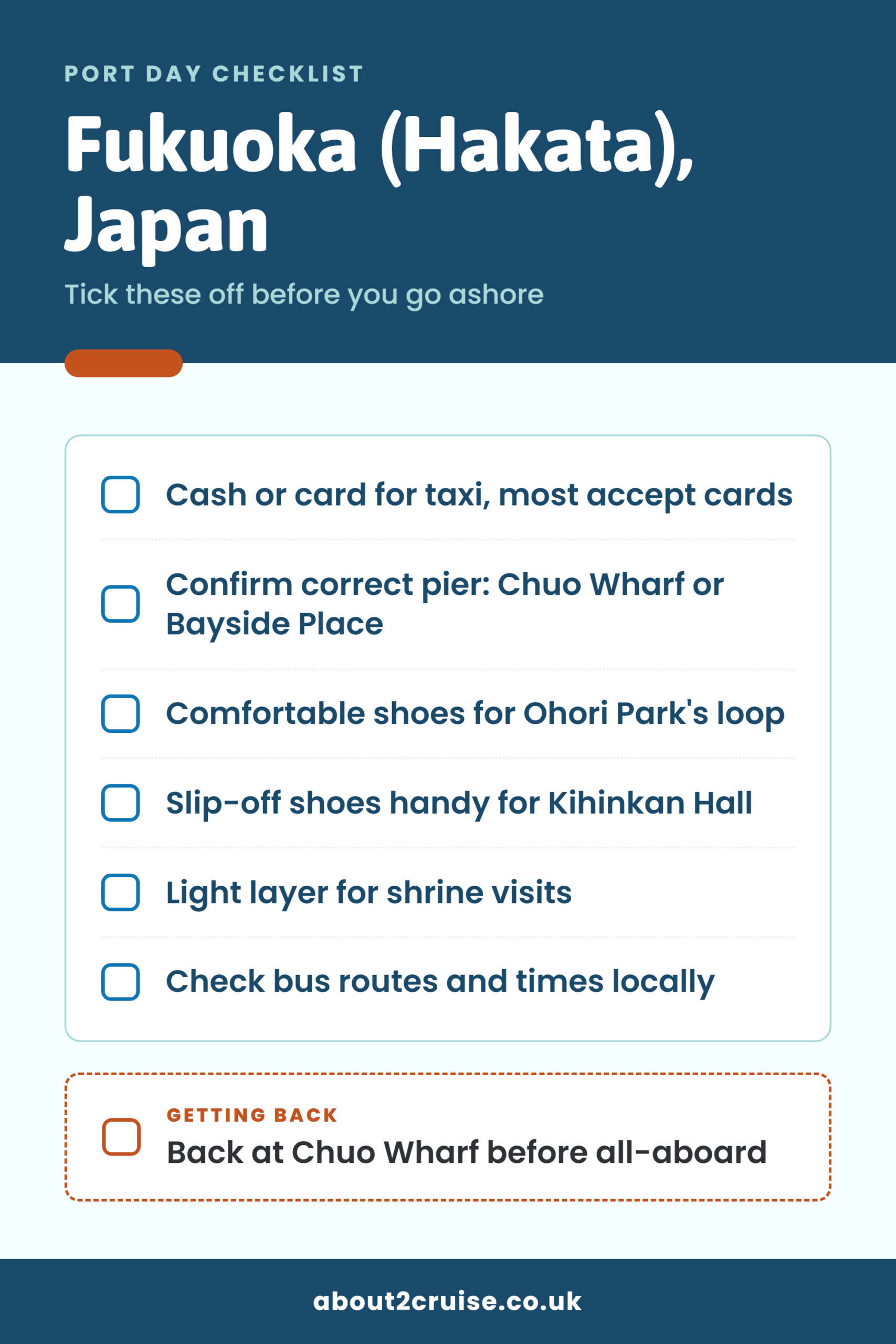
- Check which pier your cruise line means, Chuo Wharf or Bayside Place.
- Confirm whether coin lockers are available at the cruise terminal, or plan to use Hakata Station instead.
- Book luggage storage near the terminal in advance if you need it before or after your cruise.
Short port day: under 6 hours
- On dockingTaxi or shuttle to Hakata StationNo station at pierChuo Wharf has no station at the pier, so a taxi or shuttle is the only way into town, about 15 to 20 minutes.
- +30 minKushida ShrineA short subway ride from Hakata Station. Look for the torii gates that alternate between painted vermillion and bare stone.
- +1 hrLunch near Hakata StationTry Hakata ramenOrder a bowl of cloudy pork-bone Hakata ramen, and ask for kaedama if you want an extra serving of noodles.
- +2 hrsOhori ParkA taxi or bus ride to the two-kilometre pond loop and strolling garden, with a pavilion to pause at.
- +3 hrs 30 minHakata Port TowerOn the way back towards the ship, an easy stop right by Chuo Wharf.
- All-aboard minus 1 hrBack at Chuo WharfTaxis are plentiful at the pier if you're running behind schedule.
The time on the map is the whole walk, every stop added together.
Open this walking route in Google Maps
If plans change: If the taxi or subway to Kushida Shrine is delayed, Hakata Port Tower near the pier works as a quick substitute stop.
Long port day: 8 hours or more
- On dockingTaxi to Fukuoka Tower and Momochi Beach30 to 40 minAbout 30 to 40 minutes from Chuo Wharf by taxi or bus, straight off the ship. Views stretch right out over Hakata Bay.
- +1 hr 30 minOhori ParkA short taxi or bus ride from Fukuoka Tower to the two-kilometre pond loop and strolling garden, with a boathouse corner to rest at.
- +3 hrsLunch near TenjinTry yaki ramenHakata's own invention, noodles fried on a griddle with tonkotsu soup or sauce stirred through.
- +4 hrsKushida ShrineA short subway ride from Tenjin or Hakata Station, home to torii gates that alternate between vermillion and bare stone.
- +5 hrs 30 minHakata Port TowerNear Chuo Wharf itself, a last easy stop before heading back to the ship.
- All-aboard minus 90 minBack at Chuo WharfAllow extra time since there's no station at the pier, just taxis and the shuttle.
This map shows the taxi ride from the ship. The time is the drive only, not your time ashore.
Open the taxi route in Google Maps
If plans change: If bus or taxi routes to Fukuoka Tower are unclear or delayed, spend the extra time around Ohori Park and Hakata Station instead.
- Kushida Shrine: a short subway ride from Hakata Station to Kushida Shrine Station. Look out for the torii gates that alternate between painted vermillion and bare stone, marking where the sacred ground begins.
- Ohori Park: a two-kilometre loop around the pond and strolling garden, with a pavilion and a boathouse corner that both make a good spot to stop and catch your breath.
- Fukuoka Tower and Momochi Beach: views over Hakata Bay that stretch right out, about 30 to 40 minutes from Chuo Wharf by taxi or bus. Better suited to a longer day in port.
- Dazaifu: a historic shrine town that’s 60 to 75 minutes each way by train and taxi from Chuo Wharf, so it only really works if you’ve got most of the day in port.
Where to eat near Fukuoka cruise port
The best food near Fukuoka cruise port is Hakata-style ramen and street-stall cooking, found mainly around Nakasu island and Tenjin once you’re into central Fukuoka.

- Hakata ramen: a cloudy, deeply savoury pork-bone broth with thin, firm noodles. Ask for kaedama, an extra serving of noodles, once you’ve polished off the bowl. Found all over Hakata Station and Tenjin.
- Yaki ramen: Hakata’s own invention, noodles fried on a griddle with tonkotsu soup or sauce stirred through rather than poured over. Another Hakata Station and Tenjin regular.
- Mentaiko dishes: spicy pollock roe, often turned into a tamagoyaki omelette. A Fukuoka speciality worth tracking down at the yatai stalls.
- Nakasu yatai stalls: riverside food carts serving ramen, oden, yakitori and thin Fukuoka-style gyoza, reached via Kushida Shrine Station. They open from around 6:30pm, which is after many ships’ all-aboard time, so this only works if your ship has a later call.
Where to stay near Fukuoka cruise port
The best place to stay near Fukuoka cruise port depends on whether you’d rather be near the pier or near Hakata Station’s restaurants and Shinkansen connections. Both work well if you’re joining or finishing a cruise here.
- Hotel Hakata Place: about a 5-minute taxi ride from the Hakata Port International Terminal and a 5-minute walk to Bayside Place, with Hakata Station and Tenjin around 10 minutes away by bus.
- Fukuoka Sunpalace Hotel & Hall: a 5-minute walk from Hakata Wharf, with a public bathhouse right in front of the port.
- Hotels near Hakata Station, such as Hotel Okura Fukuoka or Hotel Eclair Hakata, put you within easy reach of the Shinkansen and a much wider choice of restaurants. If you’re staying at Hakata Tokyu REI Hotel and wheeling luggage, take the West 6 exit from the underground concourse rather than crossing the pedestrian bridges.
Luggage storage at Fukuoka cruise port
Luggage storage at Fukuoka cruise port itself isn’t something you can count on, so Hakata Station, a short taxi or bus ride from Chuo Wharf, is the more dependable option.
Hakata Station has well over 700 coin lockers, plus staffed cloak and delivery counters spread across the Hakata Gate, Chikushi Gate, Deitos underground area and Cloak zones. If you’re catching the Shinkansen, use the Chikushi Gate lockers. If you’re heading into Tenjin, Nakasu or Dazaifu by bus or subway, use the Hakata Gate concourse instead.
Large and XL lockers fill up fast, often full somewhere between half nine and midday, so get there early or have a plan B. The coin lockers on the 9th and 10th floor dining levels of JR Hakata City are free for three hours if you’re eating there, which is a handy fallback when the main ones are full.
If you’d rather sort this out before you land, you can book luggage storage near the terminal in advance.
What to wear in Fukuoka: outfit ideas for a port day
What to wear in Fukuoka for a port day comes down to comfortable shoes and a layer you can take off, since most of what you’ll be doing here is walking, not following a dress code.


- Flat, cushioned shoes for the two-kilometre loop around Ohori Park’s pond and garden paths.
- Shoes you can slip off easily if you’re visiting Kihinkan Hall, where everyone takes their footwear off at the door and wears provided slippers, with a separate pair kept for the restroom.
- A light layer for temple and shrine visits such as Kushida Shrine, handy for covering up as you need to.
A pair of broken-in walking shoes for women makes the Ohori Park loop and the Nakasu riverside far easier going than sandals. For more ideas, see these casual cruise outfit ideas for women and cruise outfit ideas for men.
Best photo spots in Fukuoka
The best photo spots in Fukuoka mix skyline views with waterside scenes, and a couple of them are worth timing to a specific part of the day.
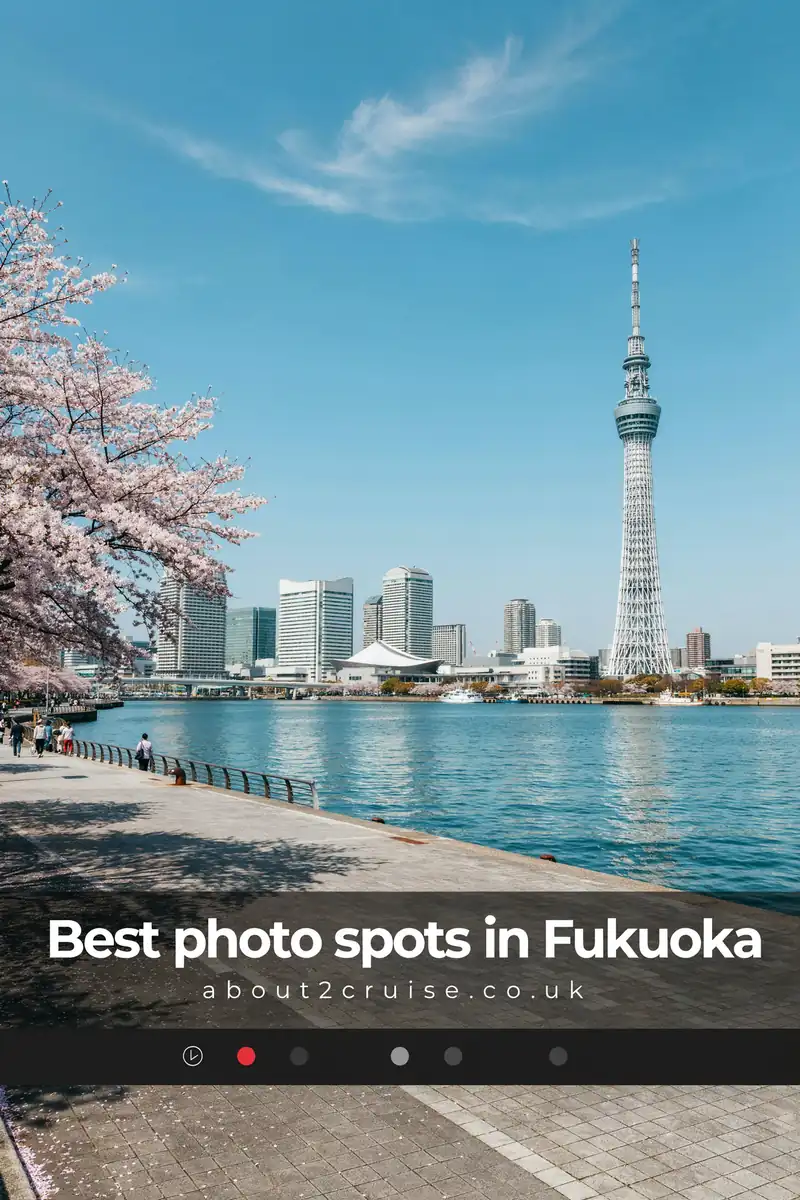
- Fukuoka Tower: views stretching over Fukuoka and Hakata Bay, best around sunset as the city lights start to come on.
- Ohori Park, Matsushima-bashi bridge (the second bridge from the east): frames the park’s pavilion and lines up with the sunset arc from late October through February. Stand on the western quarter of the bridge about 40 minutes before sundown.
- Momochi Beach: Fukuoka Tower forms the backdrop, with the coastline near Marizon good for silhouette shots as the sky turns orange.
- Hakata Port Tower: an easy stop near Chuo Wharf itself if you haven’t got time to head further into the city.
Fukuoka cruise port FAQs
Where do cruise ships dock in Fukuoka?
Cruise ships dock at Chuo Wharf, also called in places the Hakata Port International Terminal, a few kilometres from central Hakata Station.
Is Hakata Port the same as Fukuoka cruise port?
Hakata Port and Fukuoka cruise port are the same place. Hakata is the district of Fukuoka city where the cruise terminals sit.
How far is Fukuoka cruise port from Hakata Station?
Fukuoka cruise port sits around 4km from Hakata Station by road, roughly 15 to 20 minutes away by taxi or shuttle.
Is there a train station at Fukuoka cruise port?
Fukuoka cruise port has no train or subway station at the pier itself, so getting into town means a taxi, shuttle or bus.
Can I walk from Fukuoka cruise port to Bayside Place?
Walking from Chuo Wharf to Bayside Place isn’t realistic for most berths, since the distance can run past a kilometre with no direct pedestrian route. A taxi or bus covers it quickly.
Does the Fukuoka cruise terminal have currency exchange?
The Chuo Wharf passenger building has currency exchange and ATMs on site, along with free wifi and washrooms.
Does Fukuoka cruise port have luggage storage?
Fukuoka cruise port itself doesn’t reliably offer luggage storage; the coin lockers and staffed counters at Hakata Station are the better nearby option.
How far is Fukuoka Airport from the cruise port?
Fukuoka Airport sits around 15 minutes away by taxi from the cruise port, making for a straightforward transfer if you’re starting or ending a cruise here.
Is Dazaifu worth visiting on a Fukuoka port day?
Dazaifu suits cruises with most of the day in port, since the round trip runs 60 to 75 minutes each way by train and taxi from Chuo Wharf.
Last Updated: 19 October 2026