
Nassau’s historic sites sit close to the cruise wharf: Bay Street is about five minutes from the gangway, Pompey Museum six, the Queen’s Staircase 13, while Fort Charlotte and Fort Montagu are a mile out and need a taxi. Two or three done properly beat seven at a sprint.
Where Nassau’s historic sites are, measured from the gangway
Nassau’s history comes in two rings: a walkable core within about 13 minutes of the gangway, and two forts a mile either side of downtown that need wheels.
- Bay Street, the spine of the old town: about five minutes.
- Pompey Museum at Vendue House, on Bay Street opposite George Street: about six minutes.
- The Queen’s Staircase, up Bennet’s Hill: about 13 minutes on foot, or five in a taxi.
- John Watling’s Distillery, Buena Vista Estate on Delancy Street: a short walk from the wharf.
- Fort Charlotte: one mile west of downtown, off West Bay Street.
- Fort Montagu: about a mile from the centre on Eastern Road, at the east end of the harbour.
Ships tie up at Nassau’s downtown cruise wharf, so the old town starts at the gangway instead of at the end of a shuttle ride. Jitney 10 runs past Fort Charlotte and stops near the Queen’s Staircase if you’d rather not pay for a cab, and Nassau’s taxis, jitneys and local transport has the routes and fares. They drive on the left, which matters when you step off the kerb.
Nassau historic sites map
Each pin shows how far that place is from the nearest cruise pier. Tap a pin for directions.
- Prince George Wharf / Festival PlaceWhere ships dock
- Bay StreetHistoric street · About 2 km from Prince George Wharf / Festival Place
- Pompey Museum at Vendue HouseHistory museum · About 1 km from Prince George Wharf / Festival Place
- Queen’s StaircaseHistoric stairway · About 1 km from Prince George Wharf / Festival Place
- John Watling’s DistilleryDistillery · About 1 km from Prince George Wharf / Festival Place
- Fort CharlotteHistoric fort · About 2 km from Prince George Wharf / Festival Place
- Fort MontaguHistoric fort · About 4 km from Prince George Wharf / Festival Place
- Fort FincastleHistoric fort · About 1 km from Prince George Wharf / Festival Place
- Pirates of NassauWax museum · About 1 km from Prince George Wharf / Festival Place
- Parliament SquareHistoric square · About 1 km from Prince George Wharf / Festival Place
- Straw MarketCraft market · About 1 km from Prince George Wharf / Festival Place
- Junkanoo BeachBeach · About 1 km from Prince George Wharf / Festival Place
The seven sites at a glance: what each costs and how long it takes
The historic core is cheap, which isn’t something you can say about most cruise ports. The staircase, the distillery tour and a wander through Parliament Square cost nothing at all, and the forts and museums want a handful of dollars at the gate.
| Site | Where it is | Entry | Time to allow |
|---|---|---|---|
| Queen’s Staircase | Bennet’s Hill, about 13 minutes uphill | Free | 15 to 20 minutes |
| Fort Fincastle | Top of Bennet’s Hill, above the staircase | A few dollars | 20 to 30 minutes |
| Fort Charlotte | One mile west, off West Bay Street | A small fee | Longer than the other forts: moat, dungeons, passages |
| Fort Montagu | About a mile east on Eastern Road | Free tours listed | Under an hour |
| Pompey Museum at Vendue House | 2 Bay Street, about six minutes | A few dollars plus VAT | Half an hour to an hour |
| Pirates of Nassau | King and George Streets | A few dollars more than the forts | About an hour |
| John Watling’s Distillery | Buena Vista Estate, Delancy Street | Free | An hour |
Take small dollar notes. Prices are in Bahamian dollars, US cash is taken at par, and Pompey Museum adds 7.5% VAT on top. If you’d rather build the day out of the free end of the list, these free things to do in Nassau go well past the forts.

Fort Charlotte, Fort Fincastle or Fort Montagu: which fort gets the day
If you’re only seeing one fort, make it Fort Charlotte: 100 acres on a hill above the west end of the harbour, a mile out of downtown, with a waterless moat, a drawbridge, dungeons, underground passages and 42 cannons that never fired a shot in anger.
Lord Dunmore built it in 1788 and named it after Queen Charlotte, George III’s wife, and the middle bastion and western portion went up later as Fort Stanley and Fort D’Arcy. It opens at 8am daily and shuts mid-afternoon, so it’s a morning stop rather than an afternoon one.
The guides on site work for tips, and the straw vendors moved here from Fort Fincastle during the Water Tower works, so you’ll find them trading in tents on the way in.
Pick a Wednesday or a Friday. Living history runs from 11:30am with costumed characters, basketweaving, historic kitchen utensils and market fruit, and finishes with the noon cannon. It’s the only fixed appointment on this list, so plan around it or miss it.
Fort Fincastle is the other end of the scale: a small fort on Bennet’s Hill, the highest point on New Providence, built in 1793 by the same Lord Dunmore and named for his second title, Viscount Fincastle, out of limestone cut for the staircase below it.
Its guns never fired either. Twenty to thirty minutes covers it, and you get 360 degrees over the harbour, Paradise Island, the eastern approaches and the ships. Whether you can get in depends on the Water Tower works.
Fort Montagu, about a mile east on Eastern Road, is the oldest surviving fort on the island: the site goes back to 1725 and the present fort was built in 1741 and 1742 against a Spanish invasion. It’s also the only Nassau fort to have seen action, and in 1776 it was the scene of the US Marine Corps’ first military action, a raid for British-stored gunpowder.
Tours are free and listed daily from 8am to 3pm. It’s quiet, it sits by the water, and it’s the first thing to drop when the day is tight.
The Queen’s Staircase: what it was cut for, and whether you can climb it
The Queen’s Staircase is a free flight of 65 visible steps, 66 in the name, dropping about 102 feet through a limestone cutting that enslaved labourers carved in 1793 and 1794 to give Fort Fincastle a direct route into town. The Queen Victoria name came later, and it’s the one proper climb of the day, so pace yourself.
It runs through a shaded ravine with a small waterfall down one side, and it’s the one stretch of the walk where you get out of the sun. The stone is slick underfoot and the steps are steep, so it suits full mobility only: wheelchair users can look up from the bottom of the cutting but can’t climb it.
Go early. The crowds build around midday, and the gap between 8am and 11am is the gap between a photograph and a queue.
Allow 15 to 20 minutes at the steps. Self-appointed guides work the top and bottom for tips and can be insistent, so agree a price before you accept one, or simply walk on.
The complication is the Water Tower at the top. The site, which takes in Fort Fincastle and the tower, shut in March for a renovation that also refurbished the staircase, with an elevator planned in the tower and new signage telling the staircase, fort and tower story as a symbol of freedom.
The corporation that runs the site says the works should finish in the new year, and then a Ministry of Works inspection decides when it can reopen. There’s no confirmed date.
Nobody has said whether the steps themselves stay walkable while the fort and tower are shut, so ask before you commit to the hill. The tourism board still lists the staircase and Fort Fincastle as temporarily closed.
If it’s shut when you get there, the morning still works without a rewrite: Pompey Museum, the Bay Street frontages and the distillery are all a short walk from the wharf, and Fort Charlotte carries the fort story on its own.
Pompey Museum at Vendue House: the story one street off Bay Street
Pompey Museum tells the story of slavery and emancipation in The Bahamas, and it does it from a building where enslaved people were among the goods sold.
Vendue House probably dates from the 1760s, and it was listed among Nassau’s public buildings in 1784 as the Bourse, a market where commodities of all kinds, human beings included, were sold. It later held the telegraph and telephone office, then the electricity department, and became a public museum in 1992, named for Pompey, who raised a revolt over conditions on the Rolle plantation on Exuma.
It’s about six minutes from the wharf, and it’s a place for quiet reading rather than quick photographs, so allow half an hour at the very least. It opens Monday to Saturday, 9:30am to 4:30pm, closed Sundays and public holidays, and Thursdays finish at 1pm, which is how a Sunday call quietly deletes it from the day.
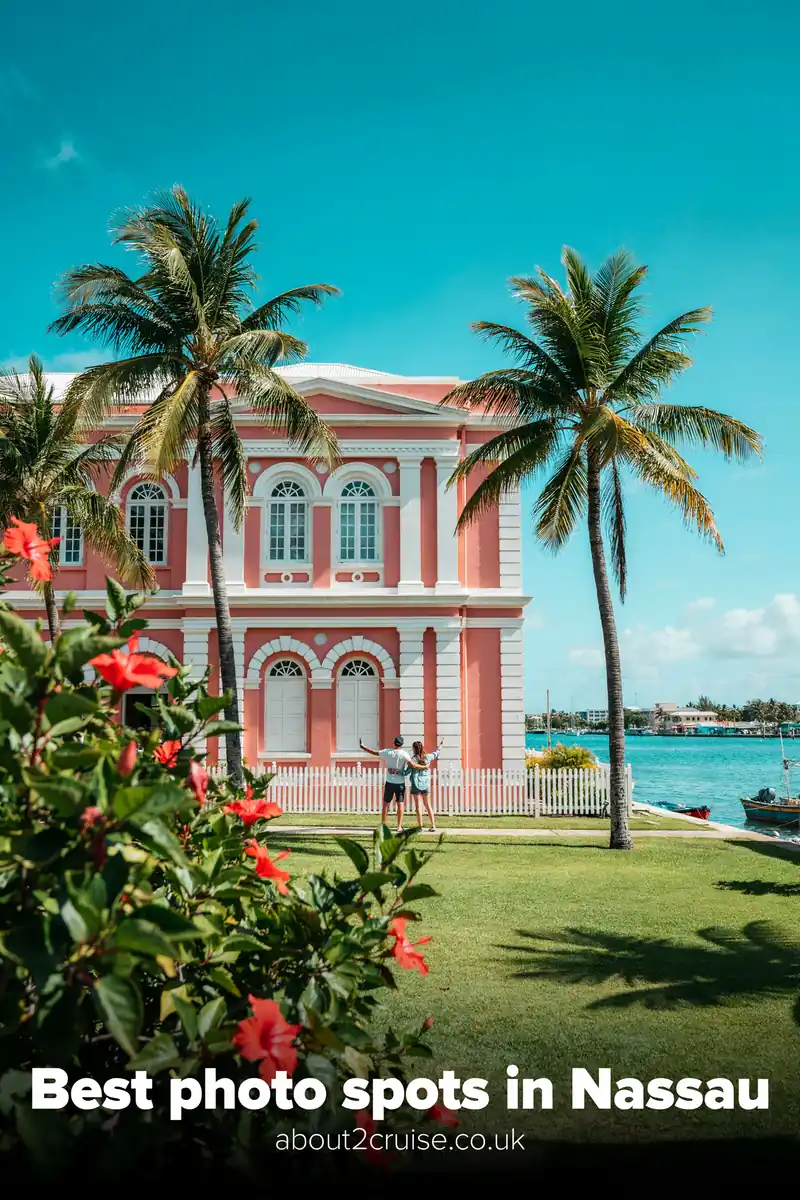
The pink frontage and its pair of Corinthian columns are among the most photographed in town.
Pompey Square beside it hosts the Creative Nassau market on Wednesdays and Fridays from 9am to 5pm, the easiest place downtown to meet Bahamian makers, and these ways to experience authentic Bahamian culture pick up where the museum leaves off.
Pirates of Nassau: the one indoor stop, and not a historic building
Pirates of Nassau is a wax museum at King and George Streets, and it’s a reconstruction rather than a survivor: a recreated pirate town, a pirate ship and a battle scene, with a few real artefacts mixed in.
That matters when you’re choosing, because an hour in there is an hour not spent on anything from the 1790s. It also matters if you’ve got children who’ve had enough of ramparts, or if the fort you wanted turns out to be shut.
You don’t need to book. It opens Monday to Saturday 8:30am to 5:30pm and Sunday 9am to 2pm, with the last tour half an hour before closing, and it costs a few dollars more per adult than the forts do.
John Watling’s Distillery: free, and open when everything else has closed
John Watling’s Distillery is the one site on the list that’s free, needs no booking and stays open into the evening: daily 10am to 6pm at the Buena Vista Estate on Delancy Street, a short walk from the wharf.
The tour is complimentary and can be self-guided or guided, the storehouse shows rum bottled by hand, and there’s a tavern. It shuts for Bahamian national holidays, so check that if your call lands on one.
It’s the sensible last stop of any Nassau history day: it sits between you and the ship, it needs no ticket, and it’s still open when the museum door has been pulled to at 4pm.
The tavern is the easy place for a rum punch before the walk back, and if you want to eat properly afterwards, these Bahamian foods to try in Nassau are what to look for on Bay Street.
Four hours, six hours or eight hours ashore: what fits
A two-hour loop covering the Straw Market, Parliament Square, the Queen’s Staircase and Fort Fincastle, with a drink back on Bay Street, is comfortable at a normal pace, which tells you how much of the list a short call really holds.
- Four hours: stay in the core. Pompey Museum and the walk up to the staircase and back down Bay Street is a full morning with time to spare. One fort at most, and no taxi.
- Six hours: the staircase and Fort Fincastle first thing, Pompey Museum after, distillery to finish. That is the free and cheap spine of the old town done properly.
- Eight hours: add Fort Charlotte in the morning by taxi or jitney, come back through the staircase and down Bay Street, and end at the distillery. Fort Montagu only if you are skipping Fort Charlotte, since they sit a mile apart in opposite directions.
What to cut, in order: the second fort first, then Pirates of Nassau. Keep the staircase early and the distillery late. If you want turn-by-turn directions for any of it, these Nassau walking routes that hit the main sights cover the same streets on foot.
Judge the walk back by the ship’s clock rather than your phone, and give the 13 minutes from the staircase a margin.
Balcony House, Parliament Square and the old gaol: the free bits on the way up
Between the wharf and the staircase are the buildings most passengers photograph and hardly anyone goes into, and not one of them charges.
- Parliament Square sits on the two-hour loop and costs nothing to walk through.
- Balcony House reopened alongside the Pompey Museum after a long pandemic closure; check the door when you pass rather than building the morning around it.
- The old gaol is now the public library on Shirley Street, on the uphill route to the Queen’s Staircase, so you pass it on the climb.
The Straw Market at the bottom of the hill is on the same walk and free to wander round. If you want more than straw, there’s a whole other side to Bay Street: Nassau shopping beyond the Straw Market.
Doing it yourself or paying a guide
Most of Nassau’s historic core is a walking route, so a paid city tour buys you commentary and a seat rather than access to anything you couldn’t reach on foot.
Where a guide earns the money is Pompey Museum, which is reading and context rather than spectacle, and the staircase, where who cut the steps and why is the entire point. The guides at the staircase work for tips and can be persistent; agree a price or decline and keep moving.
If you want Fort Charlotte and the staircase in one morning without working out the jitney, a guided historic highlights tour with transfers does the driving and the talking. If you’re still weighing the ship’s version against your own two feet, this comparison of ship excursions and self-guided historical tours lays it out.
When stairs and hills rule out the best of it
The staircase’s 102 feet of steps, the climb to Fort Fincastle on Bennet’s Hill and Fort Charlotte’s uneven chambers and ramparts all defeat anyone with limited mobility, and no amount of planning gets round it.
What’s left is still a good day: Pompey Museum about six minutes from the wharf, the distillery a short walk up Delancy Street, and the Bay Street frontages and Parliament Square in between. Wheelchair users can see the staircase from the bottom of the cutting but not climb it, so decide that before you set off uphill.
History or the beach: the trade-off
Both regrets are real: the day spent on a crowded beach when the free historic core was five minutes from the gangway, and the morning spent dragging bored children round ramparts when Junkanoo Beach was 15 minutes the other way.
If the water wins, go somewhere quieter than the obvious, because these Nassau beaches away from the Atlantis crowds are within reach on a port day. For a proper beach day rather than a swim, these Bahamas beach experiences worth leaving the ship for are the ones to compare.
And if you’d rather be in the water than looking at it, these Nassau water adventures you can book yourself don’t need the ship’s excursion desk.
What to wear in Nassau: outfit ideas for a port day
Wear shoes with grip rather than sandals, because the Queen’s Staircase is slick limestone and the only real climb of the day.


- Grippy soles rather than sandals: the steps are steep, slick underfoot and not the place to test a new pair.
- Light, loose clothing you can climb in, with a layer that comes off inside the museum and the distillery.
- A small bag you keep on you, with a few dollar notes in it for gate tickets.
For the rest, these Nassau cruise outfits for a port day cover the walk and whatever comes after it.
Best photo spots in Nassau
The best historical photographs in Nassau come from four places on this walk, and only one of them needs a ticket.
- The Queen’s Staircase: the limestone cutting and the small waterfall down one side, best early or towards sunset, with crowds arriving around midday.
- Fort Fincastle: 360 degrees over the harbour, Paradise Island and the ships, when it is open.
- Fort Charlotte: the ramparts over the harbour and Paradise Island.
- Pompey Square: the Creative Nassau market on Wednesdays and Fridays.
If you want shots beyond the historic core, these photo spots around Nassau for Instagram take in the rest of the waterfront.
Nassau historical sites FAQs
What are the best historical things to do in Nassau?
The Queen’s Staircase and Fort Fincastle for the 1790s story, Pompey Museum for slavery and emancipation, Fort Charlotte for the biggest fort, and John Watling’s Distillery to finish. The staircase, museum and distillery are a short walk from the wharf; both big forts need a taxi.
Which Nassau historical site is best with children?
Pirates of Nassau at King and George Streets: indoors, no reservation needed, and an hour covers the recreated town, ship and battle. It’s a reconstruction rather than a real building, but it holds a child’s attention where empty ramparts will not.
Where did the Fort Fincastle straw vendors go?
They moved to Fort Charlotte when the Water Tower renovation closed the Fort Fincastle site, and they’re trading there in tents while the works run.
How far is Junkanoo Beach from the cruise wharf?
About 15 minutes on foot from the gangway, which makes it the easiest way to end a history morning in the water without paying for a cab.
Do Nassau’s historic sites need booking?
No. The forts, Pompey Museum, Pirates of Nassau and the John Watling’s tour all take walk-ups, and the distillery tour is free with no reservation. Only guided tours and taxis need arranging ahead.
Is the old library in Nassau worth stopping for?
The public library on Shirley Street is the old gaol, and it sits on the uphill route to the Queen’s Staircase, so you pass it on the way up rather than making a separate trip.
Is Nassau’s history all about pirates?
No. The pirate story is the loudest, but what survives is mostly 1780s to 1800s: the forts, the staircase cut by enslaved labourers and the market building where people were sold. Pirates of Nassau itself is a modern reconstruction.
Last Updated: 14 November 2026