
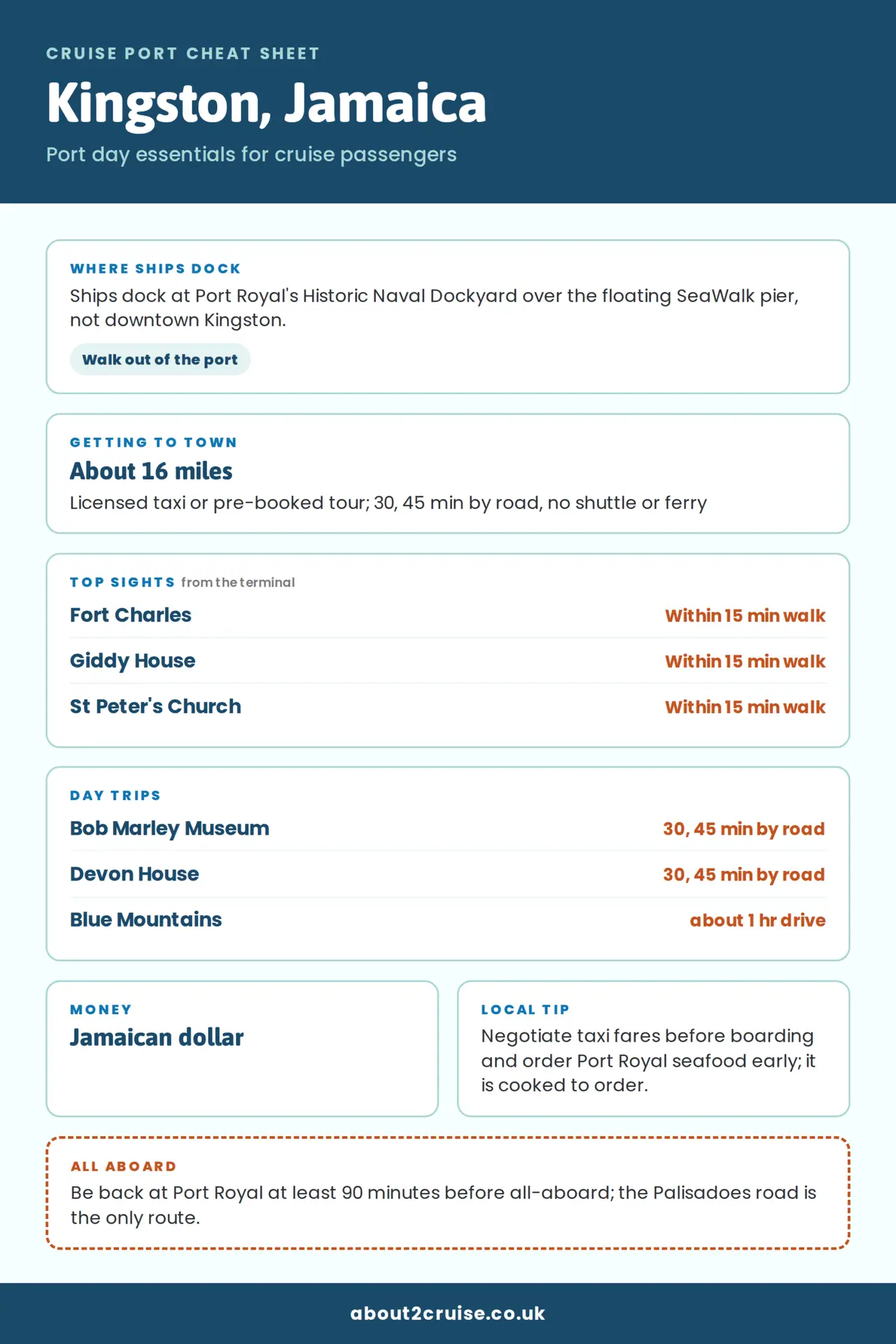
Kingston’s cruise port is actually Port Royal, at the tip of the Palisadoes spit, roughly 16 miles and 30–45 minutes from the city centre. Ships tie up at the floating SeaWalk pier, not downtown Kingston. You can walk straight from the gangway into Port Royal’s pirate-era sights, but anything in Kingston itself needs a taxi, tour or pre-booked shuttle.
Where ships actually dock: Port Royal, not downtown Kingston
Your ship will be at the Port Royal Historic Naval Dockyard, on Old Coal Wharf at the mouth of Kingston Harbour. It’s run by the Port Authority of Jamaica as one of five cruise facilities on the island, but it’s the only one at the capital end. It’s a single-berth pier, so you won’t be sharing the day with the huge multi-ship crowds that Jamaica’s north coast ports handle.
You come ashore over the SeaWalk, a 228-foot floating articulated bridge that unfolds to meet the ship. There’s no tender and no dredging right beside the sunken city. Inside the terminal you’ll find customs, immigration, public health and security, plus a plaza with kiosks, restrooms and a restaurant. There’s a separate area for buses, taxis and trams.
Because the berth is at Port Royal village on the Palisadoes, Norman Manley International Airport sits between you and Kingston. The Palisadoes is the narrow sand spit that closes Kingston Harbour and carries both the airport road and the road to Port Royal. Port Royal itself is small, only about 2,000 residents, and it’s also the Jamaica Defence Force Coast Guard base. The lines that call here tend to be smaller and more premium: Regent Seven Seas, Oceania, Silversea, Fred Olsen, Nicko, Club Med and Victoria, among others. It’s a low-volume, mostly winter port.
Kingston cruise port map
Ships dock at Port Royal Cruise Port. From the terminal, St Peter’s Church is about a 12-minute walk, Naval Hospital about 14 minutes and Fort Charles about 17 minutes. Tap a pin for directions.
- Port Royal Cruise PortWhere ships dock
- St Peter’s ChurchChurch · About 12 min walk from the terminal
- Naval HospitalHistoric hospital · About 14 min walk from the terminal
- Fort CharlesHistoric fort · About 17 min walk from the terminal
- Giddy HouseTilted house · About 18 min walk from the terminal
- Bob Marley MuseumReggae museum · About 11 km from the terminal
- Trench Town Culture YardMusic heritage museum · About 6 km from the terminal
- Devon HouseHistoric mansion · About 10 km from the terminal
- National Gallery of JamaicaArt gallery · About 5 km from the terminal
- Hope Botanical GardensBotanical gardens · About 13 km from the terminal
- Kingston Craft MarketCraft market · About 5 km from the terminal
- Victoria PierWaterfront viewpoint · About 5 km from the terminal
- Lime CayIsland · About 3 km from the terminal
- Craighton EstateCoffee farm · About 17 km from the terminal
Why Port Royal is more than just a cruise pier
Port Royal’s story is huge. It was once the largest port in the Caribbean and a base for privateers. In less than four decades it grew from a colonial outpost to the most important English settlement in the Western Hemisphere, dealing in goods and the trade in enslaved Africans. The earthquake and tsunami of 1692 destroyed it, and commerce moved across the harbour to Kingston. Today the land and submerged remains are part of a UNESCO World Heritage Site. That’s exactly why the SeaWalk was built without piling or dredging near the underwater archaeology.
Bob Marley, Trench Town and Kingston’s reggae landmarks
Kingston’s real global fame is music. Reggae is a UNESCO-listed intangible cultural heritage, and it grew in western Kingston out of ska and rocksteady. For most cruise visitors the headline stop is the Bob Marley Museum at 56 Hope Road, his former home and the old Tuff Gong label headquarters. It’s a guided experience, not a wander-through house.
- Guided tours run Monday to Saturday, 10:00–16:00, and last about 75 minutes. Closed Sundays and some holidays.
- Adult entry is around US$25; children aged 4–12 pay around US$12.
- Book online in advance. Walk-up space isn’t something to count on.
- Tuff Gong studio is at a separate address on Marcus Garvey Drive and isn’t included in museum entry.
Trench Town is where Marley lived and where the music was nurtured. The community-run Trench Town Culture Yard on First Street is a protected heritage site with a small museum. Entry is about US$20 for the yard, around US$28 including Marley’s mother’s house, and about US$40 for a guided neighbourhood walk. Do this with an organised cultural tour, not by yourself.
For food, music and dance beyond the main reggae sights, see our guide to Jamaican cultural experiences.
Fort Charles and Port Royal’s pirate-era sights
Port Royal was the largest English settlement in the hemisphere and a privateering base. Henry Morgan rose through Port Royal to become Lieutenant-Governor; the fort worked with privateers licensed to attack ships off Jamaica. Fort Charles, built in the late 1650s and originally named Fort Cromwell, was the only fortification still standing after the 1692 earthquake.
Fort Charles is operated by the Port Authority of Jamaica. The fort tour takes about 45 minutes and includes the tilted Giddy House and Nelson’s Quarterdeck, from which you can see where the sunken city lies. Foreign-adult admission is usually quoted around US$15–18, children around US$8, but there’s no reliable official price page, so confirm at the gate. It opens daily 09:00–17:00, closed Good Friday and Christmas Day.
Outside the fort, the village walk includes St Peter’s Church, where Lewis Galdy’s grave is linked to the 1692 earthquake, and the 19th-century Naval Hospital, one of the earliest prefabricated iron buildings. The tourism board suggests about 45 minutes for the fort plus a village walk.
Blue Mountains and Blue Mountain coffee tours
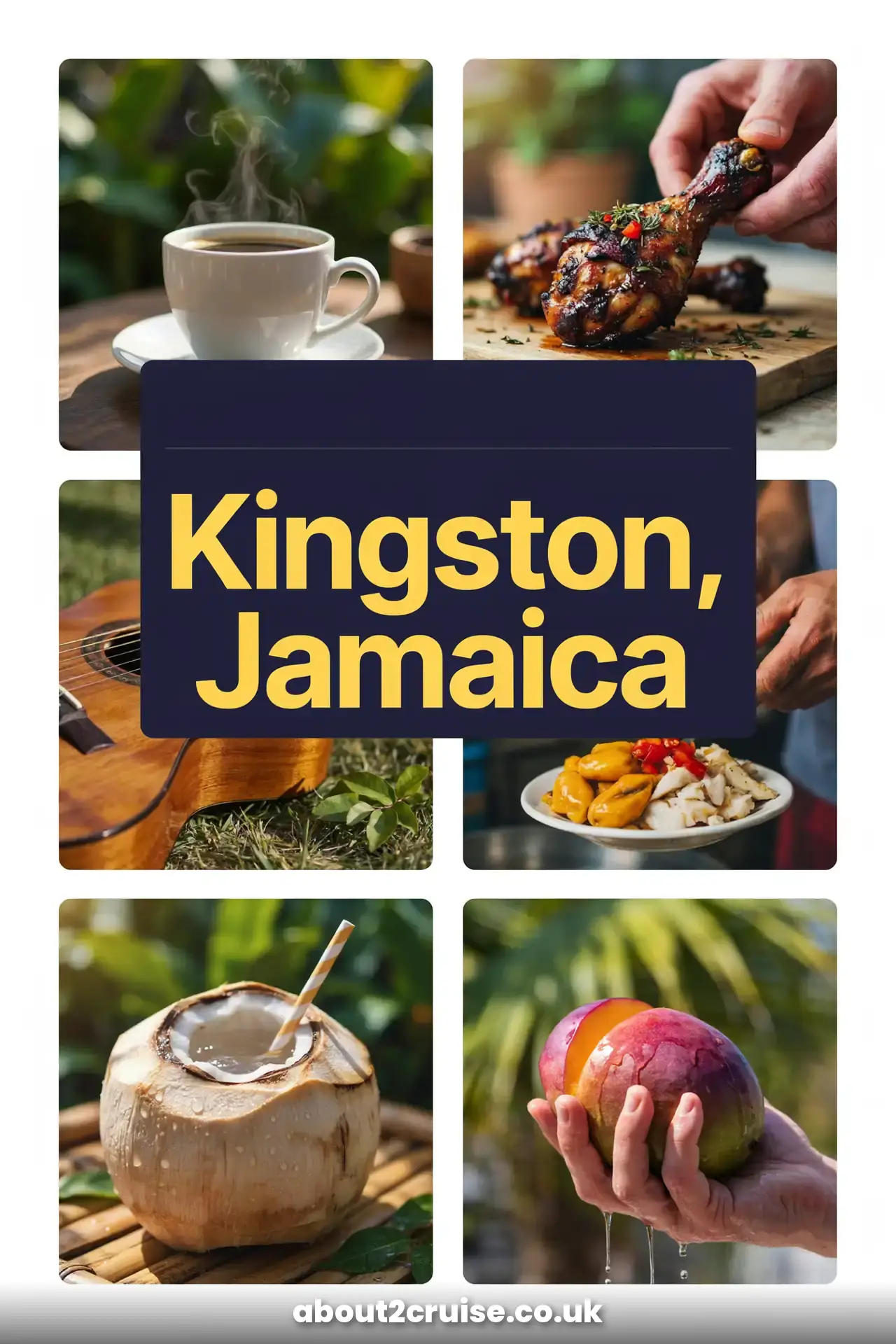
The Blue Mountains rise to about 2,350m and are Jamaica’s highest range. Jamaica Blue Mountain coffee is a protected certification mark: only coffee from a defined area of St Andrew, St Thomas, Portland and St Mary can carry the name. The Blue and John Crow Mountains are also a UNESCO World Heritage Site, recognised for both nature and Maroon history.
The easy port-day version is Craighton Estate at Irish Town, with a 90-minute coffee farm walk and tasting. Coffee-farm tours from Kingston are sold as 3–5 hour experiences, often around US$290 per person. Roads are narrow and winding, and weather can change quickly, so a pre-arranged driver or guide is the smart option.
Blue Mountain Peak itself is a 7-mile hike with about 900m of ascent, usually started in darkness for sunrise. That is not a realistic shore excursion unless you have an overnight call, private mountain transport and serious hiking kit. The park is roughly an hour’s drive from Kingston.
Our guide to Jamaica’s coffee plantations compares Craighton, Old Tavern and Clifton Mount tours, with booking rules and port-day timing.
Devon House, patties and Jamaican food culture
Devon House is the 1881 mansion of George Stiebel, Jamaica’s first black millionaire, at the corner of Hope and Trafalgar Roads. Mansion tours last 40 minutes and run Monday–Friday 09:30–16:00 and Saturday 12:00–20:00, closed Good Friday and Christmas Day. Adult tickets are around US$24, children around US$16. The grounds, shops, bakery and I-Scream parlour are free to enter. It’s about 1.2km from the Bob Marley Museum, so the two pair well if you have a private car.
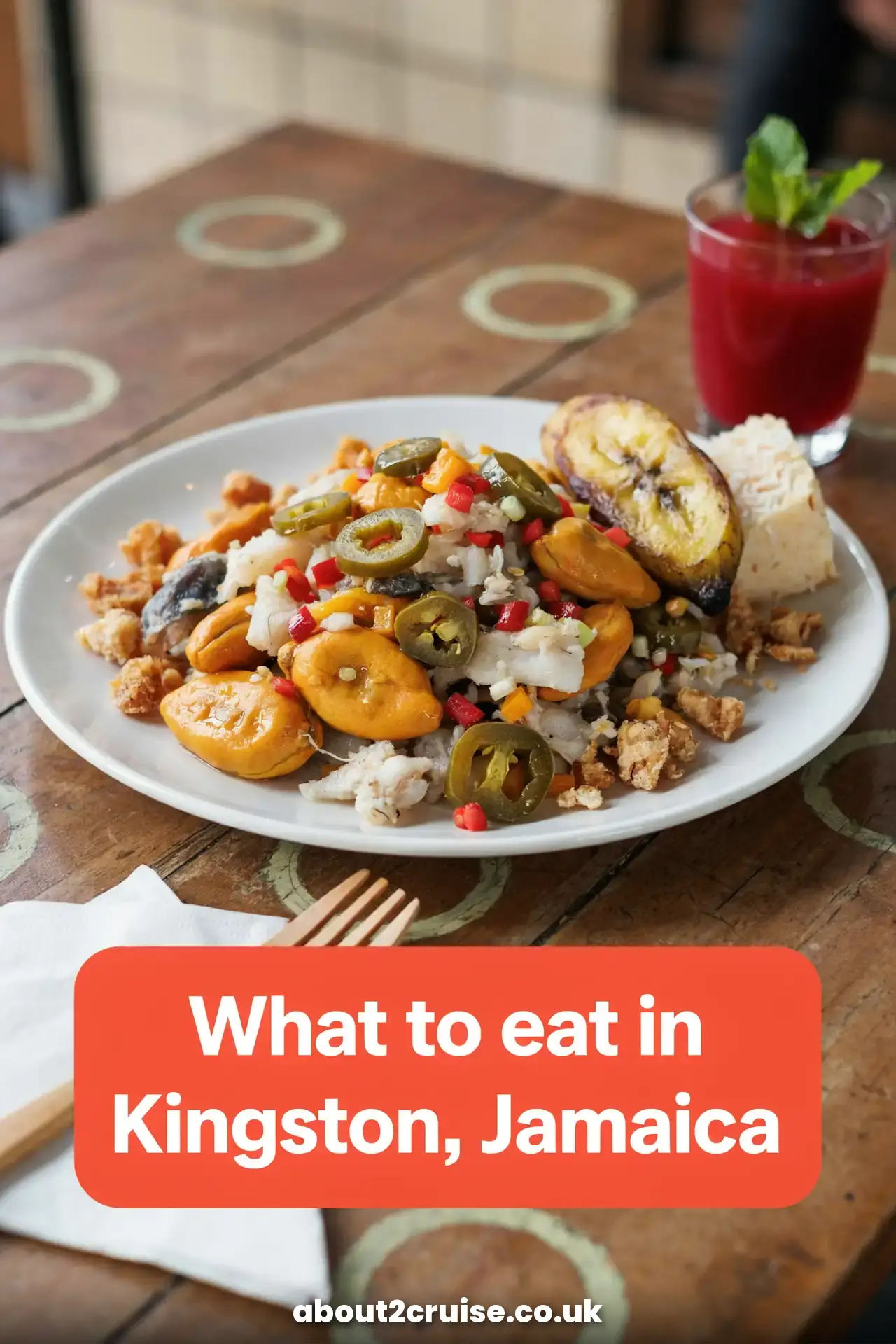
Food is central to a Kingston day. Devon House’s bakery and courtyard shops are one of the easier low-cost food stops, but the real eating section comes later in this guide.
Kingston landmarks worth your limited time
- National Gallery of Jamaica on the waterfront: the largest public art gallery in the Anglophone Caribbean. Adult entry J$400, under-17s free, closed Mondays.
- Hope Botanical Gardens: 200 acres on Old Hope Road. Tuesday–Saturday 09:00–18:00, Sunday 13:00–18:00, closed Mondays. General admission about US$5 adults, US$3 children.
- Kingston Craft Market at Port Royal Street and Ocean Boulevard: 100-plus stalls, open Monday–Saturday, quieter in the mornings.
- Coronation Market: Jamaica’s largest produce market, where haggling is expected.
- Victoria Pier: a downtown waterfront viewpoint used by city tours.
For a short port call, pick one of these plus one headline museum. Kingston is spread out and traffic can eat your day.
Should you stay at Port Royal or head into Kingston?
This is the main planning decision. The Bob Marley Museum is a 75-minute guided tour you can’t shorten, plus 25–40 minutes each way by road from Port Royal. That alone takes roughly half a port day. Port Royal’s core, Fort Charles, the Giddy House, church and waterfront, is walkable from the ship, with about 45 minutes for the fort and another 30–60 minutes for the village.
If you’re a music fan, build your day around Hope Road and add Devon House because it’s close. If you’d rather avoid traffic and stay near the ship, do Port Royal properly and skip the city. On long calls you can combine both, but don’t try to stack the museum, Devon House, downtown and the Blue Mountains in one day.
How to get from Port Royal to Kingston
No, you can’t walk. The terminal is at the tip of the Palisadoes; Kingston is across the harbour, about 24km or 16 miles by road. The only land route is the single two-lane Palisadoes road past the airport. Journey time is usually 30–45 minutes each way.
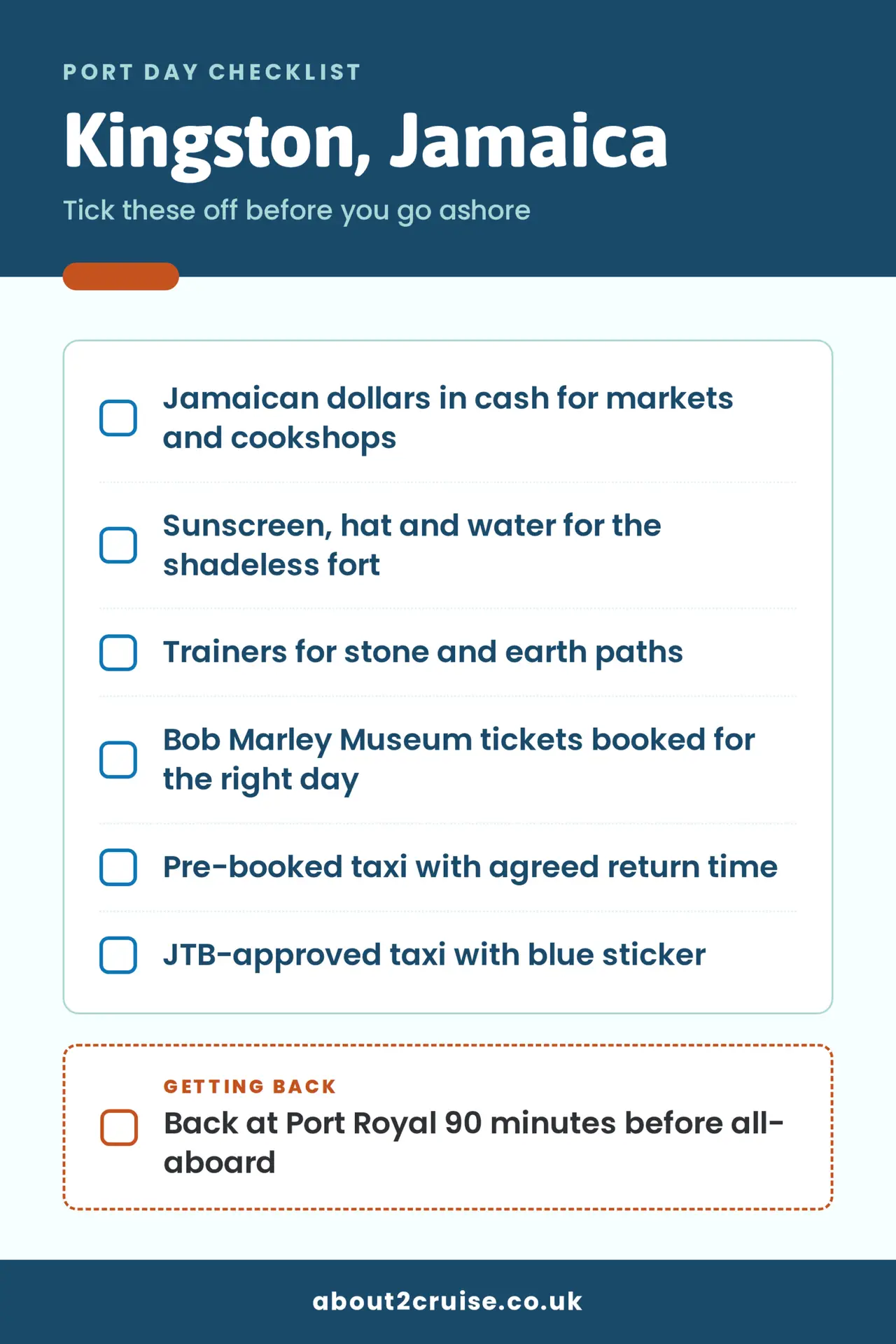
Taxis: licensed taxis wait at the terminal. They have red licence plates and fares are negotiated per vehicle, not metered. Expect US$35–45 to downtown Kingston in a standard car; some independent estimators put it at US$45–60. Always agree the fare and any waiting time before getting in. Use JTB-approved taxis and minibuses with photo ID and a blue JTB sticker if you can.
Uber: it works in Kingston, but coverage at the Port Royal terminal gate isn’t guaranteed, so don’t rely on it to get back to the ship.
No official shuttle or ferry: the old Kingston–Port Royal passenger ferry no longer runs, and there’s no published official shuttle between Port Royal and the city. Cruise-line and third-party excursion buses load at the terminal, and private transfers can be pre-booked, but there’s no hop-on/hop-off public shuttle to count on.
Public bus: the JUTC route from downtown Kingston’s Parade to Port Royal runs for a few hundred Jamaican dollars but takes 40–60 minutes and departures are unpredictable. Shared route taxis are faster but not aimed at cruise passengers. If you’re unfamiliar with Kingston, both are poor uses of a short port day.
Because the Palisadoes road is a single route, allow a buffer. Be back at Port Royal at least 90 minutes before all-aboard.
Is Kingston safe for cruise passengers?
Kingston rewards planning, but it’s not a place for random wandering. The UK Foreign Office advises that crime and homicide rates are high, with gang violence mostly in inner-city areas. Tourists are usually the target of robbery rather than violence, and resisting a robbery can provoke a violent response. Follow these rules:
- Use JTB-approved taxis and minibuses with photo ID and a blue JTB sticker.
- Don’t walk in isolated areas or deserted beaches, even in daylight. Avoid walking at night.
- Between Kingston and the airport, most people use the Humming Bird route via South Camp Road to reduce robbery risk because of sporadic violence in Mountain View. Your driver should know this.
- Zones of Special Operations and States of Emergency can impose curfews at short notice. Check locally and follow police instructions.
- Don’t drive yourself in Kingston if you’re unfamiliar.
- Marijuana is illegal in Jamaica. Possession of small amounts carries a fine payable within 30 days; other drug offences carry severe penalties.
US official advice names several specific Kingston and St Andrew neighbourhoods to avoid because of crime risk, including August Town, Denham Town, Parade Gardens, Greenwich Town, Mountain View, Nannyville Gardens and Swallowfield. For port-call purposes, the simple version is: the airport road and New Kingston sights are the usual tourist corridor, but you shouldn’t improvise a walk through downtown side streets.
Port Royal itself is different. The tourism board describes its streets as safe and walkable, and the village is small and easy to see on foot near the ship. You still shouldn’t wander away from the village at night, but the heritage core is the most relaxed part of a Kingston port call.
Shore excursions vs exploring on your own
In Port Royal, you don’t need an excursion: Fort Charles, the Giddy House, St Peter’s Church and the waterfront are walkable, and a local guide can be hired if you want more pirate story. For Kingston, an organised tour or a pre-booked private driver removes the taxi negotiation and timing stress. Cruise-line excursions aren’t usually priced publicly, but third-party tours give a benchmark: a two-hour Port Royal “Sunken City” tour with port pick-up is sometimes around US$30, and a half-day Port Royal history tour about 3.5 hours. A Kingston city tour including the Bob Marley Museum is commonly sold as a five-hour product.
DIY is possible if you have one fixed plan, a phone and a driver who will wait. The risk isn’t crime in the tourist area; it’s traffic and the single road back to the ship. Pre-book rather than relying on a line of taxis if your planned return is late afternoon.
Port Royal on foot: what you can walk to
Right from the terminal you can walk to Fort Charles, the Giddy House, St Peter’s Church, the Naval Hospital and the waterfront seafood strip, all within about 15 minutes. Heritage stone and packed earth mean you want trainers or comfortable walking shoes, sunscreen, a hat and water. The fort and waterfront have little shade, so go early.
For a local day, do Fort Charles and the Giddy House first, then the village walk, then a seafood lunch. If you plan to eat at a popular waterfront place, order your fish or curried lobster as soon as you arrive because it’s cooked to order and waits are long.
The classic photo is from Fort Charles’s ramparts or Nelson’s Quarterdeck, where cannon frame the harbour and the line of sight crosses the sunken city. The leaning Giddy House is the most photographed oddity.
What to eat and drink in Kingston and Port Royal
- Ackee and saltfish is the national dish, served at breakfast with dumplings, plantain, callaloo or green banana. Downtown Harbour Street is the traditional breakfast strip.
- Jerk chicken, pork and fish are smoked over pimento wood. In Kingston, jerk centres cluster around Stony Hill, so it’s easier with a driver.
- Jamaican patties are flaky turmeric-coloured pastries filled with beef, chicken or vegetables, often eaten with coco bread. Devon House bakery is an easy place to try one.
- Port Royal seafood on the waterfront and Queen Street includes fried fish, escovitch fish and curried lobster cooked to order.
In Port Royal, order seafood early. In Kingston, Blue Mountain coffee is best bought as beans or tasted at a mountain café or Devon House. Look for the protected JACRA mark when buying.
Money, tipping and prices in Jamaica
The Jamaican dollar is the local currency. US dollars are widely accepted in tourist-facing businesses, but you’ll get better value in local currency at markets, small shops and with taxis. Cards are fine at hotels, larger restaurants and tour operators; ATMs dispense Jamaican dollars. Keep cash for route taxis, market stalls, small cookshops and tips.
Tipping is customary: about 10–15% for guides and restaurant staff. In Port Royal and Kingston, the Jamaican dollar is the more natural currency; on the north coast US dollars dominate, but here you’ll blend in better with JMD.
Language, time zone and what to pack
English is the official language, and most Jamaicans also speak Jamaican Patois in everyday conversation. You won’t have a language problem, but you’ll hear Patois all around you.
Jamaica keeps Eastern Standard Time, UTC−5, all year, with no daylight saving. Kingston is hot year-round, with average highs around 31–33°C. The driest months are roughly February–April; October is the wettest. Hurricane season runs June to November. For a Port Royal day, pack sunscreen, a hat, water and comfortable shoes. If you’re going to the Blue Mountains, add layers and a rain jacket because temperatures drop with altitude.
Cruise terminal facilities, Wi-Fi and accessibility
The terminal building at Old Coal Wharf handles customs, immigration, public health and security. There are restrooms, a plaza with kiosks and small shops, a restaurant, and separate bus/taxi/tram lay-by areas. Wi-Fi at the terminal is reported as limited, but mobile coverage is generally good.
The SeaWalk is a floating articulated bridge, so it moves. That doesn’t automatically mean a wheelchair or scooter can use it in all conditions; arrange gangway assistance with the cruise line before disembarking. The terminal car park and entrance are listed as wheelchair accessible, but many Port Royal and Kingston tours are not. Fort Charles has uneven ground around the ramparts and cannons. If you have a mobility aid, confirm your specific tour and the SeaWalk with the ship’s shore excursion or guest services team before booking.
Passports, immigration and disembarking at Port Royal
British Citizens don’t need a visa for Jamaica and are usually granted entry for up to 90 days. Your passport must be valid for the duration of your stay and have two blank pages for entry and exit stamps. Complete the customs declaration online before arrival where possible, and declare cash or travellers cheques of US$10,000 or more. There’s no US pre-clearance at Port Royal. Port calls use standard Jamaican immigration and port security.
Lime Cay: the closest beach to Kingston
Lime Cay is the largest of the Port Royal Cays and Kingston’s beach. It’s a small sand-and-coral cay about 15–30 minutes by boat from Port Royal, with shallow reef on the sheltered side and little beyond a food and drink seller. There are no loungers, lockers or lifeguards. Boatmen charge around J$1,500 per adult and J$1,000 per child round trip, but you must agree the fare and return time before boarding. Weekends are busy with Kingston boat parties; weekdays are quieter. Treat a Lime Cay crossing as an uncertain, weather-dependent add-on, not a guaranteed shore excursion.
The underwater remains of Port Royal are protected archaeology under sediment; they’re not a snorkelling or swimming sight.
Shopping, souvenirs and Blue Mountain coffee
Kingston Craft Market on Port Royal Street and Ocean Boulevard has more than 100 stalls selling carvings, straw work, jewellery, clothing, rum and preserves. It’s open Monday–Saturday; mornings are quieter and prices are negotiable. Devon House’s courtyard shops and bakery are a lower-pressure shopping stop with no entry fee.
If you buy Blue Mountain coffee, look for the JACRA certification mark, because the name is protected and blends can be loose with the label. Port Royal has only small kiosks and snacks, so don’t expect a duty-free mall at the terminal.
One-day Kingston cruise itineraries that work
Local Port Royal day: Fort Charles and Giddy House first, then St Peter’s Church, the Naval Hospital and the waterfront. Stop for seafood lunch, but order early. Stay within sight of the ship, with no traffic risk. This works well for a short call or if you don’t want to leave the Palisadoes.
Kingston music and culture day: pre-book a driver or join a tour. Go to the Bob Marley Museum for a morning tour, then Devon House for a patio, patties or ice cream, then maybe the National Gallery or a craft market stop. Head back to Port Royal with a 90-minute buffer.
Avoid the squeeze: don’t try Blue Mountain Peak, Trench Town, the museum, Devon House and Lime Cay in the same day. Pick one headline off the ship and one or two nearby stops.
Kingston vs Ocho Rios, Montego Bay and Falmouth
Jamaica has five cruise port facilities: Montego Bay, Falmouth, Ocho Rios, Port Antonio and Port Royal. Falmouth is a purpose-built two-berth terminal built to handle the largest cruise ships. Montego Bay, Falmouth and Ocho Rios handle mass-market resort traffic. Port Royal is a single-berth, small-to-mid-ship heritage port with the capital and pirate history as its draw rather than beach-resort infrastructure.
Unlike the resort piers in Ocho Rios, Montego Bay and Falmouth, Port Royal is a single-berth heritage dock built around archaeology rather than beach-day volume. For the wider region, see our Greater Antilles cruise ports guide.
If you are comparing Jamaica’s smaller ports, our Port Antonio cruise port guide covers its blue lagoons and beaches.
Best time to cruise to Kingston
Peak cruise calls at Port Royal mirror the Caribbean high season, roughly December to April. The driest, most comfortable months for Kingston’s outdoors are winter and early spring, before the May and autumn rains. Hurricane season is June to November. If your priority is the fort, village and a less humid day, February, March and early April are the sweet spot.
If your cruise starts or ends in Kingston
Norman Manley International Airport sits on the Palisadoes, about 17km from central Kingston and much closer to Port Royal. Authorised airport taxis from JUTA and JCAL run to downtown or New Kingston in 25–35 minutes for roughly US$30–50; airport-to-Port Royal is quoted around US$15–20. There’s no general left-luggage or locker facility at the airport; Club Kingston lounge offers luggage storage, showers and Wi-Fi for a fee.
For a pre-cruise stay, New Kingston is the hotel district. Options include the Jamaica Pegasus, Courtleigh, AC Hotel by Marriott, Courtyard, Spanish Court and Terra Nova. The only hotel at Port Royal itself is the Grand Port Royal Hotel Marina, with 60 rooms, ocean-front rooms, two restaurants and a marina. New Kingston is 30–45 minutes from the terminal, so if you’re embarking at Port Royal, stay near the airport or Port Royal unless you have a reliable transfer.
The cruise terminal doesn’t publish long-stay passenger car parking or bag-drop arrangements. If you’re driving to a Kingston turnaround, confirm parking with the port or your cruise line before arrival.
Mistakes to avoid at Kingston’s cruise port
- Thinking the ship docks in downtown Kingston. It doesn’t, you’re at Port Royal.
- Not pre-booking transport and then hoping for an Uber at the terminal gate.
- Planning too many far-apart sights. Kingston’s traffic and the single Palisadoes road eat port time.
- Leaving Port Royal for Kingston too late in the day and worrying about all-aboard.
- Ordering seafood after touring Port Royal, then waiting an hour while it cooks.
- Expecting a beach resort or duty-free mall. This is a city and heritage port.
- Skipping Fort Charles because the headline is Bob Marley. The fort is the greatest hit of the actual port.
- Visiting the Bob Marley Museum on a Sunday, when it’s closed.
- Taking a chance on hiking Blue Mountain Peak on a port day.
- Using US dollars for small market and cookshop purchases when Jamaican dollars get better value.
How to spend a port day in Kingston
A port day in Kingston works best if you pick one: a walkable day around Port Royal’s fort and seafood, or a pre-booked ride to the Bob Marley Museum and Devon House.
Before you sail
- Book Bob Marley Museum entry online; tours fill and it is closed Sundays.
- Pre-book a Kingston taxi or private driver; do not rely on Uber at Port Royal.
- Check Fort Charles opening dates: closed Good Friday and Christmas Day.
Short port day: under 6 hours
- On dockingVisit Fort CharlesWithin a 15-minute walk of the SeaWalk terminal. The 45-minute fort tour includes the leaning Giddy House and Nelson's Quarterdeck.
- +1 hr 15 minSt Peter's ChurchA few minutes' walk from Fort Charles on the Port Royal village walk. Look for Lewis Galdy's grave.
- +1 hr 45 minNaval HospitalContinue the village walk to the 19th-century prefabricated iron Naval Hospital.
- +2 hrs 30 minWaterfront seafood lunchOrder earlyNear Queen Street, order escovitch fish or curried lobster as soon as you arrive; it is cooked to order.
- +3 hrs 45 minPort Royal waterfront and kiosksBrowse the terminal plaza kiosks and take the harbour view from Nelson's Quarterdeck before returning.
- All-aboard minus 90 minWalk back to the shipThe village is compact, so no road traffic to manage before you reboard.
The time on the map is the whole walk, every stop added together.
Open this walking route in Google Maps
If plans change: If Fort Charles is closed, walk the Port Royal village and waterfront instead, then take a pre-booked Kingston city tour if you want more.
Long port day: 8 hours or more
- On dockingMeet your pre-booked driverPre-bookLicensed taxis or tour buses load at the terminal. Agree the fare and waiting time before boarding.
- +30 minDrive to Bob Marley MuseumJTB taxi30, 45 minutes along the Palisadoes road into Kingston. Use a JTB-approved taxi where possible.
- +1 hr 15 minBob Marley Museum tourBook ahead75-minute guided tour of the former home and Tuff Gong HQ. Book online before you sail; closed Sundays.
- +2 hrs 45 minLunch at Devon HouseTry a pattyAbout 1.2 km from Bob Marley Museum. The free grounds and bakery are good for a Jamaican patty and Blue Mountain coffee.
- +4 hrsDevon House mansion tour40-minute ticketed tour of George Stiebel's 1881 mansion, or stay in the courtyard shops without a ticket.
- +5 hrs 30 minKingston Craft MarketMornings quieterA short drive into downtown Kingston. Browse 100-plus stalls for carvings, straw work and Blue Mountain coffee with the JACRA mark.
- All-aboard minus 90 minReturn to Port RoyalThe single Palisadoes road can clog, so leave downtown Kingston with a 90-minute buffer.
This map shows the taxi ride from the ship. The time is the drive only, not your time ashore.
Open the taxi route in Google Maps
If plans change: If Bob Marley Museum is closed or booked out, switch to a Port Royal day with Fort Charles and seafood, or a pre-arranged Devon House and National Gallery loop.
Kingston cruise port FAQ
Is there a ferry from Port Royal to Kingston?
No. The old passenger ferry no longer runs. The only route is the road. There’s also no guaranteed water taxi for Lime Cay or Kingston; boats are local and informal.
Do I need to book the Bob Marley Museum in advance?
Yes. The museum asks guests to book online in advance. It’s guided, runs Monday to Saturday 10:00–16:00 and is closed on Sundays. On a cruise day, tie your booking to pre-arranged transport because the tour lasts 75 minutes and can’t be shortened.
Is Trench Town safe for cruise passengers?
Trench Town is a culturally important but economically tough area. Visit it with the community-run Culture Yard or an organised tour, not on your own. The tour includes a guide and local access; wandering in from a taxi isn’t recommended.
Is there left luggage at the cruise terminal or airport?
No general luggage storage is published at Norman Manley International Airport or the Port Royal terminal. Club Kingston lounge at the airport offers luggage storage, showers and Wi-Fi. Check with your cruise line for terminal bag-drop if you’re on a turnaround day.
Can I pay in British pounds?
You’ll find little use for pounds. Use Jamaican dollars for small purchases, US dollars in tourist-facing spots if that’s easier, or cards at larger businesses. ATMs dispense Jamaican dollars.
Will my wheelchair or scooter work at Port Royal?
The terminal car park and entrance are listed as wheelchair accessible, but the SeaWalk is a moving floating bridge and Fort Charles has uneven ground. Arrange gangway assistance with the cruise line and confirm any tour’s wheelchair access before booking.