
Lifou is the largest of New Caledonia’s Loyalty Islands, and it’s a tender port through and through, ships anchor out in Santal Bay and small boats ferry everyone ashore to the village of Easo. Locals call it Drehu, and it pairs pale sand beaches and limestone cliffs with a pace that’s slower and more traditional than nearby Nouméa.
Where Is Lifou Island?
Lifou sits out in the South Pacific as part of the Loyalty Islands, a group that belongs to New Caledonia, an overseas territory of France. It’s roughly 190 kilometres northeast of Grande Terre, New Caledonia’s main island, and Nouméa, its capital.
You might have seen it written as Lifou Island, Lifou Isle, or Lifu Island on older maps, it’s all the same place. New Caledonia’s tourism authorities now just call it Lifou. The island shows two very different faces: steep limestone cliffs along the north coast, and pale, sheltered beaches with turquoise water down south.
Where Do Cruise Ships Dock in Lifou? Tendering at Easo
There’s no wharf at the Lifou cruise port, none at all. Ships anchor offshore in Santal Bay (Baie de Santal) and use tenders, small boats shuttling between ship and shore, to bring everyone into Easo, Lifou’s capital and its only cruise stop.
Easo beach runs about 300 metres either side of the tender pier, a golden, gently shelving stretch backed by palm trees, and plenty of passengers step off the tender straight onto the sand. Lifou doesn’t really have a downtown; the nearest thing is the village of We (also called Wé or Xepenehe), about 3 miles from the pier, but honestly, almost everything you’ll need for the day is right there at Easo.
Lifou Cruise Port Facilities and the Easo Market
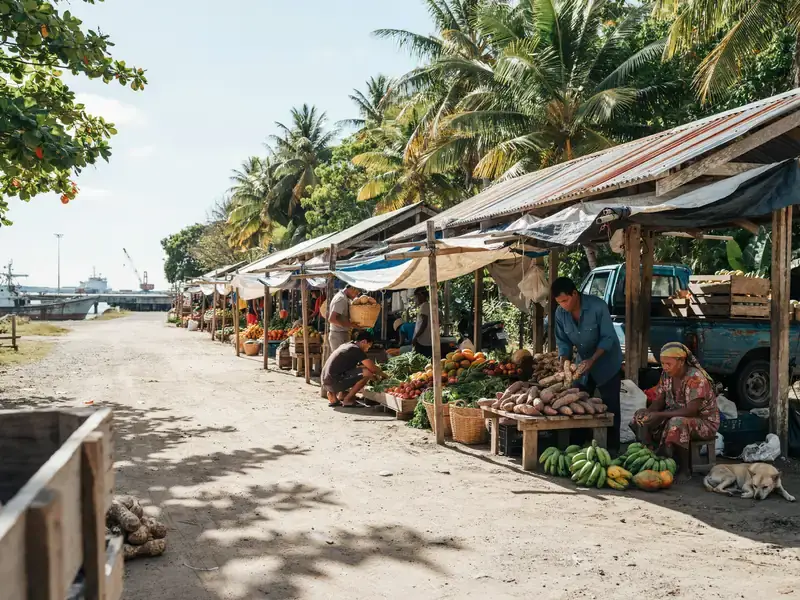
The facilities right at the pier won’t win any awards, but they’ll do for a few hours ashore:
- A small café
- Public toilets, cleaned regularly and stocked with paper, though don’t expect soap
- Beach equipment hire
- A colourful open-air market selling handcrafted souvenirs, local produce and coconut drinks
When a ship’s in, local Kanak villagers, New Caledonia’s indigenous Melanesian community, often greet passengers with a traditional welcome ceremony of singing and dancing before the market stalls even open. There’s no haggling culture here, and trying to knock down a price can properly offend people, so treat the marked price as the price, full stop.
The market sets up around tender arrivals, not a fixed weekly timetable, so forget the shop hours you’re used to at home. Some visitors reckon Sundays are quieter, but there’s no official schedule anywhere, so assume it runs when a ship’s in port and might be thin on the ground, or missing entirely, otherwise.
Getting Around Once You’re Ashore
Tourist-friendly public transport barely exists on Lifou, and the island’s a lot bigger than it looks from the ship’s deck. Most passengers heading beyond Easo rely on an organised shore excursion, a pre-booked taxi, or a hire car.
Taxis exist, but they’re thin on the ground. Book ahead, and expect a fixed price agreed up front rather than a meter running, so sort the fare before you set off. Hitchhiking is common and culturally normal here, and generally considered safe, but most cruise passengers will find pre-booked transport a lot easier to time against a tender schedule.
Independent travellers who aren’t on a cruise usually arrive by ferry from Nouméa or by air into Ouanaham Airport, which handles well over 178,000 passengers a year according to aeronautical data reported by Wikipedia, though none of that matters if you’re stepping off a tender.
Currency and Money on Lifou
The official currency is the CFP Franc (XPF), used right across France’s Pacific territories and pegged to the Euro. Market vendors will happily take Australian dollars too, though your change often comes back in Francs, and US dollars won’t get you far. Cards aren’t accepted at the market or for most local tours, so this is a cash day ashore, no way round it.
There are no ATMs or currency exchange facilities at the Easo pier, and that catches people out. The fix is simple but easy to forget, sort your cash on board or before you leave the ship, ideally a mix of small AUD notes and coins, because there’s nowhere on the island to top up once you’re ashore.
French is the official language, and you’ll find English at some tourist-facing stalls and tours, but don’t expect it everywhere the way you might in Nouméa. A friendly manner gets you further than fluency ever will.
What to Wear: Dress Code and Local Customs
Swimwear’s fine on the beach, but Lifou’s villages and customary sites want modest dress. Think what you’d wear round your gran’s, not what you’d wear to the beach bar.
- Cover shoulders and knees when entering villages, markets or customary sites
- Leave short shorts, very tight outfits and swimwear for the ship or the beach
- Topless sunbathing isn’t permitted
- Remove hats and shoes before entering a local house
- Ask permission before photographing an individual
Locals take these customs seriously and they will notice if visitors ignore them, so pack something to cover up in your day bag even if you’re planning to spend most of the day on the sand.
Things to Do in Lifou Island: Top Shore Excursions
For the few hours you’ve got ashore, here’s a quick-reference guide to the main things to do on Lifou, plus roughly how far each one sits from the pier.
Jinek Bay Marine Reserve is the standout for snorkelling, often called a natural aquarium for the sheer density of coral and fish just a short walk from the tender pier. Tickets are bought on board rather than on the beach, and the fee reportedly goes straight back into looking after the reserve, so you’re getting up close with real coral, which is exactly why sunscreen that won’t harm the reef earns its place in your bag over a standard formula.
| Attraction | Distance or time from the pier | What to expect |
|---|---|---|
| Notre Dame de Lourdes Chapel | Short, paved uphill walk | Panoramic views over Santal and Jinek Bays, built by Catholic missionaries in the nineteenth century |
| Jokin Cliffs | Organised tour, northern coast | Towering limestone cliffs formed from ancient coral, a forest walk to viewpoints, and possible caves at the base |
| Luengoni Beach | About 45 minutes by bus tour, southern coast | Powdery white sand and turquoise water, with limestone caves explorable alongside a local guide |
| Peng Beach | Short drive from the pier | A quieter, more secluded swim away from the main tourist areas |
| Secret Grotto | Short walk or drive, then a steep path down | An underground pool and rock formations, with a modest local entry fee |
| Mont N’Ga | Organised tour or hire car | Lifou’s highest point, with a small entry fee collected locally |
| Lifou Vanilla House | Organised excursion | A look at how vanilla, one of the island’s key crops, is grown and processed, with fresh pods often for sale |
Two churches are visible from the anchorage and worth knowing apart: the one on the left is Notre Dame de Lourdes, and the one on the right is St Francois-Xavier Church.
Reports on the exact entry fee for the Secret Grotto vary between sources, so treat any figure you’ve read online as a rough guide rather than a fixed price, and carry small notes in case change isn’t available. The path down can turn slippery after rain, and the uneven ground around Jokin Cliffs and Mont N’Ga rewards proper grip, so walking shoes with better grip are more useful here than sandals.
Good swimming beaches beyond the pier include Chateaubriand, Santal and Sandalwood, and the waters around Lifou are also known for diving and game fishing.
Is Lifou Safe for Cruise Passengers?
Lifou scores 8.1 out of 10 on port-safety trackers, which puts it among the safer South Pacific cruise stops, with local police around and no reports of major crime. The real risks here come from nature, not people: strong sun, reef-safe practices when you’re swimming or snorkelling, and keeping an eye on ocean currents.
Some passengers will remember unrest on New Caledonia’s main island a while back, sparked by proposed voting law changes that independence supporters said discriminated against Kanak communities. That trouble centred on Grande Terre and Nouméa rather than Lifou, though at its height some cruise lines temporarily dropped both Lifou and Nouméa from itineraries in favour of extra time at Mystery Island. The situation’s since been formally declared over, and the proposed reform was scrapped.
New Caledonia’s cruise sector has been steadily rebuilding since maritime borders reopened after the pandemic-era closures, with over 340,000 passengers visiting the territory in a single recent year, according to the Pacific Tourism Organisation. Lifou has come out of that rebuilding as the only Loyalty Island getting regular ship calls, with local press reporting dozens of tender calls to Easo Bay in a recent season, and cruise lines including Carnival, Royal Caribbean and Cunard still market it as a signature South Pacific stop. There’s no government travel advisory specific to Lifou as opposed to the rest of New Caledonia, so check general territory-wide guidance rather than assuming Lifou has its own separate rating.
If Lifou’s one stop on a longer itinerary, our New Caledonia cruise ports guide covers how the territory’s calls fit together, our Maré Island cruise port guide covers the other main Loyalty Islands stop in this group, and our Île des Pins (Isle of Pines) cruise port guide covers another popular New Caledonia call further south.
How Many People Live on Lifou?
The most recent published census puts Lifou’s population at around 10,150 people across roughly 1,207 square kilometres, making it the largest and most populous of the Loyalty Islands. Some cruise port directories quote a slightly higher figure, closer to 10,600, but no fresher official census seems to have been published since, so treat any number here as an approximation rather than a precise headcount.
The population is overwhelmingly Kanak, New Caledonia’s indigenous Melanesian community, who make up the vast majority of islanders, alongside small European and Polynesian minorities.
Wifi and Staying Connected Ashore
There’s no official data on wifi or mobile coverage at Easo, and traveller reports describe connectivity on Lifou as patchy at best, and often just not there. Treat your day ashore as a digital detox by default: download any maps, translation tools or excursion details before you leave the ship, and don’t count on checking in with the ship or confirming tender times online once you’re on the beach.
Common Questions
Do cruise ships dock in Lifou?
No, ships anchor offshore in Santal Bay and everyone’s tendered ashore to a small pier in the village of Easo, Lifou’s only cruise stop.
Where do the tenders bring passengers ashore?
Tenders land at Easo pier, right beside a golden beach stretching roughly 300 metres either side, with the market, café and toilets all a short walk away.
Can I pay with Australian dollars in Lifou?
Yes, most market vendors take AUD, though your change often comes back in local CFP Francs, so carry a bit of both.
Are there ATMs at the Lifou cruise port?
No, there are no ATMs or currency exchange facilities at the Easo pier, so sort your cash on board before you tender ashore.
Is bargaining acceptable at the Easo market?
No, haggling isn’t the done thing on Lifou, and trying to negotiate prices can cause offence, so treat the marked price as final.
What should I wear ashore in Lifou?
Swimwear’s fine at the beach, but cover shoulders and knees in villages, markets or customary sites, and skip topless sunbathing anywhere on the island.
Is Lifou safe for cruise passengers?
Yes, Lifou’s considered a safe, welcoming port with a visible police presence and no reports of major crime, the main things to watch are sun, currents and reef care.
Is there wifi or mobile signal in Lifou?
Connectivity is patchy and often unreliable across the island, so download anything you need before leaving the ship rather than banking on a signal ashore.
How do I get from Easo to We village?
We (also called Wé or Xepenehe) is about 3 miles from the pier, and since public transport is minimal, a taxi booked ahead or a hire car is your practical option.
Why Trust About2Cruise
This guide draws on cruise line shore excursion information, aviation and tourism data, and firsthand traveller reports on Easo and the wider island, cross-checked against each other rather than lifted from a single source. We haven’t sailed to Lifou ourselves, so where sources disagreed, such as the exact entry fee at the Secret Grotto or the island’s current population, we’ve said so plainly instead of presenting a guess as fact.
You can read more about how we research our port guides.
Last Updated: 3 September 2026