
This guide covers the Brazilian port of Maceió, Alagoas. Your ship docks alongside in Jaraguá, not at anchor. Pajuçara beach is about 2–3 km from the terminal, Ponta Verde about 4 km. The key call is tide: if low tide works, do the Pajuçara natural pools; otherwise enjoy the city beaches or a southern beach.


Maceió at a glance for cruise passengers
| Port | Port of Maceió, Jaraguá district |
| Tender? | No; ships berth alongside |
| Distance to Pajuçara | 2–3 km, 10–15 minutes |
| Distance to Ponta Verde | About 4 km, 10–15 minutes |
| Main attraction | Pajuçara natural pools at low tide |
| Jangada fare | About R$30–60 walk-up; agency packages R$70–95 |
| Must eat | Sururu, tapioca, coconut water, chiclete de camarão |
| Cruise season | November to April |
What Maceió and the surrounding coast are like
Maceió is the capital of Alagoas, on Brazil’s north-east coast. It is marketed as the Brazilian Caribbean because it combines a long urban beachfront with coral reefs and shallow natural pools. The name comes from the Tupi word maçayó, meaning what covers the swamp. Nearly 40 km of urban beaches run south from the port, and the water in the central bay is often turquoise and calm because the reef absorbs much of the Atlantic swell.
The city splits into three practical zones for a cruise passenger. Jaraguá is the old port and commercial district where your ship ties up. Pajuçara, Ponta Verde and Jatiúca form the beachfront strip where most visitors spend the day. Beyond the city, the southern coast runs through Praia do Francês, Barra de São Miguel and Praia do Gunga, which are the classic day-trip beaches.
The beaches and reefs that give Maceió its Caribbean look
Maceió’s beaches look the way they do because of the reef. The reefs lie inside the Costa dos Corais federal marine protected area, Brazil’s largest federal coastal-marine conservation unit. Reef fish, corals and manatees live in the wider protected area. The reef shield is strongest off Pajuçara, Ponta Verde and part of Jatiúca, which is why the water near the shore can be so clear and shallow. Further south, at Praia do Francês and Gunga, the water takes on a more open-ocean feel.
Water quality can change quickly. The state environment institute tests beach points weekly. Avoid swimming near river mouths, drainage outlets and for 24 hours after heavy rain. Some urban beach points periodically fail bathing tests, so if the water looks cloudy after rain, choose another stretch or stick to the pools if conditions allow.
Pajuçara natural pools: the tide-dependent highlight
Pajuçara’s natural pools are the sight most passengers have seen in photos: sand and coral reef forming shallow, warm, clear pools about 1–2 km off the beach. You reach them on a jangada, a traditional local sailing raft, in about 15–20 minutes each way. The whole trip usually runs 1.5–2 hours including time in the water.
This is not an all-day trip, but it is completely tide-dependent. The pools only appear at low tide. Boats leave about an hour to an hour and a half before the low-tide point. A low tide of roughly 0.5 m or less is worth making the trip; 0.6 m or more usually means the pools are not properly exposed, so skip it or do something else. Check the Brazilian Navy tide table for the Port of Maceió or use the IMA Nossa Praia app before you buy a jangada trip.
Walk-up jangada fares are commonly quoted at about R$30–60 per person round trip, with some older prices around R$20–30. Pre-sold agency and ship packages can run R$70–95 for the same crossing. Cash is the safe option because not every jangadeiro takes cards. Life jackets are mandatory and supplied. Do not stand on or touch coral, do not feed the fish, and do not take shells or organisms away.
Two adapted jangadas can carry wheelchair users, with space for up to six people including two chair users. The Pajuçara pools are the best-known activity in Maceió, but they are not a guaranteed part of every port call.
Ponta Verde and Jatiúca: the easy urban beach day
Ponta Verde and Jatiúca continue south from Pajuçara as one long, walkable beachfront. There are kiosks, a cycle lane, a running track and pavement stalls selling tapioca and coconut water. Ponta Verde has been ranked as one of the best beaches in South America in traveller awards, and the giant chair photo point sits on its seafront.
Jatiúca has the strongest waves on the central waterfront because it is less sheltered by the reef. At very low tide a sandbank known as Caminho de Moisés can emerge between Pajuçara and Jatiúca, letting people walk out towards the lighthouse. It is a good photo and walking spot, but only when the tide is genuinely low.
For a cruise stop, Ponta Verde is the easiest urban beach day if you want chairs, food and shade close together. Pajuçara is better if you want the reef pools or the craft market. Jatiúca is a good fallback if you want a quieter stretch of the same waterfront.
Day trips to Praia do Francês and Barra de São Miguel
Praia do Francês, in Marechal Deodoro, is the closest major southern beach at about 25–30 km from the port. The drive usually takes 30–40 minutes, so it can work as a half-day trip if you leave promptly and watch the clock. It is the best-known away beach that remains realistic for an independent shore day.
Barra de São Miguel and Praia do Gunga sit a little further south. Praia do Gunga is about 33–35 km away and takes 40–50 minutes by car. Access goes through a private coconut farm, with parking around R$30 and a small mirante entrance fee. Gunga has coloured cliffs, buggy tracks and a more dramatic coastline. Some ship excursions combine Francês, Paripueira or Gunga. If you go independently, treat Gunga as the furthest sensible target and allow extra time for the return.
Food you should try in Maceió
Maceió’s food is one of the best reasons to get out of the port area. Sururu, a small lagoon shellfish stewed with coconut milk, is the city’s signature dish. The other dish tourists seek out is chiclete de camarão, a creamy prawn and cheese plate served with rice and potato sticks.
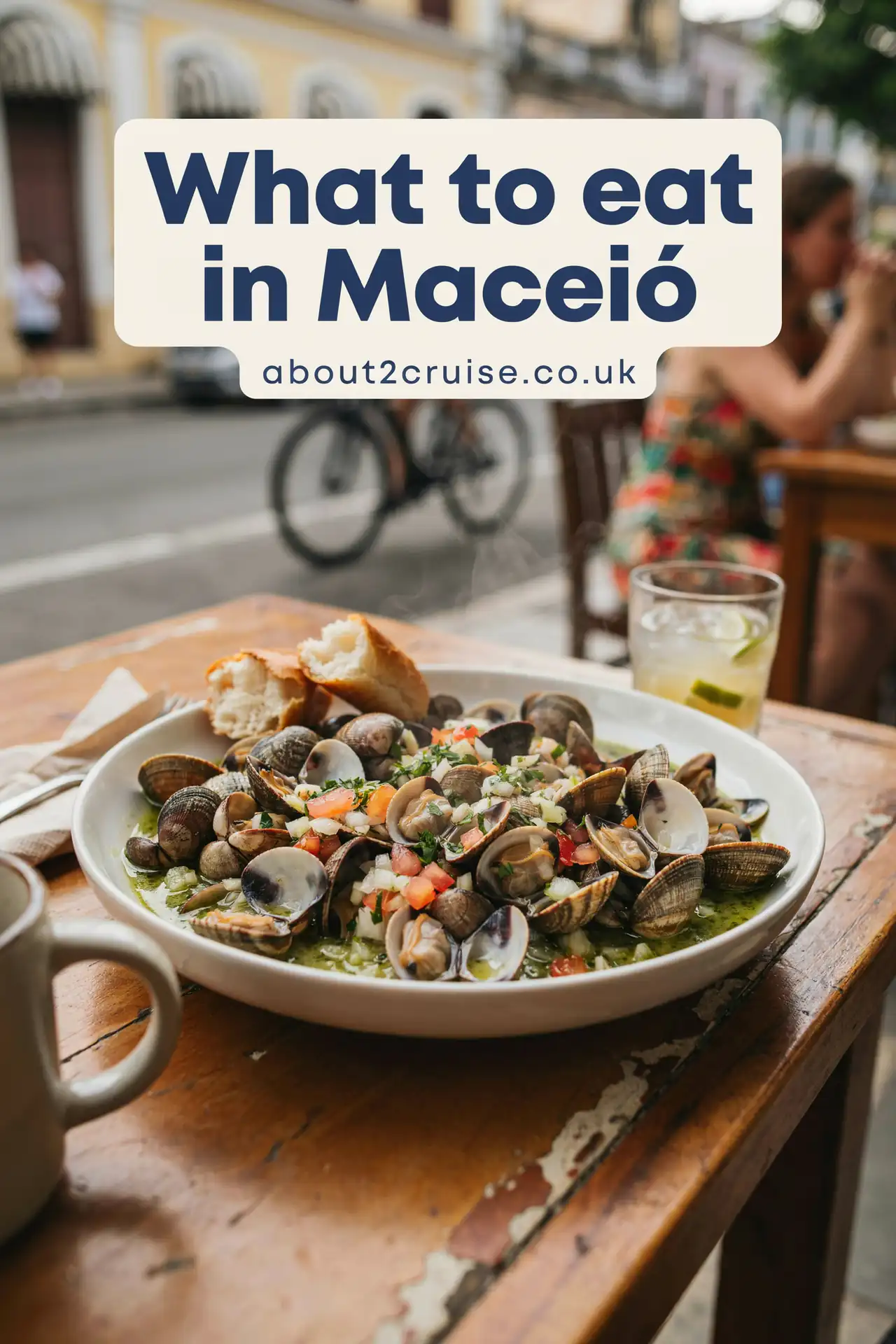
Tapioca is everywhere on the waterfront. The tapioqueiras sell freshly made tapioca with more than 20 fillings; fresh coconut with coalho cheese is the classic. Street tapioca usually costs about R$8–15. A full sururu lunch in the Mercado da Produção in Jaraguá runs about R$20–35. Beach kiosk skewers and small portions may cost R$5–15. Drink coconut water from the kiosks, but make sure the vendor opens it in front of you.
The Mercado da Produção is the local food and produce market. It trades Monday to Saturday and is busiest between 11:00 and 14:00; it closes on Sundays. This is the place for sururu, regional produce and local food boxes, but bring cash or PIX and keep an eye on your belongings.
Jaraguá, historic centre and local culture
Jaraguá, the district around the port, has 19th-century townhouses, old warehouses, churches and museums. The Museum of Image and Sound, MISA, is about a 10-minute walk from the terminal gates and is the easiest culture stop. The Museu Théo Brandão, a folklore and anthropology museum on Avenida da Paz, has at times been closed or open only by prior appointment, so confirm before setting out.
Pontal da Barra is the traditional centre of filé lace embroidery, recognised as Alagoas intangible cultural heritage. It is also the local sunset viewpoint over Lagoa Mundaú. If you want crafts, folklore and slow lagoon atmosphere rather than beach, head there, but keep an eye on the clock in late afternoon traffic.
How to plan your Maceió port day: pools, beach or city?
Start with the tide. If your ship is in port during a proper low tide, the natural pools are the default choice. You can still fit in the Pajuçara craft market or lunch nearby afterwards.
If the tide is wrong, choose between a relaxed urban beach day at Ponta Verde or Pajuçara, a food-and-culture loop in Jaraguá and the Mercado da Produção, or a longer southern beach run to Praia do Francês. Most independent passengers should not try to do pools, Francês and a full city market all in one port day.
If your ship offers a Pajuçara pools excursion, the advantage is transport and timing. If you are comfortable with Uber or a taxi, the same thing can be much cheaper independently, provided the tide works.
Tides and reef conditions for the Pajuçara natural pools
Think of the pools as a low-tide event, not a simple beach trip. You need the tide to be low enough and at the right time. Boats leave before the lowest point, and the useful window can be short. Check the Brazilian Navy tide table for the Port of Maceió or the IMA Nossa Praia app before you plan the day.
As a rule, aim for a low tide of about 0.5 m or less. If the tide is 0.6 m or above, the pools may be too deep or not properly exposed. A morning low tide is easiest for a cruise call. An early-afternoon low tide can still work if your all-aboard is late enough. A midday or late high tide usually makes the pools impossible.
Reef health matters too. Visitors are told not to stand on or touch coral, not to feed fish and not to remove shells. Snorkelling is possible but the experience in the pools is usually more about standing or floating in waist-deep clear water with small fish around you.
Docking and terminal arrangements at Maceió cruise port
Maceió is not a tender port for normal cruise calls. Ships berth alongside at the working Port of Maceió in the Jaraguá district on the city’s central waterfront. Passenger-capable berths include Berços 2, 3 and 5, but the exact berth on your day is operational and may appear only on the day’s schedule or port information.
The passenger terminal, Terminal Marítimo de Passageiros, is in the rear area of the passenger berths. It was completed in December 2022, with about 1,668 m² of built area and capacity for up to 4,000 people. The terminal has toilets, a medical post and a pantry area. On cruise days the municipal tourism secretariat normally sets up a tourist information centre inside the port with bilingual maps and staff. A second tourist information base operates at Pajuçara beach.
On some ship days there has been a free shuttle from the port to Mercado 31 in Jaraguá for passengers exploring independently. Do not count on it as a guaranteed service; check on the day when you disembark.
Maceió cruise port map
Ships dock at Maceió cruise port. From there, Mão de Deus sculpture is about a 12-minute walk and Praia de Pajuçara about 24 minutes. Tap a pin for directions.
- Maceió cruise portWhere ships dock
- Mercado 31Market · About 9 min walk from Maceió cruise port
- Mão de Deus sculptureSculpture · About 12 min walk from Maceió cruise port
- Praia de PajuçaraBeach · About 24 min walk from Maceió cruise port
- Pajuçara natural poolsNatural pools · About 2 km from Maceió cruise port
- Praia de Ponta VerdeBeach · About 3 km from Maceió cruise port
- Praia de JatiúcaBeach · About 4 km from Maceió cruise port
- Mercado da ProduçãoFood market · About 3 km from Maceió cruise port
- Feirinha de Artesanato da PajuçaraCraft market · About 2 km from Maceió cruise port
- Pavilhão do ArtesanatoCraft pavilion · About 2 km from Maceió cruise port
- Pontal da BarraCraft district · About 6 km from Maceió cruise port
- Praia do FrancêsBeach · About 17 km from Maceió cruise port
- Praia do GungaBeach · About 29 km from Maceió cruise port
Getting from the port to Pajuçara and Ponta Verde
The port gate opens onto the new 1.5 km Jaraguá waterfront promenade, which is designed to give cruise passengers direct access to the seafront and links Jaraguá towards Pajuçara. The Mão de Deus sculpture on the new promenade is 4.5 m high and faces the sea, framing the coast and sunset.
Pajuçara beachfront is roughly 2–3 km from the terminal. Ponta Verde is about 4 km. The drive is short, typically 10–15 minutes, but the route can clog in the afternoon when passengers and locals are moving at the same time. The terminal is not on a tendered anchorage, so you walk or drive from ship to gate.
Taxis, app rides and shuttle options from the port
Uber and 99 both operate in Maceió and usually wait just outside the terminal gate. This is the easiest independent option. A taxi from Pajuçara back to the terminal is quoted at about R$35. Maceió taxi tariffs are regulated: flagfall is around R$4.79, tariff 1 is about R$3.34 per km, tariff 2 about R$4.00 per km at night, on Sundays and public holidays, and waiting time is about R$15.82 per hour.
Do not hail taxis in the street. The UK Foreign Office advises booking through the official app and checking the plate and driver details, because unlicensed cars with fraudulent app accounts have been reported in Brazil. If you book a private driver or ship transfer, agree the return time and meeting point before you leave the vehicle.
Walking near the port and beach safety
The main street outside the terminal, Rua Sá e Albuquerque, has heavy port and government foot traffic by day. Empty side streets are best avoided, and the port area is not a place for a night walk. If you are returning after dark, take a taxi or app ride to the terminal gate rather than walking back along empty streets.
The new Jaraguá promenade is the safest and most pleasant walking route from the port towards the waterfront. Once you reach the main beachfront strip at Pajuçara, the urban beaches are walkable by day. Do not leave bags, phones or cameras unattended on the sand. The FCDO warns that theft is common on Brazilian public beaches, including groups running through and grabbing possessions, and advises against going onto city beaches after dark.
Getting back to the ship on time
Allow more time than the distance suggests. Pajuçara and Ponta Verde are only 10–15 minutes away in normal traffic, but afternoon traffic in Maceió can be dense and unpredictable. Leave the beach zone at least 60 minutes before all-aboard, not before the ship’s scheduled departure. That buffer gives you time for traffic, the gate and security.
If you are returning from Praia do Francês or Gunga, build in the longer drive plus traffic. A 40-minute return can become an hour or more. Ship excursions take on the timing risk; independent passengers should not cut it fine.
Money, cards and tipping in Maceió
Brazil uses the Brazilian real. Cash is still important for a Maceió port day: jangada rides, beach vendors, small market boxes and some tapioqueiras may not take cards. The Mercado da Produção and street stalls often take cash or PIX, but PIX usually requires a Brazilian bank account.
ATMs exist in Maceió, but card cloning from ATMs and in shops is flagged by the UK Foreign Office. Where possible use machines inside banks or shopping centres, cover your PIN and keep the card in sight when paying. Check the amount on the card terminal. Beach vendors sometimes overcharge or key in the wrong amount, so watch the machine.
Tipping is less formal than in the UK or US. Restaurants often add a 10% service charge; if not, 10% is common. For jangadeiros, tour guides or beach chair attendants, a small cash tip is appreciated but not mandatory. Carry small notes because change can be scarce.
Portuguese phrases for a day ashore
Tourist-facing staff in hotels and some shore excursions may speak some English or Spanish, but the beach and port are not English-speaking environments. These help:
Before you sail
- Check the Pajuçara low tide for your call date before booking any pool trip.
- Download the IMA Nossa Praia app or bookmark the Brazilian Navy tide table.
- Bring small notes in Brazilian real for jangadas, market stalls and beach kiosks.
Short port day: under 6 hours
- On dockingWalk the Jaraguá promenadeExit the port gate and follow the seafront promenade towards Pajuçara. It is about a 30 minute walk from the port.
- +45 minJangada to the natural poolsLow tide onlyAt Pajuçara beach, take a jangada to the natural pools. The return trip takes about 1.5 to 2 hours. Skip if low tide is above 0.6 m.
- +2 hrs 30 minLunch at Pajuçara kiosksTry sururuBack on the beach, order grilled fish, sururu or chiclete de camarão and drink coconut water at the kiosks.
- +3 hrs 30 minBrowse the Pajuçara craft marketWalk to Feirinha de Artesanato da Pajuçara for filé lace, straw and ceramic crafts. Keep small notes in Brazilian real.
- +4 hrs 30 minWalk back to the portReturn along the Jaraguá promenade the way you came. Allow about 40 minutes to reach the terminal gate.
- All-aboard minus 1 hrBack at the port gateIf you are running late, take a taxi or Uber from the beachfront instead of walking.
The time on the map is the whole walk, every stop added together.
Open this walking route in Google Maps
If plans change: If the jangada operators are not running or the tide is too high, stay at Pajuçara beach and Ponta Verde; the craft market and kiosks fill the day.
Long port day: 8 hours or more
- On dockingWalk the promenade and browse the marketExit the port gate, walk the Jaraguá promenade, then spend time among the stalls at Mercado da Produção before lunch.
- +2 hrsLunch at Mercado da ProduçãoTry sururuOrder sururu stewed in coconut milk and a fresh coconut and coalho cheese tapioca. Bring small notes in Brazilian real.
- +3 hrsWalk to Pajuçara beachLeave the market and walk about 25 minutes south along the waterfront to Pajuçara.
- +3 hrs 30 minJangada to the natural poolsLow tide onlyAt Pajuçara beach, take a jangada to the natural pools if low tide is about 0.5 m or less. The round trip takes 1.5 to 2 hours.
- +5 hrs 30 minBrowse the craft marketBack on the beach, walk to Feirinha de Artesanato da Pajuçara for filé lace, straw and ceramic crafts.
- +6 hrsPonta Verde beachfrontContinue south to the giant chair and Eu Amo Maceió sign on Ponta Verde. It is about 15 minutes on foot from the craft market.
- All-aboard minus 1 hrHead back to the portWalk back along the promenade or take a taxi or Uber from Ponta Verde.
The time on the map is the whole walk, every stop added together.
Open this walking route in Google Maps
If plans change: If the Mercado da Produção is closed on a Sunday, eat at the Pajuçara beach kiosks and swap the market visit for the Pavilhão do Artesanato.
- Bom dia / Boa tarde: good morning / good afternoon
- Por favor: please
- Obrigado / Obrigada: thank you, male / female speaker
- Quanto custa?: how much does it cost?
- Onde fica Pajuçara?: where is Pajuçara?
- Quero ir para as piscinas naturais: I want to go to the natural pools
- Que horas?: what time?
- Maré baixa: low tide
- Maré alta: high tide
- Dinheiro / cartão: cash / card
- Não entendi: I did not understand
- Fala inglês?: do you speak English?
Weather, rainy season and heat in Maceió
Maceió is hot all year. Average maximums run from about 27.6°C to 31.5°C, with minimums around 19.7–22.1°C. Humidity is high, often 74–83%. The driest period is around December and January, with January averaging about 83 mm of rain. The wettest stretch runs from April to July, peaking around June at about 354 mm. North-east Brazil’s rainy season is generally April to July, but heavy rain can happen outside it.
Treat sun and heat seriously. Use high-factor sunscreen, reapply, drink water, wear a hat and take shade breaks. The pools trip leaves you exposed on a raft and in the water. A reusable water bottle, sunglasses and a dry bag for your phone and cash are useful. Thunderstorms can arrive quickly in the wet season, so have a plan for indoor cover.
Cruise season and crowds in Maceió
The Maceió cruise season runs from November to April. The city’s domestic high season is December to February, which is when the beaches are busiest. If your call lands in those months, expect packed beachfronts, busy kiosks and more competition for taxis.
Pajuçara pools are most crowded on sunny weekends and on ship days with a good low tide. If you want a quieter stretch, start early or use Ponta Verde or Jatiúca. The Feirinha de Artesanato and Mercado da Produção are busy in the middle of the day regardless of cruise traffic.
Shore time planning and excursion durations
Pajuçara pools plus a beach lunch plus the craft market fit comfortably into a 6–8 hour call, provided the tide works. The pools trip alone takes about 1.5–2 hours. Praia do Francês is realistic as a half-day because it is 30–40 minutes each way. Praia do Gunga is more like a ship-excursion or private-driver day once you allow 40–50 minutes each way and time on the beach.
The Nove Ilhas lagoon boat trip on Lagoa Mundaú is not a standard port-call option. It is normally a long afternoon-to-sunset product, so it suits passengers on a hotel stay rather than a cruise turnaround. If you are boarding or disembarking in Maceió and have an extra day, it becomes more practical.
Practical essentials at a glance for Maceió
- Wear swimwear from the ship if you plan to do the pools or beach.
- Bring sunscreen, hat, sunglasses, water and a dry bag for phone and cash.
- Carry small notes in Brazilian real for jangadas, beach vendors and market stalls.
- Keep a copy of your passport or ID rather than taking the original to the beach.
- Check the tide before committing to Pajuçara pools.
- Use Uber or 99 from the port; do not hail taxis in the street.
- Leave the beach area at least 60 minutes before all-aboard.
- Do not touch or stand on coral, feed fish or remove shells.
- Do not leave belongings unattended on the sand.
Port amenities, toilets, Wi-Fi and luggage
The passenger terminal has toilets, a medical post and a pantry area. There is no confirmed public luggage-storage service at the terminal, and the port website does not advertise one. If you need to leave bags, ask your cruise line or use a local hotel baggage service.
Free public Wi-Fi is available in parts of the beachfront during cruise calls, but do not rely on fast or secure connections at the terminal itself. If you need data, a local eSIM or careful use of ship Wi-Fi is more reliable. There is tourist information staff on ship days, with maps and bilingual help.
Parking exists on the terminal site, with about 3,549 m² of car parking and plans for a new 112-space car park. There is no published public cruise parking tariff or advance-booking page, so if you are driving to the port or leaving a car, ask the port or your cruise line before arrival.
Accessibility at the port and beaches
The port terminal is modern but no official accessibility audit is published. The beachfront has wide pavements in places, but side streets and older pavements can be uneven. Beach sand is difficult for wheelchairs and walking frames unless you use the assisted access points.
Pajuçara pools have accessible options. Two adapted jangadas can carry wheelchairs, with space for up to six people including two wheelchair users, and a bamboo mat is available for the sand. Alagoas also runs the Praia Acessível programme, which provides assisted sea bathing with amphibious chairs on the urban orla. If you need this, ask the tourist information desk on the day or arrange help through your ship.
Beach chairs, umbrellas, food and toilets
Urban beach kiosks rent chairs and umbrellas, usually around R$20–35 for the set. Some kiosks offer the chair and umbrella as part of your food or drink consumption, so ask before you sit. Prices are set per kiosk and worth comparing if one area is busy.
Kiosks sell food and drink all day. Some have showers and toilets. There are no general public changing rooms along the urban orla, so wear swimwear under your clothes if you plan to swim. Tapioqueiras set up on the pavement after midday, and coconut-water vendors are easy to find.
Food and drink safety and beach vendor etiquette
Choose busy kiosks and stalls with a high turnover. If you buy coconut water, make sure the coconut is opened in front of you. Avoid raw or poorly chilled seafood in hot weather. The UK Foreign Office warns about drink spiking and methanol in spirits in Brazil, so keep an eye on your drink and use sealed bottles where possible.
Beach vendors are persistent but usually friendly. A firm “não, obrigado” works if you are not interested. If you agree on a price for a chair, jangada ride or umbrella, confirm whether it is per person or per set and whether food is included. Do not hand over your card and let it out of sight.
Souvenirs and local crafts in Maceió
The Feirinha de Artesanato da Pajuçara, on Avenida Doutor António Gouveia, has about 200 stalls and usually opens daily from around 09:00 to 22:00. The Pavilhão do Artesanato, on the same avenue, has about 100 shops selling Alagoas and north-east crafts from roughly 10:00 to 22:00.
Typical buys include filé lace and embroidery from Pontal da Barra, straw, coconut-fibre, ceramic, leather and wood pieces. Keep cash for small stalls. The Mercado da Produção also has regional produce and some crafts alongside the food boxes.
Things to do in Maceió on a cruise stop
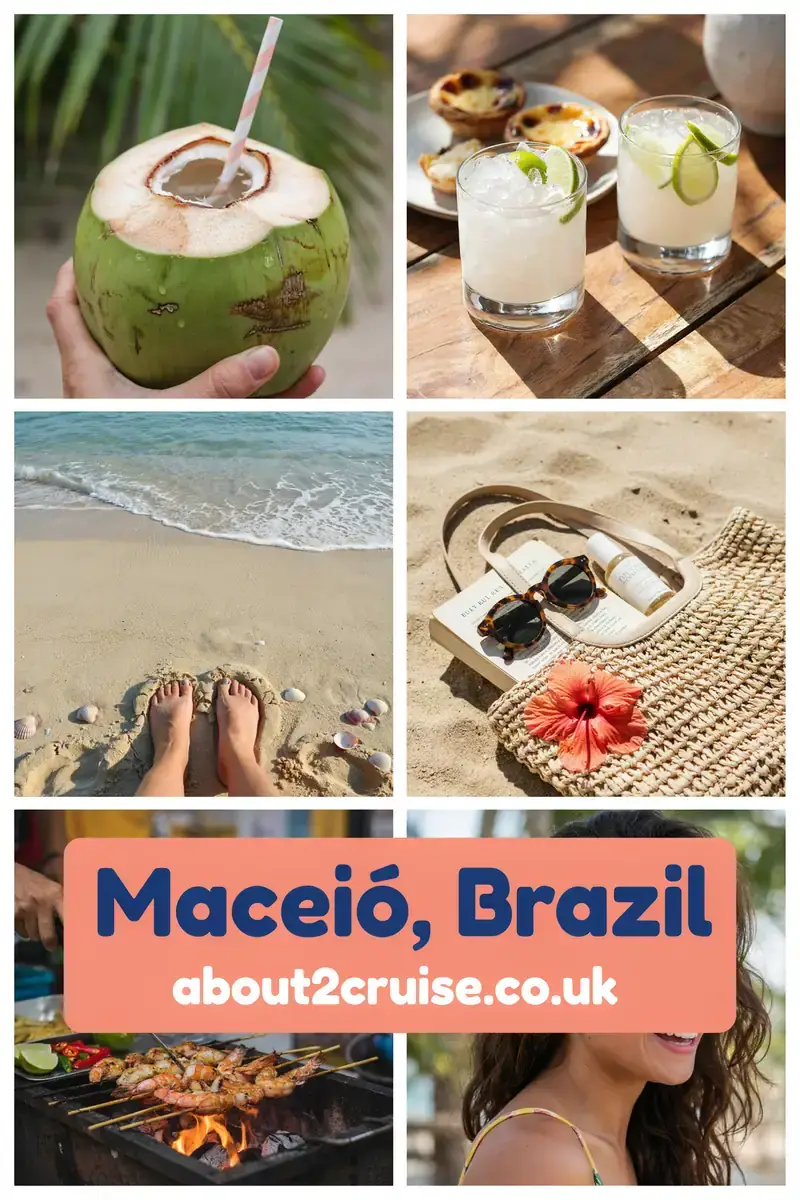
- Take a jangada to the Pajuçara natural pools at low tide.
- Spend a beach day at Ponta Verde or Jatiúca, with chairs and kiosk food.
- Walk the beachfront and photograph the Eu Amo Maceió sign, giant chair and Caminho de Moisés if the tide is low.
- Eat sururu and tapioca at the Mercado da Produção or the beachfront tapioqueiras.
- Browse the Pajuçara craft market and Pavilhão do Artesanato.
- Visit MISA or walk the old Jaraguá streets near the port.
- Take a private or ship excursion to Praia do Francês, Paripueira or Praia do Gunga.
- Head to Pontal da Barra for filé lace and, if time allows, the lagoon sunset.
Nearby attractions you can realistically reach
Pajuçara, Ponta Verde and Jatiúca are the easy ones. Add the Feirinha de Artesanato if you are already at Pajuçara. The Mercado da Produção is the best food stop in Jaraguá and much easier than a southern beach. MISA is walkable from the port in about 10 minutes.
Praia do Francês is feasible for a half-day. Praia do Gunga is the outer limit and best done on a ship excursion or with a pre-booked private driver. Pontal da Barra and Lagoa Mundaú are close by car, but the lagoon boat trips are usually too long for a standard call unless you just visit Pontal da Barra for crafts and a quick view.
Wildlife and seasonal sights around Maceió
The Costa dos Corais protected area is home to reef fish, coral and manatees, although manatee sightings are not something you should expect on a short pools trip. In the Pajuçara pools the small sargentinho fish is the one you will see most often. The water is usually clear enough for fish spotting without a snorkel.
Urban beaches attract coastal birds, and if you take a lagoon route or visit Pontal da Barra you may see mangrove and lagoon birdlife. The biggest seasonal variable is water clarity: after heavy rain, runoff can cloud the water, especially near drainage channels. Bright, dry-season days tend to give the best reef and fish viewing.
Checking ship traffic and your port call
To check your call, use the Port of Maceió cruise schedule or a site such as Portal World Cruises for Maceió escalas. Live ship tracking on MarineTraffic or VesselFinder also shows vessels in Maceió. The exact berth assignment is usually operational, so check the day’s port information or your cruise line app rather than assuming a fixed pier.
Your cruise documents, boarding pass and luggage tags normally show the terminal or meeting point. The port schedule is the cross-check if there is any doubt. Terminal assignments can change by sailing or weather, so confirm after docking.
Common mistakes to avoid in Maceió
- Not checking the tide before planning the pools.
- Bringing only cards and no cash for jangadas, tapioqueiras and small vendors.
- Hailing taxis on the street instead of using Uber, 99 or an official taxi.
- Leaving too late from the beach because the distance looks short.
- Leaving phones, cash or passports unattended on the sand.
- Swimming near drainage outlets or after rain when water quality dips.
- Touching coral or feeding fish in the natural pools.
- Trying to fit Pajuçara pools, Praia do Gunga and a city market into one short call.
What recent passengers say about Maceió
Passenger feedback tends to underline that Maceió is a much easier port than it first appears. The beachfront is close, cheap to reach and easy to enjoy independently. The most common positive mentions are about the natural pools, the urban beach kiosks and the food. The most common disappointment is arriving on a day when the tide makes the pools impossible, or trying to do too many southern beaches in too little time.
Recent passengers also mention that the terminal is simple and functional, not a huge shopping complex. The biggest stress is usually afternoon traffic, not distance. If you check the tide, use an app ride, carry cash and leave early, the day tends to work.
Our Brazil cruise ports guide covers the other ports in the region.
Quick answers to common cruise port questions
How do I find out which cruise terminal my ship uses?
Check your cruise documents, boarding pass and luggage tags first. The terminal letter or number is printed there. Then cross-check with the port’s live schedule or your cruise line app. Assignment can change by sailing, weather or berth congestion, so do not rely on an old map or a previous call.
Are cruise shuttles from port to train or city generally free?
Not usually. Cruise lines may run free shuttles only inside the port area where walking is impractical or unsafe. Shuttles into town or to stations are typically paid, if offered at all. In Maceió, a free shuttle has been provided on some cruise days from the port to Mercado 31 in Jaraguá, but you should treat that as a bonus rather than a guaranteed service.
Are there any other Maceió cruise port FAQs not covered above?
Yes. Do I need an excursion? No, the central beaches and pools are easy to reach independently if the tide works. Is it safe? During daylight in the beachfront and Jaraguá promenade areas, yes, with normal big-city caution; avoid quiet side streets and beaches after dark. Can I pay in euros or dollars? No, use Brazilian real. Is there a left-luggage desk at the port? No confirmed service, so ask your cruise line or use a hotel bag drop. Should I pre-book a jangada? You can, but walk-up boats are common; just check the tide and use an accredited operator.
More port guides for your itinerary
If you are also calling at Rio de Janeiro, Funchal or Buenos Aires, those guides cover the same practical port-day questions for your wider itinerary.
Last Updated: 19 November 2026