
Mar del Plata is Argentina’s Atlantic beach-resort city and a working fishing port, not a purpose-built cruise terminal. Small expedition and occasional boutique ships dock at a naval-base berth or container quay; tenders are not the norm. There is no cruise terminal, no reliable shuttle and no published schedule. The centre is about 5 km away by taxi, and the port’s sea-lion colony is the standout stop.

Make Sure You’re Looking at the Right Port
Mar del Plata is on Argentina’s Atlantic coast in Buenos Aires Province. Locals call it “La Feliz,” and it has nothing to do with Puerto Plata in the Dominican Republic. If your itinerary mentions Amber Cove, Taíno Bay, Umbrella Street or Puerto Plata, you need our Puerto Plata cruise port guide. Mar del Plata’s port is a single Argentine fishing and naval facility, not a Caribbean cruise complex.
Does Mar del Plata Actually Work as a Cruise Port?
It is a port of call, but not a regular mainstream cruise port. The port authority runs a multipurpose fishing, cargo and export harbour, and cruise calls are occasional. Small expedition ships and boutique vessels have used it, including the 144 m Hamburg and the expedition ship Seaventure. The harbour can handle vessels up to about 200 m in length and 6 m draft, but there is no published cruise schedule. On South American expedition itineraries, Mar del Plata sometimes sits between Buenos Aires, Ushuaia and South Georgia.

Where Ships Dock and Whether You’ll Tender
Expect to dock, not tender. Recent calls have tied up at either the Base Naval Mar del Plata on Avenida Patricio Peralta Ramos 6875, between naval berths 34 and 37, or at Terminal 2, the container terminal. The naval-base berth is a controlled Navy installation, and Terminal 2 is a working container area. The purpose-built cruise terminal building on the Escollera Norte was completed but never opened as a passenger terminal. Berthing is arranged by shipping agents for each call, so your exact berth and gate are usually confirmed by the ship or agent rather than published in advance.
Mar del Plata cruise port map
Ships dock at Base Naval Mar del Plata. From there, Escollera Sur sea-lion colony is about a 18-minute walk, Puerto de Mar del Plata about 23 minutes and Playa Grande about 25 minutes. Tap a pin for directions.
- Base Naval Mar del PlataWhere ships dock
- Terminal 2, Puerto Mar del PlataWhere ships dock
- Escollera Sur sea-lion colonySea-lion reserve · About 18 min walk from Base Naval Mar del Plata
- Puerto de Mar del PlataWorking fishing port · About 23 min walk from Base Naval Mar del Plata
- Playa GrandeSeafront beach · About 25 min walk from Base Naval Mar del Plata
- Banquina de los PescadoresOpen-air fishing waterfront · About 29 min walk from Base Naval Mar del Plata
- Torreón del MonjeRestaurant and gym complex · About 3 km from Base Naval Mar del Plata
- Bristol BeachCentral beach · About 4 km from Base Naval Mar del Plata
- Villa VictoriaCultural centre · About 2 km from Base Naval Mar del Plata
The Port Layout: a Working Harbour, Not a Cruise Centre
Don’t picture a cruise centre with shops, seating and Wi-Fi. Mar del Plata has no operating cruise terminal. The passenger experience is a working quay: there are no documented passenger toilets, Wi-Fi, café or baggage services at the berths themselves. The visitor-friendly parts of the port are the Banquina de los Pescadores, an open-air fishing waterfront, and the sea-lion reserve on the Escollera Sur. Photography inside the operational terminal areas needs prior port authorisation, and drones need separate permission. This is a functioning port with trucks, fish traffic and restricted zones.
Getting from the Ship into the City Centre
The centre of Mar del Plata is about 5 km from the naval-base berth. The closest seafront points are Playa Grande and the Torreón del Monje; one Playa Grande seafront hotel lists the port at about 1.4 km, the Torreón at 2.7 km and Bristol Beach at 2.8 km. In practice, the most useful answer is still taxi: there is no port shuttle, and when the Hamburg called, passengers left on local-agency coaches or ship-arranged tours rather than by a public port service.
Walking from the Port Is Not Really a Stroll
There is no signposted passenger walking route from either berth into town. The naval base has controlled entry, and the container terminal is an industrial working area. Buses 221 and 581 stop about 150 m from the Base Naval gate on the Peralta Ramos boulevard, but that doesn’t mean the walk from the gangway to the gate is designed for cruise passengers. With luggage or in bad weather, walking is a poor choice. Treat the port as a taxi or pre-arranged-transfer situation, not a pedestrian gateway.
Taxis, Remises and Ride-Hailing at the Port
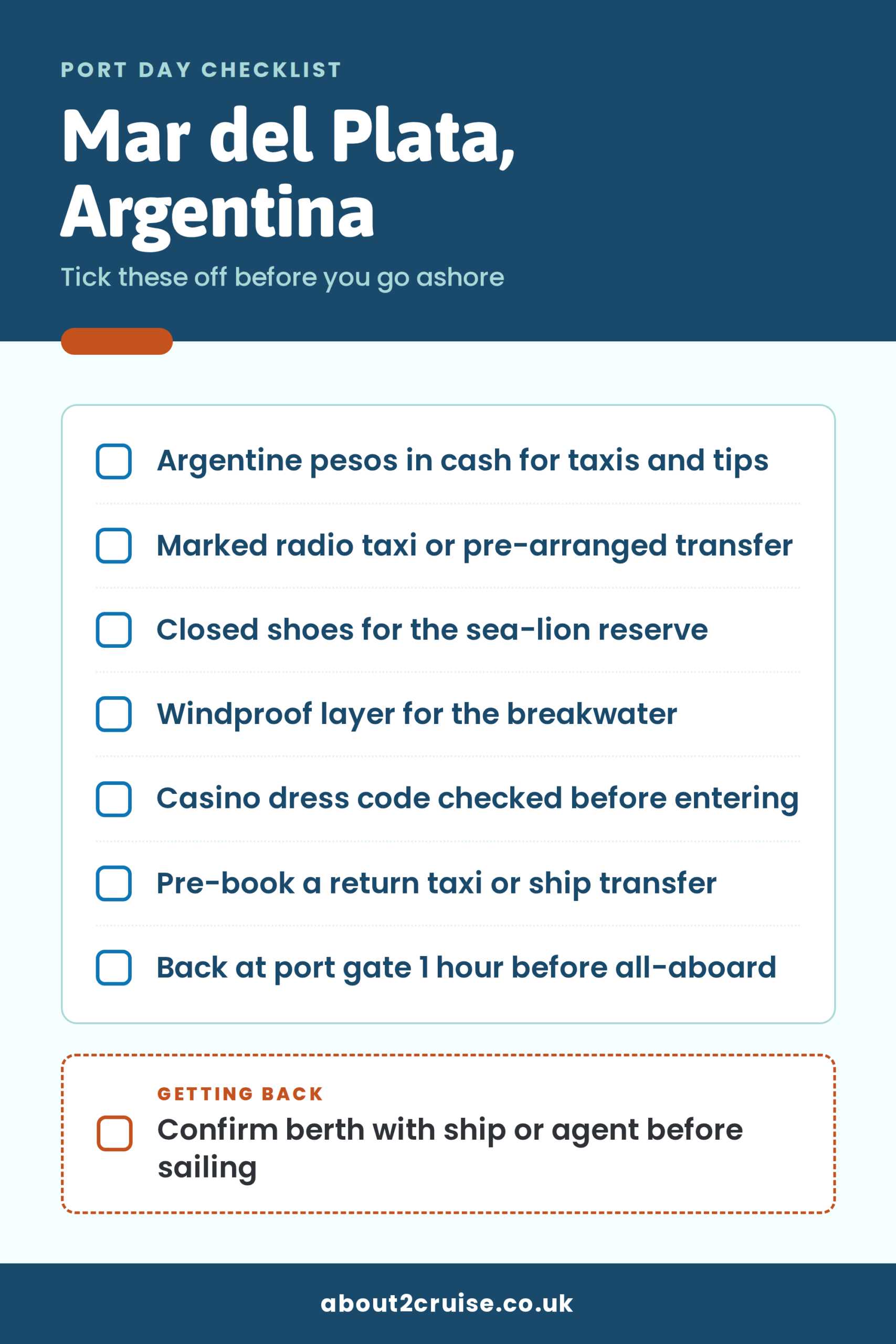
Use a marked radio taxi or remís. Published meter rates have included a flag fall of about $2,250 in the day and $2,700 at night, plus $150/$180 per 160 m and a 20% night surcharge from 22:00 to 06:00; there is also a per-bag surcharge in the tariff, but the current amount is not consistently published. Ride-hailing platforms are regulated in the city and may work in practice, but don’t rely on one as your only plan. Arrange the return before you head off: there is no rank at the quay, and the port is not a place to find a last-minute taxi.
Payment is easiest in Argentine pesos. Some taxis may accept cards or Mercado Pago, but cash is still the safest assumption for a short ride.
Public Buses and the SUBE Card
Local buses serve the port area: 221 and 581 stop about 150 m from the Base Naval gate, and 511 (except the G branch), 562, 581 and 221 serve the port/sea-lion reserve zone. But Mar del Plata buses are cashless; you need a loaded SUBE card, which costs about $880 and is bought online or at kiosks. For a one-day cruise call, this is usually more effort than a taxi. Buses make more sense if you are staying in Mar del Plata before or after an expedition cruise.
Return Timing: Give Yourself a Traffic Buffer
Because there is no terminal and no shuttle, the return is your responsibility. Fix a pickup time before leaving the ship, and aim to be back at the port gate with at least an hour to spare before all-aboard. Add extra time in high season, because the coastal boulevard loads up at beach hours. If your ship is in until early afternoon, do not push a long lunch or a distant beach unless you have a private transfer or ship excursion with a fixed return.
Sea-Lion Colony at the Port: the One Must-See
The reserve on the Escollera Sur is the northernmost sea-lion colony on Argentina’s Atlantic coast, composed entirely of males, around 800 animals. It is free, open in daylight hours every day, and sits about 1,000 m from the breakwater entrance. This is the one sight no other Argentine call has. Keep behind the double fence, don’t feed or shout, and wear closed shoes because the surface is uneven and lacks ramps. Numbers drop in early summer when many adults leave for breeding colonies, then recover from mid-February. Early morning and late afternoon give the best light and activity.
Banquina de los Pescadores and the Fishing-Port Food Scene
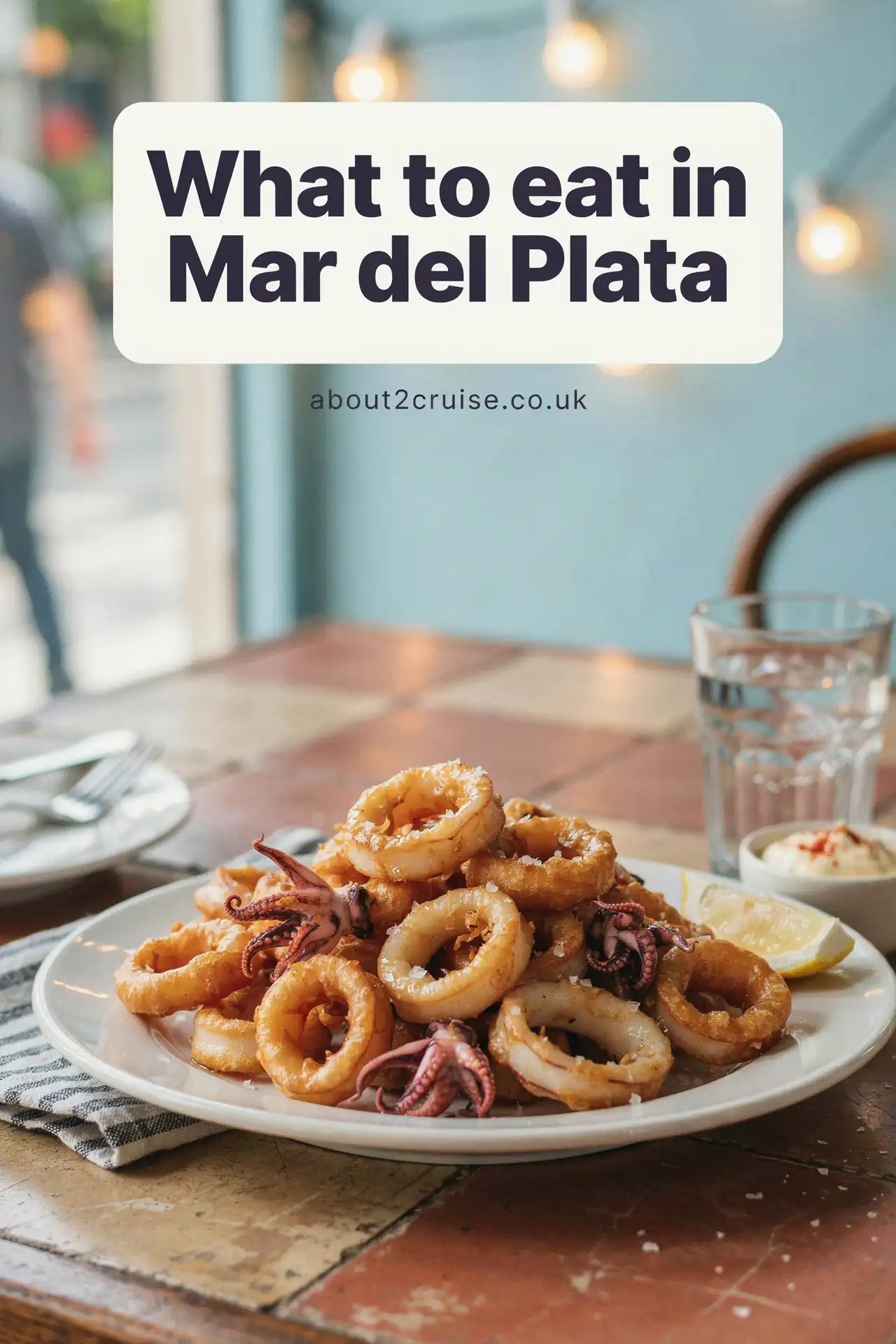
The Banquina is the port’s visitor frontage: an open-air boulevard of fishmongers, seafood stalls, souvenirs, the Fisherman’s Monument and a small port museum. The yellow fishing boats are at their best in the morning when the catch is landed. This is the traditional place to eat rabas, Mar del Plata’s signature fried squid rings, and cornalitos, fried small silversides. Prices fluctuate, but recent published examples put rabas at about $25,000 a kilo and cornalitos at about $13,000, with a sit-down port seafood meal around $30,000–33,000 per person including a drink. Facilities are simple, so don’t expect cruise-terminal comfort.
Beaches Near the Port and Beach-Day Logistics
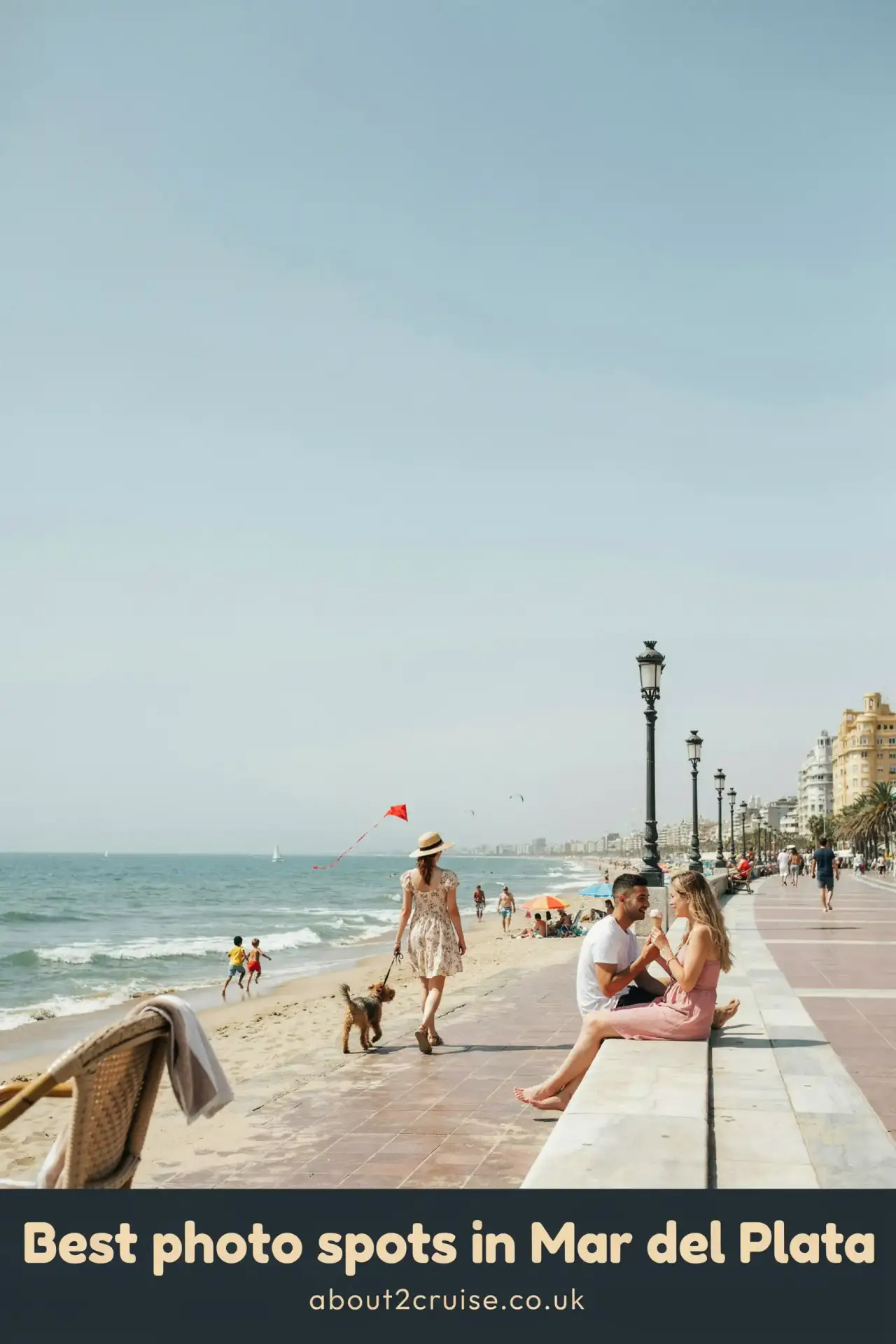
Mar del Plata has 47 km of coast, and the central beach scene is Bristol, beside the Rambla and Casino Central. Playa Grande is the closest seafront to the port. The seaside is built around private balnearios that rent shade and chairs, and the South Atlantic is cold even in summer. For a short cruise call, a beach and the sea-lion colony can compete for your time; if you want both, do the colony first and then head to Playa Grande or Bristol with a fixed return.
Torreón del Monje, Playa Grande and the Seafront
The Torreón del Monje is a 1904 building on the rocks of Punta Piedras, now a multi-level restaurant and gym complex. Free guided tours run Wednesday to Sunday at 11:00. Its terrace area gives the classic postcard view over Playa Grande on one side and Playa Chica on the other. This is the easiest waterfront viewpoint to combine with a port call because it is closer to the port than the city centre.
Bristol Beach, the Rambla and Casino Central
Bristol is Mar del Plata’s central beach, immediately below the Rambla and the Casino Central. The stone sea-lion sculptures in front of the Casino are the traditional photo stop. The Casino has strict 18-plus entry and a dress code: no torn clothing, no sleeveless vests, no flip-flops, and men may not wear shorts or swimwear. If you plan to go inside, dress accordingly; if you’re only passing, the seafront and sculptures don’t have that rule.
Villa Victoria and Mar del Plata’s Architecture
Villa Victoria, at Matheu 1851, is the English-style timber summer house of writer Victoria Ocampo, now a cultural centre. Entry is cash only and has been listed at $4,600 for adults and $3,400 for reduced tickets, with afternoon-only visits, hourly entry slots and last entry at 18:00. The ground floor has ramp access, but the first floor is stairs only. For a broader architecture look, combine it with the Torreón and the seafront villas and Rambla buildings.
Food and Drink to Try in Mar del Plata
Beyond rabas and cornalitos, local plates include cazuela de mariscos, seafood paella, lenguado and corvina. Finish with an alfajor marplatense or dulce de leche ice cream. The Güemes/Alem area is the busiest restaurant and bar district inland from the beaches, good if you want a proper sit-down meal rather than a port snack.
A Simple One-Day Mar del Plata Itinerary for Cruise Passengers
For a first call, a workable plan is:
- Morning: taxi from the port to the Escollera Sur sea-lion reserve, then walk or take a short taxi ride to the Banquina de los Pescadores to see the yellow boats and try rabas.
- Midday: taxi to Punta Piedras/Torreón del Monje for the view over Playa Grande and Playa Chica.
- Afternoon: either continue to the Bristol Rambla and Casino for the seafront photo stop, or, if you prefer indoor culture, visit Villa Victoria. In summer, substitute a short beach stop at Playa Grande or Bristol if time allows.
- Return: keep a pre-arranged taxi or ship transfer with enough buffer for beach traffic.
Ship Excursions vs Independent Plans
For most passengers, a ship excursion or local-agency coach is the simplest option at Mar del Plata because it solves the working-port transfer and the fixed return in one go. Independence works best if you are comfortable in Spanish, have cash in pesos, and pre-book or pre-arrange a taxi. Do not treat this like a walkable Mediterranean or Caribbean call with tourist infrastructure right outside the gangway.
Money, Cards, Cash and Tipping
The currency is the Argentine peso. Cards are widely accepted in hotels, restaurants and larger shops, but cash in pesos is the safe assumption for taxis, kiosks, tips and some entry fees such as Villa Victoria. ATMs carry local fees and low per-withdrawal caps, so withdraw a realistic amount once and always choose pesos rather than the machine’s own conversion. Restaurant tips of about 10% are normally left in cash.
Language and Basic Spanish Phrases
The language is Spanish, and English is not universal outside tourist-facing restaurants and hotels. A few useful phrases:
- “¿Cuánto cuesta?”: how much does it cost?
- “¿Me lleva al puerto, por favor?”: can you take me to the port, please?
- “¿Aceptan tarjeta?”: do you accept cards?
- “La cuenta, por favor”: the bill, please.
- “No hablo español”: I don’t speak Spanish.
Basic courtesy in Spanish goes a long way in taxis and small restaurants.
Safety and Security in Mar del Plata
Mar del Plata does not appear on UK travel advice as a no-go area in Argentina, but the country guidance flags pickpockets on public transport and at bus and train terminals, distraction theft, phone snatching, and advises avoiding protests. If hailing a taxi in the street, use a marked radio taxi. Emergency numbers are 911 for police and 107 for ambulance. Inside the port, stay on the visitor waterfront and sea-lion reserve rather than wandering into the operational docks.
Accessibility and Mobility
The city documents accessibility well at several sights: the Casino has a lift platform, accessible toilets and loan wheelchairs; Bahía Varese beach has a ramp, accessible toilet, changing room, shaded unit and an amphibious chair; Villa Victoria has ramp entry and ground-floor circulation but a stairs-only first floor. The weak point is the port itself: the berths are working quays with no documented passenger accessibility, and the sea-lion reserve has an irregular pavement without ramps. Plan for an assisted transfer if you have limited mobility.
Weather and What to Wear
Mar del Plata is a cool-to-warm Atlantic coast, not a tropical cruise stop. January is the warmest month, with a mean around 21°C and a mean high of about 26.8°C; July is coldest, around 8°C mean and 13°C high. Rain falls in every month, humidity is high and the coast is windy. Even in October, bring a coat, and note that the breakwater is the windiest spot in the city. At the sea-lion reserve, closed shoes and a windproof layer are the right call.


Toilets, Wi-Fi, Luggage and Photography: What to Expect
There is no cruise passenger terminal, so do not plan on toilets or Wi-Fi at the berth. Use facilities at restaurants, cafés or hotels in the city. There is no left-luggage at the port; the long-distance bus/train terminal has a staffed left-luggage office, and hotels generally hold bags for guests. The airport has no official left-luggage service. Photography inside the working port terminals requires prior port authorisation, and drones need separate permission.
Boarding or Disembarking in Mar del Plata
If your cruise starts or ends here, you’re likely arriving by air or road and staying in the city the night before, because the naval-base berth has no terminal services. Well-located hotels include the NH Gran Hotel Provincial on the Rambla opposite the Casino, Hotel Costa Galana on the Playa Grande seafront, and the Sheraton Mar del Plata in Playa Grande. None of these represent a cruise terminal; they are simply the nearest practical city hotels.
Getting to Mar del Plata if Your Cruise Starts or Ends Here
Mar del Plata is reached from Buenos Aires by long-distance bus in about 5–6 hours or by train from Plaza Constitución in about 6–6.5 hours; published train fares have included Primera from about $32,000 and Pullman from about $38,400. The railway and bus station is the Estación Ferroautomotora at Avenida Pedro Luro 4524–4600. Astor Piazzolla airport, about 7–10 km north of the centre, is a 15–25 minute taxi ride; bus 542 runs to the centre and the bus/train terminal.
How to spend a port day in Mar del Plata
A port day in Mar del Plata works best if you stay local: see the sea-lion colony and fishing port first, then the seafront.
Before you sail
- Confirm your berth with the ship or agent before sailing; nothing is published.
- Pre-arrange a port pickup or ship excursion; there is no port shuttle.
- Get Argentine pesos in cash for taxis, tips and cash-only entry fees.
Short port day: under 6 hours
- On dockingTake a taxi from the port gateNo shuttleThere is no shuttle and no passenger walking route from the working berths. Marked radio taxis or pre-arranged transfers are the practical way into town.
- +30 minEscollera Sur sea-lion colonyClosed shoesAbout 1,000 m along the breakwater, this free colony of around 800 male sea lions is open daylight hours. Stay behind the double fence and wear closed shoes.
- +2 hrsLunch at Banquina de los PescadoresTry rabasWalk or take a short taxi to the port's fishing waterfront. Order rabas, the local fried squid rings, at the stalls beside the yellow boats.
- +3 hrs 15 minTorreón del MonjeViewpointShort taxi to Punta Piedras for the classic view over Playa Grande and Playa Chica. Free guided tours run Wednesday to Sunday at 11:00.
- All-aboard minus 1 hrReturn taxi from the seafrontUse a pre-arranged pickup; don't expect a rank at the quay. Aim to be at the port gate with an hour to spare.
This map shows the taxi ride from the ship. The time is the drive only, not your time ashore.
Open the taxi route in Google Maps
If plans change: If the reserve is closed, skip it and spend the time at the Banquina and Torreón instead.
Long port day: 8 hours or more
- On dockingTake a taxi or ship excursion transferNo shuttleNo shuttle, no walking route. Use a marked radio taxi or your ship's coach to leave the working dock.
- +30 minEscollera Sur sea-lion colonyFree entryFree, daylight hours, around 800 male sea lions. Best early for light and activity; stay behind the double fence.
- +2 hrsLunch at Banquina de los PescadoresTry rabasWalk or take a short taxi from the reserve to the Banquina. Try rabas or cornalitos at the fish stalls, the traditional port lunch.
- +3 hrsTorreón del MonjeViewpointViewpoint over Playa Grande and Playa Chica. Guided tours Wednesday to Sunday at 11:00.
- +4 hrsBristol Beach, Rambla and Casino CentralDress codeShort taxi to the central seafront. See the sea-lion sculptures, and only enter the Casino if you meet the dress code: no shorts, vests or flip-flops for men.
- +5 hrs 30 minVilla VictoriaCash onlyCash-only cultural centre in Victoria Ocampo's timber house; afternoons only, last entry 18:00. Confirm opening before you go if it's essential.
- All-aboard minus 90 minReturn taxi from the centreTraffic builds on the coastal boulevard at beach hours, so leave with a fixed pickup and a buffer.
This map shows the taxi ride from the ship. The time is the drive only, not your time ashore.
Open the taxi route in Google Maps
If plans change: If Villa Victoria is closed, stay on the Bristol Rambla and Casino seafront, or add a longer beach stop at Playa Grande.
Our Argentina and Uruguay cruise ports guide covers the other ports in the region.
Quick Answers to Common Mar del Plata Cruise Questions
Is Mar del Plata a tender port?
No. The ship docks at a naval-base berth or container terminal. Tenders are not the standard operation.
Can I visit the sea-lion colony independently from the cruise berth?
Yes, the reserve is free and open during daylight hours, but access is easiest by taxi because the berth itself is not a tourist transfer point.
Are there sea lions visible from the ship or close to the berth?
Not reliably. The colony is inside the port on the Escollera Sur, about 1,000 m from that breakwater’s entrance, so it requires a short transfer or port-area visit rather than expecting them at the gangway.
Do taxis accept US dollars or cards?
Don’t rely on it. Base your taxi plan on Argentine pesos in cash; some drivers may accept cards, but that is not guaranteed.
Is there left-luggage at the cruise terminal?
No. There is no operating cruise terminal, so there is no luggage storage at the port. Use a hotel or the bus/train station’s left-luggage office.
Is the Mar del Plata port area wheelchair-accessible?
The city sights are better documented than the port. The sea-lion reserve has uneven ground and no ramps, and the working quays are not passenger-accessible in the usual sense, so arrange assistance if needed.
What is the best use of a short call?
Prioritise the sea-lion colony and the Banquina de los Pescadores, then add the Torreón del Monje or the Bristol seafront if timing allows. This makes the most of what Mar del Plata actually offers without over-committing to distant beaches.
Last Updated: 17 November 2026