
Panama City is Panama’s Pacific cruise gateway, with ships docking or anchoring at the Amador Causeway terminal on Isla Perico, sometimes listed as Fuerte Amador or Balboa. It’s the port for Casco Viejo, the Panama Canal’s Miraflores Locks, Panama Viejo and skyline viewpoints. Expect a tender possibility, US dollars, hot and humid weather, and plan around canal schedules and city traffic.
Where Your Ship Actually Docks: Isla Perico, Fuerte Amador, and the Balboa Area
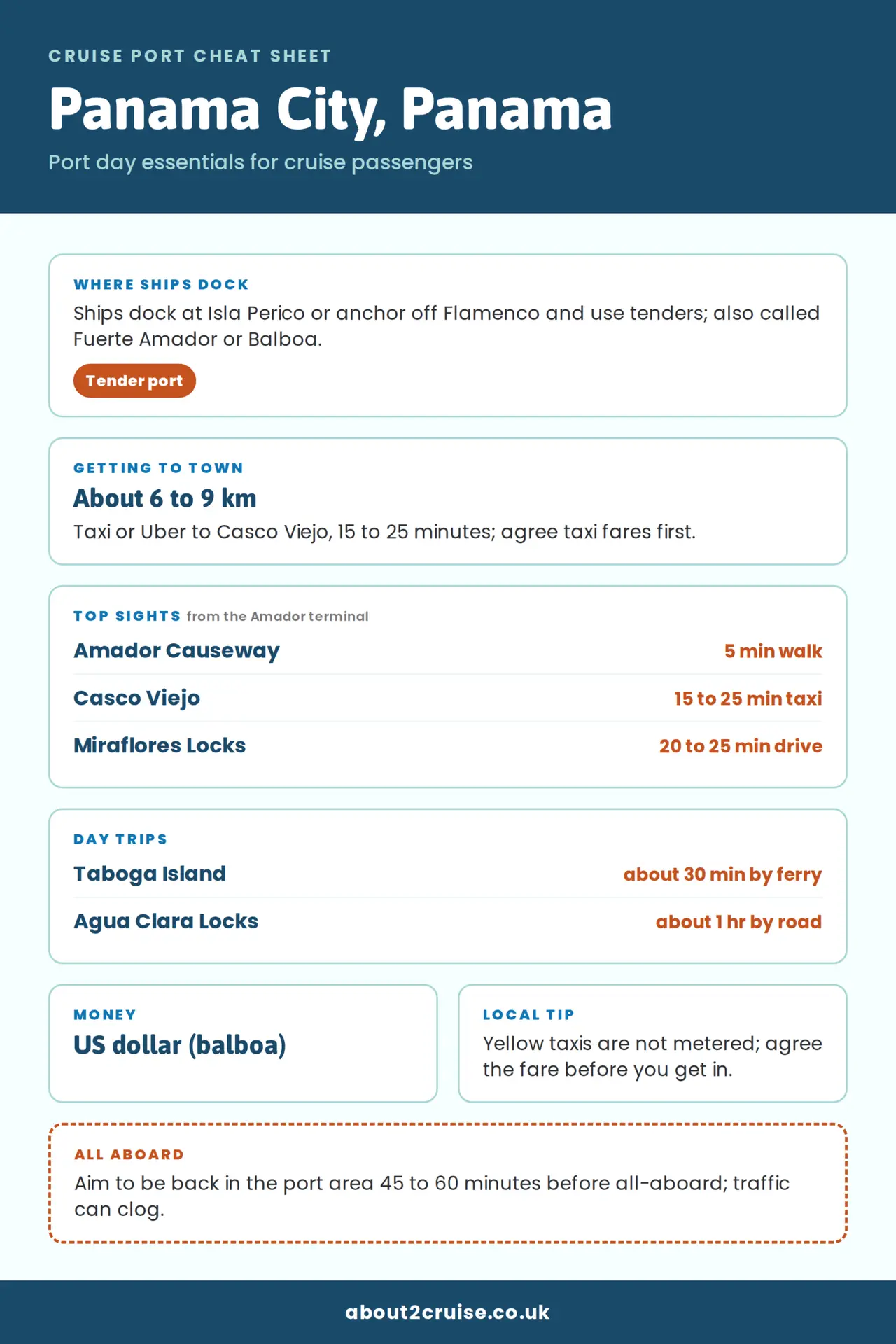
The main cruise facility is the Panama Cruise Terminal on Isla Perico, along the Amador Causeway. You may see it called Fuerte Amador, the traditional cruise port name for the area, or Port Balboa, the older working port next to the canal entrance. The Isla Perico terminal opened in March 2024 and can handle two ships up to about 360m long and 5,000 passengers each, with a navigation depth around 11–12m. It’s used both as a port of call and as a home port for embarkation and disembarkation.
Even with the new pier, your ship may still anchor offshore and use tenders, especially if the berths are full or your cruise line’s documentation says so. The area off Flamenco Island and the causeway has long been an anchorage. If it matters to you, check your cruise line’s own port page before sailing rather than assuming you will walk straight off a gangway. Tender days are more common on busy Panama Canal cruise dates, and the captain has the final say on who can go ashore. Mobility is the key constraint: staff will not lift passengers individually, and you may have to step down into a moving tender. If you use a wheelchair, rollator, or have trouble with steps, tell the cruise line well before you sail.
There is no official terminal website with a detailed passenger map, so the ship’s daily information sheet is your best source for the landing point, shuttle arrangements, and all-aboard time.
Panama City cruise port map
Tenders bring you ashore at Panama Cruise Terminal, Isla Perico. From there, Punta Culebra Nature Center is about a 19-minute walk. Tap a pin for directions.
- Panama Cruise Terminal, Isla PericoWhere tenders land
- Port BalboaWhere tenders land
- Flamenco Island tender landingWhere tenders land
- Punta Culebra Nature CenterNature centre · About 19 min walk from Panama Cruise Terminal, Isla Perico
- Metro Albrook stationMetro station · About 7 km from Panama Cruise Terminal, Isla Perico
- Casco ViejoHistoric old quarter · About 4 km from Panama Cruise Terminal, Isla Perico
- Panama ViejoHistoric old city · About 10 km from Panama Cruise Terminal, Isla Perico
- BiomuseoBiodiversity museum · About 3 km from Panama Cruise Terminal, Isla Perico
- Plaza de FranciaPublic square · About 4 km from Panama Cruise Terminal, Isla Perico
- Cerro AncónHill viewpoint · About 6 km from Panama Cruise Terminal, Isla Perico
- Mercado de MariscosSeafood market · About 5 km from Panama Cruise Terminal, Isla Perico
Panama City vs. Colón: Which Cruise Port Are You Really At?
Panama has two main cruise port areas, and itineraries sometimes blur them. Panama City sits on the Pacific side. Colón 2000 and the Cristóbal pier sit on the Caribbean side, roughly 75km and about 1h30 away by road. If your itinerary says “Colón” or “Cristóbal,” you are not in Panama City, even though excursion descriptions can look similar. If it says “Fuerte Amador,” “Panama Cruise Terminal,” “Isla Perico,” or “Balboa,” you are in the Panama City port. For details on the Caribbean-side port, see our Colón cruise ship port guide.
This matters for independent plans. A Panama Canal partial transit tour, a Miraflores Locks visit, or a walking afternoon in Casco Viejo is simple from Amador. From Colón, the same city-based day is possible but longer, with more traffic risk. Some cruises do not stop in Panama at all during a full canal transit; the ship crosses from ocean to ocean while you stay aboard. If your sailing is a full-transit itinerary, check whether the port call is before, after, or nonexistent.
How to Get from the Cruise Terminal to Casco Viejo and Downtown Panama City
Distances from the Amador Causeway terminal to Casco Viejo and central Panama City are short, usually stated as 6–9km, but traffic can make the ride feel longer. In normal conditions, allow 15–25 minutes by taxi or rideshare. The terminal is not in the old town; it sits on the causeway with the Biomuseo, marinas, and ocean views around it.
Taxis: Panama City’s yellow taxis are not metered. Agree the fare before you get in. From the port area to Casco Viejo, expect roughly US$10–20 depending on the queue, your negotiation, and whether the driver waits for a return fare. For multiple stops or a return trip, agree a total or an hourly rate first.
Uber and rideshare: Where available, rideshare is usually cheaper and simpler, with typical fares from the Amador/Fuerte Amador area into Casco Viejo around US$5–10. Drivers know the terminal by the name “Panama Cruise Terminal, Isla Perico” or “Fuerte Amador.” Use a specific terminal name, because several marinas and attractions share the Amador name.
Public transport: There is no metro station on the causeway. The nearest metro station is Albrook, linked by MiBus route C850, which runs from Metro Albrook along the causeway and stops near Isla Perico and Isla Flamenco. The C850 is cheap, around 25 cents, but it is not a luggage-friendly cruise shuttle. Another bus, C982, drops passengers near Plaza Herrera in Casco Antiguo. Public buses are best for flexible, light-travel port days, not for tight return-to-ship timing or when you are carrying beach gear.
Shuttles and private transfers: Some cruise lines offer a shuttle or a transfer-style excursion, especially when the port call is short or begins with a tender. There may be taxi-union pressure that limits independent shuttle operators right at the gate, so do not assume a free shuttle will be waiting. If you have a fixed plan, book a private transfer or have your hotel arrange one.
Return timing and traffic: Panama City rush hours are roughly 07:00–09:00 and 17:00–19:00. The road back to the causeway can clog badly, and the terminal gate itself may have a different drop-off and security lane pattern in the morning and afternoon. Aim to be back in the port area at least 45–60 minutes before the ship’s all-aboard time, and add extra buffer if you are coming from Miraflores or the old town across the city.
The Panama Canal from Panama City: Full Transits, Partial Transits, and What to Expect
A full crossing from Pacific to Atlantic takes roughly 8–12 hours and covers about 50 miles. You do not sail by yourself: a Panama Canal pilot takes navigational control for the passage. Ships are lifted in stages to Gatun Lake, about 26m above sea level, then lowered again on the other side.
There are two lock systems. The original 1914 locks are 110ft wide and handle Panamax-size cruise ships. The Neopanamax locks, open since 2016, have much bigger chambers, about 427m long, 55m wide, and 18.3m deep, and can take modern mega-ships up to around 366–370m long and about 49–51m beam. The largest cruise ship to transit, Disney Adventure, is about 208,000 gross tons and clears the locks with only a few feet on each side. From Panama City, the closest locks are Miraflores, followed by Pedro Miguel. On the Atlantic side, the big set is Agua Clara.
What you see depends on where your ship goes. A full-transit cruise takes you through every lock, Gatun Lake, and the Culebra Cut. A partial-transit from the Caribbean side enters the Atlantic locks, reaches Gatun Lake, and turns around without locking back through the other side. A port call in Panama City does not transit the canal unless you buy a separate partial-transit shore excursion. Some Caribbean cruises labelled “Panama Canal” may only visit a Caribbean-side port or not enter a lock at all. If the canal is the reason you are booking, our Panama Canal cruise guide explains how to compare full transits, partial transits, and port calls before you commit.
The canal authority controls daily transit slots. Schedules shift, and unreserved ships can wait. Cruise lines generally reserve slots well ahead, but the exact time you pass Miraflores or Agua Clara can change by hours. Do not plan a port-day photo around a precise lock time without checking the daily schedule.
Miraflores and Agua Clara Visitor Centres: See the Locks Without a Canal Transit
If your ship is not going through the canal, the easiest way to see a lock in action is the Miraflores Visitor Center, about 20–25 minutes by road from the Amador terminal and about 15 minutes from downtown. Miraflores has a large observation platform, a lower platform with wheelchair access, and an IMAX film narrated by Morgan Freeman. It is open daily 08:00–18:00, with the ticket office closing at 17:00. Non-resident adult tickets cost B/.17.22, children 6–12 B/.7.22, and under-6s enter free. The canal authority suggests about 1.5 hours for the visit; the observation platform holds 450 people, but the view is best when a ship is actually in the chamber.
Agua Clara Visitor Center sits on the Atlantic side near Colón, overlooking the Neopanamax locks and Gatun Lake. It is open daily 08:00–16:00 with tickets sold until 15:30. Non-resident adults pay B/.10, children 6–12 B/.5. Allow around three hours if you are coming from Colón; from Panama City it is roughly an hour each way, so it is usually a shore excursion rather than a quick independent trip from a Pacific-side call.
A visitor-centre ticket is not a boat transit. You are buying a viewing terrace, exhibits, and film, not passage through the canal. For independent visitors, check the daily lock schedule before you drive out, there can be long gaps when no ship is locking through. If your cruise line offers a Miraflores tour, it often includes the entrance fee and a timed visit arranged around the canal schedule.
Best Places to Watch Ships in Panama City: Casco Viejo, Amador Causeway, and More
You do not have to leave Panama City to watch ships at the canal’s Pacific entrance. The closest free ship-watching is the Amador Causeway itself. Vessels entering or leaving the canal can pass within about 200m of the causeway. The causeway is a 6km road built partly from rock excavated from the canal, linking Naos, Perico, and Flamenco. It has little shade, so mornings and late afternoons are far more comfortable than midday.
In Casco Viejo, you cannot see the locks, but you can see ships waiting at anchor in the bay and the city skyline. The sea wall at Plaza de Francia is the classic free viewpoint, especially at dawn or sunset. Ships sometimes anchor only about 500m off the wall. For an elevated view, rooftop bars such as Tantalo in Casco give you the bay panorama for the price of a drink. Live vessel-tracking maps can show you what is anchored in the Bay of Panama before you choose a spot.
General timing: cruise ships often transit northbound in the morning and southbound in the afternoon, but this is not guaranteed. If you want to photograph a ship in the Miraflores Locks, time your visit for the morning northbound window if possible, but verify locally or via AIS tracking. The best photo spots on land are the Miraflores observation platform for lock action, Plaza de Francia for anchored ships, the Amador Causeway for skyline-plus-ship shots, the Panama Viejo cathedral tower for old-vs-new contrast, and Cerro Ancón for a broad view of the city and canal entrance.
Casco Viejo: Panama City’s UNESCO Old Quarter
Casco Viejo is the compact UNESCO-listed old quarter, founded in 1673 after the original Panama City was sacked. Its streets are cobbled, its buildings range from restored colonial mansions to ruined churches, and it is the easiest half-day or evening call from the Amador terminal. Walkable highlights include Plaza de la Independencia, Plaza Herrera, Plaza de Francia, the Metropolitan Cathedral, the National Theatre, and the Museo del Canal Interoceánico. The Canal Museum is open Tuesday–Sunday 09:00–18:00; non-resident adults pay US$15 and children 6–12 US$7.50. The Paseo Esteban Huertas, built on the old sea wall, gives some of the best skyline and bay views in the city.
Casco is also where you come for good coffee, craft beer, rooftop bars, and some of the city’s best restaurants. Parking is scarce inside the old town; if you arrive by car, use the free car parks at Cinta Costera 3 and walk in. For churches, cover shoulders and knees and remove hats. The streets are uneven and cobblestone, so flat closed shoes are more practical than thin sandals.
Panama Viejo: The Original Panama City Ruins
Panama Viejo is the older archaeological site, founded in 1519 and destroyed in 1671. It is a separate site from Casco Viejo, about two hours to visit. The ruins sit east of the modern centre, with a visitor centre, internal transport, and a route of about 1km. The cathedral tower is the landmark: a 30m stone tower you can climb for a view of the ruins against today’s skyline.
The site is open Tuesday–Sunday 08:30–17:30, with the ticket office closing at 16:30. Foreign adults pay US$17, foreign children US$5, and foreign students US$7. Tickets can be bought up to 30 days ahead, and Visa and Mastercard are accepted. Parking is free and guarded. The adjacent Mercado Nacional de Artesanías is a good place for molas, painted carvings, and other crafts.
Biomuseo and the Amador Causeway: A Day Out Near the Port
Close to the cruise terminal, the Amador Causeway is a day out in itself. The Biomuseo, Frank Gehry’s only building in Latin America, sits at the causeway end and tells the story of how the isthmus changed the planet. It is open Tuesday–Friday 09:00–15:00 and Saturday–Sunday 10:00–15:00; non-resident adult tickets start at B/.20. Opening hours can be limited, so check before you go.
You can hire bicycles by the hour on the causeway, and the flat paved road is shared with cyclists and walkers. There is little shade, so carry water and sun protection. The Smithsonian’s Punta Culebra Nature Center is on Naos, with marine touch tanks and short trails. Ferries to Taboga Island leave from Flamenco Island, usually taking about 30 minutes and costing about US$24 return for adult tourists, worth knowing if you have a very long call or are staying before a cruise.
Shore Excursions from Panama City: Partial Transits and Beyond
From Panama City, the signature shore excursion is a partial canal transit by small boat. A typical tour lasts 5–6 hours. You meet at Flamenco Marina, La Playita de Amador, or Brisas de Amador, often travel to Gamboa, then continue by boat through the Culebra Cut, Pedro Miguel Locks, and Miraflores Locks, ending back on the Pacific side. The Panama Canal Authority assigns the exact departure time, usually confirmed the day before and often between 06:00 and 10:00. Prices are not cheap: around US$220 per adult plus 17% tax, and you should book through your cruise line or a reputable independent operator with cruise-day guarantees.
Cruise lines sell a wider mix: Colonial Panama and Casco Viejo walking tours, Miraflores with the IMAX film, the Panama Canal Railway with the Agua Clara locks from the Atlantic side, an Emberá village visit, and Gatun Lake wildlife cruises. A Panama Canal Railway dome-car excursion is especially useful if your ship is calling at the Pacific side but you want a look at the new locks and the canal’s interior without a full boat transit.
If you are deciding between a full-transit cruise and a Panama City port call with a partial transit excursion, the difference is fundamental. A full transit is a ship day through the canal, with no independent port time and sometimes no Panama stop at all. A port call gives you a city day plus the option to buy a canal experience. Many lines offer both products across the season; for a wider view of how Panama and its neighbours fit into a route, see our Central America cruise ports guide.
Can You Do Miraflores and Casco Viejo in One Day?
One of the most common port-day questions is whether you can do both the canal locks and the old town in a single call. Yes, if your ship gives you at least seven or eight hours and you move efficiently. The better order is usually Miraflores first, when the lock schedule and morning light are on your side, then Casco Viejo for lunch and a walk, then back to the terminal via the causeway. Miraflores is roughly 20–25 minutes from the cruise terminal, and Casco Viejo is a further 15–25 minutes from Miraflores depending on traffic.
Before you sail
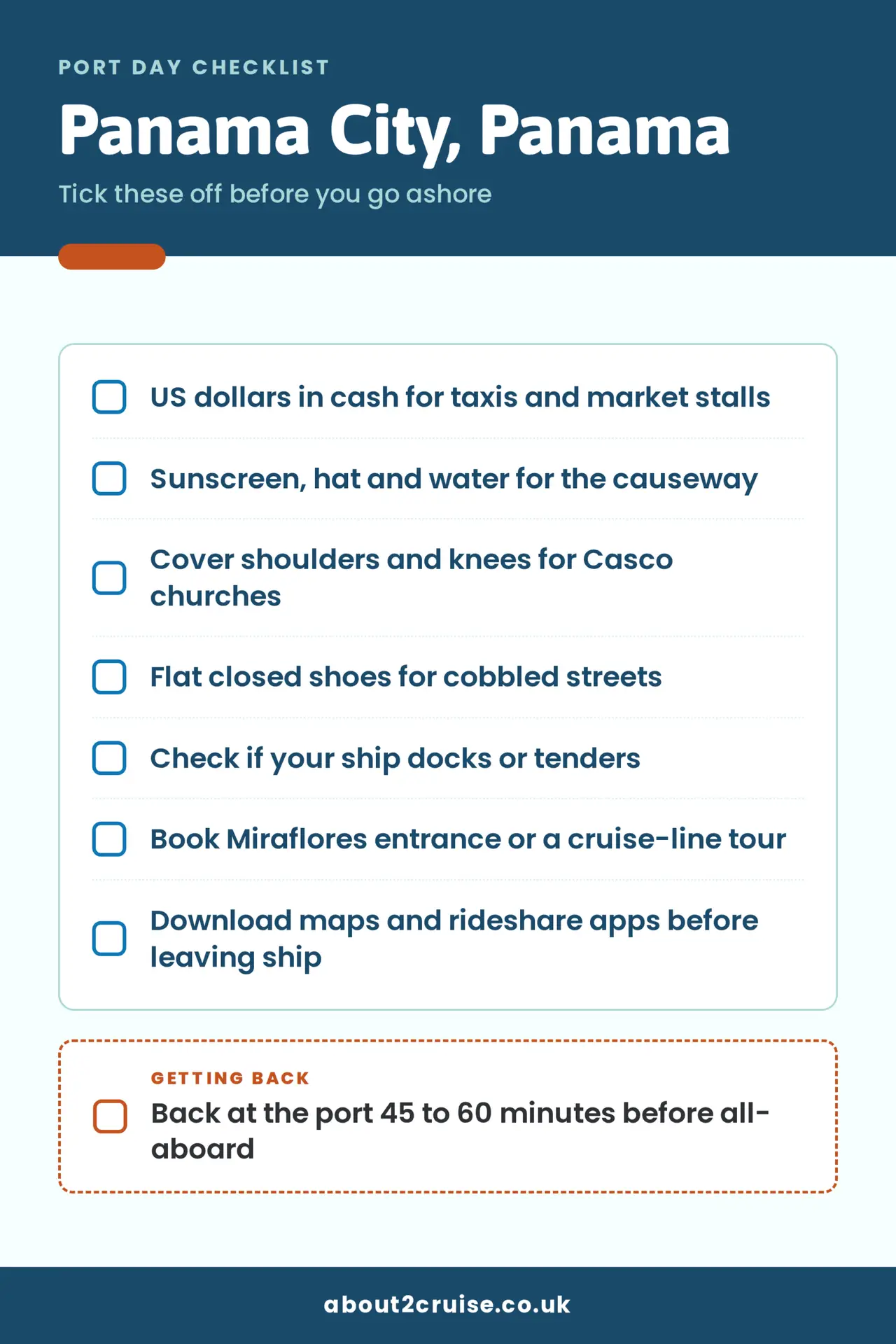
- Check your cruise line's port page to see if you dock or tender at Isla Perico.
- Book Miraflores Visitor Center tickets or a cruise-line tour that includes timed entry.
- Bring US dollars in cash for taxis and market stalls; yellow taxis are not metered.
Short port day: under 6 hours
- On dockingTaxi or Uber to Casco ViejoAgree fare firstYellow taxis are not metered; agree the fare before you get in. Rideshare is usually cheaper and easier.
- +30 minPlaza de la Independencia and CathedralStart in Casco Viejo's main square. Cover shoulders and knees to enter the cathedral; remove hats.
- +1 hr 30 minPaseo Esteban Huertas and Plaza de FranciaWalk the old sea wall for skyline and bay views. This is the classic ship-watching viewpoint.
- +2 hrs 30 minLunch at Mercado de MariscosTry cevicheSeafood ceviche at the fish market on the edge of Casco Viejo. Go before the midday rush.
- +3 hrs 45 minReturn taxi via Amador CausewayAsk the driver to pause at the causeway viewpoint for the skyline and ships before the terminal.
- All-aboard minus 1 hrBack at the terminalBe at the port area 45 to 60 minutes before all-aboard; afternoon traffic can clog.
This map shows the taxi ride from the ship. The time is the drive only, not your time ashore.
Open the taxi route in Google Maps
If plans change: If the fish market is too crowded, eat at a café on Plaza de la Independencia and use the extra time for the Canal Museum.
Long port day: 8 hours or more
- On dockingTaxi to Miraflores Visitor CenterCheck lock schedule20 to 25 minutes from the Amador terminal. Our Panama Canal cruise guide explains full transit versus port call.
- +30 minMiraflores Locks and IMAXAllow 90 minutesWatch ships in the locks from the observation platform and catch the Morgan Freeman IMAX film.
- +2 hrs 30 minTaxi to Casco Viejo15 to 25 minutes from Miraflores depending on traffic. Agree a fare for this leg before getting in.
- +3 hrsLunch in Casco ViejoTry sancochoSancocho or ceviche around Plaza Herrera. Casco Viejo is the city's gastronomic hub.
- +4 hrsWalk Casco Viejo old townPlaza de Francia sea wall, Paseo Esteban Huertas and the cathedral. Cover shoulders and knees for churches.
- +5 hrs 30 minTaxi back via Amador CausewayStop at the causeway viewpoint for skyline photos, then continue to the terminal.
- All-aboard minus 1 hrBack at the terminalBe at the port area 45 to 60 minutes before all-aboard; afternoon traffic can clog.
This map shows the taxi ride from the ship. The time is the drive only, not your time ashore.
Open the taxi route in Google Maps
If plans change: If Miraflores is closed or no ship is locking through, skip it and spend the whole day in Casco Viejo, adding the Canal Museum and a rooftop bar.
If you are using taxis or rideshares, book or negotiate each leg rather than keeping one driver waiting all day unless you have agreed a fixed hourly price. Allow 1.5 hours at Miraflores and at least two hours in Casco. For a shorter call, pick one: canal fans should choose Miraflores; food, history, and skyline lovers should walk Casco Viejo. Avoid a tight combination on a rainy-season afternoon when downpours and traffic both peak.
Best Time to Cruise the Panama Canal: Weather and Packing Tips
Panama City is hot, humid, and tropical all year, with daytime highs around 29–32°C. The dry season runs roughly mid-December to April. The wet season runs May to mid-December, with heavy showers often arriving between 2pm and 5pm. October and November are usually the wettest months. Panama sits outside the hurricane belt, so tropical cyclones are rare; the Atlantic hurricane season tends to bring rain rather than direct hits.
The most comfortable window for a Panama Canal cruise is October to April, especially from December onwards when the rains ease. The cruise season at the Amador terminal runs October to April, with many full transits clustering in spring and autumn when ships reposition between the Caribbean and Alaska or the US west coast.
Pack light, breathable clothing, a sun hat, high-factor sunscreen, sunglasses, comfortable walking shoes, and a light waterproof layer. If you plan to enter churches in Casco Viejo, bring something to cover shoulders and knees. If you will be on deck for hours during a canal transit, take more sun protection and water than you think you need, and remember that the humidity makes it feel hotter than the air temperature.
Money, Tipping, Language, and Local Etiquette in Panama
Panama uses the balboa, pegged 1:1 to the US dollar. There are no balboa paper notes; US dollar bills are the everyday currency, while Panamanian coins circulate alongside US coins. You do not need a separate currency. Cards are widely accepted in hotels, restaurants, and shops, but carry some cash for small vendors, market stalls, tips, and any taxi you negotiate. Use ATMs inside banks or shopping centres rather than on the street.
Tipping is not legally obligatory. In practice, 10% is common in restaurants, bars, and hotels, but a business may suggest a tip rather than impose one. Check the bill before adding anything extra.
Spanish is the local language. In tourist areas, English is common but not universal. A few Spanish phrases help, especially with drivers. Panama City is generally friendly to cruise visitors, but dress is more modest than beach casual when visiting churches or government buildings. Ask before photographing people, especially in the Emberá villages and markets.
Staying Safe in Panama City: Areas to Watch and Practical Tips
Panama City is a major capital, and street crime is concentrated in specific areas. Take particular mugging precautions in San Miguelito, El Chorrillo, Río Abajo, 24 de Diciembre, Santa Ana, and Juan Díaz, and stay alert around Albrook Mall, Vía España, Avenida Central, Calidonia, Casco Viejo, and Panama Viejo. Casco Viejo is a tourist highlight, but step out of its core after dark only on busy, well-lit streets.
Do not swim in the Bay of Panama, it is highly polluted. Carry a form of ID; a printed copy of your passport is usually acceptable. Avoid walking alone late at night and avoid poorly lit areas. Protests can block roads, including routes to the airport, at short notice, so stay in touch with your ship’s contact points on a port day. Use hotel-arranged transport or rideshare rather than flagging a taxi at night.
Panama Visa and Entry Requirements for Cruise Passengers
For UK passport holders arriving by cruise ship or transiting the Panama Canal, no visa is required for stays of less than three months. Your passport needs at least six months’ validity beyond your departure date and at least one blank page. If you leave the ship, officials may stamp your passport; ships in transit often do not have officials board.
You may be asked for an accommodation address, an onward ticket, and proof of funds, roughly US$1,000 or a credit card. A digital immigration and customs declaration is recommended before travel, as paper forms are being phased out. A yellow fever certificate is required if you are arriving from a country with transmission risk, but that is more relevant to some South American and African itineraries than to a cruise from the US or Europe. Airport departure tax is normally included in your ticket.
Accessibility and Mobility at the Panama City Cruise Port
At the port, the biggest accessibility variable is tender operations. If your ship anchors offshore rather than docking at Isla Perico, you must step down into a moving tender. Staff cannot lift passengers individually, and the captain decides who may go ashore. If you use a wheelchair, scooter, or rollator, or if stepping into a boat is difficult, contact the cruise line before sailing and set expectations clearly.
At Miraflores, there is a lower observation platform with wheelchair access, but not all areas of the complex are step-free. Panama Viejo provides internal transport from the visitor centre to the monuments, which helps with distances. Casco Viejo’s cobbled streets and narrow kerbs are the most difficult terrain; take a taxi or rideshare into the old town rather than walking from the modern centre. The causeway itself is flat and paved, but there is little shade.
Luggage storage is not reliably available at the cruise terminal. If you have a late flight after disembarking, the airport has a left-luggage office in Terminal 1 on level 100, usually open 24 hours and costing from about US$5 per suitcase per day. Otherwise, arrange storage through your hotel.
Wi-Fi and Connectivity in Panama City
Wi-Fi is generally good in Casco Viejo cafés, restaurants, and hotels, and at the Amador terminal if you are in a passenger building. The causeway and the photo platforms are not reliable for sustained connectivity. If you need maps, translation, or rideshare apps, download them before you leave the ship. Roaming costs depend on your UK provider: check whether Panama is included, because you will otherwise want to use a hotel or café network. Local SIMs are widely available in the city but are rarely worth buying for a single port day.
What to Buy in Panama City: Souvenirs and Local Crafts
The easiest quality souvenir stops are the Mercado Nacional de Artesanías next to Panama Viejo and the artisan stalls along the Paseo Esteban Huertas in Casco Antiguo. You will see molas, the layered Guna textile panels, carvings, jewellery, and the sombrero pintao, a woven hat with UNESCO-listed intangible cultural heritage status. Many visitors call any Panamanian hat a “Panama hat,” but the classic fine straw hat with that name is traditionally associated with Ecuador; the sombrero pintao is Panama’s own woven hat. Buy from a market or artisan store so the maker’s work is more likely to reach the right community. Bargaining is not the norm in fixed-price shops, but markets may allow polite negotiation.
What to Eat in Panama City: Local Dishes and Drinks
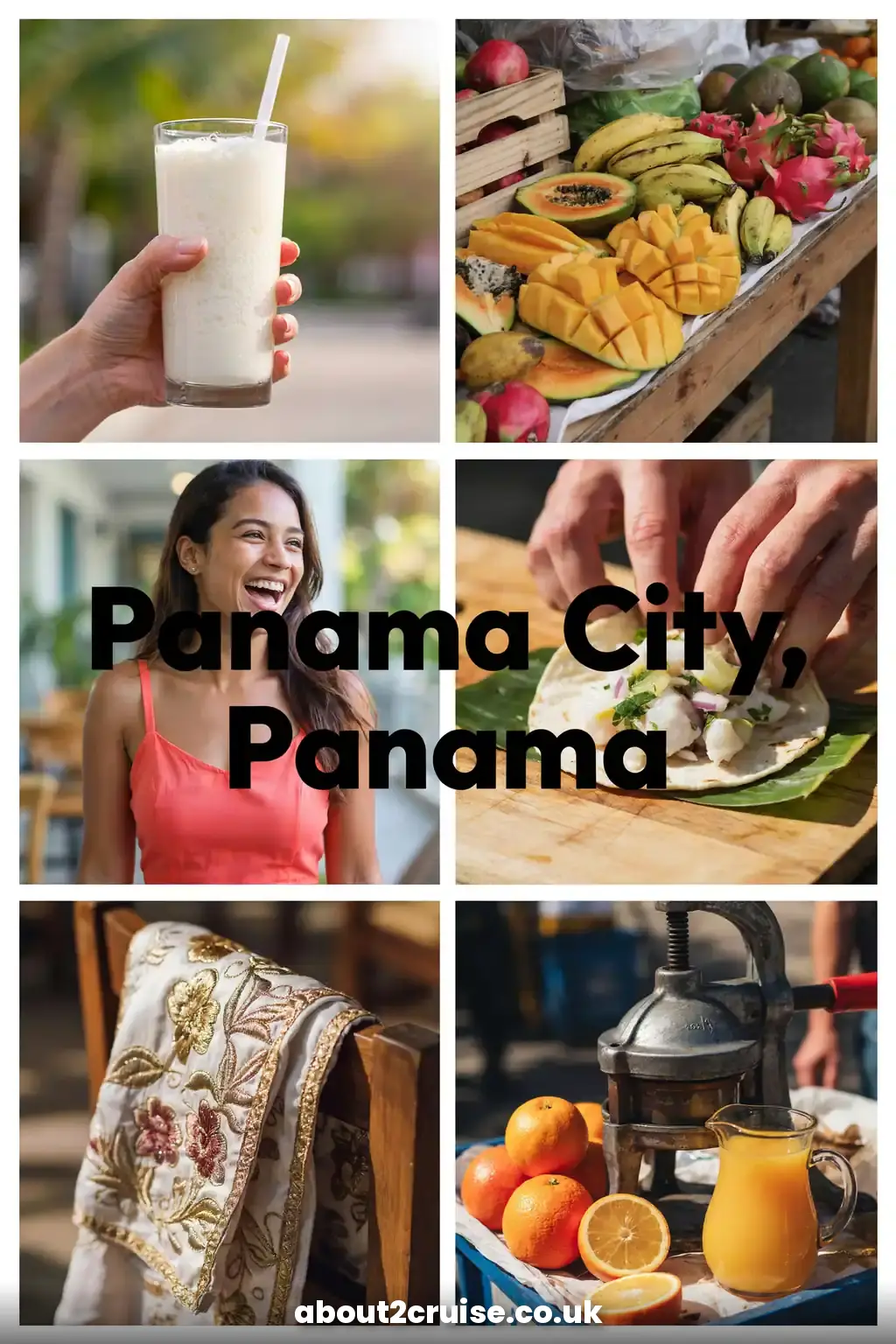
Panama City eats well. Sancocho, the national chicken soup, ropa vieja, carimañolas, patacones, and corvina are everyday staples. Seafood ceviche is a must at the Mercado de Mariscos on the edge of Casco Viejo, arrive before the midday rush for the best choice. Tamal de olla, hojaldas at breakfast, and ripe plantains round out the local menu.

Casco Antiguo is the city’s gastronomic hub, with speciality coffee, craft beer, rooftop bars, and serious restaurants. Geisha coffee from Chiriquí and Boquete is one of Panama’s most expensive and prized exports; a good coffee shop will explain what makes the lot special. Local spirits are seco and Panamanian rum. In tourist restaurants, tap water is often fine, but bottled water is the safer choice for a short visit, especially if you are prone to stomach upsets.
The Best Photo Spots in Panama City
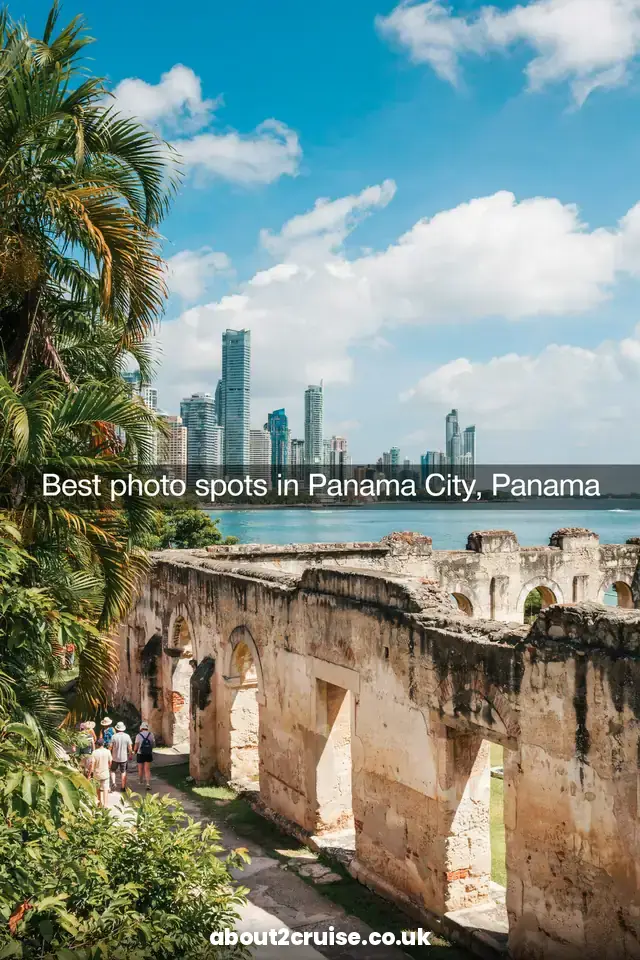
Panama City offers several distinct photo looks. For ships in the Miraflores Locks, the observation platform is the obvious choice, but you need to be there when a ship is actually locking. For anchored ships and the modern skyline, stand at the Plaza de Francia sea wall in Casco Viejo at dawn or sunset. The Amador Causeway gives you the skyline with ships entering or leaving the canal; the best sunset light is roughly 17:00–18:00 in the dry season and 18:00–19:00 in the wetter months. At Panama Viejo, the cathedral tower frames ruined stone against glass towers. Cerro Ancón is the broad panoramic overlook for the city and canal entrance.
Where to Stay Near the Panama City Cruise Terminal
If you are embarking or disembarking in Panama City, arrive at least a day early, especially from the UK. Stays split between Casco Viejo for atmosphere and restaurants, downtown Bella Vista and the financial district for chain hotels and city convenience, and Amador/Balboa for proximity to the terminal. The closest hotels to the Isla Perico terminal are the MARINN Tropical Vibes Hotel, about 0.9km or an 11-minute walk away, and the Amador Ocean View Hotel & Suites, about 0.75km or a 10-minute walk away. The Sofitel Legend Casco Viejo puts you in the old town, roughly 4.1km from the terminal. Book Amador-side rooms early if your priority is a stress-free embarkation morning.
Panama City Cruise Port: Your Questions Answered
How do cruise ships go through the Panama Canal? A pilot boards and takes navigational control. The ship is lifted in stages through locks to Gatun Lake, about 26m above sea level, then lowered again on the other side. A full transit takes roughly 8–12 hours and covers about 50 miles.
What is the best month to go on a Panama Canal cruise? The best period is October to April, with the most comfortable weather from December onwards. The dry season runs mid-December to April, and October and November are the heaviest rain months.
Is Panama City cruise port a tender port? It can be. Ships may dock at Isla Perico or anchor offshore at Flamenco and use tenders, especially on busy canal dates. Check your cruise line’s documentation rather than assuming a docked gangway.
Can I see the canal from Casco Viejo? You cannot see the locks from Casco. You can see ships at the canal’s Pacific entrance and anchored in the bay, especially from the Plaza de Francia sea wall and rooftop bars.
How far is the cruise terminal from Casco Viejo? It is usually 6–9km, about 15–25 minutes by taxi or rideshare, depending on traffic.
Do cruise passengers need a visa for Panama? UK passport holders arriving by cruise ship or transiting the canal do not need a visa for stays under three months. Your passport should have six months’ validity and a blank page.