
A Panama Canal cruise comes in three shapes: a full ocean-to-ocean transit through all the locks, a partial transit into Gatun Lake and back, or a Colón port call with no lock transit at all. Check the port list before you book, because only a full transit takes you through end to end.
Full transit, partial transit or a Colón port call: how to tell them apart
The expensive mistake is paying ocean-to-ocean money for a round trip from Florida that turns round halfway through the canal. The other one is booking a trip sold as a canal cruise that never enters a lock. You can spot both from the wording and the port list.
- Full transit. The ship enters from one ocean and leaves into the other, working Gatun, Pedro Miguel and Miraflores locks (or Agua Clara and Cocoli on the newer lane). On the port list it shows up as a scenic cruising day with no port at all, something like ‘Panama Canal Full Transit, arrival 06:00, departure 16:30’.
- Partial transit. The ship comes in from the Caribbean side, climbs through Gatun Locks into Gatun Lake, turns round and goes back out the same way. You’ll see it as a Gatun Lake call plus a Colón call, usually on a round trip from Florida.
- A Colón call. The ship docks at Colón and the canal is a shore excursion, not a transit. You might see the canal from a coach or a tour boat, but your ship never goes through a lock.
The length of the cruise is your next clue. Partial transits from Florida usually run 10 to 11 nights round trip.
Full ocean-to-ocean crossings are typically 14 to 16 nights and one-way. Holland America’s canal programme follows the same split: full transits at 14 to 23 days, partials at 10 to 11.
Watch the wording too. A port list entry that says you’re ‘cruising’ the canal doesn’t always mean a sail-by.
It can mean a proper transit. If the itinerary doesn’t spell out which ocean you enter and leave by, or name the locks, ask before you pay.
Panama Canal map: the locks, Gatun Lake and the cruise ports
The canal runs from Colón on the Caribbean to Panama City on the Pacific, with a set of old and new locks at each end and Gatun Lake in the middle. Tap a pin for directions.
- Colón 2000 cruise terminalCruise terminal, Caribbean end
- Cristóbal cruise pierCruise pier, Caribbean end
- Fuerte Amador cruise terminalCruise terminal, Pacific end
- Atlantic BridgeBridge · About 7 km from Colón 2000 cruise terminal
- Agua Clara LocksCanal locks · About 10 km from Colón 2000 cruise terminal
- Gatun LocksCanal locks · About 10 km from Colón 2000 cruise terminal
- Gatun LakeLake · About 22 km from Colón 2000 cruise terminal
- Centennial BridgeBridge · About 46 km from Colón 2000 cruise terminal
- Pedro Miguel LocksCanal locks · About 49 km from Colón 2000 cruise terminal
- Miraflores LocksCanal locks and visitor centre · About 52 km from Colón 2000 cruise terminal
- Cocolí LocksCanal locks · About 53 km from Colón 2000 cruise terminal
- Bridge of the AmericasBridge · About 58 km from Colón 2000 cruise terminal
- Amador CausewayCauseway · About 63 km from Colón 2000 cruise terminal
- Casco Viejo, Panama CityOld quarter · About 60 km from Colón 2000 cruise terminal
Which locks your ship uses: historic chambers or the new lane
Your ship decides which locks it uses, not you. The original Panamax locks take a maximum beam of 32.31 m (106 ft) and a length overall of 289.6 m (950 ft), with passenger ships allowed up to 294.43 m (966 ft).
The neopanamax locks take 51.25 m (168.14 ft) beam and 370.33 m (1,215 ft) length. By the Panama Canal Authority’s definition, anything over 107 ft beam or 966 ft length is a neopanamax vessel, and it can only use the new lane.
That’s why so many big modern ships can only give you the new locks. Cunard’s Queen Mary 2 and Queen Anne go through the neopanamax locks, as do Celebrity Edge-class ships, Norwegian Bliss and the Prima class, and Sun Princess. Queen Victoria and Queen Elizabeth use the original historic locks.
Princess Cruises is the easiest line to book if you care which locks you get, because it sells two separate products. Its 16-day ocean-to-ocean itineraries between Los Angeles or San Francisco and Fort Lauderdale use the historic locks, on Coral Princess and Island Princess, ships built to fit them.
Its 12-day round trips out of Florida, on Emerald Princess and Caribbean Princess, go through the new locks. Don’t assume a partial transit means old locks.
The historic locks give you the thing people come for. Electric locomotives called mules run along the lock walls, two lanes work side by side, and your hull sits inches from concrete. The new lane is single-lane, wider, and less gripping from the deck rail.
Nobody publishes which locks your particular sailing will use. The canal authority assigns the slots, and most lines just say ‘as assigned by the canal authority’. If your itinerary doesn’t name the locks or the lane, check your cruise documents nearer the time.
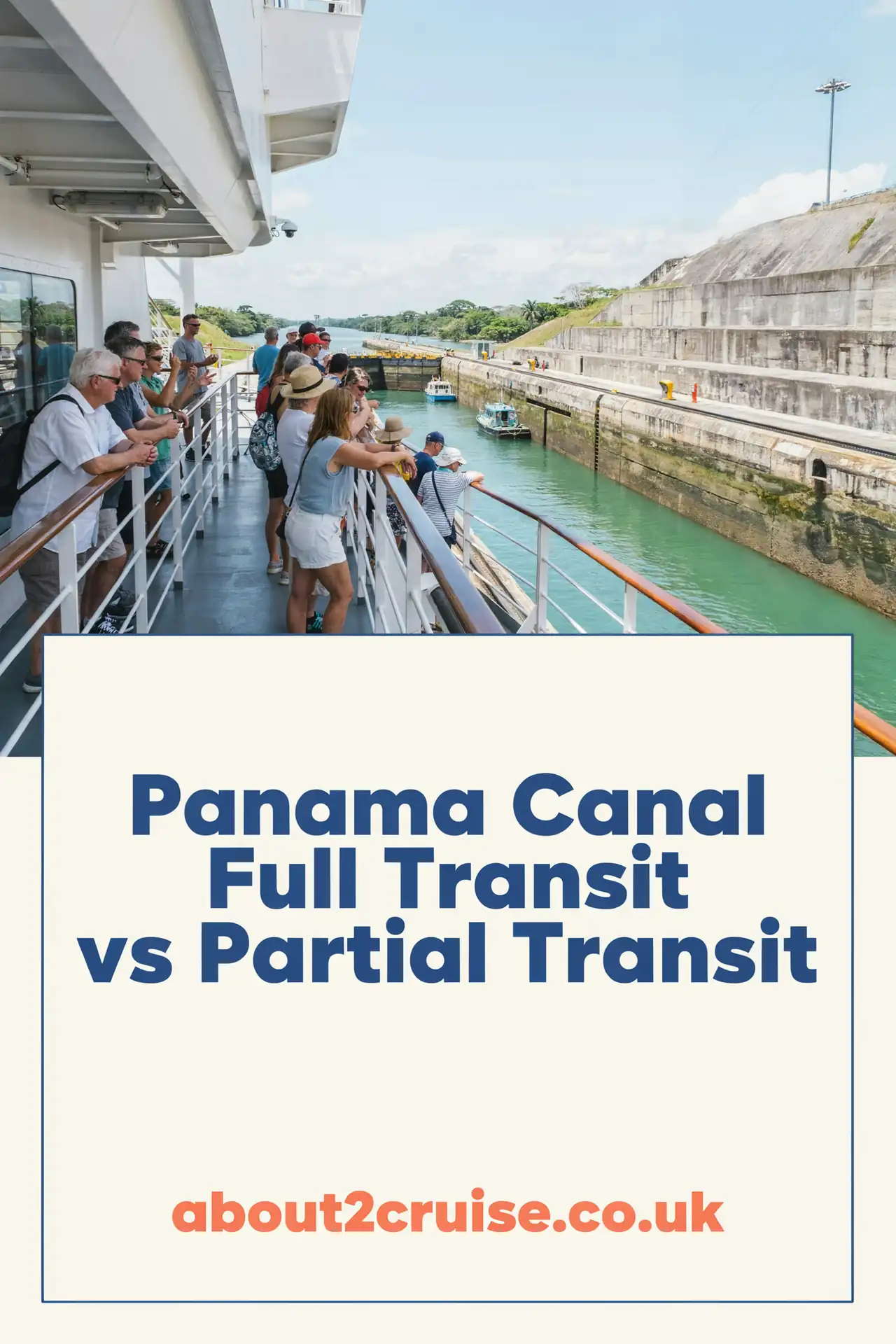
What the transit day is like
Plan for a full day, somewhere between eight and twelve hours, and plan for an early start. The canal is 48 miles long and lifts ships 85 ft.
From the Atlantic side you work three Gatun Locks up to Gatun Lake, cross the lake and the nine-mile Culebra Cut through the Continental Divide, drop 31 ft at Pedro Miguel, then the remaining 54 ft at the two Miraflores Locks into the Pacific. Gatun Lake alone covers 164 sq miles and accounts for 21 miles of the waterway.
A Panama Canal Authority pilot comes aboard and directs the transit. Your ship’s officers don’t con the vessel through. Commentary usually comes from the bridge over the public address, sometimes with a local expert aboard for the day; Holland America carries one on its canal voyages.
The bit people get wrong is the pace. Long stretches are slow progress across a lake in equatorial heat, not constant drama, and plenty of passengers retreat indoors by lunchtime. Plan for shade, water and a hat, and treat the locks as the two or three hours that matter rather than a full day of theatre.
The ship doesn’t set the timing. The canal authority assigns time slots, the ship anchors in a designated area and waits for instructions, and tour departure times are announced on board.
You could approach the locks before dawn or still be in them in the evening. Some large vessels are restricted to daylight transits, which is another reason not to book a tight flight.
Sailing east to west or west to east: what direction changes
There’s no best direction, only a best direction for you. Lines sell the same itinerary both ways, and Princess runs its 18-day New York to Los Angeles routing in reverse order on the return.
What does change is the flight and the clock.
- The one-way flight. Finish in a different ocean and you need an open-jaw ticket home. Both directions work; the cost lands at one end or the other, and a full round voyage avoids it altogether.
- The hour. You gain or lose time crossing between coasts, which matters most on a short itinerary.
- When the locks fall. From the Caribbean side the Gatun Locks come first thing in the morning. From the Pacific side Miraflores and Pedro Miguel are worked before the lake crossing, and the Gatun Lake stretch falls later in the day.
- Which ports come first. A Pacific-to-Atlantic run puts the Central American and Mexican calls before the canal; the reverse puts the Caribbean first.
Canal time is Eastern Standard Time, which catches out anyone comparing tour times with a watch still on UK time.
Balcony, bow or open deck: where to be on transit day
The open decks beat the cabin, and the bow beats the balcony. A balcony shows you one side of the lock, and when the walls rise you’re looking at concrete a few feet away. The panorama is above you.
- The bow is best for entering a lock and seeing the gates ahead.
- The stern is best for watching the gates close behind you.
- The upper open decks give the overall picture and let you move side to side.
Some ships open a normally crew-only forward area for the day, at the captain’s discretion. Ask about it on board. Many ships relay the bridge camera and commentary to cabin televisions, so you can sit in the air conditioning without missing a lock.
Port or starboard makes no consistent difference, and anyone who tells you otherwise is repeating their own sailing. Book the cabin you want for the other thirteen days, then watch the transit from the rail.
When to go: the canal season runs October to April
Mid-December to April is the dry season and the best window, with the main passenger season running roughly October to May. The canal runs year-round, but full and partial transit choices thin out between June and September, which is why you see so few summer sailings.
The wet season coincides with the Atlantic hurricane season, June to November, with the heaviest rain in October and November. Fares swing inside that window: school holidays and the dry-season peak cost more, and the shoulder weeks at either end are where the value sits.
What a Panama Canal cruise really costs
The fare is the smaller number. A two-week, sea-day-heavy sailing carries gratuities, drinks, wifi, speciality dining and excursions, plus a one-way flight at one end.
Onboard charges, per person per day:
- Cunard: US$18 Hotel and Dining Service Charge in Britannia and Britannia Club, US$19 in Queens and Princess Grill suites.
- Princess Cruises: US$18 Crew Appreciation in standard staterooms, US$19 in mini-suites, cabanas and Reserve Collection, US$20 in suites, unless you’re on a Plus or Premier package.
- Bar and speciality bills: Princess adds 20% to onboard food and beverage purchases. Cunard lists 15% on bar, wine and spa, but check the current rate before you budget.
Fares themselves go stale too fast to quote. What drives the gap is days aboard, the one-way air, and whether the sailing is a repositioning.
Full transits cost more than partials because they’re longer and one-way. No published figure survives a season.
Which cruise lines run the canal, and who each suits
Pick the itinerary first, then the line, because your favourite brand may not offer the transit type, direction or ship size you need.
- Princess Cruises has sailed the canal for decades and is the only line that states historic or new locks per itinerary. Full transits on Coral Princess and Island Princess, new-lock round trips on Emerald Princess and Caribbean Princess. It says it brings more guests to the canal than any other line. Treat that as a company boast, not an audited figure.
- Holland America uses mid-sized ships for full transits through the historic locks or partial transits, embarking Vancouver, Seattle, San Diego and Fort Lauderdale, with a local expert aboard for commentary.
- Cunard can send all four Queens through, with Queen Victoria and Queen Elizabeth on the historic locks and Queen Mary 2 and Queen Anne on the new ones.
- P&O Cruises carries canal itineraries on its adults-only ships, with a full transit on Arcadia and a partial on Aurora.
- Fred. Olsen Cruise Lines is adults-only, with tips and selected drinks with meals included on its Borealis world voyage.
- Norwegian Cruise Line has homeported at Colón and Fuerte Amador for canal round trips.
If you want a specific ship, check its dimensions against the historic lock limits before you assume you’ll get the old chambers.
Panama Canal cruises from the UK: Southampton sailings and fly-cruises
Most canal advice is written for Americans choosing between two coasts. From Britain you’ve got two routes in: a no-fly round voyage from Southampton that includes the transit as one day of a long itinerary, or a fly-cruise with the canal tucked into a Caribbean or US-coast sailing.
Southampton round voyages that include a full transit:
- Fred. Olsen Borealis, a 98-night round-the-world voyage from Southampton with a canal transit and an overnight in Colón. Adults-only, tips included.
- Cunard Queen Victoria, a 109-night Southampton round voyage with a full transit on day 17 and a return to Southampton, no flight at either end.
- P&O Cruises Arcadia, a 106-night Southampton round world voyage with a full transit.
Shorter and one-way options exist. Cunard sells Southampton to Los Angeles sectors of the Queen Victoria voyage with an inbound flight from Los Angeles included. That’s the fly-cruise mechanic in its simplest form: you sail one way and fly the other.
Marella is a fly-cruise line only, with canal content inside Caribbean packages flying from Heathrow with regional connections, not a UK round trip. Its canal element from Colón has been a partial transit by local boat rather than the ship going through.
The trade-off is time against flights. A Southampton round voyage means no long-haul flight and no baggage allowance worry, but the canal is one day of three months.
A fly-cruise puts you in Florida or California quickly and then runs 10 to 16 nights. The one-way air premium has no stable published figure, so price the open-jaw flight before you commit to an ocean-to-ocean itinerary.
Ports either side of the canal and what the rest of the itinerary adds
The canal is one day of a two-week cruise. Check the port list, because the difference between a port-heavy route and a sea-day-heavy repositioning is most of your holiday.
On the Pacific side, Fuerte Amador for Panama City sits at the canal entrance on the Amador Causeway, a one-mile causeway joining four islands built from canal excavation rock. It can be an anchorage with tenders, and ships on full transits typically arrive in the morning and stay the day.
The purpose-built Pacific Cruise Terminal is on Perico Island at the end of the causeway, about three miles from the mainland and ten minutes by road into Panama City.
On the Caribbean side, Colón has two berths roughly 2 km apart and about ten minutes by taxi: Colón 2000, with a mall at the gangway, and Cristóbal Pier 6, used by ships that enter the canal. The Gatun and Agua Clara locks are about a 25-minute drive from Colón, and Panama City is about an hour by train or coach.
Colón itself has a street-crime reputation, so stay inside the secured pier area unless you’re on a tour or with a driver. See the Colón Panama cruise port guide for the terminal layout.
The rest of a typical canal itinerary fills out with Caribbean and Central American calls. Cartagena and the ABC islands are the common Caribbean element, so Willemstad in Curaçao and Oranjestad in Aruba are worth checking against your dates, alongside the wider Western Caribbean cruise ports guide.
Closer to the canal, many sailings also stop at the San Blas Islands off Panama’s Caribbean coast, or at Puerto Limón in Costa Rica.
Costa Rica usually means Puerto Limón, Guatemala means Santo Tomás de Castilla, and Mexico brings a Cozumel or Costa Maya call. Some sailings add the San Blas Islands, which is a tender call and a different kind of day entirely.
A full transit out of Fort Lauderdale or Los Angeles will start or finish at Port Everglades in Fort Lauderdale, Los Angeles or San Diego, so read the port guide for whichever end you fly into.
The partial transit shore-excursion trap
On a partial transit, leaving the ship at Gatun Lake for a coach or boat tour means you rejoin at Colón, and you miss the return passage through the locks. That’s the trade nobody spells out at the booking stage.
At Gatun Lake only passengers on ship-booked tours may get off. Norwegian Cruise Line and Princess Cruises both say so, and it isn’t a marketing rule: there’s no town, no commercial transport and no independent touring at the lake. Those who stay aboard retrace the Gatun Locks and dock at Colón, where the tour passengers rejoin.
The common add-on is a ferry transit of the Pacific locks and the Culebra Cut, five to six hours as a standalone tour, which shows you lock operation at water level. It’s a good tour. It isn’t the canal transit you thought you were buying, and on a partial transit you see only a fraction of a fifty-mile waterway.
Gatun Lake is a tender port, so the call depends on sea and weather, and the captain decides who goes ashore. Princess cannot physically lift more than 50 lbs (22 kg) per guest, so anyone needing physical assistance must travel with an able-bodied companion. If accessibility matters, ask the line directly before you book the partial rather than the full.
Panama Canal cruise FAQs
Does a partial transit go through the original locks or the new ones?
A partial transit can use either the original locks or the new ones, and the ship decides which. Princess Cruises’ 12-day round trips go through the new locks, while its ocean-to-ocean itineraries use the historic chambers. Never assume partial means old locks.
Will I definitely see the locks in daylight?
You might not see the locks in daylight, because the canal authority assigns the slot. Some large vessels are restricted to daylight transits, and cruise lines schedule crossings in daylight where they can, but the timing is still out of their hands. You could enter before breakfast or finish in the evening.
Can I stay on the ship during a partial transit and skip the excursion?
You can stay on the ship during a partial transit and skip the excursion, and plenty of passengers do. You retrace the Gatun Locks and dock at Colón, then rejoin the ship’s tour passengers there. You see the Caribbean-side locks twice and miss the Pacific side entirely.
Is a balcony worth it for the canal day?
A balcony is not worth it for the locks, though it may be worth it for the rest of the cruise. A balcony shows one side only, and the lock walls block the view as you rise. Book the cabin for the rest of the cruise and watch the transit from the open decks, the bow and the stern.
How far ahead should I book?
Book a full transit well ahead, because these are one-way sailings with limited departures and the season runs roughly October to May. Waiting rarely produces a better cabin, only a different itinerary.
Do I need a visa for Panama on a canal cruise?
UK passport holders need to check Panama’s current entry rules for a canal cruise with the cruise line and the Panamanian authorities before sailing, because rules change and transit-only days differ from days ashore.
Last Updated: 19 November 2026