
Patmos is an island of two halves: a sleepy whitewashed harbour at Skala, where your ship arrives, and a sacred hilltop almost 250 metres above it, crowned by the fortified Monastery of St John the Theologian. Cruise ships almost always anchor off and tender into Skala. From there, the UNESCO-listed trio, Chora, the monastery and the Cave of the Apocalypse, is either a short bus or taxi ride uphill or a genuinely steep walk. With four to six hours ashore you can see the island’s spiritual heart and still have time for a harbour lunch; with more time you can add a beach or island drive.
Why Patmos? The Short, Honest Answer
Patmos is known as the island of the Apocalypse. Christian tradition says that around AD 95, John, St John the Theologian, was exiled here and wrote the Book of Revelation in a small cave on the hill between Skala and Chora. The Orthodox Church also believes the Fourth Gospel was dictated here to his disciple Prochoros. Whether you’re a pilgrim, a history lover or simply a curious cruise passenger, that single fact shapes everything: the architecture, the dress rules, the quiet atmosphere, even the island’s legal status.
In 1981 Greece declared Patmos a Sacred Island by law. That’s not tourism marketing: it’s why you won’t find big hotel chains, noisy beach clubs or heavy development. The island has around 3,000 year-round residents, no airport and one commercial port. Forbes once called it Europe’s most idyllic place to live. It sits in the northern Dodecanese, close enough to Turkey that you can often see the mainland from the monastery terrace.
Skala vs Chora: Where Your Ship Actually Docks
If you’ve been searching “Patmos cruise port” and ended up reading about Chora, it’s easy to get confused. Skala is the port. Chora is the capital. They’re two different places, about 3–4 km apart by road and roughly 250 metres apart in elevation. Your ship arrives at Skala, the island’s only commercial harbour and ferry port, on the central-east coast.
Skala gets its name from the Italian scala, meaning port or landing place: a leftover from the Venetian and Genoese era and the long Italian period in the Dodecanese. The town wraps around a long, sheltered natural bay. The water is deep enough for ferries and smaller cruise ships to come alongside. When you arrive, you’ll see a horseshoe of white and ochre buildings, a low waterfront where taverna chairs almost touch the water, and the big hill rising behind.

Patmos cruise port map
The map shows Patmos and the places worth seeing. Tap a pin for directions.
- PatmosTown centre
- GrikosAbout 23 min walk from the town centre
- Kampos beachBeach · About 5 km from the town centre
- Psili Ammos beachBeach · About 3 km from the town centre
- Kalikatsou rockRock · About 2 km from the town centre
- SkalaPort town · About 29 min walk from the town centre
- Monastery of Zoodochos PigiMonastery · About 66 km from the town centre
- Agriolivadi BeachBeach · About 4 km from the town centre
- Lambi BeachBeach · About 79 km from the town centre
Tender or Dock? How Patmos Arrival Works
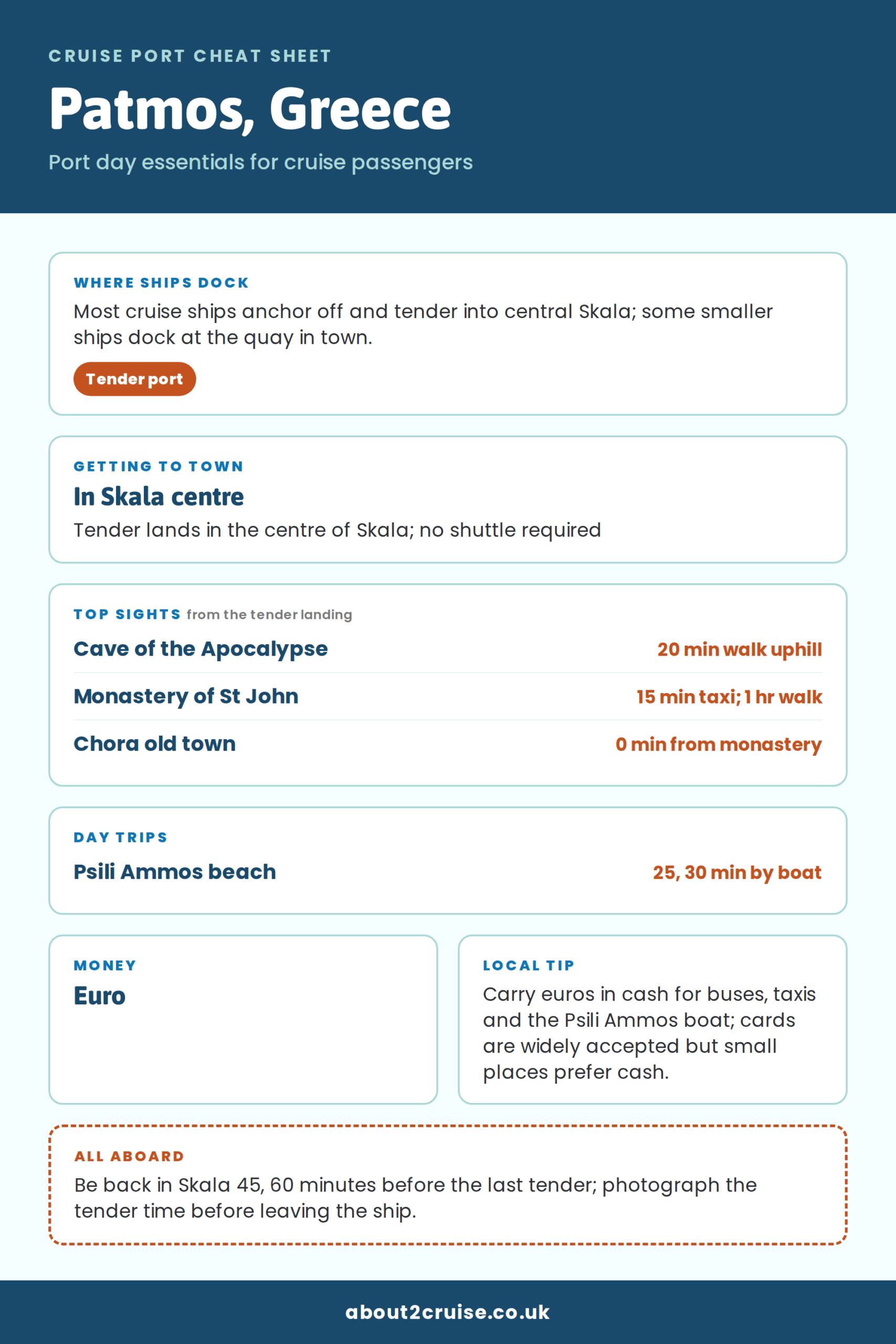
For most cruise passengers, Patmos is a tender port. Your ship usually anchors off Skala and the ship’s tenders, sometimes local port tenders, bring you ashore. The good news? The tender ride is short and drops you right in the middle of town, not at some distant industrial quay.
That said, not every ship tenders. Skala’s main quay has about 200 metres of berthing space with roughly 6.5–7.3 metres alongside. That’s enough for smaller and mid-sized cruise ships, expedition vessels and larger ferries. When a large ship needs the quay, or ferry movements clash, the port can assign a ship to anchor instead. Official port data mentions one quay, maximum ship length around 200 metres, compulsory anchoring at designated anchorages like Koumana and Vamvakia, and port tenders when needed.
The practical rule: assume you’ll tender unless your itinerary specifically says otherwise. Even ships that sometimes dock can shift to anchoring because of wind, sea state or another vessel already on the quay. Why does this matter? Tendering eats time at the start and end of your call: usually 10–20 minutes each way plus waiting. Wind can slow things down, and on rare days tender operations are suspended entirely.
First Impressions of Skala: Flat, Compact and Easy
Skala is one of the easiest Greek island ports to get your bearings. It’s flat, small and built along the waterfront. The tender landing point is effectively in the centre of town. From the quay you can reach:
- Harbourfront cafes and tavernas: 1–5 minutes on foot
- Shops and mini-markets: along the main harbour road, a minute or two from the quay
- Taxi rank: about 100 metres from the pier
- Bus stand: in the centre of the port, directly opposite the police station, a short walk from the tender landing
- Skala town beach: a narrow pebble strip immediately north of the ferry dock, shaded by trees
There’s no big cruise terminal, no long transfer and no shuttle bus required. That’s the pleasure of Patmos: you can be sitting with a coffee within five minutes of stepping off the tender.
On Your Own or a Shore Excursion? What Works Best
Patmos is genuinely doable on your own, but the choice should come down to time and mobility, not fear of missing out. A shore excursion removes the hassle of buses, tickets and dress-code worries, and it guarantees a guide who can explain what you’re seeing inside the cave and monastery. The independent route is cheaper and more flexible, but you’re in charge of your own clock.
The maths is simple. If your ship gives you four to six hours ashore, the monastery, cave, Chora and a quick Skala stop are achievable but tight. With three hours or fewer, pick one thing: either the sacred hill, or Skala plus a beach: not both. With seven hours or more, you can add a proper lunch, a swim or a slow island drive after the sites.
For most first-timers on a typical 4–6 hour call, this order works best: take the local bus or taxi up to Chora early, visit the monastery, then walk or ride down to the Cave of the Apocalypse on the way back, and finish in Skala with food and browsing near the tender point. That puts you on the downhill side of the island and leaves the easiest, flattest part of the day for the end.
If you tend to worry about getting back on time, a ship excursion is the lower-stress option. The ship waits for its own tours. It will not wait for an independent passenger who loses track of time.
Don’t Miss the Last Tender: Your Safety Buffer
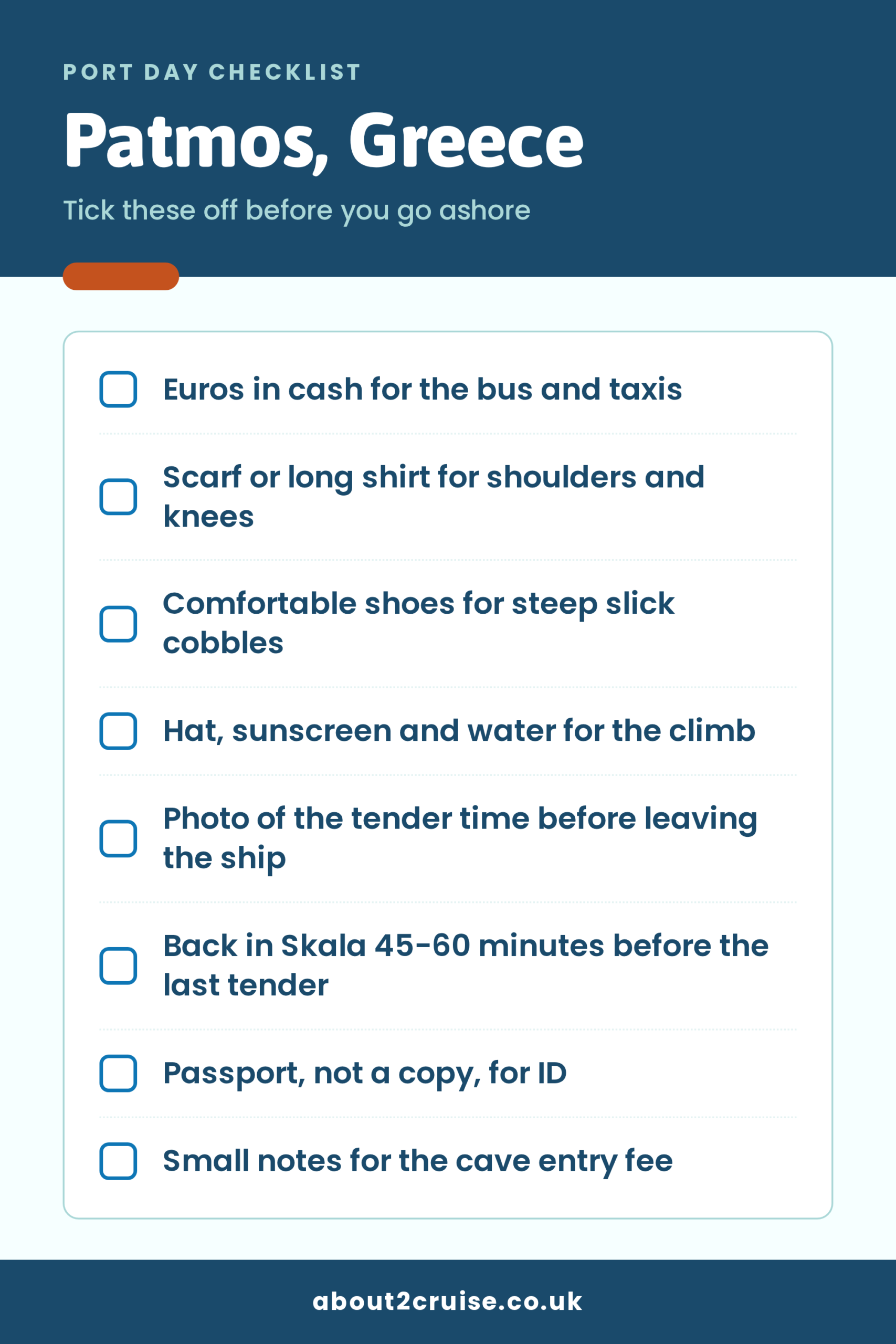
The biggest mistake on Patmos is treating the last tender as negotiable. It isn’t. Tender queues form near the advertised time, and on a small island there’s no alternative if you miss the ship. Be back in Skala 45–60 minutes before the last tender, not the ship’s departure time. Photograph the tender time on the gangway board before you leave the ship. If you’re independent, check the watch against local time: Greek time in cruise season is UTC+3, and ship time is not always the same as local time.
If something goes badly wrong and the ship leaves without you, the realistic catch-up route is a ferry to Samos or Kos, where you could rejoin by air or sea. That’s a costly and complicated fix. Patmos is a small community; ferry schedules won’t magically line up with your cruise line.
How to Reach Chora, the Monastery and the Cave
There are four realistic ways up from Skala to the sites: bus, taxi, walking and rental vehicle.
By Local Bus
The public bus between Skala and Chora runs roughly four times a day each way on weekdays, with typical departures from Skala around 07:30, 09:45, 11:35 and 13:20, and returns from Chora about 20–25 minutes later. There’s no scheduled service at weekends. Fares are paid in cash on the bus; tickets aren’t sold in advance, so carry coins. The operator sometimes adds extra unscheduled runs when cruise ships arrive, but don’t build your day around an unadvertised extra.
Two warnings. First, the Cave of the Apocalypse is between Skala and Chora, so if you ride the bus all the way up, plan the cave as a stop on the way back down or up. Second, some Skala–Chora departures route via Grikos and take much longer: check the timetable footnote before boarding.
By Taxi
Patmos has only about 12 licensed taxis. They queue at the rank in central Skala, about 100 metres from the pier. On a cruise day, demand is predictable and intense in the first hour after tendering starts. A one-way fare from Skala to Chora is commonly quoted at around €7–10, but there’s no published tariff, so agree the price before you get in. The central taxi number is +30 22470 31225 if you want to arrange a pick-up.
Taxis can’t enter the fortified core, so they drop you below the monastery. The final stretch is on foot with steps: which is part of the experience.
On Foot
The historic path from Skala up to Chora is real, rewarding and demanding. The old donkey track dates from 1794 and starts about 1 km from the port. One recorded route is 4.2 km with 222 metres of ascent, taking around 1 hour 30 minutes. A faster but steep direct route can take roughly 45–60 minutes. Allow 20 minutes or so to reach the Cave of the Apocalypse on the way up.
Don’t underestimate the heat. The road and path zig-zag uphill in full sun for much of the way, with little shade. Carry water, wear a hat and sunscreen, and avoid the peak sun hours if you can. The polished stone and marble cobbles of Chora can be extremely slick, even when dry.
By Car or Moped
Rental cars, quad bikes and mopeds are available in Skala, which gives you freedom to add Meloi beach or Kampos after the sites. UK rules apply: a photocard licence is required, a provisional licence is not valid in Greece, and a moped requires category A1. Wear a helmet: Greek law is strict and the winding roads are unforgiving. Quad bikes are often excluded from travel insurance policies, so check before you sign.
Monastery of St John the Theologian: The Crown of Patmos
The monastery sits like a stone fortress at the top of Chora, and that’s no accident. Founded in 1088 by Hosios Christodoulos Latrinos, it was built to defend itself. Its crenellated walls, towers and narrow gateway give it the look of a military stronghold, and from its terraces you get one of the great panoramas of the Greek islands: the roofs and lanes of Chora below, Skala and the bay beyond, and often the Turkish coast to the east.
Inside, the monastery holds a treasury of manuscripts, icons, vestments and liturgical objects gathered over more than nine centuries. The museum or treasury can close earlier than the main gate, so if you specifically want to see it, go early. Photography is restricted or forbidden in parts of the complex, and you should never photograph monks or clergy without asking.
You don’t need hours here. Thirty to forty-five minutes inside the monastery is enough for most cruise passengers, especially if you factor in time on the terrace for the view. The tightest bottleneck isn’t the site itself but the approach: tour groups arrive in pulses, and the narrow lanes around the entrance can feel crowded for a few minutes at a time.
Cave of the Apocalypse: Small, Sacred and Intense
The Cave of the Apocalypse sits midway along the road between Skala and Chora. It’s physically modest, a small grotto marked by an Orthodox chapel and a humble pilgrim entrance, but emotionally and spiritually it’s the reason many people come to Patmos. Inside, tradition identifies the rock where John rested his head, the triple fissure in the rock through which the voice of revelation is said to have spoken, and the ledge where he knelt. Photography is forbidden inside.
Two things to know before you go. First, the space inside is very small and fills instantly when a tour group arrives. If you want a quieter moment, go as early as possible or wait at the entrance for a group to clear. Second, the cave is an active place of worship, not a museum. It can close during services, and visitors are expected to behave accordingly.
Wandering Chora: A UNESCO Hilltop Town
Chora isn’t just a pretty backdrop for the monastery; it’s a living settlement and one of the best-preserved, oldest Choras in the Aegean. Its maze of lanes, hidden squares, whitewashed walls and dozens of small churches dates largely from the 16th to 18th centuries. Walking it is part of the point.
Because Chora was built around the fortified monastery, its streets are narrow, stepped, steep and partly shaded. Allow time to wander slowly. The polished marble cobbles become slick, and the stone alleys can feel noticeably hotter than the waterfront: the heat radiates off the walls. Bring water, wear proper footwear and accept that you’ll get a little lost. That’s normal.
At the edge of Chora, a short walk from the monastery, three restored windmills stand on a hill. Two date from 1588 and the third from 1863, and the group has won a Europa Nostra award for conservation. They’re beautiful from the square, and the hill is a superb spot for panoramic photos looking back toward the monastery and down over Skala.
Opening Hours, Entrance Fees and the Dress Code
This is where you need to hold plans loosely, because published details often disagree.
The monastery’s own website says the monastery and holy cave are open 08:00–13:00 daily, with afternoons closed. The Greek Ministry of Culture lists the monastery and Treasury as open 08:00–13:30 daily in summer, plus 16:00–18:00 on Tuesday, Thursday and Saturday, with winter hours at 08:00–13:00 daily. The sensible rule for a cruise call: plan to visit in the morning, and treat any afternoon opening as a bonus rather than a certainty. Monastery telephone for confirming hours on the day: +30 22470 20800.
For fees, the Ministry of Culture lists a €2 ticket for the monastery and Treasury, with a package ticket at €4 full price. The cave fee is not consistently published: sources disagree between free entry, €3 and around €3–5. Bring cash in small denominations and expect to pay something between nothing and €5. The Nikolaidis Mansion museum in Chora is reported at about €5, open 08:30–15:30 April to October, closed Tuesdays.
Dress code at the monastery and cave: shoulders and knees must be covered. Shorts are not accepted. Wraps are sometimes provided at the door, but on busy days they run out, so bring your own light scarf or long shirt. This applies to men and women equally.
Local Etiquette: Respecting Patmos’s Sacred Character
Patmos is not a beach-club island. The island legally protects its sacred character, and an active monastic community still lives and worships here. The Patmiada School has operated since 1713, and the monastery’s rituals, including the Byzantine Niptir on Holy Wednesday, continue. The practical result for a cruise passenger is simple: dress modestly, speak quietly in and around the holy sites, don’t photograph monks, nuns or worshippers without permission, and treat the cave as the pilgrimage place it is rather than a photo stop.
One detail that surprises visitors: local law has suppressed large hotels and heavy commercial signage. That’s why Skala and Chora look less tourist-tacky than many Greek island ports. It also means you shouldn’t expect big branded shops or a rowdy nightlife scene.
Sample Day Plans for a Patmos Cruise Call
If you have 3–4 hours ashore: Pick one lane. Option A: taxi or bus directly to Chora, see the monastery, walk or ride down to the cave, then return to Skala for a quick look at the waterfront. Option B: skip the hill entirely and spend the whole call in Skala: harbour coffee, a swim at Skala town beach, a long lunch, souvenir browsing. Trying to do the hill and a beach in three hours will make the day feel like a commuter sprint.
Before you sail
- Confirm with your cruise line whether you will dock or tender at Patmos before you sail.
- Phone the monastery at +30 22470 20800 to check opening hours and cave access.
- Bring euros in cash for buses, taxis and small purchases.
Short port day: under 6 hours
- On dockingTake the first tender into SkalaTender portShips anchor off and the tender lands in the centre of Skala, not at a distant quay. Note the last tender time before you step off.
- +15 minTaxi or bus up to ChoraCash for the busTaxis wait 100m from the pier; the bus stand is opposite the police station. Pay the bus in cash and agree a taxi fare first.
- +30 minMonastery of St JohnAllow 30, 45 minutes. Cover shoulders and knees; the terrace view over Skala and the sea is one of the island's best.
- +1 hr 15 minCave of the ApocalypseStop on the way back down; the cave sits halfway between Chora and Skala. No photos inside and it can close during services.
- +2 hrsLunch around Skala harbourTry cheese piePatmian cheese pie, grilled octopus or just-landed fish at a waterfront taverna. The harbourfront is flat and right beside the tender.
- +3 hrsSkala town beach or waterfrontA narrow pebble beach just north of the ferry dock for a quick paddle, or browse the harbour shops and cafés.
- All-aboard minus 1 hrBack at the tender pointBe in line 45, 60 minutes before the last tender; tender queues grow late and the ship will not wait.
This map shows the taxi ride from the ship. The time is the drive only, not your time ashore.
Open the taxi route in Google Maps
If plans change: If the monastery is closed or the cave is packed with a tour group, spend the whole call around Skala: the waterfront, town beach and tavernas fill a short day easily.
Long port day: 8 hours or more
- On dockingTake the first tender into SkalaTender portShips anchor off and the short tender lands in central Skala. Check the last tender time and photograph it before leaving the ship.
- +15 minTaxi or bus up to ChoraCash for the busTaxis wait 100m from the pier; the bus stand is opposite the police station. Pay the bus in cash and agree a taxi fare first.
- +30 minMonastery of St JohnAllow 30, 45 minutes. Cover shoulders and knees; go early for the terrace view before tour groups arrive.
- +2 hrs 30 minCave of the ApocalypseWalk the lanes of Chora and the windmills first, then stop at the cave on the way down. No photos inside; the space is small and fills quickly.
- +4 hrsLunch around Skala harbourTry cheese piePatmian cheese pie, grilled octopus or just-landed fish at a waterfront taverna after you walk back down.
- +5 hrs 30 minMeloi beach for a swimShort walkThe closest proper beach, 15, 30 minutes' walk north of the port. Fine sand, shallow water, tamarisk shade and a taverna nearby.
- All-aboard minus 90 minBack at the tender pointWalk back from Meloi or take a taxi if you stayed later. Be in line 45, 60 minutes before the last tender.
This map shows the taxi ride from the ship. The time is the drive only, not your time ashore.
Open the taxi route in Google Maps
If plans change: If the hill sites are closed or the bus is full, take a taxi up anyway or switch to a beach day at Meloi or Kampos.
If you have 5–6 hours ashore: This is the sweet spot. Go up early to Chora and the monastery, stop at the Cave of the Apocalypse on the way back down, then give yourself an hour or more in Skala for lunch, a paddle and shopping near the tender point. You’ll return tired in the legs but not panicked.
If you have 7 hours or more: All of the above, then add one more thing. Meloi beach is the closest proper swim; Kampos is the most organised beach and a 15-minute bus ride; Psili Ammos, the island’s only true sandy beach, is a boat day-trip in itself and needs careful timing. Alternatively, stay in hill mode longer and have a slow lunch in Chora, or add an island drive to Grikos.
Beaches Near Skala: What’s Actually Realistic
Most cruisers want to know if they can swim on a Patmos call. The answer is usually yes, if you manage expectations.
- Skala town beach: immediately north of the ferry dock. Narrow pebble strip, shaded by trees, fine for a quick paddle, less of a destination beach.
- Meloi: the closest proper beach, about 1.5–2 km north of the port. A 15–30 minute walk. Fine sand, shallow water, tamarisk shade, no sunbeds, plus a taverna and mini-market nearby.
- Agriolivado: about 4 km from Skala on the north-east coast. Around 35–40 minutes on foot.
- Grikos: about 4.5 km south-east. Sandy bay, waterfront tavernas and the Kalikatsou rock formation, known as Petra, which is the island’s signature natural shape.
- Kampos: about 6 km from Skala. The most organised and family-friendly beach on the island: roughly 15 minutes by bus.
- Psili Ammos: the only true sandy beach. Reachable only by boat from Skala, departing around 10:00 and returning around 15:30–16:00, with a 25–30 minute crossing. Tickets are roughly €12–20 return, sold in cash at the quay. No card. The beach has no sunbeds or umbrellas, one seasonal taverna, no road access and no phone signal. Taking pebbles or sand is illegal under Greek environmental law. The boat has no ramp and is not suitable for limited mobility.
The honest assessment: if swimming is essential and your call is only 4–5 hours, go to Meloi. If you have a long call and want a proper beach day, Kampos by bus is the safest choice. Psili Ammos is lovely but only works if the boat timing fits your tender schedule with a solid buffer.
Food, Drink and Shopping in Skala Harbour
Skala’s waterfront is the natural place to eat on a cruise call. The local food is simple, seasonal and honest.

What to try:
- Patmian cheese pie: a savoury fried half-moon of cheese and herbs, sometimes called poungi or pougkia. Sold at bakeries and tavernas; it’s the island’s signature snack.
- Patmian thyme honey: from the dry hillsides. Sold at the monastery shop and by small producers in Skala. Excellent gift.
- Grilled octopus and fresh fish: the harbour-taverna classics. There’s a small fish market on the Skala quay selling the day’s catch.
- Revithada, chickpeas baked overnight in a clay oven, and fava, yellow split-pea purée, are the island’s traditional pulses.
- Honey-and-almond pastries and spoon sweets: sold in Skala’s bakeries and pastry shops.
A quick lunch of cheese pie and coffee costs around €8. A taverna lunch with wine will obviously cost more. Skala’s shops keep typical Greek island hours: tourist shops run long hours in summer, while regular shops are generally open Monday–Friday 09:00–13:30 and 17:00–21:00, Saturday 09:00–14:00, with public services closing by around 14:00.
Accessibility and Mobility Limitations
The tender itself is the first accessibility gate: on any given day, the ship decides whether a mobility device can safely transfer. If you or someone you’re travelling with uses a wheelchair or scooter, ask onboard before assuming.
In Skala, the waterfront and promenade are flat, firm and step-free, which makes the harbour area the realistic accessible option. The monastery and the Cave of the Apocalypse are a different story. Cruise lines describe the sites as involving even and uneven surfaces, cobblestones, inclines and many steps, and they are not advisable for wheelchair users or those with significant mobility limitations. Excursion notes mention around 40 stairs on the cave/monastery circuit, and the cave itself is enclosed and small: it’s also not recommended for anyone with claustrophobia.
Vehicles cannot reach the fortified monastery area, so the final stretch is on foot regardless of how you arrive. The Psili Ammos boat has no ramp or assistance and is not suitable for limited mobility.
Weather, Wind and the Risk of Tender Disruption
The Patmos cruise season runs April to October. Typical daytime highs in summer range from 30–33°C in July and August, with evening lows around 21–23°C and almost no rain. July is the windiest month: the Meltemi north wind blows on many days, and that’s the main risk factor for your call.
Sailing directions warn of strong squalls blowing down into Skala bay in north-west winds. Wind can make the anchorage uncomfortable and slow tender operations; on rare occasions it can delay or suspend tendering. This isn’t unique to Patmos, it’s a fact of Greek island cruising, but it’s worth factoring into independent plans. If you’ve booked a private driver or boat, build in a margin and stay flexible. Strong winds can also make the walk up to Chora feel easier while hiding how much sun you’re absorbing.
If your call falls in April, May or October, pack a light layer. The shoulder season is drier and cooler than northern Europe but not consistently hot, and a late-afternoon tender ride can feel chilly.
Money, Language and Tipping in Patmos
Greece uses the euro. ATMs are available along Skala’s main harbour road. Cards are widely accepted in hotels, restaurants and larger shops, but you’ll need cash for buses, taxis, smaller purchases, market stalls and the Psili Ammos boat. Don’t expect US dollars to be accepted; if they are, the rate will be poor.
English is widely spoken in Skala and around the tourist sites; Greek is the local language. A few words of Greek go down well, but you won’t need them for practical purposes.
Menu prices in Greece legally include service. Tipping is discretionary: in restaurants, 5–10% or rounding up is the norm; round up taxi fares and add €1–2 on longer rides. Cash tips are best in small tavernas: card tip prompts are rare.
Greek law requires restaurants to provide an itemised bill and a receipt for goods or services, so expect a proper receipt. Always carry your passport, because Greek police may not accept a copy. And remember that photographing military installations, vehicles or buildings is illegal in Greece: you’re unlikely to wander into this on Patmos, but it’s worth knowing.
Finding Your Bearings: Skala, Chora, the Monastery and the Beaches
Here’s the mental map to hold in your head. Skala is the flat waterfront town where you arrive. Chora and the monastery sit on the hill above and slightly inland. The Cave of the Apocalypse lies on the road between the two, roughly halfway. Meloi beach is north of Skala along the coast; Grikos is south-east; Kampos is further south-east; Psili Ammos is a boat ride away on the opposite side of the island.
For photography, the three Chora windmills give one of the best panoramas on the island: Chora, the monastery, Skala and the water all in one frame. The monastery terrace is another superb vantage point, especially before 10:30 when the light is good and the crowds are thinner. The classic arrival shot is taken from the tender looking back at the bay as your ship lies at anchor. The Kalikatsou rock at Grikos is the island’s most distinctive natural landmark.
Patmos Cruise Schedule, Live Tracking and Webcam Reality
Patmos’s port authority doesn’t publish an official public cruise berth list. What you can find online comes from third-party aggregators. CruiseMapper publishes a month-by-month arrival and departure schedule for Patmos Island, and port-tracking sites such as Cruising Earth show a real-time vessel map plus current weather for the port.
There is no dedicated Patmos harbour webcam. If you search for one, what you’ll actually find are weather-cam aggregators such as Windfinder, which list live wind, temperature and any nearby cams in the Patmos area. Don’t waste time hunting for an official port webcam: it doesn’t exist. For live conditions, the wind and weather data are more useful anyway: they’ll tell you whether the anchorage is likely to be calm or lumpy.
In terms of crowd levels, Patmos is not Santorini. Autumn schedules typically show no more than one cruise ship a day, and even in high season the island’s pinch points are the tender queue and the monastery entrances, not the entire waterfront.
Which Cruise Lines Call at Patmos?
Patmos is a small-ship island in spirit, but it also welcomes mid-sized and some larger ships. Lines with scheduled calls in recent and current seasons include Celestyal, Windstar, Seabourn, Marella, Explora Journeys, Crystal, Ritz-Carlton Yacht Collection, Ponant, Star Clippers, Azamara, Oceania, Regent, Emerald, Lindblad/National Geographic and Variety Cruises. Princess has also listed Patmos as a World Cruise call.
The difference between a big-ship and small-ship experience matters here more than at many Greek ports. Large ships almost always anchor and tender, and their passengers typically get a compressed four-to-six-hour window ashore. Small ships of 30–200 guests may dock directly at the quay or anchor close enough for a very short tender, which translates into a quieter, longer and more flexible day. If your priority is the sacred sites at their calmest, a small-ship call is the ideal Patmos experience.
What’s in Port at Patmos? The 30-Second Answer
If you’re standing on deck or looking at a schedule and just need the quick version: Skala is the port, you’ll likely tender, the UNESCO monastery and Cave of the Apocalypse are 3–4 km uphill, and the harbourfront is flat, walkable and right where you land. With a normal cruise window, do the monastery and cave first, bus, taxi or steep walk, then relax in Skala. With a very short call, stay low and enjoy the harbour. With a long call, add Meloi, Kampos or a boat to Psili Ammos.
A Quick Note on Patmos Harbour Terminology
People search for “Patmos marina”, “Patmos harbour” and “Skala port Patmos” as if they might be different places. They’re not. Skala harbour is the commercial port, the ferry port, the tender landing and the marina area all rolled into one small waterfront. The marina berths for private yachts sit alongside or slightly offset from the main quay, but for cruise passengers the only term that matters is Skala. If a map or review says “marina”, it’s almost certainly referring to the same waterfront you’ll step onto.
How Long Was John on Patmos? And Other Island Background
The Bible mentions Patmos once: Revelation 1:9, where John says he was on the island “for the word of God and the testimony of Jesus.” Tradition places his exile during the reign of the Roman emperor Domitian, who died in AD 96, with John returning to Ephesus afterwards. That gives a commonly cited range of about 18 months to two or three years: no source gives a precise duration. The Orthodox account holds that the exile began under Domitian and that John returned after the emperor’s death.
On the name: Patmos is the northernmost of the Dodecanese. Its ancient name was Letois, after Leto and her daughter Artemis in Greek mythology. The exact origin of the name Patmos is debated: Greek patēma (step) and a Syriac word for terebinth have both been proposed. The island covers about 32–34 square kilometres, rises to a modest 269 metres at Profitis Ilias, and is home to roughly 3,000 people.
How to Get to Patmos from Athens or Kos
Patmos has no airport. If you’re thinking of extending your cruise or arriving independently, access is by sea.
From Athens, Blue Star Ferries runs roughly daily departures from Piraeus in season, taking about 8–9 hours, with one-way fares typically around €45–110. From Kos, the ferry to Patmos takes about 2 hours 15 minutes on average, with the fastest crossing around 1 hour 30 minutes by Dodekanisos Seaways; operators are Blue Star Ferries and Dodekanisos Seaways, with around two sailings a day and foot-passenger fares from about €11.50. Fast catamarans from Samos or Kos can reach Patmos in 60–90 minutes. The nearest airports are Kos, Samos and Leros, each with local ferry connections to Skala.
For cruise passengers, none of this matters on the day. But if you’re building a pre- or post-cruise stay, the practical advice is to travel the day before, because ferry schedules and sea conditions can shift. Skala is the natural place to base yourself: it’s where the ferries, restaurants, taxis and buses all meet.
Is Patmos Worth Visiting on a Cruise?
Patmos is not for everyone, and that’s exactly its appeal. If you want beach clubs, big shopping streets or Instagram-famous viewpoints with hundreds of people queueing, you’ll be underwhelmed. If you want a sacred site that still feels sacred, a hilltop walled monastery with a view to Turkey, a genuinely well-preserved Greek town and a harbour where you can eat fresh fish with your tender in sight, Patmos is one of the most distinctive calls in the Aegean.
It suits cruisers who enjoy quiet, history and pilgrimage. It suits small-ship passengers especially. It suits walkers and independent travellers. It does not suit anyone who only wants beaches and nightlife. In a Greek island cruise line-up, Patmos is the contemplative pause between louder ports: and for the right traveller, that pause is the highlight.
Nearby Greek Island Cruise Ports
If you’re planning a Greek islands itinerary and want the broader picture, our Mediterranean Cruise Ports in Greece guide covers the main calls in one place. For two ports that contrast nicely with Patmos, one much bigger and busier, one also small but entirely different, see our guides to the Port of Chania and Katakolon Cruise Ship Port.
Frequently Asked Questions About the Patmos Cruise Port
Do cruise ships dock or tender in Patmos?
Most cruise ships tender into Skala. The main quay can take smaller and mid-sized ships up to about 200 metres, but the standard operation is to anchor off and use ship’s or local tenders. The tender lands in the centre of Skala, with everything on the waterfront within a short walk.
How far is the Monastery of St John from the cruise port?
About 3–4 km by road, with Chora roughly 250 metres above sea level. The drive takes about 10–15 minutes; walking takes about 45–90 minutes depending on route and fitness. The Cave of the Apocalypse is about halfway between Skala and Chora.
Can I walk from Skala to Chora?
Yes, but it’s a genuine uphill climb on a steep, often unshaded path. The old donkey track starts about 1 km from the port and is uneven in places. If you have any mobility concerns, take a taxi or bus instead. Proper footwear, water and a hat are essential.
What should I wear to visit the monastery and cave?
Shoulders and knees must be covered. Shorts are not accepted. A light scarf or long shirt works for both men and women. Bring your own wrap rather than relying on the door supply, which can run out on busy days.
Are there ATMs and shops in Skala?
Yes. ATMs are along the main harbour road, and shops, mini-markets, cafes and tavernas are all within a few minutes’ walk of the tender landing. Cash is still useful for buses, taxis and small purchases.
Can I do a beach day on a Patmos cruise call?
Sometimes. With a short call, Meloi beach is the realistic option: a 15–30 minute walk north of the port. With a longer call, Kampos by bus is more comfortable. Psili Ammos, the island’s only true sandy beach, is a boat trip from Skala and only works if the timing fits your tender window.
Is Patmos suitable for wheelchair users?
The Skala waterfront is flat and generally step-free, but the monastery and the Cave of the Apocalypse involve cobblestones, inclines and many steps and are not advisable for wheelchair users or those with significant mobility limitations. The first question is always whether the ship allows a mobility device on the tender that day.
Do I need to book an excursion for Patmos?
No. Independent touring is entirely possible using the local bus, taxis or a steep walk. The sites are well signed and the distances are small. However, a shore excursion is the lower-stress option if you have a very short call, limited mobility, or simply prefer not to manage logistics in the heat.
What happens if the tender can’t run due to weather?
Ships occasionally skip or delay a Patmos call if wind makes the anchorage unsafe. This is a captain’s decision and not something passengers can influence. The most common culprit is the north-west Meltemi wind. Patmos’s own sailing directions note strong squalls can blow down into the bay.
Is there a Patmos cruise port webcam?
No. There is no dedicated official harbour webcam for Patmos. The closest useful tools are weather-cam aggregators that show wind and conditions in the Patmos area, plus third-party live ship trackers.
Can I store my luggage at the Patmos cruise port?
There is no left-luggage or bag-storage facility at the port or passenger area. Hotels in Skala typically only store bags for their own guests. For a same-day cruise call, plan to carry whatever you bring ashore.
Will I need a tender ticket?
Possibly. On many ships, organised excursions go ashore first and independent passengers receive tender tickets or wait their turn. Check the daily programme onboard. The tender ride itself is short because the anchorage sits close to the harbour.
How long do I need to see the main sites?
Allow roughly 30–45 minutes inside the monastery, 15–30 minutes at the Cave of the Apocalypse, and 30–45 minutes to wander Chora. Add transit time and a queue buffer. The total hill experience works best with at least 3–4 hours from tender to tender.
Last Updated: 19 November 2026