
Port Denarau is Fiji’s resort-and-marina hub on Denarau Island, just outside Nadi. Cruise ships tender into the marina complex, where ferries leave for island day trips and a shopping strip sits beside the jetties. There is no official port luggage storage, so day-trippers should plan around that.
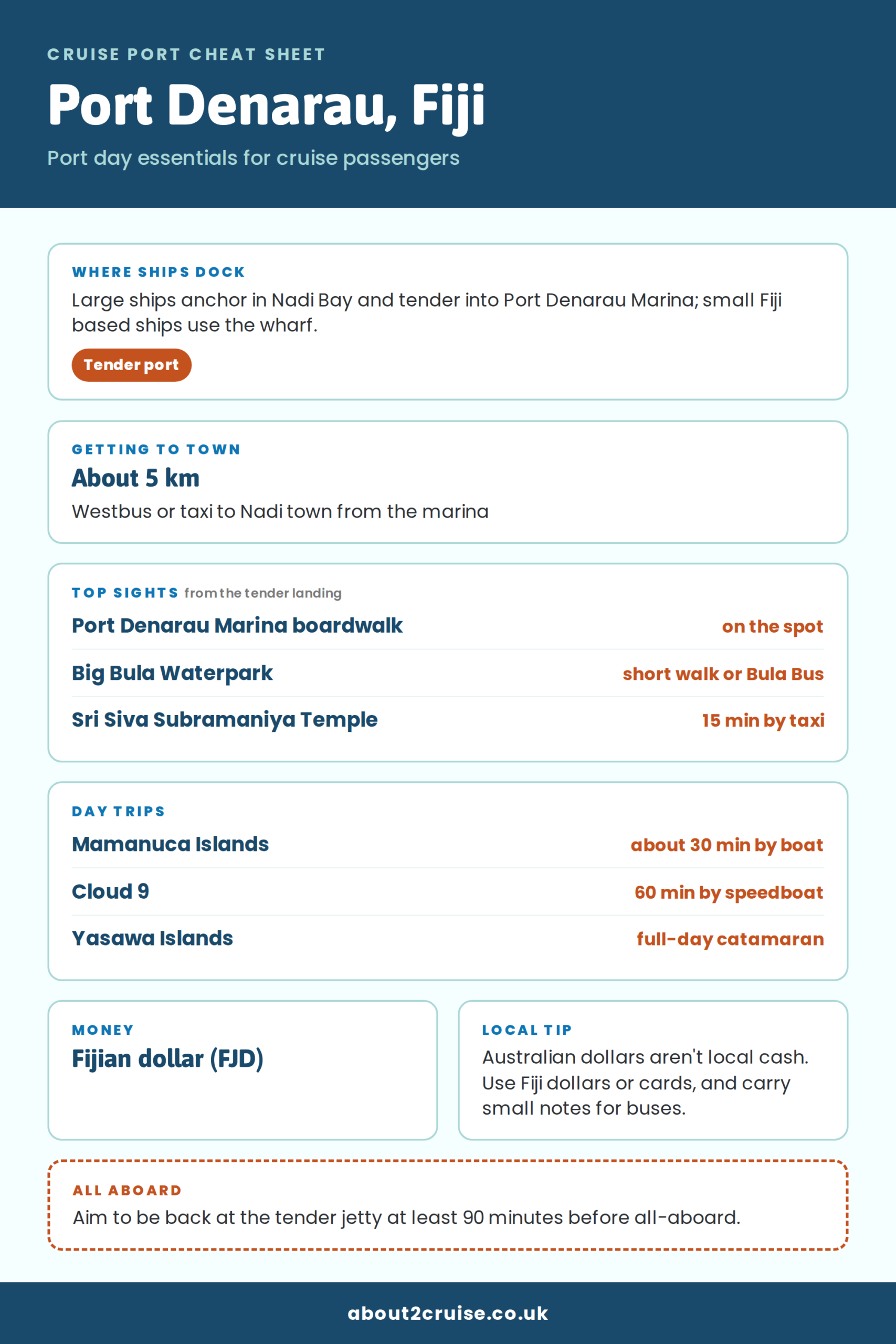
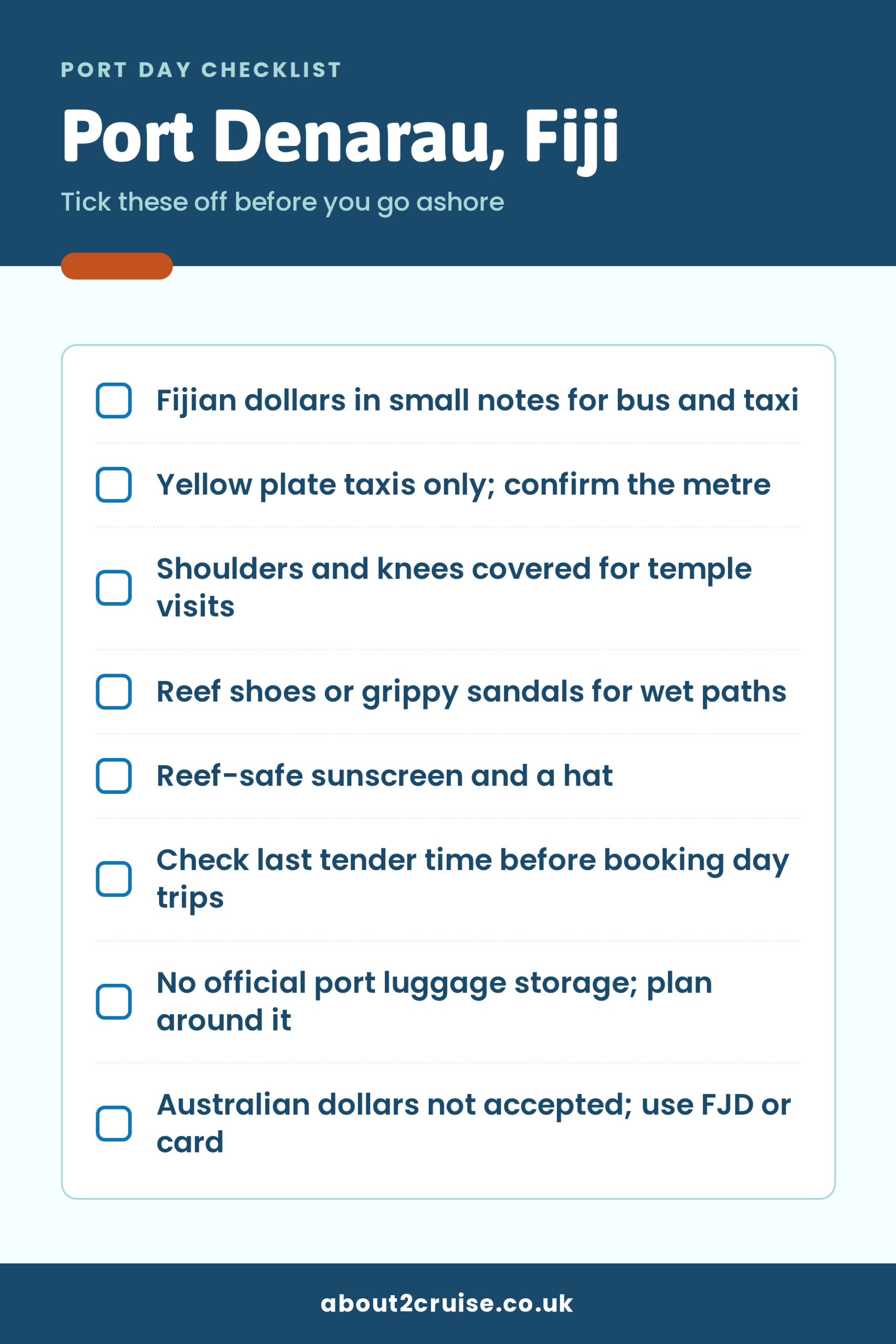
Quick Facts for Cruise Visitors
- Location: Denarau Island, western Viti Levu, Fiji, reached by a short causeway from Nadi.
- Distance from Nadi International Airport: about 10 km west; normally 20–30 minutes by road.
- Cruise type: tender port for large ships; vessels anchor in Nadi Bay and passengers land at Port Denarau Marina.
- Main terminal area: Port Denarau Retail and Commercial Centre, around 10,000 m², with shops, supermarket, pharmacy, medical centre, bakery, bank and restaurants.
- Why it exists: resort and marina hub, and the main ferry gateway to the Mamanuca and Yasawa island chains.
- Currency: Fiji dollar (FJD/FJ$). Australian dollars are not the local currency.
- Public transport: Bula Bus around Denarau, Westbus between Nadi and Port Denarau, taxis with yellow plates.
- Luggage storage: no official left-luggage office at Port Denarau itself; the nearest published facility is Nadi Airport left luggage.
Port Denarau cruise port map
Tenders bring you ashore at Port Denarau Marina tender landing. From the tender landing, Port Denarau Retail and Commercial Centre is about a 3-minute walk, Sheraton Fiji Golf and Beach Resort about 12 minutes and Big Bula Waterpark about 18 minutes. Tap a pin for directions.
- Port Denarau Marina tender landingWhere tenders land
- Port Denarau Retail and Commercial CentreShopping centre · About 3 min walk from the tender landing
- Sheraton Fiji Golf and Beach ResortGolf and beach resort · About 12 min walk from the tender landing
- Big Bula WaterparkWaterpark · About 18 min walk from the tender landing
- Denarau Island ChapelChapel · About 21 min walk from the tender landing
- Denarau BeachBeach · About 30 min walk from the tender landing
- Nadi Bus StationBus station · About 5 km from the tender landing
- Nadi MarketMarket · About 5 km from the tender landing
Why Cruise Ships Call at Denarau Island
Denarau is Fiji’s purpose-built resort island. It is not a traditional Fijian town or an untouched beach island. The whole 2.55 km² development is a gated resort precinct built on reclaimed land, with eight major hotels, an 18-hole golf course as its centrepiece, and a compact marina and shopping district at Port Denarau.
Fiji’s tourism authorities describe Denarau as an upmarket precinct on a small island off the Nadi coast, connected by a short causeway. It is known internationally for resort comfort, golf, family attractions, restaurants and a safe, polished alternative to Nadi town. The trade-off is that the beaches are not the South Pacific fantasy many people expect.
For cruise passengers, Denarau is convenient because everything is concentrated: the tender landing, ferry desks, shops, cafés, taxi rank and resort shuttle stop sit within a few minutes’ walk of one another.
Tendering Into Port Denarau: What to Expect
Large cruise ships do not tie up alongside at Port Denarau. They anchor in Nadi Bay and run tenders into the marina. The landing pontoons and jetties are modern and solid, but you will still be stepping down from the ship onto a tender and then up onto a floating pontoon or jetty. Watch your footing in wet weather.
Some small expedition-style or Fiji-based cruise products, such as Captain Cook Cruises and Blue Lagoon Cruises, use the wharf directly, so passengers walk straight on. Blue Lagoon’s check-in counter is at Port Denarau, normally open from 7.30am to 8pm daily. If you are booked on one of those, arrive at the counter about an hour before departure.
Port Denarau Marina is an official Port of Entry with Customs, Health and Immigration on site. Clearance hours are Monday to Friday 0800–1600, and the marina operates Port Control on VHF channel 14 or 16. The marina basin has 62 serviced berths, 16 swing moorings and capacity for superyachts up to 115 m, with about 5 m depth at zero tide. That matters more to yacht owners than cruise passengers, but it explains why the facilities feel well organised.
Carnival lists Port Denarau as a tender stop where its water shuttles are not accessible. If you use a wheelchair, have limited mobility or struggle with steps, ask your cruise line directly before your call. Tender access and step heights vary by ship and sea conditions.
Finding Your Way Around the Port
The marina complex and shopping centre sit on the river side of Denarau Island, closest to the causeway back to the mainland. The golf course lies inland, behind the hotels. A beachfront path connects many of the resorts along the ocean-facing side; walking from one end to the other takes roughly 20–30 minutes.
There are only a few footpaths away from the beachfront, so in the midday heat it is usually easier to use the Bula Bus or a taxi than to walk along the roads. The retail centre, taxi rank, bus stop, ferry desks and most restaurants are all within easy walking distance of the tender landing.
Use the map to zoom out and see the causeway, the marina basin, the retail strip and the nearby resort strip. If you are looking for the cruise terminal, focus on Port Denarau Marina, not on a separate cruise building.
Nadi Airport to Port Denarau: Transfers and Taxis
Nadi International Airport is the closest airport to Denarau, about 10 km west of the island, with a typical drive of 20–30 minutes depending on traffic. Road distances quoted by transfer operators are around 11.6–13 km via Queens Road and Denarau Road.
The easiest options are a taxi or pre-arranged transfer. Only licensed taxis with yellow registration plates should be used. Nadi Airport taxi fares are regulated by the Fijian Competition and Consumer Commission: FJ$5.00 flag fall, 15 cents per 100 m and 18 cents per minute waiting. A metered 10 km run at the airport rate works out to roughly FJ$26, so expect a fare somewhere in the FJ$25–35 range.
Public buses exist but the airport-to-Denarau routing is not cleanly signed. Fiji Airports says buses run from the airport to Nadi Town, Denarau Island and Suva, but timetables are not reliably posted. If you want public transport, the practical method is to take the bus to Nadi town and change to a Westbus to Port Denarau. This is inexpensive, but it eats into a short pre-cruise transfer window.
If you are staying at a Denarau hotel, book the hotel shuttle or a private transfer. Resorts such as the Sheraton, Hilton, Radisson, Sofitel, Westin and Wyndham are all on the same small island, so any Denarau drop-off is close to the marina.
For UK cruise passengers, Nadi is the long-haul gateway. There are no non-stop flights from London; routes connect via Los Angeles, San Francisco, Hong Kong, Singapore or Vancouver, and Los Angeles to Nadi is about 11 hours 30 minutes. Fiji Airways has marketed London Heathrow to Nadi return economy fares from £1,329, including taxes. If you are flying in for a cruise, build in at least one overnight before embarkation because of the long transfer time.
Getting Around: Bula Bus, Westbus, Taxis and Walking
The Bula Bus is the open-air hop-on, hop-off loop that links the major Denarau hotels, the golf and racquet club and Port Denarau. It runs roughly every 15 minutes from about 7.30am to 11.30pm, seven days a week. Fares are quoted at FJ$11 for unlimited daily travel for adults and children under 12 free; a five-day pass is about FJ$35. Buy tickets in advance at resort convenience stores or at Port Denarau, not from the driver. The Bula Bus loops Denarau only and does not go into Nadi town.
The public yellow Westbus is the only public bus allowed into Denarau. It runs roughly every 15 minutes and drops off in the middle of the Port Denarau shops. The fare between Nadi town and Port Denarau is reported at around FJ$1.60 per person, paid to the driver in cash. Have small notes ready because change is not guaranteed.
Nadi Bus Station is the hub for buses to Denarau, Lautoka, Sigatoka, Wailoaloa, the airport and Suva. There are no posted timetables; buses generally run every 10–15 minutes on weekdays. Once you are in Denarau, walking between the marina and the nearest resorts is easy. To go farther, use the Bula Bus or a taxi.
Taxis are metered on Viti Levu and rank at the marina. A taxi from Nadi town to Denarau is about 8 km and usually around FJ$8–10. Confirm the driver begins the meter, and use taxis with yellow plates.
Luggage Storage at Port Denarau: What’s Actually Available
This is the single most important practical detail for many cruise passengers, and Uncomfortable: there is no official or staffed luggage storage office at Port Denarau Marina or the Port Denarau shopping centre. The port’s own commercial directory lists medical services, car and truck rental, a day spa, law firms, real estate, a hair and nail salon and freight services, but no left-luggage counter.
There is also no reliable tourist information desk at the port. Travellers have reported that ferry operators, including South Sea Cruises, will not hold bags for security reasons. Some harbour-side restaurants may look after a bag if you are dining with them, but that is a courtesy, not a service you can book.
Hotels set their own storage policies. If you have a pre- or post-cruise stay booked, ask the property directly about holding luggage before check-in or after checkout. Some will, some may charge; there is no universal Denarau rule. Non-guests should not assume a resort will hold bags.
If you need a guaranteed bag drop near Denarau, use the left-luggage facility at Nadi International Airport. It is the only published, staffed, walk-up option in the immediate Nadi area. It means a 20–30 minute detour from the port, but it is predictable, and it solves the problem before you board a ferry or day tour.
The Terraces Apartments, about 0.2 km from the marina, lists lockers and luggage storage among its guest services. That is for staying guests, not a public bag desk, but if you are staying there it is useful.
Do not plan around unverified local bag-storage names or online third-party services unless you can confirm them directly before travel. There is no verified walk-in baggage-storage shop at Port Denarau itself in the port’s published services.
Nadi Airport Left Luggage: Prices and Rules
Nadi International Airport has a left-luggage counter in the Arrivals area, on the left as you clear Biosecurity, under a Left Luggage sign. It is open from 5am to 10pm daily.
Fees are charged per item per day, or part of a day. You pay for the total storage period upfront in Fiji dollars, and the storage money is non-refundable. The airport’s published liability is limited to the storage fee paid. Goods not collected within two months of the nominated date are deemed abandoned. You release the bag only on presentation of the counterfoil you receive when you deposit it.
| Item type | Fee per item per day |
|---|---|
| Day bags / carry-ons | FJ$7.50 |
| Suitcases / backpacks | FJ$10.05 |
| Bikes, boards, oversized luggage | FJ$15.00 |
If you are heading from the ship to the airport for a late flight, or arriving early and want to spend the day around Denarau before a cruise, this is the most reliable workaround.
Do Denarau Hotels Hold Luggage for Non-Guests?
The short version: hotel luggage holds are common for guests and unpredictable for walk-ins. If you have booked a night at a Denarau resort, the front desk will usually hold your bags before check-in or after checkout. The closer you are to the marina, the easier an early ferry is. The Palms Denarau and The Terraces Apartments are both about 0.2 km from the marina and are useful for short stays.
If you are not staying anywhere, don’t build your day around finding a hotel that will store your bag. Some have refused non-guest bags even when the ferry desk sent people over. A safer plan is to travel light, leave big bags on the ship if you are on a port call, or store them at Nadi Airport for a land stay.
How to Choose Your Port Day in Denarau
At Port Denarau there are three broad choices: stay around the marina and Denarau, take an island day trip from the ferry terminal, or use land transport into Nadi. The best choice depends on your call time and your appetite for moving. Cruise calls are often short, and many South Pacific itineraries concentrate around November to February, so tender delays and wet-season weather are real variables.
If you want a swim or a true blue-water Fiji beach, Denarau itself is not the answer: go offshore. If you want shopping, lunch, a supermarket stop, a drink, a pharmacy run or a simple stroll, stay at Port Denarau. If you want a Fijian temple, local market experience or a cheaper meal, take a taxi or Westbus into Nadi.
Before booking an island day trip, check the return time against your tender time. You need to be back at the marina with a margin, not just at the last possible minute. Many operators ask for check-in 30 minutes before departure. The Yasawa Flyer, for example, departs Port Denarau daily at 8.45am and returns at 6pm, which may not fit a 5pm all-aboard.
Best Day Trips from Port Denarau
The ferry network from Port Denarau is the reason many cruisers choose this call. Destinations include Beachcomber and Treasure Islands, Malolo Island, Malolo Lailai, Mana Island, Matamanoa Island, Nacula Island, Serenity Island, Tokoriki Island and Waya Island. South Sea Cruises runs three departures daily to Castaway Island, Malolo Island and Mana Island; Malolo Cat runs three sailings a day each way to Malolo Lailai.
Check in at the South Sea Cruises desk in the Port Denarau Marina passenger terminal at least 30 minutes before departure. Some operators, such as Malolo Cat, offer a free transfer from Nadi Airport or Nadi hotels, but this is arranged through their drivers, not an informal minibus that turns up.
Easy cruise-friendly day-trip ideas
- Malamala Beach Club: about 30 minutes from Port Denarau, with the vessel departing at 10am and returning at 4.15pm or 5.15pm. A full-day pass from Denarau, Nadi, Wailoaloa or Vuda hotels is FJ$215; a half-day from Denarau, Nadi or Wailoaloa is FJ$185. It includes return ferry, towel service, wifi and non-motorised watersports. Poolside day beds and beachside cabanas cost extra.
- Cloud 9 floating bar and pizzeria: about 60 minutes by speedboat from Port Denarau on Ro Ro Reef. Morning departure is 9am returning 2pm; afternoon departure is 1pm returning 6pm and only runs with a minimum of 25 guests. There is an FJ$60 food and drink credit per person and a FJ$10 per person fuel surcharge. It is card-only on board, and nobody under 10 is accepted.
- South Sea Island: a common introductory Fiji day trip, marketed from around FJ$255 per person. It suits passengers who want a small-island day without arranging a long stay.
- Big Bula Waterpark: on Jayant Road on Denarau Island, a short walk or Bula Bus ride away. Day passes are FJ$89 for adults, FJ$60 for children under 5, FJ$330 for a family of four, and entry only is FJ$15. Locker hire has a FJ$10 deposit. Tickets are sold at the entrance and are non-refundable, so check the weather before you commit.
Deeper into the Yasawas is possible, but the Yasawa Flyer’s daily 8.45am outbound and 6pm return makes it a poor match for most cruise ship calls. If your ship overnights or you are on a land stay before a cruise, it works.
Are Denarau Beaches Good for Swimming?
Denarau’s resorts were built on reclaimed mangrove swampland. The beach sand is grey and the water is often murky. There is no meaningful snorkelling off the beach, and regular visitors describe it as pleasant for walking but not for swimming. If swimming is the priority, book an island trip or use the resort pools.
Resorts in Denarau have large lagoon pools and swim-up bars, but those are for guests or people with a confirmed day pass or dining reservation. A few properties sell day passes, but you should not assume you can walk into a hotel pool area from the marina. Confirm a day pass before planning around it.
Sea safety is a separate issue. There are dangerous rip tides along reefs and river estuaries in Fiji. Unless you have reliable local knowledge, swim from lifeguarded beaches and follow the flag warning system. The UK FCDO notes that the only hyperbaric recompression chamber in Fiji is in Suva, and it is not always working.
Shops, Markets and Practical Amenities at the Port
The Port Denarau Retail and Commercial Centre is about 10,000 m² with 32 retail shops and 28 commercial premises. For cruise passengers it functions as a compact errand hub: supermarket, bottle store, bank, money exchange, medical centre, bakery, pharmacy, clothing and souvenir shops, bars and restaurants. ATMs and currency exchange are at the marina, including Westpac and an ANZ ATM.
This is the place to buy sunscreen, snacks, nappies, basic pharmacy items or a cold drink without leaving the port area. It is also where you pick up resort wear, Fijian crafts and souvenirs. There is not a huge local village market at Port Denarau itself; the big traditional market is in Nadi town.
Nadi Market is Fiji’s second-largest produce market, with fruit, vegetables, kava root and a handicraft section. Saturdays are busiest and Sundays it is closed. Yaqona, or kava root, is quoted there at FJ$30–40 for half a kilo. It is not at the cruise landing; take a Westbus, taxi or organised Nadi excursion.
Where to Eat and Drink Around the Marina
The standalone restaurants cluster around the Port Denarau Marina boat terminal rather than inside a mall food court. Nadina serves Fijian cooking including kokoda and a lovo feast; Bonefish does waterfront seafood; The Rhum-Ba stocks more than 100 rums and pours draught Fiji Bitter and Fiji Gold; Cardo’s Steakhouse and Cocktail Bar, Lulu’s Bar Restaurant and Cafe, Cantina Grill and Bar, Indigo Indian and Asian, and Sails @ Denarau round out the boardwalk.
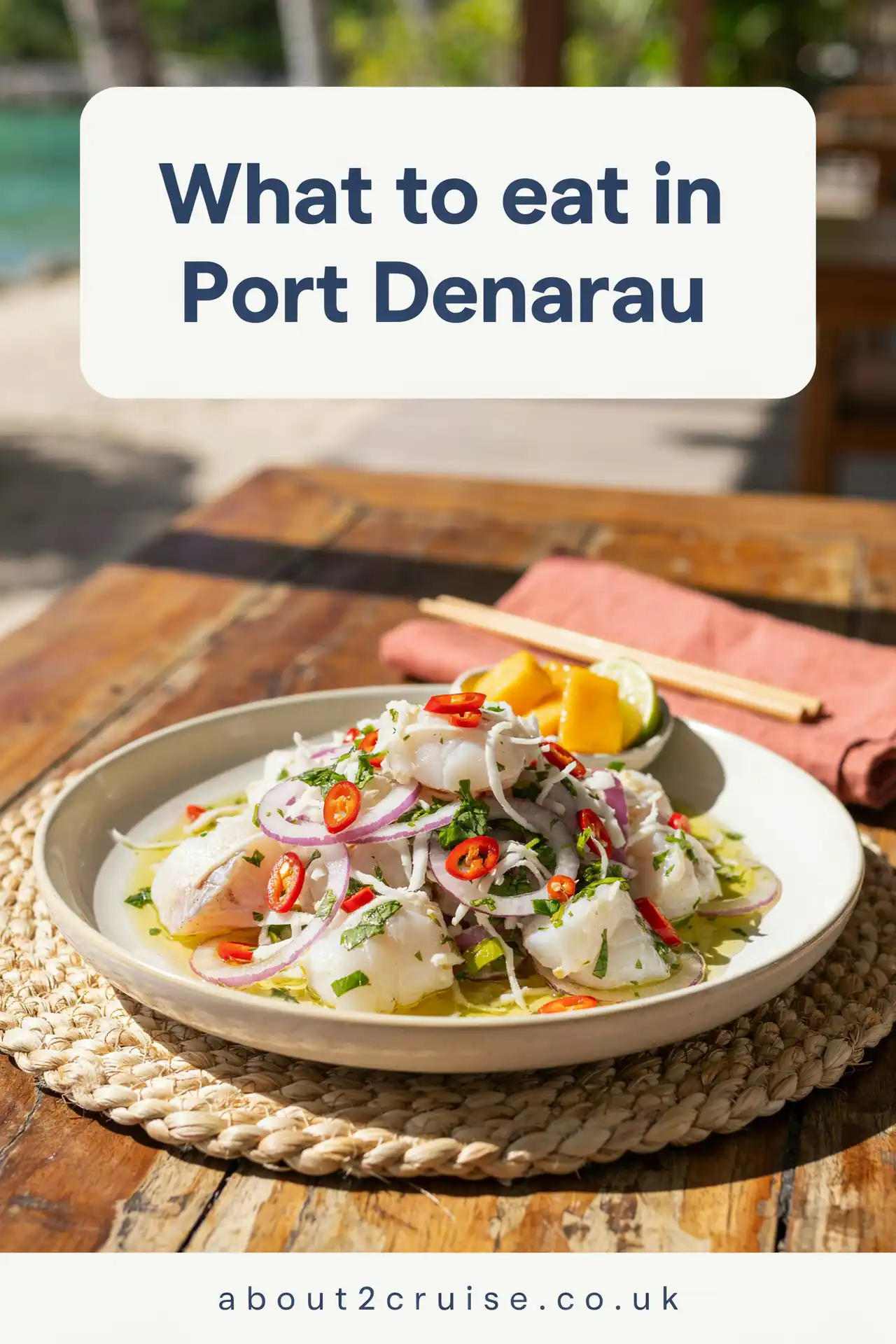
Kokoda, raw fish cured in lime juice and coconut milk, is described as Fiji’s national dish. Lovo is earth-oven cooking, palusami is taro leaves baked in coconut, and rourou is another taro-based staple. Kava, or yaqona, is the earthy national drink served at ceremonies and welcome rituals.
Most evenings at 6.30pm, except Sundays, Port Denarau holds a free Fijian dance performance. If your ship sails late, it is an easy cultural moment near the tender jetty.
Money in Fiji: Cash, Cards and AUD
The currency is the Fiji dollar, FJD. Australian dollars are not the currency of Fiji and are not usable as money. Some tourist-facing businesses may take AUD, but the exchange rate is usually poor. Pay in FJD or by card where possible.
Visa and Mastercard work at resorts and larger merchants; American Express is less widely accepted. Carry cash for buses, small cafés, market purchases and taxis. Some Fijian retailers offer dynamic currency conversion, letting you pay in AUD or another home currency, but paying in FJD at the local rate is typically cheaper.
Be alert to credit card fraud, including skimming devices. Use ATMs attached to banks or in the marina complex, and cover your PIN.
Typical Costs in Denarau and Nadi
Fiji is not uniformly cheap. Resort zones like Denarau feel priced for holidaymakers, while Nadi town and Suva local restaurants are far more affordable. A local restaurant lunch in Nadi or Suva is often FJ$10–20. In Nadi, a meal at an inexpensive restaurant averages about FJ$20, a three-course dinner for two at a mid-range place about FJ$82.50, a domestic draught beer about FJ$6, and a cappuccino about FJ$9.83.
- Green fees at Denarau Golf and Racquet Club: about FJ$220 for 18 holes with half-set hire, or FJ$350 with full clubs and a cart.
- Tennis court hire at the Denarau club: about FJ$35 per hour.
- Sri Siva Subramaniya Temple entry: FJ$5 per person.
- Bula Bus daily pass: about FJ$11; five-day pass about FJ$35.
- Port Denarau parking: driver reports suggest about FJ$4 per hour or FJ$25 for up to eight hours, with longer parking reported at FJ$40 for 8–9 hours.
- Taxis from Nadi town to Denarau: about FJ$8–10; from the marina to the airport about FJ$25.
- Coconut on Dravuni island, for perspective: about FJ$5.
Where to Stay Near Port Denarau
Denarau is the most convenient place to sleep before or after a cruise because the marina is the departure point for Mamanuca and Yasawa boats, and the retail strip holds most of the area’s restaurants. Staying one night on Denarau before an outer-island stay is a common way to remove airport-transfer stress.
Useful options near the marina include The Palms Denarau and The Terraces Apartments, both about 0.2 km away. The Palms has two- and three-bedroom apartments with kitchen, laundry and balcony; The Terraces has one-, two- and three-bedroom apartments, a 25 m lap pool and a café serving breakfast from 7am.
Larger resorts include:
- Hilton Fiji Beach Resort and Spa: about 0.6 km from the marina, with three restaurants, nine outdoor pools and a free kids’ club.
- Sofitel Fiji Resort and Spa: about 0.9 km from the marina, with four restaurants, a kids’ club and a waterslide.
- Sheraton Fiji Golf and Beach Resort: about 1.4 km from the marina, with a Fiji Airways check-in lounge, lagoon-style pools and direct access to the golf course.
- Radisson Blu Resort Fiji Denarau Island: about 1.5 km from the marina, family-focused with lagoon pools, and still within easy reach of the port restaurants.
Resorts closer to the marina make early ferry departures easier. The far end of the beachfront is quieter but adds a bus or taxi ride before any early morning check-in.
Free and Cheap Things to Do on a Port Day
Denarau is not a cheap destination by Fiji standards, but you can still keep a port day simple. Walk the marina boardwalk, watch yachts in the basin, do a supermarket run for drinks and snacks, photograph the pier and beach path, and sit for a coffee or a single beer instead of a resort lunch. The free Fijian dance performance at 6.30pm is good if your ship stays late.
Before you sail
- Check your ship's first and last tender times against any ferry or island trip you book.
- Bring Fijian dollars in small notes; buses, market stalls and many taxis run on cash.
- If you have limited mobility, confirm tender accessibility with your cruise line before sailing.
Short port day: under 6 hours
- On dockingTake the ship's tenderTender portLarge ships anchor in Nadi Bay. The tender lands at Port Denarau Marina beside the ferry desks and shops.
- +15 minPort Denarau Marina boardwalkWalk the boardwalk, see the superyachts and pick up any snacks or pharmacy items at the retail centre.
- +45 minBig Bula WaterparkA short walk or Bula Bus ride from the marina. Choose a full pass or the entry-only ticket.
- +1 hr 30 minWalk the Denarau beach pathTake the waterfront path towards the Sheraton chapel, about 20 to 30 minutes stroll.
- +2 hrs 45 minLunch at the marina boardwalkTry kokodaOrder kokoda, raw fish cured in lime and coconut, at a boardwalk restaurant near the tender jetty.
- All-aboard minus 90 minBack at the tender jettyAllow time for the last tender queue; do not cut it fine.
The time on the map is the whole walk, every stop added together.
Open this walking route in Google Maps
If plans change: If Big Bula is closed or the beach walk is too much, swap it for the marina shops and the free 6.30pm dance performance, then have lunch as planned.
Long port day: 8 hours or more
- On dockingTake the ship's tenderTender portLarge ships anchor in Nadi Bay. The tender lands at Port Denarau Marina beside the ferry desks and shops.
- +15 minTaxi to Sri Siva Subramaniya TempleYellow plate taxiUse a licensed taxi with yellow plates. The temple is about 5 km from the marina.
- +45 minVisit the templeCover shouldersRemove shoes before entering, cover shoulders and legs, and keep noise down. Photography is outside only.
- +1 hr 30 minNadi MarketA short ride or walk from the temple. Fruit, vegetables, kava root and handicrafts; closed Sundays.
- +2 hrs 30 minLunch in Nadi townTry local curryEat where locals do: a Fijian or Indian lunch costs less than Denarau. Order kokoda or a curry.
- +3 hrs 30 minTaxi or Westbus back to Port DenarauHave small notesWestbus drops at the Port Denarau shops; pay the driver in cash. A taxi is quicker if you are tired.
- +4 hrs 30 minDenarau beach pathWalk the waterfront path between the resorts and the Sheraton chapel, about 20 to 30 minutes.
This map shows the taxi ride from the ship. The time is the drive only, not your time ashore.
Open the taxi route in Google Maps
If plans change: If the temple is closed or Nadi Market is shut, stay on Denarau: Big Bula, the beach path and marina shops. Use Westbus if taxis are scarce.
The beachfront path between the resorts is free and gives a sense of the island’s scale. Sunsets over Denarau are around 6.30pm, with the beach and marina as free viewpoints. The chapel on the beach behind the Sheraton is a popular sunset and blue-hour photo spot.
Big Bula Waterpark has a low-cost entry-only ticket at FJ$15 if you want to take a look without committing to the full waterpark pass. Taking the Westbus to Nadi town and walking through Nadi Market is probably the cheapest genuine Fijian town experience you can reach from the port.
Things to Do in Nadi Town
Nadi town is the nearest mainland town, about 5 km from Denarau. The standout attraction is the Sri Siva Subramaniya Temple, the largest Hindu temple in the Southern Hemisphere. Entry is FJ$5, you must cover shoulders and legs, remove shoes before entering, and keep noise down. Photography is allowed outside but not inside. Sarongs are available at the entrance.
Where to go after that depends on your interest. Nadi Market is excellent for fruit, vegetables, kava root and a handicraft section; it is busiest on Saturday and closed Sunday. Nadi Bus Station is the transport hub for buses to Denarau, Lautoka, Sigatoka, Wailoaloa, the airport and Suva. It is not a tourist attraction in itself, but it is the place from which cheap buses leave.
Nadi airport is also the gateway to more of Fiji, but for a cruise call you will not need to visit it unless you are sorting luggage storage or changing travel plans.
Where Denarau Sits in Fiji
Fiji has 333 islands, but cruise passengers on this call are on Viti Levu, the largest island and home to more than 70% of Fijians. Viti Levu’s western tourism hub is Nadi; the capital, Suva, is in the south-east. Denarau Island is a private 2.55 km² resort development off the west side of Viti Levu, reached by a short causeway. It sits 5 km north-west of Nadi and about 10 km west of Nadi International Airport.
In practical terms, Denarau is not remote. It is a controlled, manicured, resort island attached to the mainland. That is why the port feels more like a polished marina complex than a raw South Pacific beach call.
Weather, Sea Conditions and Packing for Denarau
Fiji has a tropical marine climate with year-round temperatures typically between 25°C and 30°C. The wet season runs November to April, and the dry season May to October. February and March are the wettest months. On Denarau, average daytime temperatures are about 30°C in January and February, with around 300 mm or more of rain in the wettest months, easing to about 26°C and 47 mm in July.
Tropical cyclone season normally runs November to April, but cyclones can occur throughout the year. During the season there is a greater risk of strong winds, heavy rain, flooding, landslides and road closures. Wet-season rain is typically short, heavy bursts rather than all-day grey, but it can reduce water visibility for snorkelling.
There is no reliable public, day-specific marine forecast for cruise passengers to judge tender operations. Tender suspension risk rises in wet-season wind events. Pack as if your day might include sun, one heavy shower, a breezy tender and a slick dock.
Useful packing list:
- Light rain jacket or poncho in wet season.
- Reef shoes or grippy sandals; island paths can be slick after rain and beach sand can hide coral fragments.
- Reef-safe sunscreen and a hat.
- Small Fijian dollar notes for buses, taxis, market stalls and coconuts.
- A cover-up or sarong for temple visits and village stops.
- A dry bag or waterproof phone pouch for tenders and small boats.
Safety and Cultural Etiquette in Fiji
The risk of serious crime in Fiji is generally low, but there are occasional incidents, including sexual assault. Be careful with belongings in cities and tourist areas, avoid carrying everything in one bag, and stay alert when withdrawing money from cash machines. Take extra care walking at night in cities, towns and isolated areas, particularly for women travelling alone.
Protests can occur with little warning. Avoid demonstrations, rallies or street gatherings and any areas of obvious military or police activity. Use licensed taxis with yellow plates and minibuses with yellow number plates. Check a boat operator’s credentials and safety equipment before boarding island boats, and avoid overcrowded vessels.
Topless bathing and nudity in public is illegal. Cover shoulders and knees in rural villages and during kava ceremonies. Kava ceremonies carry a risk of liver toxicity, so it is worth being moderate. Possession of even small quantities of illegal drugs can lead to imprisonment and a large fine.
Mobile coverage in rural areas and outlying islands can be limited or non-existent; many UK phones do not roam in Fiji. SIM cards are sold at Nadi International Airport and must be registered. If you are travelling alone, tell someone your day-trip plan.
Fiji Biosecurity and Customs Rules
Fiji’s biosecurity rules are strict, and cruise passengers must take them seriously. All food brought into Fiji must be declared, even small amounts: fresh fruit and vegetables, meat, eggs, seafood, dairy, dried mushrooms, seeds, nuts, spices and herbs. Also declare live animals, animal products, salt and freshwater products, used camping, farming, hunting, sporting or gardening equipment, and soil or aggregates.
Live plants and plant cuttings are prohibited. Wood, bamboo, cane, rattan, coconut and straw items must be declared. It is strictly prohibited to take food, fruit, meat, flowers, cut or packed lunches, plants or animal products ashore from a ship.
The passenger arrival card is a legal document, and false or incorrect declarations are an offence. Failing to declare can bring a spot fine of FJ$400 plus prosecution, with a maximum fine of up to FJ$20,000 or six months’ imprisonment, or both. If in doubt, declare it.
Visitors to Fiji are normally issued a visa on arrival, and proof of booked accommodation and a return ticket may be required. On a cruise call, the ship and local agents handle most clearance formalities, but you still must respect quarantine rules.
Fiji’s Rare Iguanas and Wildlife
The animals that catch people out in this question are Fiji’s native iguanas. Fiji has three: the Fijian crested iguana, which is found only on islands in western Fiji; the Lau banded iguana, found in the Lau Group and in Tonga; and the Fiji bulabula iguana, found on the central islands and with a small population in Vanuatu. Iguanas are native only to the Americas and the Fiji Islands, which is why Fiji’s iguana story is biologically unusual.
The Fijian crested iguana is critically endangered. The uninhabited Mamanuca island of Monuriki, about a 30-minute boat ride from Port Denarau, is one of its better-known habitats. Fiji’s first wildlife sanctuary, Yadua Taba, is managed by the National Trust of Fiji and holds a large share of the crested iguana population.
The Fiji petrel is another special case: it is critically endangered and breeds only on the island of Gau. You are unlikely to see any of these from Port Denarau, but the wildlife context is part of what makes the Mamanucas more than just beaches.
Other Fiji Cruise Ports to Compare
Fiji has several cruise stops, and Port Denarau is not the only one. Suva and Lautoka are the two places where large ships can tie up alongside; Denarau, Savusavu and Dravuni are tender calls. Understanding the difference helps if your cruise is comparing itineraries.
Dravuni is a tender call with no terminal: tenders land on the main sandy beach in front of a village of fewer than 200 residents. There are no roads, no cars, no ATM and unreliable card payment, so bring small Fiji-dollar notes. A fresh coconut is about FJ$5 and hand-woven crafts about FJ$10–30. Local boat trips from the beach are often quoted at FJ$20–30 per person.
For the full picture of all Fiji cruise calls, see our Fiji Cruise Ports Guide. If your ship calls on Savusavu, read the Port of Savusavu guide. For Viti Levu’s capital call, see the Suva Cruise Ship Port guide.
Port Denarau Cruise Schedule and Tender Times
There is no official, publicly maintained Port Denarau cruise passenger schedule from the marina, Tourism Fiji or Fiji Ports. Third-party ship trackers and aggregator sites show individual calls, for example, a Norwegian Spirit call from 07:00 to 17:00, but those cannot be treated as a complete season calendar. South Pacific itineraries calling at Port Denarau are concentrated roughly November through February, and lines seen among port listings include Norwegian, Oceania and Regent, along with Royal Caribbean and others.
For your specific sailing, use your cruise line’s itinerary and any pre-cruise emails about tender times. The ship’s daily programme will confirm first-tender and last-tender times, which are what actually control your day. Do not book a non-refundable day trip before knowing those times.
Parking and Drop-off at Port Denarau
Port Denarau has a pay car park. Drivers collect a ticket at the entrance and are reported to pay at an exit booth that is cash only. There is limited one-hour free parking around the outside of the car park. Driver-reported rates are about FJ$25 for up to eight hours and FJ$40 for eight to nine hours; some visitor information says the marina complex parking is roughly FJ$4 an hour.
There is no official long-stay cruise parking page from Port Denarau, so if you are driving yourself and leaving a car for a week, confirm arrangements with your hotel or a private transfer company rather than assuming the port car park will be suitable. The drop-off zone at the marina is straightforward for taxis and private transfers, and it leaves you right beside the ferry desks and shops.
Best Photo Spots Around the Port
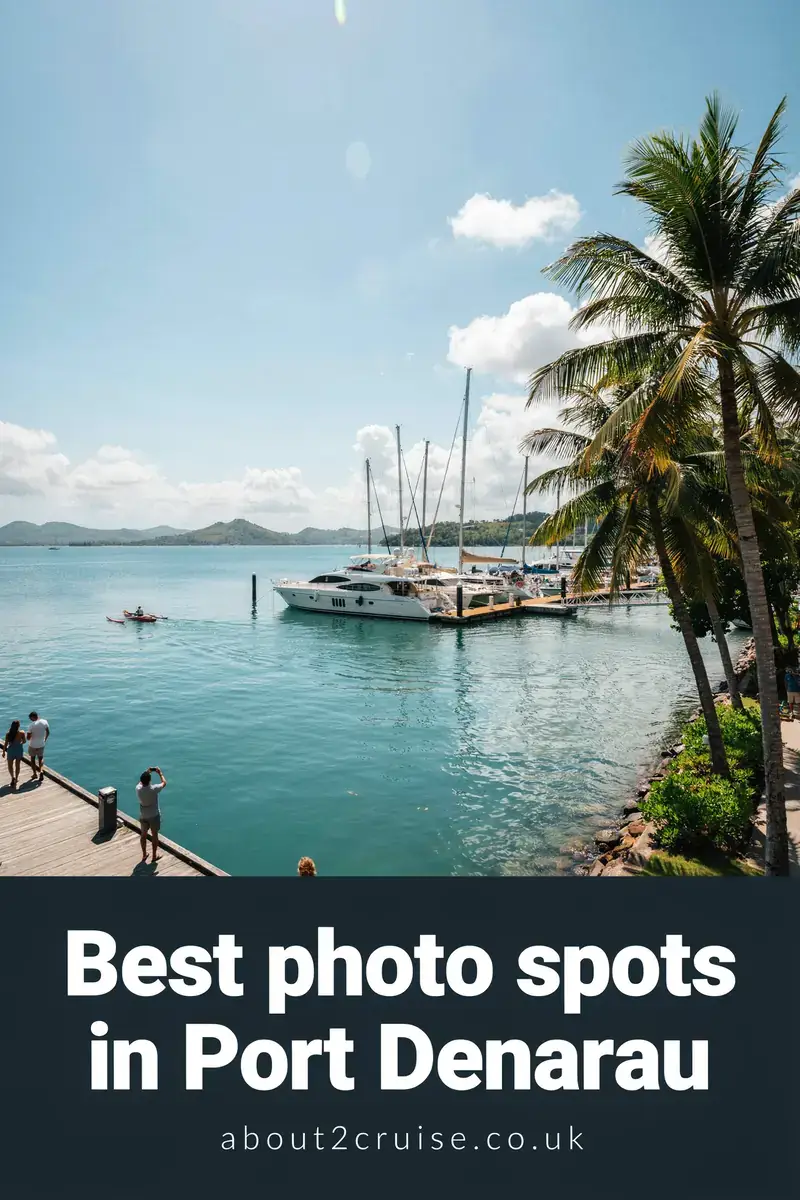
If you are photographing the port, the pier and marina boardwalk at sunset are the obvious first choices, with the pier lights coming on in the evening. The beach and marina are free viewpoints. The chapel on the beach behind the Sheraton is a strong sunset and blue-hour location. At the Sri Siva Subramaniya Temple, photography is allowed outside but not inside.
For visual orientation before you arrive, the map above is more useful than memorising terminal photos. The terminal is not a big standalone cruise building; it is an open-air settlement of pontoons, ferry desks, restaurants and shops. Expect a working marina rather than an oversized cruise hall.
What I Wish I Knew Before Visiting Fiji on a Cruise
Five things that would have saved first-timers time and stress:
- The port beach is not the Fiji you see in brochures. For blue water and snorkelling, leave Denarau.
- There is no port luggage storage. The airport left-luggage counter is the reliable workaround.
- Ferry times and tender times do not always line up. Check both before paying for a tour.
- Carry Fijian dollars. Buses, market stalls and taxis are easier, and AUD is not the local currency.
- Denarau is a manicured resort island, not a traditional Fijian village. If you want local Fiji, go into Nadi or the smaller islands.
Frequently Asked Questions from First-Time Visitors
Can I walk from the tender landing to the beach? Yes, you can walk to Denarau’s beach path, but it is a grey-sand, murky-water resort beach. It is fine for a stroll, not a snorkelling or swimming beach.
Will a Denarau hotel let me use the pool for the day if I am not staying? Not reliably. Some properties sell day passes or allow access with a confirmed dining reservation, but there is no official public day-pass price. Call or email the hotel directly before you plan your day around it.
Is Port Denarau separate from Nadi? Yes. Port Denarau is on Denarau Island, a short causeway away from the mainland. Nadi town is about 5 km away, and Nadi International Airport is about 10 km away.
Do taxis take credit cards? Some may, but many operate on cash. Carry small Fijian dollar notes and confirm the metre is running. Use yellow-plate taxis.
Can I store luggage at Port Denarau? No official left-luggage office exists at the port. The nearest published staffed option is Nadi Airport left luggage. Hotels may hold bags if you are staying with them.
Is there a direct airport bus to Port Denarau? There is no clearly signed direct airport bus timetable. The practical choices are a taxi, private transfer or hotel shuttle. If you use public buses, go via Nadi town and change to a Westbus.
What is the difference between Denarau and Dravuni? Denarau is a developed marina and resort island beside Viti Levu. Dravuni is a tiny, separate tender island with a village beach, no cars, no terminal and no ATM. They are different calls.
Are there ATMs at the port? Yes. ATMs and currency exchange are available at the marina, including Westpac and an ANZ ATM. Still carry some cash for buses and small purchases.
Last Updated: 17 November 2026