
Puerto Vallarta is a Pacific-coast port on Mexico’s Riviera cruise route. Ships dock at Puerto Mágico in Marina Vallarta, about three miles north of the Malecón, so the old town is a short taxi or bus ride rather than a walk. An easy day pairs the Malecón sculpture promenade with the Zona Romántica, a beach or a tequila lunch, with whale watching, snorkelling or zip-lining as add-ons.
| At a glance | Details |
|---|---|
| Terminal | Puerto Mágico / Terminal Marítima, Marina Vallarta, Boulevard Francisco Medina Ascencio |
| Distance to Malecón | About 3 miles / 5 km |
| Taxi time | 10–15 minutes to Malecón; 20–25 minutes to Zona Romántica / Los Muertos |
| Currency | Mexican peso; US dollars widely accepted in tourist areas |
| Language | Spanish, with English common in the port and tourist zones |
| Typical call | Daytime call, often 7–10 hours; some overnight calls |

Puerto Vallarta Port Day at a Glance
| At a glance | Details |
|---|---|
| Terminal | Puerto Mágico / Terminal Marítima, Marina Vallarta, Boulevard Francisco Medina Ascencio |
| Distance to Malecón | About 3 miles / 5 km |
| Taxi time | 10–15 minutes to Malecón; 20–25 minutes to Zona Romántica / Los Muertos |
| Currency | Mexican peso; US dollars widely accepted in tourist areas |
| Language | Spanish, with English common in the port and tourist zones |
| Typical call | Daytime call, often 7–10 hours; some overnight calls |
Arriving at Puerto Mágico: The Cruise Terminal
Puerto Vallarta has one cruise terminal: Puerto Mágico, also called Terminal Marítima. It sits in Marina Vallarta on Boulevard Francisco Medina Ascencio, around three miles north of downtown and the Malecón. Most ships pull alongside here rather than tendering. The port has three main berths, M1, M2, and M3, with depths around 9 to 11 metres. Longer ships like Discovery Princess and Norwegian Encore use these berths. If the berths are full, tenders can be used, but that’s rare.
Your exact berth can change from week to week, so don’t plan your day around a specific one. Once you step off, follow signs into the open-air commercial complex. Inside you’ll find free WiFi, a tourist information desk, ATMs, a currency exchange, cafés, restaurants, souvenir and craft stalls, a tequila museum with tasting hacienda, and an aquarium. The complex is open daily from 07:00 to 22:00 and has ramps and wide walkways. If you need supplies, a Walmart and Sam’s Club are across the main road, about a 10-minute walk from the terminal.
Ship shore excursions meet in the terminal area, check your tour ticket for the exact meeting point and time. Independent tour operators may meet outside the terminal, at the marina, or in the Zona Romántica, so confirm pickup details before you book.
There isn’t a published passenger map or official security procedure, so keep your cruise card and photo ID with you. Mexican officials can ask for your passport itself rather than a copy, but never hand it to touts or fake police. Return to the terminal with a comfortable buffer, it’s much better to relax near the gate with a cold drink than to sprint back to the ship.
Puerto Vallarta cruise port map
The map shows Puerto Vallarta and the places worth seeing. Tap a pin for directions.
- Puerto VallartaTown centre
- Malecón de Puerto VallartaSeafront promenade · About 4 km from the town centre
- Parish of Nuestra Señora de GuadalupeParish church · About 4 km from the town centre
- Zona RománticaOld town district · About 5 km from the town centre
- Isla del Río CualeRiver island · About 4 km from the town centre
- Los Muertos pierPier · About 5 km from the town centre
- Playa Los MuertosTown beach · About 5 km from the town centre
- Playa Conchas ChinasBeach · About 6 km from the town centre
- Playa de OroBeach · About 2 km from the town centre
- Mismaloya beachBeach · About 14 km from the town centre
Getting from the Ship to the Malecón and Old Town
Puerto Mágico is roughly three miles north of the Malecón and old town. Walking isn’t practical: you’d need an hour or more along a busy boulevard in the heat. Use transport instead.
- Taxi: Taxis inside the terminal gate are federal-zone cabs, often priced per person. Yellow city taxis outside the gate are usually cheaper and charge per car. Always agree whether the fare is per car or per person, and in what currency, before getting in. There’s no published official tariff, so expect a little negotiation. Budget roughly US$5–15 depending on distance and cab type; the Zona Romántica is farther than the Malecón.
- Bus: The urban bus costs about MXN 11 in cash. Walk to the main road and take a bus marked “Centro” for downtown and the Malecón. Coming back, look for buses marked “Marina” or “Walmart” and get off at the cruise terminal. Avoid buses marked “Túnel”, they take the bypass tunnel and skip the Malecón.
- Rideshare: Uber and DiDi operate, but only official taxis may enter the port area. Walk out to the main road for a rideshare pickup.
- Walking: Not recommended, especially in the heat and traffic of a port day.
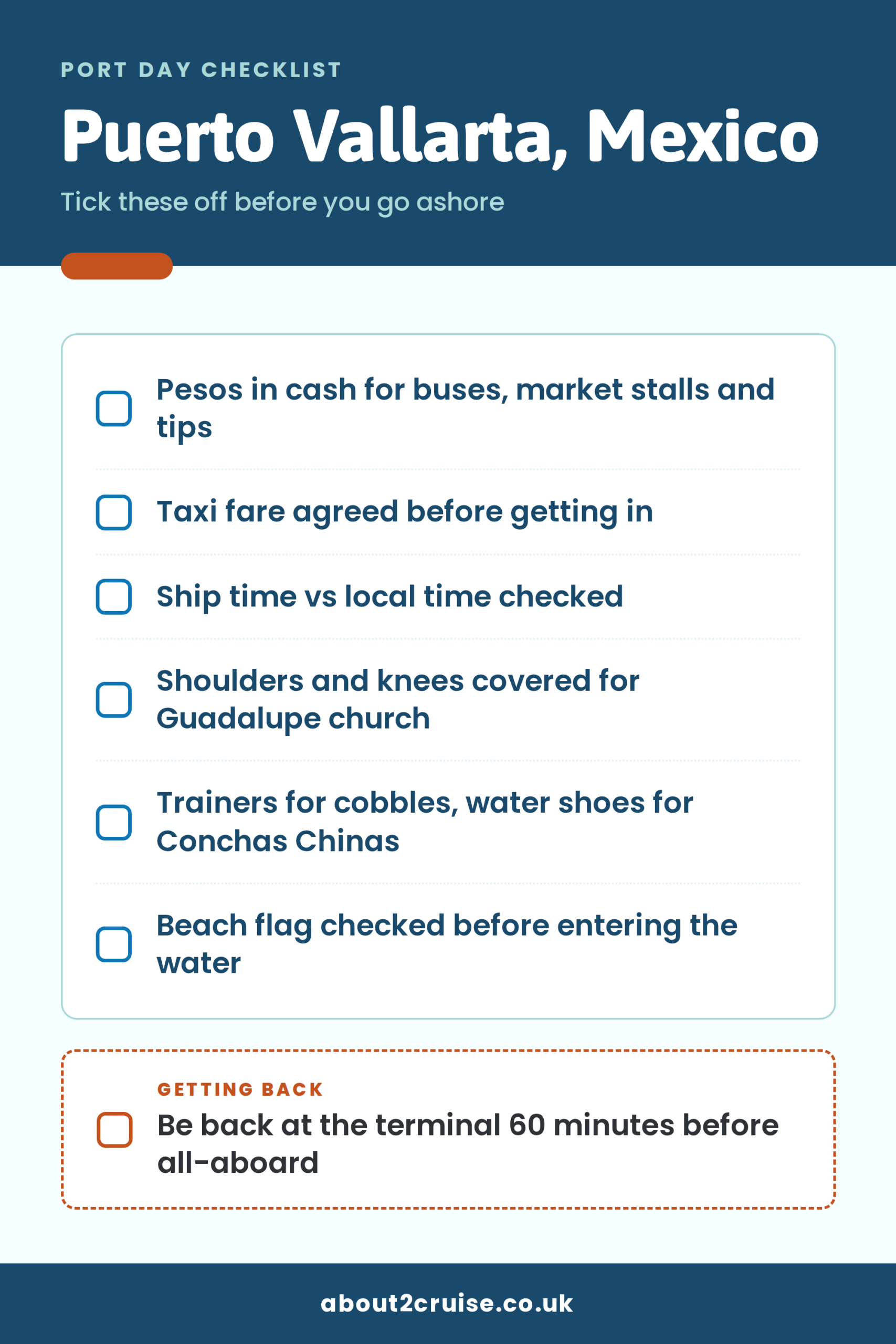
If you want a very low-key day, Marina Vallarta itself, with its boardwalk, restaurants, and lighthouse, is only a 5–10 minute walk from the terminal. For downtown, allow a 60-minute buffer on the return because coast-road traffic builds in the afternoon. Puerto Vallarta is on Central Time, and ship time may differ, so check your watch against the all-aboard time.
Walking the Malecón: Sculptures, Street Life, and Sunsets
The Malecón is Puerto Vallarta’s most famous seafront promenade. It runs about 750 metres along 12 blocks, from Plaza de los Pescadores to the Aquiles Serdán amphitheatre at Los Arcos. It’s flat, paved, and step-free, so it’s the easiest part of any independent port day.
Along the way you’ll pass a series of public sculptures. The first, “El Niño sobre el Caballo de Mar”, better known as El Caballito, is the city emblem. Others include Millennia, Nostalgia, Origin and Destiny, The Subtle Stone Eater, In Search of Reason, and La Rotonda del Mar. The Puerto Vallarta lettering near El Caballito is the classic photo spot, especially at sunset when the sky turns colour behind Banderas Bay.
The Malecón’s terraces are made for Pacific sunsets. Street performers, artists, and food carts add to the atmosphere. If you plan to visit the Parish of Nuestra Señora de Guadalupe nearby, cover your shoulders and knees, shorts and sleeveless tops aren’t allowed inside.
Zona Romántica: Old Town Charm, Food, and the Los Muertos Pier
The Zona Romántica sits south of the Río Cuale, so locals also call it Old Town, Viejo Vallarta, or the South Side. This is the colonial-character district of cobbled streets, hillside lanes, balconied houses, and some of the best food and café culture in Puerto Vallarta.
Basilio Badillo is the restaurant street, with more than 30 eating places packed into three blocks. Olas Altas is the main artery, lined with cafés, bars, and small shops. The sail-canopied Los Muertos pier is the neighbourhood’s visual landmark and the departure point for water taxis to Yelapa and other south-shore beaches.
Mercado Municipal Emiliano Zapata on Lázaro Cárdenas is a working food market with produce, seafood, and prepared food counters. Most vendors don’t accept cards, so bring pesos. Isla del Río Cuale, in the river between Centro and the Zona Romántica, has shaded paths, artisan stalls, and a cultural centre. The streets are cobbled, uneven, and steep in places, so wear trainers or flat sandals rather than heels.
Puerto Vallarta Beaches: Swimming Safety and Where to Go
Puerto Vallarta’s beach identity is built on Banderas Bay, but swimming safety can change day to day. The municipal lifeguard service uses coloured flags: green means safe, yellow means enter with caution, and red means the water is closed. Red flags are common on the main town beaches after swell and rip-current warnings, so check before you get in.
The closest beach to the ship is Playa de Oro, beside the terminal. Playa Los Muertos is the busiest town beach, with beach clubs, restaurants, watersports, and the pier. Beach clubs rent loungers, and the beach has family, party, and LGBTQ+ sections. Playa Conchas Chinas, south of Los Muertos, is quieter with clearer water, but entry is rocky, so water shoes help.
Crocodiles live in lagoons and coastal areas on Mexico’s Pacific coast. Respect warning signs, don’t walk close to the water, and never swim in lagoons. For families, Puerto Mágico has an aquarium on site, and a beach-club day at Los Muertos can work well, but always check the beach flags before children enter the water.
Why Puerto Vallarta Became Famous: The Night of the Iguana
Puerto Vallarta’s international fame began with John Huston’s 1964 film The Night of the Iguana, shot at Mismaloya cove. Richard Burton, Ava Gardner, and Deborah Kerr starred, but it was Elizabeth Taylor’s presence during the shoot that drew the paparazzi and made the then little-known port world-famous.
The film set was built on a mountainside cove about a 25-minute boat trip from Puerto Vallarta. A hotel was later built on much of the set and keeps old sets as restaurants. Las Caletas, now an exclusive Vallarta Adventures day site, was John Huston’s private retreat. The “Romantic Zone” name is a promotional label popularly linked to the Burton–Taylor romance, though the couple’s houses were north of the Cuale in El Cerro and Gringo Gulch.
Snorkeling and Diving at Los Arcos Marine Park
Los Arcos is a national marine park between Mismaloya and Las Gemelas. It covers 30 hectares with five islets up to 50 metres high, plus deep tunnels, caves, and reefs. It’s Puerto Vallarta’s best-known snorkel and dive site and a nesting area for seabirds.
Boats run from Mismaloya beach, a few minutes from the arches. You can reach Mismaloya by public bus or taxi, then join a small panga. A snorkel-and-boat trip to Los Arcos sells from about US$48 per person, often around 3.5 hours. Life jackets are compulsory in the roped snorkel area, and there can be current around the arches, so this is best for comfortable swimmers.
Whale Watching in Banderas Bay
Humpback whale season in Banderas Bay runs from 8 December to 23 March, with January and February the peak months. Around 800 humpbacks migrate into the bay each winter to mate and calve. Tours run 3–4 hours and cost roughly MXN 1,200–2,200 per person, leaving from Marina Vallarta or the Los Muertos pier.
Whales are also spotted from shore at Playa Camarones, the La Cruz lookout, Playa Conchas Chinas, and Boca de Tomatlán. Tours must hold federal permits, and two areas are closed to boats: a 1.5 km radius around the Islas Marietas and a 2 km coastal strip from Punta Mita to the Ameca river mouth.
Sport Fishing and Marina Life
Marina Vallarta is the main sport-fishing base. The port’s three marinas hold 524 berths in total, 353 of them at Marina Vallarta. Charters quote by the boat: about US$300 for 4 hours in the bay, US$450 for 8 hours to El Morro or the Marietas, and US$650 for 12 hours to El Banco, usually including licences, tackle, and crew.
Every angler needs a federal permit, but established charters include them. Billfish are normally released. If you’re not fishing, the marina boardwalk is still a pleasant place for a walk, lunch, or a look at the yachts.
What to Eat and Drink: Tequila, Seafood, and Street Food
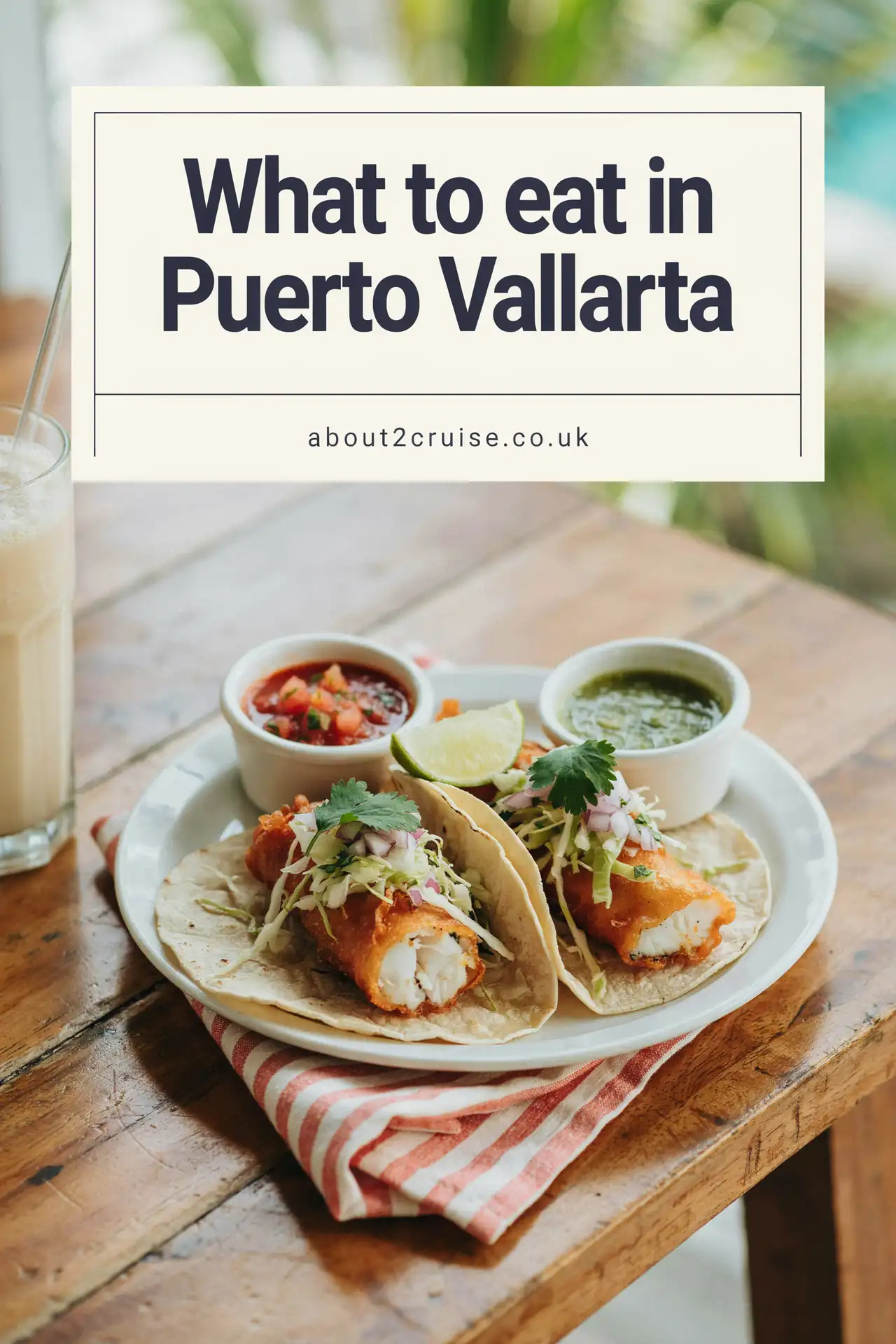
Puerto Vallarta’s food scene is one of the easiest wins of a port day. Jalisco staples to try are birria, a slow-cooked goat or beef stew in guajillo chilli broth, and tortas ahogadas, the region’s soaked pork sandwich. From the Pacific coast, look for pescado zarandeado, a butterflied whole fish grilled over wood, and pescado embarazado, charcoal-grilled fish with salsa huichol.
Morning birria stands outside the Mercado Municipal sell tacos at about MXN 25–40 and a bowl with consommé at MXN 60–80, usually until the pot runs out around noon. Street taco stands along Avenida Constitución and in the Zona Romántica sell tacos al pastor and carnitas for MXN 15–30 each. Seafood restaurants along the Malecón and the palapa places on Isla Cuale grill whole fish, and the market food court sells ceviche and seafood tostadas from about MXN 50–100.
Tequila tasting is available without going far: Puerto Mágico has the Hacienda Tequilera and Museo del Tequila with tastings and distillation demonstrations. For a more guided food experience, a three-hour taco-and-mezcal walk in the Zona Romántica sells from about US$40 per person, and a two-hour tequila and agave tasting from about US$50.
Shopping and Souvenirs Near the Port
At the terminal you’ll find a craft market and souvenir shops, so you can shop without leaving the port. In town, Isla del Río Cuale has artisan stalls, and the Malecón has galleries and tourist shops. The Mercado Municipal Emiliano Zapata is a working market with food and local flavour, but bring cash. For everyday supplies, Walmart and Sam’s Club are across from the port gate.
Day Trips: Yelapa, Las Caletas, and Sayulita
Yelapa is the bucket-list day trip for many cruise passengers. It has no road access, so water taxis leave from the Los Muertos pier in the Zona Romántica or from Boca de Tomatlán. From Los Muertos the crossing is around 45–55 minutes, with a published fare around MXN 270 one way. The last boat back is usually around 16:00–16:30, so this trip works best on a long port day and demands careful time management. There’s no reliable ATM in Yelapa, and beach pie sellers charge about MXN 60–80 a slice, so bring cash.
Las Caletas is a private Vallarta Adventures day site and former John Huston retreat. Sayulita is about 45 km north, roughly an hour by car or bus, and is a Pueblo Mágico with beginner surf breaks. The Vallarta Botanical Garden is about 30 km south of the city and is a quieter green alternative.
LGBTQ+ Travel and Nightlife
Puerto Vallarta is one of Mexico’s most LGBTQ+-friendly destinations. The Zona Romántica is the centre of the scene, particularly Calle Púlpito and its surrounding blocks. Around 49 specialist LGBTQ+ businesses operate in the district, and the local tourism ministry has said the community accounts for a large slice of resort spending.
Even if you’re not looking for nightlife, the Zona Romántica’s restaurants, cafés, and beach clubs are welcoming and relaxed. After dark, stick to busy streets, watch your drink, and use a licensed taxi if you’re moving between neighbourhoods.
Zip-lining, ATVs, and Jungle Adventures
The Sierra Madre hills behind Puerto Vallarta are the setting for zip-line, ATV, and jungle adventures. Canopy River runs zip-line circuits from an office at Insurgentes 379 in the Zona Romántica, with 8 or 11 lines over the jungle, a suspension bridge, and a 30–50 minute drive to the park. Minimum age is 6, the weight limit is about 240 lb, and sturdy shoes are needed for hiking between lines.
This is the one independent tour where the meeting point really matters. Many operators meet in the Zona Romántica or at the marina, not at the terminal, so confirm the exact meeting point and check local time against ship time before booking. If you book through the cruise line, the excursion will normally meet in the terminal area.
Ship Excursion or DIY: Which Is Right for You?
Puerto Vallarta is a good port for a DIY day if you want the old town, Malecón, and a beach or lunch. The transfer is short, the old town is compact, and you can choose what to eat and when to stop.
Book a ship excursion if you want a long day to Yelapa, Las Caletas, zip-line, or Islas Marietas, or if you don’t want to juggle local taxis and buses. Ship tours meet at the terminal, and the ship waits for ship-booked tours if there is a delay. Independent tours are usually cheaper and smaller, but you are responsible for getting back on time. Whichever you choose, allow a bigger return buffer than you think you need.
Money, Safety, and Health Tips
Money and Tipping
The currency is the Mexican peso. US dollars are widely accepted in tourist areas, but change may come back in pesos. Cards work in most shops and restaurants. Cash is needed for buses, market stalls, taxis, and tips. Use ATMs in daylight and prefer machines inside the terminal, shopping malls, or shops; avoid large withdrawals. Tipping is normally 10–15% in restaurants and for good service. The non-resident cruise passenger fee is folded into your cruise charges, so you won’t need to pay it at the pier.
Safety and Street Awareness
Puerto Vallarta is a major tourist resort area, but street crime, pickpocketing, and theft happen, including on public transport. Keep cards and cash split, don’t wear expensive jewellery or watches, and be alert around ATMs. Use regulated sitio taxis from authorised ranks; unlicensed taxis have been involved in assaults and robberies. Agree taxi fares before getting in. Timeshare and tour touts work the port and the Malecón, say no thanks and keep walking.
Be wary of criminals posing as police; ask for ID and a written fine rather than handing over cash or your passport. Don’t leave drinks unattended, because tainted or methanol-containing alcohol has caused serious illness in Mexico. After dark, stick to busy, well-lit streets and use a licensed taxi for longer moves.
Food, Water, and Health
Drink bottled or filtered water. Take care with personal, food, and water hygiene, especially if you eat at street stalls or markets. Hepatitis A and typhoid vaccines are commonly recommended for Mexico, so check with a travel health professional before you sail. If you need a pharmacy, there are options near the terminal and downtown, but if you have serious illness, use the ship medical centre or seek an English-speaking clinic through your insurer. Your travel insurance should include direct billing and cover all activities you plan, including water sports.
Family-Friendly Port Day
Puerto Mágico has an aquarium, and a beach-club day at Los Muertos is an easy option for families. Always check beach flags before anyone gets in. If booking zip-lines or ATVs, check minimum ages and weight limits in advance.
Puerto Vallarta Weather and Packing
The dry season runs November to May, with little rain and average highs around 27–30°C. The rainy season is June to October, heaviest July to September, when rain usually falls as heavy afternoon or evening downpours separated by sunshine. Sea temperatures range from about 24°C in March to 30°C in August. Humidity averages around 65–70%, and winds are generally light.
Pack comfortable shoes for cobbles, a hat, sunglasses, reef-safe sunscreen, and a light rain jacket if you’re cruising between June and October. For beaches with rocky entry, such as Conchas Chinas, water shoes help. Jungle trips need insect repellent, and if you plan to enter the Church of Our Lady of Guadalupe, cover shoulders and knees.
Passports, Entry, and Insurance for UK Cruisers
UK passport holders don’t need a visa for tourism in Mexico. You should get a passport stamp with the number of days allowed. Your passport must be valid for the duration of your stay, though the Mexican Embassy recommends 180 days. Border officers may ask for return travel, accommodation, and proof of funds. If your itinerary transits the USA, you’ll need ESTA or a visa.
Vapes and e-cigarettes are illegal to bring into Mexico, and smoking or vaping in public places can draw a fine of around MXN 3,000. Travel insurance must cover everything you plan, including diving, jet-skiing, ATV, or zip-line activities. Adventure-sport equipment standards may not match UK standards, so check your insurer’s fine print.
How to spend a port day in Puerto Vallarta
A port day in Puerto Vallarta works best if you pick one: a short walk around the Malecón and Zona Romántica, or a longer beach day with a quieter cove.
Before you sail
- Book ship excursions for Yelapa, Las Caletas or zip-lining ahead if you want the ship to wait.
- Check ship time against local time before booking independent tours; Puerto Vallarta is on Central Time.
- Bring pesos in cash for buses, market stalls and tips, and use ATMs in daylight.
Short port day: under 6 hours
- On dockingTake a taxi to the MalecónAgree the fareYellow city taxis outside the terminal gate are cheaper and charge per car. Agree the fare before getting in; 10 to 15 minutes to the Malecón.
- +15 minWalk the Malecón sculpturesThe flat 750 m promenade runs from Plaza de los Pescadores to the Los Arcos amphitheatre. See El Caballito and La Rotonda del Mar.
- +1 hrParish of Nuestra Señora de GuadalupeOne block back from the Malecón. Cover shoulders and knees; shorts and sleeveless tops are not allowed inside.
- +1 hr 30 minIsla del Río CualeCross the river on the island's shaded paths with artisan stalls and a cultural centre. Bring pesos for crafts.
- +2 hrsLunch at Mercado Emiliano ZapataBring pesosIn the old town. Seafood and prepared food counters; try pescado zarandeado or ceviche. Vendors often don't take cards.
- +3 hrsZona Romántica and Los Muertos pierWalk the cobbled old town and the sail-canopied pier. Playa Los Muertos is the busiest beach.
- All-aboard minus 60 minTaxi back to the terminalTaxis take 20 to 25 minutes from the Zona Romántica back to Puerto Mágico. Afternoon traffic builds, so leave a buffer.
This map shows the taxi ride from the ship. The time is the drive only, not your time ashore.
Open the taxi route in Google Maps
If plans change: If the Guadalupe parish is closed or the Malecón is overcrowded, the terminal's tequila museum and Marina Vallarta boardwalk make an easy fallback.
Long port day: 8 hours or more
- On dockingTake a taxi to the MalecónAgree the fareYellow city taxis outside the terminal gate charge per car. Agree the fare before getting in; the ride takes 10 to 15 minutes.
- +15 minWalk the Malecón sculpturesWalk the 750 m seafront promenade from Plaza de los Pescadores to the Los Arcos amphitheatre. See El Caballito and La Rotonda del Mar.
- +1 hrIsla del Río CualeShaded paths, artisan stalls and a cultural centre sit between Centro and the Zona Romántica. Bring pesos for stall purchases.
- +2 hrs 30 minLunch in Zona RománticaBasilio Badillo and Olas Altas are the restaurant streets. Try birria or pescado zarandeado at the cafés along these streets.
- +3 hrs 45 minPlaya Los Muertos beach clubRent a lounger and check the beach flag: green safe, yellow caution, red closed. The pier is the Zona Romántica's photo landmark.
- +5 hrs 30 minPlaya Conchas ChinasA short taxi or hilly walk south of Los Muertos. Quieter and clearer water with tide pools; water shoes help on the rocky entry.
- All-aboard minus 90 minTaxi back to the terminalTaxis take 30 minutes or more from Conchas Chinas to Puerto Mágico. Coast-road traffic builds in the afternoon.
This map shows the taxi ride from the ship. The time is the drive only, not your time ashore.
Open the taxi route in Google Maps
If plans change: If the town beaches are red-flagged, skip the swim and stay on the Malecón terraces or return early for tequila tasting at Puerto Mágico.
This is one of Mexico’s Pacific coast cruise ports. Our Mexico cruise ports guide covers the others on the Pacific and the Caribbean.
Puerto Vallarta Cruise FAQs
Do cruise ships still stop in Puerto Vallarta?
Yes. Puerto Vallarta is a regular call on Mexican Riviera itineraries with Cabo San Lucas and Mazatlán. The port can handle three ships at once, and calls include Carnival, Princess, Royal Caribbean, Holland America, Norwegian, Disney, Celebrity, and other lines. Check your cruise itinerary and the ASIPONA Puerto Vallarta arrivals calendar for monthly dates.
Can I walk from the ship to the Malecón?
It is possible but not recommended, over an hour on busy roads in the heat. Take a taxi, bus, or rideshare instead.
Are Puerto Vallarta beaches safe for swimming?
Many are, but always obey the coloured beach flags. Green means safe, yellow means enter with caution, red means the water is closed. Red flags are common after swell and rip-current warnings. Conchas Chinas has rocky entry, so water shoes help.
What should I be careful about in Puerto Vallarta?
Use licensed taxis, agree fares first, watch for pickpockets in busy markets and on public transport, avoid touts and fake police, don’t leave drinks unattended, and pay attention to beach flags and crocodile warning signs.
Are there jaguars in Puerto Vallarta?
Jaguars live in the Sierra Madre mountains and jungle around Banderas Bay, not in the cruise port, beach, or hotel zones. They are rarely seen and have not posed a risk to people in the monitored area. If you ever saw one, stay calm, back away slowly, and don’t run.
Is Puerto Vallarta a cruise turnaround port?
Not yet. It is mainly a port of call. A federal homeport project is planned but has no published start date, so don’t book flights as if your cruise will start or end there unless a cruise line says otherwise.
Do I need pesos in Puerto Vallarta?
Pesos are best for buses, market stalls, taxis, and tips. US dollars are accepted in many tourist places, but change is often given in pesos. Cards work in most shops and restaurants.
Is there an official port map?
There isn’t a public-facing passenger map from the port authority. The terminal is compact and signed, so you won’t need one, just follow signs after leaving the ship.
More Mexico Cruise Port Guides
If you’re also stopping on the Caribbean side or building a Mexico cruise itinerary, see our Cozumel cruise port guide, Costa Maya cruise port guide, and Cancun cruise port guide.
Last Updated: 19 November 2026