
Yes, Pula is a proper working cruise port, and a good one for a short call. It sits in a sheltered natural bay on the Istrian peninsula, and you’ll spot the Roman amphitheatre almost the moment you step off the ship. The docks are a fifteen minute walk from the historic centre, if that.
Pula, Croatia: Port at a Glance
Pula is the biggest city on Croatia’s Istrian peninsula, a proper working Adriatic harbour with around 60,000 people packed into a tidy 52 square kilometres. The docks sit inside a natural bay with a man-made breakwater doing the hard work, so the water stays calm even when it’s choppy further along the coast.
Smaller ships can usually pull straight up to the dock near the amphitheatre. Bigger ones tend to anchor offshore and bring you in by tender instead, so check with the crew which one you’re getting before you plan your morning.
| Detail | What to expect |
|---|---|
| Location | Natural bay on Croatia’s Istrian peninsula |
| Cruise berth area | Near the amphitheatre, sources differ on the exact quay name |
| Docking type | Smaller ships alongside, larger ships often anchor and tender |
| Walk to Old Town | Under 15 minutes |
Pula is one of several Adriatic stops in our guide to Mediterranean cruise ports in Croatia, alongside Rijeka Cruise Ship Port up the coast and Port of Korčula down south.
Pula Docks and Tenders: What Happens When You Arrive
Cruise sources can’t quite agree on the exact quay, some say Rijeka Quay near the amphitheatre, others point to a berth over in Verudela. It doesn’t matter much in practice. Wherever you tie up or anchor, the Old Town isn’t far, and the crew at the gangway will point you the right way.
When more than one large ship is in, some of them end up anchored out in the bay instead of alongside, which means a tender queue before you’ve even started walking. If your excursion has a strict start time, ask the crew early which group you’re in.
Look up from the quay and you’ll probably spot the cranes of the Uljanik shipyard along the waterline, a reminder that this harbour earns its keep well beyond cruise ships.
From the Quay to the Arena
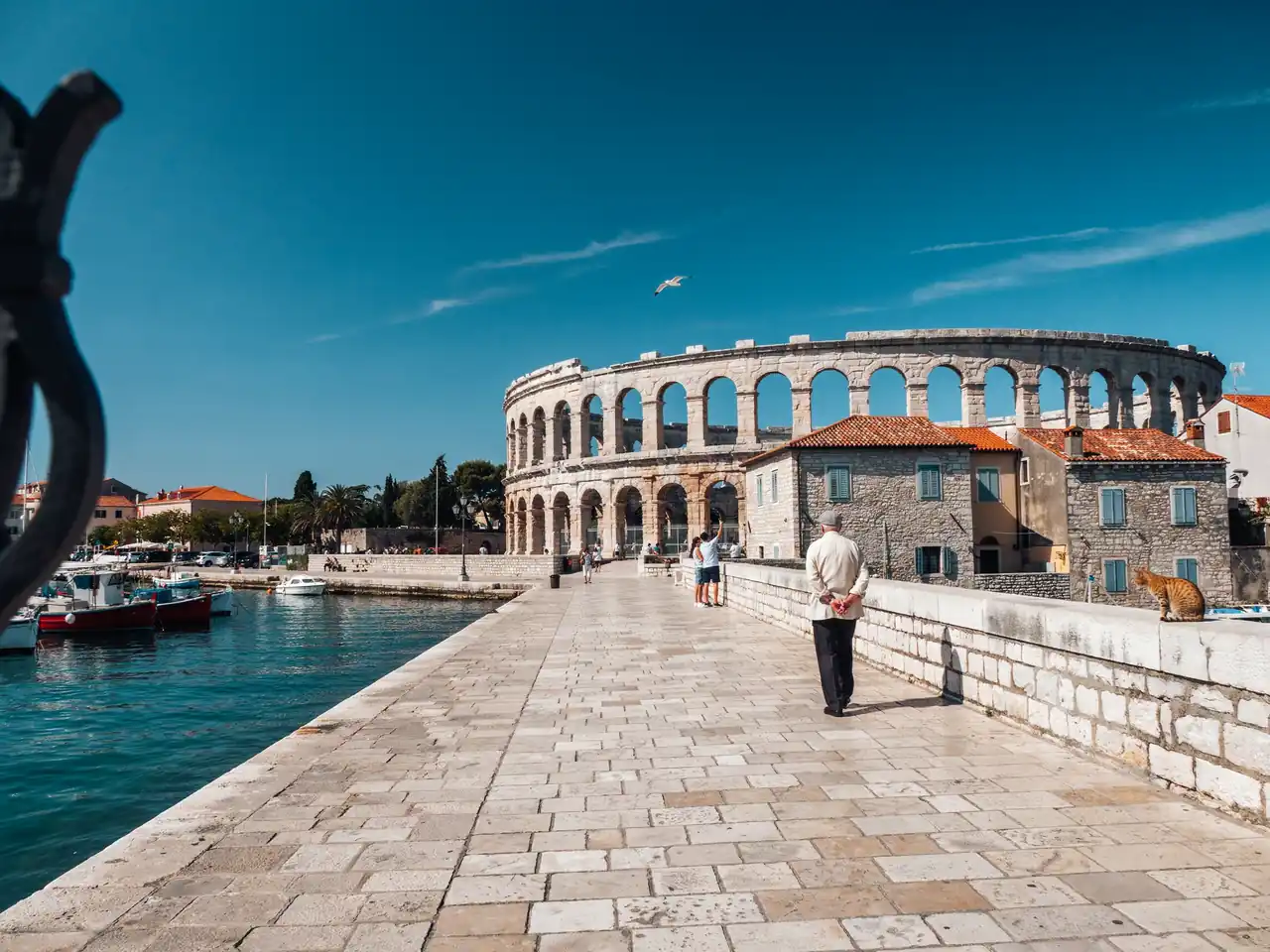
The Arena is a 1st-century Roman amphitheatre, one of the six largest still standing anywhere, and it’s close enough to the berth that it’s the obvious first stop. The pier itself looks like a working yard, all cranes and machinery, but the walk into the city happens fast, and the switch from industrial to ancient is sudden rather than gradual.
A few minutes later you’re on the Riva, Pula’s waterfront promenade, lined with cafes and restaurants and about as good a spot as any for the first coffee of the day.
- The Arena, for the amphitheatre itself
- The Riva, for cafes and a first orientation
- The Forum, Pula’s old Roman main square, a further short walk inland
Pula Castle: The Kaštel and Its Views
The Kaštel is a hilltop fortress built by the Venetians in the 17th century, designed by French military engineer Antonio De Villa as a star-shaped defence for the harbour below. These days it houses the Historical and Maritime Museum of Istria.
It’s an uphill walk from the port, no way round that, but the view is the payoff, the Arena, the harbour, the shipyard cranes, the red roofs of the Old Town and the Adriatic stretching out behind, all from the same ramparts. A collapsible water bottle earns its place in your bag for this climb, especially once summer hits.
Uljanik: The Shipyard You’ll See From the Port
Those cranes belong to Uljanik, a shipyard founded in the mid-19th century for the Austro-Venetian Navy, which makes it one of the oldest working shipyards on the planet. More recently it launched the six-star, 228-passenger Scenic Eclipse, a rare case of a luxury cruise ship built on Croatian soil.
The Uljanik Group later ran into serious money trouble and its parent company went into liquidation, though the site and equipment stayed put. A new company, Uljanik-Brodogradnja 1856 d.o.o., now trades under a similar name on the same ground, but there’s no clear, up to date word on how fully it’s operating.
A Half-Day Trip to the Brijuni Islands
If you’ve got most of the day ashore, the Brijuni Islands are worth the detour. It’s a group of islands run as a Croatian National Park and holiday resort, but you reach them by boat from the small town of Fažana, not from Pula itself.
Getting to Fažana and back, plus the crossing itself, eats a fair chunk of your day, so this only stacks up if your ship gives you most of it in port. Check the Brijuni boat times the moment you step ashore, not after lunch when you’ve already lost the morning.
Weather in Pula: What to Expect Ashore
Pula has a humid subtropical climate with no proper dry season, so rain can show up whenever it fancies, summer included. Average highs run from around 10°C in the depths of winter up to about 28°C in July and August, and the sea follows roughly the same curve, from around 10°C in February to about 25°C in August.
The comfortable window for a shore day runs from late spring to early autumn, when daytime temperatures typically sit between 21°C and 28°C. Autumn brings noticeably cooler, more changeable days than high summer, still mild enough for sightseeing but pack a layer just in case. Every so often a proper cold spell sets in and temperatures drop as low as -10°C with light snow, though that’s well outside the cruise season for most itineraries.
Midsummer sun at the Arena has real bite, and the stone terracing offers next to no shade, so keep reef-safe sunscreen handy for however long you’re out there.
Common Questions
Does the cruise ship dock directly in Pula, or do passengers tender ashore?
Depends on the ship. Smaller ones usually come alongside the pier. Bigger ships often anchor offshore and tender passengers in, which adds a short wait before you can start exploring.
How far is it from the ship to Pula’s historic centre?
Under 15 minutes on foot from the berth to the Old Town and the Kaštel, which makes Pula one of the more walkable Adriatic ports for a short call.
What happens if more than one cruise ship is in Pula on the same day?
Berth space is limited, so on busy days extra ships anchor out in the bay and tender passengers in, which usually means longer queues before you get ashore.
Is the Port of Pula used for anything besides cruise ships?
Yes. Alongside cruise calls, it handles ferries to nearby islands, cargo shipments, fishing boats and the Uljanik shipyard, so it’s a working harbour first and a cruise terminal a distant second.
Can I fit in a trip to the Brijuni Islands during a short call?
Only if you’ve got most of the day ashore. You reach the islands by boat from Fažana, not from Pula’s cruise berth, so build in travel time both ways.
Is Uljanik shipyard, visible from the port, still building ships?
A new company operates on the same site under a similar name, but there’s no clear, current statement on how fully it’s running, so treat this as background rather than a working fact.
What’s the best time of year to visit Pula on a cruise?
Late spring to early autumn, when daytime temperatures generally sit between 21°C and 28°C. Summer is hottest and driest, autumn milder and more changeable.
Is Pula worth a stop compared with other Croatian ports?
For Roman history especially, yes. Few Adriatic ports put a 1st-century amphitheatre this close to the quay, with a Venetian fortress and old town both within easy walking distance too.
Why Trust About2Cruise
This guide came from published port, tourism and shipping sources on Pula’s harbour, history and climate, cross-checked wherever those sources disagreed, such as the exact cruise quay. We haven’t sailed into Pula ourselves, so treat detail like exact berth positions as a starting point rather than gospel, and check specifics with your cruise line closer to departure. You can read more about how we put our guides together on our about us page.
Last Updated: 19 October 2026