
Your ship ties up right at the quayside in Santa Cruz de la Palma, no tender boats needed, no waiting for your number to be called over the tannoy. The berth sits close to the old town, under a kilometre away by most estimates, so a short walk gets you past the harbourfront and into the cobbled streets beyond.
If you want the layout before you’ve even set foot on dry land, the map further down this page shows how close the ship sits to the old town’s grid of streets. This harbour gets called one of the prettiest in the Canary Islands, and standing on the quay with green mountains rising behind the rooftops, you’ll see why that stuck. The real question here isn’t how to reach the centre, it’s what to do once you’re there, and that ranges from a gentle wander round the old quarter to a full day chasing volcanoes and observatories.
Santa Cruz de la Palma cruise port at a glance
| Detail | What to expect |
|---|---|
| Docking | Ships berth directly at the quay, no tender boats involved |
| Distance to old town | Estimates vary widely, from under a kilometre to around a mile and a half, roughly five to twenty minutes on foot |
| Distance to airport | About nine kilometres |
| Local buses | Lines 2, 11, 12, 20, 33, 35, 100, 200, 201, 300 and 500 stop near the port |
| Nearest beach | Playa de Bajamar, a short stroll from the terminal |
| Currency | Euro |
Where do cruise ships dock in La Palma
Santa Cruz de la Palma sits on the eastern coast of the island, and its harbour is the only major port La Palma has. Alongside the cruise ships, it handles ferries on to Gran Canaria, Lanzarote and Tenerife, plus a route across to Cadiz on the Spanish mainland.
There’s one berth area beneath the harbour wall, and you’ll spot the old town’s rooftops from the deck as you come alongside. The map below shows exactly where that sits against the streets you’ll be walking.
La Palma cruise terminal facilities
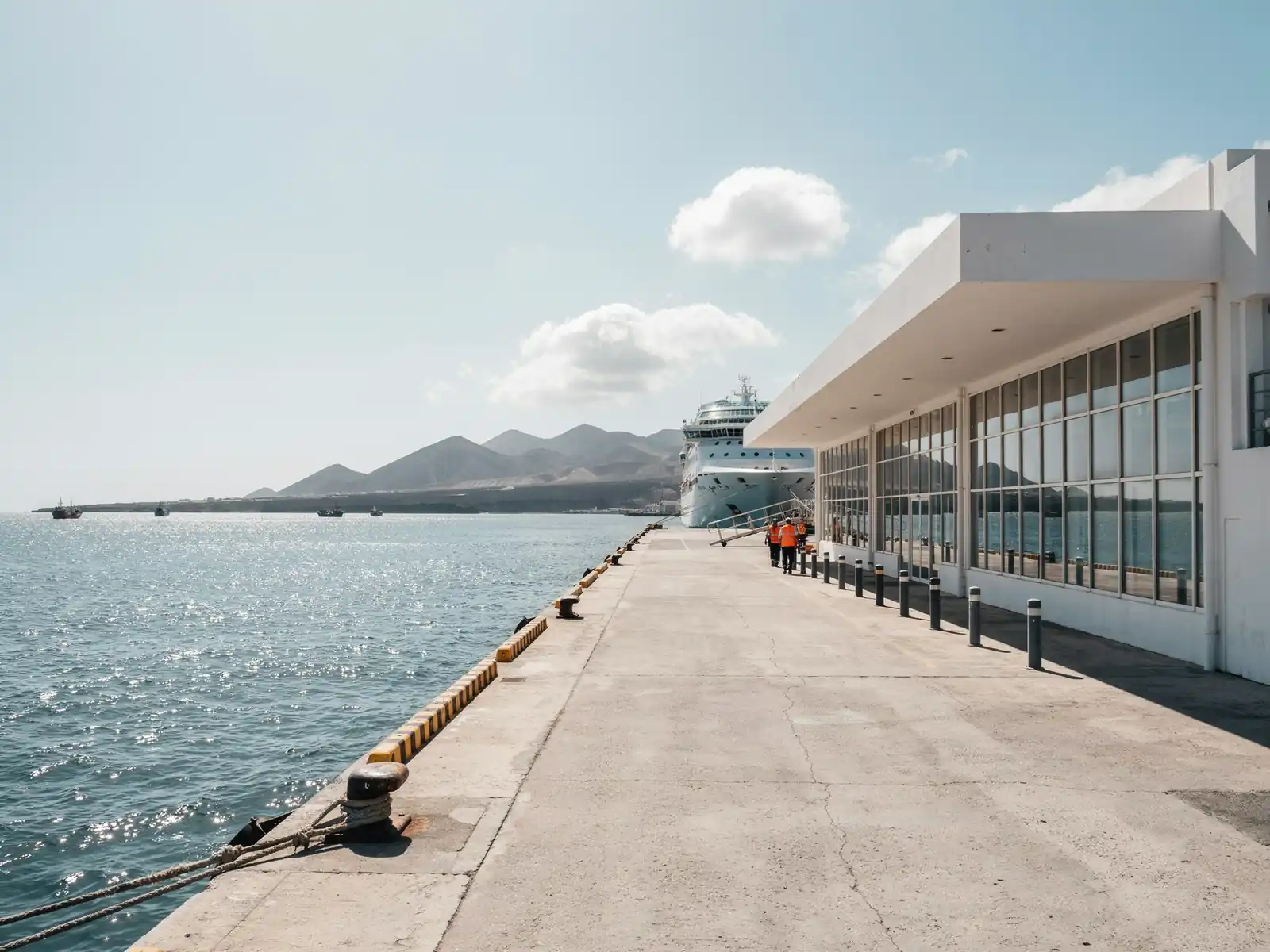
The terminal itself won’t hold you long. It’s not a shopping destination, and most of what you need is a short walk beyond the gate rather than inside it.
- No tender boats, ships berth directly at the quay
- A shuttle bus between ship and terminal gate is sometimes provided, though reliability is reported to vary
- Taxis wait immediately outside the terminal
- Bus stops for island routes are a short walk from the gate, along Avenida de Bajamar
- Shops and restaurants on Calle O’Daly and Avenida Marítima are within walking distance of the gate
How far is it really from the ship to town
Ask five sources how far it is from the port to the centre and you’ll get five different answers. Spain’s official tourism board says under a kilometre, Cunard calls it a short stroll, and independent traveller blogs put the walk anywhere from five to twenty minutes depending on how fast you go, with one source insisting it’s closer to a mile and a half.
Nobody agrees, and that’s just how this port is rather than a gap in the research. Plan for the longer estimate, budget fifteen to twenty minutes each way along the flat, paved Avenida Marítima, and treat anything shorter as a bonus. If your feet aren’t keen on long stretches of pavement, a set of blister prevention plasters tucked into your daybag are cheap insurance for the walk there and back.
Things to do in La Palma cruise port
Almost everything worth seeing in the old town is within easy walking distance of the ship, which is unusual for a Canary Islands call.
- Naval Museum, a replica of a fifteenth-century caravel on the Barco de la Virgen, with maps, sailing knots and model ships
- Church of San Francisco, a Renaissance-style church declared a Property of Cultural Interest
- Iglesia de El Salvador, the parish church built around 1500, known for its wooden ceiling, sculptures and stained glass
- The Town Hall, a historic sixteenth-century building on Plaza de España
- Plaza de España itself, the natural heart of the old town
- Calle O’Daly, a shopping street running from the port to the plaza
Castillo de Santa Catalina, worth the detour?
The castle standing there now dates from the late seventeenth century, built after an earlier fort was flattened in a French pirate attack in the mid sixteenth century. It was listed as a historical monument decades ago and has been in private hands for a long time since.
Getting inside is anyone’s guess. Some tourism guides still list it as open with panoramic views over the harbour, while a local news report says it’s closed to visitors amid ownership issues. Treat it as a photo stop from outside rather than building your afternoon around getting in, and check locally on the day if you fancy trying your luck.
Beaches within reach of the port
- Playa de Bajamar, a short stroll from the terminal, black volcanic sand sheltered from the Atlantic swell by a breakwater
- Santa Cruz Beach, roughly ten to fifteen minutes on foot along Avenida Marítima
- Los Cancajos, on the east coast, about fifteen minutes by taxi, a flat forty-five-minute walk each way, or a short hop on bus 500, with warm black sand, low waves and diving
- Charco Verde, a small black volcanic sand beach with ramps and walkways built for wheelchair access
That black volcanic sand at Bajamar and Charco Verde turns into a hotplate in strong sun, so put your reef safe sunscreen on before you leave the cabin rather than hunting for shade once you’re already stood on it.
Getting around: shuttle buses, taxis and buses
Cunard mentions a shuttle sometimes runs between ship and terminal, but other reports say it’s patchy, and if you’re on a tight schedule, walking or grabbing a taxi is the safer bet.
Taxis wait outside the terminal and around the city, with set rates for the island’s main attractions. A modest fixed fare gets you to the beach, a higher fixed rate covers an hour or so of touring, and you agree it before you set off, not after. Uber and Lyft don’t operate on La Palma, so anywhere off the beaten path means a taxi or an organised excursion.
Local buses cover around twenty routes across the island for a low, flat fare, and they’re the cheapest way to see more of La Palma in a short window. Bus 500, heading toward the airport, passes the port often and is the easiest route to Los Cancajos without paying for a taxi. If your ship is docked for a long stretch, hiring a car from Autos la Palma on Avenida Marítima is worth a look for a fuller loop of the island.
Further afield: island excursions from the port
- La Cumbrecita viewpoint, roughly forty-five minutes by taxi or shore excursion, often paired with the Roque de los Muchachos Observatory at the island’s highest point
- San Andrés, about thirty minutes’ drive, cobblestone streets and traditional Canarian architecture, often combined with the Charco Azul natural pools
- Tazacorte, about forty-five minutes away, a colourful harbour, black sand beach and some of the island’s best seafood
- Fuencaliente, around an hour by taxi, gateway to the still active Volcán de Teneguía and the calmer Volcán de San Antonio
- Caldera de Taburiente, the island’s most dramatic volcanic crater and a national park, with skies clear enough to support a major astrophysical observatory
There’s no official fare list for these longer runs, so budget for noticeably more than a short in-town hop, and settle the price with the driver before you set off, not when you arrive.
Shopping and local specialities
Calle O’Daly and the seafront Avenida Marítima are right there from the port area, which is partly why the shuttle bus never feels essential. Worth seeking out locally are hand-rolled cigars, known as puros palmeros, and bottles of Malvasía wine.
La Bodeguita del Medio sits about 350 yards from the port gates if you fancy a sit-down stop before heading back to the ship.
When more than one ship is in port
No port authority publishes a calendar of cruise arrivals, so there’s no way to check in advance whether your day will be quiet or rammed. What is clear is that traffic through this port is climbing fast, cruise passenger numbers were up by around a third year on year in the most recent reporting period, according to the Autoridad Portuaria de Santa Cruz de Tenerife, so those quiet port days may not stay quiet forever.
On a busy day, taxis and buses get stretched thin, so if your plans hinge on a taxi to somewhere like La Cumbrecita, sort it out as early as you can rather than hoping one turns up later.
Accessibility for passengers with reduced mobility
The port authority doesn’t publish accessibility information, ramps, mobility assistance and so on, for this terminal specifically. What we can confirm is that the walk into town runs along a flat, paved promenade, and Charco Verde beach has ramps and walkways built for wheelchair access.
If mobility is a concern, check with your ship’s shore excursion or accessibility desk before you disembark, since nothing port-specific is published online for this particular call.
Luggage on port day
There’s no confirmed left luggage facility at the port or in town, just an old online forum suggesting you ask your accommodation if you’re staying on afterwards. For a standard port day, the short walk into town means a light daybag is all most people need, no locker required.
If you’re combining La Palma with other Canary Islands
The harbour also handles ferries on to Gran Canaria, Lanzarote and Tenerife, plus a service to Cadiz, which is one reason plenty of fly-cruise itineraries treat this island as one stop among several in the archipelago. If your own trip strings islands together, our Las Palmas de Gran Canaria cruise port guide, Arrecife cruise port guide for Lanzarote and Santa Cruz de Tenerife cruise port guide cover the neighbouring calls.
For scale, the neighbouring port authority at Santa Cruz de Tenerife has, in past years, ranked as the busiest cruise port in the Canary Islands and the second busiest in Spain after Barcelona, so La Palma’s one quiet berth feels noticeably calmer by comparison. Wider planning across the archipelago, including our Puerto del Rosario cruise port guide for Fuerteventura and San Sebastián de La Gomera cruise port guide, is covered in our broader Canary Islands cruise ship port guide.
Common Questions
Do cruise ships tender into Santa Cruz de la Palma?
No. Ships dock straight at the quay, no tender boat in sight, so you walk off onto the harbourside the moment you’re cleared to disembark.
Is there a shuttle bus from the ship to town?
Sometimes. Some cruise lines run one, but reliability is a bit hit and miss, and the walk into the old town is short enough that plenty of passengers skip it altogether.
Can I use Uber or Lyft in La Palma?
No, ride-share apps don’t operate here. Taxis and organised shore excursions cover anywhere beyond walking distance or the local bus routes.
What currency do I need in Santa Cruz de la Palma?
The euro. Cards are accepted in most shops and restaurants near the port, but keep some coins on you for the local buses.
Is Castillo de Santa Catalina open to visitors?
Depends who you ask. Some tourism guides list it as open with panoramic views, others say it’s closed amid ownership issues, so don’t build your day around getting in.
What’s the easiest beach to reach on foot?
Playa de Bajamar, a short stroll from the terminal, sheltered black volcanic sand tucked behind a breakwater.
How do I get to Los Cancajos beach?
Bus 500 runs often from stops near the port, a taxi takes about fifteen minutes, or it’s a flat forty-five-minute walk each way if you fancy stretching your legs.
Can La Palma be combined with other Canary Islands on one cruise?
Yes, ferry routes and plenty of itineraries link it with Gran Canaria, Lanzarote and Tenerife, so it turns up often on wider Canary Islands cruises.
Why Trust About2Cruise
This guide was put together by cross-checking port authority information, cruise line guidance and independent traveller reports, and flagging it plainly wherever those sources disagree rather than picking one version and calling it settled, as with the conflicting walking distances and the uncertain status of Castillo de Santa Catalina above. Find out more about how we put together our cruise port guides.
Last Updated: 19 October 2026