
Ain Sokhna is Egypt’s closest Red Sea cruise port to Cairo and the Giza Pyramids, but it is a working commercial port, not a walk-off holiday harbour. You cannot wander into the port or hail a taxi at the ship. Most passengers use a ship excursion or a pre-permitted private vehicle for the 2–2.5-hour-each-way Cairo run, with visas or transit stamps sorted before arrival and a generous return buffer.
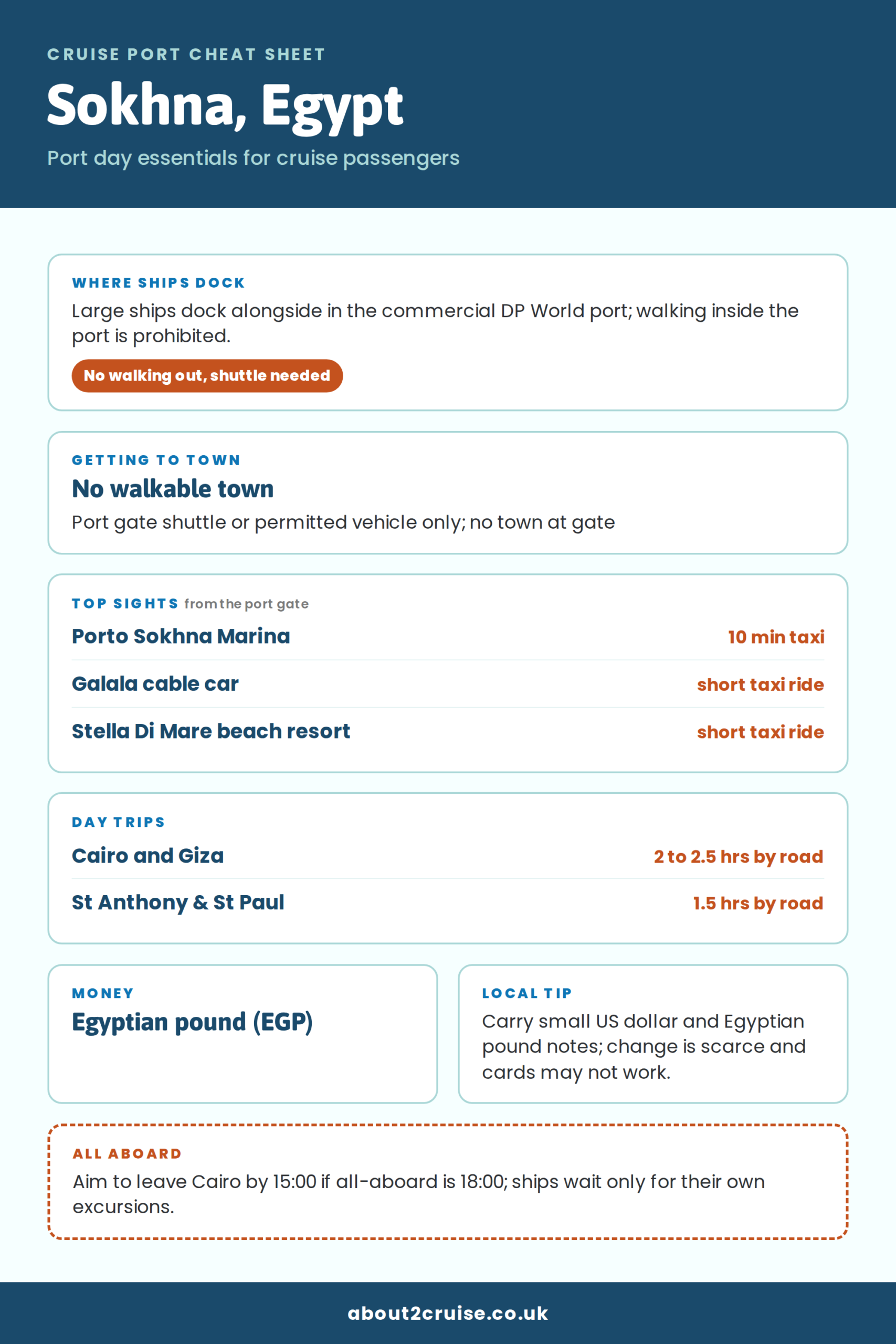
Ain Sokhna is Egypt’s closest Red Sea cruise port to Cairo and the Giza Pyramids, but it is a working commercial port, not a walk-off holiday harbour. You cannot wander into the port or hail a taxi at the ship. Most passengers use a ship excursion or a pre-permitted private vehicle for the 2–2.5-hour-each-way Cairo run, with visas or transit stamps sorted before arrival and a generous return buffer.
Ain Sokhna at a Glance
Ain Sokhna sits on the western shore of the Gulf of Suez, around 55 km south of Suez city and about 120–140 km east of Cairo and Giza by road. The name comes from hot springs near Jebel Ataqa, and the coast behind the port is a local resort strip popular with Egyptian visitors. For cruisers, however, the real headline is simple: this is the closest Red Sea cruise berth to the Giza Pyramids.
- Why ships call here: Cairo and the Pyramids, plus Suez Canal and Red Sea itineraries.
- Port type: Commercial port and industrial free zone, not a purpose-built cruise terminal.
- Berth type: Deep-water alongside, with no tendering, whatever the ship size.
- Main practical reality: You cannot walk off, and no taxis wait inside the secure port.
- Best use of a port day: A well-planned Cairo and Giza trip, or a local resort day if you have been to Cairo before.
Where Do Cruise Ships Dock in Ain Sokhna?
Ships berth inside the DP World Sokhna complex within the Suez Canal Economic Zone. This is a large, busy commercial area of about 25 sq km where container, bulk and cargo operations are the dominant activity. Cruise ships use a deep-water quay, so you step straight off the gangway rather than tendering.
Do not expect a polished cruise terminal with a café, currency exchange, shops or a passenger lounge. Depending on the day and the ship, the cruise set-up may be a temporary or basic pier-side facility. Construction traffic and new terminal projects continue around the port, and you may see container machinery and freight vehicles nearby.
- There is no confirmed public parking, taxi rank, café or tourist services inside the terminal.
- The nearby gate area is not a walkable town centre. There are no shops or cafés immediately outside.
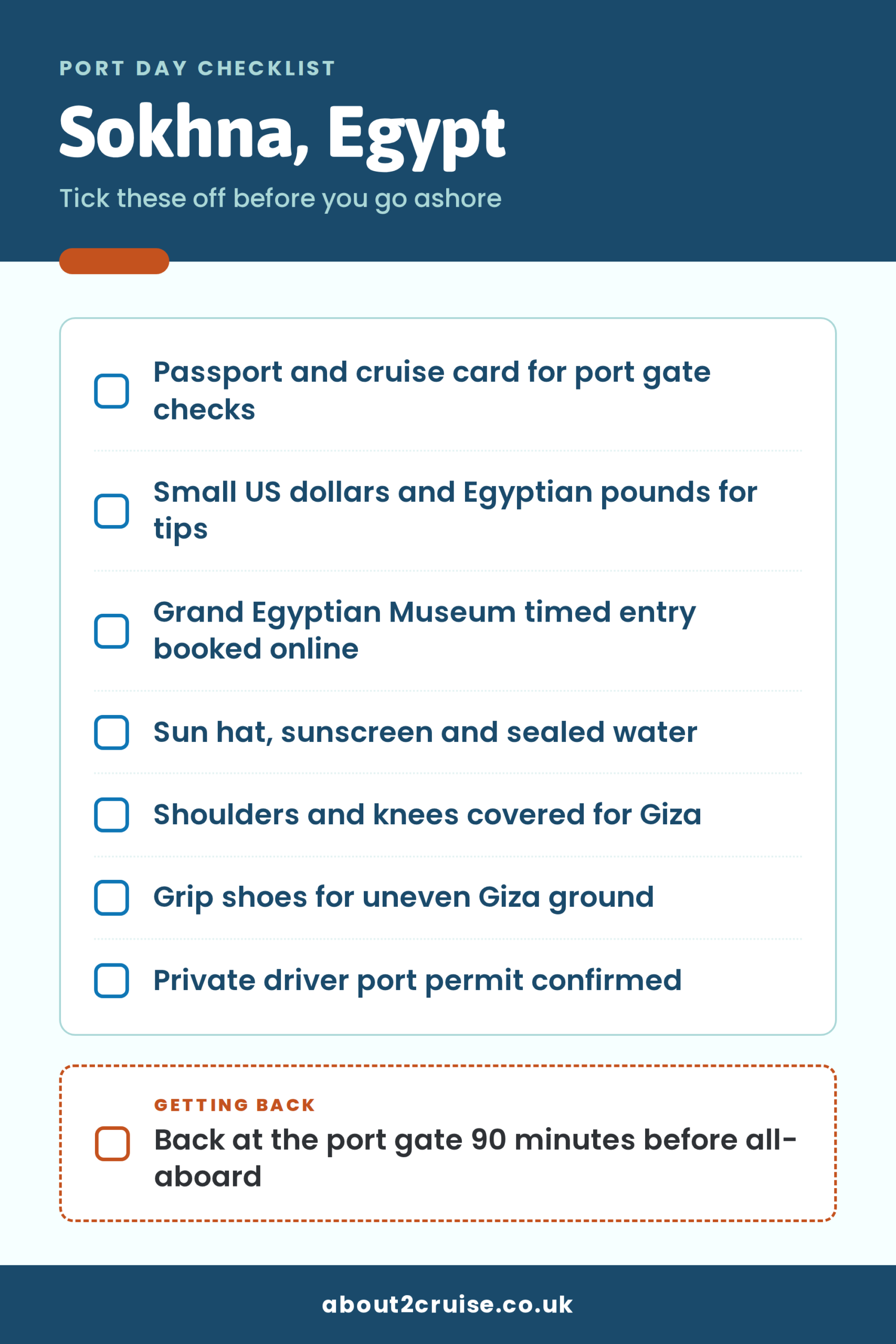
- You will need your cruise card, passport and sometimes a gate pass or security check at the port.
Sokhna cruise port map
Ships dock at Sokhna cruise quay. Tap a pin for directions.
- Sokhna cruise quayWhere ships dock
- Stella Di Mare Grand HotelHotel · About 4 km from Sokhna cruise quay
- Monastery of Saint AnthonyMonastery · About 80 km from Sokhna cruise quay
- Porto SokhnaAbout 26 km from Sokhna cruise quay
Getting Off the Ship at Sokhna: The No-Walking Rule
The single most important thing to know is that local port rules prohibit cruise passengers from walking independently within Sokhna port. It is an active commercial and security-controlled area, not a pedestrian-friendly marina.
Ship Excursion Passengers
If you book a ship-operated excursion, your coach or minibus usually loads beside the vessel on the quay. This is the simplest and most controlled way off the ship. You will still carry your cruise card and passport or the documentation the ship tells you to bring.
Private Tour Passengers
A private operator must hold a local permit to enter the port and meet you at the ship. If the operator does not have a permit, they can only meet you outside the port gate, which is not something you can walk to on your own. Always ask before booking: does the vehicle hold a Sokhna port entry permit, and will you be met at the ship or at the gate?
Fully Independent Passengers
If there is no port-provided shuttle, you may be able to use a ship shuttle to the gate, but do not assume one exists. Some ships have run a shuttle between the ship and the port gate, and from there you can meet pre-booked drivers or negotiate with drivers who wait outside. However, there is no official published shuttle timetable, no taxi rank inside the port, and no walkable town at the gate. Confirm the exact arrangement with your cruise line before sailing.
Passport point: Egyptian gate and police checks can ask for your passport. Carry it, or at least a clear colour copy, rather than leaving it in a tour vehicle.
Port Facilities and Terminal Realities
Because Sokhna is primarily a commercial port, passenger services are minimal and can vary by call.
- Toilets: Use the ship before setting out. If you need a loo near the gate or on the road, expect basic facilities and carry tissues and small EGP notes for attendants.
- ATMs and cash: There are no confirmed ATMs at the port terminal. Sort cash before you leave the ship or at Cairo Airport if you are starting or finishing the cruise.
- Wi-Fi and mobile: Do not rely on terminal Wi-Fi. Egyptian mobile data generally works on the main road, but return-to-ship plans should not depend on it.
- Shopping: There is no real port shopping. Souvenirs are better bought at Giza, the museums or Khan el-Khalili.
- Accessibility: If you use a wheelchair or scooter, confirm with the ship how you will move from gangway to transport, because not all port vehicles or temporary set-ups are accessible.
Ain Sokhna vs Suez vs Port Said
Itineraries sold as Cairo do not always mean the same Egyptian port. Sokhna is the closest Red Sea port to Cairo and Giza, roughly 120–140 km from the Pyramids. Port Said is much farther north at the Mediterranean end of the Suez Canal and is around 200 km from Giza, often with a 3–4-hour drive each way. Suez or Port Tewfik sits at the southern end of the Suez Canal about 55 km north of Ain Sokhna.
If your itinerary prints Sokhna or Ain Sokhna, this is your guide. If it prints Port Said, see our Port Said cruise port guide. A southbound Suez Canal transit day runs from Port Said to Suez and is usually a scenic sea day, not a port call where you can get off. Sokhna is not a Suez Canal excursion base, though you may see or cross the canal on some Red Sea itineraries.
Which Cruise Lines Use Sokhna?
MSC is the most visible cruise line at Sokhna, using it both as a call and a turnaround port on Red Sea itineraries. Other lines such as NCL, Celestyal, Oceania, Silversea and Emerald, plus expedition and smaller ships, also schedule Sokhna. Some sailings combine Sokhna with Safaga, Aqaba or Suez Canal transits.
On MSC calls, the cruise line is explicit: Sokhna is a commercial port where walking independently within the port is prohibited, no taxis wait inside, and passengers can only disembark on a shore excursion or with a locally permitted third-party operator. Booking an MSC excursion in advance can save up to 20% compared with onboard prices. Other cruise lines may have similar or slightly different rules, so read your shore excursion information before arrival.
For wider Red Sea and Egypt planning, see our Egypt cruise ports guide and Aqaba cruise port guide.
Egypt Visa and Passport Rules for Cruise Passengers
British passport holders normally need a visa for Egypt. For UK cruisers, the passport should be valid for at least six months after arrival, with at least one blank page. Egypt’s standard airport visa on arrival is US$30 in cash, but Sokhna is not an airport, so how you are processed depends on whether your ship runs an international arrival or an in-transit call.
On some Red Sea cruises, the ship or Egyptian immigration authorities issue a short, free transit stamp valid for 72 hours while passengers are in Egypt. This is convenient, but it is not guaranteed for every line or every sailing. Other calls require a pre-issued visa or an e-visa. The official Egyptian e-visa portal is visa2egypt.gov.eg. A multiple-entry e-visa is around US$60, though prices and rules can change.
Before you sail, check your cruise line’s specific Sokhna visa instructions. If you are booking a private tour, ask the operator what visa or transit stamp they expect you to have. If you are joining or leaving the ship in Egypt, you should usually plan for a full Egyptian visa or e-visa unless the line confirms otherwise.
- Carry US dollars in small notes for any visa fee or unexpected charge. US$30 and US$60 denominations are useful.
- Egyptian passport holders may face restrictions at Sokhna on some cruise lines, including remaining onboard during the call. If you hold an Egyptian passport, check before booking.
- Safaga is sometimes used as the alternative Egyptian port on Red Sea itineraries. See our Safaga cruise port guide.
- You must declare foreign currency above US$10,000 and can carry up to EGP 5,000 in or out of Egypt.
Cairo and Giza from Sokhna: The Main Event
Cairo is the reason most cruise passengers get off at Sokhna. The drive takes you from the Red Sea coast into the sprawling, noisy, fascinating Egyptian capital. The Giza Plateau is usually the priority, with one major museum as the logical add-on. Trying to force Giza, central Cairo, a bazaar, a long lunch and a souvenir stop into one port day can make the excursion rushed, hot and stressful.
Giza Pyramids and Sphinx
The Giza Plateau sits just outside Cairo on the edge of Giza governorate. Foreign adult area entry has been around EGP 700, but the site has moved to card payments and official prices can change. The general ticket covers entry to the plateau, the circuit shuttle and the main panoramic areas, but not going inside the Great Pyramid, Khafre, Menkaure, certain tombs or the workers’ cemetery. Those extras cost more.
- Official gates may open around 07:00–08:00 with last entry around 16:00, but the timing can vary. Arriving early is the best way to beat heat and coach groups.
- Give the plateau three to four hours, plus extra time if you plan to enter a pyramid. Pyramid interiors involve steep, narrow, warm, confined passages and are not right for everyone.
- The Giza plateau has uneven, dusty, sloping ground, little shade and long walking distances. Wear proper shoes, sun protection and breathable clothing covering your shoulders and knees.
- The Sphinx and the panorama viewpoint are the standard photo stops. Use the shuttle bus between site stops rather than trying to walk everything.
Grand Egyptian Museum
The Grand Egyptian Museum is near Giza, about 2 km from the Pyramids. It is the modern home for Tutankhamun’s collection and is a huge, climate-controlled space that works well for a port day, especially in summer. Entry is by timed ticket sold through the official ticketing channel, and adult foreign prices have been in the region of EGP 1,450–1,830 depending on the latest tariff, so check the official site before you go.
- Large bags, backpacks or parcels over 40 × 40 cm are not allowed inside and must go to the cloakroom.
- Drones, tripods, selfie sticks, external lighting and flash photography are restricted or banned.
- The GEM is significantly more wheelchair-friendly than older sites, with ramps, lifts, free wheelchairs and electric golf carts for limited-mobility visitors.
- If you are doing Giza plus the GEM, this is often the best two-stop Cairo day: both are close together, reducing traffic exposure.
The Egyptian Museum in Tahrir
The older Egyptian Museum on Tahrir Square remains a classic. Foreign adults have paid around EGP 550 and students around EGP 275. It is open daily, typically 09:00–17:00, with the ticket window closing earlier. It is busier to reach from Giza because of central Cairo traffic.
Other Cairo Add-Ons
- Khan el-Khalili bazaar: atmospheric, crowded and good for spices, perfumes, jewellery and souvenirs. Expect to haggle.
- Islamic Cairo or Coptic Cairo: a good alternative for repeat visitors, but adds traffic and time.
- Saqqara and Memphis: brilliant archaeological sites south of Giza, but better for an overnight or a long, specialist full day rather than a rushed first-time Cairo stop.
Planning a Cairo Day Trip from Sokhna
The arithmetic is what matters. Count at least 2 hours each way, often 2.5 hours in traffic, for the run between Sokhna and Giza or central Cairo. If your ship all-aboard is 18:00, aim to leave central Cairo by 15:00 at the latest. If you are travelling in July or August, some operators use a 05:30 departure so you see the Pyramids before the worst heat and return earlier.
For a realistic port day of 8–10 hours, choose either:
- Giza Pyramids + Sphinx + one indoor museum with a simple lunch, or
- Giza Pyramids + Sphinx + a short Cairo city or food stop if you do not need to be back early.
Adding central Cairo, Khan el-Khalili, Saqqara, a long lunch and a souvenir shop to a single day makes the schedule fragile. If you want more than Giza and one museum, book an overnight programme or accept that you will be racing.
Will the Ship Wait for Late Passengers?
Ships wait for late passengers who are on the ship’s own excursions. They do not normally wait for independent passengers or private tour groups. This is the strongest reason to book the cruise line’s tour if you are anxious about traffic, queues or getting back. The next Egyptian call may be Safaga, Aqaba in Jordan, or another country, and rejoining is neither cheap nor simple.
What to Do if Your Private Tour Is Running Late
- Stay in telephone contact with your guide and driver. Ask them to make a hard decision early: continue, or turn back.
- Save the port agent’s number, the ship’s number and your tour operator’s emergency line before you leave.
- Do not agree to one more stop after the agreed turnaround time.
- If you are clearly going to miss all-aboard, get transport to the next feasible port, but this can cost hundreds of pounds, and you will need your passport and insurance.
Ship Excursion vs Private Cairo Tour
From Sokhna, a ship-operated Cairo day tour is the lowest-risk option. It boards on the quay, handles security, uses licensed guides, and protects your return if the tour is delayed. The downside is less flexibility: you move with a larger group and the itinerary is fixed.
A private tour or small group minibus can be better if you want a private Egyptologist, fewer people, a custom pace or a specific combination such as Giza and the Grand Egyptian Museum. The safer private operators monitor your ship’s ETA and ETD and use port-permitted vehicles.
- Ship excursions: roughly US$99–299 per person for a full Cairo day.
- Independent Sokhna shore excursions from UK sellers: often £102–£224 per person.
- Private Giza and Grand Egyptian Museum day from Sokhna: advertised from around US$179 per person for six people, rising toward US$375 per person for two.
Before paying for a private tour, ask these questions:
- Does the vehicle hold a Sokhna port entry permit?
- Will the guide or driver meet me at the ship or at the gate?
- Are entrance tickets, lunch and water included?
- What is the guide’s Egyptologist qualification or licence?
- What time do we turn around, and what is the emergency number?
Transfers, Taxis and Private Drivers from Sokhna
Because there is no taxi rank inside the port, independent transport really means one of two things: a pre-booked private car or minibus with port access, or negotiating a car at the port gate after taking a shuttle there. The second option is less predictable.
- Pre-booked private car to Cairo and back: about US$95–110 per vehicle depending on type, size and wait time.
- Taxi or car negotiated at the gate: often US$100–150 for a full day to Cairo and back.
- Uber or Careem: these apps work in Egypt, but vehicle availability at Sokhna port is inconsistent. Drivers may not enter the secure port, and you can have trouble finding one for the return. Do not rely on ride-hailing for a ship-day.
Agree the full price before you get in. Confirm whether it covers fuel, tolls, parking, waiting time and return to the quay or gate. Carry small US dollar notes and Egyptian pounds because drivers may not have change for large notes.
If you are on a ship that only allows excursion passengers to disembark, a random taxi at the gate is not a workaround. You need a shore excursion or a local operator with a port permit.
The Drive from Sokhna to Cairo: Roads, Stops and Checkpoints
The main road from Sokhna to Cairo and Giza is a fast, tolled desert highway, generally improved but of variable quality. The drive is usually about 1 hour 40 minutes to 2.5 hours each way, depending on which road you take, the time of day and how Cairo’s traffic behaves. The Giza and Cairo end is where the schedule most often slips.
- There are tolls on the Cairo–Ain Sokhna route, typically a few Egyptian pounds, but your guide or driver should include them.
- Police and security checkpoints are normal. Keep your passport or a colour copy accessible.
- Comfort stops are usually at roadside cafés or restaurants, not motorway services on a UK model. Toilets may be basic. Carry tissues, hand sanitiser and small EGP notes.
- Egyptian roads have a higher accident rate than UK roads. Avoid unnecessary night driving and choose a professional driver.
What to Do Near Sokhna Instead of Cairo
If you have already visited Cairo, are travelling with young children, or simply want a quieter day, there are local alternatives.
Before you sail
- Book Grand Egyptian Museum timed entry through the official site and check current entry rules.
- Check your cruise line's Sokhna visa or transit stamp rules; arrange an e-visa if required.
- Confirm any private tour vehicle holds a Sokhna port entry permit and meets you at the ship.
Short port day: under 6 hours
- On dockingTake the port shuttle to the gateNo walking offWalking inside the commercial port is prohibited. Confirm the shuttle and gate arrangement before you sail.
- +30 minTaxi to Porto Sokhna marinaAgree fare firstAbout 10 minutes from the port gate. Set the full fare in advance and confirm it includes return.
- +45 minWalk Porto Sokhna marina promenadeFree to stroll, with marina views, cafés and the Galala mountains behind.
- +1 hr 45 minLunch at a beachfront fish restaurantTry Red Sea fishOrder the local Red Sea fish and seafood, often chosen from the display and grilled. Many beachfront places are cash only.
- +3 hrsTaxi to the Galala cable carCheck opening hoursA short drive to the coastal station, open about 10:00 to 18:00. Buy a cable car return ticket.
- +3 hrs 30 minRide the Galala cable carThe 4.5 km cable car climbs about 650 m with panoramic views over the Gulf of Suez.
- +4 hrs 15 minReturn taxi to the port gateAllow time for gate security and the shuttle back to the ship. Do not be late.
This map shows the taxi ride from the ship. The time is the drive only, not your time ashore.
Open the taxi route in Google Maps
If plans change: If the cable car is closed or queues are long, stay at the marina cafés or ask your driver about a resort day pass.
Red Sea Beach and Resort Day
Ain Sokhna’s beaches are almost all private resort property, but several resorts sell day-use passes to cruise passengers. Mövenpick El Sokhna and Stella Di Mare are the most commonly used. A day pass typically includes beach and pool access, towels and sometimes a buffet lunch, with prices often around EGP 800–1,500 per person. You will need transport to the resort. The port gate is not a walkable beach.
Galala Cable Car and Porto Sokhna
The Galala cable car runs 4.5 km and climbs around 650 m from the coast to the Galala plateau. It is open roughly 10:00–18:00, with return tickets around EGP 200 per adult. The views over the Gulf of Suez are the draw, and it is far cooler than Giza in summer.
Porto Sokhna marina promenade is about 10 minutes by taxi from the port gate and is free to stroll. This is not a public beach, but there are cafés, marina views and a feel of the local resort strip.
Monasteries of St Anthony and St Paul
About 1.5 hours south of Sokhna in the Eastern Desert, the Coptic monasteries of St Anthony and St Paul are an interesting religious and historical excursion. This option involves desert driving and modest dress. It is best booked through a local operator who knows the roads and current visitor access.
Overnight Cairo and Luxor Excursions from Sokhna
Some itineraries give you overnight time in Sokhna. In that case, operators sell overnight Cairo programmes, and a few sell overnight Cairo-plus-Luxor programmes that fly you or drive you from Cairo to Luxor. Luxor is far: about 609 km by road and roughly 7 hours 40 minutes from Ain Sokhna. An overnight Luxor add-on is a serious commitment, not a casual port-day add-on.
If your cruise schedules an overnight at Sokhna, a two-day Cairo programme lets you see Giza, the museums and more without the same return pressure. You still need the correct visa or transit arrangement and a hotel that suits your arrival time.
Money, Cards, ATMs and Tipping in Egypt
The currency is the Egyptian pound. In the Sokhna and Cairo tourist bubble, US dollars and euros are widely accepted by taxi drivers, tour operators and resort day-pass desks, but for small purchases, meals, tips and market shopping you will want Egyptian pounds. Small bills are valuable because change can be scarce.
- Cards: Established museums, hotels and larger shops accept Visa and Mastercard. Giza has moved to card-only payments for official tickets. Keep cash as a backup for small vendors, cafés and tips.
- ATMs: There are no confirmed ATMs inside the Sokhna port terminal. Get cash before the port day or at Cairo Airport if you are on a turnaround.
- Tipping and baksheesh: A private Egyptologist guide often receives around US$10–20 per traveller per day, a driver about half that, toilet attendants EGP 5–10, and mosque shoe-minders EGP 10–20. Many restaurant bills already include service, but 5–10% extra in cash is common for good service.
Food, Water and Hygiene on a Sokhna Port Day
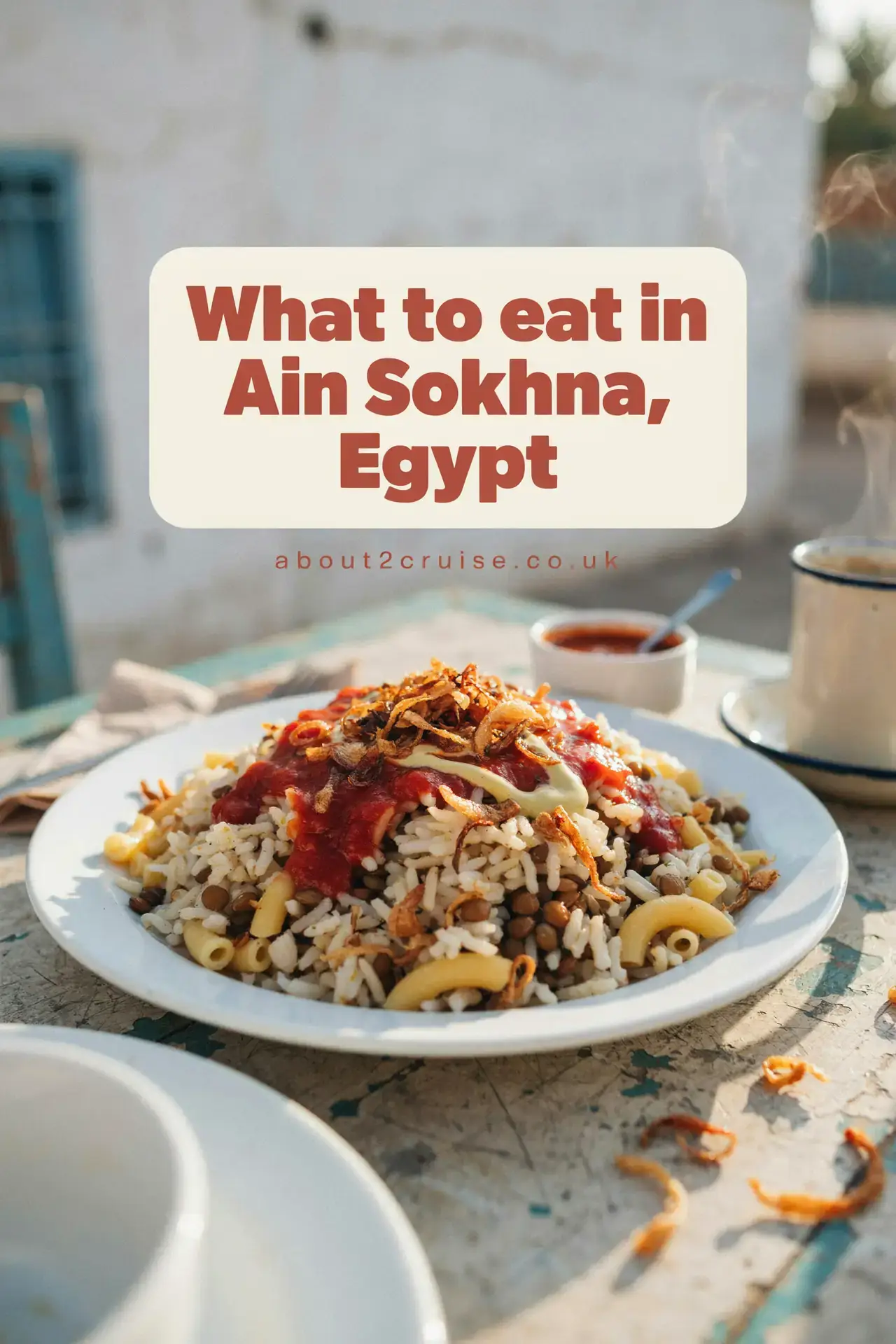
Egyptian street food and simple restaurant food can be a highlight, but you need a degree of care. In Cairo, the dishes to try are koshary, ful medames and ta’ameya. Near Sokhna, the coast is known for Red Sea fish and seafood, often chosen from the display and grilled.
- Choose food that is freshly cooked and served hot.
- Drink only sealed bottled water, ship water, or water from a trusted restaurant or hotel. Avoid ice of unknown origin.
- Be cautious with raw salads, uncooked herbs and fruit you have not peeled yourself.
- Carry hand sanitiser and use it before eating, especially after touching money or door handles.
If you have a sensitive stomach, the easiest rule is to eat where your guide or tour company recommends, stick to vegetarian hot dishes or sealed snacks, and avoid street carts on a tight ship schedule.
Heat, Hydration, Clothing and Comfort
Sokhna and Cairo can be intensely hot, with May to September regularly exceeding 40°C. The Giza Plateau is open, dusty and has very little shade. Dehydration and heat exhaustion are the main physical risks of a Sokhna call.
- Wear breathable, light-coloured clothing that covers your shoulders and knees. This helps with both sun protection and local etiquette.
- Use a wide-brim hat, sunglasses and high-factor sunscreen. Reapply sunscreen more often than usual because of sweat and dust.
- Take a refillable bottle if your guide provides water, and drink before you feel thirsty.
- Choose shoes with grip. Giza’s surfaces are uneven, sloped and sometimes sandy. Open sandals are not ideal.
- In July and August, the smartest tours leave very early to do the Pyramids before the heat peaks. If your ship offers an early departure, take it seriously.
Language, Etiquette, Ramadan and Alcohol
The local language is Arabic, but English is common in organised tourism and at the main Cairo sights. Outside that, speaking a few words of Arabic is appreciated but not required.
- Dress modestly, especially in rural areas, mosques and markets. Men and women should avoid very short shorts, tank tops and sleeveless shirts.
- Mosques require covered arms and legs. Women may be asked to cover their hair. Remove shoes before entering prayer areas.
- Public displays of affection are frowned upon. Holding hands is generally fine, but behaviour accepted in a resort may not be accepted in Cairo or at religious sites.
- During Ramadan, it is culturally insensitive to eat, drink or smoke in public during daylight. Shops and restaurants may change their hours.
- Drinking alcohol outside licensed restaurants, bars, private homes or certain tourist resorts is illegal. If you are not in a licensed hotel or resort, do not assume alcohol is available or acceptable.
Safety, Security and Common Scams
Egypt has a low general crime rate, and most cruise passengers visit Cairo and Giza without incident. The main issues are tourist scams, persistent vendors, road safety and the need to respect local security rules.
- Stick with organised shore excursions or a licensed private guide and driver. Do not walk into the commercial port or accept impromptu help from people around the gate.
- At Giza and other busy sites, vendors can be persistent. A polite, firm no usually works. Agree prices in advance for any camel ride, horse carriage, photo service or guide who attaches themselves to you.
- Police checkpoints and ID checks are normal. Carry your passport or a clear colour copy. Avoid leaving your passport as a deposit unless you have no option and understand why.
- Road accidents are common in Egypt because of variable road quality and driving standards. A professional driver on the main highway is the right call. Avoid driving at night outside the main route.
- Women should not travel alone in taxis or accept uninvited personal attention from hotel workers or excursion staff. This is particularly relevant if you arrange independent transport.
Check the UK Foreign Office travel advice for Egypt before you travel. The common warning areas of North Sinai and parts of eastern Ismailiyah are not Cairo, Giza or the Sokhna coast, but you should still stay on the beaten tourist path.
Photography, Drones and Mobile Phones
Phone photography is fine for most tourist sites, but Egypt has firm rules about certain subjects and equipment.
- Do not photograph or film military property, the Suez Canal, police buildings or infrastructure that could be considered sensitive.
- Professional photography or film equipment may require a permit. This includes items like large lighting kits and some lens or equipment combinations.
- Drones are strictly controlled. Bringing in or using a drone without permission can lead to imprisonment or a fine. Leave it on the ship or at home.
- You should ask before photographing local people, especially children. Written permission is technically required by tourism rules.
Mobile data generally works along the Sokhna–Cairo road and in Cairo, but do not build your return plan around it. Save the driver’s number, tour emergency contact and port agent number offline. Tourist SIMs are sold at Cairo Airport by Vodafone, Orange, Etisalat and WE if you are flying in for a turnaround.
Shopping and Souvenirs
The best souvenir shopping on a Sokhna call is in Cairo, not at the port. Khan el-Khalili is the classic bazaar for spices, perfumes, lanterns, clothing and Egyptian handicrafts. Expect to haggle. The first price is usually a starting point.
- Grand Egyptian Museum has on-site shops, which can be convenient for good-quality reproduction items and books.
- Papyrus institutes are common tour stops, but quality and pricing vary. If you are not genuinely interested, politely decline rather than using your limited Cairo time.
- At Giza, avoid buying antiquities from touts. Real antiquities cannot legally be exported, and the item is almost always fake.
- Keep haggling friendly. Carry small EGP notes and coins for small purchases and market stalls.
Toilets, Accessibility and Limited Mobility
There are no confirmed passenger toilets or accessibility services inside the Sokhna commercial terminal itself. Use the ship bathroom before heading out. On the road, comfort-stop toilets are often basic, and you should carry tissues and EGP 5–10 notes for attendants.
If you use a wheelchair, scooter or have limited mobility:
- Ask the ship what the berth set-up will be: stairs, ramps, vehicle access and whether an accessible shuttle is available.
- Confirm with any private tour operator that the exact vehicle can carry your chair or scooter and that the driver is prepared to help.
- Giza is difficult for limited mobility: uneven ground, slopes, dust, heat, long distances and poor shade. The site shuttle bus helps, but pyramid interiors are not accessible.
- The Grand Egyptian Museum is the best Cairo sight for accessibility, with ramps, lifts, free wheelchairs and electric golf carts.
- A resort beach day at Sokhna may involve sand, steps, slopes and a long path from reception. Ask what the access is like before booking.
Best Time to Visit Sokhna and Cairo by Month
The best months for a Cairo-in-a-day trip from Sokhna are October to April. May to September can be ferociously hot, especially at Giza, where there is little shade.
| Month | Typical daytime max | What to expect |
|---|---|---|
| January | 19°C | Cool, comfortable sightseeing |
| February | 21°C | Good for Cairo and Giza |
| March | 23°C | Warm but manageable |
| April | 28°C | Pleasant early, hotter by late afternoon |
| May | 32°C | Starting to feel hot |
| June | 34°C | Hot and often windy |
| July | 36°C | Very hot; Giza can feel like 45°C |
| August | 35°C | Very hot and muggy |
| September | 33°C | Hot, muggy spells |
| October | 30°C | Warm, improving |
| November | 25°C | Excellent sightseeing |
| December | 20°C | Cool and clear |
Rain is minimal all year. The sea temperature stays roughly 17–26°C across the year. The muggy season runs from mid-June to mid-October, peaking in August.
Medical, Emergency and Port Security
Sokhna port is a secure commercial area, and the ship remains your main medical facility for routine issues. Egypt’s emergency numbers are police 122, ambulance 123, fire 180 and tourist police 126. The British Embassy in Cairo can be reached on +20 (0)2 2791 6000.
Ain Sokhna’s first emergency hospital on the Ain Sokhna–Galala road has been in preparation, but do not count on nearby emergency services being available or equipped like a UK A&E. If you have a serious medical condition, think carefully before doing a long, hot Cairo day.
- Make sure your travel insurance covers Egypt, shore excursions and, if relevant, air or sea rescue. Egyptian authorities may require guaranteed payment before starting a rescue, and private rescue can cost more than US$4,000 per hour.
- If you are unwell, the ship’s medical centre is your first call if you can get back on board.
- Report any crime before you leave Egypt. The tourist police number is 126.
Duty-Free, Luggage and Prohibited Items
Egypt’s standard duty-free allowance is 1 litre of alcohol and 200 cigarettes, or 25 cigars or 200 g of tobacco. If you are flying in for a turnaround, this is what you can bring. If you are on a closed-loop cruise and only stepping ashore for a day, keep duty-free purchases within your ship’s limits if you need to bring them back on board.
There is no confirmed left-luggage facility at Sokhna port or the terminal. The Grand Egyptian Museum has a cloakroom for bags, but it restricts large bags over 40 × 40 cm. Cairo Airport does not have a widely confirmed official left-luggage service, so do not plan around storing bags.
- Do not carry drones, professional filming equipment without a permit, or anything that looks like military or security-related equipment.
- Ask your cruise line about any prohibited items before bringing large luggage, alcohol or sharp objects into the port area.
Getting to Sokhna for a Cruise Turnaround or Pre-Cruise Stay
If your cruise starts or ends at Sokhna, the practical gateway is Cairo International Airport, around 135 km or about 1 hour 40 minutes by private transfer. Pre-booked private transfers are the easiest option, especially with cruise luggage.
- Bus: Go Bus runs services from Cairo locations to Ain Sokhna resorts, taking about 1 hour 40 minutes to 2 hours, with fares in the tens to a few hundred Egyptian pounds depending on class and route. It is useful if you are staying at a Sokhna resort, but not ideal for cruise luggage or exact ship timings.
- Rail: Egypt’s first high-speed line is planned to link Ain Sokhna with Cairo and northern Egypt, with trial operations ongoing. Do not rely on passenger rail until an official service starts.
- Hotels near the port: Stella Di Mare Grand Hotel is the closest major hotel, just outside the port area, but arrange a vehicle to the cruise terminal rather than walking because Sokhna is a commercial port. Mövenpick El Sokhna is another common resort option farther along the coast.
Frequently Asked Questions About Ain Sokhna Cruise Port
Can you walk off the ship at Sokhna port?
No. Sokhna is a working commercial port, and walking independently inside the port area is prohibited. You need a shore excursion, a locally permitted private vehicle, or an approved shuttle to the gate.
How far is Sokhna from Cairo and the Pyramids?
It is about 120–140 km by road, with a realistic drive time of 2 to 2.5 hours each way depending on traffic, road and checkpoints.
Do UK cruise passengers need a visa for Egypt?
Usually yes, but some cruise calls arrange a free short transit stamp for passengers. This is not guaranteed on every line. If you are not covered by a cruise line transit arrangement, you may need an e-visa or another Egyptian visa. Check before sailing.
Will the ship wait if my tour is late?
The ship normally waits only for its own excursions. Independent passengers and private tour groups should build in a return buffer and follow the ship’s all-aboard time strictly.
Is Ain Sokhna port safe for cruise passengers?
Yes, for organised excursions and permitted transport. The port is secure, but it is not pedestrian-friendly. Cairo and Giza are outside the UK Foreign Office’s main no-go areas for Egypt, but you should use licensed guides and drivers and avoid unnecessary night driving.
Is Sokhna the same as Suez Port?
No. Sokhna is about 55 km south of Suez city on the Gulf of Suez. Suez or Port Tewfik is at the southern end of the Suez Canal. If your itinerary says Port Said, that is at the northern end and is much farther from Giza.
What can I do if I don’t want to go to Cairo?
The main alternatives are a resort beach day pass, the Galala cable car, a short stop at Porto Sokhna marina, or a desert excursion to the monasteries of St Anthony and St Paul.
How much is a taxi from Sokhna port to Cairo?
A pre-booked private car to Cairo and back is usually about US$95–110 per vehicle. A taxi negotiated at the port gate may start around US$100–150 for the day. Uber and Careem are unreliable at the port.
Are there ATMs at Sokhna port?
There are no confirmed ATMs inside the port terminal. Get Egyptian pounds before the port day or at Cairo Airport if you are starting or finishing the cruise.
What should I do if my private tour runs late?
Call your driver, tour operator and the ship or port agent immediately. Make the decision to turn back early rather than risking one more stop. If you miss the ship, you will need to arrange and pay for onward transport to the next feasible port.
More Egypt and Red Sea Port Planning
For more on the area, see our Egypt cruise ports guide, Port Said cruise port guide, Safaga cruise port guide and Aqaba cruise port guide.
Last Updated: 19 November 2026