
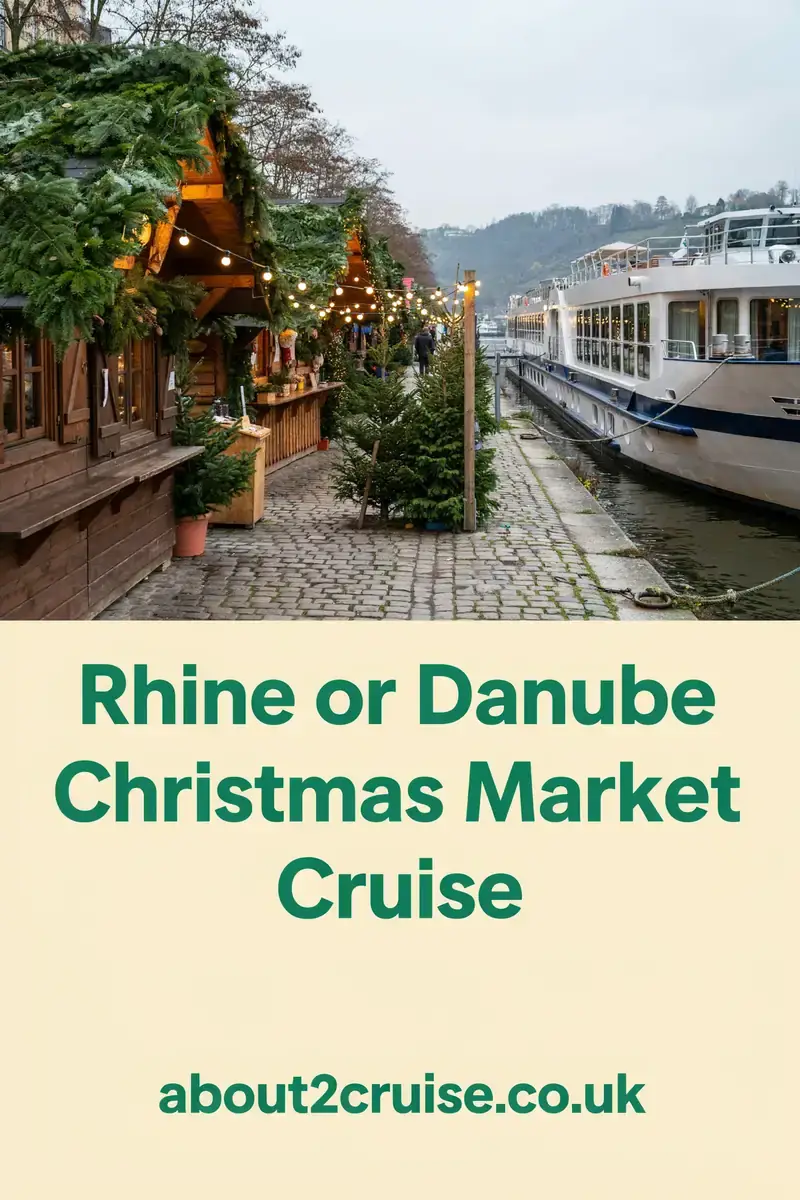
A European Christmas market cruise is a river trip, not an ocean one. The ship ties up in the old town, sails overnight and puts a different market in front of you each morning.
The Rhine gives you Strasbourg and Cologne in a week; the Danube gives you Vienna and Budapest. Sail between late November and mid-December.
What a Christmas market river cruise is, and what it isn’t
A river ship ties up in the old town, sails overnight and is at the next market by breakfast. That’s the whole trick: several cities in a week with no repacking, no station dashes and no coach between hotels. These ships are small, usually around 200 guests at most, so the dates and cabins that suit you go early.
An ocean Christmas sailing still calls at a port, but the markets become a day out from a terminal that’s usually well away from the centre. If you want the market square a short walk from the gangway, book a river ship.
Viking, Avalon Waterways, Uniworld, AmaWaterways, Tauck, Scenic and CroisiEurope all sell festive sailings. Most run seven or eight days, though some lines sell five to eight. If this is your first river cruise, the guide to European river cruises explains how the days and cabins work, and the Viking River Cruises fleet guide goes through Viking’s own vessels one by one.
Rhine or Danube: the routes compared, plus the Main, Moselle and Dutch waterways
Choose the river before you choose the date. The Rhine is short hops between wine towns, with Strasbourg and Cologne at the heart of it. The Danube means longer days and capital cities, Vienna and Budapest, plus more coach transfers to the markets most people have on their list.
| Route | What it puts in front of you | Typical length | What it feels like |
|---|---|---|---|
| Rhine, Basel to Amsterdam | Cologne, Koblenz, Rüdesheim, Heidelberg from Mannheim, Strasbourg (often via Kehl), Breisach, plus Amsterdam and Düsseldorf on some routings | 4 to 7 nights | Short hops between wine towns, castles and the Rhine Gorge |
| Danube, Nuremberg or Passau to Vienna and Budapest | Nuremberg, Regensburg, Passau, Vienna, Budapest, with Bratislava and Dürnstein or Melk on some itineraries | 5 to 8 nights | Capitals and longer days, with more coach transfers |
| Main and Main-Danube Canal | Nuremberg, between Frankfurt and Vienna; a few lines link Rhine, Main and Danube in one longer voyage | Varies, and a few do it in one long run | Nuremberg’s Christkindlesmarkt, but not on every festive itinerary |
| Moselle | Cochem and the Moselle Valley by coach from Koblenz | A day inside a Rhine cruise | Vineyard hills, a castle and around five hours of it |
| Dutch and Belgian waterways | Amsterdam, Gouda, Den Haag, Ghent, Bruges, Antwerp, Brussels | 8 days | Winter markets and light festivals rather than German squares |
A standard Rhine week runs Amsterdam to Basel with Cologne, Koblenz, Mannheim for Heidelberg, Strasbourg and Breisach in between. Calls can be short, 08:00 to 16:00, which is enough for a market and a wander. It is not enough for a market, a museum and lunch.
The Danube packs in more headline names, and you pay for that with time in a coach. Nuremberg is reached through the Main and the Main-Danube Canal rather than the Danube proper, so it turns up on those routings, not on every festive itinerary. Trafalgar’s eight-day Danube sailing runs Budapest to Passau via Vienna and Bratislava on the 128-passenger Reverie.
The Moselle is usually a day trip rather than a mooring. From Koblenz, Cochem and the valley mean a coach day of around five hours, and on some lines you pay extra for it.
The Dutch and Belgian option is a different holiday altogether. Tauck’s eight-day Yuletide Spirit runs Amsterdam to Brussels with Gouda, Den Haag, Ghent, Bruges and Antwerp, an evening Amsterdam Light Festival canal cruise, and winter markets rather than German squares.
The best Christmas market cruise ports, and how close the ship gets
Cologne is the straightforward one. The cathedral market sits on Roncalliplatz at the foot of the Dom, so it’s in front of the berth area rather than a coach ride away, with the big tree under a canopy of lights in the middle. Cologne’s river cruise port guide covers where the ships tie up and the walk into the centre.
Strasbourg depends entirely on where you moor. Some ships tie up across the river at Kehl on the German bank and coach you over to the Grande Île. Others dock in Strasbourg itself, and you walk to the markets.
Colmar is the clearest case of a headline market with no river berth. The ship stays at Breisach, the Alsace berth for Colmar, and coaches run inland, so the length of the excursion and whether it’s included matter more than the itinerary name. CroisiEurope builds a full-day Colmar excursion into the fare, while on other lines the same day is an optional extra.
The same pattern crops up again. Heidelberg is a coach from Mannheim, Cochem and the Moselle Valley a coach from Koblenz, and Freiburg a coach from Breisach. Nuremberg’s Christkindlesmarkt needs a Main or Main-Danube Canal routing, and Nuremberg’s river cruise port guide covers the market and the way in from the ship.
Short calls change the day. On a Rhine itinerary with 08:00 to 16:00 stops at Cologne, Strasbourg and Breisach, you see the markets in daylight and the ship leaves before the lights come on. If the lit-up market is the point of the trip, check call times, not just itinerary names.
On the Danube, Vienna’s Rathausplatz spreads out in front of the City Hall with an ice rink alongside. Budapest splits the crowds between Vörösmarty tér and the Advent Basilica light show on Szent István tér. Both are at their best after dark, and dark arrives early.
Market opening dates against sailing dates
Each city sets its own dates. Cologne’s cathedral market runs 16 November to 23 December. Nuremberg’s Christkindlesmarkt runs 27 November to 24 December, Strasbourg’s Christkindelsmärik 27 November to 24 December, and Vienna’s Rathausplatz 13 November to 26 December.
A sailing between 20 November and 22 December sees every market open. A December departure should finish by 22 December, when Passau’s market closes, or you’re paying for a Christmas market cruise without the markets.
A few lines keep sailing through the holiday itself, with Christmas dinner and New Year’s Eve on board in Vienna or Budapest, but the markets are shut by then. Those sailings belong with Christmas and New Year cruises, not market cruises.
How long to go, and what the fare covers
Seven or eight days is the standard, and it’s the length that does either river properly. Short tasters exist.
CroisiEurope sells a four-day Strasbourg to Breisach and Colmar round trip, and a four-day Strasbourg to Basel run via Riquewihr and Colmar. Three or four nights buys two or three markets, not six, so it’s a taste of the format rather than the holiday.
Fares are hard to compare from the headline price. One line’s price covers full board, drinks with lunch and dinner, gratuities, selected shore excursions, Wi-Fi and port taxes.
Another includes drinks at the bar and with meals, all listed excursions with coach and guide, travel assistance insurance and port fees. A third includes its shore excursions and grades them from gentle to active, with bike tours and late-riser options.
Travel, transfers, premium drinks and optional excursions usually sit on top, so compare totals rather than headlines. Add tips, transfers, the hotel night before and any land extension. Lead-in fares apply to only a few cabins on each date.
Water levels, ship swaps and changed itineraries
Low or high water can force a ship swap, a bus ride in place of a day’s sailing or, rarely, a cancellation. High water after heavy rain can stop a ship fitting under a bridge. Low water has affected December sailings as well as summer ones.
Lines handle it differently, from moving you to a sister ship to partial refunds or credits. Published river itineraries are a guide that can be changed for operational reasons, including high and low water. Read the line’s policy before you book, insure for trip interruption and leave the last day loose in case the ship finishes in a different town.
Christmas market cruises with children
Family-focused festive river sailings are rare. Tauck’s Holiday Magic: Danube Family River Cruise is the one that exists. It’s eight days on ms Savor, with Vienna’s Prater and its Christmas market, games and festivities built in.
Price and age rules do the rest. CroisiEurope takes 20% off children aged two to nine sharing a double cabin with an adult, 30% off a third occupant of a triple cabin, and carries under-twos free. Viking doesn’t accept guests under 18, so check before you book a family group on it.
Free attractions help. Vörösmarty Square in Budapest runs a small railway at no charge, 14:00 to 20:00 on weekdays and 11:00 to 20:00 at weekends. Vienna’s Rathausplatz has an ice rink beside the market that stays until 6 January. European river cruises for families covers what else works with children on board.
Getting to the ship from the UK
No Christmas market cruise starts at a UK port. Every itinerary starts on the continent: Amsterdam or Basel on the Rhine, and Basel, Strasbourg, Budapest or Passau on the other routings. Flights or Eurostar plus a transfer are part of the cost and part of the risk.
Transfers aren’t always included. CroisiEurope sells a coach transfer between Basel and Strasbourg as an add-on, guaranteed only with a minimum of 25 passengers. Some lines sell flights as an add-on, with the protection applying only if you book through them.
Two habits cover most of it. Arrive at least a day before boarding. If you’re flying home from Basel, book nothing before 10:00.
When to book, and what sells out first
Christmas market cruises are the first river sailings to sell out each year. Popular lines are often full by August for a December departure. Book by spring if you want a choice of cabin rather than a choice of date.
Emerald’s eight-day Christmas Markets on the Rhine, calling at Cologne, Strasbourg and Amsterdam, runs across the next two holiday seasons. Departures are bunched between late November and mid-December, and some of those dates had already gone by early October.
Next winter is on sale elsewhere too. Scenic has festive itineraries out for the next two seasons, and Trafalgar has opened its Christmas market cruises for the next two, with each itinerary sailing four times in each season.
Within the season, late November has the markets just open, fewer people, more cabins left and softer prices. The first two weeks of December are the most popular departures, and the week before Christmas is the fullest.
Who a Christmas market cruise doesn’t suit
If you want markets guaranteed in Christmas week, most of these routes have shut up shop by then. If you’re expecting a family product, one line sells one family festive sailing, and that’s the list.
If you want every stop to be a market square, Heidelberg, Cochem, Freiburg and Colmar are coach days, and so is Strasbourg on any ship that berths at Kehl.
If you want long daylight hours, the sun sets around 4pm in Vienna and Budapest in December, and around 4:40pm in Basel. If you want one city in depth rather than six in a week, a city break serves you better.
On the day: cash, glühwein mug deposits and the hours markets keep
Take euros in small notes and coins. Cards work at most stands, but stalls move faster with cash.
Basel uses Swiss francs and Budapest uses forints. Leave bag room for a mug.
Glühwein comes in a ceramic mug with a Pfand, a deposit, added to the price. It’s usually around €3, with some markets at €2 and others at €4 or €5.
You get it back by returning the mug to any stall at the same market. Keeping it isn’t automatic, because the deposit is a returnable deposit rather than a purchase price. Ask the stallholder, or buy one sold as a souvenir.
Markets keep evening hours rather than all-day ones. Cologne runs 11:00 to 21:00 or 22:00, Vienna 10:00 to 22:00, Strasbourg 11:00 to 21:00. Cologne’s cathedral market also closes on Totensonntag, the Sunday before Advent.
Dress for standing about rather than walking from a car. Layers, a waterproof hooded coat, hat, gloves, scarf and shoes with tread, because cobbles get slick. Keep your bag across your body, since crowded markets are where pickpockets work, and a crossbody bag that keeps cash in front of you does that job.
What to eat where: the Rhine runs on glühwein, bratwurst and lebkuchen, while the Danube runs on goulash, Sachertorte, chimney cakes and mulled wine. A few worth aiming for:
- Rüdesheim: Rüdesheimer coffee made with locally produced brandy, on the Drosselgasse, with lebkuchen alongside.
- Strasbourg: bredele, the small Alsace cakes, at the Bredle Market among the dozen markets along the Grand Rue under the cathedral.
- Cologne: heart-shaped lebkuchen at the stalls in front of the cathedral.
- Budapest: hearty Hungarian dishes and mulled wine on Vörösmarty tér.
- Basel: Läckerli, the spice cookie, at the Läckerli Huus.
European Christmas market cruise FAQs
What is the best Christmas market river cruise in Europe?
There’s no single best Christmas market river cruise. It splits between the Rhine and the Danube. The Rhine gives you Strasbourg and Cologne with short hops between wine towns. The Danube gives you Vienna and Budapest, with longer days and more time in a coach.
How many Christmas markets do you visit in a week?
Four to six on a typical week. AmaWaterways builds its Danube itinerary around five markets: Nuremberg, Regensburg, Passau, Vienna and Budapest.
What is the best Christmas market in Europe to plan a cruise around?
Nuremberg’s Christkindlesmarkt and Strasbourg’s Christkindelsmärik are the two that carry a trip. Nuremberg opens with a prologue at 17:30 on the first day. Strasbourg fans a dozen markets along the Grand Rue under the cathedral.
Which Christmas markets stay open latest?
Budapest’s Vörösmarty tér runs to 31 December, and the Advent Basilica on Szent István tér to 1 January. That’s later than anything else on these routes.
Last Updated: 14 November 2026