
Civitavecchia is the port everyone passes through on the way to Rome, but it holds its own without Rome’s help. There’s a Renaissance fortress, a seafront promenade and a proper shopping street, all within walking distance of the terminal. Bootstour, German for boat tour, is one thing you don’t need booking here, because your ship already counts. So the smartest use of your shore time is simply walking.
Civitavecchia Port, In Brief
This port’s been around a while. Emperor Trajan had it built, with the architect Apollodorus of Damascus doing the actual design work, and today it covers around 2,000,000 square metres of docks, 34 operational berths and more than 16 kilometres of quayside. That’s a serious amount of concrete for a town most passengers spend two hours in.
It’s also home to the Port System Authority of the North Central Tyrrhenian Sea, which oversees Civitavecchia, Fiumicino and Gaeta. The cruise side keeps breaking its own records. One recent year saw almost 2.95 million cruise passengers pass through, according to Ports Europe. The following season that climbed past 3.5 million passengers across 862 ship calls, per CruiseMapper. That makes Civitavecchia Italy’s busiest cruise port, and the only place in Europe that beats it is Barcelona.
Getting From Civitavecchia Port Into Town
Most people take the free shuttle from the ship to Largo della Pace, the main exit and the hub where you can walk into town, grab a taxi or find your tour guide. The ride usually takes five to ten minutes. Port Mobility runs the shuttle, free for every passenger, with a stop at Fortezza, right by the fort, which is roughly where the port ends and the old town begins.
How far you’ll walk depends entirely on where your ship berths. Land at the newer terminal, berths 12 and 13, and you can walk straight into town, with the market about 1.8 km away on foot. Anywhere else, allow 15 to 45 minutes. The port keeps setting passenger records, so having more than one ship in on the same day is increasingly normal, and that means longer queues for both the shuttle and the taxi rank. Build extra time into your return. If your legs are up to it, walking is often faster and more predictable than standing around waiting when several ships are in port at once.
Things to Do in Civitavecchia When You Have a Few Hours
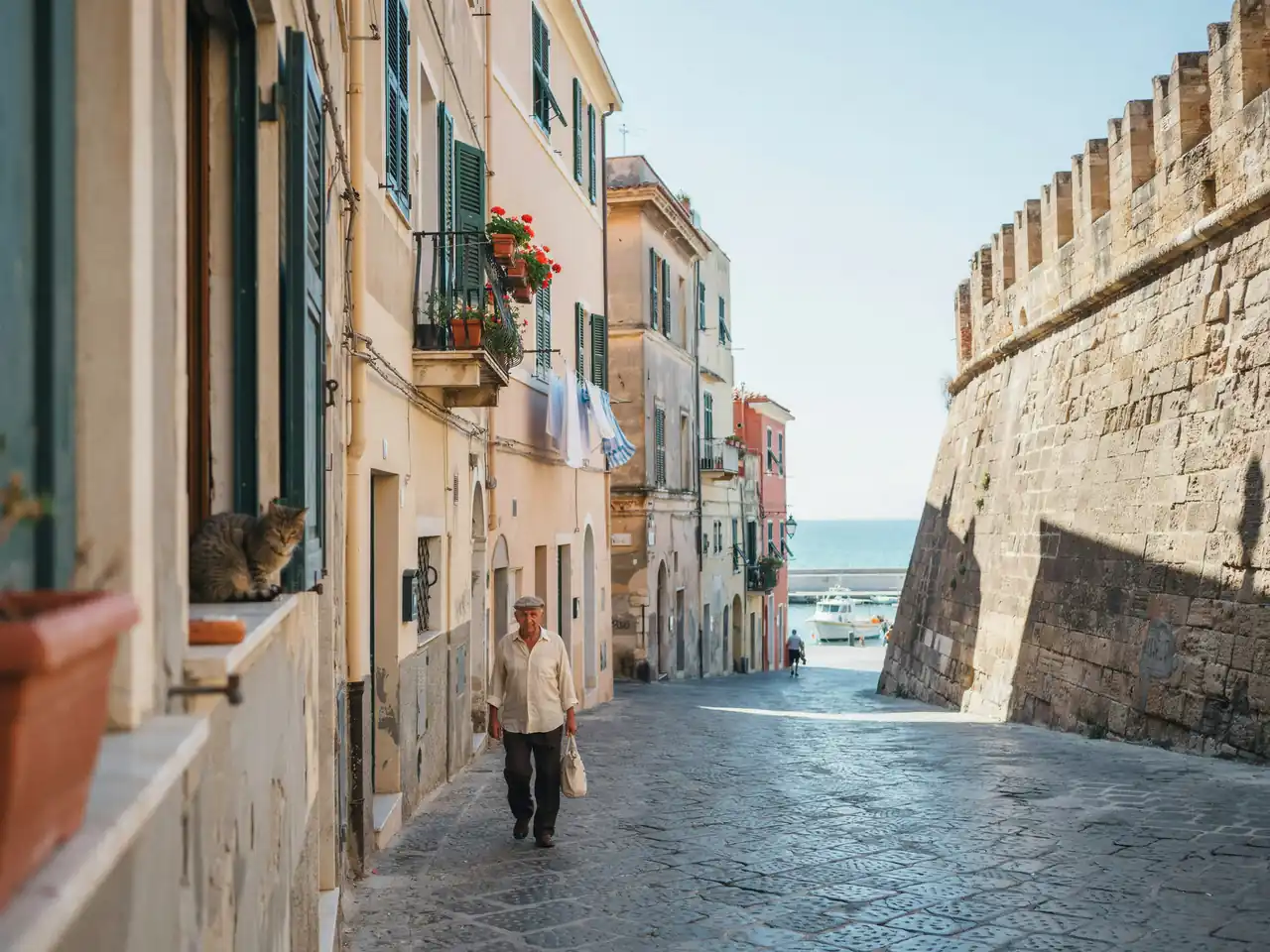
You don’t need a car or a tour bus for a good day here. Everything below is walkable from Largo della Pace, or a short taxi ride if you’d rather save your legs.
- Walk to Forte Michelangelo, the 16th-century fortress that gives the old town its skyline
- Follow the seafront promenade, a roughly 2.2 km loop past a Bernini-era sea wall and the ruins of a medieval castle
- Pop into the free National Archaeological Museum just outside the port gate
- Browse the shops along Via Giacomo Matteotti and Largo Plebiscito
- Spend an hour or two on the sand at Pirgo beach
- Take the train into Rome if your port stay gives you six hours or more
Civitavecchia Attractions Within Walking Distance
Here’s what’s realistically reachable without a car.
| Attraction | What it is | Distance from port |
|---|---|---|
| Forte Michelangelo | Renaissance fortress started by the architect Donato Bramante and completed under Michelangelo Buonarroti, whose name it carries; the courtyard and a small chapel dedicated to Santa Fermina are sometimes open to visitors at weekends | About a 10-minute walk from the train station, close to Largo della Pace |
| Seafront promenade and the Rock of Civitavecchia | A landscaped path along the water with a stone sea wall built by Bernini in the 1600s and the ruins of a medieval castle dating to around 1400 | Begins near Forte Michelangelo |
| National Archaeological Museum | Free museum covering the area’s Roman and Etruscan history | Just outside the port gate |
| Terme Taurine | Excavated Roman bath ruins | About a 10-minute drive, best for longer port days |
| Pirgo beach | A secluded stretch of sand with an arched pier and a beach club offering umbrellas and sunbeds | A walk along the promenade from the port |
Weekend opening hours for the fortress courtyard aren’t published anywhere reliable, so treat a visit there as a bonus if the gates happen to be open, not something to build your whole morning around.
What to Do in Civitavecchia in a Half Day
With half a day ashore, staying local beats gambling on Rome. The fortress, promenade and shopping street can all be covered on foot without watching the clock the whole time.
- Walk from Largo della Pace to Forte Michelangelo, about ten minutes if you’re near the station
- Loop the seafront promenade past the old sea wall and castle ruins
- Cut back through town to Via Giacomo Matteotti for an hour of browsing
- Stop for lunch before heading back to the ship; our best restaurants in Civitavecchia guide covers where locals and cruise passengers both eat
The promenade loop is flat and paved the whole way, so a pair of comfortable walking shoes for men or a well-worn pair you already trust will do you far better than anything you’d only wear on formal night.
Shopping in Civitavecchia
Expecting a curated list of boutiques? This is a working port town, not a shopping destination, but there’s enough here to fill an hour comfortably.
Via Giacomo Matteotti is the main shopping street, lined with everyday Italian shops rather than souvenir stalls. You’ll find outlets like a Fastweb Store and the clothing shop Gaballo along its length. A short walk away, Largo Plebiscito has an Intimissimi store among its options. There’s also a town market, the mercato, around 1.8 km on foot from the newer cruise terminal, though official days and hours aren’t published anywhere reliable, so ask at the port information point if timing matters to you.
There’s no official tourism-board list of recommended shops here, so what’s above comes from local business directories rather than a curated guide. Treat it as a starting point rather than gospel, and expect the mix of shops to shift over time.
Getting to Rome from Civitavecchia Port
Rome sits around 80 kilometres, or roughly 45 miles, southeast of the port, and it’s the reason most people are here in the first place. The train is the standard way in. Travel time varies depending on who you ask: some sources quote as little as 47 minutes on the fastest services, others put it closer to an hour and fifteen minutes on average, so build in a margin rather than cutting it fine.
A widely used rule among port-day guides is that if your stay in Civitavecchia is under six hours, an organised Rome excursion is properly tight once you account for the walk or shuttle to the station, the train each way, and getting back through the gate before all-aboard. Trains between Civitavecchia and Rome are mostly local stopping services rather than fast intercity trains, and punctuality on this particular leg has a reputation for being unreliable, so treat any train-based Rome day as needing a buffer, not a tight connection.
If Rome is the priority, our guide to the best ways to get to Rome breaks down every option, and our one-day itinerary for Rome is built around exactly the kind of time limit a cruise stop imposes. For more on the port itself as Rome’s gateway, see our dedicated Rome cruise port guide.
Beaches Near the Port
The beaches around Civitavecchia are a modest, palm-lined sliver rather than a Riviera stretch, but they’re pleasant enough for an afternoon if you’d rather skip sightseeing altogether. The water along this stretch of the Tyrrhenian Sea averages around 18.7°C across the year, warming to about 25°C in August.
A short walk along the beachside promenade brings you to Pirgo, a quieter spot with an ornate arched pier and a beach club offering umbrellas and sunbeds. There’s no official word on showers, lifeguards or whether every stretch is free to use, so pack your own kit rather than assume the facilities will be there, including a quick-drying beach towel.
Civitavecchia Weather and When to Go
Summer here is reliably hot. July and August average around 25 to 28°C, while January, the chilliest month, sits around 8 to 9°C. Rain is more of a shoulder-season problem than a summer one, with November the wettest month at around 150mm and July the driest at around 15mm.
None of this changes what’s open, but it does affect how comfortable the promenade walk or a beach afternoon will feel. Cruising outside peak summer? Pack a layer for the walk back from town in case a shower rolls in.
Is Civitavecchia Worth Visiting?
Yes, for the few hours most passengers have, though it helps to know what kind of worth it is. Civitavecchia isn’t a bucket-list destination in its own right. It’s a properly pleasant, functional port town that rewards a short walk far more than it rewards a long one.
- The fortress, promenade and shopping street give you a satisfying half day without needing to book anything
- It’s the practical gateway to Rome, so combining a Rome day trip with even an hour back in Civitavecchia works well if your ship stays late
- If you’re already familiar with Civitavecchia from a previous cruise, our guide to coastal towns near Civitavecchia that cruise ships skip covers where to go instead
- If you’re arriving the night before your cruise, it’s worth reading whether staying in Civitavecchia before your cruise makes sense for your itinerary
Common Questions
How far is Civitavecchia from Rome?
Around 80 kilometres, 45 miles if you prefer, southeast of the port. By train, budget 70 to 90 minutes each way, depending on the service and how many stops it makes.
Can I walk from the ship into Civitavecchia town?
Often, yes. From the newer cruise terminal you can walk straight in. From other berths it can take 15 to 45 minutes, so check with crew or use the free shuttle if you’d rather not risk it.
Is there a free shuttle bus at Civitavecchia port?
Yes, Port Mobility runs a free shuttle for every passenger between the ship and the main exit at Largo della Pace, usually a five to ten minute ride.
What is there to buy in Civitavecchia?
Via Giacomo Matteotti is the main shopping street, with everyday Italian shops rather than tourist stalls. Largo Plebiscito nearby has a few clothing outlets too.
How long do I need in Civitavecchia to see Rome?
Most port-day guides suggest at least six hours ashore before attempting an organised Rome excursion, given the train time each way and the walk or shuttle at both ends.
Is there a beach near Civitavecchia cruise port?
Yes, a modest palm-lined beach sits near the port, and a short walk along the promenade leads to Pirgo, a quieter spot with a beach club and pier.
What is Forte Michelangelo?
A 16th-century fortress begun by the architect Donato Bramante and finished under Michelangelo Buonarroti, whose name it carries. Its courtyard is sometimes open to visitors at weekends.
Does Civitavecchia get busy with multiple ships in port?
Yes, the port keeps setting consecutive passenger records, and on days when several ships call at once, shuttle buses and taxi ranks get noticeably busier.
Is Civitavecchia worth visiting if I’m not going to Rome?
Yes, for a few hours. The fortress, seafront promenade and shopping street are enough to fill a pleasant half day without ever leaving town.
Why Trust About2Cruise
This guide draws on port authority data, transport operator information and independent travel research to give an accurate picture of what a cruise passenger can realistically do in Civitavecchia. We don’t push specific deals or claim to have sailed every itinerary ourselves. Instead, we cross-check details so you can plan a port day with fewer surprises. Read more about how we put our guides together on our About2Cruise team and approach.
Last Updated: 26 September 2026