
Croatia’s main cruise ports are Dubrovnik, Split and Zadar, with Šibenik, Trogir, Hvar, Korčula, Rovinj, Pula and Rijeka/Opatija as the next ring. Many Adriatic itineraries also call at Kotor Bay in Montenegro and Koper in Slovenia because the whole coast works as one cruise route between Venice, Greece and the Aegean.
Croatia cruise ports map
Croatia’s 9 cruise ports run from Koper and Pula in the far west to Kotor Bay and Dubrovnik in the far east. Tap a pin to open that port’s guide.
Where Ships Dock in Croatia and the Northern Adriatic
Dubrovnik Cruise Port: Gruž, Not the Old Town
Ships dock at Gruž, about 3 km north-west of the walled Old Town. Large ships never enter the old harbour beneath the walls. You’ll usually take a 10–15 minute shuttle, bus or taxi to Pile Gate. Dubrovnik is Croatia’s signature port: the city walls, Stradun, Mount Srđ cable car, Game of Thrones corners and Lokrum island are the main pulls.
Split Cruise Port: An Easy Walk to Diocletian’s Palace
Split’s cruise berths sit inside the city harbour at Obala kneza Domagoja. The inner berths are a 5–10 minute flat walk to Diocletian’s Palace; the outer breakwater adds up to about 20 minutes. You don’t need a shuttle. Split is the easiest major Dalmatian city to do on foot, with the palace, Riva promenade, Pazar market and ferries to Brač and Hvar all close.
Zadar Cruise Port: Gaženica, a Short Ride from the Old Town
Most cruise ships use Gaženica, a modern passenger port 3.5–4 km from the old-town peninsula. A shuttle, taxi or app car takes 10–20 minutes. Walking is unshaded and not recommended. Zadar is small and flat, best for the Sea Organ, Greeting to the Sun, Roman forum, St Donatus and the maraschino cherry liqueur connection.
Šibenik Cruise Port: A Short Walk to Krka’s Gateway
Ships berth at the Vrulje quay, a flat 10–15 minute walk from the medieval centre. The UNESCO Cathedral of St James is the old-town anchor. Šibenik is also the practical gateway to Krka National Park, about 25 minutes by road, so it suits passengers who want waterfalls without a long transfer.
Trogir Cruise Port: Small Ships and Easy Embarkation
Trogir is a small UNESCO island town near Split Airport. Small ships and yachts dock or check in beside the old town, a five-minute walk from the medieval lanes. It’s used more as an embarkation point than a large-ship port, but some small-ship lines start or finish here when Split harbour is congested.
Hvar Cruise Port: Tendering to the Riva
Hvar Town has no cruise quay; ships anchor in the bay and tender to the Riva, a couple of minutes from St Stephen’s Square. Some larger ships call at Stari Grad on the other side of the island instead. Hvar is the glamorous island stop: Fortica fortress views, Pakleni islands, pebble beaches and early-evening bars.
Korčula Cruise Port: Tiny Old Town, Tender Ashore
Korčula is usually a tender or small-ship port. The tender landing or town quay is under 100 m from the old-town gate. The walled peninsula is tiny, steep and stepped, best for the cathedral, the disputed Marco Polo house and a waterfront sunset over the Pelješac peninsula.
Rovinj Cruise Port: A Car-Free Istrian Gem
Rovinj is a tender port on the Istrian peninsula. Tenders land on the old harbour pier about 200 m from Balbi’s Arch. It’s a car-free, cobbled Venetian-style town, best for slow wandering, artist lanes, Golden Cape park and sunset photography.
Pula Cruise Port: Roman Ruins and Brijuni Islands
Pula’s cruise berth is the Riječki gat quay a short walk from the Roman Arena, though larger ships sometimes anchor and tender. Pula is the best northern Adriatic call for Roman history and a more everyday Croatian town, and the Brijuni Islands are a short transfer away.
Rijeka and Opatija Cruise Ports: Kvarner Coast Pair
Rijeka’s passenger terminal sits on the breakwater about 10 minutes from the Korzo; Opatija is mostly a tender call at the Mul pier, with big ships sometimes using Rijeka instead. This pair covers the Kvarner coast, Habsburg villas, Trsat Castle and the Lungomare promenade.
Kotor Bay Cruise Port: The Scenic Adriatic Sail-In
Not Croatia, but a constant on the same Adriatic itineraries. Ships sail deep into a fjord-like bay and dock or tender at Kotor’s old town. It’s the most scenic sail-in of the region, best for the old town, Perast, the mountain switchbacks and a Montenegro shore day.
Koper Cruise Port: A Quieter Gateway to Slovenia
Also not Croatia, but often paired with Croatian ports on northern Adriatic sailings. Ships berth a short walk from Koper’s compact old town. Koper is the gateway for Ljubljana, Piran and the Slovenian coast, with less crowd pressure than Venice or Dubrovnik.
Dubrovnik, Split or Zadar? How to Choose
For first-time Mediterranean cruisers, Dubrovnik and Split are the two headline calls. Dubrovnik is the polished walled-city showpiece, with the full city walls, cable car and historic lanes. Split is more lived-in, built around Diocletian’s Palace, and it’s the easiest major Dalmatian city to walk from ship to sight. Zadar is smaller and less pressured, with the Sea Organ and a compact Roman core.
The island and Istrian ports suit slower, small-ship calls. Hvar and Korčula are about atmosphere, harbours, swimming and evening wine. Rovinj and Pula add northern Adriatic variety with Venetian and Roman layers. Šibenik and Trogir are UNESCO stops with better access to Krka or Split Airport. Kotor and Koper are not Croatian, but they appear so often on the same runs that they’re worth planning around.

Where Croatia Sits on the Adriatic Cruise Map
Croatia sits between the Venice/Trieste/Ravenna homeports and the Greek islands. The typical routing runs Venice or Ravenna to Rovinj, Pula or Rijeka, then Zadar, Šibenik or Split, followed by Hvar or Korčula, then Dubrovnik, Kotor, and Greece. Most cruises choose a few Croatian calls rather than all of them, because the distances are short and the coast is port-heavy.
Big-Ship Calls vs Small-Ship Island Hopping
Large cruise lines use the deep-water ports of Dubrovnik, Split and Zadar most often, with Šibenik, Pula and Rijeka appearing on secondary itineraries. They can’t berth at Hvar Town, Korčula old town, Rovinj or Opatija, which is why those are tender calls or substitutions.
Small ships, gulets and boutique yachts of about 16–50 passengers work the other way round. They slip into Hvar, Korčula, Vis, Brač, Mljet and the Pakleni Islands, and they run daily swim stops in quiet coves. Sail Croatia and similar operators usually depart from Split or Dubrovnik, sometimes Trogir, on seven-night Split–Dubrovnik or Split-return routes.
Cost-wise, a mainstream big-ship Adriatic cruise can start under £1,000 per person for an inside cabin on a 10-night sailing. Small-ship Croatia typically costs about £1,700–£3,500 per person for seven nights, with luxury and ultra-luxury higher. Always budget separately for shore excursions, port taxes, gratuities and flights.
Best Time to Cruise Croatia (and When to Avoid Crowds)
The Croatian cruise season concentrates between April and October. July and August bring highs of 28–32°C, sea temperatures around 27°C, and the busiest stone towns. Dubrovnik’s Old Town peaks between 10:00 and 14:00 on multi-ship days. May, June, September and October are usually the smart months: warm water, fewer ships and less punishing midday heat.
The bora wind can arrive in any season and can stop the Dubrovnik cable car or make tendering choppy. Shoulder-season callers should pack a light layer for wind and possible rain, but the sea stays swimmable well into October in Dalmatia.
Money, Cards and Tipping in Croatian Ports
Croatia uses the euro. Cards and contactless are standard in Dubrovnik, Split, Zadar and the main coastal towns, including Apple Pay and Google Pay. Carry €30–50 in small notes for markets, bakeries, taxis, public toilets and tips.
Use bank ATMs such as Zagrebačka banka, PBZ, Erste, OTP, HPB or Raiffeisen. Avoid standalone Euronet machines, and always choose euros on card terminals or ATMs rather than your home currency. Tipping is not mandatory, but 10–15% is standard for good restaurant service and is easiest left in cash.
Getting from Ship to Shore at Croatia’s Ports
Ships docking in Split, Šibenik, Pula, Koper and Rijeka are mostly within walking distance of the old town or a short shuttle. Dubrovnik and Zadar use ports a few kilometres out, where shuttle, bus or taxi makes sense. Hvar, Korčula, Rovinj and Opatija are tender ports, so the crossing and the queue eat into your day.
On tender days, plan to be at the tender pier 75–90 minutes before all-aboard. Last-tender times are set by the ship, not the port, so always use the ship’s announcement rather than online schedules. Missing the last tender can mean a private speedboat to the next port costing upwards of €500.
Safety, Swimming and Practical Warnings in Croatia
Croatia has low violent crime, but pickpockets work the busy tourist areas in Dubrovnik, Split and Zadar. Be careful in taxis, especially around Dubrovnik, where fares can be inflated: agree a price or insist on the meter, and use Uber or Bolt where possible.
Public drinking, sleeping or urinating in public, walking shirtless or in swimwear, and climbing on monuments can bring on-the-spot fines, particularly in Split and Dubrovnik. Sea urchins are common on rocky sea beds, so water shoes are useful for pebble and rock beaches. Fresh water should not be used on a jellyfish sting.
Unexploded mines remain in some war-affected rural areas of Croatia, including parts of Zadar County. Stick to marked paths outside resorts and old towns.
What to Eat in a Croatian Port: Dalmatian Food, Wine and Specialties
The Dalmatian dishes worth targeting are crni rižot, brudet, pašticada, peka and fritule. In Zadar, maraschino is the local cherry liqueur. Pag cheese, Ston oysters, Dalmatian pršut and grilled fish are standard coastal orders.
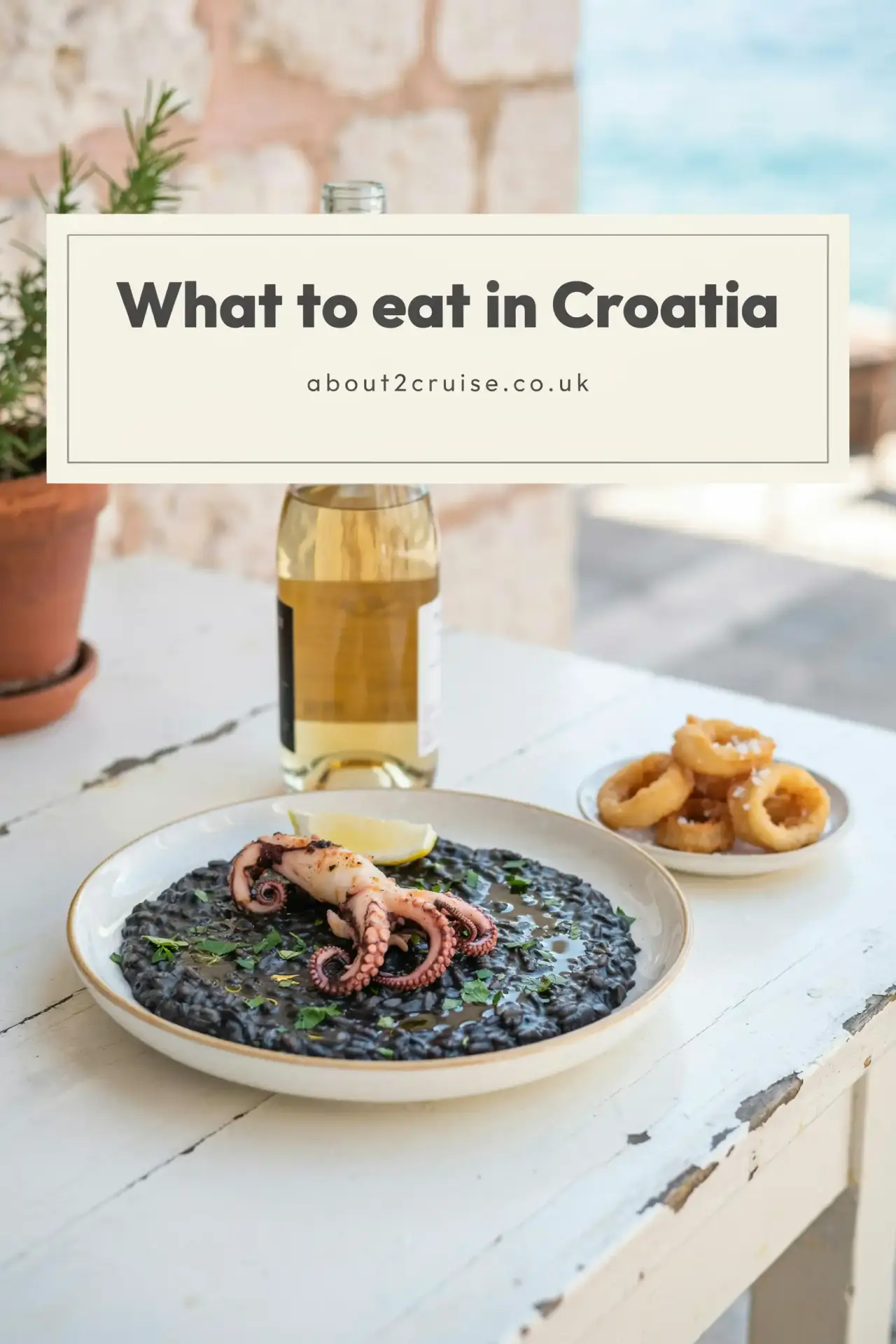
Near the berths, Dubrovnik has the Gruž open market and old-town konobas in the side lanes. Split has the Pazar market and Veli Varoš. Zadar’s city market and Kalelarga are close, while Korčula, Hvar and Rovinj all have waterfront promenades with local food within minutes of the tender landing.
Accessibility at Croatian Cruise Ports
Split’s berth-to-Riva route is flat and paved, and the main palace lanes can be reached step-free through the cellar corridor, but surfaces are uneven and the bell tower is stairs only. Zadar’s Gaženica terminal is modern and step-free inside, but the old town has cobbles and stone.
Korčula and Rovinj old towns are steep, stepped and cobbled, with limited wheelchair access. Tender ports are not suitable for all mobility equipment, and cruise lines may exclude motorised wheelchairs and scooters from tenders. If you have limited mobility, choose an itinerary with docked calls in Split, Zadar, Šibenik, Pula or Koper.
Ship Excursions vs Doing Croatia on Your Own
Dubrovnik, Split, Zadar old town, Korčula, Hvar town, Rovinj, Pula, Trogir and Koper are all doable independently. Šibenik’s old town is easy on foot, but Krka by public bus is risky on a short call because buses are not frequent and the park needs time.
Ship excursions earn their place for Krka from Šibenik, Plitvice from Zadar, and Mostar or Medjugorje from Dubrovnik. Book Dubrovnik’s city walls, Krka entry and Plitvice tickets ahead in high season. A short Split call covers the palace, cellars, cathedral, Riva and markets, not Krka or an island.
Croatia Embarkation Ports, Airports and Fly-Cruise Options
Split, Dubrovnik and Zadar are the main turnaround ports for Croatia, and Trogir works as an embarkation point for small-ship lines. Split Airport is about 25 km from the Riva, with a licensed shuttle to the bus station beside the ferry port for about €10 one way. Dubrovnik Airport is about 22 km from Gruž, with similar shuttle pricing. Zadar Airport is about 20 minutes from Gaženica.
No-fly British cruising to Croatia is sold from UK ports, and fly-cruise packages with overseas transfers are common. If you’re staying before or after the cruise, Gruž and Lapad are more convenient for Dubrovnik embarkation than the pedestrian Old Town, while Split’s hotels around the waterfront put you closest to the ship.
See also Korčula.
Croatia Cruise FAQs: Ports, Costs, Visas and More
What is the main sea port in Croatia?
Split is Croatia’s largest passenger port, handling ferries, catamarans and cruise ships. Dubrovnik is the busiest cruise port by passenger numbers and the most famous. Rijeka is Croatia’s largest cargo seaport, but it also takes smaller and mid-size cruise ships.
Is Split walkable from the cruise port?
Yes. The inner berths are about a 5–10 minute flat walk from Diocletian’s Palace. The outer breakwater berth can take 15–20 minutes. There is usually no need for a shuttle in Split.
Where do cruise ships stop in Croatia?
The main calls are Dubrovnik, Split, Zadar, Šibenik, Trogir, Hvar, Korčula, Rovinj, Pula and Rijeka/Opatija. Kotor in Montenegro and Koper in Slovenia are also common on the same Adriatic sailings.
How much does a Croatia cruise cost?
A mainstream big-ship Adriatic cruise can start under £1,000 per person for an inside cabin on a 10-night sailing. Small-ship Croatia usually costs about £1,700–£3,500 per person for seven nights, with luxury and ultra-luxury higher. Add shore excursions, port taxes, gratuities and flights.
Where does Sail Croatia leave from?
Sail Croatia and similar small-ship operators generally depart from Split Harbour or Dubrovnik, with some departures moved to Trogir when Split is congested. Seven-night routes typically run Split–Dubrovnik or Dubrovnik–Split in both directions.
What is the best Croatian port for first-time cruisers?
Dubrovnik and Split are the two headline choices. Dubrovnik is the walled-city icon; Split is the easy Roman palace call. If you can only have one, choose Dubrovnik for drama and Split for ease and food.
Do UK citizens need a visa for Croatia?
No. Croatia follows Schengen rules. Your British passport must have been issued less than 10 years before arrival and expire at least three months after departure. You can stay visa-free for up to 90 days in any 180-day period.
How far is Zadar cruise port from the old town?
Most ships dock at Gaženica, about 3.5–4 km from Zadar’s old town. A shuttle, taxi or app car takes 10–20 minutes. Walking is unshaded and not recommended.
For more port-by-port detail across the region, see our cruise port guides.
Last Updated: 19 November 2026