
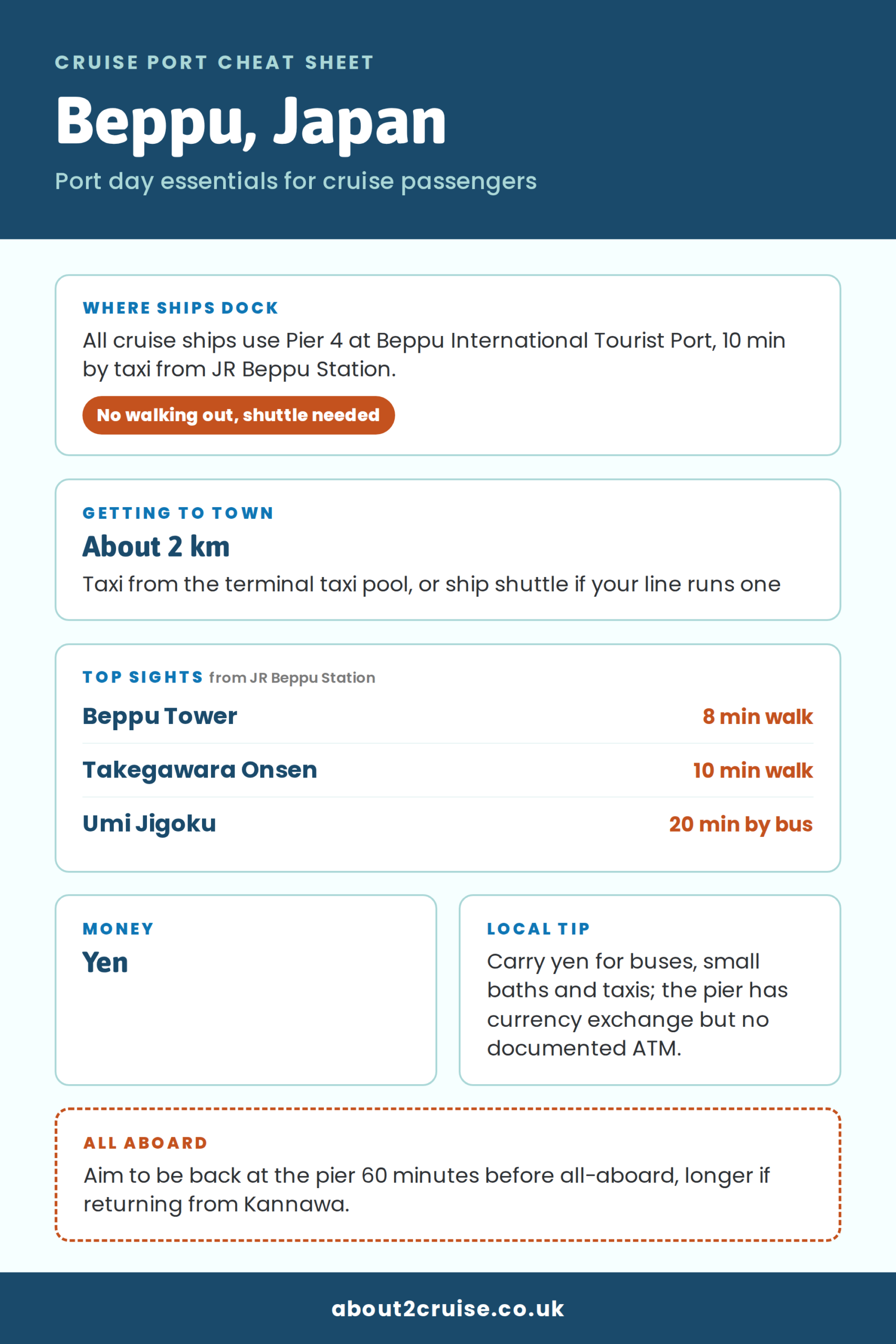
Beppu is Japan’s onsen capital on Kyushu’s east coast. Cruise ships dock at Pier 4 of Beppu International Tourist Port, about 10 minutes by taxi from JR Beppu Station. A port day is best spent at the Seven Hells, a sand bath or a tattoo-friendly onsen, with a strict time buffer back to the ship.
What Makes Beppu Special: Steam, Hells and Hot Water
Beppu is not a gentle spa town. Steam pours out of vents across the city, and more than 80,000 litres of hot spring water rises every minute from over 2,000 sources. That’s the largest hot-spring discharge in Japan. Seven of the ten officially recognised spring types appear here, and many vents run at 90–100°C. Locals call the steam yukemuri, and a national scenery survey once ranked Beppu’s steamscape second only to Mount Fuji.
The headline attractions are the Jigoku Meguri, or Seven Hells. These are boiling hot springs to look at, not bathe in. The other half of a Beppu port day is actually getting wet: an onsen soak, a private family bath or a hot-sand bath. If you only have one day, you can do the hells in the morning and a bath in the afternoon, but you’ll need to be realistic about transport.
Beppu sits on the east coast of Kyushu in Oita Prefecture, on the inner part of Beppu Bay. The bay opens towards the Seto Inland Sea, and the city climbs from the waterfront up the slopes of Mount Tsurumi, one reason the steam views are so striking.
Just to be clear: Beppu is not a suburb of Tokyo, and it is not the same place as Oita City. Oita is the prefectural capital, about 25 minutes away by road. Beppu is a call port, not a turnaround port. Ships visit, passengers go ashore, and the ship leaves the same day.
Where Your Cruise Ship Docks in Beppu: Pier 4 at Beppu International Tourist Port
All cruise ships use Pier 4 at Beppu International Tourist Port, sometimes written as Beppu International Tourism Port. The cruise pier is in the Ishigaki district, north of the city centre. Pier 3 next door is the car-ferry terminal, so if you wander the wrong way you’ll see ferries rather than cruise facilities.
The official berth length for Pier 4 is 280m with a depth of 10m, and the port says it can handle 170,000-ton-class ships. Don’t panic if your ship is longer than 280m. Vessels such as Diamond Princess, around 290m long, appear on the published call list, so the largest ships are handled operationally. For passengers, the key point is that big mainstream and premium lines do berth here.
Terminal facilities include free Wi-Fi, a foreign-currency exchange counter, a tourist information desk, toilets, a waiting area and a taxi pool. There is no published left-luggage or baggage service at Pier 4 itself. If you need to store a bag, use the station lockers or the tourist information centre in town.
Where Is Beppu on the Map?
The map shows Beppu and the places worth seeing. Tap a pin for directions.
- BeppuTown centre
- JR Beppu StationTrain station · About 2 min walk from JR Beppu Station
- Takegawara OnsenHot spring bathhouse · About 10 min walk from JR Beppu Station
- Beppu TowerTower · About 18 min walk from JR Beppu Station
- Umi JigokuBoiling hot spring · About 6 km from JR Beppu Station
- Chinoike JigokuBoiling hot spring · About 7 km from JR Beppu Station
- Beppu Spa BeachBeach · About 40 km from JR Beppu Station
- Beppu Bus CenterBus station
- Yama JigokuBoiling hot spring
- Kamado JigokuBoiling hot spring
- Shiraike JigokuBoiling hot spring
- Tatsumaki JigokuGeyser hot spring
- Beppu Beach Sand BathHot sand bath
- Mount TsurumiMountain
Which Cruise Lines Visit Beppu?
Beppu is a same-day call port. Most published arrivals run from roughly 08:30 to 18:00, but always check your ship’s actual all-aboard time. Recent and upcoming call lists include Seabourn Encore, Diamond Princess, Eastern Venus, Mitsui Ocean Sakura and Mitsui Ocean Fuji, with more calls added through the year.
If you’re looking at Princess or Royal Caribbean Japan cherry blossom seasons, Princess has Beppu on several Diamond Princess and Sapphire Princess itineraries in 2026 and 2027. Royal Caribbean ships do not dominate Beppu’s published call list in the same way, so check the official prefectural cruise schedule before booking a sailing specifically for Beppu. Japanese lines such as Mitsui Ocean Fuji also call regularly.
The best way to check your date is the Oita Prefectural Government cruise call list, which shows ship name, tonnage, length and capacity. Beppu’s cruise promotion council also publishes a PDF of confirmed calls.
How to Get from Beppu Cruise Terminal into Town
This is the part that surprises people. The cruise terminal is not directly outside the station. The pier is about 2km from downtown, and official port planning documents assume a shuttle bus is needed. That doesn’t mean a public shuttle is always waiting at the gangway.
Some cruise lines run their own complimentary shuttle into the city centre; some don’t. If your ship runs one, take it. It will usually drop you near JR Beppu Station or the downtown bayfront area. If there is no shuttle, take a taxi from the port’s taxi pool.
If you prefer rail, the nearest station is JR Beppu University Station, about 10 minutes on foot from the pier area. It has fewer trains and less onward bus choice than the main station. JR Beppu Station is the real transport hub, but it’s about 8 minutes away by car. Walking all the way from the ship to downtown takes around 40 minutes, which eats too much of a short port day in summer heat.
Public buses do serve the port area, but the stops are not immediately at the gangway. If you’re returning from JR Beppu Station to the port, you can take Kamenoi Bus route 20 or 26, or Oita Bus route 50, to the Fukamachi stop and walk about 3 minutes. In practice, most cruise passengers use the ship shuttle or a taxi.
Leave a return buffer. If your all-aboard is 17:30, aim to be back at the pier by 17:00. From Kannawa or the hells, allow at least 45–60 minutes for the return, longer if you’re relying on a bus.
Beppu’s Main Areas: Station, Bayfront and Kannawa
JR Beppu Station is the city’s spine. The east exit leads towards the bayfront, Beppu Tower and Takegawara Onsen. The west exit is where most buses leave for Kannawa, the onsen district and the Seven Hells. The ride to Kannawa takes about 20 minutes and costs around ¥330 one way from the west exit.
Kannawa is the old hot-spring district above the modern city. Five of the Seven Hells are within walking distance of each other there. The remaining two, including Chinoike Jigoku, are in the Shibaseki district a short bus ride further on. The Yukemuri Observatory and the Jigoku Mushi Kobo steam kitchen are also in the Kannawa area.
Downtown Beppu is compact but stretched along the bay. It is not a giant grid like Tokyo. Once you’re there, the station area, bayfront and main shopping streets are walkable.
Visiting the Seven Hells of Beppu (Jigoku Meguri)
The Seven Hells are Beppu’s signature sight. They are scenic hot springs, not bathing pools. The water is far too hot and dangerous to enter. Each hell has a different colour or feature, from cobalt blue to red to a geyser that erupts on schedule.
The seven are Umi Jigoku, Oniishibozu Jigoku, Kamado Jigoku, Oniyama Jigoku, Shiraike Jigoku, Chinoike Jigoku and Tatsumaki Jigoku. They open at 08:00 and close at 17:00 every day.
A combined seven-hell ticket costs ¥2,400 for adults and ¥1,200 for children. Single sites cost ¥500 and ¥250. Buy or collect the combined ticket at Umi Jigoku or Chinoike Jigoku, then show it at each site. Main ticket counters and larger gift shops accept cards and IC cards, but keep small notes and coins for smaller stalls.
Allow 2.5–3 hours for all seven at a comfortable pace. That’s the whole morning on a typical cruise call. Five hells sit together in Kannawa, and two are in Shibaseki, about 5 minutes away by bus. If time is tight, do the Kannawa cluster and skip the bus hop, or pair Umi Jigoku in Kannawa with Chinoike Jigoku in Shibaseki by taxi.
A guided Kamenoi Bus sightseeing course runs from JR Beppu Station east exit at 09:20 and 14:00. It takes about 3 hours, costs ¥4,500 for adults including all admissions, and removes the transport hassle. Book ahead if possible, but it can be a good fallback on a busy day.
Umi Jigoku and Chinoike Jigoku: The Two Hells You Shouldn’t Miss
Umi Jigoku, the Sea Hell, is the most photographed. It’s a cobalt-blue pond about 200m deep, heated to roughly 98°C and coloured by iron sulphate. The site has a footbath, a café and a water-lily greenhouse. The steam and red torii gate make it the image most people recognise from Beppu.
Chinoike Jigoku, the Blood Pond Hell, is the oldest of the seven and sits in Shibaseki. Its water is red from iron oxide. The site sells a red-clay ointment and the famous ‘Everyday is Hell’ T-shirts. If you only have time for two hells, these are the pair to choose, but expect a short taxi or bus hop between them.
Onsen Etiquette: What to Expect Before You Bathe
Bathing in a Japanese onsen is nude and gender-separated at most facilities. You are not expected to wear a swimming costume unless a specific mixed-gender or family facility says otherwise. The order is: undress in the changing room, take only a small towel, wash thoroughly at a seated shower station, rinse off all soap, and then enter the bath.
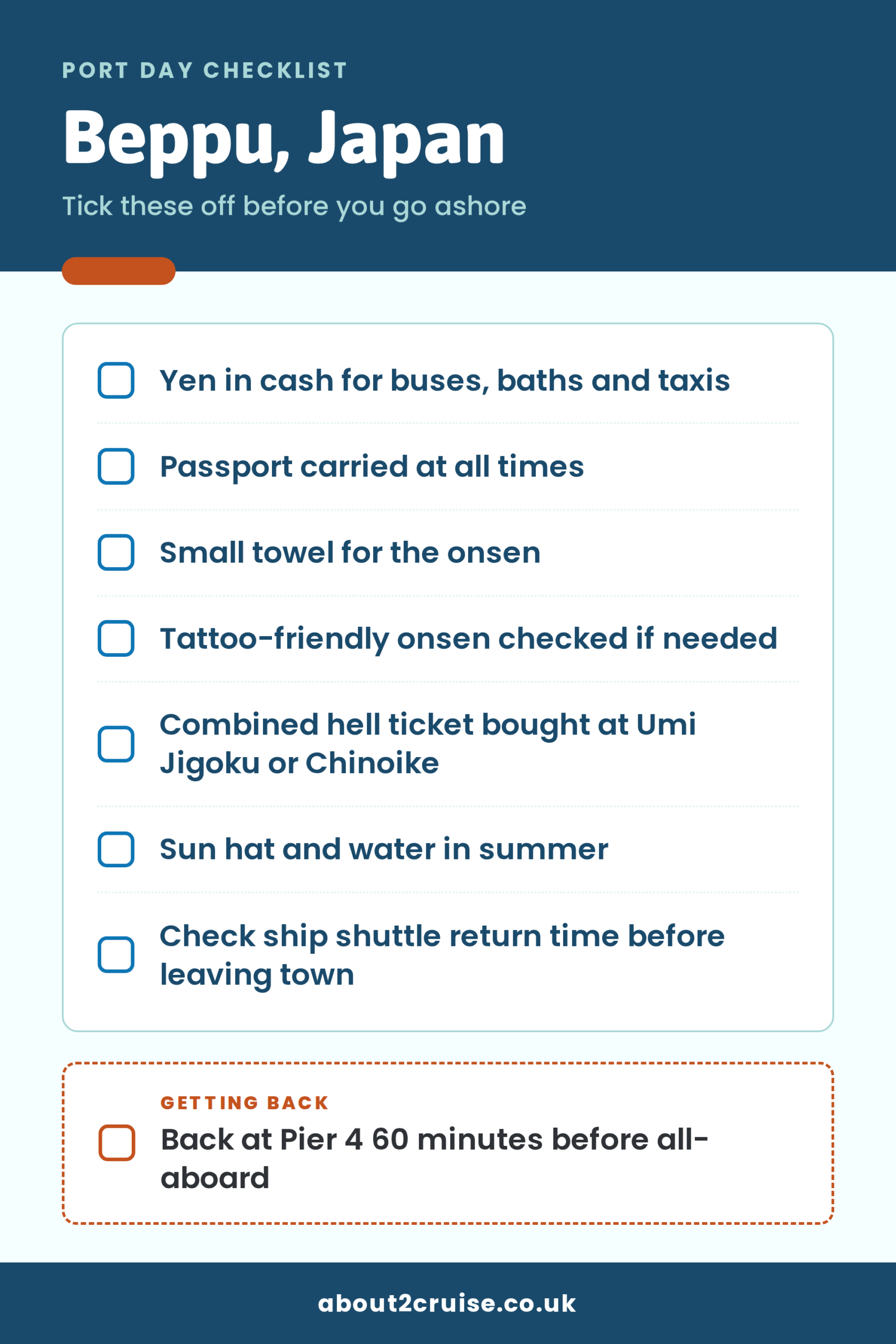
Keep the small towel out of the water. Leave it on the edge of the bath or balance it on your head. Tie long hair up. Don’t swim, don’t put your head under, and don’t jump in. The water is often 42°C or hotter. Take breaks and drink water afterwards. Leave jewellery off because the minerals can discolour it.
If the nudity or rules worry you, choose a private family bath. That’s the easiest way for a first-time onsen user to avoid embarrassment.
Tattoo-Friendly Onsen, Private Baths and Mixed-Gender Options in Beppu
Foreigners are welcome in Japanese onsen. Nationality is not the issue; tattoos often are. Many traditional baths still prohibit tattooed guests because of the old association with organised crime, but Beppu is unusually open.
Beppu publishes a tattoo-friendly onsen map with more than 100 baths that welcome tattooed visitors. The map covers public baths, private family baths and footbaths. Named examples include Takegawara Onsen, Hyotan Onsen, the Kannawa Mushiyu steam bath, Shibaseki Onsen and the beach sand bath at Sand SPA.
Private or family baths, called kashikiri, are the safest option if you have visible tattoos. You rent the room and bathe alone or with your own group, so there is no one else to object. Hyotan Onsen in Kannawa allows tattoos across its open-air bath, sand bath, steam bath and family baths.
A few mixed-gender facilities require swimwear, but most standard onsen are single-sex and nude. Check the sign or ask staff before you undress if you’re unsure.
Sand Baths and Takegawara Onsen: A Different Way to Soak
Takegawara Onsen is the downtown wooden bathhouse, about 10 minutes on foot from JR Beppu Station’s east exit. The ordinary bath costs ¥300 for adults and ¥100 for children. The sand bath costs ¥1,500, includes a yukata, and is open 08:00–22:30 with last entry at 21:30.
The sand bath takes eight people at a time and cannot be reserved. It’s first come, first served, so buy your ticket as early as possible on a busy cruise day. You lie in warm sand while an attendant shovels it over you up to the neck. A session lasts about 15 minutes. The sand is hot, the yukata is worn against the skin, and you will get sand in your hair.
The seaside alternative right next to the port is Sand SPA, also called Beppu Kaihin Sunayu, in Shoningahama Park. It costs ¥2,500 for adults and ¥1,800 for children, including the sand bath, a large bath and a towel. Hours vary by season, roughly 08:00–20:00 in spring, 08:00–22:00 from June to October, and 08:00–18:00 from November to March. It closes about two days a month to change the sand.
Hyotan Onsen in Kannawa also offers sand bathing with no set time limit.
Jigoku-Mushi: Eating Food Cooked by Hell Steam
Jigoku-mushi is food cooked in geothermal steam at around 98–100°C. The best place to try it is Jigoku Mushi Kobo Kannawa, the public steam kitchen. You rent a steam chamber, buy vegetables, eggs, seafood or meat, and cook the food yourself at the vent. Tea, utensils and condiments are provided.
Chamber rental starts at ¥400–¥600 for the first 15 minutes, with a cheaper rate per extra 10 minutes. The kitchen opens 10:00–19:00 with last cooking start at 18:00. It closes the third Wednesday of the month, or the next day if that is a holiday. The facility is barrier-free with an accessible toilet, elevator and disabled parking.
If you don’t have time to cook, buy onsen-steamed pudding in the Kannawa area. It’s the portable version of the same geothermal idea and much easier to carry back to the ship.
Yukemuri Observatory: The Best View of Beppu’s Steam
The Yukemuri Observatory is a free viewpoint above the Kannawa onsen district. It looks out over the steam plumes rising from Beppu and Kannawa. The observatory is open 08:00–21:00, with a steam light-up on Saturdays, Sundays and public holidays from 19:00 to 21:00.
By bus, take a route to the Yunokawa stop from JR Beppu Station east exit, about 25 minutes and ¥320, then walk up a steep slope for about 9 minutes. Wear grippy shoes. There is parking for a few cars, including one disabled space. The observatory is in a residential area, so keep noise down.
This is the best photo stop for the steam cityscape, but it’s not ideal for passengers with limited mobility because of the steep approach from the bus stop.
Beppu Ropeway and Mount Tsurumi: Is It Worth Your Port Day?
The Beppu Ropeway runs to the summit station of Mount Tsurumi at 1,375m in about 10 minutes. It’s one of Kyushu’s larger ropeways, with a 101-passenger cabin. The return fare is ¥1,800 for adults, ¥900 for children, and ¥1,700 for seniors aged 70 and over.
The base station is reachable by Kamenoi Bus from JR Beppu Station in about 20 minutes. The ride runs year-round but can suspend for bad weather, maintenance or inspection. Don’t plan this as your only activity on a short, wet cruise day. Check the weather before you commit.
The cherry trees around the base area at Tsurumidake Nature Park flower later than in town, typically early to mid April.
Beppu Tower, the Bay and the Beach
Beppu Tower is a downtown landmark in the Kitahama area, 8–10 minutes on foot from JR Beppu Station. The observation deck on the 16th–17th floors costs ¥800 for adults, ¥600 for junior high and high school students, and ¥400 for younger children. It’s open 09:30–21:30 with last entry at 21:00. The deck looks over Beppu Bay and the city.
The 5th-floor Kitahama Grand Platform is not wheelchair accessible and closes in rain. The lower levels and the attached area are easier to visit.
Beppu Spa Beach is an artificial beach beside Mochigahama Park, about 10 minutes from the station and close to the tower. Shoningahama Park, next to the cruise port, holds the Sand SPA beach sand bath. Marine Field Beppu is the yacht harbour and marina along the same bayfront; it’s not a major sight for cruise passengers but shows up on maps and searches.
Beppu Weather, Rain Plans and Cherry Blossom Season
Beppu has hot, humid summers. July and August often reach 35°C or more, with real heat-stroke risk. June brings the heaviest rain of the year. September is also wet, and typhoon season runs from June to December, peaking from July to September. Winter is mild by UK standards but cool enough for a jacket.
Spring and autumn are the best port-day seasons. Cherry trees in Beppu Park usually flower from late March to early April. Beppu Park is 10–15 minutes on foot from JR Beppu Station and has around 100 large cherry trees. The ropeway and Mount Tsurumi base bloom slightly later, into early or mid April.
If it rains, skip the outdoor hell circuit and head to Jigoku Mushi Kobo Kannawa, Takegawara Onsen, Beppu Tower’s observation floors or the covered station arcades. The hells are outdoor walking sites, so they lose their appeal in heavy rain. Carry a small towel, a rain shell and shoes with grip.
DIY Shore Excursion vs. Cruise Line Tour in Beppu
Beppu is a realistic DIY port if you keep the plan simple. The easiest independent day is: taxi from the pier to JR Beppu Station, bus from the west exit to Kannawa, see the Kannawa hell cluster or the full seven with a combined ticket, eat jigoku-mushi or buy pudding, then return to town for a sand bath at Takegawara. That uses about 5–6 hours plus transfers.
The weak point is transport. The hells are split across two districts, and the pier is not at the station. A taxi makes the difference. If you’re not comfortable hailing taxis or reading Japanese bus boards, take a ship excursion or join the guided Kamenoi Bus hell tour from the station.
Cruise-line excursions add further-flung sights that don’t fit independently on a 7–8 hour call: Yabakei Gorge, Usa Jingu, private hot-spring baths and countryside viewpoints. They also take responsibility for your return to the ship. If your cruise line offers a hells-plus-onsen tour, that can be the most relaxed way to see Beppu in one day.
Accessibility at Beppu Cruise Port and Local Sights
Beppu is improving but is not fully step-free. The Pier 4 terminal is a modern building with toilets and waiting space, but there is no moving walkway or boarding bridge. You use the ship’s own gangway.
The Beppu/Oita Barrier-Free Tour Center gives free advice on wheelchair-accessible sightseeing, hotels and onsen, and can arrange bathing assistance for a charge. It is open 09:00–17:00, closed Sundays and holidays. WANDER COMPASS BEPPU at JR Beppu Station lends wheelchairs.
Jigoku Mushi Kobo Kannawa has an accessible toilet, an elevator and disabled parking. Beppu Tower’s mid-level deck is stair-access only. The Yukemuri Observatory has a challenging steep approach from the bus stop. The Seven Hells are outdoor park sites with paved but not guaranteed step-free paths. Ask the Barrier-Free Tour Center about a specific bath before setting off.
Money, Cards, Wi-Fi, Luggage and Tourist Information in Beppu
Japan remains a cash-heavy country, especially in small onsen, neighbourhood restaurants and bus stations. Carry yen. Reliable ATMs for foreign cards are Japan Post Bank and Seven Bank machines, often in 7-Eleven convenience stores. The terminal lists currency exchange and free Wi-Fi, but no ATM is documented at the pier itself.
IC cards such as Suica or PASMO work on Kamenoi buses and many small purchases. The Seven Hells main ticket counters and larger shops take cards and IC cards. Small sento and coin showers may accept coins only.
Luggage storage is not available at the pier. JR Beppu Station has coin lockers by the east and west exits, roughly ¥300–¥700 depending on size, usable 24 hours with cash or IC card. Yamato Transport and WANDER COMPASS BEPPU offer paid baggage storage at the station. The Kannawa Tourist Information Office also takes bags from 09:00–17:00, useful if you go straight to the hells.
For English help, WANDER COMPASS BEPPU is a JNTO-certified tourist information centre one minute from the station’s east exit, open 08:45–18:00. A second certified counter sits inside the Kamenoi bus waiting room in Kannawa, 09:00–17:00. The national Japan Visitor Hotline for emergencies is +81 50 3816 2787.
Where to Eat and Drink in Beppu
The best food streets are around JR Beppu Station, the Kitahama bayfront near Takegawara, and Kannawa around the hells and steam kitchen.
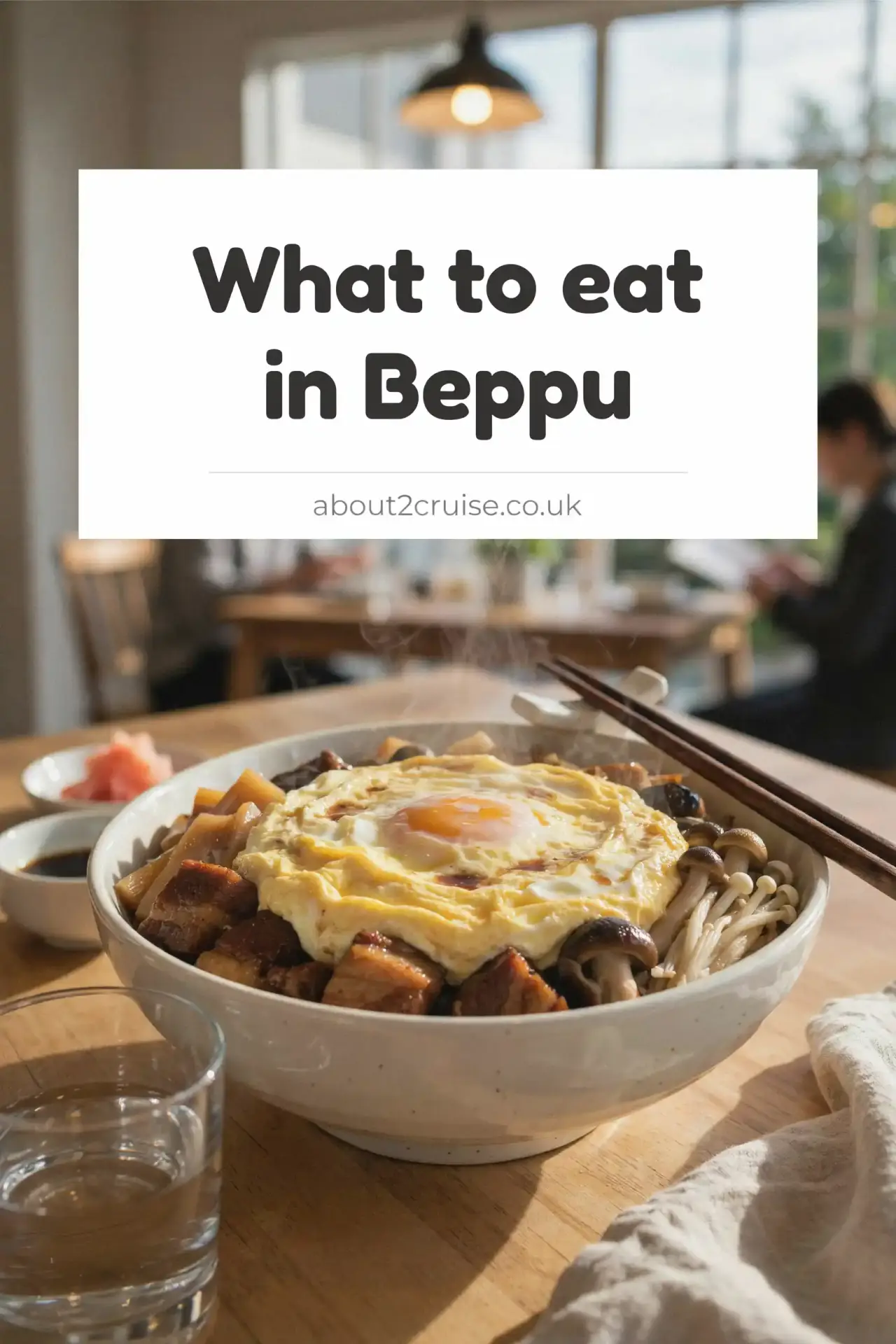
Try jigoku-mushi at the Kannawa steam kitchen. Toriten, Oita’s chicken tempura, is served with ponzu and mustard in set-meal shops near the station. Beppu reimen, cold noodles, is a local speciality. Dango-jiru, a hand-stretched wheat dumpling soup, appears on set menus downtown. Onsen-steamed pudding is the easiest local snack to carry back.
If you’re short on time, the station area has the densest choice of quick restaurants and convenience stores.
Hotels and Onsen Stays: Where to Sleep in Beppu
Beppu is a call port, not a turnaround, so most cruise passengers won’t need an overnight hotel. If you’re adding a land stay before or after a cruise, base yourself at JR Beppu Station for transport. Hotel Seawave Beppu directly faces the station and has its own onsen, but it does not admit tattooed guests to its onsen.
Kannawa, next to the hells, is the best base for a stay built around bathing. Ryokan there sit within 100m of the hells and 500m of the steam kitchen. Suginoi Hotel runs a free shuttle to and from JR Beppu Station.
For a one-night land stay, pick one district rather than moving. Beppu’s sights are spread out, and hotel onsen often remove the need to queue at public baths.
Is Beppu Worth Visiting? How Much Time Do You Need?
Beppu is absolutely worth a cruise call if you like hot springs, volcanic landscapes and Japanese food. It’s not a temple-heavy destination, and it’s not as international as Kyoto or Tokyo. Its uniqueness is the steam, the hells and the bathing culture.
For a port day, one full day is enough for the Seven Hells plus one proper bath. For a land stay, two nights gives you time for a slower onsen crawl, the ropeway and the steam kitchen. You can’t see everything in an afternoon, but you can do the best two- or three-hour combination and leave satisfied.
Tokyo to Beppu: Trains, Flights and Wider Japan Travel
Beppu has no direct Shinkansen station. From Tokyo, take the Tokaido/Sanyo Shinkansen to Kokura, then change to the Sonic limited express for Beppu. The journey takes about 6 hours and costs around ¥26,000 one way. Flying is often faster: Tokyo Haneda to Oita Airport is about 90 minutes, then a 50-minute bus to Beppu costing ¥1,600.
From Fukuoka/Hakata, the Sonic limited express to Beppu takes about 2 hours. Beppu is on JR Kyushu’s Nippo Main Line, with JR Beppu and JR Beppu University stations on either side of the centre.
As a cruise port, Beppu often appears alongside Kochi, Hiroshima, Nagasaki, Kagoshima, Busan, Osaka, Shimizu and Yokohama. If you’re comparing Japanese ports, see our Kochi Cruise Ship Port guide for a Shikoku call and our Port of Ishigaki guide for the southern islands.
Beppo or Beppu? Name Mix-Ups and Port Confusion
Beppu is sometimes misspelled Beppo. It’s the same place. There is no separate cruise port called Beppo in Japan. Beppu should also not be confused with Oita Port. Oita City is the prefectural capital, about 25 minutes away by road. If your ship’s itinerary says Beppu, it will dock at Beppu International Tourist Port, not Oita.
There is also a small town named Beppu in Gifu Prefecture, but it has no cruise terminal and is not related to the hot-spring city.
How Beppu Compares to Other Japan Cruise Ports
Beppu is one of the most distinctive calls in Japan because it’s built around geothermal activity. Unlike Yokohama, Kobe or Tokyo, it’s not a turnaround port. Unlike Kyoto or Kochi, it’s not primarily a temple-and-castle call. It compares more naturally to Hakone or Noboribetsu, except the ship docks close enough to the city for a practical independent day.
The terminal is small and functional, not a big international cruise hub. Expect a friendly welcome, free Wi-Fi and a local taxi queue rather than a huge shopping mall. That’s part of the charm.
How to spend a port day in Beppu
A port day in Beppu works best if you pick one: the Seven Hells and a soak in Kannawa, or a downtown sand bath and bay views.
Before you sail
- Check whether your ship runs a port shuttle; not all lines do at Beppu.
- Book the guided Kamenoi Bus hell tour from JR Beppu Station if you want transport and tickets handled.
- Bring yen in cash for buses, small baths and taxis; there is no documented ATM at the pier.
Short port day: under 6 hours
- On dockingTake a taxi or ship shuttle to JR Beppu StationCash for the taxiThe terminal taxi pool takes about 8 minutes to the station. There is no confirmed public shuttle from Pier 4.
- +20 minTakegawara Onsen sand bathNo reservationsA 10 minute walk from the east exit. Buy the sand bath ticket early; capacity is eight and there is no reservation.
- +1 hr 30 minBeppu Tower observation deckBay viewsAn 8 minute walk from the bathhouse. The deck looks over Beppu Bay and the city.
- +2 hrs 30 minLunch near JR Beppu StationTry toritenOita's chicken tempura, toriten, is served with ponzu and mustard in the station area; Beppu reimen cold noodles are another local choice.
- +3 hrs 30 minWalk the Kitahama bayfrontEasy flat walkStroll past Beppu Spa Beach and Mochigahama Park, beside the tower, before heading back.
- All-aboard minus 1 hrTaxi back to Pier 4Leave downtown with enough time for the 8 minute drive. If two taxis leave without you, ask your ship about a late shuttle.
This map shows the taxi ride from the ship. The time is the drive only, not your time ashore.
Open the taxi route in Google Maps
If plans change: If the sand bath queue is long, use the ordinary bath at Takegawara or walk to Beppu Tower and return later.
Long port day: 8 hours or more
- On dockingTaxi to Umi JigokuGo earlyThe terminal taxi pool can take you directly to Kannawa in about 20 minutes. Ask for Umi Jigoku or the Seven Hells.
- +30 minKannawa hells on footCombined ticketBuy or collect the combined ticket at Umi Jigoku, then see Umi, Oniishibozu, Kamado and Oniyama in the Kannawa cluster.
- +2 hrsChinoike Jigoku by taxi or busA short ride to Shibaseki for the red Blood Pond Hell. Show the same combined ticket.
- +3 hrsJigoku-mushi lunchHell-steamed lunchAt Jigoku Mushi Kobo Kannawa, rent a steam chamber and cook vegetables, eggs or seafood in geothermal steam. Onsen-steamed pudding is quicker.
- +4 hrs 30 minSoak at Hyotan OnsenTattoo-friendlyHyotan Onsen welcomes tattoos across its open-air bath, sand bath, steam bath and family baths. Wash before entering the bath.
- +5 hrs 45 minYukemuri ObservatoryGrippy shoesA short taxi or bus from Kannawa, then a 9 minute walk up a steep slope. Free viewpoint over the steam cityscape.
- All-aboard minus 90 minTaxi back to Pier 4Allow 45 to 60 minutes from Kannawa. If two taxis leave without you, contact the ship's port agent.
This map shows the taxi ride from the ship. The time is the drive only, not your time ashore.
Open the taxi route in Google Maps
If plans change: If the hells or ropeway are closed, switch to Takegawara Onsen and the covered station arcades, or join the guided Kamenoi Bus hell tour from JR Beppu Station.
Frequently Asked Questions About Beppu Cruise Visits
Can foreigners go to Japanese hot springs?
Yes. Foreign tourists are welcome in onsen. The main restriction is tattoos, not nationality. Many Beppu facilities are tattoo-friendly, and private family baths avoid the issue entirely.
Is Beppu Port the same as Oita Port?
No. Beppu is a separate city from Oita, about 25 minutes away by road. Cruise ships calling at Beppu dock at Beppu International Tourist Port Pier 4, not Oita Port.
Can I walk to the Seven Hells from the cruise ship?
No, it is too far. The hells are in the Kannawa and Shibaseki districts, roughly 20 minutes by bus from JR Beppu Station. From the pier you would first need to reach the station by taxi or shuttle, then take a bus or taxi uphill to Kannawa.
Do I need to book the Seven Hells in advance?
No. The combined ticket can be bought on arrival at Umi Jigoku or Chinoike Jigoku. The only booked element worth considering is the guided Kamenoi Bus hell tour from JR Beppu Station, which handles both transport and admission for a set price.
Are there taxis at the Beppu cruise terminal?
Yes, there is a taxi pool at the terminal. Fares are metered. Cash is safer, as not all taxis in provincial Japan accept international cards. The station is about 8 minutes away and Kannawa around 20 minutes.
What should I do if it rains during my Beppu port day?
Head to the Jigoku Mushi Kobo steam kitchen, Takegawara Onsen, Beppu Tower’s observation floors or the covered station arcades. The Seven Hells are outdoor walking sites and are not the best rain option.
How long is the Beppu Ropeway ride?
The ride to Mount Tsurumi’s summit station at 1,375m takes about 10 minutes. It can close in bad weather, so check before you travel.
Does the ship dock near downtown Beppu?
No. The cruise pier is about 2km north of downtown. You need a shuttle, taxi or bus to reach JR Beppu Station and the bayfront. Walking from the pier to the centre takes about 40 minutes.
Is Beppu worth a cruise stop?
Yes, particularly if you are interested in hot springs, volcanic scenery or Japanese bathing culture. The Seven Hells plus a sand bath or private onsen make a memorable and manageable port day.
Last Updated: 14 November 2026