
Jeju Island runs two cruise terminals, not one: Jeju Port up on the northern coast near Jeju City, and Seogwipo Gangjeong Cruise Terminal down south near Jungmun. They’re the best part of an hour apart by road, so which one your ship lands you at basically decides your whole day for a cruise to Jeju Island.
Smaller ships tend to get Jeju Port, the bigger ones get sent to Gangjeong, and you won’t find out which until you’re aboard and checking the ship’s daily programme. There’s a map of the Jeju Island cruise port further down this page, and if you’ve only got a few hours ashore, things to do near each Jeju cruise port are covered in the shore excursion sections below. For the rest of the country’s ports, our South Korea cruise ports guide is a good starting point, and if your trip begins or ends in the capital, our Incheon Seoul cruise ship port guide covers that terminal in full.
Where Do Cruise Ships Dock in Jeju Island?
Which terminal you get comes down to size, plain and simple. Anything under roughly 140,000 tons usually ties up at Jeju Port, in the north near Jeju City’s old downtown. Bigger ships get sent south to Seogwipo Gangjeong Cruise Terminal, next door to the Jungmun Tourist Complex.
Nobody quite agrees on Gangjeong’s ceiling either. Some sources say 150,000 tons per ship, others put the combined figure as high as 220,000 tons for two ships berthed together, so treat any tonnage number as a guide rather than a guarantee. The only way to know for certain which terminal you’re getting is to check your ship’s daily programme, sometimes called the cruise compass, once you’re aboard.
Jeju Port vs Seogwipo Gangjeong Cruise Terminal
Step off the ship and the difference is obvious straight away. Jeju Port drops you close to the middle of Jeju City, so the downtown markets and old town are a short walk or a quick taxi away. Gangjeong came later, built specifically to handle the bigger ships, and it shows. It’s quieter, more purpose-built, and there’s not much to walk to right outside the gate.
| Terminal | Location | Distance to city centre | Typical ship size | Facilities |
|---|---|---|---|---|
| Jeju Port (Jeju International Passenger Terminal) | Jeju City, northern coast | About 2km, an easy taxi ride | Smaller and mid-sized ships | Tourism desk, convenience store, currency exchange, occasional cultural performances |
| Seogwipo Gangjeong Cruise Terminal | Seogwipo, southern coast | Jungmun Tourist Complex is next door, central Seogwipo is a shuttle ride away | Larger ships, including two berthed at once | Tourism desk, convenience store, currency exchange |
The map below shows exactly where Jeju Port sits against Jeju City, handy if you fancy walking into town instead of waiting around for the shuttle.
Jeju Port sometimes puts on short cultural performances for arriving passengers, including a chance to try on a hanbok, the traditional Korean dress. Don’t count on it happening every call though, ask at the terminal’s information desk.
Clearing CIQ: What Happens When You Step Off the Ship
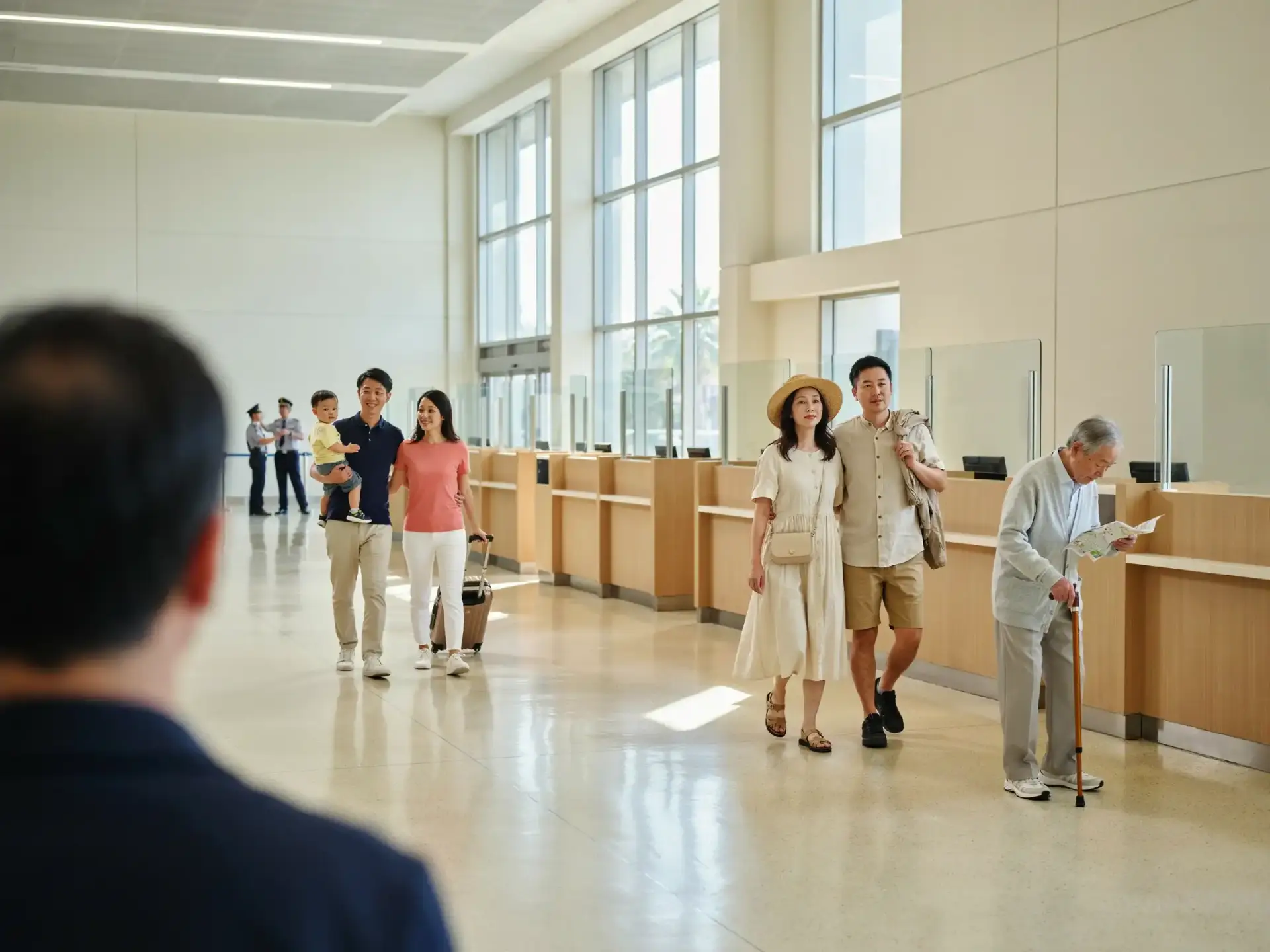
Every single arrival goes through CIQ, customs, immigration and quarantine, before you’re free to wander off. The order is always the same: off the ship, through the CIQ checkpoints, then out through the terminal to the shuttle or parking area.
Gangjeong has more immigration desks than Jeju Port, which tracks given it’s built to handle larger ships. If two ships happen to be in port on the same day at either terminal, expect the queue to outlast whatever time the ship quoted you, so build in extra buffer before any independently booked tour.
Getting Around: Shuttles, Buses and a Navigation Quirk
Both terminals get a free shuttle bus courtesy of the Jeju Tourism Organization. From Jeju Port it loops round to the Gwandeokjeong market area roughly every 20 minutes, from Gangjeong it heads into downtown Seogwipo. Timings shuffle about when several ships are in, so check with the terminal information desk on the day rather than trusting a printed schedule.
Google Maps trips up most first-time visitors here. It doesn’t work reliably for navigation or public transport in South Korea, government mapping restrictions see to that. Naver Map or KakaoMap do the job instead, both give real-time bus arrivals and walking routes that match the road you’re standing on, and they’re worth downloading before you leave home.
Local buses have also gone cashless. Every bus on Jeju now takes international contactless Visa and Mastercard, so a card that supports contactless, or Apple Pay or Google Pay, is all you need to hop on and off around either terminal.
Things to Do from Jeju Port, in the North
Jeju Port lands you closest to the island’s old downtown, so this is the easier terminal for pottering about on your own rather than a full booked excursion.
- Yongduam Rock, a dragon-head shaped rock formation on the coast, where street vendors grill octopus, oysters and squid on skewers.
- Dongmun Market, one of Jeju’s oldest traditional markets, good for fresh seafood and street food without needing a tour.
- Manjanggul Lava Tube, a UNESCO-listed lava cave stretching several kilometres underground, with a walkable section reaching a tunnel over 20 metres tall. The tube can be damp underfoot, so a waterproof phone pouch earns its keep if you want photos of the basalt walls.
- Seongeup Folk Village and Seongsan Ilchulbong, a crown-shaped volcanic crater reached by a roughly 40-minute hike with breaks. Blister prevention plasters are worth packing if a 40-minute hike isn’t your usual daily walk. Both sights are further afield, so this pairing usually only works as a booked shore excursion from Jeju Port given the drive time.
Things to Do from Seogwipo Gangjeong, in the South
Gangjeong sits in Jeju’s most scenic corner, closer to waterfalls and cliffs than markets.
- Cheonjiyeon Waterfall and Hallasan Mountain, both commonly featured on tours run from this terminal.
- Jusangjeolli Cliff, a stretch of hexagonal volcanic rock columns along the coast.
- Yakcheonsa Temple, a large Buddhist temple a short drive from the port.
- Seogwipo Olle Market, for fresh seafood, local produce and Jeju souvenirs.
- Gangjeong Haeoreum Sunset Path, a walking trail right beside the terminal, handy if you’d rather stretch your legs than book anything.
The Jungmun Tourist Complex sits right next to the terminal too, the easiest option going if you don’t want to travel far from the ship.
What Kind of Cruises Call at Jeju Island?
Jeju sits on the well-worn Far East cruise circuit, and most calls here form part of short round trips out of Shanghai or longer itineraries that also take in mainland China and other South Korean ports. Royal Caribbean’s Spectrum of the Seas, for example, has sailed round trips from Shanghai calling at Jeju as part of three to eight night Far East itineraries.
Cruise calls from China were suspended for several years and only resumed fairly recently, so itineraries pairing Jeju with Chinese ports have become common again now that gap’s closed. More recently still, Jeju has begun offering semi-homeporting, meaning Korean passengers can join international sailings directly from the island rather than travelling to the mainland first. It’s a newer option, so check availability with the cruise line directly.
Jeju itineraries are often paired with a call at Busan, covered in our Busan cruise ship port guide, or with stops in mainland China, detailed in our China cruise ports guide. For the wider region, our Asia cruise ship ports guide covers how these ports connect.
Getting to and from Jeju International Airport
Flying in or out around your cruise? The two terminals couldn’t be more different for journey times. Jeju Port is the closer of the two, only around 20 minutes’ drive from Jeju International Airport, so a taxi is straightforward even on a tight connection.
Gangjeong is a different story entirely. Port sources put the drive at around 60 minutes, and independent estimates to the nearby Jungmun area and Seogwipo bus terminal suggest a similar range, so budget at least an hour, more if traffic around Jungmun is having a bad day.
Common Questions
Is Jeju Port the same place as Jeju International Cruise Terminal?
Yes, though don’t confuse it with Gangjeong. Jeju Port’s official facility is the Jeju International Passenger Terminal, while Seogwipo Gangjeong Cruise Terminal is a separate site an hour’s drive south, so check your cruise documents to see which one your ship uses.
Why does Seogwipo Gangjeong feel more industrial than Jeju Port?
Gangjeong started life as a civilian-military complex before opening to the public, then got further investment later to expand its cruise capacity. That history explains the more functional, less touristy feel compared with Jeju Port.
Is there a long walk from the ship to the terminal building at Gangjeong?
Passenger reviews keep mentioning a long, moving-walkway style walk from berth to terminal exit at Gangjeong. There’s no official distance published, so allow more time than you might expect, especially with anyone slower on their feet in your group.
How busy can Jeju Port’s terminal get if two ships are in?
Jeju Port’s terminal building is designed for up to 3,000 people, so it can absorb a double-ship day reasonably well, though CIQ queues will still take longer than usual.
What are the terminal opening hours?
Both terminals officially run from around 09:00 to 18:00, seven days a week. Your day ashore is governed by your ship’s own timings though, not by the terminal’s opening hours.
Is Jeju International Airport busy?
Jeju International Airport is South Korea’s second-largest, so it can get busy, particularly around ship turnaround days. Build in extra time for your onward flight if you’re not staying on the island.
Does either terminal offer cultural experiences for arriving passengers?
Jeju Port occasionally puts on short cultural performances for arriving passengers, including a hanbok, or traditional Korean dress, experience. It isn’t guaranteed on every call, so ask at the terminal’s information desk when you arrive.
Why Trust About2Cruise
This guide draws on official terminal information, cruise industry reporting and passenger accounts to cover both of Jeju’s cruise terminals accurately, including the spots where sources flat out disagree, such as the exact tonnage limit at Gangjeong. We haven’t sailed into Jeju ourselves, so where the record is incomplete, we say so rather than guess. Read more about how we research and fact-check every port guide on our about us page.
Last Updated: 7 September 2026
2 responses
Do you realize that this article “Jeju Island Cruise Ship Port Guide” has contradictory information about the Northern Jeju Port? You say that it can accommodate a ship of up to 80,000 GT in 2 places but then says it can accommodate up to 140,000 GT in another. Please update/correct. This is very confusing.
Hi Barbara, thank you so much for pointing out our mistake. I’ve updated the article now so there is no confusion with the size of the ships and where they dock at Jeju.