
Antofagasta is a working Chilean copper port on the edge of the city centre, not a purpose-built cruise terminal. For most passengers, the best port day is a half-day to La Portada natural arch, the Huanchaca silver-smelter ruins and the compact historic centre, leaving time for seafood and a waterfront walk. San Pedro de Atacama is too far for a ship call.

First Impressions of an Antofagasta Cruise Call
Antofagasta is a desert-and-heritage port, not a beach resort. The realistic highlights are La Portada, the Huanchaca ruins and the Plaza Colón historic centre. Cruise calls are still rare, the port is a working cargo and copper facility, and there is no purpose-built cruise terminal. Tourist infrastructure around the city is thin, but one well-planned day is enough.
If your cruise also uses Valparaíso or San Antonio as a turnaround or port call on the same Chilean coast, see our Valparaíso (Santiago) Cruise Port Guide and San Antonio Cruise Port Guide.
Is Antofagasta Really the Gateway to the Atacama?
People often call Antofagasta the gateway to the Atacama Desert, and regionally that’s fair. What’s not realistic is trying to reach San Pedro de Atacama on a cruise call. It’s about four hours by road each way, so it only makes sense if your ship has an overnight stay and a very long excursion window.
What you can experience on a port day is the desert coast: the bare hills around the city, La Portada on the coastal highway, the Hand of the Desert on Ruta 5, the Tropic of Capricorn marker north of town, and, if your call runs into the evening, a stargazing stop under the dark desert sky. Think of Antofagasta as an Atacama taster rather than the full desert interior.

Copper, Mining and the City’s Industrial Story
Antofagasta is Chile’s mining capital. The surrounding region produces around half the country’s copper, and the huge Escondida mine, the world’s largest copper mine, lies south-east of the city. Escondida itself is not open to cruise visitors, but the Museo Ruinas de Huanchaca tells the region’s geology, mineralogy, astronomy and mining history well.
The working port you sail into is part of that story too: it handles copper concentrate and mining cargo. For nitrate-era heritage, ship excursions sometimes run to the ghost towns of Chacabuco or Baquedano, but those involve long road transfers of 90 minutes or more each way.
La Portada: The Natural Arch You’ll Actually Have Time For
La Portada is the symbol of Antofagasta. This natural sea arch sits about 18 km north of the centre, roughly 25–30 minutes by road. It stands 43 m high, 23 m wide and 70 m long, formed in marine sedimentary rock on a volcanic base. The arch and the 31.27 hectares around it are protected as a Natural Monument.
Entry is free and the site is normally open daily from 08:30 to 18:30. There is no regular public transport to the viewpoint, so you need a private vehicle, taxi or organised tour. Access is off Ruta 1 around kilometre 15, then Ruta B-446 for about 2 km. The road is passable year-round and you don’t need a 4×4.
Timing, Access and Photo Tips for La Portada
You view La Portada from clifftop viewpoints. The beach below is closed and not safe for swimming. There are no reliable facilities at the arch these days, the old education centre, café and museum may be closed, so bring water and use a toilet before leaving the ship or port area.
Morning coastal fog, called camanchaca, can hide the arch, especially earlier in the day. Late afternoon light is usually better for photography, and bird activity picks up. There are large ‘Antofagasta’ letters at the site for the standard souvenir photo. Even on a sunny day, bring a warm layer and windproof; the cliff top is exposed and can feel much cooler than the city.
The Hand of the Desert: Worth the Drive?
The Mano del Desierto is 75 km south of Antofagasta on Ruta 5, the Pan-American Highway, about an hour by road. It’s an 11 m reinforced-concrete hand by Chilean sculptor Mario Irarrázabal. There is no ticket office, no opening hours and no formal visitor centre. A short dirt track of a few hundred metres leads from the highway to the base, with informal parking.
There’s no public transport, so use a pre-arranged taxi, private driver or ship excursion. The best light is late afternoon and sunset, and the site is also popular for night photography. On a short cruise call, this becomes a half-day trip. It works best if combined with the city, the Huanchaca ruins or another stop in the same direction. If you’ve already seen La Portada and want another iconic photo, it’s worth doing, but don’t make it your only plan.
Beaches and Coastal Walks Around Antofagasta
Antofagasta’s beaches are mostly artificial, built as part of a national coastal programme. Balneario Municipal is the best known, with about 130 m of beach frontage, calm water protected by breakwaters, a swim-out raft, lighting, restaurants and a promenade. Playa Paraíso sits near the historic quarter, and Playa Trocadero is in the northern sector.
The sea along this coast is cold year-round because of the Humboldt Current, which is why locals use the sheltered artificial beaches. There’s also a nearly 2 km coastal park with sea viewpoints, ramps and stairs between Pinares and Playa Trocadero. For a more local coastal stop, Caleta Coloso, a fishing cove about 12 km south, has seafront restaurants and a morning fish auction. The beach below La Portada is closed and dangerous.
Where to Eat Seafood and Local Chilean Food
The Terminal Pesquero fish market next to the port is the city’s seafood heart. Stalls serve ceviche, paila marina, sea urchin, shellfish and seafood empanadas, with sea lions and pelicans around the boats. Go early for the freshest fish and fewer crowds, and expect strong fish-market smells.
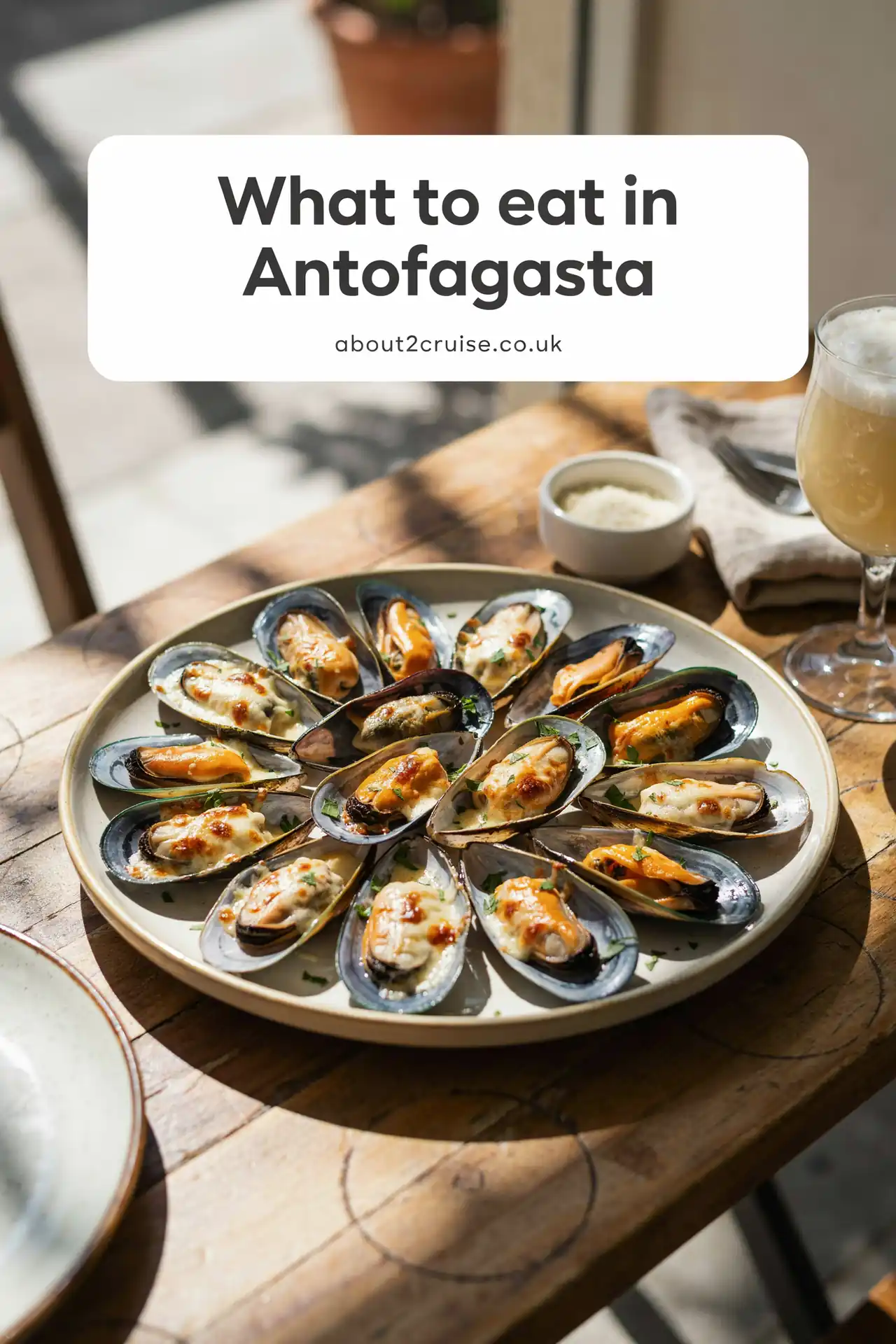
In the centre and around Plaza Colón, look for pastel de choclo, machas a la parmesana, empanadas de mariscos and pisco sour. The Mercado Central is known for cheap, accessible local food. The seafront around Balneario Municipal and the streets off Plaza Colón have the main cluster of restaurants and bars.
Stargazing Near Antofagasta: What’s Actually Possible
This region is famous for clear desert skies and world-class observatories, but the big names are too far for a normal port call. ESO’s Paranal Observatory, home of the Very Large Telescope, is 120–130 km south, about two hours by road. Public visits are free and run on Saturdays, but you must book in advance, have your own vehicle and allow about two and a half hours. Paranal sits at 2,635 m altitude, and children under four are not allowed.
The Extremely Large Telescope site on Cerro Armazones is also roughly 130 km by road. The realistic astronomy option from a cruise call is a ship excursion that drives 90 minutes or so into the desert for sunset and stargazing, with a clear dark-sky stop. If your call is daytime only, treat astronomy as a reason to return, not as a port-day plan.
Historic Piers, Railways and the Old Maritime Quarter
The Barrio Histórico is the listed coastal strip between Calle Simón Bolívar and Avenida Balmaceda. Its most memorable stop is the Muelle Histórico Melbourne Clark, a restored saltpetre pier and national Historic Monument. Entry is free, it’s usually open from around 08:00 to 20:00, and late in the day sea lions often haul themselves onto the pavement. Chilean troops landed at this pier at the start of the War of the Pacific.
Nearby, the former Aduana building of 1867 houses the Museo de Antofagasta. Entry is free, but note the opening pattern: Tuesday to Thursday 10:00–18:00 and Friday 14:00–18:00, closed at weekends and on many public holidays. The old customs house, nitrate pier and former railway station form a compact heritage circuit in the centre. Antofagasta’s railway to Bolivia is now freight-only; there is no passenger rail service from the city.
Plaza Colón, Markets and Everyday City Life
Plaza Colón is the compact historic core and the most useful landmark for cruise passengers. The surrounding streets are flat and walkable, with banks, restaurants, small shops and the old covered Mercado Central. Mall Plaza Antofagasta is on Avenida Balmaceda near the centre if you want air conditioning or familiar brands.
This is a working Chilean city rather than a prettified tourist quarter. You’ll see everyday life, small businesses and local commerce. The national tourism service office is at Arturo Prat 461, office 100, open Monday to Thursday 08:30–17:30 and Friday 08:30–16:30, but don’t rely on it on a weekend call.
Getting From the Ship to the City
Antofagasta ships usually berth alongside inside Puerto de Antofagasta, often at Sitio 2 of the Terminal Multioperado. On recent calls there has been no tender, but always confirm with your ship because cruise-port directories can be vague. The port is a controlled ISPS industrial facility, so you can’t simply wander off the quay on foot unless the ship or port has arranged a walking or shuttle route.
Many cruise lines or the port itself run a shuttle between the ship and the port gate or Plaza Colón. Some passengers report a free port shuttle; others have been taken directly to the centre. Confirm the shuttle plan and return meeting point before leaving the ship. If you exit at the port gate, Plaza Colón is about 1–2 km away, a flat 15–20 minute walk through the Barrio Histórico along or near Avenida Balmaceda.
Official taxis wait outside the terminal. Agree the fare before setting off, because meters may not be used. Ride-hailing apps including Uber, Cabify and DiDi operate in Antofagasta. Shared colectivos and taxis are the practical way to reach sights outside the centre. There is no regular public transport to La Portada or the Hand of the Desert.
Port Facilities at the Berth
There is no proper cruise terminal building at Antofagasta. On cruise days the port has sometimes set up an artisan craft fair and a tourism information stand for passengers, but don’t count on it. Expect basic passenger handling rather than a lounge, shopping arcade or dedicated services.
Don’t plan on left luggage at the port. The port area is controlled and commercial. Bring your ship card, a photo ID and the local currency you need. Heavy Pacific swell can close the terminal and cause cancellations or diversions, sometimes to Iquique. If your ship is unlucky, follow the cruise line’s revised instructions.
Antofagasta cruise port map
The map shows Antofagasta and the places worth seeing. Tap a pin for directions.
- AntofagastaTown centre
- Terminal Pesquero fish marketFish market · About 10 min walk from the town centre
- Muelle HistóricoHistoric pier · About 7 min walk from the town centre
- Museo de AntofagastaMuseum · About 4 min walk from the town centre
- Museo Ruinas de HuanchacaMuseum and ruins · About 5 km from the town centre
- La PortadaNatural sea arch · About 16 km from the town centre
- Balneario MunicipalBeach · About 3 km from the town centre
- Caleta ColosoFishing cove · About 14 km from the town centre
Shore Excursions vs Exploring on Your Own
The classic organised shore excursion is a half-day combining La Portada, the Huanchaca ruins and the historic centre. Other recurring options include the Hand of the Desert combined with the city, nitrate ghost towns such as Chacabuco or Baquedano, and evening stargazing in the desert. San Pedro de Atacama and Paranal Observatory are generally not offered as ordinary port-day trips.
Independent sightseeing works well for confident travellers. The centre is walkable, and a pre-arranged taxi or private driver can handle La Portada or the Hand of the Desert. A private driver also makes sense for the Huanchaca ruins, which sit about 5 km from Plaza Colón on the far side of the city from the port. Organised tours reduce the friction of this working port, but they’re not essential if you have a plan and agree return times clearly.
Money, Cards, ATMs and Tipping
Chile uses the Chilean peso. Displayed prices include 19% IVA. Cards are widely accepted in the city, including contactless in many shops, hotels and restaurants. US dollars are not generally accepted in everyday places. Markets, small shops, taxis and some food stalls need cash.
ATMs are on the Redbanc network and accept international cards, but don’t rely on an ATM inside the port. Head to bank branches around Plaza Colón or the mall. If a card terminal or ATM offers to charge you in sterling, decline and choose Chilean pesos. A 10% tip is customary in restaurants and is usually suggested on the bill. Taxi drivers don’t expect a tip, but rounding up is normal.
Basic Spanish for Your Antofagasta Stop
Spanish is the language of Antofagasta. English is found mainly in tourism operators, larger hotels and some restaurants, but not everywhere. A translation app and a few phrases will help: hola, gracias, ¿cuánto cuesta?, ¿aceptan tarjetas?, una mesa para dos, por favor. The police emergency number is 133.
Weather, Sun and What to Pack
The Antofagasta coast has a desert coastal climate: very little rain, high humidity, abundant cloud and frequent morning camanchaca fog. Mean monthly highs run about 25–26°C in January and February, 23–24°C in March and December, and 16–18°C in winter. Lows are roughly 12–18°C depending on the season.
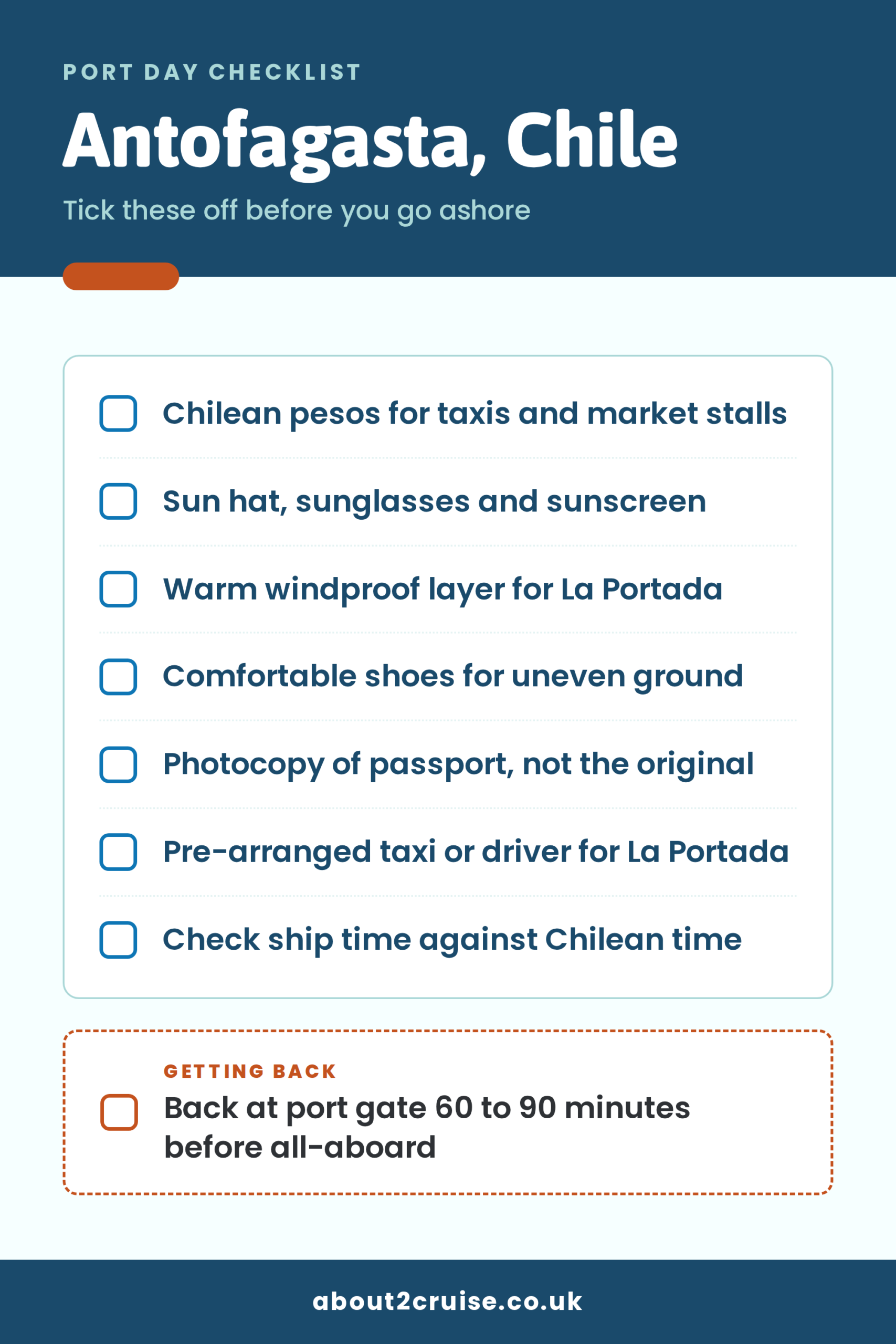
Rain is negligible, but the sun is extremely strong and the air is dry. Wear high-factor sunscreen, a hat and sunglasses, and carry water even on a cloudy morning. Bring a warm layer and windproof for the coast and for cliff-top viewpoints such as La Portada. Comfortable walking shoes are needed for the promenade and for uneven desert or historic stops.
Staying Safe in Antofagasta
Chile has high rates of pickpocketing, mugging and theft from vehicles, including at ports, transport hubs and tourist sites. Documented scams include distraction robbery, the ‘liquid spill’ trick and taxi overcharging. UK advice is not to resist a mugging, to book taxis in advance rather than hailing them in the street and to carry a photocopy of your passport rather than the original.
The centre is walkable and straightforward by day. Keep to busy streets after dark, avoid the port surroundings and peripheral districts at night, and don’t leave valuables in a parked vehicle. Demonstrations can turn violent in Chilean cities, particularly on Friday afternoons and evenings. If you feel uncomfortable, return to the ship area or use a pre-booked taxi.
Accessibility and Getting Around with Limited Mobility
Berthing alongside means no tender for most calls, but the working port may still involve a walk or shuttle across the quay to the gate. The streets around Plaza Colón are flat and relatively easy. The star sights beyond the centre are less forgiving: La Portada is viewed from an uneven clifftop terrace, and the Huanchaca ruins climb stone terraces on a hillside.
For limited mobility, the most practical option is a private vehicle with a driver who can take you to viewpoints and drop you close to entrances. The central museums and the Huanchaca cultural park advertise accessible routes and adapted toilets, but the port itself does not promise a full assistance setup.
Ship Time, Local Time and Getting Back on Time
Antofagasta keeps the same time as Santiago: UTC−3 in Chilean summer time and UTC−4 in winter. That may not be the same as ship time, so always keep your watch on ship time and confirm with local contacts what time you need to be back at the port gate.
Aim to return 60–90 minutes before all-aboard. Allow for highway traffic, security at the port gate and the shuttle or walk across the working quay. A delayed taxi or a slow port gate can eat into your buffer quickly.
Souvenirs: Copper, Crafts and Local Shopping
Copper handicrafts and regional crafts are sold around Plaza Colón and the Mercado Central area. On some cruise days an artisan craft fair is set up inside the port itself. Mall Plaza Antofagasta is the main air-conditioned mall near the centre.
Bring pesos for market purchases. Some market stalls and small shops don’t take cards, and US dollars are not a reliable fallback. If you want a copper souvenir, buy it in the centre or at the port fair rather than waiting for the airport.
Practical Breaks: Toilets, Water and Snacks
Carry a refillable water bottle and a small snack. La Portada and the Hand of the Desert have no dependable facilities. Use a toilet before leaving the ship or port area, and then at museums, restaurants, the mall or beach cafés. Public toilets are not guaranteed along the port-day route.
The Terminal Pesquero is great for seafood, but it’s a working fish market. If you’re sensitive to strong smells or slippery floors, consider a restaurant near Plaza Colón or Balneario Municipal instead. You can find toilets and better comfort in the mall and larger restaurants.
Chile Entry Rules for UK Passengers
British citizens can visit Chile for up to 90 days without a visa. Immigration issues a white A5 tourist card on entry, which you must keep and hand back on departure. Your passport should have an expiry date after the day you plan to leave Chile.
Chile enforces strict customs rules on goods brought in and out. On a cruise call, the port is cleared with agriculture, immigration police, customs and health authorities working with the ship, which is why passenger controls happen at the berth. Carry a photocopy of your passport and leave the original in your cabin safe unless a tour requires the original.
So, Is Antofagasta Worth a Cruise Port Day?
Yes, if you like desert geology, coastal landscapes, mining heritage and a raw working Chilean city. It’s not a polished beach resort or a shopping destination, and the most famous Atacama sights are out of reach. One day is enough for La Portada, the Huanchaca ruins, the historic centre and a good seafood stop.
If your cruise is calling only at Antofagasta as a South American port-of-call pause, treat it as a low-key, interesting contrast to Valparaíso and San Antonio. If you were expecting San Pedro de Atacama or Paranal, this port won’t deliver that on a short call.
How to spend a port day in Antofagasta
A port day in Antofagasta works best if you pick one: a low-key walk around the historic centre and fish market, or a private-driver loop to La Portada and the Huanchaca ruins.
Before you sail
- Book a private driver for La Portada or the Hand of the Desert before you sail; taxis may not use meters.
- Check Huanchaca museum closure days: Mondays and many public holidays.
- Check ship time against Chilean time and allow a 60 to 90 minute buffer.
Short port day: under 6 hours
- On dockingTake the port shuttleConfirm the drop-offYou cannot wander off the working quay. Ask your ship or the port team where the shuttle drops: the gate or Plaza Colón.
- +15 minTerminal Pesquero fish marketGo earlyNext to the port. Walk through the stalls for fresh ceviche, razor clams and sea lions around the boats.
- +45 minMuelle HistóricoA restored saltpetre pier on Avenida Balmaceda. Free to walk from about 08:00 to 20:00, with old cranes and bay views.
- +1 hr 15 minPlaza Colón and Mercado CentralClosed weekendsThe flat historic core. Browse copper crafts and the covered market, or duck into the free Museo de Antofagasta if it is open.
- +2 hr 15 minLunch near Mercado CentralLocal dishTry pastel de choclo or machas a la parmesana in the streets off Plaza Colón. This is the local lunch district.
- +3 hr 45 minSeafront walk to Balneario MunicipalA 10 to 15 minute flat walk along Avenida Balmaceda to the artificial beach and promenade.
- All-aboard minus 1 hrBack at the port gateReturn shuttles and port security can be slow. Be at the gate 60 to 90 minutes before all-aboard; if the shuttle is missing, take a taxi.
The time on the map is the whole walk, every stop added together.
Open this walking route in Google Maps
If plans change: If the Museo de Antofagasta is closed, carry on to the coastal walk and the Mall Plaza for coffee and toilets.
Long port day: 8 hours or more
- On dockingTake the port shuttle and meet your driverBook aheadConfirm the drop-off and meet your pre-arranged private driver near the port gate or Plaza Colón.
- +15 minDrive to La PortadaPrivate vehicle onlyPrivate taxi or pre-arranged driver north on the coast road, about 25 to 30 minutes to the Natural Monument.
- +45 minLa Portada viewpointSee the sea arch from the clifftop, take the Antofagasta letters photo and watch for pelicans and boobies. Stay behind barriers.
- +2 hr 15 minDrive to Huanchaca and visit the museumCheck Monday closureDrive 20 to 25 minutes to the Museo Ruinas de Huanchaca. Stone terraces, mining and geology rooms. Entry is paid and cards are accepted; closed Mondays.
- +4 hr 15 minDrive to Plaza Colón and lunch near Plaza ColónSeafood lunchDrive 15 minutes back to the centre, then try pastel de choclo, machas a la parmesana or empanadas de mariscos around Plaza Colón.
- +5 hr 30 minBarrio Histórico and Muelle HistóricoWalk Calle Balmaceda and the restored saltpetre pier. Sea lions often appear late in the day.
- All-aboard minus 1 hrBack at the port gatePort security and shuttle queues can add time. If the shuttle is missing, take a taxi and be at the gate at least 60 minutes before all-aboard.
This map shows the taxi ride from the ship. The time is the drive only, not your time ashore.
Open the taxi route in Google Maps
If plans change: If Huanchaca is closed on a Monday or the driver falls through, drop the ruins and do the city route instead, or join a ship excursion that bundles all three.
Our Chile cruise ports guide covers the other ports in the region.
Frequently Asked Questions
Can I walk from the ship into Antofagasta?
Not directly across the working quay. You’ll usually take a shuttle or organised walk from the ship to the port gate or Plaza Colón. From the port gate to Plaza Colón is about 1–2 km, a 15–20 minute flat walk.
Is there a proper cruise terminal at Antofagasta?
No. Expect a controlled working port with basic passenger handling, possibly a craft fair and tourism stand on cruise days, but no dedicated cruise lounge or terminal shopping.
How far is La Portada from the cruise port and can I do it independently?
La Portada is about 18 km north, about 25–30 minutes by road. You can do it independently with a pre-arranged taxi or private driver. There is no regular public transport to the viewpoint.
Is the Hand of the Desert worth the drive on a short call?
It’s worth it if you want the iconic desert roadside photo and can spare about three hours or more. It works best combined with the Huanchaca ruins or the city rather than as a standalone trip.
Can I get to San Pedro de Atacama or Paranal Observatory on a port day?
No. San Pedro de Atacama is about four hours each way. Paranal Observatory is about two hours each way, needs advance booking and usually requires your own vehicle on Saturdays.
Are taxis available at the port and do they use meters?
Yes, official taxis wait outside the terminal. Don’t assume a meter; agree the fare before setting off. Ride-hailing apps such as Uber, Cabify and DiDi also operate in the city.
Do I need Chilean pesos or can I use cards everywhere?
Cards are widely accepted in the city, but you need Chilean pesos for taxis, market stalls, small shops and some food sellers. US dollars are not generally accepted.
Is Antofagasta safe for independent cruise passengers?
It’s manageable by day with normal precautions. Use pre-booked taxis, keep valuables hidden, carry a photocopy of your passport and avoid the port surroundings and peripheral districts after dark.
What should I do if my scheduled call is cancelled or diverted?
Antofagasta can be closed by heavy swell, and ships are sometimes diverted to Iquique. Follow the cruise line’s revised instructions and don’t arrange an inflexible private tour without cancellation cover.
Is there left luggage or an ATM inside the port?
Left luggage is not advertised at the port. There is no guaranteed ATM inside the port either, so use bank ATMs around Plaza Colón or the mall if you need pesos.