
Iquique is a compact northern Chilean port where the Atacama Desert drops into the Pacific. Most cruise ships berth beside the city centre, so the nitrate-era squares, wooden architecture, beach, dune and seafront are all close. Cavancha is the safe beach, Cerro Dragón is the viewpoint and sunset spot, and Zofri is the tax-free shopping zone. It is one of Chile’s easier independent port days.
What’s Iquique Like? Desert, Beach and Saltpetre History
Iquique is the capital of Tarapacá region, squeezed between the Atacama Desert and the cold Humboldt Current. The city grew rich during the nitrate boom, and that money is still visible in the timber palaces, theatres and clock tower around Plaza Prat and Calle Baquedano.
Today the main cruise-day draws are the downtown heritage walk, Cavancha beach, the huge Cerro Dragón sand dune, paragliding, the Battle of Iquique naval story and the Zofri duty-free zone. On a longer call, the UNESCO saltpetre ghost towns of Humberstone and Santa Laura sit about 45 km inland.
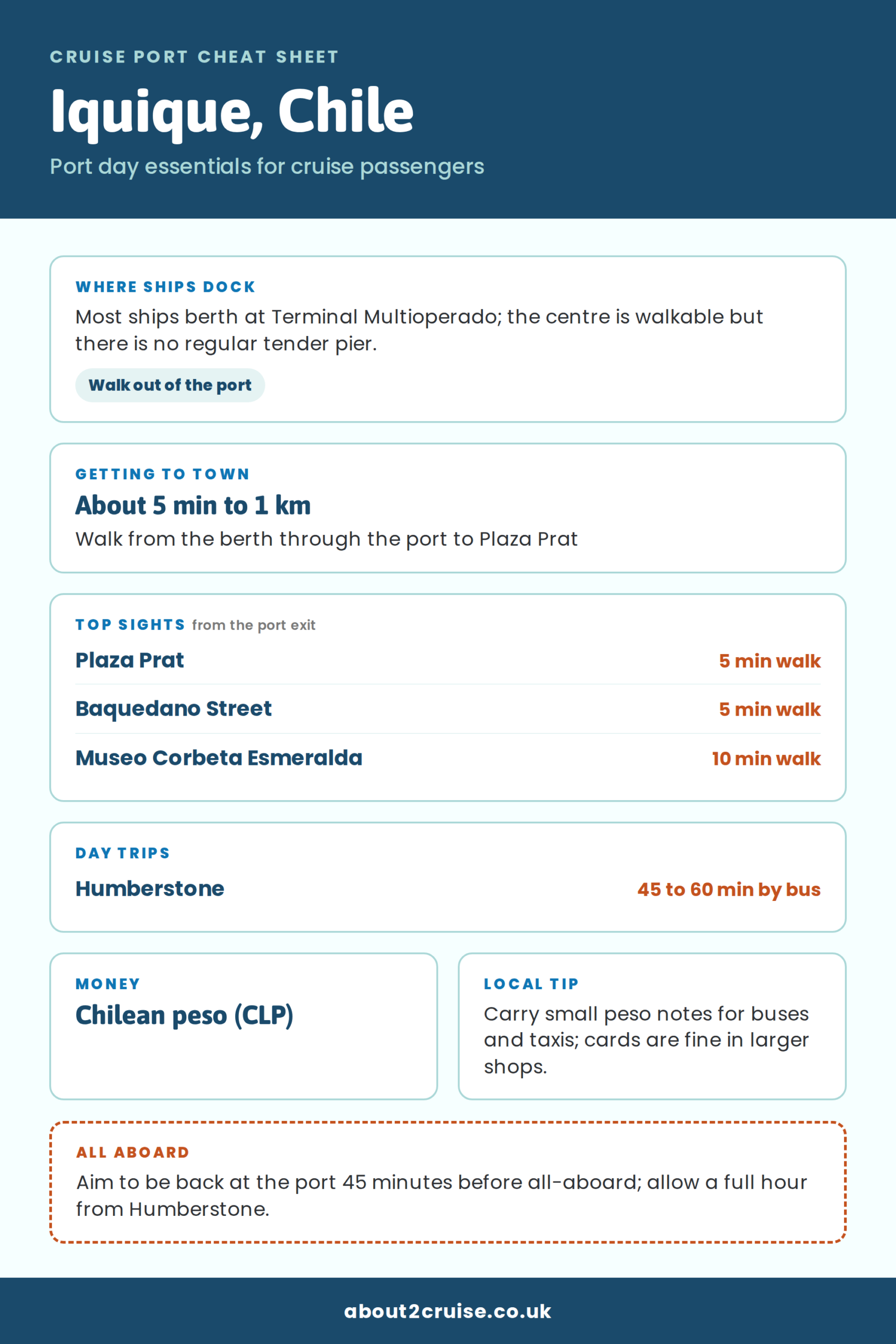
Where Cruise Ships Dock in Iquique
Iquique’s port code is CLIQQ. The same IQQ code also covers Diego Aracena International Airport, so don’t be confused if you see IQQ on flight or port paperwork.
Cruise ships berth alongside at the Terminal Multioperado, also called the Terminal Molo, operated by Empresa Portuaria Iquique, or EPI. The normal cruise berth is Sitio 1. The terminal building is open 24/7 and has a passenger area of about 4,200 m² plus 6,000 m² of parking. There is no second cruise terminal in the city.
Most sources describe the terminal as being beside or inside the port zone, with the Paseo Peatonal waterfront walkway no more than about 600 m from the city centre. Normally you walk off the gangway and through the port. Pay close attention to the instructions on board, because Iquique does not always publish a clear passenger walking route, and the procedure can change between calls.
Iquique is not a regular tender port. It has no purpose-built tender landing pier. In past seasons, when swell made the gangway unsafe, a ship had to leave early because the ramp could not be positioned, and a Zodiac tender attempt could not be completed safely. If your itinerary says Iquique, expect to dock, but don’t book anything with zero flexibility before you know the all-aboard time and whether the ship is definitely alongside.
Iquique cruise port map
Ships dock at Iquique cruise port. From there, Museo Corbeta Esmeralda is about a 16-minute walk, Caleta Riquelme about 17 minutes and Plaza Prat about 21 minutes. Tap a pin for directions.
- Iquique cruise portWhere ships dock
- Museo Corbeta EsmeraldaMuseum ship · About 16 min walk from Iquique cruise port
- Terminal de Buses de IquiqueBus station · About 17 min walk from Iquique cruise port
- Caleta RiquelmeCove · About 17 min walk from Iquique cruise port
- Plaza PratHistoric square · About 21 min walk from Iquique cruise port
- Muelle PratPier · About 2 km from Iquique cruise port
- Mercado CentenarioMarket · About 2 km from Iquique cruise port
- Playa CavanchaCity beach · About 3 km from Iquique cruise port
- Playa BravaSurf beach · About 5 km from Iquique cruise port
- Cerro DragónSand dune · About 8 km from Iquique cruise port
- Mall ZofriDuty-free shopping centre · About 2 km from Iquique cruise port
- HumberstoneSaltpetre ghost town · About 38 km from Iquique cruise port
- Santa LauraSaltpetre ghost town · About 36 km from Iquique cruise port
How Far Is the Historic Centre? Can You Walk?
Yes, the historic centre is walkable. Most published estimates put Plaza Prat about 5 minutes to 1 km from the port exit, with flat streets and pavements or boardwalks underfoot. The closest big sights are Plaza Prat, Calle Baquedano and the Museo Corbeta Esmeralda near the waterfront. If your ship is landed at the Paseo Peatonal terminal instead of the main berth, you are already on the edge of the centre.
Use the clock tower in Plaza Prat as your landmark. Baquedano Street runs off the square, and the seafront and Cavancha peninsula continue south. Cavancha beach is about 2.5 km from Plaza Prat, roughly a 30-minute flat walk. Some passengers prefer to walk the centre first, then take a short taxi or bus to the beach.
Taxis, Uber and Local Buses
Short taxi hops in town are generally quoted around CLP 4,000 to 6,000, though Iquique does not publish an official city taxi tariff. Agree the fare before getting in or check that the meter is running if using one. Uber is available in Chile and is widely used, including in Iquique.
Local buses are cheap and useful. The adult bus fare is CLP 610, and services run along Avenida Arturo Prat between the centre and Cavancha. Line 10 and Line 10 Express serve the Zofri free-trade zone every 8 minutes or so. Buses require small notes or coins, so keep change from your taxi or ice cream stop.
Plaza Prat, Baquedano Street and the Nitrate Era
Calle Baquedano and Plaza Prat are protected as a zona típica because they hold some of the best surviving saltpetre-era architecture in Chile. The buildings are mostly Oregon pine, built in balloon-frame style with double facades and shaded verandas designed to cope with desert heat.
Look for the Plaza Prat clock tower, which was brought from England and installed in 1878. The Municipal Theatre opened in 1889, and the Centro Español dates from 1904. Other protected buildings include the Palacio Astoreca and the former Nitrate Agencies building.
A small free tourist tram runs at walking pace along Baquedano from Plaza Prat for about ten blocks. There is no fixed timetable, so if you see it and there is space, hop on. The Museo Regional de Iquique is also on Baquedano at number 951. Entry is free, and it is usually open Tuesday to Saturday. It’s a useful short stop for context on the nitrate era if you want to stay indoors for a while.
Cavancha Beach and the Seafront Promenade
Cavancha is Iquique’s city beach and the one the maritime authority repeatedly certifies as the only beach in Iquique suitable for safe bathing. It has a green flag system: green means bathing is permitted, red means not suitable, usually because of swell or storm advice. Lifeguard towers, a rescue boat and a paramedic are present during the certified beach seasons, which run roughly December to March and April to November, so in practice most of the year.
The water is cold because of the Humboldt Current, ranging from about 62°F to 73°F, or 17°C to 23°C. That is refreshing on a hot desert day but not tropical. Surfing, bodyboarding and jet skis are common.
The Cavancha peninsula has a modern seafront walkway with universal accessibility, lighting, cycle lanes, rest areas and viewpoints. It’s the right place for a stroll, a drink or a sunset. Playa Brava, immediately south of Cavancha, has bigger surf and is not for swimming. It is better for walking and photography.
Cerro Dragón and Paragliding
Cerro Dragón is one of the largest urban sand dunes on the planet. It is about 4 km long, covers roughly 337 hectares, rises to about 320 m above sea level and is protected as a Nature Sanctuary. It forms the southern edge of the city, so from the top you get the classic Iquique view of desert, city and Pacific.
The dune is free to visit and has no shade. Take water, wear sun protection and strong shoes, and go late in the afternoon for the best light. It is about 4 km south of the centre along Avenida Arturo Prat and then Avenida La Tirana to the signposted access.
Iquique and Tarapacá are considered one of the best paragliding areas in the world, flyable year-round because of the coastal geography and the dune. A tandem flight typically costs CLP 50,000 to 80,000 per person, with several operators around CLP 60,000. Expect 10 to 20 minutes in the air and about two hours door to door. Take-off is usually above Alto Hospicio, and the landing is at Cavancha or Playa Brava. Photos and video are often included, but check before booking.
Flights generally operate in the morning with pickups from around 09:00 to 14:00. Weight limits vary by operator, commonly between around 20 kg and 130 kg. Flights are weather-dependent, so have a backup plan. Sandboarding on the dune costs about CLP 45,000, and a combined paraglide and sandboard day can run around CLP 95,000.
The Battle of Iquique and the Esmeralda Museum
On 21 May 1879, during the War of the Pacific, the Chilean corvette Esmeralda under Captain Arturo Prat was sunk in Iquique bay by the Peruvian monitor Huáscar under Miguel Grau. 21 May is now a major Chilean public holiday, Día de las Glorias Navales. The story matters far beyond the city: you will see Prat’s name on streets and squares all over Chile.
The Museo Corbeta Esmeralda is a full-size replica of the corvette, built on the waterfront near the port on Paseo Almirante Lynch. Visits are guided only, usually in groups of about 12, and last around 50 minutes. The replica recreates life on board the day before the battle. Foreigners pay about CLP 5,500, children under 6 are free, and the museum is closed on Mondays outside January and February. Book at least 24 hours ahead if you can. The museum has a lift and step-saving chairs for reduced mobility.
If you don’t have time for the full museum, a small boat trip from Muelle Prat can take you to the Esmeralda buoy marking the wreck site. Trips last about 30 minutes, cost around CLP 3,000 per person, and often pass sea lions and the fishing boat sector. It’s a good way to get onto the water and still feel the naval history.
Zofri Duty-Free Zone and What It Means for UK Visitors
Zofri is Iquique’s free-trade zone on the north side of the city. The retail part, Mall Zofri, has about 464 units over roughly 28,550 m² and receives around 10 million visits a year. It is a proper indoor shopping centre rather than a single store, and it can get busy at lunchtime.
Opening hours are important. Mall Zofri is normally open Monday to Saturday from 11:00 to 20:00. On Sundays only Etapa 7, the food court and the gastronomic boulevard open, usually 11:00 to 19:00. Because it opens at 11:00, you cannot shop there first thing on a morning port call. Build it into the middle of your day or use the afternoon.
Prices are not automatically lower than online or UK prices. Compare branded goods, keep receipts, and treat Zofri as a chance to browse and buy occasional bargains rather than a guaranteed saving. The traveller allowance from the free zone is around US$1,218 per person, though older customs guidance has quoted US$1,375, so check the current figure before your cruise. Keep receipts and be aware that purchases may be checked when leaving the region or at the airport.
For UK passengers, your return-to-UK allowances are separate. You can bring back £390 of other goods, or £270 if arriving by private boat or plane. Duty-free allowances include 200 cigarettes, 100 cigarillos, 50 cigars or 250 g of tobacco, and alcohol such as 4 litres of spirits or 9 litres of drinks up to 22%, plus 18 litres of still wine and 42 litres of beer. If you exceed the allowance, duty is usually charged on the whole category value, not just the excess. You can declare online up to five days before arrival in the UK.
Humberstone, Santa Laura and the Saltpetre Ghost Towns
Humberstone and Santa Laura are former saltpetre works, now a UNESCO World Heritage Site about 45 km from the port. They are the best-known inland excursion from Iquique. The tourism board quotes about 42 minutes by road, while cruise lines often allow about an hour, so plan for the longer time if you are making your own way.
A single ticket covers both sites and is bought at Humberstone. Prices are about CLP 8,000 for adults, CLP 6,000 for seniors, CLP 5,000 for students and children aged 7 to 17, and free for under-7s. Sites are generally open 09:00 to 18:00 in winter and 09:00 to 19:00 from mid-December to mid-March, closed on 1 January.
Important rules: wear closed shoes at all times, no smoking, no eating in the exhibition buildings, and do not drink the water on site. Visitors with reduced mobility can request a vehicle access permit at each guard office.
On a short visit, focus on the pulpería, or company store, which is now an interpretation centre, the restored theatre and the recreated hospital. Independent buses from Iquique to Humberstone or Pozo Almonte take roughly 45 to 60 minutes and cost about CLP 10,900 to 17,000. Half-day tours with a local operator cost from about USD 60 per person including entry. Cruise-ship Humberstone excursions of about 4.5 hours are often priced around USD 140. The site is dusty, exposed and not wheelchair accessible on typical cruise excursions.
Seafood, Ceviche and Where to Eat
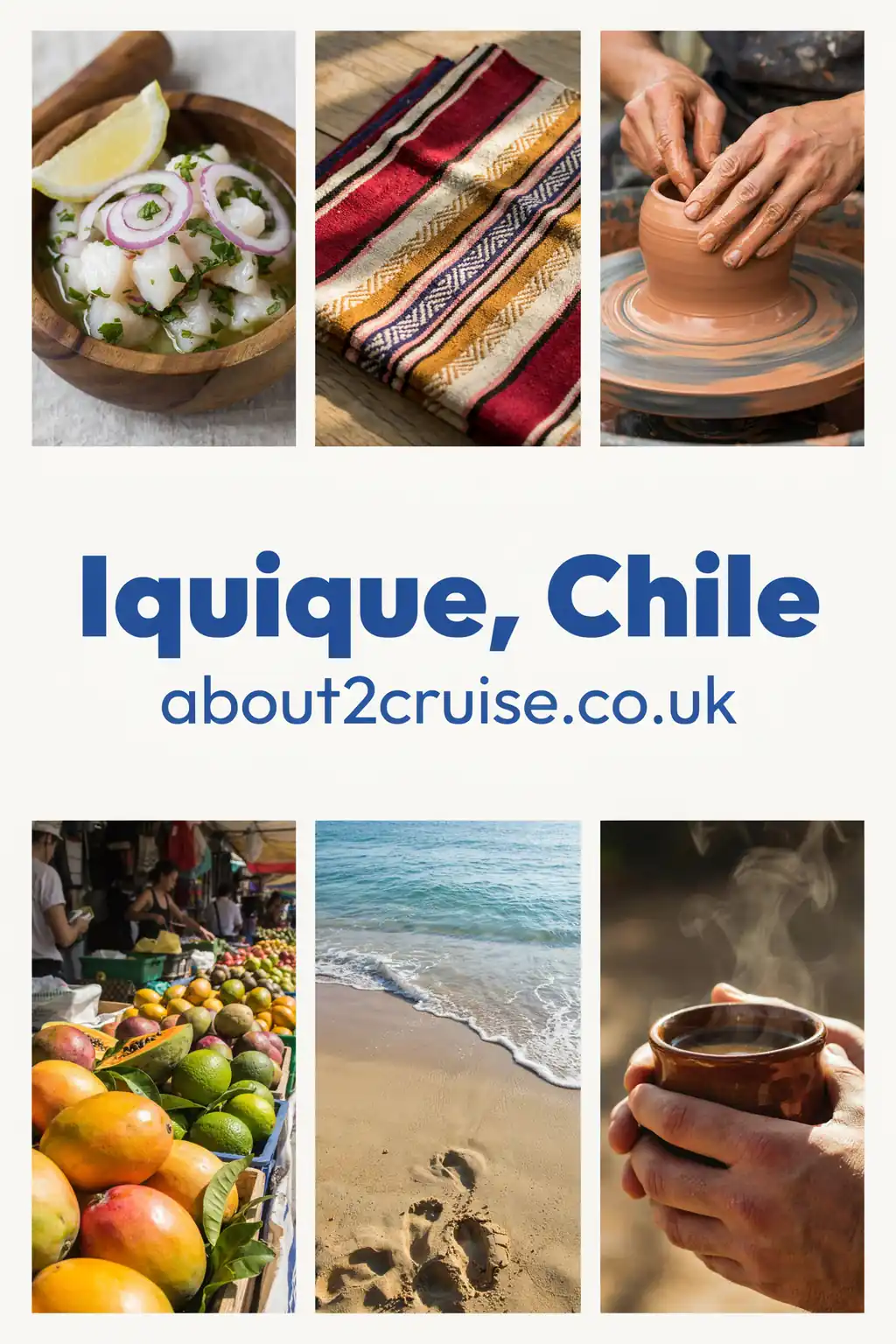
Iquique’s food is shaped by cold-water Humboldt Current fish and shellfish, with a strong Peruvian influence. Ceviche, conger eel and shellfish soups are the local staples.

The traditional market hall is the Mercado Centenario on Barros Arana 850. It is the place for fish, seafood lunches and fresh juices, with eating places on the upper floor. Caleta Riquelme, near Muelle Prat, has fishermen’s stalls and is a good stop for ceviche. The Cavancha seafront is lined with restaurants, bars and pubs, and Plaza Prat and Baquedano have cafes and restaurants inside heritage buildings.
Restaurant lunch in Chile is usually eaten from about 13:30 to 15:30, and service is unhurried. If you have a short port day, tell the server you are in a hurry, or eat at a market stall. Displayed prices normally include 19% VAT, and a 10% suggested tip, or propina sugerida, is common on restaurant bills.
Try the local sweet chumbeque, a layered slab of flour, fat and honey, often flavoured with Pica lemon. It keeps well and makes an easy snack to carry. A pisco sour and a glass of Chilean wine are the obvious drinks with a long Pacific lunch.
Money, Cards and Chilean Pesos
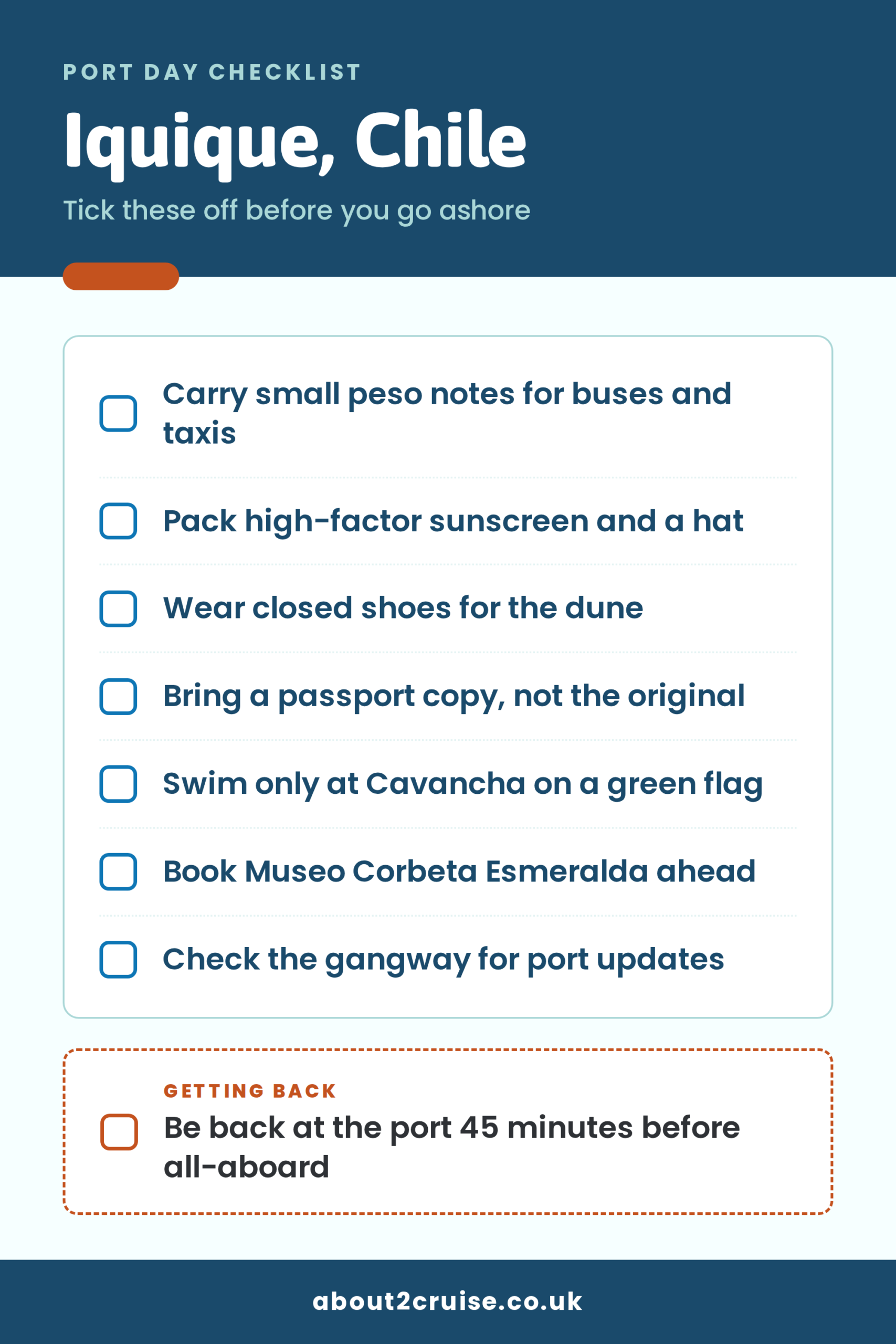
The local currency is the Chilean peso, written CLP or simply $ in Chile. Cards are widely accepted in larger shops and restaurants, and contactless payments often work with phone or watch. Carry cash for markets, small shops, buses, taxis and tips.
ATMs are plentiful around the centre and banking district near Plaza Prat. Withdraw inside banks or shopping centres when possible, and decline the machine’s offer to charge you in your home currency; that usually gives a worse rate.
Chilean banknotes are often in large denominations, so ask for smaller bills when withdrawing or break big notes at a supermarket or pharmacy. Bus drivers will not thank you for a CLP 20,000 note.
Language Tips and How to Pronounce Iquique
Iquique is pronounced ee-KEE-kay. The word comes from the Aymara expression iki iki, meaning a resting place, probably because of the seabirds and sea lions that gathered on the shore. Locals may speak fast and drop sounds, but a few phrases go a long way.
- Hola: hello
- Gracias: thank you
- Cuánto cuesta: how much does it cost
- La cuenta, por favor: the bill, please
- No entiendo: I don’t understand
- Dónde está la playa: where is the beach
- Dónde está el museo: where is the museum
- Necesito un taxi: I need a taxi
Many museum staff will do their best with English, especially at the Corbeta Esmeralda, where audio guides are available in English, French, Portuguese, Chinese and Russian. In smaller shops and market stalls, Spanish is the working language.
Weather, Desert Coastal Climate and What to Wear
Iquique has a cloudy coastal desert climate. Annual rainfall is close to zero on the coast, often around 0 to 8 mm, and the sea moderates the temperature. Average highs range from about 19°C in June to August to 26°C in February. Average lows sit between 14°C and 19°C. Morning fog, called camanchaca, is common because of the cold Humboldt Current. It often burns off to strong, hot sunshine by late morning.


Wind averages about 25 km/h, which makes the beach and dune feel cooler than the temperature suggests. Sea temperatures range from about 17°C in August to 23°C in February. The best general tourism months by temperature and rain are late February to early June and late August to early January, but cruise calls happen throughout the southern summer and shoulder months.
Pack light, breathable clothing, a hat, sunglasses, high-factor sunscreen and a light layer for the foggy morning. Closed shoes are best for the dune, the port walk and Humberstone. Swimwear belongs at the beach, not on the city streets.
Swimming, Sea Conditions and Food Safety
Only swim at Cavancha, and only on a green flag. The Humboldt Current is cold, and Playa Brava has bigger surf and rip currents. Red flags mean no swimming, however calm the water looks. If you are not a strong open-water swimmer, paddle in the shallows and keep an eye on children at all times.
For food and water, choose busy restaurants and market stalls where the turnover is high. The tap water in Iquique is generally not recommended for visitors, so use bottled water for drinking and brushing teeth if you are cautious. Fully cooked seafood, freshly cut ceviche at reputable places, and fruit you peel yourself are your best short-port-day choices. Wash your hands before eating, especially after touching the ship railings, the dune or market counters.
Safety and Common Sense in Iquique
Chile-wide travel advice says pickpocketing, mugging and theft are common, including at transport hubs such as ports. Iquique appears on government lists of tourist spots where bag-snatching and robberies can occur. The main tourist areas around Plaza Prat, Baquedano, the Muelle Prat and Cavancha are busy by day and generally fine. Local reporting shows that some robberies happen around the Cavancha peninsula and its park after dark, especially in poorly lit parts.
Keep your phone and camera secure, wear a cross-body bag, and do not leave valuables on cafe tables or beach towels. Carry a copy of your passport rather than the original, and hand over valuables rather than resist. Avoid demonstrations and roadblocks.
Chile is highly seismic, and Iquique has tsunami evacuation signage. If you feel strong shaking, move inland or uphill without waiting for an announcement. Emergency numbers are police 133, ambulance 131 and fire 132.
Accessibility and Mobility
The best accessible sights are the Museo Corbeta Esmeralda, which has a lift and step-saving chairs, and the newer Cavancha seafront walkways, which were built to universal accessibility standards with tactile paving and ramped beach access. Humberstone and Santa Laura allow visitors with reduced mobility to request a vehicle access permit at the guard office, but much of the ground is uneven and dusty. Cruise-line Humberstone excursions are usually flagged as not wheelchair accessible.
Iquique’s historic centre is flat but has some old pavements, kerbs and timber boardwalks. The cruise terminal itself does not publish a detailed accessibility statement, so speak to your ship’s shore excursions team before disembarking if you use a wheelchair or have limited mobility.
Time Zone, Ship Time and Meeting Points
Iquique follows mainland Chile time: UTC−4 in winter, changing to UTC−3 in summer. Chile moves the clocks on the first Sunday in September and the first Saturday in April. There is one national time zone, so ship time and local time usually match, but always check the all-aboard time posted at the gangway against a local clock or your phone.
Tour meeting points in Iquique are often hotels in the city centre, with paragliding pickups sometimes at Avenida Santiago Polanco. Confirm the exact address before you leave the ship.
Independent Exploring vs a Shore Excursion
The historic centre is genuinely doable on your own. Plaza Prat, Baquedano, the Esmeralda museum, the Mercado Centenario and even Cavancha are walkable or a short taxi ride apart. You do not need to book a tour unless you want commentary or have limited time.
Humberstone, Santa Laura, Pintados, Pica and the altiplano are the trips that need wheels. Local operators sell a city tour with a bay boat trip and Baquedano and Plaza Prat, often stopping at Zofri at the end, for around USD 55 per person. Humberstone half-day tours run from about USD 60 including entry. Cruise-line Humberstone excursions of about 4.5 hours often cost around USD 140. Full-day combos of Humberstone, Santa Laura, Pintados geoglyphs or Pica run 9 to 10 hours and sell for roughly USD 110 to 145 on resale platforms. Ship excursions are covered if they run late; independent travellers are not, so plan to be back early.
How to Plan a Short or Full Port Day
Short call, four to six hours: Walk from the port to Plaza Prat and the clock tower. Stroll along Baquedano to take in the timber facades. Visit the Museo Corbeta Esmeralda if the timing works, or take the 30-minute boat trip to the Esmeralda buoy. Then taxi or walk to Cavancha for a seafront drink and a look at the beach. If you are more interested in views than swimming, head to Cerro Dragón instead, then return to the ship with 45 minutes in hand.
Full day, eight to ten hours: Use the morning for Humberstone or paragliding. Humberstone is best early because it is inland and exposed. Paragliding is a morning activity. Return for lunch at the Mercado Centenario or a Cavancha restaurant. Spend the early afternoon at Cavancha or shopping at Zofri from 11:00 onwards. Finish with the sunset from Cerro Dragón or the Cavancha to Playa Brava shoreline, then return to the port.
Getting Back to the Ship: Buffer, Traffic and Delays
For a berthed ship, all-aboard is usually 30 minutes before the advertised sailing time. Check the sign at the gangway, not just the daily programme. Iquique is compact, but the road to Humberstone is a desert highway and city traffic around the port and Zofri can be slow. Swell can occasionally affect the gangway or shorten a call.
If you miss the ship, the next realistic Chilean calls are Arica or Coquimbo, both hundreds of kilometres away over desert roads. Build in a 45-minute buffer for independent trips and a full hour if you are coming back from Humberstone.
Port Code, Ship Schedules and Arrival Info
Iquique’s UN/LOCODE is CLIQQ and the airport code is IQQ. There is no official public cruise-call calendar. EPI announces each call as a news item on its own site, and third-party schedule sites fill the gap.
Recent cruise callers include Viking Polaris, Viking Octantis, Fred Olsen’s Borealis, Oceania’s Vista, Phoenix Reisen’s Artania, Regent’s Seven Seas Explorer, Crystal Serenity and Hurtigruten. The largest recent caller listed was Borealis at 238 m with about 1,107 passengers and 612 crew. Calls have been cancelled for non-weather reasons, including a nationwide truckers’ protest, so always check with your cruise line close to departure and read any port updates on board.
Is Iquique Worth Visiting on a Cruise?
Yes, if you want a real northern Chilean city rather than a manufactured cruise stop. Iquique is not about a single world-famous monument. It is about the contrast of desert and Pacific, the preserved wooden architecture, the war memory, the dune and the beach. The centre is easy to reach, the food is good, and the port day feels unhurried compared with bigger South American ports. If you only visit one beach, one dune and one square, you will still have seen the best of the place.
Best Things to Do in Iquique in One Day
Before you sail
- Book Museo Corbeta Esmeralda tickets at least 24 hours ahead; visits are guided.
- Bring small Chilean peso notes for buses, taxis and tips.
- Check Zofri opening hours and the current traveller allowance before you dock.
Short port day: under 6 hours
- On dockingWalk to Muelle PratWaterfront firstFrom the berth, walk through the port to the wooden Muelle Prat, about 5 minutes from Plaza Prat.
- +15 minBoat trip to the Esmeralda buoyCash for the boatAbout 30 minutes around the bay, passing sea lions and the fishing-boat sector, with the Battle of Iquique story.
- +1 hrPlaza Prat and clock towerWalk about 5 minutes inland to the square and its English-made clock tower.
- +1 hr 30 minBaquedano StreetStroll the wooden verandas and saltpetre-era facades; a small free tourist tram runs from the square if it passes.
- +2 hr 30 minLunch at the marketTry cevicheMercado Centenario or nearby Caleta Riquelme for ceviche, conger eel or shellfish soup.
- +3 hr 30 minTaxi or bus to CavanchaCash for the busAbout 10 minutes by taxi or 15 minutes on a local bus; walk the seafront and paddle only if the green flag is up.
- All-aboard minus 45 minBack at the port gateReturn by taxi or bus with at least 45 minutes before all-aboard.
The time on the map is the whole walk, every stop added together.
Open this walking route in Google Maps
If plans change: If the boat trip is cancelled or the museum is closed, spend longer at Plaza Prat, Baquedano Street and the Mercado Centenario.
Long port day: 8 hours or more
- On dockingTake a taxi or bus to HumberstoneGo earlyHead from the port to the bus terminal or take a taxi; the journey takes about 45 to 60 minutes.
- +1 hrHumberstone and Santa LauraClosed shoesOne ticket covers Humberstone and Santa Laura. See the pulpería, restored theatre and recreated hospital.
- +3 hrReturn to IquiqueTake a taxi or bus back; allow about an hour, then head to Mercado Centenario.
- +4 hrLunch at Mercado CentenarioTry cevicheOrder ceviche, conger eel or a shellfish soup. Service is unhurried, so tell them if you are short on time.
- +5 hr 30 minCavancha BeachBus or taxi to the seafront; walk the promenade and swim only on a green flag.
- +6 hr 30 minCerro Dragón viewpointTake waterTaxi to the dune for the desert-city-ocean view. Carry water and sun protection; there is no shade.
- All-aboard minus 1 hrBack at the portReturn to the ship with a full hour in hand; Humberstone road and afternoon city traffic can be slow.
This map shows the taxi ride from the ship. The time is the drive only, not your time ashore.
Open the taxi route in Google Maps
If plans change: If Humberstone buses are cancelled or the site is closed, walk the historic centre, then taxi to Cavancha and Cerro Dragón.
- Walk from the port to Plaza Prat and the Baquedano heritage street.
- Photograph the wooden balconies and the clock tower.
- Visit the Museo Corbeta Esmeralda or take a boat to the Esmeralda buoy.
- See the sea lions and fishing boats around Muelle Prat.
- Eat ceviche or seafood at the Mercado Centenario or Caleta Riquelme.
- Swim or stroll at Cavancha, the only beach for safe swimming.
- Climb or view Cerro Dragón for the desert-city-ocean panorama.
- Paraglide over the dune if you want the adrenaline version.
- Browse Mall Zofri in the afternoon for tax-free shopping.
Families, Couples and Independent Travellers
Families do best with Cavancha beach, the sea lion boat trip, the Esmeralda museum and the free tram along Baquedano. Cerro Dragón is a big sandy adventure for children, but take water and keep them away from the steepest faces.
Couples tend to enjoy the late-afternoon dune viewpoint, a pisco sour on the Cavancha seafront and a slow walk through the heritage centre.
Independent travellers will find Iquique straightforward: walk the centre, use local buses, eat at the market and treat Zofri as a local experience rather than a must-see.
If You’re Staying or Starting/Ending a Cruise in Iquique
Iquique is normally a port of call rather than a turnaround port, but if you need a hotel, stay near Plaza Prat and Baquedano. Terrado Arturo Prat at Aníbal Pinto 695 is directly opposite the square and has early breakfast from 06:30 on weekdays, a pool, gym and 122 rooms. Hotel Mediterraneo on Wilson 119 is two blocks from the square and close to the seafront. Ibis and Ibis Budget Iquique have 24-hour reception in the centre. Gran Cavancha Suite and Hilton Garden Inn put you on the beach but about 1.5 to 2 km from the square and further from the berth.
Diego Aracena International Airport is about 45 km south of the city. Allow 35 to 45 minutes by road. Official reference taxi fares are around CLP 25,000, Uber is available, and shared vans are cheaper. The bus terminal is at Patricio Lynch 50, near the port. There is no passenger rail service to Iquique. If you need left luggage, the intercity bus terminal offers luggage custody, and private storage points sometimes operate near the Mercado Centenario and Cavancha.
Other Chile Cruise Ports
If your cruise continues south along the Chilean coast, see our Valparaiso (Santiago) Cruise Ship Port Guide and our San Antonio Cruise Ship Port Guide for the other main gateway ports.
Our Chile cruise ports guide covers the other ports in the region.
If your cruise continues north from Iquique into Peru, Matarani is the port for Arequipa and a likely next call.
Frequently Asked Questions
How far is the cruise ship from Iquique city centre?
Most ships berth beside the city centre. Plaza Prat is about 5 minutes to 1 km from the port exit, depending on exactly where the gangway is. It is flat and walkable.
Do cruise ships tender in Iquique?
Usually no. Iquique is a docking port, normally at the Terminal Multioperado or Terminal Molo. There is no proper tender pier, so in rough swell the call can be affected. Follow the instructions on board.
Is Iquique safe for cruise passengers?
The main tourist areas are generally fine by day. Use the same anti-pickpocket precautions as in any Chilean port, avoid poorly lit beach park areas after dark, carry a passport copy and do not resist if robbed.
Can I do Humberstone independently?
Yes. Buses from Iquique to Humberstone or Pozo Almonte take about 45 to 60 minutes and cost roughly CLP 10,900 to 17,000. Entry is about CLP 8,000. A tour adds convenience and commentary but is not essential.
What is the beach like at Iquique?
Cavancha is the city beach and the only one considered safe for swimming. The water is cold, from about 17°C to 23°C, and there is a green and red flag system. Playa Brava is for walking and sunsets, not swimming.
Do shops take US dollars or euros?
Almost all shops, buses and taxis use Chilean pesos. Some larger tourist shops may accept dollars, but the rate will be poor. Use a card where accepted or withdraw pesos from an ATM in town.
What should I see if I only have four hours?
Walk to Plaza Prat, stroll along Baquedano, see the Esmeralda museum or the waterfront, and taxi to Cavancha for a quick look. If you prefer views over museums, do Plaza Prat and then go straight to Cerro Dragón.
Is tap water safe in Iquique?
Visitors are generally advised to drink bottled water. Use bottled water for drinking and brushing teeth if you are cautious. Order drinks without ice if you are unsure of the source.
What happens if I miss the ship in Iquique?
Missing the ship is expensive. The next practical Chilean calls are Arica or Coquimbo, both far away over desert roads. Build in a 45-minute to one-hour return buffer, especially if you go to Humberstone.
Does Iquique use the same time as the ship?
Usually yes, because mainland Chile has one time zone and ships adjust to local time. Check the gangway sign and a local clock or phone before heading ashore.
Last Updated: 20 November 2026