
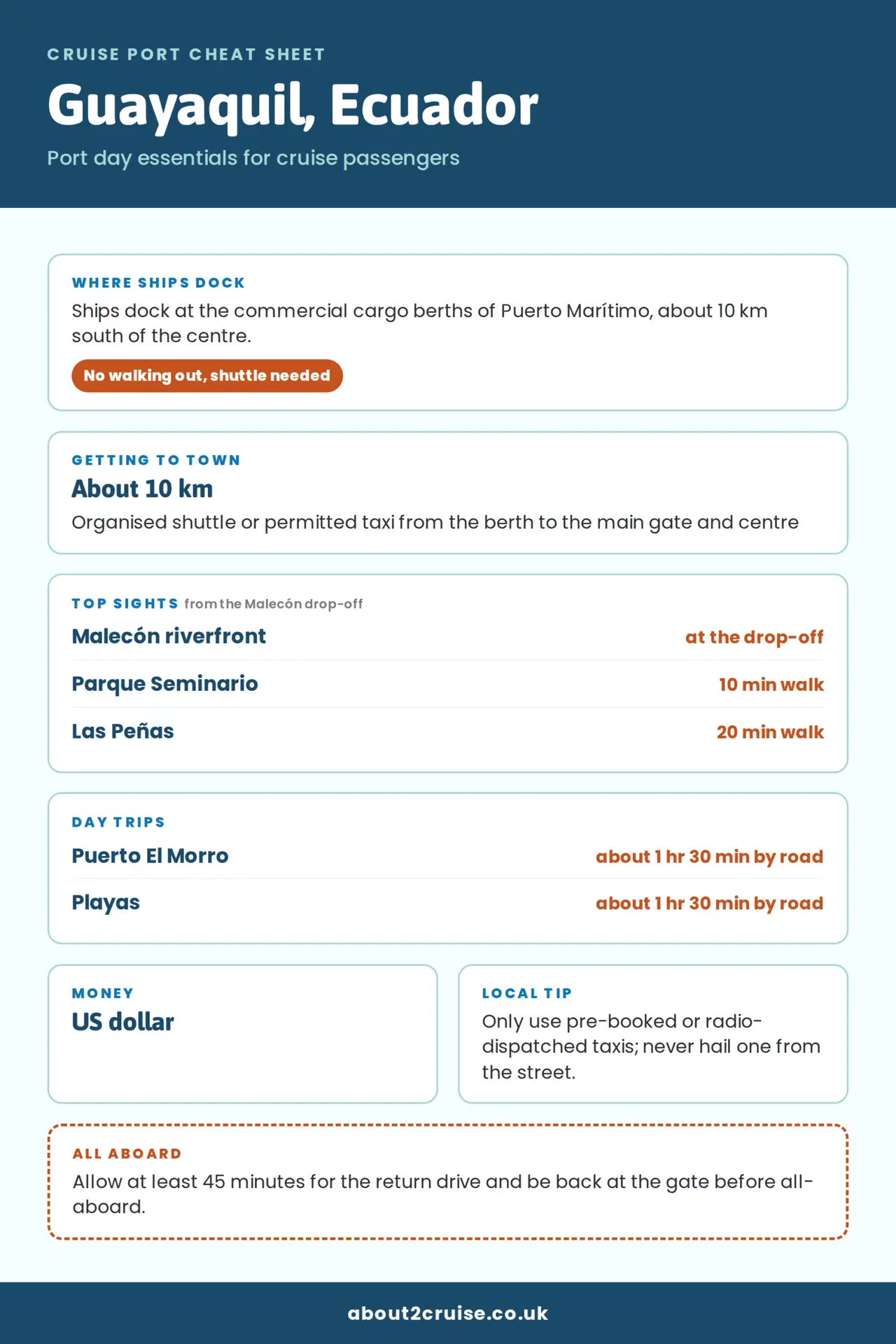
Guayaquil is Ecuador’s largest city and the mainland gateway to the Galápagos, but it is not a beach port. Cruise ships berth about 10km south of the centre at a working cargo port, so you transfer by shuttle or permitted taxi. The UK FCDO advises against all but essential travel to Guayas province, including Guayaquil, so shore visits need extra caution and ship-organised excursions often make the most sense.
Guayaquil at a glance: Ecuador’s coastal workhorse
Forget any mental image of a resort pier. Guayaquil is a hot, busy, working river port and Ecuador’s commercial engine. The city proper has more than three million residents, and about 85% of Ecuador’s non-oil cargo passes through its maritime port. The cruise berth is inside that cargo operation, not beside a promenade.
For cruisers, Guayaquil works best as a short, well-organised city stop or a turnaround point for mainland Ecuador and Galápagos itineraries. It is not the place for a lazy beach day within walking distance of the ship. The nearest true Pacific beach is Playas (General Villamil), around 96km away and roughly 1.5 hours by road.
Because the port sits roughly 10km south of the central sights, everything ashore depends on a reliable transfer. If you are also comparing Pacific South American calls, Guayaquil feels very different from the easier Pacific beach or wine-country port days in Arica, Coquimbo/La Serena or Valparaíso/Santiago.
Where your ship actually docks in Guayaquil
Cruise ships use the commercial berths at Puerto Marítimo ‘Libertador Simón Bolívar’, a heavily controlled cargo and container port on the Estero Salado. There is no purpose-built cruise terminal, no shopping arcade and no pleasant waterfront gate. Depending on the assigned quay, the walk from the gangway to ground transport may be as little as 8–15 metres to a coach, but the distance from the ship to the port’s main gate can be anywhere from about 100 metres to 2km.
The exact berth varies by ship and the port’s operational plan. Two large vessels can sometimes berth at once, but this is not a high-volume cruise port. A typical season sees only 8–10 cruise vessels. Ships also spend time navigating the channel inland from the Gulf of Guayaquil before docking, so arrival views are mostly industrial and riverine rather than postcard-worthy.
Because this is a working cargo environment, you cannot simply step off the ship and walk into the city. The port is fenced, controlled and not designed for pedestrian cruise access. Any independent movement starts after a shuttle or permitted vehicle takes you to the gate or into the centre.
Guayaquil cruise port map
The map shows Guayaquil and the places worth seeing. Tap a pin for directions.
- GuayaquilTown centre
- Malecón riverfrontRiverside promenade · About 16 min walk from the town centre
- Las PeñasHistoric neighbourhood · About 27 min walk from the town centre
- Cerro Santa AnaHilltop viewpoint · About 18 min walk from the town centre
- Parque SeminarioCity park · About 11 min walk from the town centre
- MAAC museumAnthropology and art museum · About 24 min walk from the town centre
- Museo Nacional del CacaoChocolate museum · About 16 min walk from the town centre
- La PerlaObservation wheel · About 7 min walk from the town centre
- Puerto Santa AnaModern riverside district · About 30 min walk from the town centre
- Parque Histórico GuayaquilHeritage park · About 5 km from the town centre
- Mercado Artesanal GuayaquilCraft market · About 16 min walk from the town centre
- Metropolitan CathedralCathedral · About 10 min walk from the town centre
- Puerto Marítimo Libertador Simón BolívarCargo port · About 10 km from the town centre
How to get from the port to central Guayaquil
An organised road transfer is the norm. The ground handler’s port plan recommends shuttles or coaches to the main gate as the drop-off point, with an escort at the drop-off. On some recent cruise calls, the municipality has laid on tourist coaches for city circuits covering the Cacao Museum, the Metropolitan Cathedral, Malecón 2000 and Las Peñas.
Private vehicles and taxis can only drive onto the pier if they have a ground-operator permit. Otherwise they wait outside the main gate. This matters because it rules out casually hailing a street taxi from the ship. Plan ahead, or use whatever transport your cruise line organises.
Expect the port-to-centre taxi ride to be about 25–30 minutes and roughly US$15–20, but there is no official published tariff. Arrange a fixed price before getting in. The same drive back needs a realistic buffer. Allow at least 45 minutes for the return, especially near the midday and early-evening traffic peaks. The ground handler specifically advises against shuttle or coach movements between 12:00–13:30 and 17:30–19:30 because of traffic.
Uber and DiDi both operate in Guayaquil, but pick-up inside the port is unreliable. A licensed, pre-arranged vehicle or a recommended radio-dispatched taxi is safer than hailing on the street. Better still, use a driver and a guide together rather than a driver alone. Public buses and the Metrovía system are not recommended for foreign visitors, mainly for security reasons.
Is Guayaquil safe for cruise passengers? Let’s be direct
There is no way around this: the UK Foreign, Commonwealth and Development Office currently advises against all but essential travel to Guayas province, including Guayaquil, except airside transit within Guayaquil airport. If you fly into Guayaquil and immediately connect to the Galápagos without leaving the airport, that is different from going ashore in the city.
The FCDO points to gang-related violence linked to drug trafficking, a very high murder rate, and the risk of being caught up in incidents even if tourists are not usually targeted. It warns that travel insurance can be invalidated if you travel against FCDO advice. Before booking or leaving the ship, check your cruise line’s position and your own insurance.
For those whose ship still calls, the practical security message is blunt: do not treat Guayaquil like a relaxed walkable port day. Mugging, pickpocketing and distraction theft are common. Known methods include liquid-squirt scams, staged fights, bag-snatching from motorbikes and express kidnapping, often involving taxis hailed from the street. Scopolamine has been used to incapacitate victims.
Stick to ship-organised excursions, licensed guides and pre-booked transport. Avoid displaying jewellery or expensive phones. Keep bags closed and in front of you. Do not hail taxis from the street. Avoid the city centre, southern parts of the city and port areas after dark, and be particularly alert around ATMs. The FCDO advises using taxis booked through a hotel or a known radio-dispatched service.
Ship excursion or independent Guayaquil visit: which is better?
For most first-time callers, a ship excursion is the sensible default. It removes the uncertainty of the port gate, the risk of unlicensed taxis and the lack of official transport information. It also gives you a guide and a fixed return time, which matters in a city with real crime warnings.
Independent sightseeing is possible if you are experienced, speak some Spanish, and arrange a licensed guide and driver in advance. The central route along Malecón 2000 to Las Peñas and Parque Seminario is compact enough for a half-day, but it still requires a transfer each way. If you choose independent exploring, keep it to daylight hours, avoid flashy behaviour, and have a confirmed pick-up for the return. Do not wing it from the port gate.
Transfer times and return-to-ship timing
Map distance between the maritime port and central Guayaquil is about 10km, but traffic can stretch the drive. A realistic transfer is 25–30 minutes. The port’s operating plan suggests avoiding midday and early-evening windows, which means a morning shore excursion should leave the city by early afternoon to avoid the worst traffic.
For a standard port-of-call visit, be back at the port gate or shuttle pick-up with ample margin. For a turnaround day, many lines assign a fixed check-in slot and close embarkation about an hour before sailing. If you are joining or leaving the ship in Guayaquil, treat it like a fly-in, transfer-heavy embarkation port, not a leisurely terminal.
Best things to do in Guayaquil on a short cruise call
Before you sail
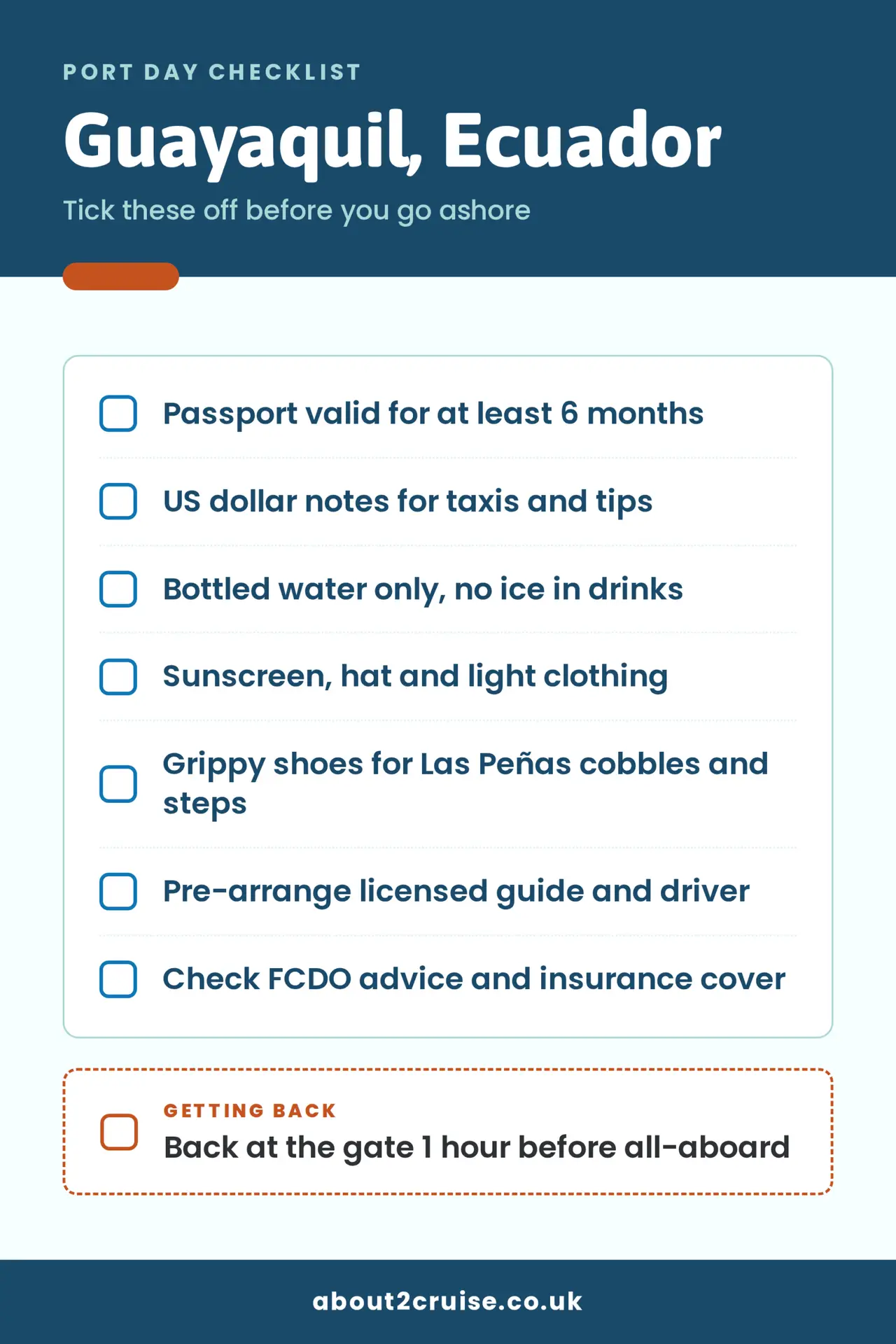
- Check the UK FCDO travel advice for Guayas province and your insurance before going ashore.
- Pre-book a licensed guide and driver, or choose a ship excursion, for the port day.
- Book Galápagos flights and buy the transit card at the airport before check-in.
Short port day: under 6 hours
- On dockingTake the organised shuttle or permitted taxiNo walking outYou can't walk through the cargo port. Use the ship shuttle or a pre-arranged vehicle to the Malecón riverfront; the drive takes 25 to 30 minutes.
- +30 minMalecón riverfrontWalk the flat, paved promenade to see La Rotonda and the Moorish Clock Tower. Free, open every day.
- +1 hr 15 minLas Peñas and Cerro Santa Ana444 stepsWalk north to the cobbled heritage street, then climb the 444 numbered steps to the lighthouse for the panoramic view.
- +2 hr 45 minLunch near Calle PanamáTry encebolladoOrder encebollado, ceviche or patacones at the food street near the Cacao Museum, or use a Malecón food plaza.
- +4 hr 15 minParque Seminario and the CathedralWalk to the iguana park in front of the Metropolitan Cathedral. Watch the iguanas and turtles, but do not feed them.
- All-aboard minus 1 hrBack at the port gateAllow at least 45 minutes for the return drive. Avoid the midday and early-evening traffic peaks.
This map shows the taxi ride from the ship. The time is the drive only, not your time ashore.
Open the taxi route in Google Maps
If plans change: If a museum is closed or queues are long, swap it for the free riverfront or MAAC and keep the same timing.
Long port day: 8 hours or more
- On dockingTake the organised shuttle or permitted taxiGo earlyShuttle queues build in a small port; be on one of the first transfers to the Malecón riverfront.
- +30 minMAAC museumClosed MondaysStart at the air-conditioned Museo Antropológico y de Arte Contemporáneo on Malecón Simón Bolívar at Loja. Free, Tuesday to Sunday 09:00 to 17:00.
- +1 hrMalecón riverfrontWalk the 2.5 km promenade: La Rotonda, Clock Tower, gardens and river views. Stop for a river boat ride if you like.
- +2 hrLas Peñas and Cerro Santa Ana444 stepsWalk north to Calle Numa Pompilio Llona, then climb the numbered stairway to the lighthouse. Use the municipal police post for reassurance.
- +4 hrLunch in Puerto Santa Ana or Calle PanamáTry encebolladoOrder encebollado, ceviche or bolón de verde. Puerto Santa Ana is the modern riverside dining district; Calle Panamá is the food street.
- +5 hr 30 minParque Seminario and Cacao MuseumVisit the iguana park and Cathedral, then the free Museo Nacional del Cacao nearby. Allow 30 minutes for the museum.
- +6 hr 30 minMercado Artesanal GuayaquilBrowse the 168 stalls for toquilla-straw Panama hats and cacao products. Open Monday to Saturday 09:00 to 18:00, Sunday 10:00 to 16:00.
This map shows the taxi ride from the ship. The time is the drive only, not your time ashore.
Open the taxi route in Google Maps
If plans change: If the Santa Ana climb is too much in the heat, skip the steps and ride La Perla for the same city view.
Walk the Malecón 2000 riverfront
Malecón 2000 is the riverfront promenade and the easiest base for a short visit. It stretches 2.5km along the Guayas River and is free to enter, open every day from 07:00 to midnight. Along it you will find more than 60 sculptures and monuments, the Hemiciclo de La Rotonda, the Moorish Clock Tower, gardens, food plazas, seven ATMs and 152 toilets.
Short river boat rides from the Malecón cost about US$4, and pedal boats are also available. If you only have a few hours, this flat, paved stretch is the most practical place to stretch your legs, take photographs and use decent facilities.
Climb Las Peñas and Cerro Santa Ana
Las Peñas is the city’s most atmospheric neighbourhood: 36 heritage timber houses along the 300-metre cobbled Calle Numa Pompilio Llona, with galleries, cafés and bars. It sits at the foot of Cerro Santa Ana, whose numbered stairway climbs 444 steps to a chapel and lighthouse. The payoff is a 360-degree view over the city and river.
The climb is free, but it is a genuine workout in tropical heat. Wear grippy shoes for the cobbles and take water. A municipal police post operates at Puerto Santa Ana and Las Peñas, which adds some reassurance in daylight. Do the climb early, not in the midday sun, and never after dark unless you are with a guided group.
Meet the iguanas at Parque Seminario
Parque Seminario, in front of the Metropolitan Cathedral, is famous for its free-roaming green iguanas and around 200 turtles in a pond. It is free, centrally located and a solid photo stop. The iguanas are used to people, but they are wild animals. Don’t feed them or try to pick them up. Early morning is cooler and better for photos.
Visit the MAAC museum
The Museo Antropológico y de Arte Contemporáneo sits on Malecón Simón Bolívar at Loja. It is free, open Tuesday to Sunday from 09:00 to 17:00 and closed on Mondays. The permanent exhibition covers roughly 10,000 years of ancient Ecuador, making it a worthwhile air-conditioned break on a hot day.
Learn about chocolate at Museo Nacional del Cacao
Guayaquil’s identity is tied to cacao, and this small museum at Panamá and Imbabura streets traces that story. It is open Tuesday to Sunday from 10:00 to 17:00 and currently free under municipal administration, though a small fee may be introduced. The visit takes about 30 minutes. It sits conveniently near the Calle Panamá food cluster.
Ride La Perla Ferris wheel
La Perla is a 57-metre observation wheel with 36 cabins, marketed as the largest in South America. It gives riverfront and city views without climbing Santa Ana. Weekday hours are 12:30–20:00 Monday to Thursday, and weekend hours are 10:00–22:30 Friday to Sunday. Standard tickets cost about US$3.50 on weekdays and US$5 on weekends and holidays, with an express option at US$7 or US$10 and reduced rates for seniors and disabled visitors.
Explore Puerto Santa Ana
This modern riverside district has restaurants, bars and a safer, more polished feel than some older streets. It is home to the Julio Jaramillo music museum and smaller football museums dedicated to Barcelona and Emelec. It sits close to Las Peñas and Santa Ana Hill, so it fits naturally into a city circuit.
Visit Parque Histórico Guayaquil
Parque Histórico lies in Samborondón, outside the immediate centre, and works well as a half-day excursion rather than a quick walk. It is open Wednesday to Sunday from 09:00 to 17:00. Entry costs about US$4 for adults and US$2 for children. The park has a wildlife zone, a recreated Malecón 1900 and a rural house, giving a good overview of Ecuadorian coastal culture in one stop.
Take the Aerovía cable car
The Aerovía crosses the Guayas River to Durán in about 17 minutes and costs roughly US$0.76, or US$0.38 reduced. It is a cheap way to see the city from above if you want something different, but factor in the transfer and use it only in daylight with a clear plan for the other side.
A simple independent route for a half-day in Guayaquil
If you decide to go independently with a pre-arranged driver and guide, start at Malecón 2000. Walk the flat riverfront to see La Rotonda and the Clock Tower, then continue to Las Peñas. If you have the energy and the day is still cool, climb the 444 steps to the Santa Ana viewpoint. Afterwards, drive to Parque Seminario and the Cathedral, and finish with the Cacao Museum or lunch in Puerto Santa Ana or Calle Panamá.
This route keeps you in the most visited central zone, avoids unnecessary wandering and can be completed in about four to five hours. Beg the driver not to rush the return. Heavy traffic can turn a 25-minute ride into a much longer one.
Guayaquil shore excursion ideas: half-day and full-day options
Classic city circuit: Malecón 2000, Las Peñas, Santa Ana Hill, Iguana Park, the Cacao Museum and lunch. This covers the essentials and works for a first visit.
Culture and nature: Combine Parque Histórico with a short Malecón stop. It is less intense than the 444 steps and offers shade, wildlife and cultural exhibits.
Dolphin and mangrove trip: Puerto El Morro is a mangrove reserve about 104km from Guayaquil, roughly 1.5 hours each way. Boat trips cost around US$7–15, and the area has a resident bottlenose dolphin population. This is a full-day option, not a quick add-on.
Nearest beach: Playas, about 96km and 1.5 hours away, is the nearest Pacific shore. It is not a cruise-ship beach resort and requires a full day with a reliable driver. Check safety and current conditions before committing.
Galápagos flights and pre/post-cruise logistics from Guayaquil
Guayaquil is the sea-level air gateway to the Galápagos. José Joaquín de Olmedo International Airport sits about 5km north of the centre and roughly 14–15km from the maritime port, with a road transfer of about 25–31 minutes. If you are flying from the ship to the Galápagos, allow far more time than the map suggests because of port movement, screening, city traffic and airline procedures.
Only LATAM and Avianca fly to the Galápagos. The nonstop Guayaquil–Baltra flight takes about 1 hour 55 minutes. Round-trip fares for foreign visitors commonly run US$300–500 before extras. You will need a US$20 transit control card bought at the departure airport before check-in. The Galápagos Government Council desk at Guayaquil airport operates from 06:00 to 12:00 daily.
On arrival in the Galápagos, expect the national park entry fee: US$200 for international visitors over 12 and US$100 for children under 12, payable in cash. Travel health insurance is mandatory for foreign tourists, and you must show a hotel booking or host letter and a return mainland flight. Tourist stays are capped at 60 days.
If you are only transiting through Guayaquil airport to the Galápagos, check with your airline that you can remain airside. That is the one scenario the FCDO carves out from its otherwise strong caution for Guayas province.
There is left luggage at the airport’s domestic arrivals hall, open 07:00–23:00 Monday and Tuesday, and 07:00–18:00 Wednesday to Sunday. There is no equivalent luggage storage at the cruise berth.
Ecuador entry requirements for UK passport holders
UK visitors do not need a visa for tourism of up to 90 days in any 12-month period, extendable once by a further 90 days for a fee. Your passport must be valid for at least six months beyond your arrival date. Border officials may ask about your reason for travel and want proof of onward or return travel.
Land or river entry from Peru or Colombia has extra requirements, including an apostilled criminal record certificate or a SIMIEC check. This does not apply to arrival by air. If you are carrying goods or cash worth US$10,000 or more, you must complete customs registration online at least three days before travel.
Money, cards and tipping in Guayaquil
Ecuador uses the US dollar, alongside Ecuadorian centavo coins. Cards are generally accepted in city shops and restaurants, but carry small notes for markets, taxis and tips. The FCDO advises withdrawing cash inside banks or shopping centres and avoiding ATMs after dark. Police can provide a free escort on 911 for large withdrawals. There are seven ATMs along Malecón 2000 and several 24-hour ATMs at the airport.
Restaurants typically add a 10% service charge plus 12% IVA, so check the receipt before adding anything extra. A small cash tip for good service beyond that is fine. For private guides and drivers, tip in cash if you are happy with the service, usually a few dollars per person for a half-day.
Useful Spanish phrases for a Guayaquil port day
Spanish is the everyday language. English is not reliably spoken outside cruise staff, hotels and licensed tour operators. A few phrases go a long way.
- Buenos días: good morning
- Por favor: please
- Gracias: thank you
- ¿Cuánto cuesta?: how much does it cost?
- ¿Dónde está el baño?: where is the toilet?
- La cuenta, por favor: the bill, please
- No entiendo: I don’t understand
- ¿Aceptan tarjeta?: do you accept cards?
- Llame a un taxi autorizado, por favor: please call an authorised taxi
Health precautions, vaccinations and food and water safety
Hepatitis A and tetanus are recommended for most travellers. Typhoid, hepatitis B and rabies are risk-based depending on activities and length of stay. Yellow fever is not recommended for Guayaquil. There is no malaria risk in Guayaquil or the Galápagos, but dengue, chikungunya and Zika occur in the region, so daytime mosquito-bite avoidance matters.
Drink bottled or filtered water and avoid ice in drinks. Public healthcare is free for visitors but stretched. Private hospitals are expensive and usually require a credit card guarantee. The emergency number is 911.
Weather, humidity and what to wear in Guayaquil
Guayaquil is hot and humid all year. Daytime highs typically range from 29–32°C and night-time lows from 20–24°C. The wet season runs roughly January to April, with February and March the wettest months. May to December is drier, but humidity still averages around 70% and the equatorial sun is strong.
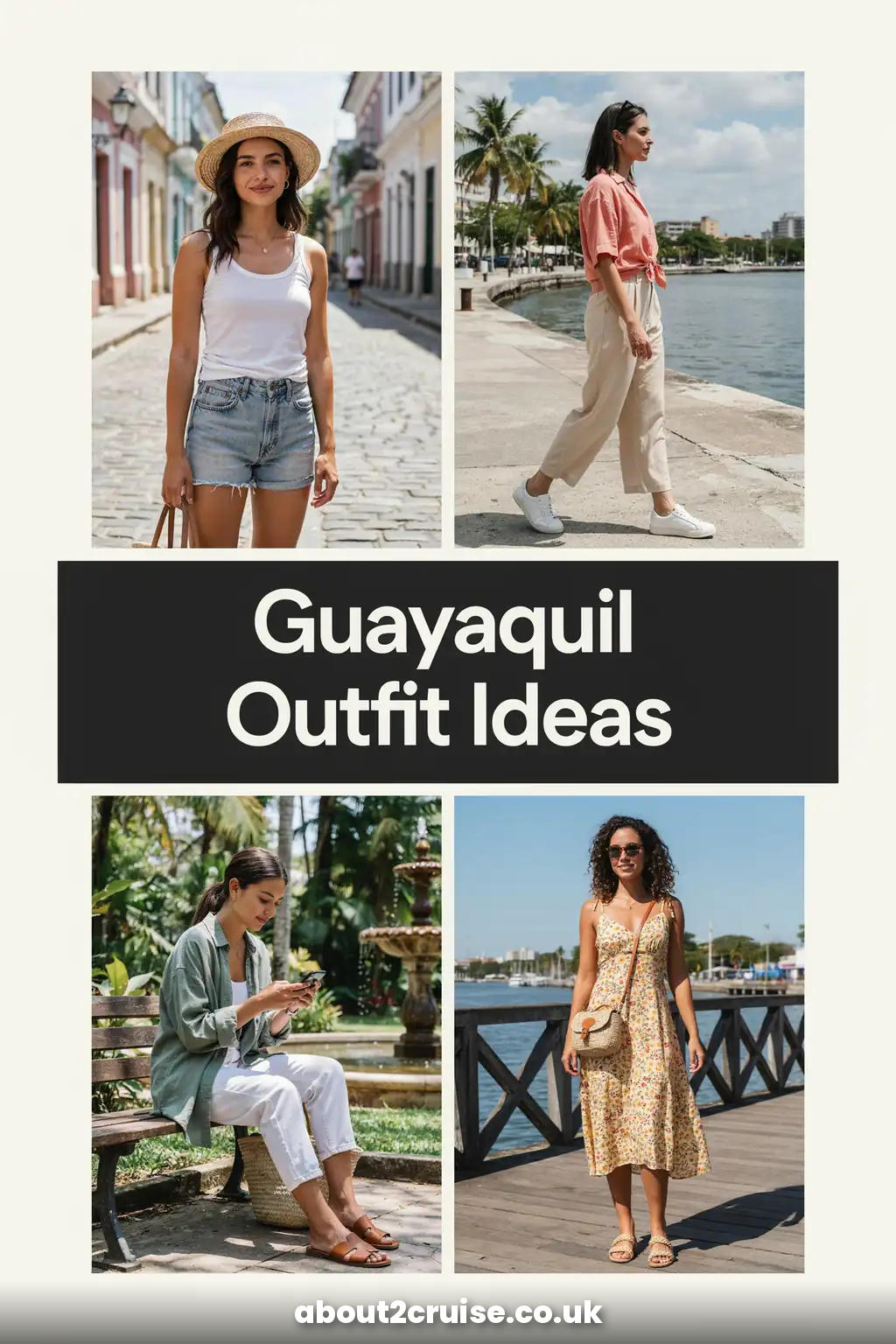
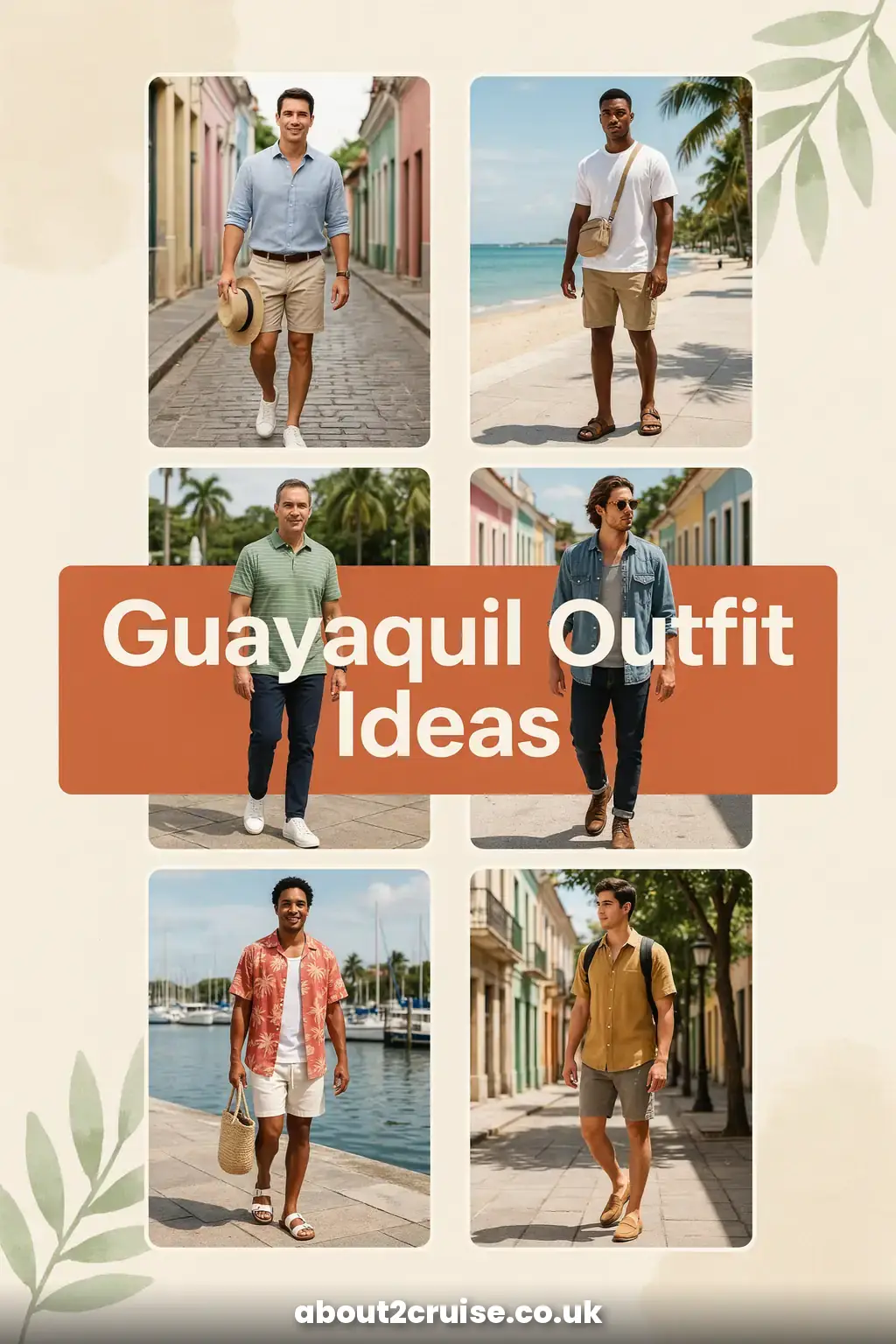
Daylight runs roughly 06:00–18:15 all year, so sunset comes early. Wear light, breathable clothing, a hat and high-factor sunscreen. Choose shoes with grip for the cobbles of Las Peñas and the steps of Santa Ana. If you enter the cathedral or churches, cover shoulders and remove hats.
Accessibility at Guayaquil port and attractions
Accessibility at the berth is limited. The gangway slope, pier distance, shuttle steps and coach access all vary by ship and quay. Check directly with your cruise line before travel if you use a wheelchair or have limited mobility.
Malecón 2000 is the most accessible part of central Guayaquil: flat, paved and well supplied with toilets. Santa Ana Hill is not accessible for most wheelchair users because of the 444 steps. La Perla may have accessible cabins, but confirm in advance. Parque Histórico is more accessible than the hill climb, though paths vary.
Cruise terminal facilities: what actually exists at the port
Do not expect a cruise terminal. There are no passenger shops, no dedicated luggage storage, no café and no reliable public Wi-Fi at the berth. Use the ship’s facilities before you leave. The nearest published left-luggage service is at the airport, roughly 14km away. If you are joining or leaving the ship and need to store bags, ask your cruise line or hotel in advance.
There is also no published cruise passenger parking at Puerto Marítimo. This is a fly-in turnaround port, not a drive-and-park departure point.
Embarkation and disembarkation at Guayaquil port
Disembarkation is controlled because the port is a cargo environment. Follow the crew’s instructions and use only authorised transport. For turnaround days, checked luggage is normally handled by the port and the line, but you may still need to move from a baggage hall to a coach via steps. Check-in slots are often fixed, and embarkation usually closes about an hour before sailing.
If you are flying home or to the Galápagos the same day, allow for slow port exits, city traffic and airline check-in. The airport is not far, but the port is not an efficient passenger terminal.
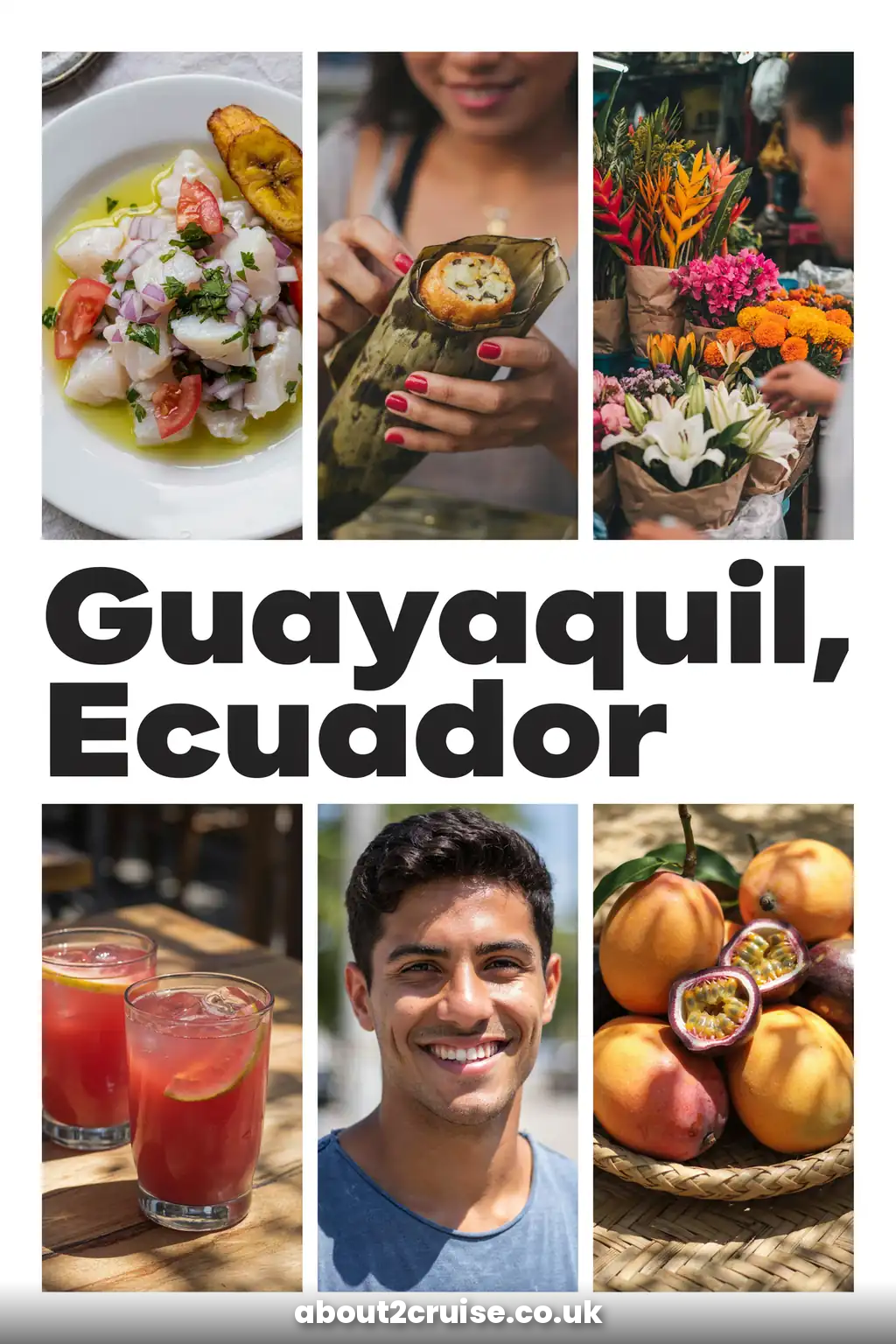
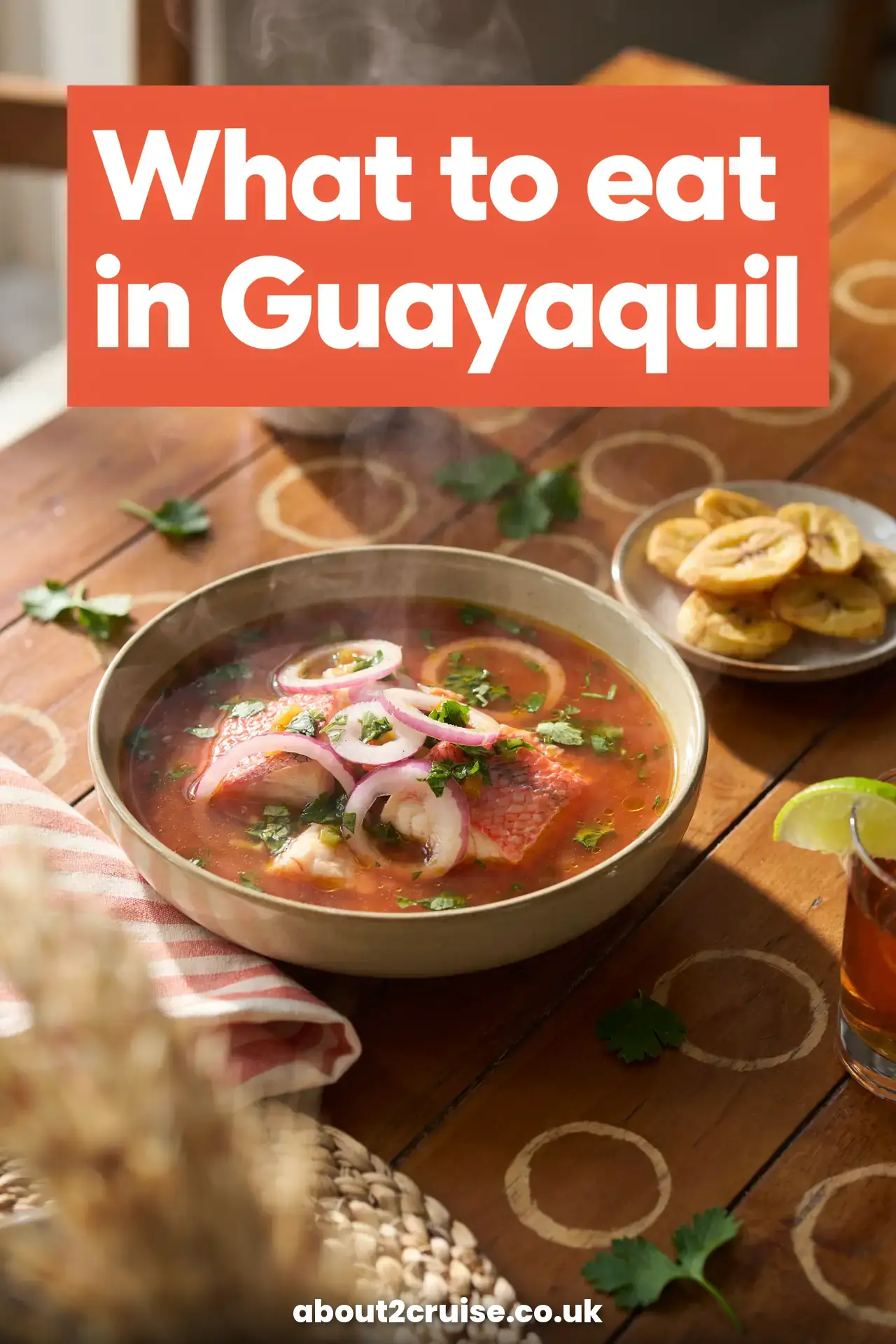
Guayaquil food to try: encebollado, ceviche and plantain plates
Guayaquil has a distinctive coastal food culture. The dish to know is encebollado: a breakfast soup of albacore tuna, yuca and pickled red onions. It sounds unusual first thing, but it is the city’s hangover cure and comfort food.
Other things worth ordering include ceviche, bolón de verde, patacones, arroz con menestra and sango de camarón. For a safe first meal, eat at the food plazas on Malecón 2000, Mercado del Río or the restaurants along Calle Panamá. Adventurous eaters can ask a guide about Mercado de Portete, but do not wander into less touristy market areas on your own.
Shopping in Guayaquil: Panama hats, cacao and local crafts
Despite the name, the genuine Panama hat is woven in Ecuador from toquilla straw. The weave is UNESCO intangible cultural heritage, and hats can take anywhere from five days to eight months to make. The best central shopping stop is Mercado Artesanal Guayaquil on Loja between Baquerizo Moreno and Pedro Carbo. It has about 168 stalls, including eight selling toquilla-straw hats, and is open Monday to Saturday from 09:00 to 18:00 and Sunday from 10:00 to 16:00.
Cacao products, chocolate and local crafts also appear in craft fairs along Malecón 2000. Bargain politely, but don’t expect aggressive haggling to be welcomed in formal shops.
Evening activities and sunset viewpoints in Guayaquil
Sunsets are early because of the equator, usually just after 18:00. The Cerro Santa Ana lighthouse is the classic viewpoint, but it means a steep climb and a return descent in fading light. Do that only with a guided group, or stay on the Malecón for the riverfront views. La Perla is open into the evening and gives illuminated city views without the hill.
Puerto Santa Ana has the most tourist-friendly evening dining scene, but under current FCDO advice, independent evening wandering is not recommended. If you are staying overnight in a hotel, use the hotel restaurant or a pre-booked transfer for dinner.
Guayaquil vs Quito, river cruises, birdwatching and nature tours
Guayaquil is the sea-level mainland gateway to the Galápagos, while Quito sits at about 2,819 metres. The nonstop Quito–Baltra flight takes about 2 hours 10 minutes against roughly 1 hour 55 from Guayaquil. Quito is around 420km away, about eight hours by coach or 45 minutes by air. If you are avoiding altitude or prefer a shorter Galápagos hop, Guayaquil has the practical edge.
River cruises in the city are limited to short Malecón boat rides. For real nature, Puerto El Morro offers dolphin and mangrove birdwatching, and Parque Histórico gives a managed wildlife experience. One note: Isla Santay still appears in many old guides as a nature trip, but visitor access via the Guayaquil pedestrian bridge and river access has been closed. Do not plan a day around it unless your ship or a licensed operator confirms it has reopened.
Other Pacific South America cruise ports to compare
If you are building a South American Pacific itinerary, these guides may help: Arica Cruise Ship Port Guide, Coquimbo/La Serena Cruise Ship Port Guide and Valparaíso/Santiago Cruise Ship Port Guide.
Our Peru and Ecuador cruise ports guide covers the other ports in the region.
If your South America itinerary includes Guayaquil, the Peruvian port of Salaverry (Trujillo) is often the next or previous call along the Pacific coast.
You may also call at Puerto Bolívar (Machala) on Ecuador’s southern coast, often as the next or previous call on a Guayaquil itinerary.
Guayaquil cruise port FAQ
Is Guayaquil safe for cruise passengers?
The UK FCDO advises against all but essential travel to Guayas province, including Guayaquil. Tourists are not usually targeted, but violent gang-related crime, mugging, pickpocketing and express kidnapping are documented risks. If your ship calls, the safest approach is a ship-organised excursion or a licensed guide and driver arranged in advance.
Can I walk from the cruise ship into Guayaquil?
No. The ship berths in a controlled cargo port roughly 10km south of the centre. You cannot walk through the port, and the area around the gate is not a tourist zone. You need a shuttle, coach or permitted taxi.
Can I visit the Galápagos as a day trip from a Guayaquil cruise call?
No. The Galápagos requires a flight from Guayaquil to Baltra or San Cristóbal, park fees, a transit control card and mandatory health insurance. A same-day return from a cruise call is not realistic.
What is near the port?
Nothing of interest to cruisers. The port is industrial and south of the city centre. You need a transfer to reach Malecón 2000, Las Peñas, Iguana Park or anywhere else a visitor would want to go.
Can I use Uber or DiDi at the cruise port?
Both apps list Guayaquil, but pick-up inside the port is unreliable. Taxis can only enter the pier with a ground-operator permit. Use a pre-arranged licensed vehicle or arrange the app pick-up outside the gate with caution and only in daylight.
Do I need a visa for Ecuador if I’m on a cruise?
UK passport holders do not need a visa for up to 90 days in any 12-month period. Your passport must be valid for at least six months beyond arrival. You may be asked for proof of onward travel.
Is the water safe to drink?
No. Drink bottled or filtered water and avoid ice in drinks unless you are in a reputable hotel or international restaurant where you trust the source.
What currency do I need in Guayaquil?
The US dollar is the official currency. Carry small bills for taxis, markets and tips. Cards are fine in established restaurants and shops, but cash is more useful near the port and for local guides.
Is there a cruise terminal with shops and Wi-Fi?
No. There is no purpose-built cruise terminal. Toilets, food, shops and Wi-Fi are on the ship, not at the berth. Malecón 2000 has toilets and ATMs once you reach the city.
Can I leave my luggage anywhere near the port?
No. There is no left-luggage facility at the cruise berth. The nearest published left-luggage service is at Guayaquil airport, about 14km away.
Does the FCDO advice affect my travel insurance?
It can. Standard travel insurance may be invalid if you travel against FCDO advice. Check with your insurer before going ashore independently in Guayaquil.
What’s the best short excursion if I only have one day?
For a first visit, a guided city circuit covering Malecón 2000, Las Peñas, Santa Ana Hill, Iguana Park and the Cacao Museum is the best balance of safety, culture and time. If you prefer something calmer, choose Parque Histórico or a managed dolphin and mangrove trip to Puerto El Morro.
Last Updated: 20 November 2026