
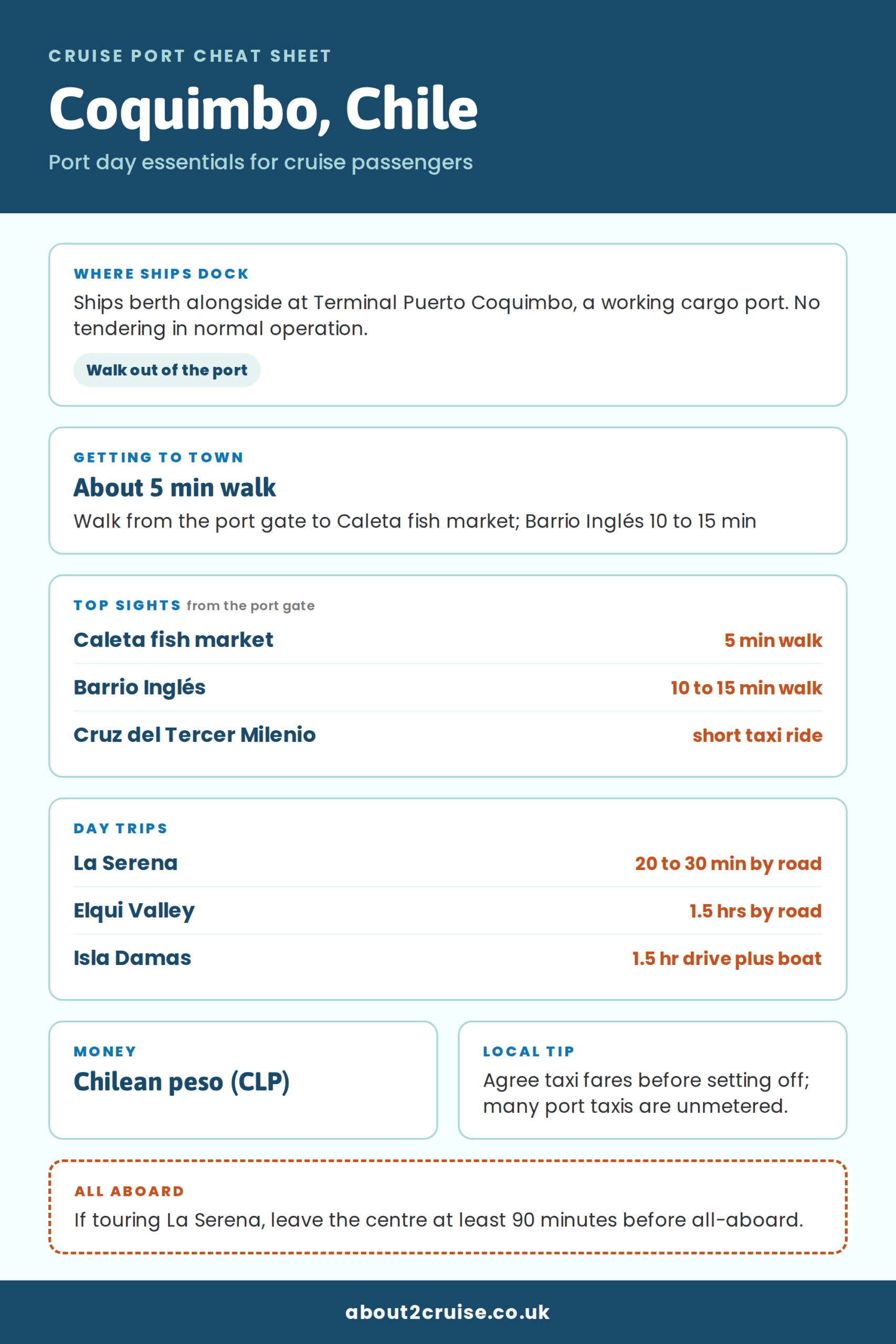
Coquimbo is a working cargo port and cruise gateway to La Serena, the Elqui Valley, and penguin islands. Ships dock alongside, not tender. You can walk to Coquimbo’s fish market and Barrio Inglés, but La Serena is a 20–30 minute ride. The Elqui Valley needs six hours; stargazing usually misses sail-away.
Why Ships Stop Here: Coquimbo and La Serena in a Nutshell
Coquimbo and its neighbour La Serena form a coastal conurbation of more than 400,000 people on Chile’s semi-arid northern coast. The region is known worldwide as an astronomy and pisco gateway. La Serena is Chile’s second-oldest city, founded in 1544, and it’s famous for colonial churches, stone plazas, and a long beachfront. Coquimbo is the working port with a gritty fishing caleta, a restored Victorian-era Barrio Inglés, and the 93-metre Cruz del Tercer Milenio on Cerro El Vigía.
Inland, the Elqui Valley produces pisco under some of the clearest skies on Earth, and it’s home to major observatories and certified Starlight reserves. Offshore, Isla Damas and Isla Choros host Humboldt penguin colonies.
Docking and Tender Info: You’ll Walk Off the Ship
Ships berth alongside at Terminal Puerto Coquimbo. This is a working cargo port that also handles copper and fruit exports, so it’s not a polished cruise terminal with shopping arcades. There is no tendering in normal operation. Recent calls from ships as large as Majestic Princess (4,200 passengers) and Aurora (272 metres) have used the berths. A newer finger pier, Site 3, can take vessels up to 300 metres long and 14 metres draft.
The terminal address is Av. Costanera 600, Coquimbo. Inside the passenger terminal there’s a tourist information desk staffed by the municipalities of Coquimbo, La Serena, Vicuña, and Ovalle, and Carabineros are posted at the port exit. Passengers are processed through the terminal and exit via the port gate. Independent guides without port permits wait outside the gate. Some third-party guides mention an internal shuttle between berth and gate, but confirm the current procedure on board because the berth sits inside a working port.
Coquimbo cruise port map
Ships dock at Terminal Puerto Coquimbo. From there, Cruz del Tercer Milenio is about a 20-minute walk. Tap a pin for directions.
- Terminal Puerto CoquimboWhere ships dock
- Cruz del Tercer MilenioMonumental cross · About 20 min walk from Terminal Puerto Coquimbo
- Caleta fish marketFish market · About 6 km from Terminal Puerto Coquimbo
- Fuerte LambertFort · About 2 km from Terminal Puerto Coquimbo
- La Serena Plaza de ArmasMain square · About 10 km from Terminal Puerto Coquimbo
- La Recova MarketMarket · About 10 km from Terminal Puerto Coquimbo
- Archaeological MuseumAbout 10 km from Terminal Puerto Coquimbo
- Monumental LighthouseLighthouse · About 8 km from Terminal Puerto Coquimbo
Exploring Coquimbo on Foot from the Port
From the port gate, the Caleta fish market is about five minutes’ walk, and Barrio Inglés is 10–15 minutes away. The route is mostly flat along the waterfront, but pavements are uneven and streets slope inland.
The fish market’s upper floor has cheap, very fresh seafood restaurants. Barrio Inglés is Coquimbo’s historic dining and nightlife quarter, best seen in the morning before businesses switch to evening trade. Further along, Fuerte Lambert and the English cemetery are reachable on foot or by short taxi. The walk to the Cruz del Tercer Milenio is a long uphill pull, so a taxi is the sensible choice. Colectivos (shared taxis) and public micros also run along the main road outside the port.
Getting to La Serena: Distance, Shuttle, Bus, Taxi
La Serena’s Plaza de Armas is about 10 km from Coquimbo downtown, or 13 km by road. The typical drive is 20–30 minutes. There is no official port-operated shuttle to La Serena. Any shuttle depends on your cruise line, so ask on board for its destination, cost, and last return time.
Public “micro” buses run on the road outside the port, and Line 1 links the port area with La Serena and the beaches. Colectivos (fixed-route shared taxis) cost around CLP 1,000 per person. Intercity buses between Coquimbo bus terminal and La Serena bus terminal run every 20 minutes and take about 10 minutes.
Taxis queue at the terminal exit. Fares are often unmetered, so agree the price before getting in. From the port gate, expect to pay CLP 5,000–8,000 to La Serena, and around CLP 15,000 back from Plaza de Armas to the terminal. Uber, Cabify, and DiDi also operate in Greater La Serena.
What to Do in La Serena with Limited Time
La Serena’s compact old town can be walked in a 2 km loop covering Plaza de Armas and the cathedral, La Merced church, San Agustín church, the Archaeological Museum (which displays an authentic moai and is free), and La Recova market.
Before you sail
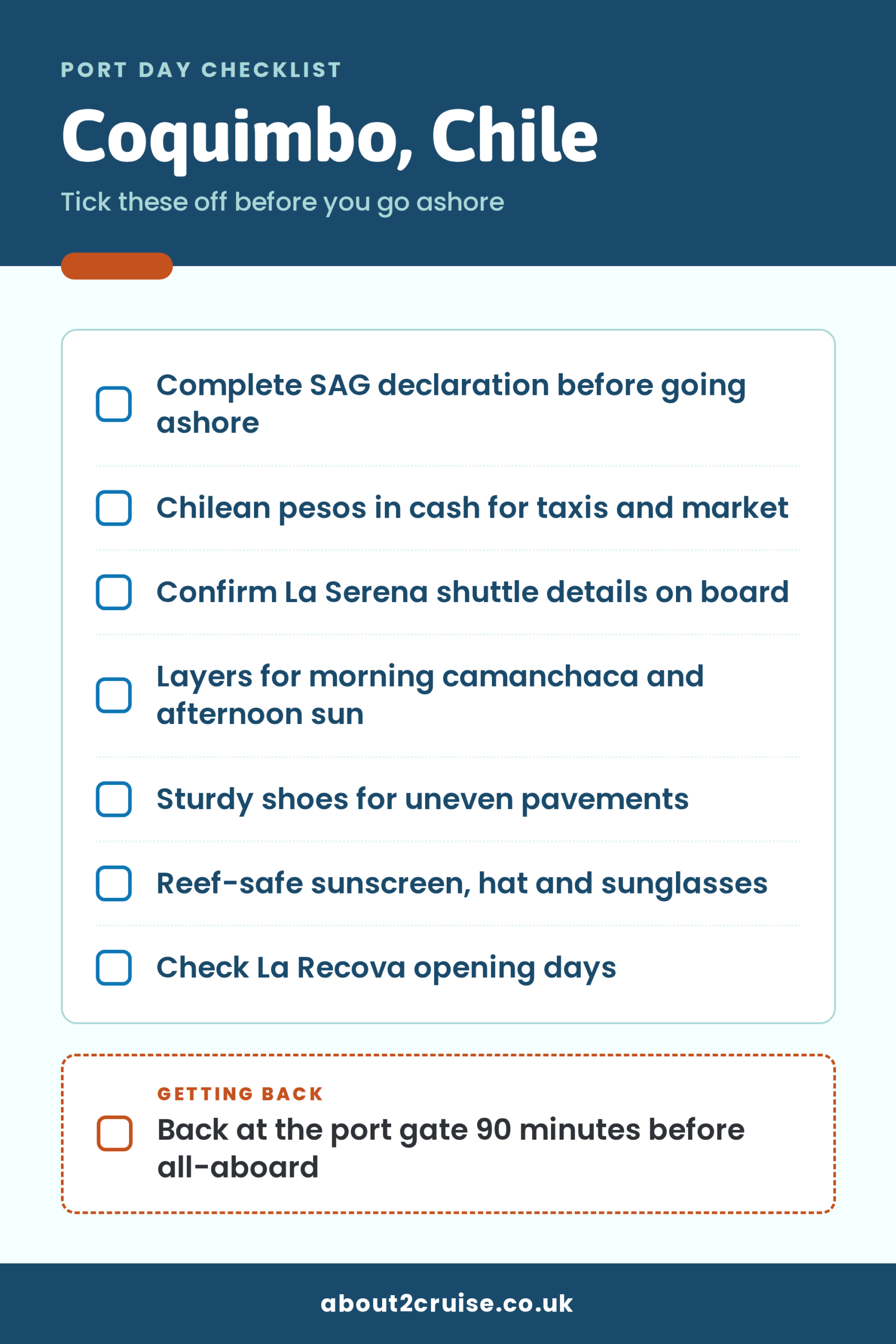
- Complete Chile's SAG agriculture declaration online before you arrive.
- Confirm on board whether your ship runs a La Serena shuttle.
- Bring Chilean pesos in cash for taxis, colectivos, and the fish market.
Short port day: under 6 hours
- On dockingExit the port gateWalk from the berth through the port gate. From the gate, the fish market is about 5 minutes on foot.
- +15 minCaleta fish marketCash for seafoodFive-minute walk from the gate; busy fish stalls and small restaurants.
- +45 minBarrio Inglés10 to 15 minutes on foot; restored Victorian houses are quietest in the morning.
- +1 hr 30 minLunch at the fish marketTry pastel de jaibaPastel de jaiba (crab casserole) is the regional signature; try it on the upper floor at the fish market.
- +3 hrsFuerte Lambert and English cemeterySteps for the viewWaterfront walk from Barrio Inglés or a short taxi; about 70 steps to the cannon viewpoint.
- All-aboard minus 1 hrBack at the port gateAllow a buffer for the walk back and reboarding through the terminal.
The time on the map is the whole walk, every stop added together.
Open this walking route in Google Maps
If plans change: If Barrio Inglés is quiet, swap it for a taxi up to the Cruz del Tercer Milenio and its viewing decks.
Long port day: 8 hours or more
- On dockingTaxi or colectivo to La SerenaAgree the fareFrom the port gate, take a taxi or colectivo to La Serena. Agree the fare before setting off.
- +30 minPlaza de Armas and cathedralThe heart of Chile's second-oldest city; start your walk here.
- +1 hr 30 minColonial churches and Archaeological MuseumFree moaiA 2 km loop covers La Merced, San Agustín, and the Archaeological Museum. The museum displays a real moai and entry is free.
- +3 hrsLunch at La Recova marketTry empanadasUpstairs food stalls serve seafood empanadas and pastel de jaiba. The market is closed Sundays and Mondays.
- +4 hrs 30 minMonumental Lighthouse and Avenida del MarMove to the lighthouse at the western end of the beachfront; entry is free. Stroll along the beachfront.
- +5 hrs 30 minHead back towards the portCoastal road jamsDo not leave La Serena centre any later than this. A taxi from Plaza de Armas back to the terminal is the safe option.
- All-aboard minus 90 minBack at Terminal Puerto CoquimboRejoin the ship through the terminal. If traffic is bad, call the port on +56 51 233 4000.
This map shows the taxi ride from the ship. The time is the drive only, not your time ashore.
Open the taxi route in Google Maps
If plans change: If La Recova is closed (Sundays and Mondays), swap the market lunch for a café around Plaza de Armas and continue to the beach.
La Recova opens Tuesday–Friday 10:30–18:00 and Saturday mornings. It’s closed Sundays and Mondays. The Monumental Lighthouse at the western end of Avenida del Mar is free and open daily with guided visits. Avenida del Mar runs roughly 6 km of beachfront back toward Coquimbo. Average sea temperature is only 17–18°C in summer, so swimming is for the brave. The Japanese garden Kokoro No Niwa opens Tuesday–Sunday 10:00–18:00 and costs CLP 3,000 for adults.
Elqui Valley: Pisco, Clear Skies, and the Stargazing Catch
The Elqui Valley is the region’s headline excursion. Vicuña is 64 km from La Serena, about 1.5 hours each way. Pisco Elqui is about 100 km. A typical ship-run valley tour lasts 5¾ to 8 hours and includes the Puclaro reservoir, Vicuña, a pisco distillery with tasting, and the Paihuano viewpoint. Independent tours run 6–7 hours from about $120 and meet outside the port’s main gate.
The Capel tourist centre and pisco museum near Vicuña is open 10:00–18:00 daily. True night stargazing does not fit a standard port call: observatory sessions start 18:30–20:30, and ships usually sail in late afternoon. Daytime alternatives exist: solar observation at Alfa Aldea is sold as a ship excursion, and Mamalluca Observatory runs planetarium shows 10:30–17:30 for CLP 15,000 per adult. Book 48 hours ahead. The valley has roughly 300 clear nights a year, but on a cruise you’ll see the valley by day, not the stars by night.
Penguin Islands: The Nature Option That Often Doesn’t Fit
Punta de Choros, the departure point for Humboldt Penguin National Reserve, is 116 km and about 1.5 hours from La Serena. Boats circle Isla Choros to see penguins, then land on Isla Damas for about one hour. Boat trips cost roughly CLP 17,000 midweek and CLP 23,000 Thursday–Sunday, plus a CLP 10,000 landing ticket.
Park tickets are sold only in person on the day at the park office in Punta de Choros, and they’re card only. There’s a daily landing cap and no landings on Mondays. The crossing can be cancelled by sea state and is never guaranteed. Organised penguin trips are sold as 10–12 hour days from La Serena, so they do not fit a standard cruise call. If your ship stays unusually late, until 22:00 or later, a private full-day trip could work, but confirm all-aboard carefully.
Ship Excursion or Independent Travel: Which Makes More Sense Here?
Ship excursions are the easiest way to do the Elqui Valley or a guided La Serena tour. They manage timing, language, and return guarantees. Independent taxis from the port to La Serena and the valley are cheaper, but drivers generally do not speak English and are not guides. If you want commentary, hire a separate guide or book a day tour.
Car hire desks sit at La Serena’s La Florida airport, 15–20 minutes from the city. Daily rates start around CLP 16,700–19,900 plus VAT. A UK photocard licence is valid in Chile for three months, and you must carry your passport and tourist card in the vehicle. Parking in La Serena is on-street or in hotel lots. There is no official cruise parking at the port because it is not a turnaround terminal.
Getting Around: Colectivos, Taxis, Buses, and Apps
Colectivos, black shared taxis on fixed routes, are the cheapest link to La Serena at about CLP 1,000 per person. Public micros run from the main road outside the port. Intercity buses between Coquimbo and La Serena bus terminals depart every 20 minutes and take 10 minutes.
From the port gate, a taxi to Coquimbo downtown should cost CLP 2,000–5,000. To La Serena, budget CLP 5,000–8,000. Returning from La Serena centre to the terminal, budget CLP 15,000. Uber, Cabify, and DiDi all operate in Greater La Serena. Always agree taxi fares before departure, as many port taxis are unmetered.
Money, Cards, ATMs, and Tipping
Chile uses the Chilean peso (CLP). Cards, including contactless, are widely accepted in hotels, shops, and restaurants. If a foreign card is offered instalments, say “sin cuotas” to pay in full. Carry pesos for taxis, the fish market, colectivos, and small cafés. Some vendors take US dollars but at poor exchange rates.
ATMs (cajeros/redbanc) are plentiful in the city centre. Vicuña is the last place in the Elqui Valley with an ATM and fuel. Restaurant bills carry a suggested 10% tip, which is standard practice. Tour guides are typically tipped 5–10%.
Language, Signage, and How Much English to Expect
Spanish is the local language. English is limited outside cruise staff, official excursions, and some hotels. Most taxi drivers cannot guide in English, and ship tours warn that guides speak English as a second language. Basic Spanish phrases or a translation app will help, especially at the fish market, colectivos, and independent taxis. Street signs are in Spanish, but the tourist office at the port hands out bilingual maps.
Safety, Scams, and Port Security Smarts
Coquimbo is generally safe for tourists with normal precautions, but pickpocketing and theft from vehicles are common in Chile, particularly at transport hubs and ports. Documented scams include distraction robbery, the liquid-spill trick, deliberate tyre punctures, and taxi meter fraud. Do not resist a mugging, and carry a photocopy rather than the passport where possible. Use licensed taxis or ride-hailing apps.
The municipality has added over 205 CCTV cameras, drones, and electric scooters in areas used by cruise visitors. Drinking alcohol in streets, squares, and promenades is illegal. Protests can turn violent and are a deportation risk for foreigners who take part. Earthquakes are a genuine risk, follow local evacuation instructions.
Accessibility and Mobility Reality Check
Ship-run Coquimbo tours are commonly marked not wheelchair accessible. The Cruz del Tercer Milenio has lifts to the viewing decks but stepped platforms between levels, so it is not fully step-free. Fuerte Lambert involves about 70 steps on some routes. Pavements are uneven, and the lighthouse area is sandy.
Accessible vehicles should be arranged in advance; they are not assumed available at the pier. A shorter, vehicle-light day in Coquimbo itself, fish market, Barrio Inglés, and the cross by taxi, is the sensible choice for limited mobility.
Weather, Fog, and How to Dress
La Serena has a semi-arid coastal climate with abundant morning cloud. The camanchaca fog often blankets the coast until late morning, then burns off. Summer highs are 22–24°C and lows 14–16°C. Rainfall is virtually zero from December to March. Inland at Vicuña it is hotter by day and much colder at night.
Dress in layers: a windproof jacket for the damp foggy morning, short sleeves underneath for the strong midday sun, and a warm layer for the valley or any evening astronomy. Sturdy shoes are essential. Sun protection, hat, sunglasses, reef-safe sunscreen, is a must. Churches are working Catholic buildings, so covered shoulders and knees are the safe default for visits.
Food and Drink: Seafood and Pisco
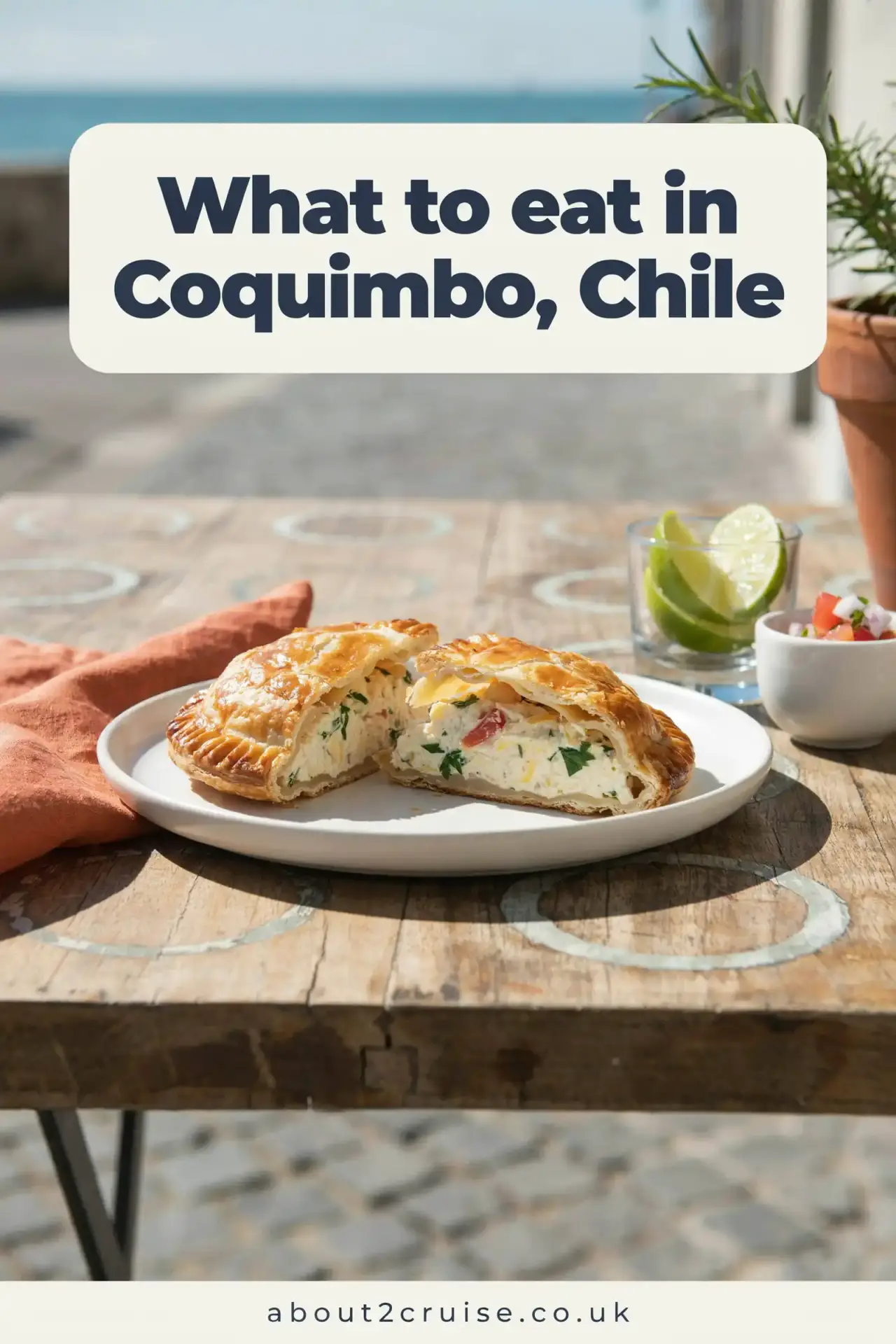
Eat on the upper floor of the Caleta fish market for very fresh seafood at local prices. Pastel de jaiba (crab casserole) is the regional signature. Other dishes to try include paila marina (shellfish stew), machas a la parmesana (razor clams with parmesan), empanadas de mariscos, caldillo de congrio, and picante de mariscos.
La Recova in La Serena has regional food stalls upstairs and sells papaya products, dried fruit, pisco, and crafts. Papaya, candied or juiced, is the local product to taste, and pisco sour is the regional drink. Seafood handling and cold-chain safety are enforced. Stick to busy places and avoid raw shellfish if you have a sensitive stomach.
Shopping and Souvenirs
La Recova is the main crafts market: Andean wool, rain sticks, jewellery, dried fruit, papaya products, and pisco. Pisco is the signature take-home, and the region’s papaya preserves are the other local food gift, keep labels sealed for inspection. Lapis lazuli, Chile’s national stone, is sold in Coquimbo and La Serena markets.
La Recova shuts on Sundays and Mondays, so market shopping fails on those days. Bargaining is limited to small market stalls; malls are fixed price.
Port-Day Timing, All-Aboard Cushions, and Missing the Ship
Typical calls are short: 08:00–16:00 or 09:00–18:00. A 7–8 hour call realistically allows one main outing, not both cities plus the valley. If you go to La Serena independently, leave the centre at least 90 minutes before all-aboard because the coastal road can jam in summer.
If you miss the ship at Coquimbo, the next common ports are San Antonio or Valparaíso to the south, or Antofagasta to the north. See our guides to Valparaíso (Santiago) and San Antonio, Chile. Port operations can be contacted on +56 51 233 4000 in an emergency. Peak domestic holiday season, mid-January to mid-February, congests Avenida del Mar and the coastal road.
If your South America cruise continues north along the Pacific, Guayaquil is a likely later call.
On many South America itineraries, you may call at Manta before or after Coquimbo, trading this desert coast for a wetter equatorial climate.
Immigration, Customs, and Chile’s Biosecurity Rules
Chile’s agriculture service requires a sworn declaration from every arriving passenger over 18, listing animal or plant products, and can fine those who fail to declare. Fresh fruit, vegetables, seeds, plants, flowers, honey, and plant- or wood-based crafts are restricted or barred. SAG inspects passengers’ goods on cruise calls at Coquimbo, and fresh produce should not be taken ashore.
A tourist card is issued on entry and must be kept for departure. British citizens can stay up to 90 days visa-free. Passports must be valid beyond the day you leave Chile. Sealed, labelled alcohol in passenger luggage may enter up to 30 litres per product type per adult, but must still be declared.
Staying Connected: Wi-Fi, SIMs, and Roaming
There is no published terminal Wi-Fi. Plan on mobile data or a local SIM from Entel, Movistar, or Claro once ashore. Chilean SIM cards are cheap and widely available in city centres. Most cafés and hotels in La Serena offer free Wi-Fi. Check your UK operator’s roaming charges for Chile before you travel, or buy an eSIM for the day.
Our Chile cruise ports guide covers the other ports in the region.
Quick FAQs
Is Coquimbo a tender port?
No. Cruise ships dock alongside at Terminal Puerto Coquimbo. Large ships up to 300 metres and 14 metres draft use the berths.
Can I do stargazing on a cruise call to Coquimbo?
Almost never. Night astronomy starts after 18:30, and ships usually sail by 16:00–18:00. Daytime options include solar viewing at Alfa Aldea or Mamalluca’s planetarium shows.
Is the water safe to drink in Coquimbo and La Serena?
Tap water in urban areas is treated and generally safe for brushing teeth, but many travellers prefer bottled water for drinking to avoid any stomach upset. Bottled water is widely available.
Do I need a visa for Chile on a cruise?
British citizens can visit Chile visa-free for up to 90 days. You’ll receive a tourist card on entry; keep it for departure. Ensure your passport is valid beyond your departure date.
Can I use US dollars or euros in Coquimbo?
Some tourist shops and taxis may accept US dollars, but at poor exchange rates. Use Chilean pesos for most transactions. ATMs are plentiful in the city centre.
What if I have limited mobility?
Ship excursions are often not wheelchair accessible. A taxi-based day in Coquimbo, visiting the fish market, Barrio Inglés, and the Cruz del Tercer Milenio, is the best option. The cross has lifts but some stepped platforms. Arrange accessible vehicles in advance.