
Manta is Ecuador’s tuna capital and a working commercial port on the Manabí coast. Cruise ships dock inside the cargo harbour and a free shuttle takes you to the purpose-built cruise terminal on the Malecón. From there you can walk the seafront, shop for a Montecristi hat, eat Manabí seafood, or join a whale-watching or Isla de la Plata trip.
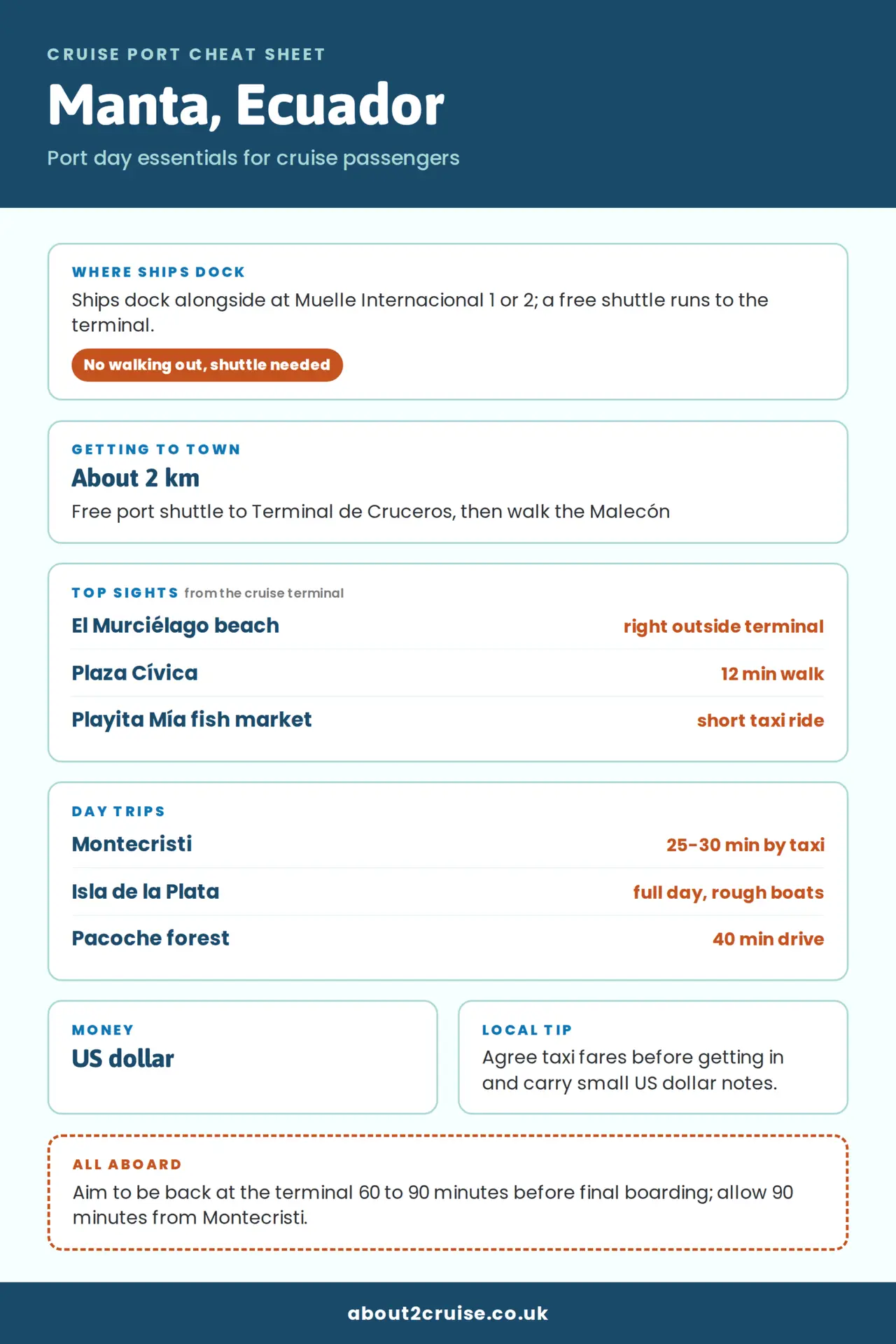
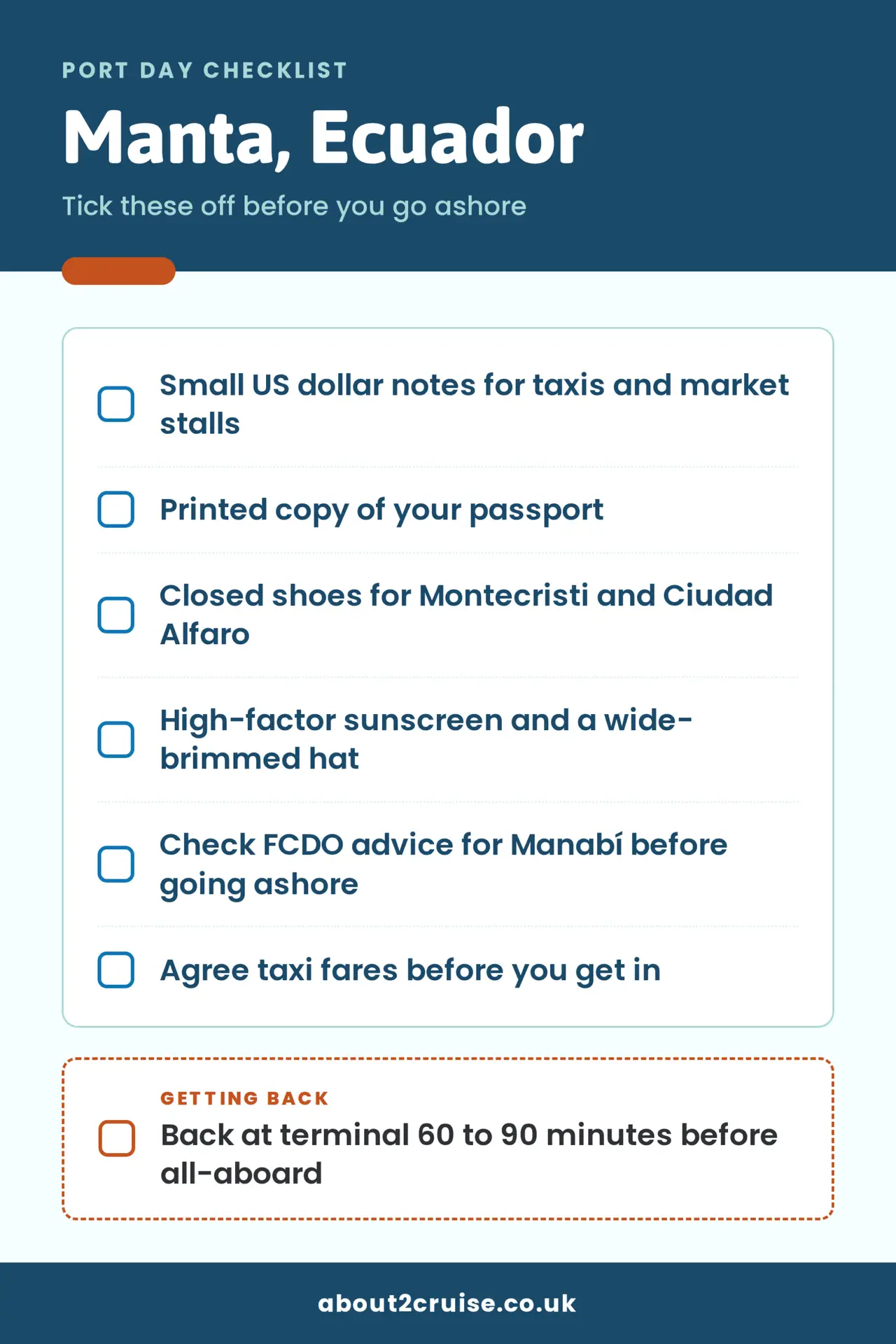
Manta at a Glance: Quick Facts for Cruise Passengers
Manta is the principal fishing port of Ecuador and the commercial centre of Manabí province, sitting on Manta Bay. It calls itself the world capital of tuna: about 90% of Ecuador’s tuna fleet operates from here and roughly 70% of Ecuador’s canned tuna exports leave through its quays and plants. This is not a tourist-only dock. Manta is a genuine working port handling tuna, containers, bulk cargo, cars and cruise ships at the same time.
- Region: Manabí province, central Ecuador coast
- Currency: US dollar
- Language: Spanish; some English around the terminal, tour desks and larger hotels
- Known for: tuna fishing, Playita Mía fish market, Montecristi Panama hats, Isla de la Plata, humpback whales, Machalilla National Park, Manteño archaeology, Manabí seafood
- Cruise season: roughly October to April, with around 18 scheduled calls and about 25,000 cruise passengers a year
- Original name: Jocay, inhabited from around 3000 BC and home to the Manteño culture before the Spanish arrived
Where Your Cruise Ship Docks in Manta
Here’s the good news: Manta is an alongside berth, not a tender port. Cruise ships dock inside the commercial Terminal Portuario de Manta at Muelle Internacional 1 or Muelle Internacional 2. There are four international berths across roughly 800 metres of quay. Muelle Internacional 2 has been extended to about 360 metres, with water depths of about 12–13 metres, which means Manta can take large cruise ships without tidal waits.
The quay is shared with container ships, tuna boats, car carriers and Ro-Ro traffic, so it is an operating cargo area. You cannot simply walk off the ship and wander through the port. You will step onto the quay and board a port shuttle for the short ride to the passenger terminal.
The Terminal de Cruceros is at Avenida Malecón Jaime Chávez Gutiérrez S/N y Calle 20, beside the El Murciélago beach car park. It is Ecuador’s only purpose-built cruise passenger terminal. The building covers 1,253 square metres and has air conditioning, toilets, a café/bar, free Wi-Fi, craft stalls, security screening, information desks, tourist counters and disabled access. Wi-Fi is useful but can get slow when the ship is in port.
Terminal contact if needed: (+593) 5 370 2490, commercial@tpm.ec.
Manta cruise port map
Ships dock at Terminal de Cruceros. From the cruise terminal, Museo Centro Cultural Manta is about a 3-minute walk, Mall del Pacífico about 6 minutes and El Murciélago beach about 9 minutes. Tap a pin for directions.
- Terminal de CrucerosWhere ships dock
- Museo Centro Cultural MantaMuseum and cultural centre · About 3 min walk from the cruise terminal
- Mall del PacíficoShopping centre · About 6 min walk from the cruise terminal
- El Murciélago beachCity beach · About 9 min walk from the cruise terminal
- Plaza CívicaTown square · About 17 min walk from the cruise terminal
- Playita Mía fish marketSeafood market · About 2 km from the cruise terminal
- MontecristiHat-making town · About 14 km from the cruise terminal
- Ciudad AlfaroCivic complex and museum · About 8 km from the cruise terminal
- Pacoche wildlife refugeNature reserve · About 30 km from the cruise terminal
- Isla de la PlataIsland · About 53 km from the cruise terminal
Getting From the Ship to Town: Free Shuttle in Manta
On a cruise day, complimentary shuttle buses run from the bottom of the gangway to the Terminal de Cruceros. The ride is normally only about three to five minutes. Because walking across the working cargo port is not permitted, the shuttle is the only way between the ship and the terminal.
On large ships the shuttle can operate on a numbered turn system, so it is worth collecting a turn early if you want to get ashore quickly. Once you arrive at the terminal you clear security and exit onto the Malecón Escénico.
Outside the terminal:
- El Murciélago beach is directly in front of the terminal door.
- Mall del Pacífico is about 200–370 metres away, with shops, ATMs and air conditioning.
- Plaza Cívica is about 1 km away, roughly a 12-minute flat walk along the seafront.
- Taxis and tour vehicles wait at the port gate or outside the terminal area rather than on the quay.
Can You Walk From the Manta Cruise Port Into Town?
Yes, but only after the shuttle drops you at the cruise terminal. You cannot walk from the ship through the cargo docks. Once you are at the terminal, stepping outside puts you straight onto the Malecón, Manta’s seafront promenade. El Murciélago beach is in front of you, the Mall del Pacífico is a few hundred metres away, and the centre of Manta is roughly a 20-minute flat walk along the seafront.
The easiest walking route is simply to follow the Malecón Escénico. It runs along the bay, past restaurants and the MANTA letters sign, toward Plaza Cívica and the central area. If you have limited mobility or the heat is intense, a taxi is cheap and easy.
Taxis, Ride Apps and Local Transport in Manta
Manta taxis are cheap by UK standards, but they generally use agreed fares rather than meters. Agree the price before you get in. A daytime run near the centre can cost about US$1.50–2, while tourist fares may be quoted higher. Useful benchmark fares include:
- Manta airport to Malecón: about US$5–7
- Manta to Santa Marianita: about US$18–22
- Manta to San Mateo: about US$12–15
Uber coverage in Manta is inconsistent. The local ride-hailing app that tends to work is inDrive. Public buses are cheap but are not generally recommended for cruise visitors because routes, stops and safety can be hard to read on a short call. Traffic is heaviest roughly 07:00–09:00, 13:00–14:00 and 17:00–19:00, so build that into your return timing.
Manta’s Seafront, Fish Market and City Beaches
Manta’s city beach is Playa El Murciélago, a 1,700-metre bay beach facing the Malecón Escénico. It has a wooden boardwalk down to the sand and amphibious beach wheelchairs at the accessible point. The seafront is also home to the big MANTA letters sign, which is the city’s signature photo stop.
For atmosphere, go to Playita Mía in the Tarqui area. This is Manta’s artisanal fish landing beach and seafood market, with around 350 traders and wooden fishing boats pulled up on the sand. It is at its best early, from about 06:00 to 08:00, when the light catches the boats and the landings are busy. Think of it as a place to look, photograph and absorb the fishing economy rather than a guaranteed place to eat. The city’s own development plan flags hygiene problems at the beach market, so most cruise visitors are better eating cooked seafood at a proper restaurant on the Malecón.
Right next to Playita Mía there is also a beach boatyard where wooden fishing boats are built and repaired. It makes a good add-on for photographers.
If you want a longer beach day, local beaches include Los Esteros, Playita Mía, Tarqui, Barbasquillo, Piedra Larga, San Mateo, Santa Marianita, Ligüiqui, San Lorenzo and Las Piñas. The best-known for kitesurfing is Santa Marianita, about 20–35 minutes south, with reliable winds from June to November.
Montecristi: The Real Home of the Panama Hat
Montecristi is about 15–16 km inland from Manta, normally a 25–30 minute drive depending on traffic. A taxi can cost around US$8–12 each way, or roughly US$40 return including waiting time. Local buses are very cheap, under US$1, but you first need to reach Manta’s bus terminal, so a taxi or tour vehicle is far easier on a port day.
The town is the historic centre of the paja toquilla hat trade. The name “Panama hat” is a misnomer: the hat is Ecuadorian, and the traditional weaving of the toquilla straw hat is on UNESCO’s Representative List of the Intangible Cultural Heritage of Humanity.
Hat shops and workshops line the streets leading up toward the church and central plaza. The artisan promenade is the main shopping street. Genuine quality is judged by weave tightness, fineness of the straw, finishing and the maker, not by whether the hat can be rolled. A cheap tourist hat is not the same as a genuine handwoven Montecristi fino. Authenticity is now supported by artisan registration and QR-coded seals linked to the maker. The finest hats can sell for hundreds or even thousands of dollars, so treat “very cheap fino” claims with scepticism.
While you are in Montecristi, consider adding Ciudad Alfaro, the hilltop civic complex and museum. It houses the Eloy Alfaro museum and mausoleum, has a craft promenade, and offers a wide view over the plain toward Manta. Entry is free and it is usually open 08:30–17:00, closed Tuesdays for maintenance. The streets and site are uneven and stepped, so closed shoes are more practical than sandals.
Outside Montecristi, the small village of El Chorillo is known for agave-fibre work and tagua, or vegetable ivory, carving.
Whale Watching and Isla de la Plata From Manta
Whale season: humpback whales are present off Manabí from roughly June to September, with some sources extending the season into June–October. Estimates suggest 6,000–10,000 humpbacks arrive in Ecuadorian waters each season. Puerto López and Manta are the two Manabí bases for whale watching. You may see operators on Playa El Murciélago in Manta, but many trips run from Puerto López. A basic two-hour whale-watching trip from Puerto López is advertised from about US$25 per person. Combined Isla de la Plata and whale-watching days cost more, often US$40–75, depending on what is included.
Ecuadorian rules require boats to stay at least 100 metres from whales, with no more than three boats on one group, no swimming with or touching whales, and reduced speed within 300 metres. Book with a licensed operator and accept that sightings are never guaranteed.
Isla de la Plata is in Machalilla National Park and is nicknamed the “poor man’s Galápagos” for its blue-footed and Nazca boobies, frigatebirds and waved albatross. It is reached by boat from Puerto López, not from Manta, so you first need to drive about 89 km, roughly 1 hour 25 minutes, to Puerto López. The boat crossing takes about one to two hours each way depending on sea state. Day tours usually leave Puerto López around 08:00–09:00 and last five to nine hours, including an island walk, possible snorkelling, lunch and park entry.
On the island the trail involves about 150 steps and roughly 60 minutes of walking. It is not suitable for limited mobility. The sea crossing can be rough, and the whole day only works if you have a genuinely long port call. Do not attempt Isla de la Plata on a four-hour call. It is best done as a cruise-line excursion or a carefully arranged private tour with a guaranteed return and a large time buffer.
Machalilla National Park and the Best Beaches Near Manta
Machalilla is Ecuador’s coastal national park, covering dry tropical forest, beaches and marine zones between Puerto Cayo and Puerto López. It is normally open daily 08:00–16:30, and entry is currently reported as free, though fees and local service charges can vary. Playa Los Frailes is the park’s best-known beach. It has toilets, showers and a car park at the entrance, but the protected sand itself has no services. The Agua Blanca community inside the park charges about US$5 per person for its archaeological site and sulphur lagoon.
For a more active beach day near Manta, Santa Marianita is the reference kitesurf beach and has casual beach restaurants selling plates from about US$5, including ceviche. Currents along this coast can be strong, and many beaches do not have swimming warning flags, so take local advice before entering the water.
Another good nature stop is the Pacoche wildlife refuge, about 26 km and 40 minutes from Manta. The “Pasaje del Mono” trail is 1.5–2 km and takes around 1.5–2 hours with a mandatory local guide. A guided walk can cost around US$20 per group of up to ten people. This is a good half-day add-on if you want forest, monkeys and coastal ecology rather than another beach.
Manteño Archaeology and Museums in Manta
The Manteño culture occupied the central Ecuadorian coast from about 500 AD until the Spanish conquest, organised in chiefdoms including Jocay, based at Manta. The culture is especially known for U-shaped stone seats called sillas manteñas and the spondylus shell trade.
The big archaeological site is Cerro Hojas-Jaboncillo, a 3,500-hectare archaeological park between Montecristi and Portoviejo. It has hundreds of stone structures, terraces and the “Camino del Puma” trail. Entry is free and guided visits run about 90 minutes; the site is open daily 08:30–16:30.
In Manta itself, the Museo Centro Cultural Manta sits on the Malecón and displays Valdivia, Machalilla, Chorrera, Jama Coaque, Bahía, Guangala and Manteño material. It is free and usually open weekdays 08:30–17:00 and weekends or holidays 10:00–16:00. The Cancebí ethnographic museum is a smaller option focused on the lives of Manabí’s coastal people.
Manabí Food: What to Eat in Manta
Manabí cooking is recognised as intangible cultural heritage in Ecuador, and the region has been designated a world gastronomy region. The defining ingredient is peanut, or maní, which appears in many savoury dishes.
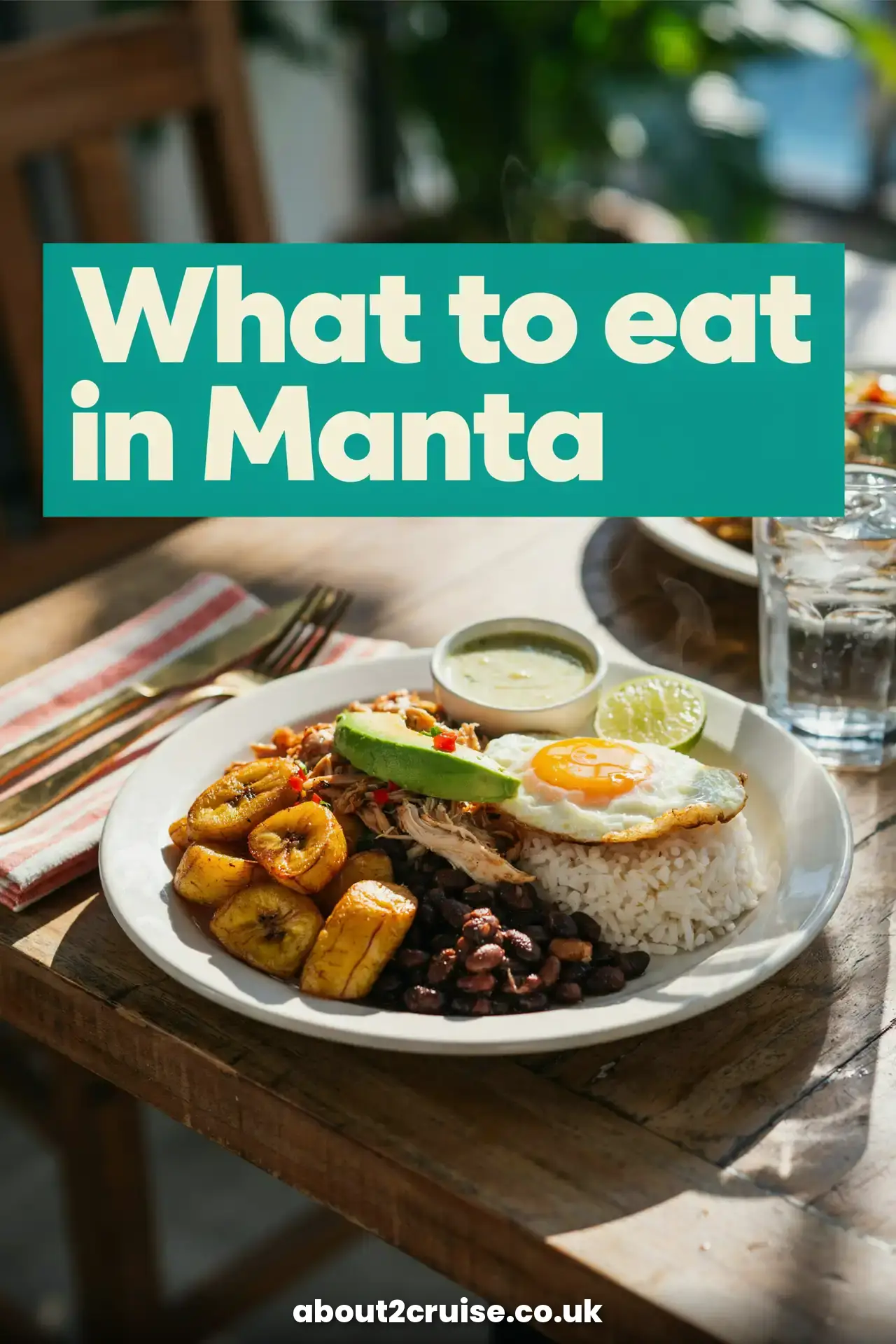
Dishes to try include encebollado (tuna and cassava soup), viche (thick peanut and fish or seafood soup), ceviche, corviche (plantain fritter), tonga, bolón and bollo. Manabí is also known for seco de chivo, a goat stew, and corn or plantain snacks such as bolones and empanadas de verde.
The easiest places to eat near the port are the Malecón Escénico and El Murciélago beachfront restaurants. Playita Mía is brilliant for atmosphere and photography, but it is a working fish landing beach with hygiene concerns, so most cruise passengers are safer eating cooked seafood in an established restaurant. Do not drink tap water. Stick to bottled or boiled water and be cautious with ice unless you trust the venue. If you have a sensitive stomach, avoid raw fish, lukewarm street food and anything that has been sitting out.
Shore Excursions vs Doing Manta on Your Own
You do not need a shore excursion for Manta itself. The Malecón, El Murciélago beach, the fish market and even Montecristi can be done independently by taxi or on foot, provided you keep an eye on time. A ship excursion adds convenience and guaranteed return, but it is not essential for the town and hat-shopping circuit.
Typical ship excursions include a “Manta & Montecristi” tour of about four hours, often sold from around US$89. Independent small-group tours are advertised at about US$75–117 per person, and private shore tours from about US$560 per group. Local operators generally promote English-speaking guides and often refund in full if the ship cancels the call, but confirm that before booking.
Where a tour matters more is for Isla de la Plata, Machalilla and whale-watching days that involve long road transfers and boat crossings. For those, either take the cruise line’s excursion or use a trusted private operator with a strict return plan.
Sample Manta Port Day Itineraries
All-aboard is usually one hour before departure. You still have to clear security and take the shuttle back to the ship, so aim to be back at the terminal 60–90 minutes before final boarding. From central Manta allow about 45 minutes before all-aboard. From Montecristi allow 90 minutes because the single highway can jam.
A typical call gives about 07:30–18:00 ashore, but some calls are as short as 07:30–14:30. Work from your ship’s actual schedule, not a generic port time.
Short call, about 4 hours: stay in Manta. Walk the Malecón, see the MANTA letters, visit the Museo Centro Cultural Manta, spend a little time at El Murciélago beach, and take a taxi to Playita Mía for the fish market atmosphere. Lunch at a reputable Malecón restaurant before heading back.
Medium call, 6–8 hours: add Montecristi. Spend the morning in Manta or at Playita Mía, then taxi to Montecristi for the hat workshops, artisan promenade and Ciudad Alfaro. Return for seafood on the Malecón.
Long call, 9–10 hours: consider Pacoche forest plus Montecristi, or a longer beach day at Santa Marianita or Los Frailes. Isla de la Plata is only realistic on a long call with a ship excursion or a private driver and a tight, pre-agreed return plan.
Can You Visit Guayaquil From Manta?
Realistically, no. Guayaquil is about 190–198 km from Manta, roughly 2 hours 50 minutes to 3 hours 15 minutes by road each way. That eats up most of a standard port day and leaves no time for sightseeing with a safety buffer. Keep Guayaquil for a different port or a pre- or post-cruise stay.
Money, Tipping and Bargaining in Manta
Ecuador uses the US dollar. Only US dollars and Ecuadorian 5, 10, 25 and 50 centavo coins are legal currency. Bring small, clean US$1, US$5 and US$10 notes, because drivers and market vendors rarely change large bills. Cards are generally accepted in city shops and restaurants but not everywhere. ATMs are available at Mall del Pacífico, about 200 metres from the terminal, and at banks near the beach. Use ATMs inside banks or shopping centres and avoid withdrawing cash after dark.
Restaurants usually add a 10% service charge plus VAT. If the 10% is already on the bill, no extra tip is expected. Taxis are not usually tipped; rounding up to the next dollar is normal. Guides are often tipped about US$5 a day and drivers about US$2 a day. Expect a “gringo tax” on quoted tourist prices. Agree taxi fares before getting in and haggle politely in markets. Carry a printed copy of your passport, because ID is legally required.
Spanish Phrases and Local Etiquette in Manta
Spanish is the everyday language in Manta. The terminal provides translators on ship days, and local tour operators advertise English-speaking guides, but taxi drivers and market staff may have little English. A greeting first, such as “buenos días” or “buenas tardes”, is expected before asking a question or price. Ask before photographing fishermen or market workers close up.
Useful phrases:
- Buenos días / buenas tardes: good morning / good afternoon
- Por favor / gracias: please / thank you
- ¿Cuánto cuesta? or ¿Cuánto es?: how much does it cost?
- ¿Me puede llevar a…?: can you take me to…?
- ¿Habla inglés?: do you speak English?
- No entiendo: I don’t understand
- La cuenta, por favor: the bill, please
Is Manta Safe? FCDO Advice and Practical Safety Tips
At the time of writing, the UK Foreign, Commonwealth & Development Office advises against all but essential travel to Manabí province, where Manta is located, because of gang-related violence linked to drug trafficking. The FCDO notes that tourists are not usually targeted but could be caught up in an incident or mistaken for someone else. Armed robbery is a risk throughout Ecuador, and Manabí is one of the provinces singled out for particular care.
A state of emergency has been declared in Manabí in some periods, with a heavier police and military presence and curfews from midnight to 05:00. The port operator says there have been no reported robberies or attacks on cruise tourists in the port area, and cruise calls continue. In practice, the main tourist corridor between the terminal, the Malecón, El Murciélago, the mall and Montecristi is what most cruise passengers use, and it generally feels workable during the day.
Practical safety rules for a Manta port day:
- Check the current FCDO travel advice before you cruise.
- Stay in the main tourist areas and avoid wandering into quiet side streets alone.
- Do not flash expensive jewellery, phones or large amounts of cash.
- Use a hotel, terminal-arranged or radio-dispatched taxi rather than hailing a random cab.
- Use ATMs inside banks or the mall, not street machines after dark.
- Follow your ship’s security advice and return before the all-aboard deadline.
Weather, Sea Conditions and What to Pack for Manta
Manta’s annual mean temperature is around 25°C. Monthly means run from about 23.7°C in August to 26.2°C in February. Most rain falls from January to April, while August to October are nearly rainless. The wet season can bring flooding and landslides, and El Niño years can be much wetter. From May to November the coast often has a grey coastal cloud called garúa, with misty drizzle and cooler air from the Humboldt Current. Humidity is high, typically 73–81%, and the UV is strong even under cloud.
Pack light, breathable clothing, a wide-brimmed hat, sunglasses and high-factor sunscreen. Use reef-safe sunscreen if you plan to snorkel or swim near marine areas. Take a waterproof layer for boat trips. Closed shoes are better for Montecristi’s uneven streets and Ciudad Alfaro’s steps. For Pacoche, long light trousers and insect repellent are useful.
Accessibility and Family Travel in Manta
The cruise terminal was built with disabled access and services. Playa El Murciélago has a 150-metre wooden walkway down to the sand and four amphibious beach wheelchairs, with lifeguards trained to help. That makes the beach beside the terminal one of the easiest accessible stops in the area.
Montecristi’s streets and Ciudad Alfaro are uneven and stepped, so a wheelchair or heavy scooter will not manage everywhere. Isla de la Plata is not wheelchair accessible and involves about 150 steps plus a boat crossing. If you have mobility concerns, ask your cruise line in writing whether the gangway, shuttle and any tour vehicle can take a wheelchair or scooter. On some local tours an “accessible” vehicle may still lack a lift.
For families, the easiest day is the Malecón, the MANTA letters, El Murciélago beach, the mall and the fish market by taxi. Older children may enjoy seeing hat weaving in Montecristi or a whale-watching trip in season, but long boat trips to Isla de la Plata can be rough and tiring for young children.
Souvenirs and Responsible Shopping in Manta
The classic Manta souvenir is a Montecristi hat. Buy from an artisan, cooperative or gallery that can name the maker or show the new certification or QR system. Other good local crafts include tagua carvings, agave-fibre work, La Pila pottery, spondylus jewellery and woven hats. You will also find craft stalls at the terminal on ship days.
Do not buy coral, shells, wildlife products or anything sold as an archaeological artefact. It may be illegal, and bringing it back through customs can cause problems.
What If Your Manta Port Call Is Changed or Cancelled?
If the ship cancels the Manta call, there is little to arrange ashore unless you have pre-booked an independent tour. Many local operators refund in full if the ship cancels the call, but confirm that before paying. If the call is shortened, drop the most distant plans first: Isla de la Plata, Machalilla and Guayaquil. A short Manta stop can still work well as a Malecón, museum and fish-market morning.
How to spend a port day in Manta
A port day in Manta works best if you pick one: a walkable seafront and fish-market morning in town, or add Montecristi for hat workshops and hilltop views.
Before you sail
- Check the current FCDO travel advice for Manabí before you cruise.
- Bring clean, small US dollar notes; many drivers and stalls cannot change large bills.
- Book any Isla de la Plata or whale-watching trip with a licensed operator that states its return plan.
Short port day: under 6 hours
- On dockingTake the free port shuttleNo walking in portYou cannot walk through the cargo port. The shuttle from the gangway to Terminal de Cruceros takes a few minutes.
- +15 minEl Murciélago beach and MANTA lettersBoth are right outside the terminal. Walk the Malecón to the big MANTA letters sign for a photo.
- +45 minMuseo Centro Cultural MantaContinue along the Malecón to this free museum, with Manteño and pre-Columbian displays.
- +1 hr 30 minLunch on the MalecónTry encebolladoOrder encebollado or ceviche at a proper seafront restaurant, not from the beach market.
- +2 hrs 30 minTaxi to Playita MíaShort taxi to Tarqui fish market and boatyard. Go to photograph the boats, not to eat.
- All-aboard minus 1 hrBack at the terminalReturn by taxi and clear security. Shuttle queues grow near all-aboard, so do not cut it fine.
The time on the map is the whole walk, every stop added together.
Open this walking route in Google Maps
If plans change: If the Museo Centro Cultural Manta is closed, use the extra time at El Murciélago beach and the craft stalls inside the terminal before lunch.
Long port day: 8 hours or more
- On dockingShuttle, then taxi to MontecristiGo earlyTake the free port shuttle to the terminal, then agree a taxi fare for the 25 to 30 minute drive to Montecristi.
- +45 minHat workshops and artisan promenadeWalk the artisan promenade. Look for a named maker and the QR authenticity seal, and judge by weave tightness, not whether the hat rolls.
- +2 hrsCiudad AlfaroVisit the hilltop civic complex and Eloy Alfaro museum. It is free and usually open, but closed on Tuesdays.
- +3 hrs 30 minTaxi back to MantaReturn by taxi. The single highway can jam, so start back with a comfortable buffer.
- +4 hrs 15 minLunch on the MalecónTry vicheOrder viche or encebollado at a proper seafront restaurant. Avoid raw fish from the beach market if your stomach is sensitive.
- +5 hrs 45 minMuseo Centro Cultural MantaWalk along the Malecón to this free museum, with Manteño stone seats and pre-Columbian displays.
- All-aboard minus 90 minBack at the terminalClear security and take the shuttle. From the Malecón you are close, but allow a buffer for queues.
This map shows the taxi ride from the ship. The time is the drive only, not your time ashore.
Open the taxi route in Google Maps
If plans change: If Ciudad Alfaro is closed on a Tuesday, skip the hilltop stop and spend the extra hour in the hat workshops and artisan promenade before returning to Manta.
Our Peru and Ecuador cruise ports guide covers the other ports in the region.
On a Pacific coastal itinerary, Callao (Lima) often follows Manta as the next major call, giving you a gateway to Lima.
On a southbound Pacific coastal itinerary, Salaverry (Trujillo) is a common next call after Manta.
On some coastal itineraries you may call at Puerto Bolívar (Machala) before or after Manta; it lies further south on Ecuador’s Pacific coast.
Manta Cruise Port FAQs
Is there a beach within walking distance of the ship?
Yes. El Murciélago beach is right outside the cruise terminal after you take the shuttle from the ship. It is a city beach with lifeguards and an accessible walkway, but currents can be strong, so ask locally about conditions before swimming.
Do I need cash, or can I pay by card?
Bring cash. US dollars are the currency, and small vendors, taxis and market stalls often cannot change large bills or take cards. Cards are more widely accepted in the mall, larger restaurants and hotels, but cash is more reliable for a port day.
Are Panama hats cheaper in Manta than Montecristi?
You may find tourist hats at the terminal or in Manta shops, but for an authentic hat with a clear maker and quality grading, Montecristi is the better place. The cheapest hats are usually not genuine fine weaves. Look for a named maker and the QR authenticity seal.
Can I do Isla de la Plata on a standard cruise call?
Usually no. It works only on a long call of nine hours or more, because you must drive to Puerto López, take a one-to-two-hour boat each way, do the island walk and return. Use a ship excursion or a private operator with a strict return plan, and only if your schedule has a large buffer.
Do I need a guide for Pacoche?
Yes. The forest trails at Pacoche require a mandatory local guide. A guided walk can cost around US$20 per group of up to ten people, making it a good value option if you have a few people.
What can I do in Manta if I don’t want a long tour?
Keep it simple: walk the Malecón, take a photo at the MANTA letters, visit the free Museo Centro Cultural Manta, spend time at El Murciélago beach and taxi to Playita Mía for the fish market. Stop for a seafood lunch on the Malecón and return to the ship early.
More South America Cruise Ports
- Valparaiso/Santiago Cruise Ship Port Guide
- Coquimbo/La Serena Cruise Ship Port Guide
- Arica Cruise Ship Port Guide