
Peru and Ecuador’s cruise ports split into two different holidays. The Pacific mainland ports, Callao (for Lima), Salaverry (for Trujillo), Pisco/Paracas, Manta and Guayaquil, are used by conventional South America cruises. The Galápagos ports and gateways at Baltra, San Cristóbal and Isabela belong to a separate small-ship expedition world with its own flights, entry fees and park rules. A few Panama–Chile repositioning voyages also call at Buenaventura in Colombia on the same routing. A standard cruise ship cannot tour the Galápagos islands themselves.
Peru and Ecuador cruise ports map
Peru and Ecuador have 11 cruise ports: Buenaventura in the north-east; Manta in the east; Guayaquil in the south-east; San Cristóbal and Isabela Island in the west. Tap a pin to open that port’s guide.
Three Ways to Cruise Peru and Ecuador
Most cruisers are really choosing between three products. There is the mainstream Pacific coast voyage, usually a Panama-to-Chile or Miami-to-Callao repositioning, with day calls at Manta, Guayaquil, Salaverry, Pisco and Callao. There is the Galápagos expedition cruise, on a 16-to-100-guest ship, starting or ending at Baltra or San Cristóbal after a flight from Quito or Guayaquil. And there is the combination package, sold by lines such as Celebrity, which pairs a Galápagos loop with a mainland Peru land tour to the Sacred Valley and Machu Picchu. The first product is a normal big-ship cruise; the second and third are expedition or fly-cruise products, and they are not interchangeable.
Peru’s Mainland Cruise Ports
Peru’s working cruise ports are Callao, Pisco/Paracas and Salaverry. Ilo and Matarani are cargo-focused ports that occasionally appear in future planning discussions, but the regular passenger calls are these three. All are commercial terminals rather than purpose-built cruise terminals, so expect shuttle buses, industrial quays and a little patience.
Callao: The Port for Lima
Callao is the main Peruvian turnaround and port call. Ships berth at APM Terminals’ Terminal Norte Multipropósito inside a secured industrial port, with no walking route out and no tender. Transfers, shuttles or tour coaches get you 14 km to Lima’s historic centre or about 20 km to Miraflores. Many lines run shuttles to Miraflores or Larcomar. It is the port for Lima’s UNESCO colonial core, the San Francisco Monastery, ceviche in Miraflores and Barranco, and it is where a Machu Picchu land add-on usually starts: but not as a single port day.
Salaverry: Gateway to Trujillo and Chan Chan
Salaverry is a small commercial port about 14 km from Trujillo. There is no cruise terminal building; passengers take a shuttle from the berth to the port gate, then about 30 minutes into the city. This is the archaeology port: Chan Chan, the largest adobe city in the Americas, the Moche pyramids at Huaca de la Luna and the beach village of Huanchaco are the reasons to get off the ship.
Pisco and Paracas: Ballestas Islands and Coastal Desert
Pisco uses Terminal Portuario General San Martín, another working cargo port with no passenger facilities at the pier. The main tour base is Paracas/El Chaco, about 20–25 minutes by road. It is best known for the Ballestas Islands wildlife boat trips, sea lions, Humboldt penguins and the Candelabro geoglyph, plus the Paracas National Reserve desert-and-coast scenery.

If Matarani appears on your itinerary, compare the Arequipa transfer with a Mollendo day and check which inland trips are realistic.
Ecuador’s Mainland Cruise Ports
Ecuador’s big-ship calls concentrate on Manta and Guayaquil, with the occasional stop at Puerto Bolívar near Machala. Manta is the beach and craft port; Guayaquil is the riverfront city and main flight gateway to the Galápagos. Both sit in coastal provinces where the UK Foreign Office currently advises caution, so shore independence needs a bit more planning than in Lima.
Manta: Panama Hats, Beaches and Coastal Ecuador
Manta is a Pacific fishing and tuna port with a cruise terminal on the Malecón, about 2 km from the city centre and usually served by a free shuttle. It is the call for Montecristi, where Panama hats are woven, the Pacoche cloud forest, beach stops and Ecuadorian coastal food. The city itself is walkable near the seafront, but organised excursions reach the best craft and nature sites.
Guayaquil: Riverfront City and Galápagos Gateway
Guayaquil is a river port and Ecuador’s largest city. Ships berth at a commercial cargo terminal, so you travel by shuttle or organised transfer to the riverfront. The core attractions, Malecón 2000, the painted stairs of Las Peñas, Cerro Santa Ana and the iguana-filled Parque Seminario, are all along the river and best done by day. It is also the main springboard for flights to the Galápagos, though many island-bound passengers only transit the airport airside.
Puerto Bolívar: A Rare Working Port Stop
Puerto Bolívar is a banana and container port used by a few luxury and expedition itineraries, usually as a short call or provisioning stop rather than a tourism destination. It is on the same coast corridor as Guayaquil and Manta but has far less passenger infrastructure, so independent exploring is limited.
Galápagos Cruise Ports: Small-Ship Gateways
Galápagos cruising is small-ship only. The national park caps cruise vessels at 100 guests, and a licensed naturalist can lead only 16 guests ashore at a time. Most cruises start or end at Baltra or San Cristóbal, with a flight from mainland Ecuador. Isabela is usually a port of call during the cruise, not an embarkation point for most ships.
Baltra: The Main Galápagos Cruise Hub
Baltra is a flat airport island, not a town. Passengers fly into Seymour Airport, then take a bus and the Itabaca Channel barge to Santa Cruz. It is the most common Galápagos cruise start and end point because it is set up for large passenger turnovers. From Baltra, you reach the Santa Cruz highlands’ giant tortoises, Puerto Ayora and the Charles Darwin Research Station.
San Cristóbal: A Town-Based Galápagos Start
Puerto Baquerizo Moreno is the Galápagos provincial capital and the landing point for San Cristóbal Airport. Some expedition cruises start or end here instead of Baltra, which means a shorter transfer from plane to ship and a real town with seafront sea lions. It is the base for visits to Cerro Brujo, Kicker Rock and the island’s interpretation centre.
Isabela Island: A Scenic Stop Inside the Galápagos
Isabela is the largest island in the archipelago and is usually a call within a Galápagos cruise rather than a start point. Ships anchor or use the small dock at Puerto Villamil, with panga transfers. It is the island for volcano scenery, giant tortoises, wetlands and a quieter, less crowded feel than Santa Cruz or San Cristóbal.
Buenaventura: A Colombian Stop on the Same Route
Buenaventura is not in Peru or Ecuador, but it appears on some South America west coast itineraries that sail between Panama and Chile, so it often sits at the top of a Peru–Ecuador corridor voyage. It is Colombia’s main Pacific port and a working cargo city rather than a beach resort. Treat it as a practical stop on a repositioning cruise: take an organised tour if you go far from the port, and keep your expectations modest.
How These Ports Compare
For mainstream big-ship passengers, Callao is the long, rewarding port call, often an overnight or turnaround, while Manta, Guayaquil, Salaverry and Pisco are shorter day calls of roughly six to nine hours. Lima gives you the most complete single day: colonial centre, coastal districts and food. Salaverry and Pisco are archaeology and wildlife calls; Manta is crafts, beach and coastal scenery; Guayaquil is a compact riverfront with a big-city edge. If your priority is the Galápagos, none of the mainland ports is a substitute; you need the add-on cruise or a package.
Best Time to Cruise Peru and Ecuador
Peru’s cruise season at Callao runs from October to April, and the coast is a cool desert under the Humboldt Current. Lima is grey and drizzly from May to November, with daytime highs around 19–23°C, then warmer and sunnier from December to April at about 25–28°C. The Andean rainy season runs November to May, which is the key planning window for Machu Picchu add-ons. Galápagos has warm, calm water from December to May, and cooler, rougher seas from June to November, with the choppiest crossings usually August to October. If you are combining both, the southern summer is the obvious window, but Galápagos is a year-round destination and the cool season brings richer marine life.
Which Cruise Lines Sail Peru, Ecuador and the Galápagos
On the Pacific mainland corridor, Holland America, Oceania, Seabourn, Norwegian and Crystal are among the lines that include Callao, Salaverry, Pisco, Manta or Guayaquil on Panama-to-Chile, Miami-to-South America, or longer world and repositioning voyages. Typical published segments range from roughly 12 nights between Miami and Callao up to 36 nights and longer. Galápagos operators include Silversea, Celebrity, Lindblad-National Geographic and Ecoventura, with ships carrying between 20 and 100 guests. Celebrity also packages a 16-night Galápagos inner loop with Quito, the Sacred Valley, Machu Picchu and Cusco as one land-cruise combination. An equator crossing ceremony happens only on itineraries that begin north of Ecuador and head south: not on every Peru–Ecuador call.
Galápagos vs Mainland: Ship Size, Fees and Park Rules
A conventional cruise ship can call at mainland Ecuador but cannot tour the Galápagos islands. The park effectively keeps expedition boats at 100 guests or fewer, with daily landings by panga and a maximum of 16 guests per naturalist guide. Foreign visitors pay a US$200 national park entrance fee in cash on arrival at Baltra or San Cristóbal, and buy a US$20 Transit Control Card at the mainland airport before flying. You also need travel health insurance valid for the islands and evidence of a return flight. Turn up early for the island flight: three hours before departure is the standard advice because of biosecurity and TCT checks. On the islands, keep 2 m from wildlife on land and in the water, do not use flash photography or drones without authorisation, avoid sunscreens containing oxybenzone or octinoxate, and never remove sand, shells, coral or volcanic rock.
Should You Visit Peru or the Galápagos First?
There is no wrong order. Peru first lets you acclimatise gradually in the Sacred Valley before Machu Picchu, then finish with the Galápagos at sea level. Galápagos first gives you a gentler, warmer start and leaves the big cultural set-piece of Machu Picchu for the end. Either way, build in a one- to two-night buffer between the two regions, because Andean weather and flight connections can delay transfers.
Planning Machu Picchu Before or After Your Cruise
Machu Picchu cannot be done from a Callao port day. It is a multi-day overland add-on, usually starting in Lima with a flight to Cusco, a road transfer into the Sacred Valley, and a train to Aguas Calientes. Foreign adult standard tickets cost about S/163, roughly US$45–48, and are sold through the official tuboleto.cultura.pe platform. You pick one date, one entry hour and one circuit; there is no re-entry, and daily capacity is limited. The classic viewpoint is on Circuit 2. Pack light: Machu Picchu bans large bags, umbrellas, selfie sticks, tripods, food and hard-soled shoes. Altitude is the other planning factor. Cusco sits at about 3,400 m, the Sacred Valley at about 2,800 m, and Machu Picchu at 2,430 m, so spending a night or two in the Sacred Valley before the site makes a real difference.
Visas, Entry Requirements and Health
UK passport holders need at least six months’ validity for both Peru and Ecuador, and both countries offer visa-free tourist entry for stays of up to 90 days. The catch on a combined Peru–Ecuador trip is yellow fever. Ecuador requires an International Certificate of Vaccination against yellow fever from travellers who have spent more than 10 days in Peru, as well as from nationals or residents of Peru and several neighbouring countries. The vaccination must be given at least 10 days before travel. Galápagos adds its own controls: a return ticket, the US$20 transit card, the US$200 park fee and mandatory travel health insurance. Malaria risk is low or absent on the Pacific coast, in Lima, Cusco, Machu Picchu, Guayaquil and Galápagos, but it is worth checking TravelHealthPro before you book any Amazon extension.
Money, Tipping, Time Zones, Plugs and Language
Peru uses the sol; bring clean, untorn banknotes, because worn or marked notes are often refused. Ecuador and the Galápagos use the US dollar, which simplifies island spending. Galápagos ATMs are limited to Puerto Ayora and Puerto Baquerizo Moreno, routinely run out of cash, and cap withdrawals around US$300, so carry cash for park fees, water taxis and small operators. Many Galápagos businesses add a 5–10% card fee. Peru is UTC−5, mainland Ecuador is UTC−5, and Galápagos is UTC−6, so island clocks run an hour behind Lima and Quito year-round. Peru runs on 220 V with type A/C sockets; Ecuador runs on 110–120 V with type A/B sockets, so check whether your devices are dual-voltage. Spanish is the working language across the region, with English spoken mainly in tourism businesses.
Getting Around: Flights, Taxis and Transfers
Lima’s Jorge Chávez airport is in Callao, close to the cruise berth, but road transfers in Lima traffic can still take 20–40 minutes. In Peru and Ecuador, use licensed or app-based taxis; do not hail cabs in the street. For the Galápagos, you fly from Quito or Guayaquil to Baltra or San Cristóbal. Guayaquil is closer, at about 90 minutes non-stop, while Quito flights often stop in Guayaquil. A night on the mainland before the island flight is standard practice, and many cruise packages include it. For Machu Picchu, the overland sequence is Lima to Cusco by air, then road to Ollantaytambo or the Sacred Valley, train to Aguas Calientes, and the Consettur shuttle bus up to the site entrance.
Staying Safe in Port
Lima, Cusco and Arequipa have significant street-crime risks, including muggings and fake taxis. Use licensed or app-based taxis and avoid hailing cabs at the airport or bus stations. In Ecuador, the UK Foreign Office advises against all but essential travel to the coastal provinces that include Guayaquil and Manta, mainly because of gang-related violence. Cruise lines still call there, but the advice has an insurance implication: travel insurance may not cover you if you travel against FCDO advice. If you go ashore, stick to organised excursions or a tight riverfront loop in Guayaquil, and carry a paper copy of your passport and entry stamp rather than the original. Protests and roadblocks can disrupt Machu Picchu access in Peru, and photographing military sites is illegal.
Packing and Accessibility
Pack for three climates: cool coastal mist in Lima, strong equatorial sun in Galápagos, and altitude chill in the Andes. Churches in Lima and Cusco require covered shoulders and knees. Galápagos landings are wet or dry, so closed walking shoes or boots are essential, plus a hat and reef-safe sunscreen. Machu Picchu bans large bags and walking sticks without rubber tips. Accessibility is the limiting factor in the Galápagos: ships and shore landings involve moving pangas, uneven lava trails and no wheelchair access on most expedition boats. Mainland ports are commercial terminals, so check gangway slope and pier distance with your line before booking if mobility is a concern.
Food Worth Planning Around
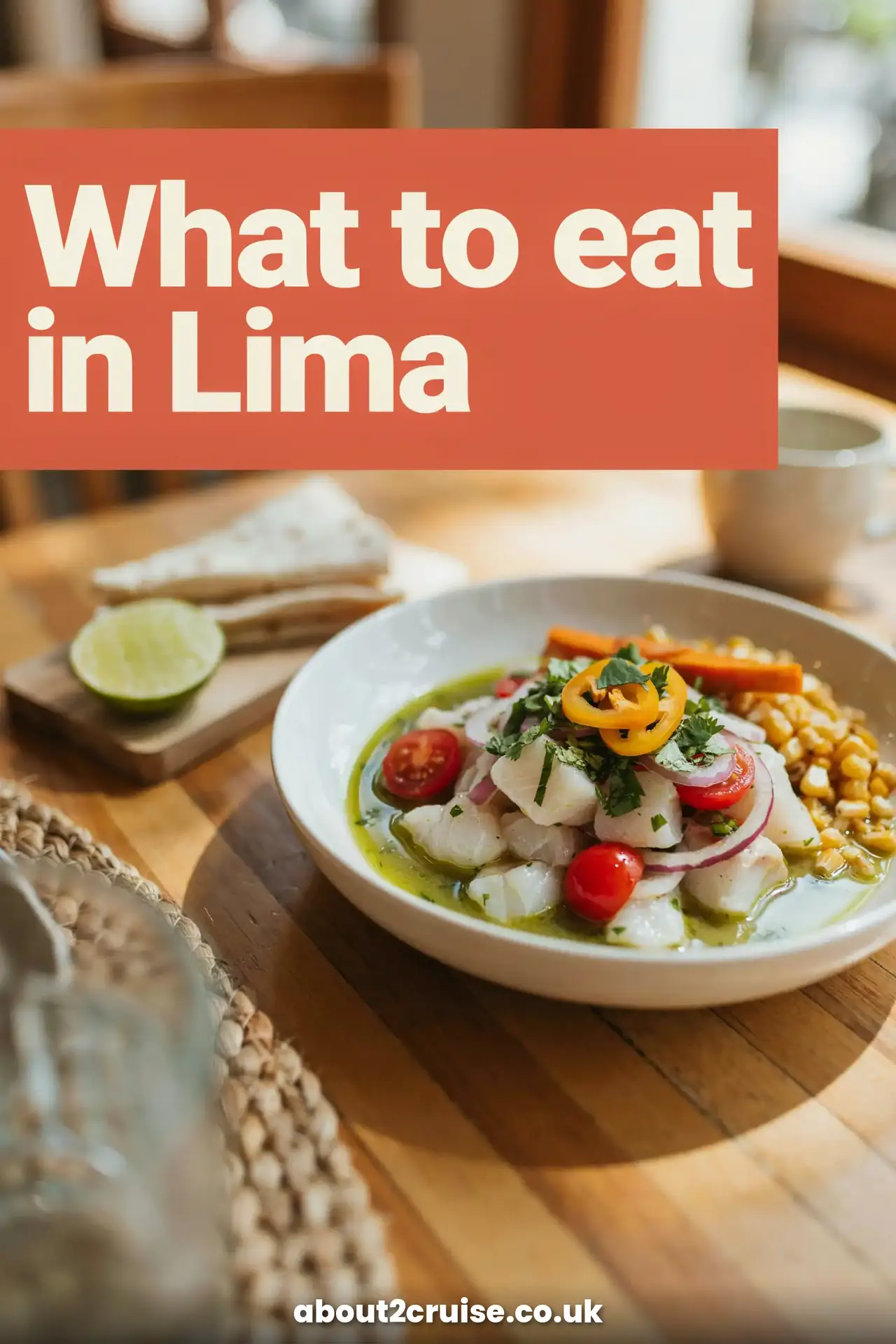
Peru’s coast means ceviche at lunch, pisco sours and market food such as anticuchos and picarones. Lima’s cevicherias cluster in Miraflores and Barranco. In Ecuador, the coastal signature is encebollado, a tuna and yuca soup eaten at breakfast, and the highland favourite is llapingachos, cheese-stuffed potato patties. Manta and Guayaquil are the places to try street-side ceviche, bolón and chifles. Tap water is not safe to drink in either country; use bottled or filtered water.
Our South America cruise ports guide covers the other ports in the region.
Frequently Asked Questions
Can I visit Machu Picchu on a port day from Callao?
No. Machu Picchu requires a flight to Cusco, a road transfer, a train to Aguas Calientes and an early morning site entry. It is a pre- or post-cruise extension of at least three to five days, not a day trip from the coast.
Do I need a separate flight to the Galápagos if my cruise calls at Manta or Guayaquil?
Yes. A conventional cruise ship cannot tour the Galápagos islands. You need a separate small-ship Galápagos cruise that starts with a flight to Baltra or San Cristóbal, usually from Guayaquil or Quito.
How much cash should I carry in the Galápagos?
Carry enough for the US$200 park fee, the US$20 transit control card, water taxis, small meals and tips. ATMs exist only in Puerto Ayora and Puerto Baquerizo Moreno, often run out of cash, and cards can carry a 5–10% surcharge.
Is it safe to go ashore in Guayaquil and Manta?
Both are in coastal provinces where the UK Foreign Office advises against all but essential travel. If you go ashore, keep to organised excursions or well-defined tourist areas such as Guayaquil’s Malecón and Las Peñas, and check your travel insurance before travel.
What is the difference between starting a Galápagos cruise in Baltra or San Cristóbal?
Baltra is a purpose-built airport island with a longer transfer via barge to Santa Cruz and is used by most ships. San Cristóbal is a real town with a shorter airport-to-ship transfer and a smaller, local feel. Your operator chooses based on the cruise route and yacht schedule.
Do all Peru–Ecuador cruises cross the equator?
No. Manta and Guayaquil are just south of the equator, so a cruise from Panama or Miami to Peru will cross the line, but a cruise starting in Ecuador or Peru and heading south will not. The crossing ceremony depends on your specific itinerary.