
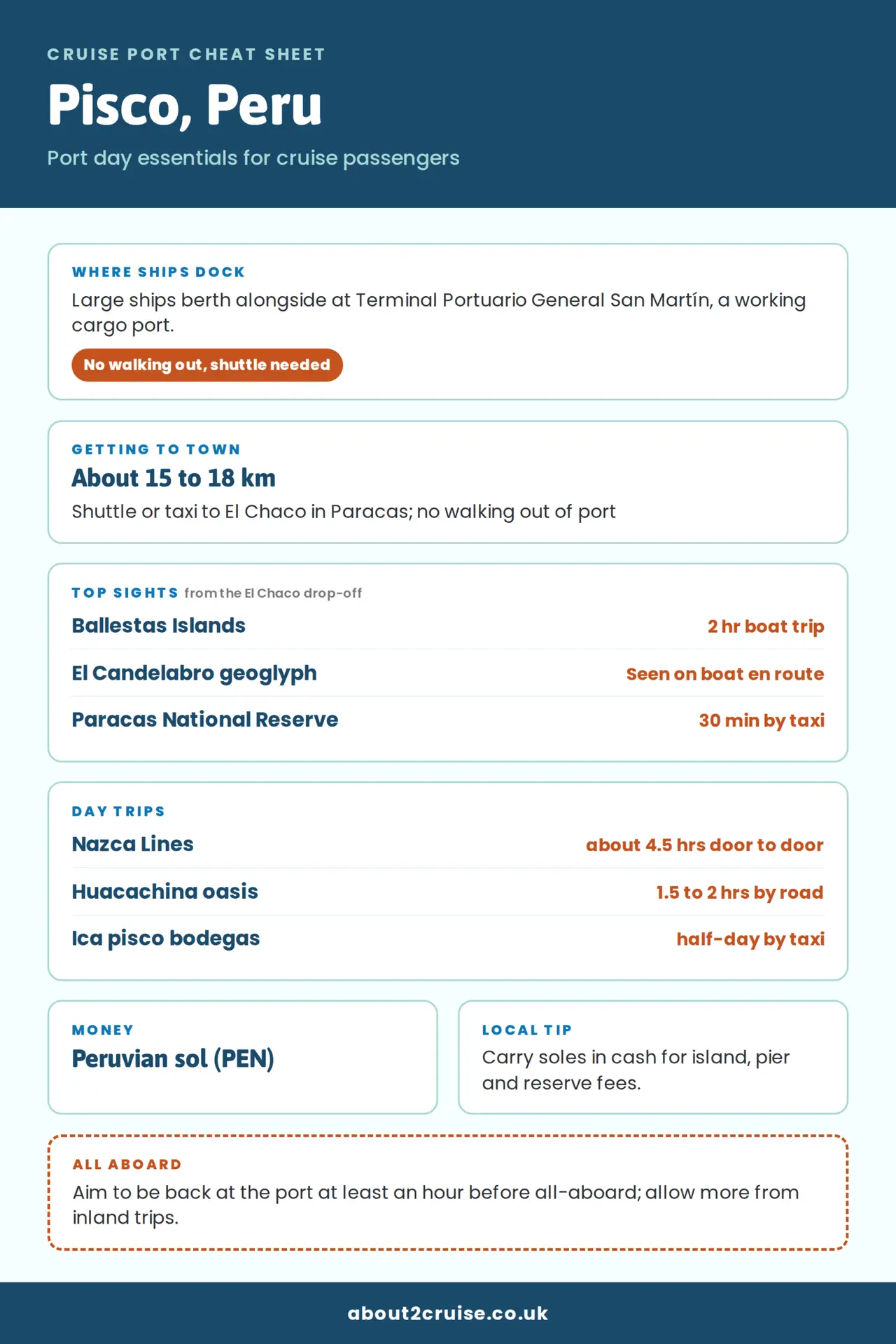
Your ship docks at Terminal Portuario General San Martín, a working cargo port on the Paracas peninsula, not in Pisco town itself. From the quay, most passengers shuttle or ride to Paracas, the real hub for the Ballestas Islands, Paracas National Reserve, pisco bodegas and Nazca Lines overflights. You cannot walk out of the port, so plan your transport before you leave the ship.
Where Does Your Ship Actually Dock?
Most cruise ships calling at “Pisco” berth alongside at Terminal Portuario General San Martín, also called Puerto General San Martín or Terminal Portuario Paracas. It sits at Punta Pejerrey on the Paracas peninsula, around 270 km south of Lima, with direct access from the Panamericana Sur. The address is Carretera Punta Pejerrey Km 39, Paracas, Ica.
This is not a purpose-built cruise terminal. It is a modernised commercial cargo port with a 700 m marginal quay made up of four berths. Passenger ships get priority over cargo on cruise days, but the infrastructure is still an industrial quay. You dock alongside. There is no tender operation for mainstream cruise ships. Some smaller expedition vessels and superyachts may use Portuario Paracas across the bay, but large cruise ships use San Martín.
There is no passenger terminal building, no terminal café, no reliable Wi-Fi, and no left-luggage desk. On cruise days the port does allow licensed taxis, tour operators, and local artisans inside, and ships are often welcomed with a Paracas-culture performance. You may see craft stalls just off the ship, but do not count on terminal facilities. Use the ship’s toilets before heading out, carry what you need, and treat the port as a transit zone rather than a destination.
Pisco cruise port map
Ships dock at Terminal Portuario General San Martín. From there, Pisco Plaza de Armas is about a 27-minute walk. Tap a pin for directions.
- Terminal Portuario General San MartínWhere ships dock
- Pisco Plaza de ArmasTown square · About 27 min walk from Terminal Portuario General San Martín
- Ballestas IslandsIsland group · About 14 km from Terminal Portuario General San Martín
- El Candelabro geoglyphHillside geoglyph · About 16 km from Terminal Portuario General San Martín
- Paracas National ReserveNational reserve · About 19 km from Terminal Portuario General San Martín
- Playa RojaRed-sand beach · About 23 km from Terminal Portuario General San Martín
- Tambo ColoradoInca archaeological site · About 41 km from Terminal Portuario General San Martín
- El ChacoResort village · About 15 km from Terminal Portuario General San Martín
Pisco or Paracas? Don’t Confuse the Town with the Tourist Hub
The name “Pisco cruise port” confuses many first-time visitors because the ship does not dock in Pisco city. The terminal is on the Paracas peninsula, close to the resort village of El Chaco, the tourist heart of Paracas. Paracas and the port are the natural base for nearly every shore excursion.
Pisco city itself lies about 20 km from the terminal, depending on the route, and is generally a 20–40 minute drive. Paracas town, where the Ballestas Islands boats leave from, is about 15–18 km away, usually 20–30 minutes by road. For most cruise passengers, “Pisco” and “Paracas” become interchangeable on a port day, but if a driver or tour seller mentions Paracas, that is the area you actually want.
Getting from the Port to Paracas or Pisco Town
You cannot walk out of San Martín port, and there is no scenic pedestrian route to Paracas. Your practical choices are the ship’s shuttle, a pre-booked tour meeting you inside the port, or a taxi from the terminal exit. Tour operators need port permits to collect passengers inside the terminal. Several independent companies meet guests just a few metres from the gangway.
On most cruise calls, the ship or local operators run a shuttle from the port to El Chaco in Paracas. The ride typically takes 20–30 minutes. Some operators describe the shuttle as free and running every 30 minutes, often dropping passengers near the fountain in El Chaco, but there is no official public timetable. Confirm the shuttle schedule on board before you go ashore, and note the last return time.
Taxis wait near the terminal exit. Agree the full fare in Peruvian soles before you get in. Drivers commonly quote a price for a direct ride to Paracas, or a half-day or full-day hire covering the reserve, Ica, Huacachina, or Pisco town. There is no widely available ride-hailing at the port, so organised transport is the dependable option.
Ballestas Islands from the Cruise Port: The Headline Trip
The Ballestas Islands are the reason most cruise passengers get off the ship. The standard trip is a roughly two-hour boat excursion from the El Chaco pier in Paracas. Boats head out to El Candelabro, a large hillside geoglyph, then circle the islands themselves. You do not land. The boat stands off the rocks while you watch wildlife from the deck.
Expect to see South American sea lions, Humboldt penguins, Peruvian boobies, cormorants, pelicans, Inca terns, and large colonies of guano birds. The islands are protected as part of the Reserva Nacional Sistema de Islas, Islotes y Puntas Guaneras, managed by SERNANP. Visiting hours are morning-only, generally 06:00–13:00, which is why almost every Ballestas trip runs early in the day.
Keep cash for entry costs. The usual fees are S/11 for the SERNANP islands ticket plus S/5 for the pier fee, so about S/16 per adult in total. Children aged 5–16 pay S/3 plus the pier fee, and under-fives are free. A combined ticket covering the islands sector and the Paracas National Reserve is about S/17 per adult. If you simply turn up, a shared boat at the pier may cost around S/40 per person before fees, though cruise-port packages sold with port pickup and transfers are typically higher.
Sea state matters. The boats are open and can be cancelled or shortened when wind and swell make the run unsafe. Early morning sailings usually have the calmest water. Operators may substitute a different coastal route or refund if conditions are too rough. If you are prone to motion sickness, take medication in advance and do not board on a heavy meal.
Paracas National Reserve: Desert, Cliffs, and Red Sand
The Paracas National Reserve is a stark, beautiful mix of coastal desert, cliffs, and sea. Entry costs about S/11 per adult, S/3 for children aged 5–16, and is free for under-fives. Visiting hours are normally 09:00–16:00 daily, with access through the Santo Domingo checkpoint. Buy your ticket at the checkpoint or online before you go.
A typical reserve tour by car or minibus lasts about 3–4 hours and includes stops at the Turritelas fossil bed, the La Catedral viewpoint, Playa Supay, Yumaque beach, and Playa Roja in Lagunillas bay. Playa Roja’s red sand comes from iron-oxide-rich eroded granite and looks most intense in late-afternoon light. La Catedral is a rock formation that partly collapsed in the 2007 earthquake but is still a worthwhile viewpoint.
Roads inside the reserve are largely unsealed tracks, so expect a bumpy ride and a dusty vehicle. There is very little shade and minimal food once you are inside, apart from a few small fish shacks near Lagunillas with irregular hours. Carry water, sun protection, and cash.
Nazca Lines Overflight from Pisco: Is It Worth It?
Pisco is the most northerly departure point for a Nazca Lines overflight, which saves you the long road journey to Nazca town. Flights leave from Capitán FAP Renán Elías Olivera airport at San Andrés, roughly 20 minutes north of Paracas and close to Pisco city. A flight typically costs about USD 295–320 per person, plus an airport tax of about S/70 per person.
The flight itself lasts about 95–100 minutes, including roughly 30–35 minutes over the lines and geoglyphs. You do not choose an exact departure slot. Operators assign times between about 07:00 and 15:30, and weather can delay departures. Passengers over 120 kg may pay a supplement of around USD 165. The lines and geoglyphs are a UNESCO World Heritage property. The overflight involves repeated banking turns, so motion sickness is common. Take medication beforehand and eat lightly.
This is not an excursion to improvise on a short port call. Door to door, allow about 4.5 hours including transfers and flight time, and always protect your all-aboard time. A ship-sold Nazca overflight may cost significantly more, but it puts the timing and delays onto the cruise line, which is a real advantage if the weather shifts.
Huacachina Oasis and Ica Dune Trips
Huacachina is a small oasis surrounded by high dunes near Ica, about 1.5–2 hours by road from Paracas. The popular activity is a dune buggy ride with sandboarding, usually lasting about two hours and costing around S/80–120 per person before entrance fees. You will also pay a small Huacachina entrance fee, roughly S/8 per person, in cash. Board rental only may be S/20–30 if you skip the buggy.
The classic Huacachina experience is a late-afternoon or sunset trip, which often does not fit a cruise call with an early evening all-aboard. If you want to do it from a ship, book a private vehicle or ship excursion with a clear return time, and be ready for a hot, dusty, bumpy afternoon. The dunes are photogenic, but the buggies around Ica and Huacachina are not universally regulated, and accidents have happened. Use a reputable operator, wear closed shoes, and listen to the driver.
Pisco Bodegas, Brandy, and Tasting Tours
Pisco is a Peruvian grape brandy with a protected denomination of origin. It must be made from one of eight named grape varieties, distilled in copper stills, and nothing is added. Peruvian pisco is unaged and colourless, usually between 38% and 48% alcohol. The pisco sour, with its lime, syrup, egg white, and bitters, was created in Lima and has become Peru’s signature cocktail.
From the port, a bodega route into the Ica valley is a genuine half-day or full-day option. Well-known stops include Tacama, one of South America’s oldest working wineries, the artisan bodegas El Catador and Nietto, and Hacienda La Caravedo, described as the oldest continuously operating distillery in the Americas. Viñas Queirolo opens Monday to Thursday only, so check opening days before booking an independent tour. Tastings usually include wines, piscos, cachaça-like cachina, and sweet pisco creams. If you are driving or joining a long tour, pace yourself and stay hydrated.
Should You Spend Time in Pisco Town Itself?
Pisco city is a provincial capital of around 135,000 people, and its name comes from the Quechua word for bird. Historically it prospered from vineyards and pisco shipped through its port, but a magnitude 7.9 earthquake in 2007 destroyed much of the centre, killing 595 people and affecting hundreds of thousands. The colonial San Clemente cathedral collapsed, and a new red-brick church now stands on the same site. The 1929 Moorish Palacio Municipal was wrecked and remains unrepaired, though the equestrian statue of José de San Martín survived.
The Plaza de Armas is a large square declared an urban monument, and the pedestrianised San Martín street runs west from it with benches, trellises, and a fountain. For most cruise visitors, however, Pisco town is not the main draw. Unless you are specifically interested in earthquake history, everyday Peruvian town life, or a pisco museum, your limited port time is usually better spent in Paracas, the reserve, or the bodegas.
Tambo Colorado: An Inca Stop Away from the Coast
If you want an archaeological stop away from the desert coast, Tambo Colorado is an Inca adobe administrative complex in the Pisco valley, about 47 km and 50 minutes from Pisco’s Plaza de Armas. Entry costs about S/5 per adult, with reduced or free entry for students and children. The site is open Tuesday to Sunday, 09:00–17:00, and the final approach road is partly unpaved.
This works as a half-day excursion by taxi or private tour, but it is not the main reason most cruise passengers call at Pisco. Choose it if the Ballestas Islands and Paracas Reserve do not appeal, or as part of a wider Pisco valley route.
Where and What to Eat: Ceviche, Scallops, and Pisco Sours
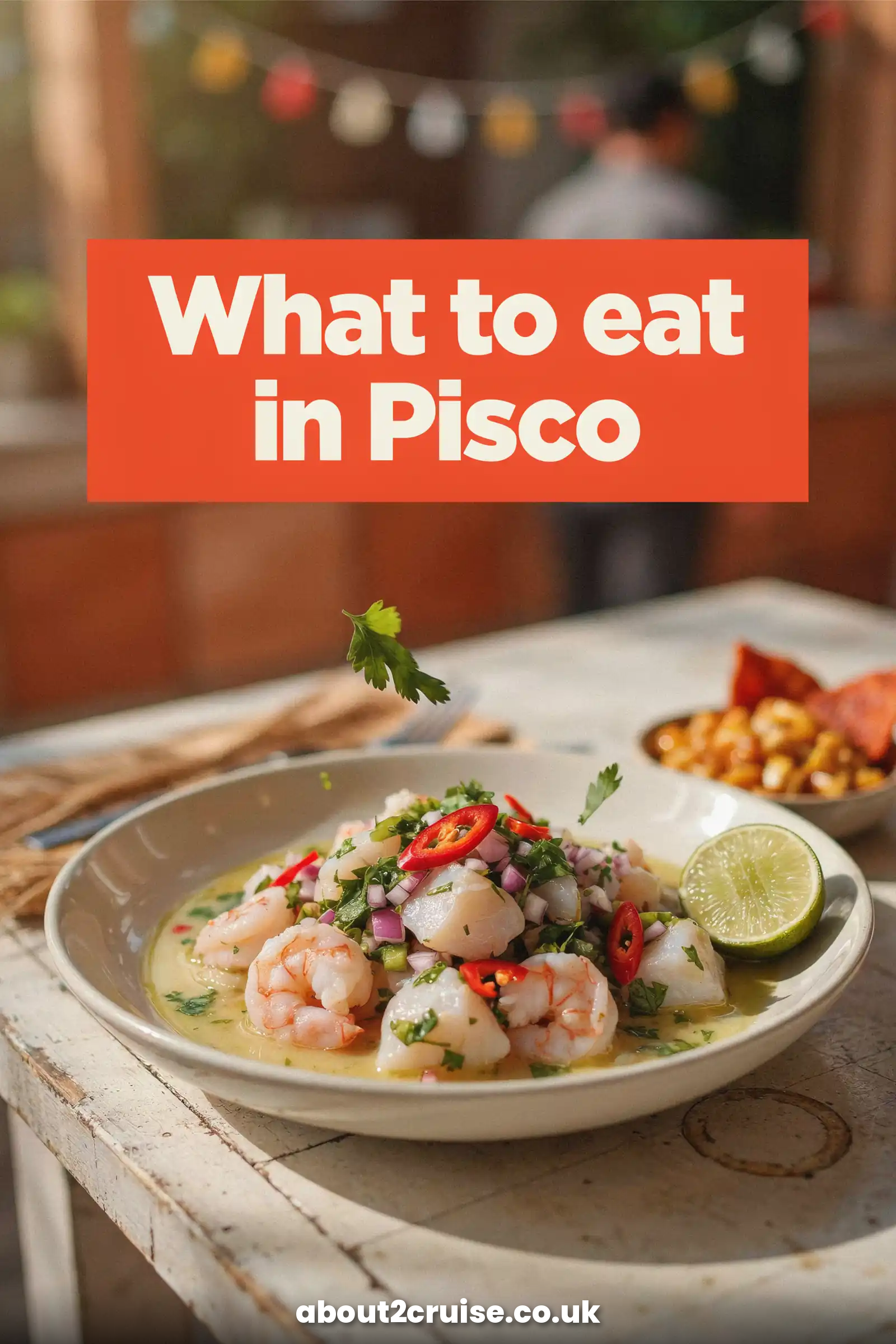
The eating around Paracas and Pisco is dominated by seafood. Along the El Chaco waterfront, expect ceviche mixto, mixed seafood cured in lime, at roughly S/45–58. Conchas de abanico, Paracas bay scallops, are a local speciality, often baked with cheese or served al ajo for around S/32–40. Tiradito de lenguado, sole in a spiced leche de tigre, and chicharrón de pescado, fried fish pieces, are also standard.
If you want a cheap local lunch, walk a block or two back from the waterfront for set menus at S/14–18. Around the Paracas pier, vendors sell plastic cups of ceviche for S/12–20, mostly from late morning into early afternoon. In Pisco town, cafés and pizzerias around the Plaza de Armas and pedestrian boulevard offer simpler tourist menus. A pisco sour in a Paracas bar costs about S/18–22. Seafood is generally best in the cooler months when scallop production is higher.
Ship Excursions vs Local Operators
For a short call, the Ballestas Islands and Paracas National Reserve are straightforward with either a ship tour or a permitted local operator. Ship excursions remove the guesswork, but independent operators often sell the same islands-and-reserve combination at a lower headline price, with port pickup inside San Martín and English-speaking guides. Ask what is included before comparing: entrance fees, pier fee, transfers, and water may or may not be in the price.
For the Nazca Lines overflight, the ship’s excursion has a strong argument in its favour. Weather and air-traffic delays are common, and the cruise line takes responsibility for the timing. For a simple Ballestas boat trip, the risk of missing the ship is low if you book an early operator and confirm the return. For Huacachina, Ica, or a multi-bodega route, use a private driver or ship excursion with a fixed return rather than relying on shared public transport.
Whatever you book, keep the ship’s all-aboard time in your head, not just the departure time. Carry the port agent’s contact details and a fully charged phone, and allow at least an hour of buffer on long inland trips.
Money, Cards, ATMs, and Tipping
Peru’s currency is the sol, written S/ or PEN. You will need cash for the Ballestas Islands SERNANP ticket, the Paracas pier fee, the reserve entry, taxis, market stalls, public toilets, and tips. Have small notes and coins. Ticket desks and taxi drivers may not have change for large notes.
Cards are accepted at resort hotels, established Paracas restaurants, and tour offices, but small restaurants, taxis, and stalls are cash-only. US dollars are sometimes accepted in tourist-facing places, but at a worse exchange rate, and notes must be clean and untorn. ATMs are limited in Paracas town and effectively absent once you leave it. BCP and Scotiabank machines are the most reliable, though most cap withdrawals at S/700–1,000 per transaction. Do not rely on finding an ATM at the port.
Tipping is cash-based. In restaurants, about 10% is standard if service is not already included. For guides, roughly US$3–5 per person per day is a common range, with drivers around US$2–3, and boat crews happily accept a few soles. Taxi fares are usually agreed in advance and rounded up rather than tipped as a percentage.
Weather, Seasons, and Sea State in Paracas
Paracas has a hot desert climate and is one of the driest places on earth. Rain is negligible year-round. Cruise season runs roughly November to April, when daytime highs are around 24–27°C, though the muggy season lasts from December into early May. The windy season runs from late May to early December, with average wind speeds above 10.5 mph, and afternoon wind whips up sand inside the reserve.
UV is extreme in midsummer, so sun protection is essential even when the air feels cool. Sea temperature is about 21°C in January–March but drops to 17°C or below from June to November. For the Ballestas Islands, morning is usually calmer and drier. The port operator describes the climate as good year-round, with winter temperatures around 20°C and frequent sun, but boat trips still depend on daily swell and wind.
What to Pack for a Pisco Cruise Port Day
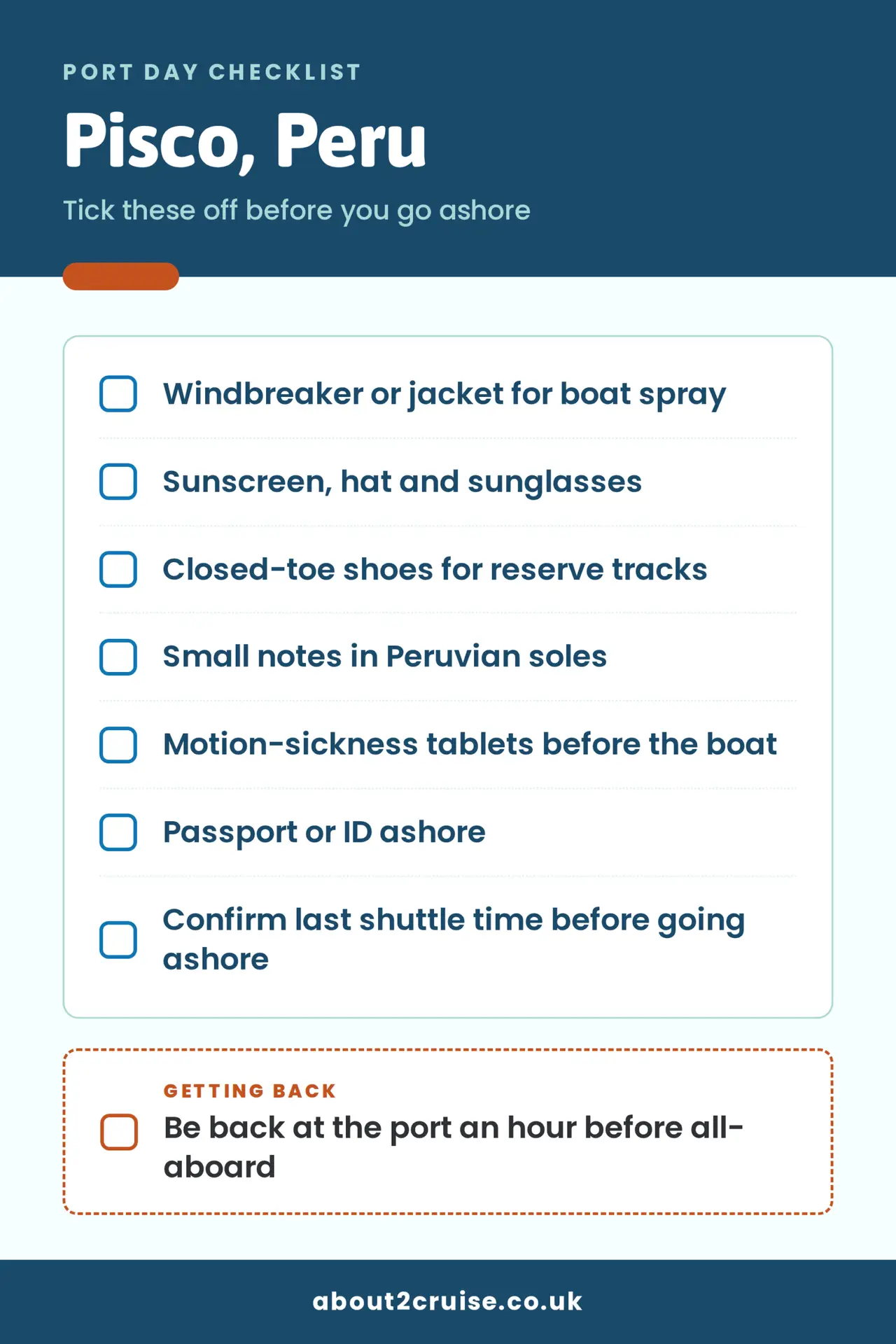
Bring a windbreaker or light jacket for the boat, plus sunscreen, sunglasses, and a hat. The Ballestas boats are open and fast, so spray and wind are constant. Life jackets are mandatory, but they do not keep you dry or warm. Take motion-sickness tablets before the boat or overflight if you are at all prone to nausea.
Closed-toe shoes work best for reserve tracks, dune walking, and getting on and off boats. A small daypack should hold water, cash, your cruise card, passport or ID, and a phone with offline maps. Do not plan to swim at Playa Roja; currents near the rocks are unpredictable. A light scarf or buff helps with dust and sand in the reserve and dune areas.
Safety and Practical Precautions
Pisco and Paracas are generally considered safe for cruise visitors, especially on organised tours, but petty theft, pickpocketing, and bag-snatching happen in busy tourist areas. Keep bags closed and in sight, do not leave anything unattended on the beach or pier, and avoid flashing large amounts of cash.
Use licensed taxis or transport arranged through your ship, hotel, or tour operator rather than informal street hails. Political protests can block roads in Peru with little notice, so on long inland trips carry water, cash, and medication. Always carry ID. Avoid photographing military installations. The sand-buggy industry around Ica and Huacachina is not universally regulated, so choose a reputable operator. As anywhere, avoid unbranded or suspiciously cheap spirits because adulterated alcohol has caused deaths in Peru.
Accessibility and Mobility at San Martín Port
San Martín is an industrial cargo port without a passenger terminal, so everyone must use a vehicle to leave the quay. If you have mobility limitations, arrange transport in advance and confirm the vehicle type. Some islands tours advertise wheelchair-accessible transport and surfaces, but many reserve and boat tours state they are not suitable for people with mobility impairments, back problems, heart or respiratory conditions, or for pregnant travellers.
The Paracas National Reserve has unsealed sandy tracks, dust, and little shade. The boat trip involves stepping from a moving pier to a moving boat. Tambo Colorado has dirt ground and is difficult for wheelchairs. SERNANP exempts people with disabilities, over-66s, and under-fives from protected-area entrance fees, but the practical barrier at Pisco is usually the port-to-car-to-boat sequence rather than the ticket cost.
Joining, Leaving, or Transferring Here
Some South America cruises begin or end at San Martín, though it is far less common than Lima. Lima’s Jorge Chávez airport is about 240–260 km north, roughly 3–3.5 hours by road, so joining or leaving here requires a long private transfer. Scheduled coaches run Lima to Paracas with Cruz del Sur in about 3h15–3h45, usually from around S/55 or USD 15–26, but you would still need a taxi between the bus station and the port. There is no coastal railway to Pisco.
The port has no advertised left-luggage office or passenger waiting lounge. If you are ending a cruise here and have a late flight, arrange luggage storage through a Paracas hotel or tour operator, or book a private transfer that keeps the car with you. Confirm with your cruise line whether bags can be handled ashore at San Martín before you make independent plans.
How Pisco Fits into a South America Cruise
Pisco often appears on longer South America itineraries alongside other Chilean and Peruvian ports. If you are also calling at Valparaiso (Santiago), Arica, or Coquimbo (La Serena), Pisco is the day built around wildlife, desert scenery, and pisco heritage. For the wider region, see our guide to Peru and Ecuador’s cruise ports.
How to spend a port day in Pisco
A port day in Pisco works best if you pick one: a morning Ballestas Islands boat from Paracas, or a longer day that adds the Paracas National Reserve after lunch.
Before you sail
- Confirm the ship shuttle drop-off and last return time before going ashore.
- Book a Nazca Lines overflight as a ship excursion or with fixed return transfers.
- Bring Peruvian soles in small notes; ATMs are limited in Paracas.
Short port day: under 6 hours
- On dockingShuttle from San Martín to El ChacoNo walking outThe ship docks at a working cargo terminal. Take the ship shuttle or a permitted tour transfer to El Chaco in Paracas.
- +45 minBallestas Islands boat from El ChacoMorning onlyA two-hour boat trip with no landing. Watch sea lions, penguins and boobies. Pay the island and pier fees in cash before boarding.
- +3 hrsBack at El Chaco pierBoats return to the same pier. Walk along the waterfront towards the restaurant strip.
- +3 hrs 30 minSeafood lunch in El ChacoTry ceviche mixtoThe waterfront is known for ceviche mixto, bay scallops and tiradito. Walk one block back for cheaper set menus.
- +4 hrs 30 minStroll the El Chaco waterfrontBrowse craft stalls and photo spots before the return shuttle. Check the last shuttle time on board before you go.
- All-aboard minus 1 hrShuttle back to San MartínLeave a bufferReturn shuttles can get busy. If two leave without you, take a licensed taxi to the ship.
The times on the map are for the whole journey there by train and bus.
Get train and bus times in Google Maps
If plans change: If the Ballestas boat trip is cancelled or full, walk the El Chaco waterfront and take a taxi to the Paracas National Reserve viewpoints.
Long port day: 8 hours or more
- On dockingShuttle from San Martín to El ChacoNo walking outThe ship docks at a working cargo terminal. Take the ship shuttle or a permitted tour transfer to El Chaco in Paracas.
- +45 minBallestas Islands boat from El ChacoMorning onlyA two-hour boat trip with no landing. Watch sea lions, penguins and boobies. Pay the island and pier fees in cash before boarding.
- +3 hrsBack at El Chaco pierBoats return to the same pier. Walk along the waterfront towards the restaurant strip.
- +3 hrs 30 minSeafood lunch in El ChacoTry ceviche mixtoThe waterfront is known for ceviche mixto, bay scallops and tiradito. Walk one block back for cheaper set menus.
- +4 hrs 30 minTaxi into Paracas National ReserveCash entry feeA thirty-minute ride to the Santo Domingo checkpoint. The reserve's desert cliffs and red sand are the main inland sight.
- +5 hrs 30 minLa Catedral viewpoint and Playa RojaStop at the sea-rock viewpoint, then continue to Playa Roja, where late-afternoon light deepens the red sand.
- All-aboard minus 90 minReturn to San MartínAllow time to leave the reserve and transfer back to El Chaco, then take the shuttle or taxi to the ship.
The times on the map are for the whole journey there by train and bus.
Get train and bus times in Google Maps
If plans change: If the reserve road is blocked or the checkpoint is busy, swap to a pisco bodega route in the Ica valley by taxi.
Pisco Cruise Port FAQ
Is the Pisco cruise port worth visiting?
Yes. The Ballestas Islands are one of South America’s best wildlife boat trips, and the Paracas National Reserve is a striking desert-and-coast landscape. Even a short call can deliver both before the afternoon heat and wind build.
Can you walk from the Pisco cruise port to town?
No. You cannot walk out of San Martín port, and neither Pisco town nor Paracas is a practical walk from the quay. You need a shuttle, taxi, or pre-arranged tour.
How far is Paracas from the Pisco cruise port?
Paracas town, specifically the El Chaco pier area, is about 15–18 km from the terminal, usually a 20–30 minute drive depending on traffic and shuttle stops.
Are Ballestas Islands tours available from the cruise port?
Yes. Many independent operators hold port permits and meet passengers inside San Martín, then transfer to the El Chaco pier for the morning boat trip. You can also take a ship shuttle into Paracas and buy a boat tour at the pier.
Can you do the Nazca Lines from a cruise ship call?
Usually yes, but only as a pre-arranged excursion. The overflight, transfers, and check-in take about 4.5 hours door to door, and weather or air-traffic delays are common. A ship-sold excursion is the safest way to protect your all-aboard time.
What facilities are at San Martín Port?
Very few. There is no passenger terminal, no reliable Wi-Fi, no café, and no left-luggage service. On cruise days you may find taxi drivers, permitted tour staff, and artisan stalls, but facilities such as toilets and shade are minimal.
Do I need my passport on shore?
Carry some form of ID. Many tours ask for passport details, and police may ask to see identification. A colour photo of your passport is useful, but follow your ship’s advice on whether to take the physical passport ashore.
What happens if my Ballestas boat is cancelled?
If the sea is too rough, operators may offer an alternative coastal route, postpone within the morning window, or refund the boat portion. If you booked through the ship, the cruise line will adjust or cancel the excursion. Independent operators usually handle changes in Paracas before sailing.