
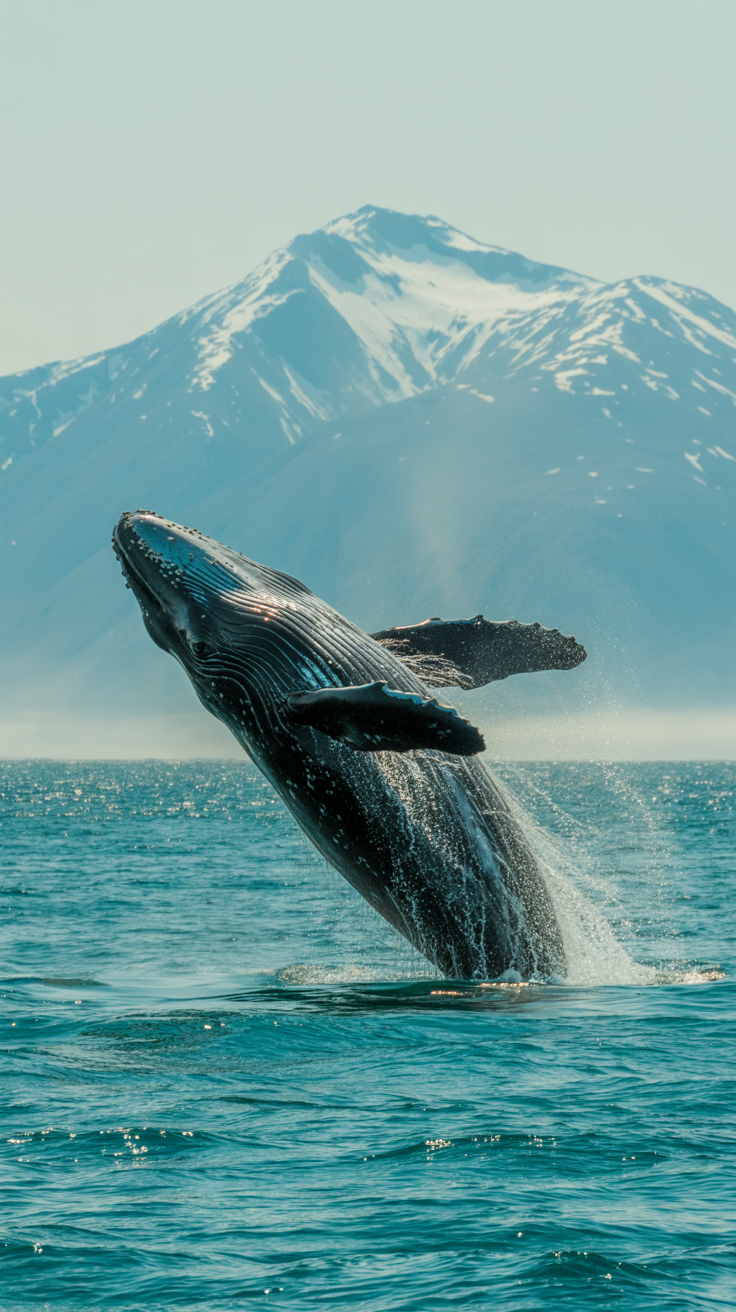
Alaska’s gray whales migrate along the coast from April through June, traveling between Baja California and Arctic feeding grounds. These baleen whales reach 40-50 feet long and are commonly spotted from cruise ships in Inside Passage waters, particularly near Icy Strait, Glacier Bay, and Southeast Alaska’s channels, often displaying surface behaviors like breaching and spy-hopping.
Quick Facts About Alaska Gray Whales
| Detail | Information |
|---|---|
| Best Viewing Months | April through June (northward migration) |
| Average Length | 40-50 feet |
| Weight | Up to 40 tons |
| Migration Distance | 10,000-12,000 miles round trip |
| Typical Speed | 3-5 mph while migrating |
| Lifespan | 50-70 years |
| Primary Food | Bottom-dwelling amphipods and other small crustaceans |
| Best Ship Locations | Port side (left) heading north, starboard (right) heading south |
Want to know more about the incredible wildlife you’ll encounter on your Alaska cruise? Gray whales are just one part of Alaska’s spectacular marine ecosystem.
Why Gray Whales Choose Alaska Waters
Gray whales aren’t just passing through on a leisurely swim. These creatures are completing one of the longest migrations of any mammal on Earth, and Alaska’s nutrient-rich waters serve as their all-you-can-eat buffet after a long journey. Unlike their cousins the humpback whales that also frequent Alaska waters, gray whales are bottom feeders. They dive to the seafloor, roll on their sides, and scoop up mouthfuls of sediment, filtering out tiny crustaceans through their baleen plates.
This feeding behavior is why you’ll spot them in shallower coastal areas rather than deep ocean waters. The continental shelf along Alaska’s coast provides perfect feeding conditions with depths of 120-200 feet where amphipods and other small creatures thrive in the muddy bottom.
Where to Spot Gray Whales From Your Cruise Ship
Not all cruise routes offer equal gray whale viewing opportunities. Here’s where your chances skyrocket:
- Icy Strait Point – This area consistently delivers sightings because gray whales feed extensively in these protected waters. The strait funnels whales past cruise ships at relatively close range.
- Glacier Bay National Park – The entrance to Glacier Bay and surrounding waters offer excellent opportunities, particularly in the morning hours when whales are actively feeding.
- Frederick Sound and Stephens Passage – These channels serve as migration highways. Ships transiting between ports often encounter gray whales here.
- Sitka Sound – Ships arriving or departing Sitka pass through prime gray whale territory.
- Chatham Strait – This deep channel sees consistent gray whale traffic during peak migration.
Understanding the broader context of wildlife viewing opportunities throughout Alaska can help you plan where to position yourself during different segments of your cruise.
How to Identify Gray Whales (And Not Confuse Them With Other Species)
Here’s the thing: when you’re scanning the water from a cruise ship deck, you need to know what you’re looking for. Gray whales have distinctive characteristics that set them apart from orcas and humpbacks you’ll also encounter:
- Mottled gray appearance – They look like swimming rocks covered in white barnacles and orange whale lice (yes, that’s a thing)
- No dorsal fin – Instead, they have a series of 6-12 knuckles or bumps along their back ridge
- Heart-shaped blow – Their spout reaches 10-13 feet high and appears bushier than other whales
- Slow, deliberate movements – They’re not speed demons; you’ll see a relaxed surfacing pattern
- Muddy water trails – When feeding, they create clouds of sediment that rise to the surface
Best Times and Ship Positions for Viewing
Timing matters more than luck when it comes to whale watching. Gray whales are creatures of habit, and understanding their schedule gives you a significant advantage.
Peak Migration Windows
If you’re booking specifically to see gray whales, May Alaska cruises hit the sweet spot. The migration peaks in mid-to-late May when the largest numbers are passing through. June Alaska cruises still offer excellent viewing, particularly early in the month, though numbers begin tapering off by late June as whales reach their Arctic destinations.
Time of Day
Early morning from 6-9 AM provides optimal conditions. The water tends to be calmer, lighting is better for spotting blows, and whales are often actively feeding after the night. Late afternoon from 4-7 PM offers a second peak viewing window.
Which Side of the Ship?
This insider tip saves countless passengers from missing sightings: when your ship is heading north (toward Glacier Bay, Skagway, or Juneau from the south), position yourself on the port side (left). Gray whales hug the coastline, and Alaska’s coastline typically runs along the port side on northbound routes. Reverse this for southbound segments.
What Behaviors You Might Witness
Gray whales aren’t just floating logs. They’re remarkably active and curious, often approaching boats and ships. Here’s what to watch for:
- Spy-hopping – They’ll poke their heads straight up out of the water to look around. It’s believed they’re checking their surroundings and possibly looking at you as much as you’re looking at them.
- Breaching – Full or partial body launches out of the water. Scientists aren’t entirely sure why whales breach, but theories include communication, removing parasites, or simply playing.
- Fluking – Lifting their tail flukes high before a deep dive. Gray whale flukes are 10-12 feet across and create spectacular photo opportunities.
- Logging – Resting motionless at the surface. They’re not dead; they’re just taking a break.
- Feeding behavior – Rolling onto their side near the bottom creates distinctive mud plumes visible at the surface.
For those interested in capturing these moments, check out our guide to Alaska wildlife photography opportunities for camera settings and positioning tips.
Understanding the Challenges Gray Whales Face
Gray whales have a complicated history. They were hunted to near extinction twice but made remarkable recoveries after protection was implemented. The eastern Pacific population (the one you’ll see in Alaska) was removed from the endangered species list after successfully rebounding.
However, recent observations show some concerning trends. Gray whales arriving in Alaska sometimes appear thinner than historical norms, possibly due to changing food availability in their feeding grounds. Climate change affects the tiny crustaceans they depend on, which could impact future populations.
Your cruise ship follows strict marine mammal protection protocols, maintaining minimum distances and speed restrictions in whale-heavy areas. These regulations ensure that tourism doesn’t negatively impact these incredible animals.
Shore Excursions vs. Ship-Based Viewing
You’ll face this decision during your cruise: book a dedicated whale watching excursion or rely on ship-based viewing? Both have merits.
Ship-Based Viewing Advantages
- No additional cost
- Comfortable facilities and amenities nearby
- Higher vantage point for scanning larger areas
- Continuous viewing opportunities throughout your voyage
- Indoor viewing options if weather turns nasty
Dedicated Excursion Advantages
- Eye-level encounters that feel more intimate
- Smaller, more maneuverable boats can position better
- Expert guides focused solely on finding whales
- Access to areas cruise ships can’t reach
- Typically 2-4 hour dedicated viewing time
Many experienced Alaska cruisers recommend doing both. Enjoy the casual ship-based viewing throughout your cruise, and book one dedicated whale watching excursion in a prime location like Icy Strait or Glacier Bay.
What to Bring for Optimal Whale Watching
Don’t be that person who sees a whale and realizes their phone died or their binoculars are in the cabin. Pack a whale watching kit:
- Binoculars (8×42 or 10×42) – Essential for scanning distant waters and getting better looks at behaviors
- Polarized sunglasses – Cut through water glare and help spot subsurface shadows
- Layered clothing – Deck temperatures run 15-20 degrees cooler than you think, especially in morning viewing hours
- Camera with zoom capability – Phones work for close encounters, but a camera with at least 200mm zoom captures better distant shots
- Waterproof outer layer – Whale blows can drift surprisingly far, plus Alaska weather changes instantly
- Portable phone charger – You’ll be taking more photos than planned
- Notebook – Recording sighting times and locations helps you identify patterns for later viewing opportunities
Gray Whales vs. Other Alaska Marine Wildlife
Your Alaska cruise will introduce you to an incredible range of marine life beyond just gray whales. Understanding how these species differ helps you appreciate each encounter:
| Species | Size | Key Identifier | Behavior |
|---|---|---|---|
| Gray Whale | 40-50 feet | No dorsal fin, mottled gray with barnacles | Slow, methodical, bottom feeding |
| Humpback Whale | 45-50 feet | Long pectoral fins, prominent dorsal hump | Active, breaching, bubble net feeding |
| Orca | 20-30 feet | Black and white coloring, tall dorsal fin | Fast, travels in pods, hunts actively |
| Harbor Porpoise | 5-6 feet | Small, dark gray, barely visible blow | Quick, shy, brief surface appearances |
While you’re focused on marine mammals, don’t miss the other spectacular wildlife Alaska offers. The comprehensive Alaska wildlife guide covers everything from brown bears and black bears to bald eagles, puffins, and the incredible salmon runs that fuel Alaska’s entire ecosystem.
Bonus Tips Most Guides Won’t Tell You
- Watch the birds – Seabirds diving and congregating often indicate bait fish, which attracts whales to the same area
- Look for “footprints” – Circular smooth spots on the water surface indicate a whale just dove there; they’re created by the whale’s fluke movement underwater
- Listen for the naturalist announcements – Ship naturalists often spot whales before passengers and announce sightings over the PA system; keep your room phone volume up
- Use the ship’s wake as a reference – It’s easier to spot whale blows against the smooth wake water than choppy open ocean
- Scan systematically – Don’t just stare randomly; scan in grids from near to far, left to right, spending 3-5 seconds on each section
- Morning deck walks pay off – Take a lap around the outer decks during breakfast; you’ll often spot whales when fewer people are watching
- Ask crew for recent sighting patterns – Deck officers and naturalists track sightings and can tell you which areas have been most productive
- The forward observation decks get crowded – Mid-ship outdoor areas often provide equally good viewing with fewer people
- Gray whales can stay submerged 10-15 minutes – Be patient after a sighting; the whale will likely resurface in the same general area
- Cold, calm days are best – Whales are easier to spot when there’s less wind chop on the water surface
Conservation and Responsible Viewing
Part of being a responsible Alaska cruiser means understanding how to observe wildlife without disturbing it. While your cruise ship follows federal guidelines, your behavior matters too:
- Never throw anything overboard to attract whales
- Keep noise levels reasonable on outer decks
- Don’t use flash photography (it doesn’t work anyway and can startle animals)
- If on a small boat excursion, follow your guide’s instructions about movement and positioning
- Report any vessels violating approach distances to your crew
- Support cruise lines with strong environmental track records
These magnificent creatures have traveled thousands of miles to reach Alaska’s waters. The least we can do is observe them respectfully and ensure future generations can enjoy the same experiences.
Common Questions and FAQ
Do gray whales travel alone or in groups?
Gray whales typically travel alone or in small loose groups of 2-3 individuals during migration. Unlike orcas that maintain tight family pods, gray whales are more solitary. You might see multiple whales in one area simply because that location offers good feeding, not because they’re traveling together. Mothers with calves are the exception and stay paired through the migration journey.
Can you tell male and female gray whales apart from a ship?
Not easily. Females are slightly larger than males on average, but the size difference isn’t obvious unless you have whales side-by-side for comparison. The only reliable way to determine sex is viewing the genital area on the underside, which you obviously won’t see from a cruise ship. Unless you’re watching a mother-calf pair where the relationship is obvious, assume you can’t determine sex from normal observations.
What happens if a gray whale approaches our cruise ship?
This occasionally happens, and it’s magical. Gray whales are naturally curious and sometimes approach vessels. Federal law prohibits ships from approaching whales within certain distances, but there’s no violation if a whale approaches the ship. Your captain will typically maintain course and speed or slow down to avoid startling the whale. The whale will investigate briefly then continue on its way. These encounters are safe for both whale and passengers.
Why do gray whales have so many barnacles compared to other whales?
Gray whales accumulate more barnacles because they spend significant time in shallow coastal waters where barnacle larvae are abundant, and their slow swimming speed makes them ideal hosts. A single gray whale can carry 400-1000 pounds of barnacles and whale lice. While it looks uncomfortable, these hitchhikers don’t harm the whale. The barnacles get free transportation to food-rich waters, and the whale gets some camouflage. It’s a neutral relationship rather than parasitic.
Will I see gray whale calves during an Alaska cruise?
Possibly, but it’s less common than seeing adults. Gray whale calves are born in the warm lagoons of Baja California from January through March. By the time the migration reaches Alaska in April through June, calves are 3-5 months old and somewhat independent, though still staying near mothers. You’re more likely to see mother-calf pairs in May than June since stronger calves make the journey faster. The calf will be noticeably smaller, about 18-20 feet long compared to mom’s 45 feet.
Are gray whales endangered or threatened?
The eastern North Pacific population (what you’ll see in Alaska) is not currently endangered. These whales recovered remarkably after receiving protection and were removed from the endangered species list. However, a distinct western Pacific population that feeds off Russia and Korea remains critically endangered with only about 200 individuals. Scientists monitor both populations closely, and recent concerns about whale body condition have prompted additional research into food availability and climate impacts.
What’s the difference between a blow, a spout, and a fluke?
These are different whale behaviors that help with identification. A “blow” or “spout” is the same thing – the visible mist when a whale exhales through its blowholes. Gray whales have a V-shaped blow reaching 10-13 feet high. “Fluking” refers to when a whale lifts its tail flukes (the horizontal tail fins) out of the water before diving deep. Gray whales don’t always fluke before diving, but when they do it’s spectacular. If someone on your ship shouts “fluke up,” grab your camera immediately.
Can gray whales vocalize like humpback whales?
Yes, but differently. Gray whales produce sounds including knocks, clicks, pulses, and low-frequency moans typically below human hearing range. They don’t create the elaborate “songs” that male humpback whales are famous for. Gray whale sounds serve primarily for navigation and basic communication rather than the complex breeding displays of humpbacks. You won’t hear these vocalizations from a cruise ship; they require special underwater microphones to detect.
Personal Experience
Last spring, I stood on the deck of our Alaska cruise ship near Icy Strait Point, and honestly, nothing could have prepared me for that first glimpse of a gray whale surfacing just a few hundred feet away. The crew had mentioned we were passing through prime viewing territory during the northward migration, and they weren’t kidding. What struck me most was how close these gentle giants came to the ship – close enough to see the barnacles on their backs and watch the mist from their blowholes catch the afternoon light. Our naturalist guide explained that gray whales hug the coastline during their journey, which is why Alaska’s Inside Passage offers such incredible viewing opportunities from April through June.
The best tip I can share is to spend time on the outer decks early in the morning when the water’s calmer and easier to scan. I almost missed several sightings because I was too focused on looking far out, but gray whales often surface much closer than you’d expect. Bring binoculars, sure, but keep your eyes moving across the water at different distances. And if you’re choosing excursions, the smaller boat tours around Glacier Bay and Frederick Sound are absolutely worth it – we spotted a mother and calf pair feeding in the shallows, and being at water level made the experience feel even more intimate. The guides know exactly where to position the boats without disturbing the whales, and their knowledge about migration patterns and behavior really enriched the whole experience.