
Bastia is Corsica’s old Genoese capital and still feels like a real working port rather than a purpose-built tourist stop. Cruise ships berth in the commercial port right in town, usually within a 10–20 minute walk of Place Saint-Nicolas, the Old Port and the historic centre. Most passengers spend the day walking, eating Corsican food and either climbing to the citadel or driving the Cap Corse peninsula.
Where Cruise Ships Dock in Bastia
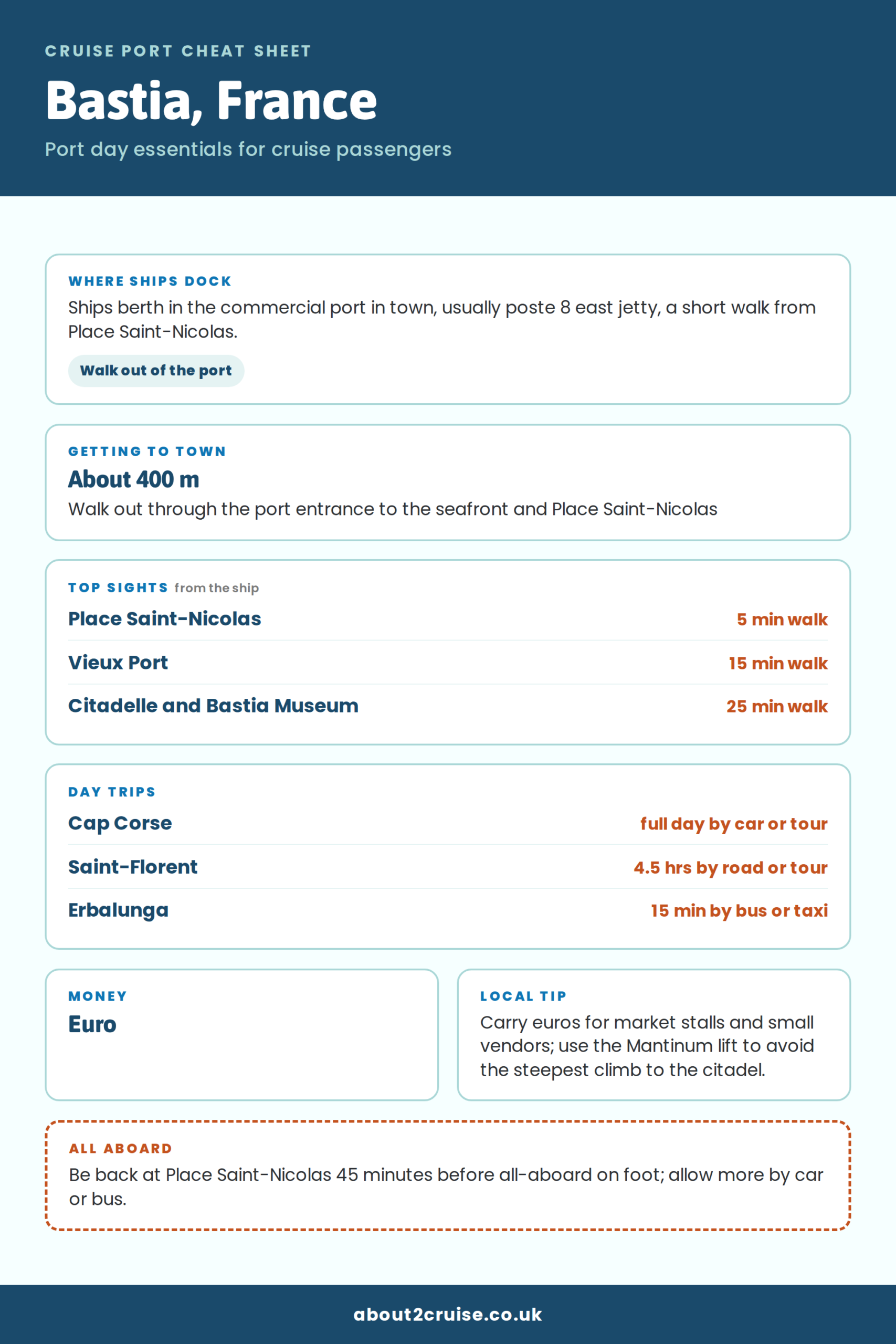
Bastia’s commercial port sits right in the middle of the city, between Place Saint-Nicolas and the Toga marina. It handles ferries, cargo, and cruise ships through the same entrance. Cruise ships normally tie up alongside the eastern quay, often called poste 8 or the east jetty. That puts you on the working harbour edge, a few hundred metres from the centre, not in the old marina.
The port has two maritime stations, north and south, which are staffed during ship calls. They have reception desks, toilets, drinks machines, free wifi, and a defibrillator. There’s no dedicated cruise terminal with a lounge or check-in desk; you’ll be processed through the ferry terminals, so don’t expect a big cruise hall.
Ship size matters here. Bastia isn’t built for 300-metre mega-ships. The preferred cruise berth has limited alongside length and about 9 metres of draught, so calls tend to be premium and luxury small-to-mid-size ships. Wind matters too: port entry and exit can be restricted in strong winds, so a call can occasionally be shortened or skipped in bad weather.
Bastia cruise port map
Ships dock at Bastia ferry terminal. From there, Place Saint-Nicolas is about a 4-minute walk, Saint-Jean-Baptiste about 11 minutes and Vieux Port about 14 minutes. Tap a pin for directions.
- Bastia ferry terminalWhere ships dock
- Place Saint-NicolasTown square · About 4 min walk from Bastia ferry terminal
- Bastia stationTrain station · About 8 min walk from Bastia ferry terminal
- Saint-Jean-BaptisteChurch · About 11 min walk from Bastia ferry terminal
- Vieux PortHarbour · About 14 min walk from Bastia ferry terminal
- Jardin RomieuTerraced garden · About 16 min walk from Bastia ferry terminal
- Bastia MuseumHistory museum · About 17 min walk from Bastia ferry terminal
- Citadelle de BastiaCitadel · About 18 min walk from Bastia ferry terminal
- Sainte-Marie cathedralCathedral · About 19 min walk from Bastia ferry terminal
- Sainte-Croix oratoryOratory · About 19 min walk from Bastia ferry terminal
- AldilondaSeafront walkway · About 19 min walk from Bastia ferry terminal
- Fort LacroixFort · About 24 min walk from Bastia ferry terminal
- Ficaghjola beachPebble beach · About 25 min walk from Bastia ferry terminal
- Arinella beachSandy beach · About 3 km from Bastia ferry terminal
- ErbalungaFishing village · About 8 km from Bastia ferry terminal
Walking from the Cruise Dock to the Old Port and Old Town
The ship-to-centre walk is one of the best things about docking in Bastia. From the commercial berth, Place Saint-Nicolas is roughly 400 metres, about five minutes on flat pavement. From there, the Old Port, Terra Vecchia, and the market square are another 10 minutes or so, and the citadel adds a further uphill 10 to 15 minutes depending on your pace.
A straightforward walking route: leave the port entrance, cross to the seafront boulevard, walk south with the water on your left, pass Place Saint-Nicolas, then turn into the narrow streets behind the church of Saint-Jean-Baptiste to reach the Vieux Port. If you want to go straight to the citadel, use the Mantinum lift from the Old Port to avoid the steepest climb, or follow the signed lanes up through Terra Nova.
Total from ship to the Old Port is usually 15–20 minutes at an easy pace. To the top of the citadel allow 25–30 minutes. To Ficaghjola beach add another 10–15 minutes along the Aldilonda seafront walkway.
How to Get Into Bastia: Walking, Shuttle, Taxi, and Bus
Walking is the default answer for most passengers. There is a free shuttle, but it’s only an intra-port shuttle that moves people around the quays inside the port, not a town shuttle. If your ship is at the far end of the eastern quay, ask staff whether the shuttle is running to the port entrance; otherwise just walk.
A taxi rank sits outside the North Terminal during ship arrivals. Taxis Bastiais can be reached on +33 4 95 32 70 70. Taxis are most useful for the beach at Arinella, a Cap Corse village transfer, or if you have reduced mobility and don’t want to tackle the old-town cobbles.
The urban bus network, Via Bastia, serves the town and some Cap Corse villages. A single ticket is €1.50. Line C heads north towards Erbalunga and Brando, useful if you want a cheap look at Cap Corse without hiring a car.
The little tourist train leaves from Place Saint-Nicolas opposite the tourist office. It runs about 45–50 minutes with commentary and a short walking section, normally April to October. Adults pay €9, children €4. It’s a good option if you want orientation without the climb.
Why Bastia’s Genoese History Still Shapes the City
Bastia was Corsica’s Genoese capital and still looks like it. The city grew from a stronghold above the fishing haven of Porto Cardo, today’s Vieux Port. The upper town, Terra Nova, was laid out on a Genoese grid pattern, and the lower town, Terra Vecchia, grew steeply around the market and the old harbour.
Bastia deserves its comparison with Corsica’s more resort-like stops. It’s a working city with ferry traffic, markets, wine bars, and fishermen landing their catch. The historic core is genuinely old, not prettied up, and the tourist office promotes it as a Ville d’Art et d’Histoire. For many cruisers, that authenticity is the appeal: you can do Bastia on foot without needing a beach club or a long transfer.
The Old Port, Terra Vecchia, and the Market Square
The Vieux Port is the postcard view: a small horseshoe harbour lined with café terraces, brightly painted old buildings, and the twin campaniles of Saint-Jean-Baptiste rising directly above. Cruise ships don’t berth here; it’s a marina for private boats and small local craft.
Start with a walk around the quay. The café tables are good for a morning coffee or a glass of Vermentino, but the real local life is uphill in the market square. The square, place de l’Hôtel de Ville, is called u mercà in Corsican, and it holds its producers’ market every Saturday and Sunday. Expect coppa, lonzu, figatellu, brocciu, canistrelli, honey, and beignets. Even on weekdays, the surrounding cafés and food shops make this the best food stop near the Old Port.
Terra Vecchia is the lower old town around the market. It’s steep and stepped; the Genoese themselves described it as a very steep place, painful to the walker. That’s true, but the lanes are short. If you move slowly, you can still see the main food sights without climbing to the upper town.
The Citadel, Terra Nova, and Bastia’s Main Museum
Terra Nova is the walled upper town on the rocky promontory. The easiest approach is the Mantinum lift from the Old Port, which climbs about 30 metres to the top of the citadel and saves the hardest steps. Once up there, you’re in a flatter, calmer quarter of wide Genoese streets.
The core sight is the Governors’ Palace, now the Bastia museum. It holds the city’s history collections and has gardens with views over the Old Port and Cap Corse. The museum is typically open 10:00–18:30 in high season, with reduced hours in low season and Monday closures in some months. Entry to the permanent exhibition and gardens is €5, with reductions and free under-10s.
Next to the palace are Sainte-Marie cathedral and the Sainte-Croix oratory. The adjacent Romieu garden terraces step down towards the sea and are one of the best photo spots in Bastia, especially in morning light before the heat builds.
Baroque Churches, Oratories, and Local Festivals
Bastia has some of Corsica’s richest baroque church heritage. Saint-Jean-Baptiste, above the Old Port, is one of the largest churches on the island and is impossible to miss because of its twin towers. On rue Napoléon, two baroque oratories, Saint-Roch and the Immaculée-Conception, sit close together and are worth a quick look for their painted interiors.
Religious festivals are the deep-cut cultural highlight. Holy Week in Bastia is Corsica’s defining religious event, with processions by the confraternities, night processions, and a hooded penitent carrying a cross through the streets. If your cruise happens to call then, expect the old town to feel a little more solemn and much more local. Outside festival days, the churches are easy to visit; cover shoulders and knees, remove hats, and keep phones silent.
Place Saint-Nicolas, the Aldilonda Walkway, and the Seafront
Place Saint-Nicolas is the huge plane-tree square between the commercial port and the Old Port. It has cafés, the Napoleon statue, and a Sunday flea market. It’s also your orientation landmark: if you get lost in the lanes, come back to the seafront and you can see the masts of your ship from much of the square.
The modern seafront addition is the Aldilonda walkway, a 450-metre pedestrian and cycle path five metres above the water, hugging the rock under the citadel. It is designed for people with reduced mobility and connects the Old Port area towards the northern seafront. Combined with the broader Spassimare route, you can walk from the marina all the way towards Arinella beach on a soft, mostly level surface with the sea on one side.
Two Beaches Near the Port: Ficaghjola and Arinella
Bastia is not primarily a beach port, but you do have two honest options. Ficaghjola is a small pebble beach on the city seafront, reached on foot via the Aldilonda and Spassimare. It has a summer lifeguard post and is the easiest swim if you want to stay within walking distance of the ship. Bring shoes that can handle pebbles.
Arinella is the bigger, sandy beach and the one locals use. It’s about eight minutes by car from the Old Port, or roughly 30 minutes on foot from the citadel along the seafront. It has lifeguards in summer, accessible facilities, and a seasonal shuttle. If you want a proper beach day, head to Arinella rather than expecting a long sandy sweep in the old town.
Cap Corse: The Most Popular Day Trip from Bastia
Cap Corse is the long finger of mountains and fishing ports north of Bastia, and it’s the most popular day trip from the city. The D80 circles the peninsula. Going north from Bastia on the east side, you pass Pietranera, Erbalunga, and the little marines of Sisco and Pietracorbara before reaching Macinaggio; then the road climbs and comes down the wilder west coast through Centuri, Nonza, and Patrimonio. The full circuit is about 110 km and needs a full day, ideally with a rental car or a ship excursion.
For cruise passengers, the easy highlights are Erbalunga, a fishing village about a quarter of an hour north with a Genoese tower and a pebble beach, and Nonza, dramatically perched above a black beach reached by more than 500 steps. Patrimonio is the wine stop: Corsica’s oldest appellation, with Muscat du Cap Corse and Vermentino tastings along the D81.
Boat trips to Cap Corse and Capraia run from the Old Port on small boats with swimming stops. Ship excursions in Bastia are typically structured around Cap Corse, with a full Cap Corse circuit around five and a half hours, or a Saint-Florent and Patrimonio wine tasting around four and a half hours. Independent car hire gives more freedom, but you need to book ahead in summer and be very serious about return time.
If you prefer a relaxed multi-stop itinerary, you could use a shore excursion to visit nearby coastal villages or spend longer over lunch, leaving the ship to handle the return logistics.
What to Eat, Drink, and Buy in Bastia
Corsican food is the reason to stay in town rather than rushing away. Look for charcuterie: prisuttu, coppa, lonzu, and figatellu. Brocciu appears in omelettes, cannelloni, and as a fresh cheese. Fiadone is the island’s lemon-and-brocciu cake, and canistrelli are the crunchy biscuits to buy for the ship.
For drinks, Cap Corse is a wine-based aperitif with macerated oranges and quinquina. Pietra is the local chestnut beer. Vermentino is the white to order with seafood, and Sciaccarellu rosé suits the heat. Patrimonio and Cap Corse Muscat are the two wine names to remember.
The best quick food stop is the market square, especially Saturday and Sunday, followed by the café terraces along the Old Port. Fish landed in the Old Port arrives a very short distance from the tables. Rue Napoléon and the streets off Place Saint-Nicolas have more restaurants and wine bars, and the market stalls sell vacuum-packed charcuterie and cheese that can be taken back on board.
Shopping Near the Port and in the Old Town
Bastia is better for food shopping than fashion. The best edible souvenirs are vacuum-packed Corsican charcuterie, brocciu or other sheep and goat cheeses, canistrelli, honey, fig jam, and a bottle of Cap Corse or Patrimonio wine. Buy them in the market or from the food shops near the market square rather than in the tourist-tat stalls right at the port.
There are some craft and clothing boutiques in the old town, and Place Saint-Nicolas has the Sunday flea market. Cards are accepted in most shops, but bring some euros for market stalls and small vendors. A small tip is optional in restaurants because service is included, but leaving a euro or two for good service on the terrace is appreciated.
Guided Tours, Boat Trips, and Doing It Independently
The tourist office runs a guided walk called Les Légendines on Tuesdays from Place Saint-Nicolas. It lasts about two and a half hours and includes legends, history, a private Corsican polyphony concert in an oratory, and a tasting of local produce. It costs about €25 per person and is a good cultural add-on if your call falls on the right day.
The little tourist train is the easiest low-effort introduction, and Cap Corse boat trips from the Old Port are the best way to see the peninsula without driving. For independent travellers, the town itself is walkable, the bus to Erbalunga is cheap, and car hire is the best tool for a full Cap Corse circuit. Taxis are better for short point-to-point transfers than for sightseeing.
Fort Lacroix and the Viewpoint Walk Above Bastia
Fort Lacroix is the 19th-century fort above Bastia, built in 1890 and now converted into a four-hectare urban park called U Forte à A Croce. It’s not a museum; it’s the city’s panoramic green space, with children’s play equipment, an amphitheatre, and wide views over Bastia, the Biguglia lagoon, the Tuscan archipelago, and the Italian coast on clear days.
From the Old Port, a waymarked walk via the citadel to Fort Lacroix and Fort Maurel is about 4.8 km with 205 metres of ascent and takes just under two hours at walking pace. That’s more than most cruise passengers want on a hot day, but it answers the specific 19th-century fort near the port question well: you can see the fort area from the lower town, and fit walkers can reach it as a steep but rewarding add-on. If you only want the view, a taxi or a hike to the park viewpoint is the target, not the old fort structure itself.
How to Plan Your Bastia Port Day and How Much Time You Need
Most cruise calls in Bastia are full-day calls of eight to ten hours, which is more than enough for the town. A compact Bastia day is: ship to Place Saint-Nicolas, Old Port, market square, citadel and museum, then lunch and a seafront walk. That can comfortably take four to five hours at a relaxed pace, including stops.
For a half-day left over, add either Arinella beach, a bus or taxi to Erbalunga, or a wine stop in Patrimonio. A full Cap Corse circuit only makes sense if you’re in port long enough, usually at least eight hours with a car or ship tour. If your ship calls for only four or five hours, stay in Bastia and do the Old Port plus citadel, not Cap Corse.
Return timing is simple but important. The walk back from the Old Port to the ship is 15–20 minutes, but from Arinella or a Cap Corse village you need a taxi buffer. Plan to be back in Place Saint-Nicolas at least 45 minutes before all-aboard if you are on foot, and earlier if you are driving or relying on a bus.
Practical Tips for Money, Language, and Staying Safe
The currency is the euro. Cards are accepted in most shops and restaurants, but market stalls, small cafés, and village vendors may prefer cash or apply a minimum spend. Carry some euros for the market and small purchases. French is the official language; Corsican place names appear on signs, and the local names like u mercà are part of daily speech. The tourist office publishes information in French, English, German, and Italian, which helps German-speaking passengers looking for Bastia Hafen or planning a Corsica cruise on their own.
Petty theft and pickpocketing are the main risk in busy markets and around the port, so use an anti-theft crossbody bag or an anti-theft backpack and keep valuables in inside compartments. France requires you to be able to prove your identity, so carry a passport or photocard driving licence. In summer, respect wildfire alerts and check beach flags before swimming.
Weather, Sun, and What to Pack for a Bastia Cruise Stop
Bastia is hot in cruise season. July and August average around 29°C by day and can reach well into the 30s, with strong sun. Rain is rare in midsummer but can appear in spring and autumn. The walking surfaces are hard: cobblestones, steps, and steep lanes between the Old Port and the citadel, and pebbles on the close-in beach. Choose women’s walking shoes or men’s walking shoes rather than flip-flops if you plan to do the citadel.
Pack for heat and sun: reef-safe SPF 50 sunscreen, a packable sun hat, women’s sunglasses or men’s sunglasses, and a collapsible water bottle to refill. A lightweight packable jacket or packable rain jacket is useful in spring, autumn, or for an exposed boat trip. A beach tote bag works well for towels and market purchases.
On board, a waterproof cruise lanyard keeps your cruise card handy if you’re doing a boat or beach stop, and magnetic hooks are useful in the cabin for drying clothes. An RFID passport holder or RFID blocking travel wallet is a sensible extra in busy port and market areas, and a cable lock for luggage is useful if you leave bags anywhere.
Accessibility and Mobility: Getting Around Bastia with Limited Walking
Bastia is partly accessible, but the historic core is not flat or step-free. The commercial port has a dedicated vehicle for passengers with reduced mobility on request at the Information Point. The Mantinum lift provides step-free vertical access between the Old Port and the citadel area, and the Aldilonda walkway was designed for pedestrians, cyclists, and people with reduced mobility. The Bastia museum is accessible, with a reserved parking space at the Cours Favale entrance.
The challenge is between the quay and the Old Port: the route is generally level along the seafront, but Terra Vecchia and the citadel involve steep lanes, steps, and cobbles. If you have mobility concerns, use the port PRM vehicle or a taxi for the transfer, then stick to Place Saint-Nicolas, the seafront walkways, and the citadel via the Mantinum lift, rather than trying to navigate the stepped old-town lanes.
Taxis, Trains, and Airport Connections in Bastia
Taxis wait outside the North Terminal during ship calls. The local taxi number is +33 4 95 32 70 70. Fares aren’t published as flat rates, so agree a price for airport or Cap Corse transfers before setting off. The bus station also has a rank.
Bastia station is under ten minutes on foot from Place Saint-Nicolas and about a quarter of an hour from the Old Port. It’s the northern terminus of the Corsican railway. The train to Ajaccio takes around three hours and passes through Corte; Calvi on the northwest coast is served by the same network through a spectacular mountain line. Fares are reasonable: Bastia–Corte around €10.10, Bastia–Calvi around €16.40, Bastia–Ajaccio around €21.60. There’s also a Pass Liberta for seven consecutive days of unlimited travel if you’re staying on.
Bastia Poretta Airport is about 30 minutes’ drive from the centre. The official website is bastia-aeroport.cci.corsica. The airport shuttle runs to Bastia station in about 25 minutes for a guide price of €10, but it can only be booked on the day and timetables are published week by week. Allow extra time for port traffic on busy ferry days.
Parking, Luggage Storage, and the Ferry/Cruise Port Mix-Up
Three ferry operators serve Bastia, with routes to Marseille, Toulon, Nice, Livorno, and several Italian ports. This is why the port can feel busy with ferries on the same day as your cruise call: the same maritime stations and port entrance handle both types of traffic.
Bastia’s port has a 70-space pay car park at €1 per hour, with the first 30 minutes free. There are larger city car parks at Place Saint-Nicolas, the market, the station, and the citadel. The long-stay P1–P9 zones are designed for ferry passengers with vehicles, not for day cruise car parking, so if you have a car it’s easier to use a city car park or the port’s hourly spaces.
Luggage storage exists in the city centre through shop-based services, typically from around €4.50–5.50 per bag per day, with points a few minutes’ walk from the port or near the station. There’s no official left-luggage office in the terminal, so book ahead during peak season if you need a guaranteed drop-off.
One common mistake is assuming the cruise ship will dock in the Vieux Port. It won’t. The Vieux Port is the old marina beneath the citadel. Cruise ships and ferries use the commercial port north of Place Saint-Nicolas, behind the same entrance. If you’re dropped at a maritime station, you’re in the right place.
Is Bastia Worth Visiting on a Cruise? Compared with Ajaccio and Bonifacio
Yes, if you like walking cities and food, Bastia is one of Corsica’s best cruise stops. It’s not a beach-resort port, and it doesn’t have Bonifacio’s white limestone drama. Bonifacio sits at Corsica’s southern tip and is a different landscape entirely: sheer cliffs, a marina, and a compact walled town. Ajaccio feels more polished and takes around three hours by train from Bastia, but it handles far more cruise traffic. Bastia’s advantage is that the ship is in the city: you can be at the Old Port in 15 minutes on foot, shop in a real market, and still have time for Cap Corse.
For UK-based passengers, Bastia is usually a stop on western Mediterranean itineraries rather than a cruise that starts or ends in Bastia, and you can cruise from Southampton or many other Mediterranean ports to reach it. This makes it a useful starting point for exploring other cruise ports in Corsica without needing a separate holiday.
How to spend a port day in Bastia
A port day in Bastia is a walking day. Do the Old Port, citadel and market in about five hours, and add Cap Corse only if you have eight hours or more.
Before you sail
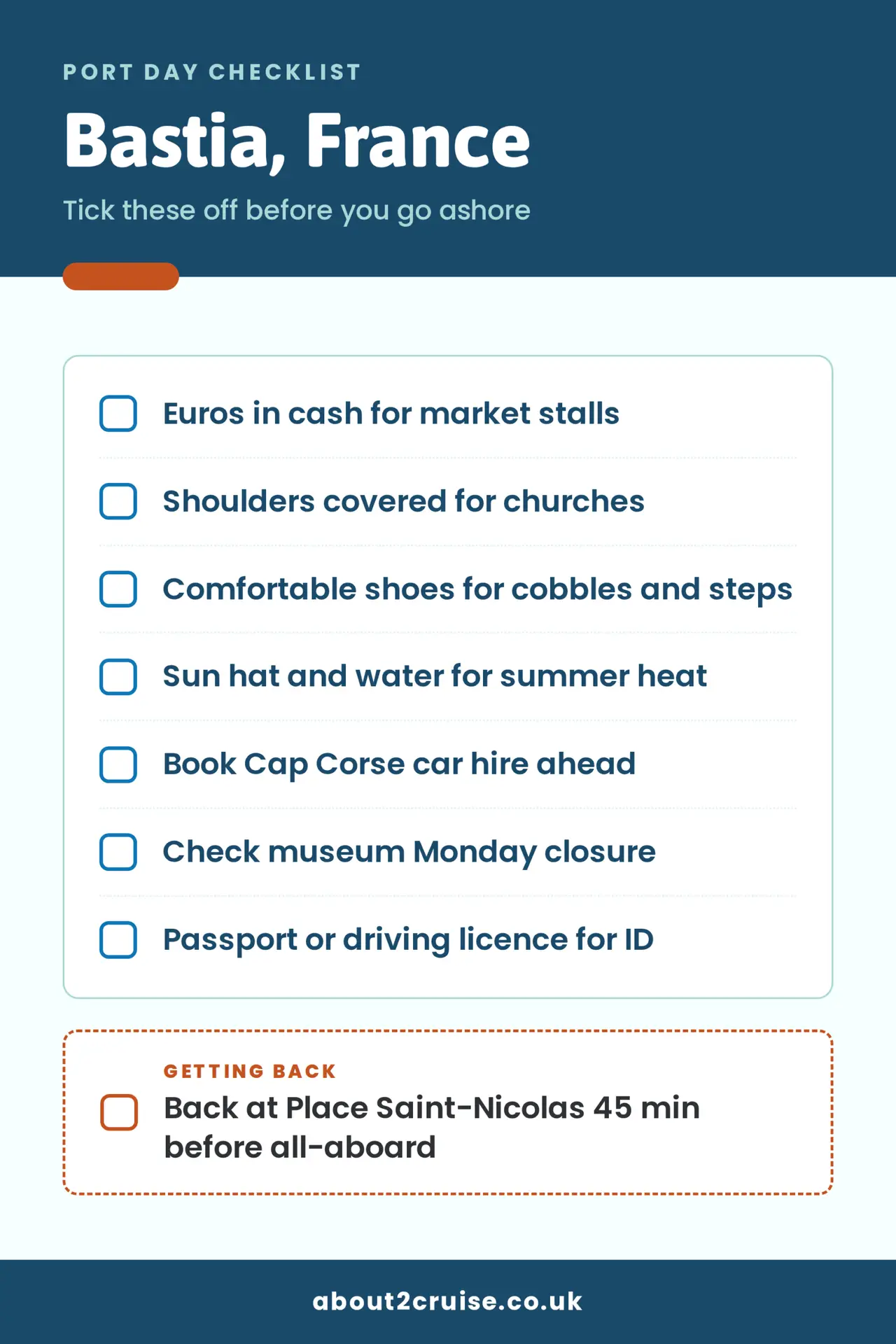
- Book Cap Corse car hire or ship excursion ahead in summer.
- Check Bastia museum opening hours and Monday closures.
- Carry euros for market stalls and small cafés.
Short port day: under 6 hours
- On dockingWalk from the quayNo city shuttleFrom the commercial berth, allow about 5 minutes to Place Saint-Nicolas and 15 to 20 minutes to the Old Port. The free shuttle only runs inside the port.
- +15 minOld Port and Saint-Jean-BaptisteWalk around the horseshoe harbour and look up at the twin-towered church above the quays. This is Bastia's postcard view.
- +45 minMantinum lift to the citadelSaves the climbThe glass lift beside the Old Port climbs about 30 metres to the top of the citadel, saving the steepest lanes.
- +1 hrBastia museum and Jardin RomieuVisit the Governors' Palace museum and gardens, then step down the Romieu garden terraces for views over the Old Port and Cap Corse.
- +2 hrs 15 minLunch near the market squareTry figatelluCorsican charcuterie, brocciu and canistrelli are the easy lunch. Find them in the market square and the surrounding food shops.
- +3 hrs 15 minAldilonda seafront walkFollow the walkway north from the Old Port towards Ficaghjola beach, with the citadel rock on one side and the sea on the other.
- All-aboard minus 45 minReturn via Place Saint-NicolasWalk back along the seafront to the port entrance. You need about 20 minutes from the Old Port to the ship.
The time on the map is the whole walk, every stop added together.
Open this walking route in Google Maps
If plans change: If the Bastia museum is closed, use the saved time to walk the Aldilonda and the seafront to Ficaghjola beach.
Long port day: 8 hours or more
- On dockingTake a Cap Corse tour or hire carFull dayMeet your ship excursion or pick up a rental car from Bastia. The D80 circuit is about 110 km and needs the whole day.
- +30 minErbalunga Genoese towerFirst stop 15 minutes north of Bastia. See the ruined Genoese tower, the rocky point and the pebble beach.
- +1 hr 30 minEast coast to MacinaggioDrive the D80 through Pietranera, Sisco and Pietracorbara to Macinaggio, the northern marina on the east side.
- +3 hrsNonza viewpointCross the col de la Serra and descend the west corniche to Nonza, perched above a black pebble beach reached by over 500 steps.
- +4 hrsLunch in Saint-FlorentTry brocciuStop at a terrace near the water in Saint-Florent for Corsican charcuterie and brocciu.
- +5 hrs 30 minPatrimonio wine tastingWine stopOn the way back on the D81, stop in Patrimonio, Corsica's oldest wine appellation. Taste Vermentino or Muscat and buy a bottle.
- All-aboard minus 60 minBack at the portDrive back on the D81 allowing extra time for the narrow corniche. Drop off your hire car or leave the tour at the terminal.
This map shows the taxi ride from the ship. The time is the drive only, not your time ashore.
Open the taxi route in Google Maps
If plans change: If you cannot get a car or the Cap Corse road is busy, take the bus to Erbalunga and spend the extra time at Arinella beach.
Frequently Asked Questions About Docking in Bastia
Where exactly is Bastia?
Bastia is on the north-east coast of Corsica, at the base of the Cap Corse peninsula, in the Haute-Corse department. The Corsican spelling is Bastìa, which explains why you sometimes see the name written that way; Bastija is a misspelling.
Do cruise ships dock at the main commercial port or some use the ferry terminal?
All cruise calls use the commercial port, not the Vieux Port. The ship’s gangway may be at the eastern quay near the ferry maritime stations, so you may see ferry buildings and ramps. That is normal. The ferry terminal area and the cruise berth are effectively in the same port complex.
Is there a free shuttle from the ship in Bastia?
There is a free shuttle inside the port grounds, but it’s not a city shuttle. If the ship is at the far end of the quay, the port shuttle can move you to the terminal or port entrance. Walk into town from there or take a taxi.
Can you walk from the cruise port to the Old Port with luggage?
You can walk, but it’s not ideal with heavy bags. The route is mostly level along the seafront, but the old-town lanes are cobbled and steep. Use a taxi or store your luggage in the city centre if you’re arriving before a hotel check-in.
What’s the best thing to do if you only have four hours in Bastia?
Walk to the Old Port, look up at Saint-Jean-Baptiste, climb or take the Mantinum lift to the citadel, see the Bastia museum gardens and the Romieu garden terraces, then eat Corsican charcuterie and canistrelli in the market square before returning along Place Saint-Nicolas.
Is the Bastia museum open on Mondays?
Hours vary by season. In high season it often opens daily in July and August, but in May, June, and September it may close Mondays. In low season it closes Sundays and Mondays and has split hours. Check on the day if you’re on a Monday call.
Can you get to Saint-Florent from Bastia on a cruise call?
Yes, by car or ship excursion. Saint-Florent is on the west side of Cap Corse, after Patrimonio. The drive takes the D81 through the wine country, and ship excursions typically run about four and a half hours for Saint-Florent and Patrimonio wine tasting. It’s possible independently, but allow extra time for the narrow corniche road.
Is it worth missing the ship’s Cap Corse tour to stay in Bastia?
It depends on your priorities. Bastia’s old town is genuinely interesting and food-focused, but Cap Corse gives you the scenic coastline and villages that most cruisers want from Corsica. If you’re on a longer cruise with other rustic towns, staying in Bastia is a good independent day. If this is your only Corsican stop, a Cap Corse tour is the safer way to see more of the island.