
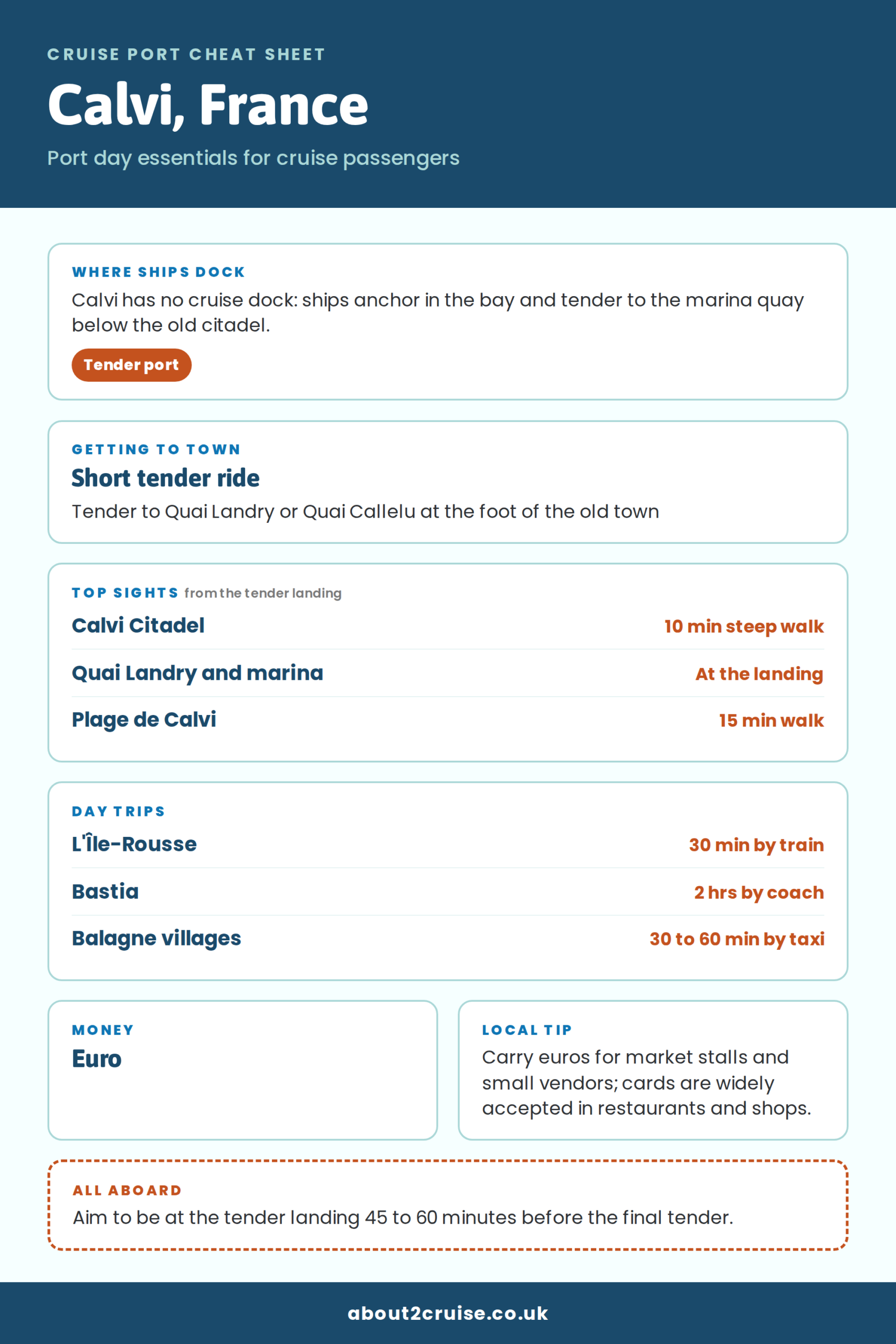
Calvi is a tender port on the north-west coast of Corsica. Cruise ships anchor in the bay and run tenders to the marina quay directly below the old Genoese citadel. From that landing, the waterfront restaurants and shops, sandy beach, and steep hilltop old town are all within walking distance. It makes a compact, attractive port day.
Where Is Calvi? A Quick Look at the Port Layout
Calvi is in Haute-Corse, on the north-west coast of Corsica, and it’s the capital of the Balagne region. The old harbour is the centre of everything: Port Xavier Colonna marina sits immediately under the citadel, the lower town spreads along the waterfront, and Plage de Calvi curves around the bay. There’s no separate cruise terminal. The tender landing is in the town-centre harbour, so your day starts right in the middle of Calvi.
If you’re travelling by road, Ajaccio is about 165 km (2 h 50 min) away, Bastia around 111 km (1 h 50 min), L’Île-Rousse about 24 km (30 min), and Calvi-Sainte-Catherine airport roughly 7 km (10 min).
A quick note on names: Calvi is on Corsica, not Sardinia. Sardinia is a separate island reached by the Bonifacio–Santa Teresa ferry. Calvià is on Mallorca, and Porto is a different Corsican village further west, best known for the Scandola reserve and the Calanques de Piana.
If you’re comparing cruise calls, Calvi sits within a wider set of Corsica cruise ports including Bastia, Ajaccio and Bonifacio.
Calvi cruise port map
Tenders bring you ashore at Quai Landry (tender landing). From the tender landing, Place du Marché is about a 2-minute walk, Calvi Citadel about 7 minutes and Notre-Dame de la Serra about 15 minutes. Tap a pin for directions.
- Quai Landry (tender landing)Where ships dock
- Place du MarchéMarket square · About 2 min walk from the tender landing
- Calvi stationTrain station · About 3 min walk from the tender landing
- Calvi CitadelMedieval citadel · About 7 min walk from the tender landing
- Notre-Dame de la SerraHilltop chapel · About 15 min walk from the tender landing
- Revellata lighthouseCoastal lighthouse · About 3 km from the tender landing
- Port de Plaisance de CalviMarina
- Gare routière de CalviBus station
- Plage de CalviBeach
- Oratoire Saint-AntoineOratory
- Tour du SelSalt tower
- Pointe de la RevellataHeadland
- Statue de Christophe ColombStatue
- Théâtre de VerdureOpen-air theatre
Arriving by Cruise Ship: How the Tender Landing Works
There’s no cruise dock in Calvi. Ships anchor in the bay and use tenders, small boats from the ship, to bring you to the quay at the foot of town. The quay area is the working waterfront around Port Xavier Colonna. The exact landing point can move between Quai Landry and Quai Callelu depending on conditions and harbour instructions, but both are next to the lower town and within a short walk of everything central.
The tender ride is usually short, but you do need to step across a moving gap between the ship’s pontoon and the tender. Crew can steady you but aren’t allowed to lift passengers. If you use a wheelchair, scooter or walker, ask your cruise line before the cruise whether tendering can be managed on your sailing. On any tender day, the ship’s master can restrict boarding if the sea is running.
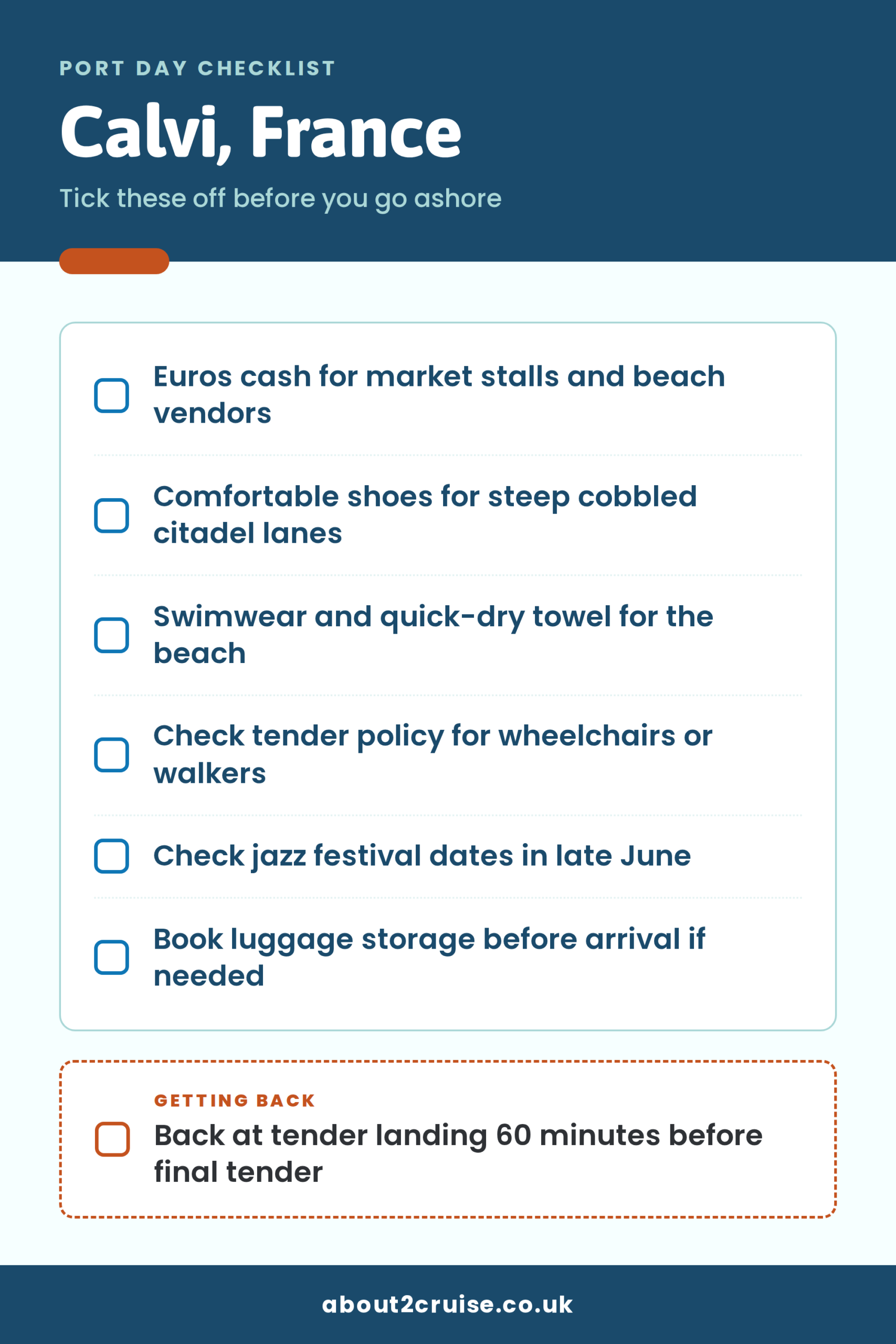
Think of tendering as a constantly running shuttle, not a timed service. You can normally go back and forth during the call, but the only all-aboard time that matters is the one printed on the ship. Return to the landing at least 45–60 minutes before the final tender, because queues build at the end of the day and sea conditions can slow the boats.
Sea state matters here. The marina is considered well sheltered except from the north-east wind. If the wind gets up or the swell is high, tendering can be delayed, wet or cancelled. Calvi is not the place to leave your return to the last possible minute.
Calvi Marina and Lower Town: What’s Around the Quay
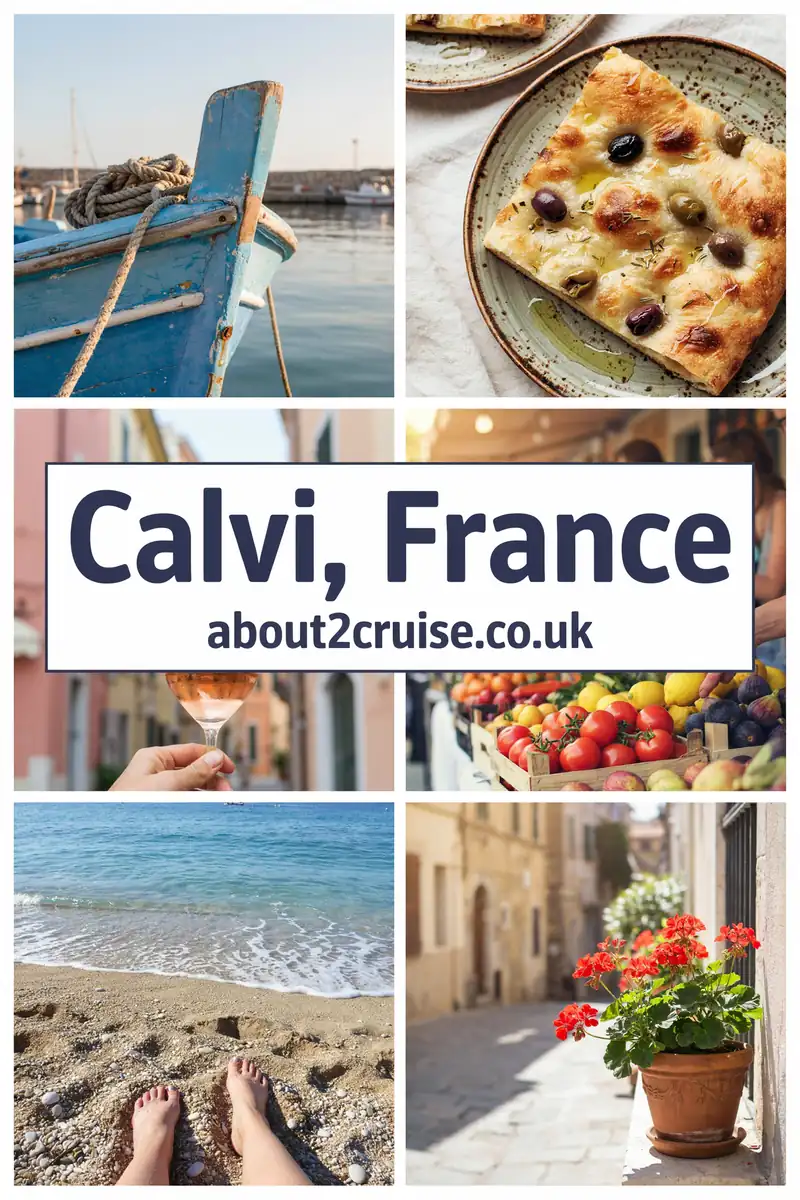
From the tender landing, you’re on the edge of the marina, not in an industrial port. Quai Landry curves around the harbour toward the Torre del Sale, lined with restaurants, cafés and bars. The covered market on Place du Marché runs every morning, usually about 08:00–13:00, and there’s a fish market on Sunday mornings at the foot of the Torre del Sale.
The lower town behind the waterfront is flat and easy to walk. Boulevard Wilson, Avenue Christophe Colomb and Rue Clémenceau are the main shopping streets. The tourist office is on the marina at Chemin de la Plage, with a seasonal information desk at the citadel entrance. There’s no large terminal building, port shopping arcade or left-luggage desk at the landing; the town itself is the terminal.
Because the marina area is so compact, you can see a lot of Calvi in a few hours without transport: coffee on the quay, market browsing, a look around the shops, then either the citadel or the beach.
Calvi Citadel and Old Town: What to Expect
The big sight is the medieval Genoese citadel on the rocky promontory above the marina. It’s free to enter and open year-round. From the tender landing it’s roughly 500–700 m, but the last part is a steep climb, and the lanes inside are cobbled, uneven and often stepped. Wear comfortable walking shoes; this is not the stop for new leather sandals.
Inside you’ll find narrow lanes, the Saint-Jean-Baptiste cathedral, the Saint-Antoine oratory, small churches, and a free contemporary art museum under the entrance porch. From the ramparts you get a 360° view over the town, marina, bay and mountains, the classic Calvi photo.
The tourist office offers an audio-guided citadel walk in English, French, German and Italian with 11 numbered stops for about €8 per person, plus a children’s treasure hunt for about €5. Guided walking tours of Calvi and the citadel are also available locally for about €16 per adult and €8 per child, with younger children often free. It’s worth joining one only if you want the history; otherwise the free rampart views and lanes are satisfying on their own.
Calvi also claims a link to Christopher Columbus. A plaque on a house in Rue Del-Filo marks the traditional birthplace claim, though most historians place his birth in Genoa. It’s a curiosity rather than a major site, but the old town is full of small details like this.
If you have limited mobility, enjoy the waterfront and lower town; the citadel climb and cobbled lanes are demanding and not step-free.
Calvi Beach and the Bay: A Relaxed Beach Day
Plage de Calvi is nearly 4 km of fine sand backed by pines, with a wooden boardwalk running from the town centre. It’s shallow and family-friendly, which makes it a very easy beach day from a cruise ship. The nearest sand is about 1 km from the tender landing along the marina and seafront, or you can walk to a beach club further along and rent a sunbed. There are beach clubs or paillotes along the sand for sunbeds and drinks.
For a DIY beach day, pack light. A quick-dry beach towel, a waterproof beach bag, a waterproof phone pouch, reef-safe sunscreen and a packable sun hat cover most of it. The sand gets hot and the sun is strong in midsummer.
Lifeguards are usually on duty from mid-June to mid-September, roughly 09:30–18:30. Respect the flag system: conditions can change quickly even if the water looks calm. There’s a dedicated reduced-mobility set-up with beach mats and Hippocampe wheelchairs available from the lifeguard post and from Calvi Nautique Club.
If you arrive by car, several signed accesses off the N197 lead to pine-shaded car parks. Calvi’s municipal parking is paid from 1 April to 31 October, so check the machine and signage even if you have a hire car. You also have to cross the railway line to reach the sand at some access points. The little Balagne beach train, U Trinighellu, serves beach halts along the bay between Calvi and L’Île-Rousse if you want to change beaches.
Revellata Peninsula, the Lighthouse, and Calvi’s Best Views
The Revellata peninsula is the rocky headland west of town, protected by the Conservatoire du Littoral, with 100 m cliffs and an automated lighthouse at the end. It’s a wild contrast to the marina and beach.
There’s a longer coastal walk from Calvi station to the Revellata lighthouse: roughly 13.8 km, about 3 h 30, with around 280 m of ascent. A shorter loop from the D81b is about 9.2 km and 2 h 45. Neither is a quick stroll before lunch; take water, wear proper shoes and carry a collapsible water bottle and a quick-dry travel towel if you plan to dip your feet or sweat through a hot hike.
For the easiest big view, Notre-Dame de la Serra chapel above town gives a panorama over the bay, mountains and citadel. It’s best reached by taxi. Other photo spots are the citadel ramparts, the pine-backed beach looking back at the old town, and Quai Landry for the marina and yacht view. A waterproof phone pouch is useful if you are taking photos near the water.
Calvi Jazz Festival and Other Seasonal Events
Calvi’s jazz festival is the island’s oldest jazz event, usually four days in late June, with performances in Calvi and nearby Lumio. It’s small but lively, with around 45 artists and tickets from about €15. If your cruise calls around late June, it’s worth checking whether the festival overlaps your date.
Even if there’s no festival, summer brings markets, open-air eating, and a much busier, more sociable waterfront. The busiest time is July–August. If you prefer a calmer Calvi, May, June, September and early October are better, but some beach clubs and seasonal services may be reduced outside high summer.
Do You Really Need a Shore Excursion in Calvi?
For most cruise passengers, no. The citadel, lower town, marina, market and beach are all within walking distance or a short ride, and the town is easy to read. A half-day DIY plan works well: climb the citadel first while it’s cooler and less crowded, come down for a coffee or market stop, then spend the rest of the call on the beach or at a waterfront restaurant.
Shore excursions earn their money when you want to go beyond the town: inland Balagne villages, mountain viewpoints, wine tasting, or longer coastal scenery. Local guided walks and tours of the citadel are available from the tourist office and cost modestly, so you don’t need an expensive ship excursion for history. Taxis are useful for Notre-Dame de la Serra or a specific village. A tourist train or the little beach train is an easy alternative if you want to sit and see the bay.
If you have very limited time or poor mobility, staying on the flat waterfront and taking a short tourist train or local taxi is more comfortable than trying to conquer the old town.
Where to Eat and Drink in Calvi
Calvi’s restaurant centre is Quai Landry and the lanes immediately behind the marina. That’s where you’ll find everything from pizza and seafood to Corsican slow-food plates. Because the harbour is central, you can have lunch facing the boats and still be five minutes from the tender landing.
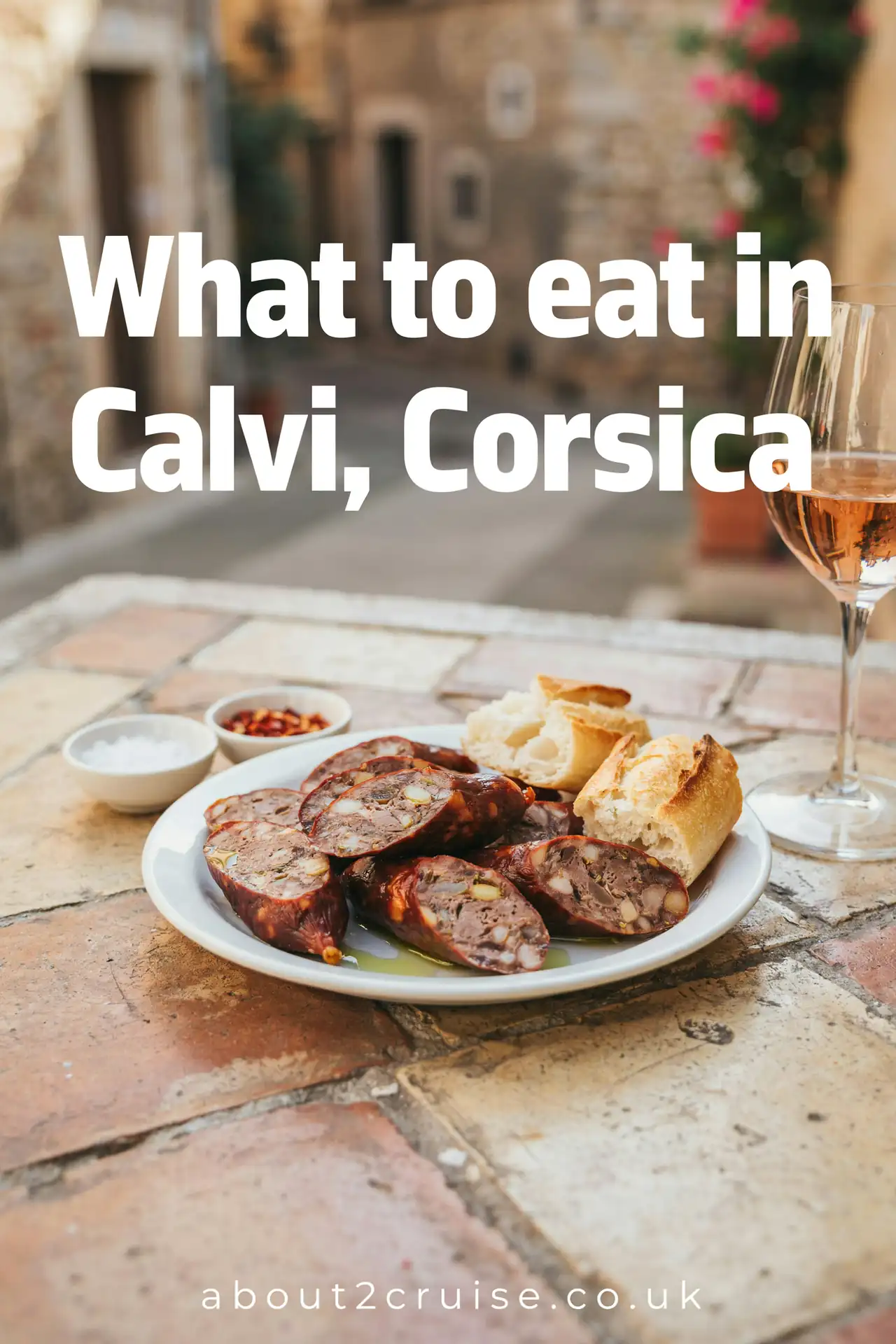
Signature things to try: aziminu (Corsican rockfish soup), pulenda (chestnut-flour polenta), figatellu (Corsican sausage), brocciu (ewe’s or goat’s whey cheese), fiadone (brocciu and lemon cake), and canistrelli biscuits. Market stalls often sell migliacci, nicci and brocciu fritters, which are ideal if you want something quick and local. For drinks, look for Pietra chestnut beer, Cap Corse aperitif, and white Vermentino from the Corse Calvi appellation.
The covered market is the place for cheese, charcuterie and produce. For a proper restaurant lunch, the Quai Landry waterfront is the obvious choice, but the quality is generally better in the small streets behind the port than in the most touristy front-row tables. Cash is helpful for market stalls and small vendors, while cards are widely accepted in restaurants and shops.
Shopping in Calvi: Marina and Old Town
Shopping in Calvi is compact and easy: Boulevard Wilson, Avenue Christophe Colomb and Rue Clémenceau are the main streets in the lower town, while the citadel lanes have smaller crafts and souvenir shops. The covered market is best for food gifts, honey, charcuterie, cheese, biscuits, wine and herbs.
Typical non-food buys are Corsican knives, olive-wood crafts, ceramics and local textiles. There’s no cruise terminal mall or duty-free arcade at the tender landing; the port shops are the town’s shops. The main thing to know is that prices are higher along the immediate waterfront. A five-minute walk back into the lanes usually gives you more character and better value.
Getting Around Calvi: Walking, Train, Taxi, Bus, and Car Hire
Walking is the default. The lower town, marina, station and tender landing are all within a few minutes of each other, the citadel is a steep 500–700 m away, and the beach is roughly 1 km along the seafront.
The Balagne train is useful if you want a scenic ride. Calvi–L’Île-Rousse costs about €6 one way. The little beach train runs along the bay, and the main CFC railway has two main-line departures a day from Calvi toward Bastia, Corte and Ajaccio. Buy tickets at the station or on the train; there’s no seat reservation. For a week of network travel, the Pass Liberta costs about €50 for seven days.
Taxis are better for Notre-Dame de la Serra or inland villages. There’s a taxi rank, and airport transfers are typically about €20–30 from Calvi-Sainte-Catherine airport. Coach services to Bastia take about two hours and cost around €19. Car hire is not worth it for a single cruise day unless you intend to leave Calvi immediately and have a long call. The ferry situation is less clear: some sources list Calvi ferry crossings, but Balagne ferry traffic more commonly uses L’Île-Rousse, about 30 minutes away.
Calvi Weather, Sea Conditions, and When to Visit
Calvi’s cruise season runs roughly May to October. Daytime maxima are around 19°C in May, 23°C in June, 26°C in July and August, 24°C in September and 21°C in October. Sea temperature climbs from about 17°C in May to 25°C in July–September, so midsummer is best for swimming. July is the driest month, August is still relatively dry, and October and November are wetter.
The biggest weather risk to a Calvi call is not rain but wind and swell, because this is a tender port. The harbour is exposed to the north-east; if a north-east wind is blowing or the sea is running, tendering can be delayed or cancelled. Shoulder-season calls are cooler but often less crowded. Pack a packable lightweight jacket for early or late season, and carry a collapsible water bottle in summer. Also remember that forest and scrub access can be closed at short notice in hot, dry conditions because of wildfire risk.
Practical Cruise Day Info: Money, Safety, Luggage, and Accessibility
France uses the euro. Calvi has ATMs and bank branches, and cards are widely accepted in restaurants, hotels and larger shops. Markets, beach sellers and some small vendors may prefer cash, so carry a small amount of euros. Keep your passport and cards protected in a zipped pocket or bag, and consider an anti-theft backpack in busy areas.
For emergencies, dial 112. The SAMU number is 15 and the fire service is 18. The gendarmerie is on Route d’Ajaccio, and the Centre hospitalier Calvi-Balagne has a 24/7 emergency department on Lieu-dit Guazzole.
There’s no official left-luggage at the port, marina, station or tourist office. Commercial storage networks list partner shops and lockers in Calvi from roughly €4–6 per bag per day; if you need storage, book before arrival and check opening times, as they are not cruise facilities.
Accessibility centres on the tender. Once ashore, the waterfront and lower town are easier. The citadel is steep and cobbled. The beach has reduced-mobility mats and Hippocampe wheelchairs from the lifeguard post and Calvi Nautique Club. The marina has a defibrillator and is listed as accessible independently or with help, but the moving tender remains the main barrier for those with limited mobility.
Duty-Free? Customs and Local Rules for Cruise Passengers
Calvi is in France, so there’s no duty-free shopping on a call within the EU in the way some passengers expect. The real question is your return to the UK. British personal allowances include 42 litres of beer, 18 litres of still wine, 4 litres of spirits over 22% or 9 litres of other alcohol, 200 cigarettes or equivalent, and other goods worth up to £390, or £270 by private boat. If you exceed any allowance, you pay tax and duty on the whole category, not just the excess.
Do not bring back protected food or plant items without checking current UK rules, and remember that causing a wildfire in France is illegal even if accidental. Respect any local access restrictions in forest and scrubland during hot weather.
Common Calvi Visitor Mistakes to Avoid
- Assuming Calvi has a cruise terminal or dock, there isn’t one.
- Overplanning a big inland tour on a short tender day and then missing the town’s best simple thing: the citadel and bay views.
- Returning to the tender point exactly at the last tender, especially when a queue has formed.
- Wearing flip-flops into the citadel and slipping on steep, polished cobbles.
- Confusing Calvi with Sardinia, Mallorca’s Calvià, or Porto in western Corsica.
- Swimming outside flagged areas or ignoring changing sea conditions.
- Visiting the beach without checking parking payment if you drove; Calvi municipal parking is paid April–October.
- Spending all day in the first waterfront restaurant and missing the better-value lanes behind the port.
- Not carrying cash for small market stalls and beach vendors.
- Underestimating the midday heat on the exposed quay below the citadel.
More Corsica and Western Mediterranean Ports
If Calvi is one stop on a larger Mediterranean cruise, compare it with the island’s other convenient ports. Bastia gives you Cap Corse and the north-east coast, Ajaccio is Napoleon’s home town, and Bonifacio is the cliff-top harbour near Sardinia. For the wider region, see our Western Mediterranean cruise ports guide and our Corsica cruise ports overview.
How to spend a port day in Calvi
A port day in Calvi works best if you pick one: a slow morning in the citadel and old town, or a longer day that adds the beach.
Before you sail
- Check your cruise line's tender policy for wheelchairs, scooters or walkers.
- Check Calvi Jazz Festival dates if your call is in late June.
- Book a luggage storage shop before arrival if you need it.
Short port day: under 6 hours
- On dockingTake the tender to Quai LandryNo cruise dockShips anchor in the bay and tender passengers to the quay below the citadel. The ride is short but may be wet.
- +15 minClimb to the Calvi Citadel500 to 700 m from the landing, last part steep. Free entry, cobbled lanes and rampart views.
- +45 minExplore the citadelWalk the ramparts, see the cathedral and the free art museum under the entrance porch.
- +1 hr 30 minCovered market at Place du MarchéRuns every morning until about 13:00. Browse cheese, charcuterie and local biscuits.
- +2 hrsLunch near Quai LandryTry aziminuCorsican fish soup is the dish to try. Lanes behind the marina offer better value than the front row.
- +3 hrsLower town shopsBrowse Boulevard Wilson, Avenue Christophe Colomb and Rue Clémenceau for crafts and souvenirs.
- +3 hrs 45 minStroll back along the marinaWalk Quai Landry to the Torre del Sale, then return to the tender landing.
The time on the map is the whole walk, every stop added together.
Open this walking route in Google Maps
If plans change: If the citadel is closed for an event, the waterfront, covered market and lower-town shops fill the same hours on foot.
Long port day: 8 hours or more
- On dockingTake the tender to Quai LandryNo cruise dockTenders run from the anchored ship to the marina quay. The ride is short but you step across a gap; crew can steady but not lift you.
- +15 minClimb to the Calvi CitadelA 500 to 700 m walk from the landing, the last section steep. Entry is free and the ramparts give the classic view over the bay.
- +45 minOld town lanes and cathedralCobbled lanes, Saint-Jean-Baptiste cathedral and the Christopher Columbus plaque are inside the citadel.
- +1 hr 30 minCovered market at Place du MarchéRuns every morning until about 13:00. Good for cheese, charcuterie and produce.
- +2 hrsLunch near Quai LandryTry aziminuOrder aziminu rockfish soup or a brocciu dish in the lanes behind the marina, rather than the busiest front-row tables.
- +3 hrs 30 minWalk to Plage de CalviAbout 1 km along the marina and seafront to the sand. A wooden boardwalk runs from the town centre.
- +4 hrsBeach timeLifeguards in summerPlage de Calvi is shallow and family-friendly. Sunbeds are available at beach clubs, or use the free sand.
The time on the map is the whole walk, every stop added together.
Open this walking route in Google Maps
If plans change: If the beach is closed, stay around the marina and Quai Landry, or take the little beach train along the bay for the sea views.
Calvi Cruise Port FAQs
Is Calvi worth visiting on a cruise?
Yes. It gives you a proper Corsican port day without needing a long coach transfer. The Genoese citadel, old town, marina and sandy beach are all in one compact area, and the view from the ramparts is one of the most recognisable scenes in Corsica.
Where exactly does the tender drop passengers in Calvi?
At the town-centre marina quay below the citadel, usually around Quai Landry or Quai Callelu. There is no separate terminal building. The old town, restaurants and shops are immediately behind the waterfront.
How long is the tender ride in Calvi?
The ride itself is short, often well under 10–15 minutes once you are on the boat. The bigger variable is waiting time, especially at the start and end of the call. Allow extra time for queues and sea conditions.
Can I walk to everything from the Calvi tender landing?
Yes for the citadel, old town, marina, market and nearest beach. The citadel involves a steep climb. Notre-Dame de la Serra and the Revellata lighthouse are better by taxi or, for the lighthouse, a proper hike.
Is Calvi in Sardinia?
No. Calvi is on Corsica, which is part of France. Sardinia is a separate Italian island to the south, reached from Corsica via ferry.
Is there luggage storage at Calvi cruise port?
There is no official left-luggage at the port, marina, station or tourist office. Commercial storage providers have partner shops and lockers in town, typically about €4–6 per bag per day, but they should be booked in advance.
Do I need a shore excursion in Calvi?
Not for the town, beach or citadel. You mainly need an excursion, taxi or local guide if you want to visit inland Balagne villages, vineyards, mountain viewpoints, or longer sections of coast.
What should I do with one day in Calvi?
A good plan is to climb the citadel first, visit the covered market and lower-town shops, have a Corsican lunch near the marina, then walk along the seafront to the beach or take the little beach train for a scenic ride along the bay.
Last Updated: 15 November 2026