
Madagascar’s cruise ports are Nosy Be, Antsiranana, Toamasina, Taolagnaro, Mahajanga, Sainte-Marie, Toliara and Morondava, plus smaller expedition landings at Nosy Komba, Nosy Tanikely and Nosy Hara. Nearly all of them are port-of-call stops rather than turnarounds, and ships either tie up at a commercial quay or anchor and ferry you ashore in a tender.
Madagascar cruise ports map
Madagascar has 8 cruise ports: Mahajanga in the north-west; Nosy Be and Antsiranana in the north; Sainte-Marie in the north-east; Mauritius in the east; Toamasina in the south-east; Toliara and Morondava in the south-west. Tap a pin to open that port’s guide.
Nosy Be (Hell-Ville): tenders to the island capital
There’s no cruise berth on Nosy Be, so the ship drops anchor in the bay and runs tenders to the Hell-Ville landing. That’s a 15 to 20 minute ride. Hell-Ville’s official name is Andoany, and the market and the colonial streets are about 10 minutes’ walk from the pier.
If it’s your first time in Madagascar, this is the call that does the most work for you. Lokobe Special Reserve and Nosy Komba fit into half a day.
Nosy Tanikely is the marine trip most people book. Nosy Iranja needs seven to eight hours, which tells you what sort of day that one is.
Antsiranana (Diego Suarez): Montagne d’Ambre and the Red Tsingy
Antsiranana, which everyone calls Diego Suarez, uses Port d’Antsiranana. Most ships that can berth use the commercial quay, with 8.5 m alongside; very large ships may anchor instead, and landing plans can change. A ship’s master once looked at a purpose-built pontoon, decided it was unsafe and abandoned the call altogether.
The town centre is a 15 to 20 minute walk. Montagne d’Ambre is 30 to 35 km out, 45 to 60 minutes by road, and the Red Tsingy eats three to four hours on its own.
Montagne d’Ambre is where you go for crowned lemurs and Sanford’s brown lemurs, best between 08:00 and 11:00, and you’ll need a park guide. Doing both in one day takes seven to eight hours, which is most of your call gone.
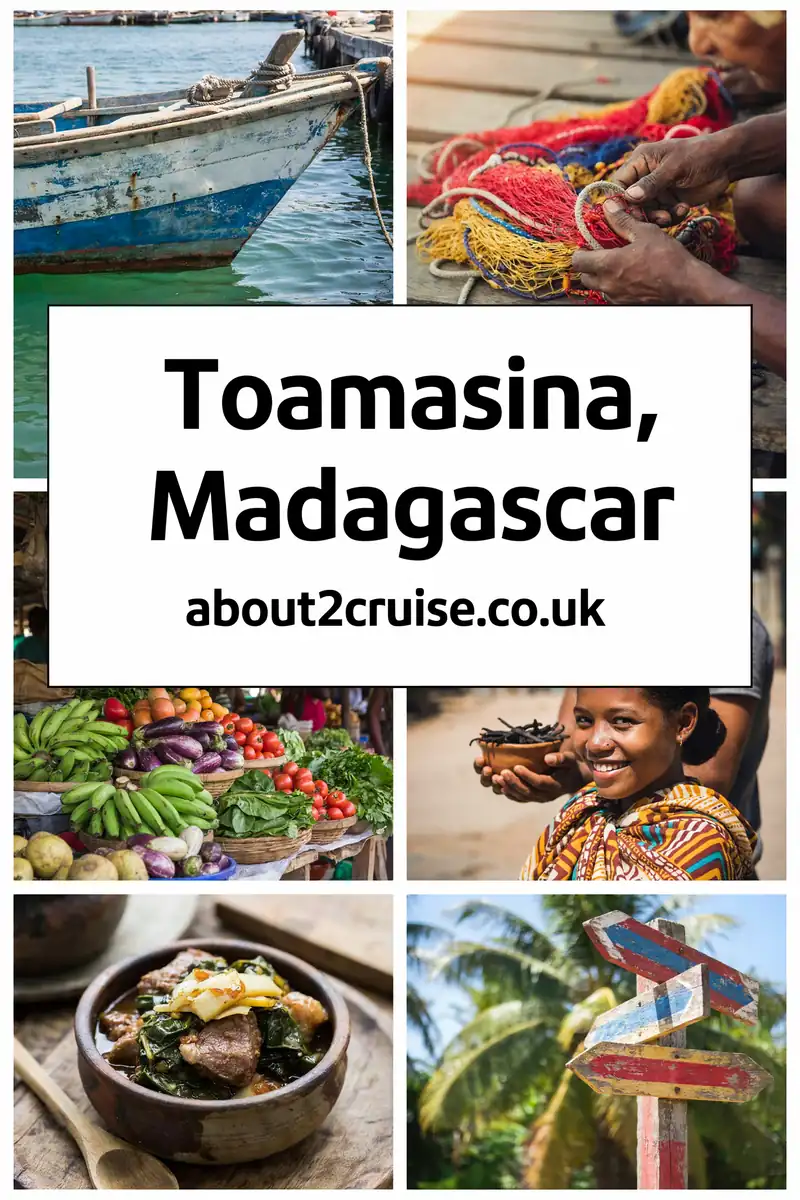
Toamasina (Tamatave): quai Môle B and the Canal des Pangalanes
Toamasina, or Tamatave, is Madagascar’s main commercial port, run by the Société du Port à gestion Autonome de Toamasina (SPAT). Cruise ships berth at quai Môle B, and the surroundings are industrial rather than pretty, so use the ship’s shuttle or an approved pick-up to get clear of the port before you start doing your own thing.
The Canal des Pangalanes is the trip people come for. Ivoloina Park is the low-effort wildlife option. Andasibe-Mantadia is a full day inland, so it only works if your call is a long one.
Taolagnaro (Fort-Dauphin): shuttle from Port d’Ehoala
Ships dock at Port d’Ehoala, about 10 km from Fort-Dauphin, and there’s no walking route between the two. Free shuttle buses run between the port and the town. Smaller expedition vessels sometimes tender straight to the town waterfront instead.
Nahampoana reserve is within 10 km and holds six species of lemur. Libanona beach is a bajaj three-wheeler ride away. Berenty is about 85 km off, and typical calls run seven to nine hours, so Berenty is a stretch.
Mahajanga (Majunga): quai du bac and the cirque rouge
Mahajanga, or Majunga, is a secondary ocean-going port. Ships work at the quai du bac, where APMF put in a removable gangway and steps so you don’t have to step into the water.
The two local trips are the sacred lake of Mangatsa and the cirque rouge.
Sainte-Marie (Nosy Boraha): Port de l’Ilot Madame and whale watching
Sainte-Marie, or Nosy Boraha, lands you at the Port de l’Ilot Madame, with a second facility used by tourist passenger ships. The cargo berth is only 150 m with 4.5 m of draft and takes vessels up to 250 t, so don’t expect a big ship alongside. This one is a small-ship call.
Humpback whales are the reason anyone comes here.
Toliara (Tuléar): Nosy Ve and Sarodrano on the south-west coast
Toliara, or Tuléar, is a secondary ocean-going port on the south-west coast, and the calls here are expedition-sized. Nosy Ve and Sarodrano are the marine and beach landings smaller ships use. It’s not a town-based port day.
Morondava: west-coast expedition calls
The Ministry of Tourism records cruise calls at Morondava, and smaller expedition ships pair it with Belo sur Mer. It’s a west-coast stop for small ships, and the day is an expedition landing rather than a big-ship port day.
Smaller expedition landings
Nosy Komba
Nosy Komba is 20 minutes by boat from Hell-Ville, with semi-wild lemurs and the village of Ampangorina. The lemur-on-your-shoulder photo comes with a small cash tip for the villagers, so bring coins. The boat leaves from the same pier your tender arrives at.
Nosy Tanikely
Nosy Tanikely is the most popular marine excursion from Nosy Be, with turtles and tropical fish. Reef shoes aren’t a style choice here: stonefish, sea urchins and reef cuts all have a say. Reef-safe sunscreen is required.
Nosy Hara
Nosy Hara’s marine tsingy is a protected area with around 280 marine species. It’s a snorkelling stop, not something you walk around, so plan a water day and leave the walking shoes on the ship.
Where Madagascar cruises leave from: Mauritius, Cape Town and Durban
You don’t join a Madagascar cruise in Madagascar. UK passengers fly out and board abroad, usually in Port Louis in Mauritius, Cape Town or Durban, with Madagascar as the port calls.
There are no direct flights from the UK either: you connect via Paris, Addis Ababa, Nairobi or Johannesburg, and the whole thing commonly runs 13 to 22 hours including the layover. The shortest London to Antananarivo connection is about 13 hours 15 minutes via Nairobi.
Otherwise Madagascar turns up on long world voyages from Southampton and on Indian Ocean grand voyages, not on short round-trip UK itineraries. If you board in Mauritius, the Port Louis cruise port guide covers the transfer from the airport. If you’re still weighing up embarkation ports, the cruise port guides index sets out the practical detail for each one.
Which cruise lines go to Madagascar
MSC Cruises includes Antsiranana and Nosy Be on South Africa and Indian Ocean itineraries, and Fort Dauphin on Southern Africa voyages. Ponant runs Madagascar-focused expedition voyages of roughly 10 to 14 days with Le Dumont-d’Urville, Le Champlain, Le Bougainville and Le Lyrial.
Regent Seven Seas Cruises’ Seven Seas Voyager runs a Cape Town to Mauritius route calling at Nosy Be, Antsiranana and Toamasina, and Azamara places Taolagnaro mid-voyage between Réunion and Richards Bay. Silversea Cruises, Seabourn, Oceania Cruises and Crystal also feature the island. Royal Caribbean International and Carnival Cruise Line don’t include Madagascar on standard itineraries.
How a Madagascar port day works: tenders, timing and booking
Most Madagascar calls run eight to ten hours, though expedition ships may overnight at Nosy Be or Diego Suarez for 16 to 24 hours, and MSC sometimes schedules six to seven hours at Nosy Be, which doesn’t leave much room for a slow lunch.
- Be back at the landing 45 minutes before the announced last tender. Ships do leave passengers behind, and the afternoon road back to the Hell-Ville pier clogs with minibuses and fruit trucks.
- Book shore trips two to three months out. Operators fill 60 to 90 days ahead, and the agent at the tender pier offering trips well below the going rate has a habit of missing the reboarding deadline.
- Nosy Be’s rough missed-call rate is 3 to 7%, with tender lines the usual reason passengers cut it fine.
- On Ponant, the excursion programme appears about eight months before departure, booking opens about two months before, and only one excursion per port day can be pre-booked. One.
- At tender ports, stepping from ship to small boat can be difficult, so passengers with limited mobility should ask the cruise line whether tendering is possible on the day.
Madagascar visa rules for UK passports
UK passport holders can visit for up to 15 days without a visa, paying an administration fee on arrival and showing onward or return tickets. Stays longer than 15 days need a 30 or 60 day single-entry tourist visa, bought on arrival in US dollars, euros or ariary and extendable to 90 days in total.
Your passport must be valid for at least six months beyond arrival, have at least two blank pages and be stamped on entry. Visa counters at the airport are cash only, and the official eVisa portal at evisamada.gov.mg warns of fraudulent copycat sites. Fees are listed on evisamada.gov.mg and in the Foreign, Commonwealth and Development Office travel advice, so check the current charge before you travel.
All arrivals complete a health declaration and undergo screening; a yellow fever certificate is required if you arrive from a country listed as a transmission risk, and a polio certificate in some circumstances. You may hear that cruise passengers in port under 24 hours get a free visa. Don’t bank on it: check with your cruise line before you sail.
Safety ashore in Madagascar
The Foreign, Commonwealth and Development Office advises a high degree of caution across Madagascar, and the practical risks for a port day are street crime, isolated beaches and road travel.
- Robberies and thefts are commonplace and foreigners are targets. Violent robberies and assaults have happened in daylight on isolated and remote beaches, including on Nosy Be, at Ankify Port, around Ambanja and on beaches north and south of Toliara. Get local advice or use an experienced operator for any beach.
- Armed robberies on main roads are frequent at night and outside major towns. Avoid multi-passenger minibuses and taxi-brousses, on crime and road-safety grounds.
- Carry your passport at all times, as police make random ID checks and do not always accept copies. Do not photograph police or security personnel.
- Check fady, the local taboos, with a guide before visiting rural areas. In the south, the triangle between Ihosy, Toliara and Fort Dauphin is tense, and the FCDO advises travelling to Fort Dauphin by air.
- Boat travel can be dangerous, with overloaded, poorly maintained craft. There’s no local app-based transport, and public transport is unreliable.
Money, cash and customs on a Madagascar port day
Madagascar uses the Malagasy ariary. Shore operators commonly accept US dollars or euros in cash, while small restaurants and souvenir vendors in Hell-Ville take ariary only. There are ATMs in Hell-Ville centre within walking distance of the tender pier, accepting Visa and Mastercard; Amex is less reliable, and paying by card at smaller venues is a gamble.
Up to 400,000 ariary may be taken into Madagascar, and foreign cash of 7,500 euros or more must be declared. Taking food, including fruit, into Madagascar is illegal, and collecting, buying or exporting protected animals, plants or products made from them is illegal, including certain woods such as rosewood.
Madagascar cruise port FAQs
Is Antananarivo a cruise port?
Antananarivo isn’t a cruise port. It’s inland, and no sea port appears for it on the Agence Portuaire Maritime et Fluviale (APMF) port list. Cruise calls are at coastal ports such as Nosy Be, Antsiranana, Toamasina and Taolagnaro.
How many cruise ships call at Madagascar each year?
Roughly 30 to 60 cruise ship calls a year, across all Madagascar ports combined. That’s small enough that port days are patchy, and local operators fill up when a ship is in.
Can a Madagascar cruise start in Madagascar?
A Madagascar cruise can start in Madagascar, though most calls are port-of-call stops. Nosy Be, Antsiranana, Toamasina and Fort Dauphin are named as possible Indian Ocean embarkation points. UK packages more commonly board in Mauritius, Cape Town or Durban.
What is the local beer in Madagascar?
Three Horses Beer, usually called THB, is the local beer. You’ll see it at cafés by the Hell-Ville harbour, where you can watch dhows and tenders.
What should I buy on a Madagascar port day?
Vanilla, local spices, hand-woven textiles, embroidered linen, wood carvings and straw articles are the usual buys. The Bazar Be in Hell-Ville is about 10 minutes from the tender pier, and quayside vendors display similar crafts.
Last Updated: 13 November 2026