
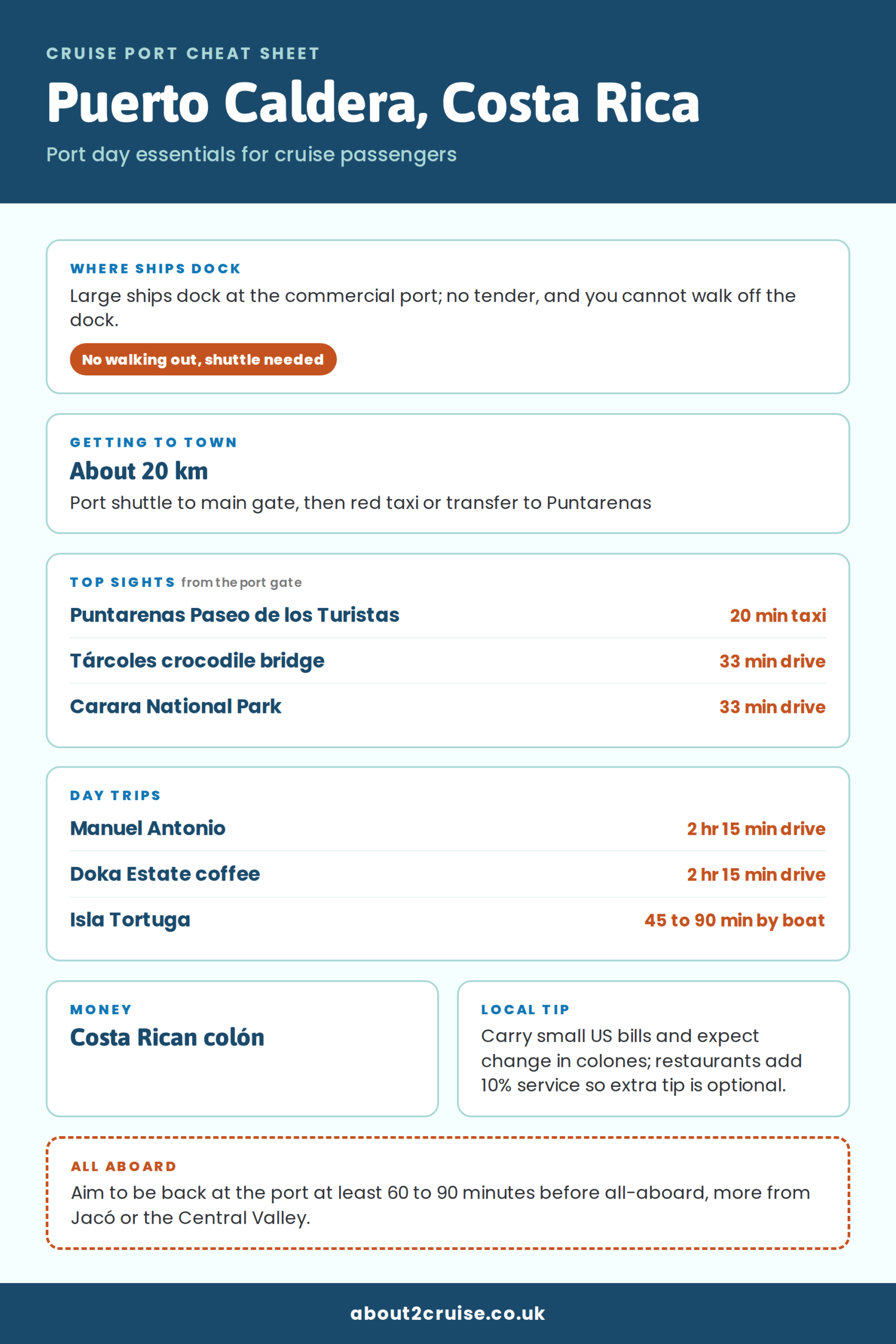
Puerto Caldera is Costa Rica’s Central Pacific cruise gateway: a working commercial port about 20 km south of Puntarenas, often sold under the Puntarenas name. This is not a walk-off town pier. Most good days involve a vehicle, a guide and a firm return-to-ship buffer, with rainforest, crocodiles, coffee, Jacó or a catamaran as the payoff.
Puerto Caldera vs Puntarenas: Two Ports That Sound the Same
They are two different places. Puntarenas is the town pier right on the Paseo de los Turistas promenade. Puerto Caldera is a commercial port in Esparza canton, roughly 20 km south. Some cruise lines sell the stop as “Puntarenas (Puerto Caldera)”, while others write “Puerto Caldera, San José”. That confusion matters a lot.
At Puntarenas you can walk straight into town. At Caldera you are inside a working port and cannot walk off the dock. So before you make any plans, check your itinerary and the actual port name on your booking. The port authority publishes separate cruise lists for both ports, and larger ships or expedition vessels often end up at Caldera because Puntarenas can’t take them or the swell is too much.
If your ship is actually at Caldera, you need transport for even the simplest town visit.
If your cruise also calls on Costa Rica’s Caribbean side, our Puerto Limón cruise port guide compares the walk into town and taxi options.
What the Terminal and Working Port Actually Feel Like
Your first impression will be industrial. This is Costa Rica’s main Pacific commercial port, so expect container ships, bulkers, cargo vessels and maybe tuna boats alongside the cruise berths. The good news? Ships tie up alongside, so there’s no tendering.
The passenger terminal itself is small. There are a few souvenir shops, a seating area and restrooms, but no food or drink and no left-luggage service. There is also no useful passenger car park, so do not plan to leave a car here.
This is not a purpose-built cruise village. If you stay on board, you’ll be looking at port infrastructure rather than a beach. If you get off, you need a destination or a transfer, because the terminal area can be seen in a few minutes.
If your cruise also calls in Guatemala, our Puerto Quetzal cruise port guide covers the working port, the terminal market and timing a trip to Antigua.
Puerto Caldera cruise port map
Ships dock at Puerto Caldera Cruise Terminal. Tap a pin for directions.
- Puerto Caldera Cruise TerminalWhere ships dock
- Puntarenas Paseo de los TuristasSeafront promenade · About 16 km from the port gate
- Puntarenas CathedralCathedral · About 15 km from the port gate
- Municipal Market, PuntarenasMarket · About 15 km from the port gate
- Tárcoles crocodile bridgeCrocodile-viewing bridge · About 17 km from the port gate
- Carara National ParkRainforest national park · About 21 km from the port gate
- Jacó BeachSurf beach · About 35 km from the port gate
- Isla TortugaIsland · About 25 km from the port gate
- Doka Estate CoffeeCoffee estate · About 59 km from the port gate
Getting Off the Ship, Through Security and Out of the Gate
If you booked a ship-organised excursion, it usually leaves right from the pier, so you may not need the shuttle bus at all. Independent taxis, private drivers and tour operators are generally not allowed inside the port. They wait outside the main gate.
For independent bookings, the normal routine is to take the free shuttle from the gangway to the commercial-port exit and meet your driver there. Some operators say the walk from the berth to the van queue is about five minutes, but don’t assume you can wander through the cargo area on foot. Follow the port’s instructions.
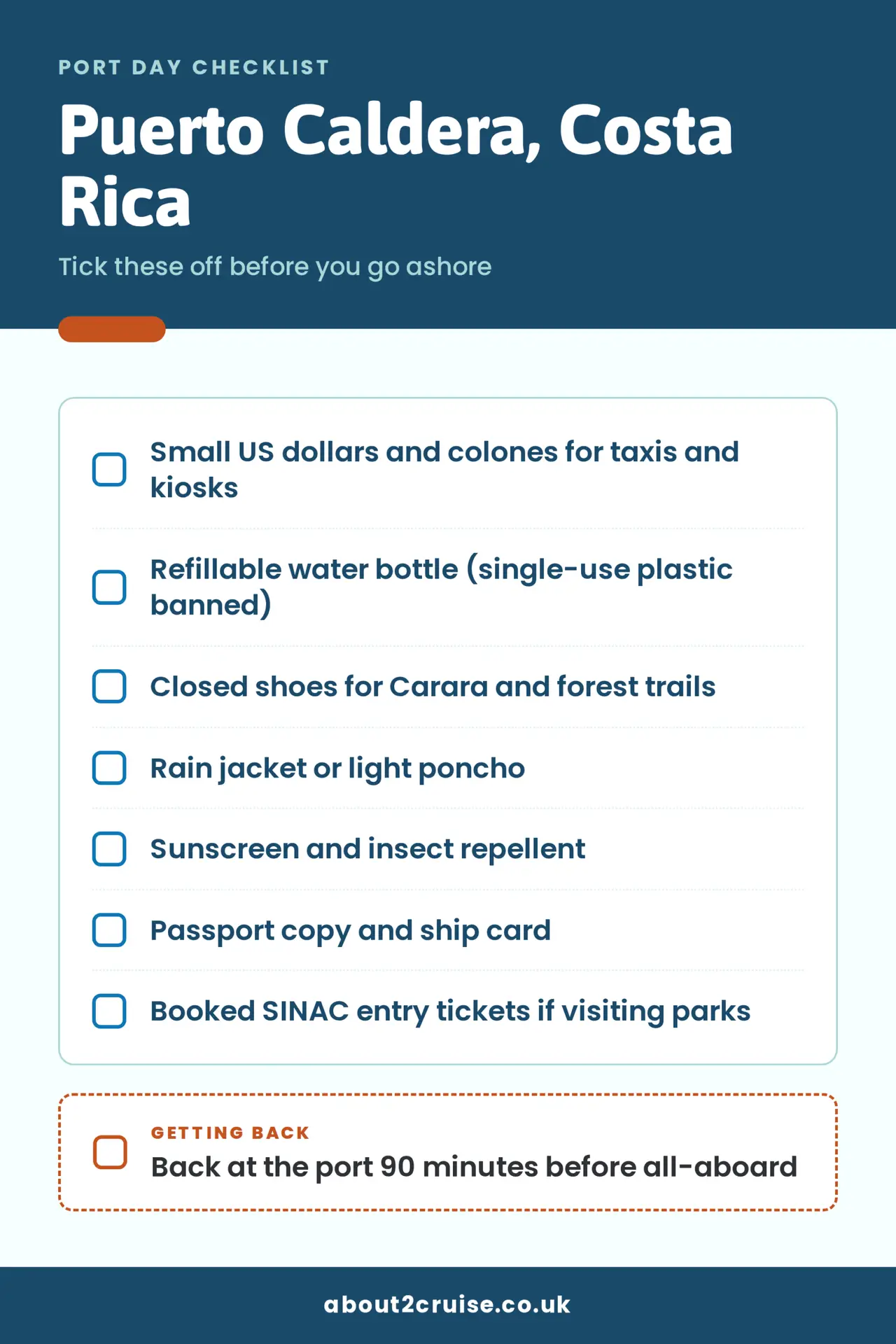
Carry your ship card and a photo ID, like a printed passport copy. Security may check ID at the gate, and Costa Rican law expects foreigners to prove legal identity. Keep the original passport in the safe unless a specific excursion or the ship tells you otherwise.
Taxis, Fares and Ride-Hailing at the Gate
Official Costa Rican taxis are red with a triangular sticker and a roof box showing the company name and number. The driver’s ID should be visible, and the metre should be used when available. For a Caldera-to-Puntarenas run, estimates vary from roughly US$14 to US$25 one way. There’s no easy official published fare, so agree on the price or confirm the metre before you set off.
Avoid unlicensed taxi piratas who may approach passengers outside the gate.
Ride-hailing apps are not something to rely on here. Uber lists Puntarenas among its Costa Rican cities, but cars are concentrated in the Central Valley, and the apps operate without a full legal framework. DiDi and inDrive also exist nationally. In practice, for a ship call, a pre-booked private transfer or a licensed taxi is far more dependable than hoping a car is nearby.
Ship Excursions vs Independent Tours: Which Is Smarter Here?
Ship excursions are the low-stress choice at this port. They meet at the pier, you skip the gate shuttle, and the cruise line’s operator handles the timing. That matters because many of the best experiences are 45 minutes to more than two hours from the ship.
Independent tours can be more flexible and cheaper, but they pick up outside the main gate. Reputable operators are usually very familiar with cruise schedules and say they build in a return around 90 minutes before all-aboard, even covering the cost of catching the ship at the next port if they’re late. Confirm that promise before handing over money, and double-check the ship’s all-aboard time yourself.
For first-time Costa Rica cruisers, a private or small-group independent tour with a naturalist guide can be excellent, especially for Carara or the Tárcoles river. For long-distance options like Manuel Antonio or anything in the Central Valley, a ship tour or a very well-reviewed private operator is safer.
Timing, Ship Time and All-Aboard
Most calls are eight to twelve hours, with ships arriving in the morning and sailing for Panama or the next Pacific stop in the late afternoon or evening. Check whether your ship keeps ship time or local time. Costa Rica is on UTC−6 all year and does not change clocks, but not every cruise ship changes its onboard clocks to match. If your phone says one time and the gangway sign says another, the gangway sign is the one that protects your cruise.
An operator may schedule pickup 30 minutes after arrival and return 90 minutes before all-aboard. Treat that as a sensible minimum. If you’re off on your own in Puntarenas, Jacó or elsewhere, leave enough return time that a flat tyre, a closed road or a heavy downpour doesn’t turn into a missed ship. Costa Rica’s roads can slow considerably in rain, especially near rivers and through the mountains.
If you are sailing on to Panama, our Panama City cruise port guide covers the shuttle, taxi and rideshare options.
Manuel Antonio National Park: The Long-Distance Bucket List Option
Manuel Antonio is one of Costa Rica’s most famous wildlife and beach parks, but it’s a serious day from Puerto Caldera. The road distance is about 125 km, and the drive is roughly two hours and fifteen minutes each way without stops. On a standard eight-to-ten-hour port call that’s possible, but there’s little slack.
The park is closed every Tuesday, including holidays, and normally opens Wednesday to Monday from 07:00 to 16:00 with last entry at 15:00. Non-resident adult entry is about US$18.08 including tax. Children aged 2 to 12 pay around US$5.65. Tickets are sold online only through SINAC for a named person and date, and the window opens about two months ahead.
Rules are strict: no outside food or drink, no single-use plastics, no aerosols, no drones, no loudspeakers, no balls, no beach chairs or umbrellas, no hammocks and no surfboards. Rangers check bags at the gate.
The payoff can be monkeys, sloths, birds and beautiful beaches, but this is a long, hot day with limited accessibility on trails. If your itinerary also calls at Quepos, Manuel Antonio is often offered from that port instead, where the logistics are far easier.
Carara National Park and the Tárcoles Crocodile Bridge
Carara is the easier rainforest choice from Caldera: about 30 km and 33 minutes by road. It sits in the transition zone between dry and humid forest and is known for more than 400 bird species. Scarlet macaws are easiest to see early in the morning as they arrive, or around sunset as they head back to coastal mangroves.
Foreign adults pay about US$10 plus VAT. Children aged 2 to 12 pay about US$5 plus VAT. The park is open daily, typically 07:00 to 16:00 from December to April and 08:00 to 16:00 from May to November. Tickets have been sold only through SINAC’s online system since September 2023, so book ahead.
Carara has Costa Rica’s first universal-access trail: a 1.2 km route with nine rest bays, drinking water along the way, an adapted toilet and signage in Spanish, English and braille. That makes it the most realistic rainforest option for wheelchairs, walkers and strollers.
The rules matter here too: stay on trails, no smoking, no single-use plastic, no food on the trails and no feeding or touching wildlife. There are no litter bins on the trails, so carry out what you carry in.
Just before the Carara entrance, the Tárcoles River bridge is the famous crocodile stop. The river holds one of the world’s largest colonies of American crocodiles, which can reach about 15 feet. People watch them from the bridge and from boat safaris on the river. It feels touristy, but it delivers.
Keep phones and cameras secure if leaning over the rail, and follow any local safety advice. Crocodiles are not a joke on this coast. There have been warnings and attacks on Pacific beaches popular with surfers from Playa Azul to Playa Esterillos.
Jacó, Herradura and the Beach Choices
Jacó is the best-known beach town on this stretch of the Pacific coast, about an hour’s drive from the pier. Its beach is a long, roughly 4 km stretch of dark sand with a surf scene, plenty of places to eat and a bit of edge. It is not a calm swimming beach. Rip currents and surf are real, and there are often no lifeguards.
Herradura, just north of Jacó, has a viewpoint and the Los Sueños marina area. Caldera has its own grey-sand beach about 3.5 km long beside the port. It’s used mainly by local families and has Blue Flag status, but it has strong surf and currents and no cruise facilities, so it’s not a practical ship-day beach.
Puntarenas town beach runs along the Paseo de los Turistas, but the water is often dark and murky. If you want a genuine beach break, a beach resort day in Jacó or Herradura, or a boat trip to Isla Tortuga, is a better plan.
Coffee Country and Central Valley Tasting Tours
Costa Rica’s Central Valley coffee experiences are popular but involve long drives from Caldera. A Doka Estate coffee tour can run seven hours with about two hours and fifteen minutes each way. Doka sits at 4,500 feet and has Costa Rica’s oldest wet coffee mill.
Café Britt in Barva is another common ship-excursion stop, often with a cupping session and lunch. Some tours combine coffee with Sarchí, the artisan town famous for painted oxcarts, or with butterfly gardens.
These tours work best on long port days or as a disembarkation-day tour that ends at the airport. They’re not the best use of a short call if what you really want is rainforest or beach time. If the idea is simply to drink good Costa Rican coffee, you can do that more cheaply in Puntarenas or at a café stop on the way to Jacó or Carara.
Canopy Tours, Zip-Lines and Adventure Combos
The closest serious adventure park is around Herradura, about 20 to 30 minutes by van from Caldera. Operators there sell zip-line and ATV combos, or zip-line plus crocodile safari combos.
A zip-line and ATV package can run about US$180 for five hours, while zip-line and crocodile safari can be around US$149 for six hours. Age and weight limits vary, but one major local operator accepts children from age 4 and up to 250 lb on the zip-line. Many Costa Rican zip-lines take children from about age 6 and have maximum weights of 220 to 280 lb.
Closed-toe shoes are usually required, and you want lightweight clothes that can get muddy. Check that your travel insurance covers zip-lining, quad biking and other adventure activities, because general policies often exclude them.
If you’re not an adrenaline person, the same area still works for a softer nature day, but there are no gentle rainforest walks at the adventure park itself.
Catamaran, Snorkelling and Isla Tortuga Boat Trips
Isla Tortuga is the classic Pacific boat day from this part of Costa Rica. From the Puerto Caldera/Puntarenas area, a tour usually involves a short drive to a marina or pier, then a boat ride through the Gulf of Nicoya. The island is about 12 nautical miles from Puntarenas, with a protected forest and Blue Flag water status.
A cruise-line version often runs around eight hours and includes beach time, a boat ride and perhaps snorkelling or banana-boat rides at extra cost. Some independent catamarans leave from Los Sueños Marina and reach Tortuga in about 45 minutes, including snorkelling gear, lunch and drinks.
Do not book an independent boat trip without the return time in writing and tied to your ship’s all-aboard. More importantly, take rip currents and snorkelling safety seriously. Drownings are common enough on Costa Rica’s Pacific beaches, and there have been recent fatalities on snorkelling tours. Choose an operator with life jackets, a safety briefing and a realistic view of conditions. If the sea looks rough, it’s better to lose the deposit than to push it.
Volcano and Cloud Forest Day Trips: Probably Not from Here
Arenal is about a three-hour drive from Puerto Caldera, and Monteverde is about two and a half hours. In both cases, that’s too far for an ordinary transit call. These are best left for pre- or post-cruise extensions or unusually long overnight stays.
Poás volcano is closer to the Central Valley but is still a long inland drive, and it is an active volcano. Poás has closed at times during periods of increased eruptions and after road access problems. It uses online tickets, has a capped number of visitors at the crater viewpoint and requires helmets. If you’re determined to include it, check the current park status on the day, not just the tour company’s website.
The takeaway: a volcano or cloud forest is not a casual port-day add-on from Caldera. Use your limited hours for the Pacific slope and coast, where the transfer times work in your favour.
San José and Airport Transfers on Turnaround Days
Puerto Caldera is about 85 km from San José and about 70 km from Juan Santamaría International Airport, usually a 90-minute transfer on Route 27. A shared cruise transfer leaving the port around 09:00 may reach SJO around 10:30, which is why many cruise lines suggest flights after 13:00. Private transfers can be quicker but still need a buffer for traffic and road delays.
There is no left-luggage service at the terminal, so if you’re on a disembarkation-day tour, your bag needs to stay on the tour vehicle. Many cruise lines and private operators sell tours that end at SJO, including coffee or rainforest stops with luggage carried on the bus.
If your cruise starts or ends here, the practical place to stay is inland near San José or the airport, not at the port. Liberia airport is about three hours away, so it is not the airport to choose for a Caldera turnaround.
What to Wear and Pack
For most Caldera excursions, you need light, breathable clothing and proper closed shoes, not sandals, if you’re walking in Carara or any forest trail. Take a hat, sunscreen, insect repellent and a rain jacket or light poncho even in the dry season. A refillable water bottle is essential, especially because national parks ban single-use plastic.


For Manuel Antonio, aerosols are not allowed. For a boat day, add swimwear, a towel, a dry bag and motion-sickness medication if you’re prone to it. For zip-lining, closed-toe shoes and secure pockets are a must.
Rain can turn trails muddy, so quick-dry fabrics beat denim. You will also be hot. High humidity means you may feel like you need a second shirt after a rainforest walk, and if you’re going from a wildlife walk to a nice café stop, a spare shirt in your daypack makes the difference.
Heat, Humidity and Rainy-Season Planning
Puntarenas and Puerto Caldera sit in one of Costa Rica’s driest and warmest Pacific climate zones, but that doesn’t mean it feels dry. Highs are around 30°C through much of the year and the humidity is often oppressive.
The Pacific dry season runs roughly December to March. April and November are transitional. The rainy season runs May to October, with September and October the wettest months and most rain falling in the afternoon and early evening. There is often a drier lull in July and August.
Plan outdoor activities for the morning when you can, not only for wildlife but because afternoon downpours are common in the rainy season. Hurricane season runs June to November, and heavy rain can cause flooding or landslides that close roads. If your port day falls in that window, build even more return buffer into an independent trip.
Rain also means the rainforest is actually at its greenest, so don’t cancel a Carara walk just because of a shower. Just dress for it and keep an eye on time.
Money, Cards and Tipping
Costa Rica’s currency is the colón, but US dollars are widely accepted, especially in tourist areas. Major credit and debit cards work in many restaurants, shops and tour offices, but small sodas, market stalls and taxis are more cash-based.
Prices generally include 13% IVA, and restaurants typically add a 10% service charge, so an extra tip is optional. If you pay in US dollars, expect change in colones at the business’s rate, and carry small US bills because a $20 can be hard to break in a small town.
There are ATMs in Puntarenas town, but the Caldera terminal itself is not the place to sort out cash. For guides and drivers, US dollars are the most practical tip currency. A rough and entirely optional guide is US$5 to US$10 per person for a full-day naturalist guide, and a little less for a driver. Tip for good service and in line with your own cruise conventions.
Food, Drink and Local Coffee Stops
If you get into Puntarenas, the local must-tries are ceviche de corvina, the Churchill (shaved ice with syrup, condensed milk and ice cream), casado, seafood soup and gallo pinto. The Paseo de los Turistas is lined with kiosks and food trucks selling ceviche and Churchills, and the municipal market has small seafood comedores.
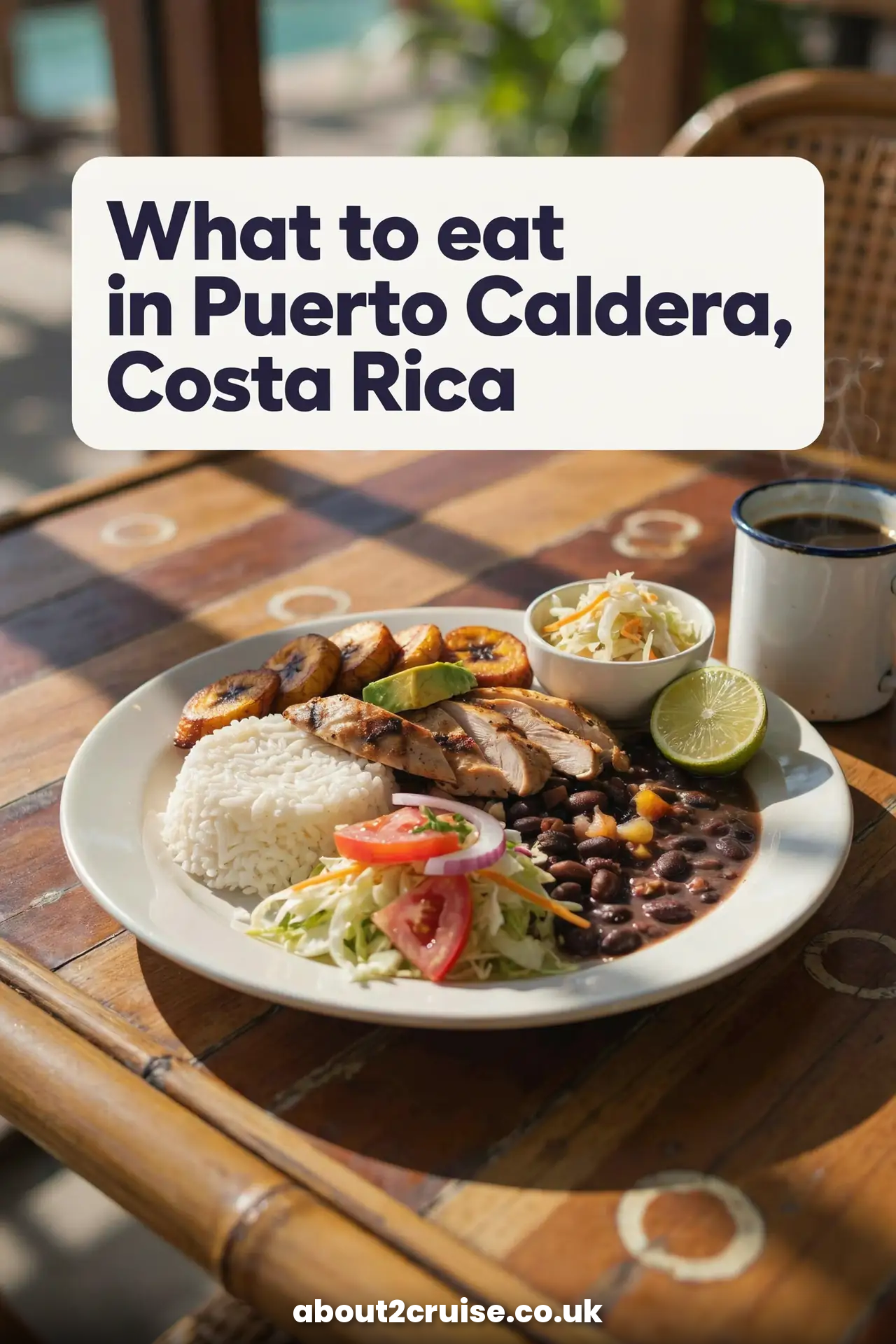
Typical prices are around US$3 to US$5 for a Churchill, US$4 to US$8 for a cup of ceviche and US$6 to US$9 for a casado in a soda. There is also a gastronomic boulevard in front of the cathedral, usually open from 11:00 to 22:00 Monday to Saturday with live music at times.
At Puerto Caldera itself there is no food or drink in the small terminal, so bring water and a snack if you plan to spend any time there. If you’re going straight out on a tour, the guide will usually stop at a café or restaurant. Costa Rica’s coffee is excellent everywhere, so you don’t need a full coffee tour to get a good cup.
Shopping and Souvenirs
The Puerto Caldera terminal has a few souvenir shops selling jewellery, wooden crafts and Costa Rican coffee. Puntarenas kiosks near the cruise pier sell local foods, drinks, arts and crafts, and the Paseo de los Turistas has colourful souvenir stands.
Coffee is one of the easiest and most genuinely Costa Rican souvenirs to bring back. If you take a Central Valley tour, Sarchí is the place for painted oxcart items, which are far more distinctive than generic T-shirts.
Don’t plan a big shopping trip at Caldera. This is an embarkation point and a working port, not a retail destination. Puntarenas town is your nearest practical shopping stroll once you’ve taken a taxi or transfer there. For easy photo stops beyond wildlife, the Paseo de los Turistas and the cathedral area in Puntarenas do the job.
Language, Guides and Booking Communication
Spanish is the main language in and around Puerto Caldera and Puntarenas, but many people working in tourism speak at least some English, and certified naturalist guides often speak very good English.
If you’re booking independent tours from the UK, WhatsApp is widely used for last-minute pickup instructions and changes. Confirm the exact meeting point, whether it’s inside or outside the main gate, and what name your driver will hold.
Don’t assume the person who answers the phone at a taxi cooperative speaks fluent English. Keep your destination written down, including the port name in Spanish: Puerto Caldera. A printed confirmation with the operator’s phone number is more useful than a long email thread when you’re standing at the gate in the heat.
Safety and Port-Day Awareness
Costa Rica is not a high-crime warzone, but theft and muggings are significant problems in some tourist areas, and you should treat Puntarenas and Jacó with normal street sense. Keep valuables on you rather than in a beach bag, be aware at ATMs and keep luggage in view on buses. Avoid unlicensed taxis and don’t flash cash near the port gate. Carry ID: a printed passport copy is usually fine, while the original stays in the safe.
The bigger day-to-day risks are water and wildlife. Rip currents are very common, there are often no lifeguards, and drownings in Costa Rica average 50 to 60 a year. Crocodiles are present on Pacific beaches in places, and deaths and serious illness have been caused by cheap local spirits containing methanol. For jungle visits, use an experienced local guide and stay on marked trails. National parks have rules for a reason, and there are fines for unauthorised entry into restricted conservation areas.
Accessibility and Mobility
Puerto Caldera is not an easy port for independent mobility. There is no walkable town from the berth, so every option involves a vehicle. The terminal is small and basic, and there is no detailed official accessibility information for the port shuttle or terminal route. If you use a wheelchair, walker or scooter, contact your cruise line before the call to understand exactly how the gangway and shuttle will work.
The best accessible excursion is Carara National Park’s universal-access trail: a 1.2 km route with nine rest bays, drinking water, an adapted toilet and signage in Spanish, English and braille. Many boat and bus excursions require steps, and Manuel Antonio’s trails have limited accessibility. Some coffee tours can store a collapsible wheelchair on the bus, but the wet-mill areas may have steps.
Family-Friendly Tours, Age Limits and Weight Restrictions
Families can do well here, but choose carefully. The crocodile safari on the Tárcoles River and a Carara nature walk are straightforward for most children. A catamaran or Tortuga Island boat trip is also a good family day if the boat has shade and life jackets.
Zip-lines often take children from age 4 to 6, depending on the operator, with maximum weights around 220 to 280 lb. Check before booking. ATV combos have driver age rules, so a child may need to ride as a passenger.
Manuel Antonio’s online tickets are named and dated, including for children, and the park bans many of the things families might normally bring, such as outside food, beach chairs, umbrellas and balls. It’s a long drive for younger children unless your ship offers it as a well-supported excursion. Bring more water and snacks than you think you need, because you can’t rely on terminal facilities at Caldera.
Wildlife Photography and National Park Rules
This is one of the easiest Costa Rican ports for big-wildlife photography. Scarlet macaws are best photographed early morning or late in the day around Carara and the nearby coast. The Tárcoles bridge gives you close, safe views of crocodiles from above, and a boat safari gets you lower with a naturalist guide. If you want monkeys and sloths, Manuel Antonio is the classic spot, but its distance and rules make it a more demanding day.

National-park rules are strict and enforced. No drones, no loudspeakers, no feeding or touching wildlife, no smoking, and no single-use plastic in Carara. In Manuel Antonio, the ban list is even longer, including food and drink, aerosols, surfboards, hammocks, beach chairs, umbrellas and balls. Use a zoom lens, stay on the trail, and accept that the best wildlife moments often come when you’re still and quiet.
Is Puerto Caldera Worth Staying on Board For?
If you’re tired, mobility-limited or have already done Costa Rica rainforest days before, staying on board is a perfectly reasonable choice. The terminal has little to offer, the weather can be wilting, and a long transfer is not for everyone.
But if you get off, the best use of a Puerto Caldera port day is usually a half-day or three-quarter-day trip that gets you out of the port and into either the rainforest, the Tárcoles crocodile river, the coffee country or a catamaran day.
This is a very different call from Puerto Vallarta, Mexico, where the ship can be steps from a walkable malecón, or from Huatulco, Mexico, where beach life is often closer to the pier. On a Panama Canal or Central America run, Colon, Panama is another commercial port where the terminal and the tour logic are not the same. If you’re working out how the stops fit together, our guide to Central America’s cruise ports can help you plan the bigger picture.
Turnaround Day vs Transit Call
Puerto Caldera can be either a port of call or the start or end of a cruise. The planning changes accordingly. On a transit call, your priority is excursion timing and getting back to the pier. On a turnaround day, you have luggage, immigration or ship clearance, transfers and possibly a flight to consider.
The terminal has no left-luggage service, so any disembarkation tour needs to keep your bags on the vehicle. If you’re joining a cruise here, plan to stay inland near San José or SJO the night before unless your line includes a transfer. There is essentially no cruise-oriented hotel at Caldera itself. If you’re ending the cruise, don’t book a tight morning flight unless it’s part of the cruise line’s own transfer timing. Even then, allow for Route 27 traffic.
How to spend a port day in Puerto Caldera
A port day in Puerto Caldera works best if you pick one: a slow day around Puntarenas, or a beach day in Jacó.
Before you sail
- Book Carara or Manuel Antonio SINAC entry tickets online ahead; they are named and dated.
- Arrange a licensed taxi or private transfer before the call; ride-hailing is not dependable.
- Check Manuel Antonio closure days and confirm your ship time versus local time.
Short port day: under 6 hours
- On dockingTake the port shuttleNo walking outYou can't walk through the working dock. The shuttle drops independent passengers at the main gate.
- +15 minTaxi to PuntarenasTake a licensed red taxi from the gate; about 20 km, 20 to 30 minutes. Agree the fare or confirm the metre.
- +45 minPaseo de los TuristasWalk the mile-long promenade along the beach, with Gulf of Nicoya views and souvenir stands.
- +1 hr 30 minChurchill or coffee on the PaseoStop at a kiosk for a Churchill or a good Costa Rican coffee while you get your bearings.
- +2 hrsPuntarenas CathedralA short walk inland to the historic cathedral with four clocks on its tower and a gastronomic boulevard out front.
- +2 hrs 45 minMunicipal market and lunchTry cevicheOrder ceviche de corvina, a casado or seafood soup at a market comedor or food truck.
- All-aboard minus 90 minBack at the port gateReturn by taxi to the cruise terminal, arriving at least 90 minutes before all-aboard.
This map shows the taxi ride from the ship. The time is the drive only, not your time ashore.
Open the taxi route in Google Maps
If plans change: If the market or food trucks are too busy, the cathedral and nearby cafés on the gastronomic boulevard are a short walk away.
Long port day: 8 hours or more
- On dockingTake the port shuttleNo walking outYou can't walk through the working dock. The shuttle drops independent passengers at the main gate.
- +15 minTaxi or pre-booked transfer to JacóA private driver or licensed taxi from the gate takes about an hour to Jacó, with the fare agreed in advance.
- +1 hr 30 minJacó Beach walkWalk part of the 4 km dark-sand beach. Surf and rip currents are real, and there are often no lifeguards.
- +3 hrsLunch in Jacó townTry fresh seafoodHead into town for ceviche, grilled fish or a casado at a casual restaurant; many add a service charge.
- +4 hrs 30 minShops and surf-town strollBrowse the surf shops and cafés on Jacó's main streets. Keep valuables secure and carry ID.
- +5 hrs 45 minBeach time or a coffee breakRelax on the sand or take a shaded coffee break before the drive back; do not go far from your pickup point.
- All-aboard minus 90 minBack at the port gateDrive back takes about an hour; be at the port at least 90 minutes before all-aboard.
This map shows the taxi ride from the ship. The time is the drive only, not your time ashore.
Open the taxi route in Google Maps
If plans change: If Jacó feels too crowded or the beach is red-flagged, ask your driver about Herradura near the Los Sueños marina as a quieter fallback.
Puerto Caldera FAQs
Is Puerto Caldera the same as Puntarenas? No. They’re separate ports about 20 km apart. Puntarenas town pier is walkable from the town promenade; Puerto Caldera is a commercial port where you need transport.
Can you walk to a beach from Puerto Caldera? Not really. There is a local beach beside the port, but it has strong surf and no cruise facilities. The practical beach options involve a taxi, transfer or boat tour to Puntarenas, Jacó, Herradura or Isla Tortuga.
Can you walk out of the port? No, or at least not through the working dock area. Independent passengers take the port shuttle from the berth to the main gate, where taxis and private drivers wait. Ship excursions leave from the pier.
Are taxis or ride-hailing apps available at Puerto Caldera? Licensed red taxis are the usual short-hop option from the gate. Uber, DiDi and inDrive are not dependable for this port call. A pre-booked private transfer is the most comfortable choice.
What can you do near the port without an excursion? Very little at the terminal itself. The easiest independent day is to take a taxi to Puntarenas and walk the Paseo de los Turistas, eat ceviche and shop at the market. For nature, Carara and the Tárcoles crocodile bridge need a taxi or tour but are close enough for a half-day.
What are the best Puerto Caldera tours for first-time Costa Rica cruisers? For most first-timers, the best mix is Carara National Park plus the Tárcoles crocodile river, a zip-line or coffee-and-nature combo, or a catamaran trip to Isla Tortuga. Manuel Antonio is wonderful but is a long day with strict rules.
How early should you return to the ship? Aim to be back at the port with at least 60 to 90 minutes to spare before all-aboard, more if you’re returning from Jacó or the Central Valley on a rainy afternoon. Reputable tour operators often plan a 90-minute buffer. If you’re travelling on your own, use the ship’s all-aboard time, not just the departure time.
Does Puerto Caldera use ship time or local time? Costa Rica is on UTC−6 all year and does not change clocks. Your ship may keep its own time. Confirm with the purser or the daily programme, and set your watch accordingly before leaving the ship.
Is there Wi-Fi at the terminal? Don’t count on reliable free Wi-Fi or a comfortable lounge at Puerto Caldera. Download maps, tickets and transport confirmations before you arrive.
Do I need Costa Rican colones or are US dollars enough? US dollars are widely accepted in tourist areas, but carry small bills. Change often comes back in colones, and small cafés or taxis may not accept large notes. Cards work in many places, but cash is useful for markets, sodas and tips.
Last Updated: 23 November 2026