
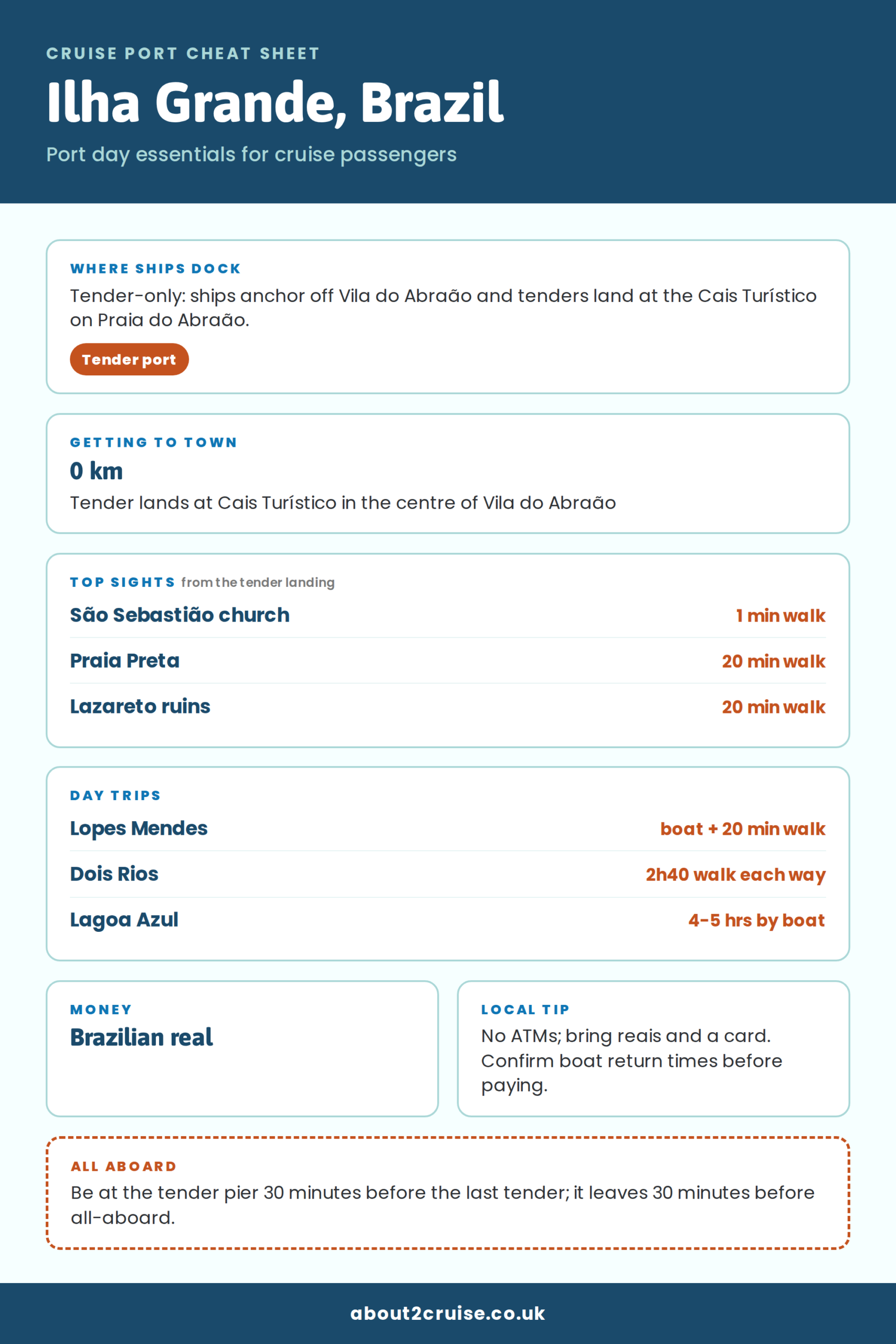
Ilha Grande is a tender-only, car-free island off Brazil’s Costa Verde. Ships anchor off Vila do Abraão, and you go ashore by tender into a sand-street village. Most cruisers choose between Lopes Mendes beach, a snorkelling boat trip or a short rainforest trail. Sort your tender ticket, last-tender time, reais/card and return boat times before leaving the ship.

What Makes Ilha Grande Different?
Ilha Grande is a 193 km² mountainous island covered in Atlantic rainforest. It’s part of the UNESCO World Heritage site Paraty and Ilha Grande: Culture and Biodiversity, and the Ilha Grande State Park protects roughly 80% of the island with more than 80 km of trails. There are no cars, taxis, ride-hailing apps or public buses. You either walk or you take a boat. The main settlement is Vila do Abraão, and that’s where large cruise ships send their tenders.
The island’s headline beach is Lopes Mendes, a long white-sand sweep you reach by boat plus a short forest walk or a much longer hike. Other popular stops include the old prison colony at Dois Rios, the snorkelling lagoons Lagoa Azul and Lagoa Verde, dark-sand Praia Preta, the Pico do Papagaio viewpoint and the small waterfall at Feiticeira. The whole place feels relaxed, outdoorsy and Brazilian, with seafood restaurants and kiosks dotted along the waterfront.
Ilha Grande cruise port map
Tenders bring you ashore at Ilha Grande cruise port. Tap a pin for directions.
- Ilha Grande cruise portWhere tenders land
- Praia do AbraãoBeach · About 6 km from the tender landing
- Praia do AbraãozinhoBeach · About 7 km from the tender landing
- Praia do PousoBeach · About 10 km from the tender landing
- Lopes MendesBeach · About 11 km from the tender landing
- Dois RiosOld prison colony site · About 9 km from the tender landing
- Museu do CárcerePrison museum · About 9 km from the tender landing
- Feiticeira waterfallWaterfall · About 4 km from the tender landing
Tendering Ashore at Vila do Abraão
There is no cruise berth at Ilha Grande. Your ship anchors offshore in the sheltered Baía da Ilha Grande, and all passengers go ashore by the ship’s tender boats. Tenders land at the Cais Turístico da Vila do Abraão, on Praia do Abraão, right next to the São Sebastião church and the state park entrance. You step off in the middle of the village. There is no shuttle and no taxi waiting; restaurants, boat-tour agencies and shops are within a few minutes on foot.
On most ships the order is:
- Ship excursion passengers go ashore first.
- Suite guests, loyalty members or early ticket holders follow.
- Other guests use numbered tender tickets.
- Later in the morning many ships switch to open tender, with no ticket.
The last tender from shore usually leaves about 30 minutes before all-aboard. The exact time is printed in the ship’s daily programme. Missing it means paying your own way to the next port, so treat the last tender time as a hard deadline. Tender boarding may be denied or difficult for guests with wheelchairs, balance problems or reduced mobility, and some cruise lines state it is at the guest’s own risk.
The bay is protected, but wind, swell, heavy rain or poor visibility can still slow or cancel tender and local-boat operations. Winter cold fronts known as ressacas can make crossings difficult even if the village looks calm.
First Impressions of Vila do Abraão
Vila do Abraão is the island’s main village and the only settlement that receives large cruise ships. It has pousadas, dozens of restaurants, more than 40 boat-tour agencies, bakeries, pharmacies, police, fire service and the state park office. The streets behind the waterfront are sand, cobbles and dirt, so think beach town rather than paved cruise port.
The landing beach, Praia do Abraão, is directly where the tenders come in. If you only want a simple beach day, you do not need transport. The waterfront Rua da Praia and the streets behind it hold most food and tour desks. You can walk the centre in 10–15 minutes.
Do not count on public toilets, water fountains or showers at the tender pier. Use a restaurant, pousada or kiosk if you buy something. Carry a reusable bottle and fill it from bottled water before setting out.
Cruise Ships That Visit Ilha Grande and How Long You Get
Ilha Grande is a seasonal Brazilian cruise port of call, not an embarkation port. The season runs roughly from late October or November into March or April. Ships that have called include MSC Musica, MSC Divina, MSC Splendida, Costa Serena, Scenic Eclipse, Seven Seas Mariner, Amadea, Zaandam and Insignia.
Typical published port times range from a short call around 07:00–14:00 to a longer call around 08:00–20:00. Short calls suit the village, Praia Preta or a tightly timed boat trip. Long calls are better for Lopes Mendes, Dois Rios or the Pico do Papagaio trail.
To see which ship is in port on your date, check the live or forthcoming schedules on CruiseMapper or CruiseTimetables, or use an AIS ship-tracking app. Ilha Grande is a call, not a turnaround: passengers joining or leaving a cruise normally do so at Santos, Rio de Janeiro or Itajaí. If your itinerary also visits Rio, see our Rio de Janeiro cruise ship port guide. For sailings to or from Argentina, see our Buenos Aires cruise ship port guide.
Búzios lies further along the Rio de Janeiro coast and is often the next or previous call on your Brazil cruise.
You may also call at Ilhabela, another Brazilian island port on São Paulo’s northern coast.
Money, Cards and Everyday Essentials
The local currency is the Brazilian real. US dollars and euros are not widely accepted, so have reais or a travel card. There are no ATMs and no banks in Vila do Abraão. Sort money on the mainland or on the ship before arriving. Cards are widely accepted in restaurants, shops and for boat tours, and PIX is common. Carry a little cash as backup for small kiosks or if a card machine loses signal.
Angra dos Reis has a municipal sustainable-tourism tax called the TTS, but digital collection has been suspended. There is no confirmed current method for cruise passengers to pay it at the tender pier. Carry some reais and ask locally whether anything is collected, but do not assume you will be stopped.
Key money and service points:
- A 10% service charge, serviço, is normally already on the restaurant bill.
- Prices on the island are higher than on the mainland because everything arrives by boat.
- Return boats from beaches often take cards. If there is no signal at the beach, you pay back in Abraão.
- English is not widely spoken. A few words help: bom dia good morning, obrigado/obrigada thank you, quanto custa? how much?, sem gelo without ice, conta, por favor the bill please.
- Tap water is not safe to drink, and ice is made from the same water. Order drinks sem gelo unless you trust the venue’s filtered ice.
- Mobile signal works near the coast and village on Claro, TIM and Vivo, but drops inland and at remoter beaches. Village Wi-Fi is patchy and radio-linked.
- Power micro-outages are common. Bring a power bank.
Easy Beaches Within Walking Distance of the Pier
If you do not want a long trip, you can still have a relaxed beach day.
- Praia do Abraão: the village beach where tenders land. Easiest option, with restaurants and kiosks close by.
- Praia Preta: about a 20-minute walk from the village. The dark sand comes from minerals washed down by the Abraão stream. The easy T1 circuit links Praia Preta, the Lazareto ruins, the 1893 aqueduct and the Poção freshwater pool in about 1–2 hours total.
- Praia da Júlia and Praia do Abraãozinho: about 30 minutes on foot from the village. Smaller and quieter than Praia do Abraão.
- Biquinha, Canto and Crena: small local beaches reachable on foot or by short water taxi. Water taxis have no published timetable or fixed fare table, so confirm the price before boarding.
For a short port call, the T1 circuit to Praia Preta and the Lazareto ruins is the best low-effort sampler of Ilha Grande’s nature and history. Decent flip-flops are fine for this route in dry weather.
Getting to Lopes Mendes: The Beach Everyone Wants to See
Lopes Mendes is the beach most passengers ask about: a nearly 3 km sweep of white sand on the ocean side of the island. It has no buildings, no bars, no sun loungers and no road. Boats do not land directly on Lopes Mendes.
The standard independent route is:
- Buy a return boat ticket in Vila do Abraão to Praia do Pouso.
- Boats leave the waterfront in the morning, typically between about 09:30 and 11:30.
- From Pouso, walk about 1 km on the T11 forest trail, roughly 20–30 minutes, to reach Lopes Mendes.
- Return boats from Pouso usually run in the afternoon, with published slots such as 15:00, 16:00 and 17:00.
- Return fares are roughly R$40–50 per person. A slow schooner takes about 50 minutes; a faster lancha takes about 25 minutes. Some operators quote R$70–100 for return trips.
The whole trip, including beach time, realistically eats 4+ hours. If your ship has a short call, do not attempt Lopes Mendes independently unless there is a generous buffer and an early tender. Bring water and food because there is nothing to buy at Lopes Mendes. The ocean side has real surf and colder water than the bay, so check conditions and swim near others. Some full-day Super Sul boat tours include Lopes Mendes only when the sea is very calm, so do not rely on one if Lopes Mendes is the whole point of your day.
Hiking the entire way from Abraão uses trails T10 and T11, about 6–7 km and around 3 hours each way with climbs and mud after rain. That is only sensible on a long call and for fit walkers.
Dois Rios and the Former Prison Colony
Dois Rios is the island’s old prison colony site. The prison operated until it was decommissioned and demolished. Today the village holds the Museu do Cárcere, part of the Ecomuseu Ilha Grande run by the state university. Entry is free, but advance booking is advised. Reference hours are usually Tuesday–Sunday, 10:00–16:00.
The route is the T14 dirt road: about 8.15 km one way, rated heavy, taking around 2h40 each way on foot. It passes the soldiers’ pool, prison ruins, the Ecomuseu and the university campus. This is a long, hot walk that is only realistic for long port calls with an early tender and good fitness. Most cruise passengers should not attempt it on a 07:00–14:00 call unless the ship runs a dedicated excursion.
Snorkelling Lagoons and Hidden Beaches
Ilha Grande’s established snorkelling lagoons are Lagoa Azul and Lagoa Verde. Neither is a beach. You jump in from the boat with a mask and snorkel for 30–60 minutes. Lagoa Azul has shallow clear water and tame sergeant-major fish, and is busiest roughly 11:00–15:00. Lagoa Verde is known for green corals, seahorses and turtles.
Some third-party cruise listings mention a Sereia Lagoon, but the island’s documented lagoon stops are Lagoa Azul and Lagoa Verde. If an excursion advertises Sereia Lagoon, ask exactly which body of water it visits before booking. Likewise, an older name you may see is Praia da Preguiça or Laziness Beach; it is not a primary cruise excursion target, and access is best confirmed locally.
Caxadaço Beach is a tiny hidden beach behind a rock wall with a waterfall. Reaching it means about 2 hours on the Dois Rios dirt road plus about 1.5 hours of steep forest trail. Guided versions can run about 9 hours from US$175. This is not a casual port-day option.
Saco do Céu is a boat-access spot famous for the island’s most famous sunset. If your ship stays into the evening, a late afternoon boat trip can work, but confirm return time against the last tender.
Boat Trips, Snorkelling and Diving from Vila do Abraão
The easiest way to see Ilha Grande from the sea is a shared boat trip. Boats leave the Cais da Vila do Abraão, usually between 09:30 and 11:00, and are booked in the village.
- Classic meia volta: Lagoa Verde, Lagoa Azul, a beach and lunch. Lasts about 6 hours, costing roughly R$100–200 by schooner or R$180–250 by shared speedboat.
- Lagoa Azul trip: about 4–5 hours, from around R$80 by schooner.
- Full-day guided kayak: Saco do Céu kayak trip, about 18 km and 7 hours, around R$360 per person including kayak, guide, mask, lunch and photos.
- Introductory diving: from about R$250–270.
- Two-tank dive day: about R$300–330 cash or card.
Boat tours are independent, so check what is included, whether snorkel gear costs extra, and what time you are back at the Cais. The ship’s excursion may be worth it if the ship has a short call or if sea conditions are marginal, because the ship will normally wait for its own excursions.
Hiking Trails and Pico do Papagaio
Ilha Grande is a hiking island. Entry to the state park is free, but trails are steep, muddy after rain and often remote.
- T1 circuit: Praia Preta, Lazareto ruins, aqueduct and Poção pool. About 1–2 hours, easy-to-moderate, OK in decent flip-flops when dry.
- Feiticeira waterfall: about 2.8 km moderate trail to a waterfall roughly 15 m high. Wear closed shoes, not flip-flops.
- T10/T11 to Lopes Mendes: T10 Abraão–Pouso is 5.9 km one way, 2h50, semi-heavy. T11 Pouso–Lopes Mendes is 1 km, 30 min, light.
- T14 to Dois Rios: 8.15 km one way, 2h40, rated heavy.
- Pico do Papagaio: the island’s hardest trail. The summit is around 982 m, about 5.2 km from Abraão, 2–3 hours up and 3.5–5 hours return. The peak is nicknamed Bico do Papagaio, Parrot’s Beak, and is visible on the approach to Vila do Abraão.
The Pico do Papagaio trail is managed: access is capped at 90 people per day, with 18 people at the summit and 10 at the base at any one time, and groups of no more than 6 per guide. Between 17:00 and 07:00 the trail may only be walked with an INEA-accredited guide or conductor, and visitors must sign a risk acknowledgement form. This is a fair-weather, early-start route for long calls only.
Park rules: no campfires, no pets, no trawl fishing or spearfishing, no litter, no fires or barbecues on beaches, and no feeding wildlife. Some beaches have strict rules against dogs and selling.
What to Eat and Drink on the Island
Ilha Grande’s food is simple, seafood-heavy and caiçara-influenced. The signature dish is peixe com banana: fish baked with banana. Also look for moqueca, caldeirada de frutos do mar, grilled fish with pirão, fried fish at the kiosks and caipirinha.
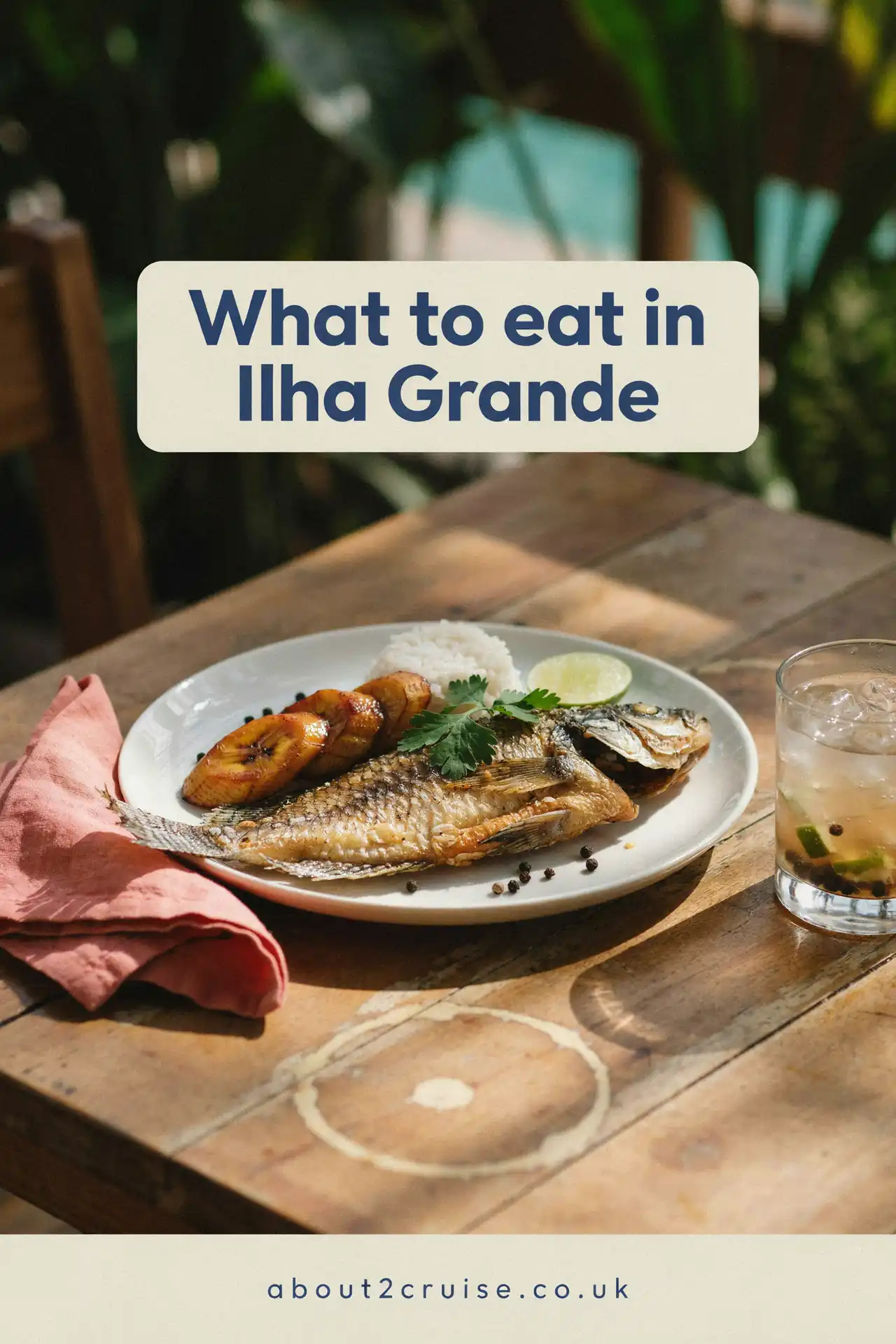
Everything is centred on Vila do Abraão, especially the waterfront Rua da Praia, the streets directly behind it, and the kiosks and stalls by the pier. A typical quick bite is pastel de camarão, fried prawn pastry. Most restaurants add the 10% serviço to the bill. If you are worried about ice, order drinks sem gelo.
Shopping, Luggage and Village Services
Ilha Grande is not a shopping port. You will find small shops selling beachwear, souvenirs, artesanato and basic supplies in Vila do Abraão. There is no large shopping centre and no big cruise terminal.
There is no confirmed left-luggage or bag-drop at the tender pier. If you need to leave a bag, ask a pousada or tour agency if they will hold it for a fee. For an overnight stay, luggage is moved by hand cart on sand and cobbles, with cart trips costing roughly R$70–100.
Abraão has two pharmacies and a health post. There are no banks or ATMs. Toilets and drinking water can be hard to find away from restaurants, so plan around food stops.
Accessibility, Families and Travelling with Limited Mobility
Ilha Grande is challenging for guests with limited mobility. The tender ride itself may be unsuitable for wheelchairs, power chairs, walkers or people with balance problems, and some cruise lines warn that guests with reduced mobility may not be able to disembark. Once ashore, the streets are sand and cobbles, and many trails have steps, roots and mud.
That said, a careful cruiser with some mobility can still enjoy the village. Praia do Abraão is right at the landing, and waterfront restaurants are a short walk away. A boat tour may also work if you can manage the step from tender to boat and from boat to ladder for snorkelling. Families with children should choose the village beach, Praia Preta or a shorter boat trip. Lopes Mendes is doable with older children but not ideal for toddlers because of the walk, heat and lack of facilities.
Staying Safe and Handling Emergencies
Crime on Ilha Grande itself is described as rare in a community of about 6,000 with little tolerance for theft. The wider Brazil safety advice still applies. The UK Foreign Office warns about theft and robbery, including beach arrastões, phone theft between 16:00 and 21:00, card cloning, express kidnapping and unlicensed taxis or ride-hail cars. It also warns that heavy rain can cause flash floods and landslides where mountains meet the coast, and that the rainy season in Rio de Janeiro state runs November to March.
Swimming on the ocean side, especially at Lopes Mendes, can have strong currents and surf. Check conditions, watch flags and do not swim alone. Bring travel insurance that covers medical evacuation, because serious cases are transferred by boat to mainland hospitals in Angra dos Reis, such as Hospital de Praia Brava or Hospital Geral de Japuíba.
Emergency numbers in Brazil are 190 police, 192 ambulance/SAMU and 193 fire. Calls to 112 and 911 are routed to 190. Abraão has a 24-hour health post, but serious problems mean a boat transfer to the mainland.
Passports and Entry Requirements for UK Visitors
British citizens can visit Brazil visa-free for up to 90 days for tourism. Your passport must be valid for at least six months after arrival. Make sure it is stamped on entry, and carry a copy of your passport and photo ID when ashore. The ship will normally handle cruise-line documentation for port calls, but check whether you need your cruise card, passport or a copy when going ashore.
Weather, Best Time to Visit and What to Pack
Angra dos Reis has a hot, wet climate with no real dry season. January averages about 302 mm of rain; August is much drier at around 61 mm. January daytime maximums are about 30°C, February about 31°C, and May around 26°C. Sea temperatures are about 26–27°C in January and February, falling to about 22°C in July. Humidity is high and UV is extreme in midsummer. January and February are the wettest months, usually with short, violent afternoon downpours. Winter is drier with clearer water, but cold fronts can make tendering and boat crossings difficult.
Pack for a hot, wet, island day:
- Footwear: decent flip-flops or sandals for the village and T1; closed shoes with grip for forest trails.
- Rain layer: sudden rainforest rain is normal.
- Insect repellent: mosquitoes and tiny biting borrachudos are common, especially on beaches and trails.
- High-factor sunscreen and a hat.
- Reusable water bottle: buy bottled water before setting out.
- Power bank: power outages and patchy charging points make this useful.
- Small cash in reais plus a card.
Independent Plans vs Ship Shore Excursions
Independent touring works well for the village and the nearby T1 circuit. You can simply walk off the tender and explore. It also works for Lopes Mendes if you have an early tender, a long call and a clear return boat plan.
Ship excursions are often worth it for Lagoa Azul, distant beaches and any trip where the return time matters. If the ship’s tour is delayed, the ship waits. Some ship-run options here include a schooner trip to Lagoa Verde, a history walk of about 2.5 hours, and a Feiticeira waterfall walk, priced from roughly €26–45. The guided walking excursion requires closed shoes and is not suitable for guests with mobility problems.
Check your line’s cancellation window. Some lines allow shore excursions to be cancelled free up to 24 hours before port or 48 hours before the tour once on board. Independent third-party tours follow their own terms.
How to Spend a Short Port Call
If your ship is only in port from about 07:00–14:00, keep it simple:
Before you sail
- Bring reais and a card; there are no ATMs in Vila do Abraão.
- Check the last-tender time and tender ticket process in the ship's daily programme.
- Book a Pico do Papagaio guide or boat tour if you want a specific trip; popular slots fill.
Short port day: under 6 hours
- On dockingTender ashore to Cais TurísticoYou step off the tender in the centre of Vila do Abraão. The tender may be difficult for wheelchairs or balance problems.
- +15 minPraia do Abraão and São Sebastião churchWalk the village beach and the waterfront Rua da Praia. The church is next to the landing.
- +30 minT1 circuit to Praia Preta and Lazareto ruinsEasy trailWalk 20 minutes to the dark-sand beach, then follow the T1 loop past the Lazareto ruins, aqueduct and Poção freshwater pool.
- +2 hrsLunch near Rua da PraiaTry peixe com bananaThe island's signature dish is fish baked with banana. Order it at a waterfront restaurant or kiosk.
- +3 hrs 30 minRelax on Praia do AbraãoSpend the remaining time on the village beach or browsing the shops behind the waterfront.
- All-aboard minus 1 hrBack at the tender pierReturn to Cais Turístico with time to spare. The last tender usually leaves 30 minutes before all-aboard.
The time on the map is the whole walk, every stop added together.
Open this walking route in Google Maps
If plans change: If the T1 trail is too muddy, spend the extra time on Praia do Abraão and at the waterfront kiosks.
Long port day: 8 hours or more
- On dockingTender ashore to Cais TurísticoBe on an early tender so you have time for the full walk.
- +30 minT1 circuit to Praia Preta and Lazareto ruinsEasy trailWalk 20 minutes to the dark-sand beach, then continue to the Lazareto ruins, aqueduct and Poção freshwater pool.
- +2 hrs 30 minLunch near Rua da PraiaTry peixe com bananaThe island's signature dish is fish baked with banana. Order it at a waterfront restaurant or kiosk.
- +3 hrs 30 minWalk to Feiticeira waterfallClosed shoesA moderate 2.8 km forest trail leads to a 15 m waterfall with a bathing pool.
- +5 hrs 30 minBathe and return from the waterfallCool off under the falls, then walk back to the village.
- +6 hrs 30 minPraia do Abraão or shoppingUse any remaining time for the village beach or small shops before heading back.
- All-aboard minus 90 minBack at the tender pierReturn to Cais Turístico with time to spare. The last tender usually leaves 30 minutes before all-aboard.
The time on the map is the whole walk, every stop added together.
Open this walking route in Google Maps
If plans change: If the Feiticeira trail is closed or you are too tired, swap it for a longer lunch and a boat trip to Lagoa Azul if time allows.
- Walk the village and Praia do Abraão.
- Do the T1 circuit to Praia Preta, the Lazareto ruins, aqueduct and Poção.
- Take a short boat trip if timings align and you are back at the Cais with at least an hour before the last tender.
Skip Lopes Mendes, Dois Rios and Pico do Papagaio on a short call. They need more shore time than you have.
On a long call from roughly 08:00–20:00, you can realistically choose one big objective: Lopes Mendes, a full-day boat/snorkel trip, Dois Rios or Pico do Papagaio for fit hikers. Build in an hour of buffer before the last tender.

If the Ship Can’t Tender
If wind or swell prevents tendering, the ship may wait, delay, or skip the call and substitute another port. Ship excursions are normally refunded when the ship cannot land. Independent tours follow their own terms, so check cancellation policies before paying a deposit. Travel insurance may cover missed port calls only if the policy includes it. Do not book non-refundable independent tours for Ilha Grande unless you are comfortable losing that money if the ship cannot anchor.
Best Photo Spots on Ilha Grande

- Lopes Mendes: the long white-sand sweep, best on weekday mornings outside December–February.
- Praia Preta and the Lazareto ruins/aqueduct: dark sand and ruined quarantine-hospital views. Go early and you may have the Lazareto to yourself.
- Saco do Céu: the island’s most famous sunset, roughly 17:00–18:30, reachable only by boat.
- Vila do Abraão waterfront and São Sebastião church square: bay, boats and hills behind.
Our Brazil cruise ports guide covers the other ports in the region.
Ilha Grande Cruise FAQs
Do I need to book a boat tour in advance?
Not usually. Most boat tours are sold in the village on the day. If you are on a tight schedule or want a specific tour, book early or use the ship’s excursion. For Lopes Mendes, you can buy a return boat ticket on the day, but do it early and confirm the return slot before you pay.
Can I leave my bag at the tender pier?
There is no confirmed left-luggage or bag-drop at the pier. Ask a pousada or tour agency in Vila do Abraão, but do not assume it is available.
Are there public toilets near the tender pier?
Public toilet provision is limited and not documented at the landing. Use a restaurant, pousada or kiosk if you buy something. Plan ahead before hikes or boat trips.
Can I use my UK phone and mobile data in Ilha Grande?
Mobile signal works near the coast and village on Claro, TIM and Vivo, but drops inland and at remoter beaches. Village Wi-Fi is patchy and radio-linked. Do not plan to rely on live maps or online booking on the trail.
What if I miss the last tender?
If the ship has sailed, you will need to arrange and pay for your own transport to the next port. That usually means a boat to the mainland and then flights or buses. Always subtract 30–60 minutes from the last tender time as a buffer.
Is Ilha Grande suitable for wheelchair users?
No. The tender ride and sand/cobble streets are major barriers. Some lines state that wheelchair users or guests with reduced mobility may not be able to disembark at tender ports. If you use a walker or have balance problems, discuss the tender with guest services before attempting it.
Last Updated: 19 November 2026