
Life on a cargo ship is three fixed meals, a cabin among the crew and up to fifteen hours a day nobody fills for you. There are no more than twelve passengers, no entertainment, no doctor and no cruise-style itinerary, so your day is built around breakfast, lunch and an early dinner.
The twelve-passenger rule that explains why nothing is organised
Put more than twelve passengers on a ship and the international safety rules stop seeing a freighter and start seeing a passenger ship. That brings stricter construction and equipment standards, and the twelve-passenger line exists partly because a ship carrying more than twelve has to have a doctor aboard.
Freighters stay under it. Most have room for four to six passengers, usually in around half a dozen double cabins, and not all of those berths get used.
Once you follow that through, the rest of life on board makes sense. No doctor means no medical staff, and no medical staff means no hospitality staff of any kind. There’s no entertainment team, no menu to choose from, no shore excursion desk and nobody whose job is to keep you busy.
The United States draws the same line. A vessel can carry twelve people on top of the crew on an international voyage, or sixteen on other voyages, without being inspected as a passenger vessel.
How much the cargo runs your day depends on the ship. On a classic container or bulk carrier the freight is the reason the ship sails and you’re the berth left over, which is why calls move and schedules slip.
A certified passenger-cargo ship works the other way round. Aranui 5 carries about 230 passengers in 103 cabins alongside roughly 1,226 tons of freight, and her itinerary is built around delivering supplies.
If you were expecting cruise-style hosting, these key differences between freighter travel and a cruise cover what changes.
A day on a cargo ship, from the 07:00 breakfast to the midnight watch
The ship runs on watches, usually four hours on and eight off, though it varies with the ship type and trade. On a foreign-going merchant vessel the pattern is fixed.
The second officer has midnight to 04:00 and noon to 16:00, the chief officer has 04:00 to 08:00 and 16:00 to 20:00, and the third officer has 08:00 to noon and 20:00 to midnight, covering the chief officer’s dinner break around 18:00.
That splits sleep into two short blocks. A shower comes before each watch, and the eight-hour rest window has to absorb eating, sleeping and washing.
A typical third officer’s day goes like this: up at 07:00 for breakfast, on the bridge at 07:45, weather report at 10:00, handover at 11:45, lunch, two hours of deck duties from 13:00, then the watch again from 20:00 to midnight. The relentless repetition is what lets the crew fit the rest of life around work, and there are no days off.
Your day hangs on the same frame but carries none of the work. Meal hours are set by the Master, posted, and kept to, and nothing is served in your cabin.
On a Hapag-Lloyd container ship the crew come to the canteen and officers’ mess from 07:30 and dinner is at 17:30. Passenger hours on one freighter ran 08:00, 12:30 and 18:30.
Ask for the times when you board and set an alarm for the first few mornings. Miss breakfast and the next thing that happens is lunch.
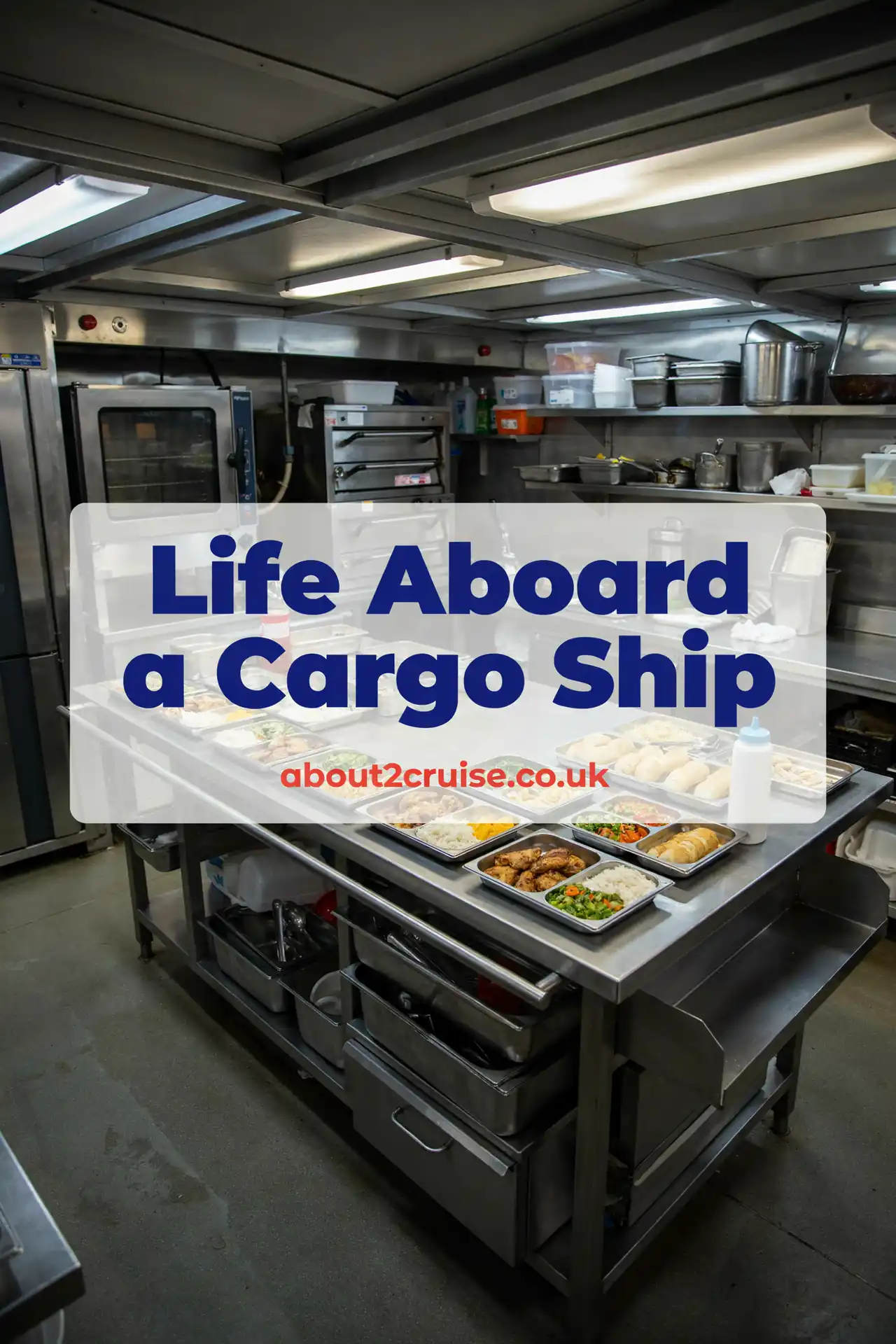
Cargo ship food: one galley, one menu and a cook who is not cooking for you
You eat in the officers’ mess, at the officers’ hours, off the menu the cook has written for the crew. The galley cooks to their nationality and preferences, not yours.
On a Hapag-Lloyd container ship the same kitchen turns out leczo for a Polish captain and crew and pork ribs with rice for the Filipino crew on the same day. Menus shift with the destination and the mix of nationalities, and foreign dishes turn up often.
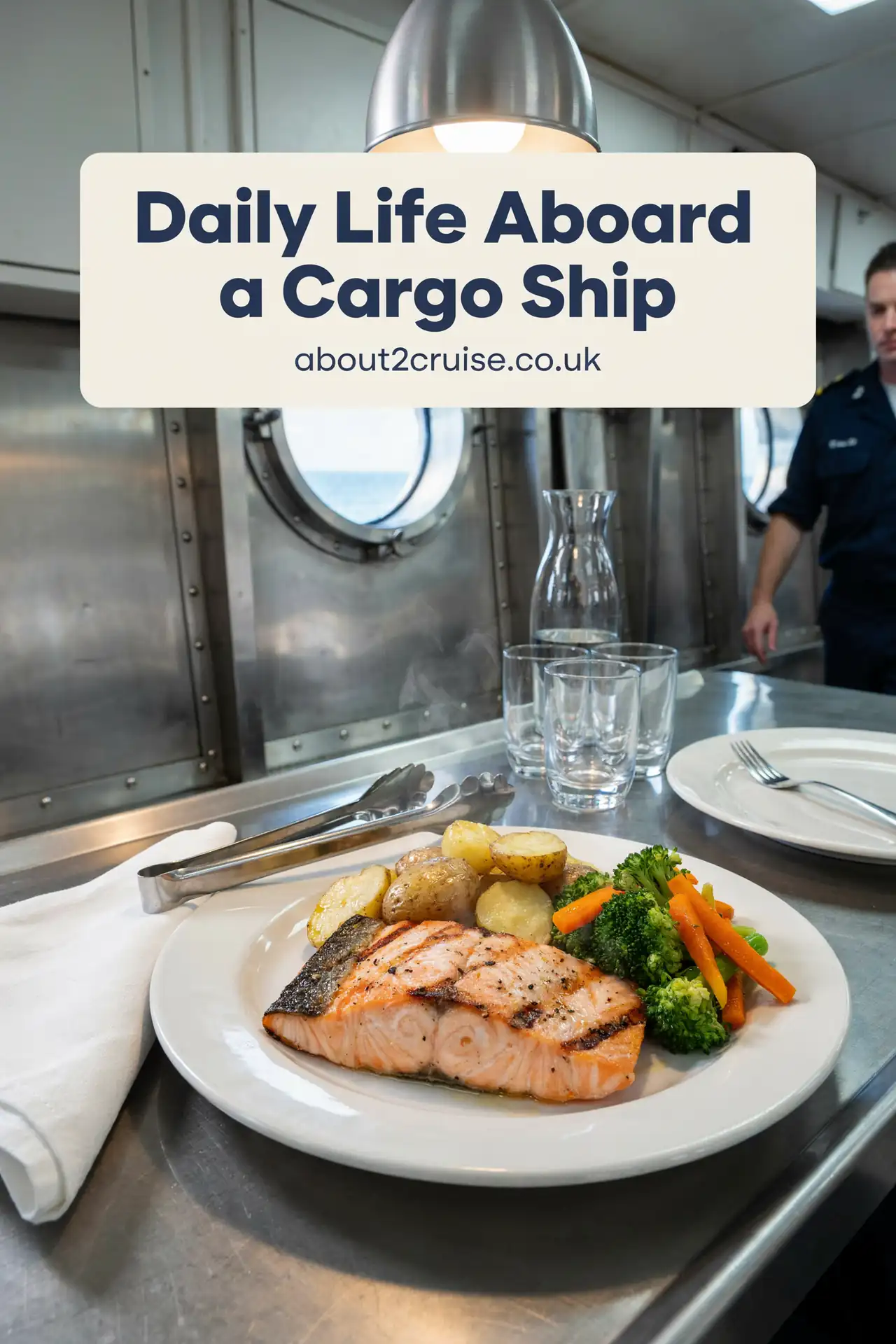
Most ships have two messes: an officers’ mess of around ten seats and a crew mess of up to thirteen. Three freshly cooked meals a day are included and the standard is generally good, though not restaurant or cruise ship standard. Between meals the pantry is open for snacks.
Special diets split the operators. Some German operators won’t do them at all, while others will discuss most needs with the cook. Raise it when you book, get the answer in writing, and remind the cook on your first day, because nobody on board will ask twice.
Alcohol is generally not available on board, and you usually can’t bring your own for private consumption, because the ship is a place of work. If a drink with dinner matters to you, ask before you pack rather than after.
Filling five to fifteen hours of empty time a day
Nothing is programmed, so you provide the activity. Passengers share the officers’ facilities, which means a lounge and dining areas, and on some ships a bar, a swimming pool, a gym and a lift.
Crew recreation shows you the scale of what’s there. On a large container ship there’s an officers’ lounge with a ping-pong table and a television, a crew lounge with a poker table, a gym and a movie locker holding hundreds of titles. On a car carrier the off-duty entertainment runs to karaoke and dancing.
Beyond the meals, the day usually becomes time alone in your cabin or the lounge with the sea going past. Pack as though you were going somewhere quiet for weeks: books, downloaded films and music, anything you rely on daily, and sturdy shoes for steel decks and stairs. A loaded e-reader for the long evenings earns its place more than almost anything else in the bag.
Your fellow passengers are mostly mature travellers with a smaller younger contingent, and the common factor is a love of the sea. On a ship with four to six berths you’ll know them all by the second evening.
The crew are working, not hosting
The Master, officers and crew have a duty routine to keep, and in port they’re loading and unloading cargo. A large container ship runs on roughly 20 to 25 crew, officers’ mess and crew mess included.
You’re a guest in their workplace, not a customer in their hotel, and working deck areas aren’t yours to wander without supervision. Filming is heavily restricted for crew privacy and port security and usually isn’t possible without the owner’s permission. You can’t work your passage under any circumstances.
The moments that work are mealtimes and quiet evenings, when an officer is most likely to explain the ship, the route or what’s in the holds. On busy coastal services the officers are often too stretched for much conversation at all.
A freighter has no spare people. When the US-flagged cargo ship SS El Faro sank in Hurricane Joaquin, the 33 people aboard were all crew, including five contract repair workers. There were no fare-paying passengers among them.
Your cabin, the stairs and the deck as your exercise
Cabins are comfortable, often described as suites for one or two, with single, twin and double layouts. Most are outside rooms with a sitting area, desk, shower and toilet.
Grimaldi Lines is the exception that also sells inside cabins. Linen and hand towels are washed once a week, and there’s a laundry with a washing machine, detergent, a drier and a drying room.
Your cabin is cleaned and made up daily in the earlier part of the morning. If the steward can’t get in, you do it yourself.
Fitness is a booking condition, not a preference. You have to climb the gangway and the internal stairs unaided, wheelchairs aren’t permitted and there are no adapted cabins. A few ships have a lift; most don’t, and the stairs become your day. What to expect from cargo ship cabins and facilities goes through the rest of it.
Outside space is the awkward one. Deck access varies by ship and no operator publishes it, so ask before you book whether there’s a circuit you can walk and whether passengers may walk it alone. Lap walking is the main exercise available, and on some ships you get the length of one deck.
Port days: 12 to 36 hours in a working container terminal
A call lasts anywhere from 12 to 36 hours, and it isn’t a port day in the cruise sense. The ship may berth at night, shift berth, or sit at anchor waiting for a slot. These are working container terminals rather than tourist harbours, and there’s no shore excursion desk and nobody to point you towards town.
Getting ashore is at the Captain’s discretion, granted where it’s safe and around cargo work. It isn’t guaranteed and it isn’t part of what you paid for. If you’re not back when the cargo work is finished, the ship can sail without you.
The terminal itself is the obstacle. Since the ISPS Code came in, a container terminal has been a controlled security zone, and the gate procedures are designed for truck drivers and stevedores, not for a passenger with a suitcase wanting to walk into town. Ask an officer the day before what the arrangement will be, and accept that the answer can change overnight.
Ports of call aren’t guaranteed either, because freight comes first. If there’s no cargo demand for a stop, the ship goes where the business is. Build your expectations around the sea, not the ports.
Internet and phone signal: paid, patchy and second to the ship’s business
Many ships have internet and email, but you’ll likely pay for it, the ship’s business takes priority and it isn’t guaranteed. Where there’s no internet there’s usually a way to send and receive emails or make calls by satellite. Offshore there’s often no mobile signal at all, and where there is wi-fi it’s often slow.
Decide before you sail what you’re doing about home. If you plan to work remotely, assume you can’t.
If you plan to worry, agree a schedule with family instead. A short message every second or third day, sent when the ship has a window, beats hoping for a signal.
Rough weather, seasickness and the days the ship is rolling
Size is no guarantee of comfort. A big car carrier can still move hard in the Bay of Biscay, and flat-bottomed ships can roll on North Sea crossings in the colder months.
Some routes are more exposed than others. The Chilean fjord run answers to weather in the Golfo de Penas, and in the Marquesas the sea can be livelier in July and August, when a mid-ship cabin helps anyone sensitive to motion.
Plan for seasickness on a multi-week passage rather than a short one. In rough conditions the tables carry fiddle boards around the edges, which tells you what mealtimes become.
With no doctor aboard, a bout that won’t settle has only three outcomes: first aid by radio, a diversion, or a helicopter if the ship is near a coast. A medical kit for the days there is no doctor is worth the space.
The second-week slump and how a long voyage feels
The first days run on novelty: the ship, the coast dropping away, the meals, the other passengers. Then the flat patch arrives, usually somewhere around the second week, when the routine has stopped being interesting and there are still weeks to run. This is where a three-week passage goes wrong for people who booked it expecting to be entertained.
What holds a long passage together is ritual. A fixed hour for a walk, a fixed hour for reading, coffee in the lounge at the same time, a film after dinner, a book you only read in one chair.
The days that break the pattern, a call that happens, a coastline, a stretch of flat calm, are worth more because there are so few of them. By the end the routine either soothes you or grates, and which one it does is largely decided by whether you built a shape for the day in the first week.
Who a cargo ship routine suits
It suits people who are good at their own company, who read, who like watching a ship work, and who don’t need a plan. Couples do well because they have each other.
Solo passengers do well when they’re comfortable eating alone and starting conversations. It doesn’t suit anyone who needs to be doing something, or who measures a day by how much of it was spent ashore.
Roughly half of freighter passengers travel alone, so a single traveller isn’t the odd one out at the table. If you’re unsure, start short. A week-long European sailing shows you whether you like life on a working ship before you commit to a month at sea, and these tips for planning a first cargo ship voyage cover the preparation.
The rules that can end a booking: age, certificates and insurance
Most services take passengers from over 16 up to the 78th birthday, with 79 on some wordings, and one vessel, mv St Helena, has no upper age limit. Upper limits are set by insurers rather than by the shipping company and are usually a firm number rather than a judgement on you, so there’s no point leaving it late.
A doctor-signed fitness certificate is standard, because nobody aboard is qualified to manage a deteriorating passenger. If you’ve been denied air travel you’re very unlikely to meet the fitness requirements for sea travel. Medical facilities are basic first aid only, and no operator will take a passenger with a severe chronic condition needing monitoring.
Deviation insurance is mandatory on top of travel insurance. It covers the ship, not you, in case the vessel is forced to change course for a passenger’s needs.
Where a serious diversion is a real risk, insurers may also demand evacuation cover. The Pitcairn Islands supply service requires medical insurance and evacuation cover of at least US$500,000 for arrivals.
The one thing that catches people out is the schedule. Published dates are for guidance only, the instructions for joining the ship are often confirmed at the last minute, the port you sail from can change, and getting off somewhere other than the itinerary’s final port is a real possibility.
Build buffer days at both ends, never book onward travel for the day you’re due to arrive, and take cancellation insurance if you have fixed commitments anywhere in the plan.
What is bookable now: the routes that still take passengers
Deep sea intercontinental freighter voyages aren’t currently bookable. Transatlantic crossings, Europe to South America, Europe to Australia or New Zealand, transpacific and round-the-world passages, Suez and Panama Canal transits, and voyages to, from or within Asia and Oceania have all come off the market.
The giant box carriers aren’t an option in any case. MSC Group’s container shipping division carries freight on the major trade routes, while its passenger business is MSC Cruises and Explora Journeys, and no passenger-carrying container service is listed.
What remains is shorter and more regional. Aranui 5 in French Polynesia, Relais Nordik’s Bella Desagagnés in Quebec, and MACS Shipping between Northern Europe and South Africa, plus short European, Mediterranean and Baltic sailings and summer voyages on the coastal vessel Nordstjernen.
Elsewhere there’s the Pitcairn supply ship from Rikitea in Mangareva, the Puerto Montt to Puerto Natales cargo ferry through the Chilean fjords, Greenland’s west coast coastal ship, and the Norwegian coast booked port to port.
The day differs hugely between them. Aranui 5 runs 12-day voyages from Papeete to the Marquesas via the Tuamotus, with shore time averaging three to five hours a call, tied to loading and unloading and open to change for weather or cargo.
Bella Desagagnés makes a weekly round trip with many short calls, among them Port-Menier on Anticosti and six Lower North Shore villages with no road connection: Kegaska, La Romaine, Harrington Harbour, Tête-à-la-Baleine, La Tabatière and Saint-Augustin. Stopovers there are set by how long the goods take to move.
The Norwegian coastal route does the same at scale, Bergen to Kirkenes with 34 ports in twelve days and local passengers travelling a single leg.
Pick the ship for the rhythm you want rather than the route on the map, and start with the freighter routes that still carry passengers. Booking through an agency or direct with the line changes how much help you get when a sailing moves.
Cargo ship life FAQs
How long can you spend on a cargo ship?
You can spend anything from five to ten days on a short North Sea or Baltic crossing to 80 to 120 days on a round-the-world passage, though that last kind isn’t currently bookable. The realistic choice now is a week or two on a regional service.
How much luggage can you take on a cargo ship?
Luggage allowances run from 20kg to 100kg per person depending on the line, and you carry it and store it in your cabin. Household or commercial goods have to travel as freight, not as luggage.
Can you take children on a cargo ship?
Children generally can’t travel on a cargo ship: passengers under 18 are usually not carried, because the ship is a working environment with the safety considerations that follow. Age limits start above 16 on most services.
Can you take a pet on a cargo ship?
You can’t take a pet on a cargo ship. Unaccompanied pets aren’t possible on any cargo ship, and the cabin and deck rules leave no room for an animal to travel with you.
Do you need a visa for a cargo ship voyage?
You need a visa for a cargo ship voyage, and for every country the ship may call at rather than just the final destination. Because ports of call aren’t guaranteed and can change, the paperwork has to cover the whole possible route.
Last Updated: 13 November 2026