
Your cabin on a cargo ship sits high in the superstructure, level with the Master and senior officers and below the bridge. Most are outside cabins with a porthole or window, and each usually has its own shower and toilet. Cabins vary a lot from ship to ship, so ask for photos of the actual room before you pay.
Cargo ship cabins: rooms high in the superstructure
Containers stacked alongside the hull can leave you with daylight and no view, so a window isn’t the same as a view. Windowless inside cabins exist too. Grimaldi sells them next to outside cabins, junior suites and an owner’s suite, which tells you it’s the grade you book, not the line, that decides what your room looks like.
Cargo ship accommodation can be a bunk-bed cabin with a table, a two-seater sofa, a chair, a fridge and open wardrobe space on a ConRo service between Antwerp and Finland, which takes up to eight passengers in four cabins. At the other end, Neoliner Origin has six double cabins of 27 m², each with its own balcony, twin beds or one double, a seating area and a shower and WC.
Grimaldi’s Mediterranean freighters take the small-ship idea about as far as it goes: two passenger cabins, full stop. Each has three lower beds and a fold-down bed, two wardrobes, a writing table and chair, and its own facilities. They’re on deck 11 next to the dining room, lounge and a small gym, air conditioned and reached by lift.
Don’t assume one ship’s photos apply to another. Grimaldi says the furniture on its freighter ships is simpler than on its other vessels, and on some container ships you may be in an officer’s cabin, like the fourth engineer’s: private shower and toilet, a seat and a fridge, neat and functional but nothing like a cruise cabin.
Cabin names like Owner’s, Supercargo and Purser describe what the cabin was originally for, not who shares it. Ask the agent for photos of the actual cabin and a deck plan. That one step saves you weeks of discomfort.
The bathroom: your own shower, or down the corridor?
Most passenger cabins on cargo ships are en-suite with a private shower and toilet, and sometimes a bath, but this is the detail to confirm for your ship rather than assume. Standard cabins on the Antwerp to Finland ConRo and the Neoliner Origin doubles both include a shower and WC.
Grimaldi supplies sheets, towels and a shower kit in every cabin grade. Some mid-range cabins have a shower but no bath, and not every booking comes with both a shower and a toilet, which is why the grade matters more than the brochure.
Self-service laundry is available on Grimaldi’s Grande-class freighters and is usual on cargo ships, so you can wash your own clothes instead of packing for three weeks.
Cabin cleaning isn’t the daily turn you get on a cruise ship. The steward looks after your cabin and serves at meals, and tipping that steward is customary on some vessels. It varies, so ask your agent what’s expected on the ship you book.
Food and the mess hall: fixed times, one menu
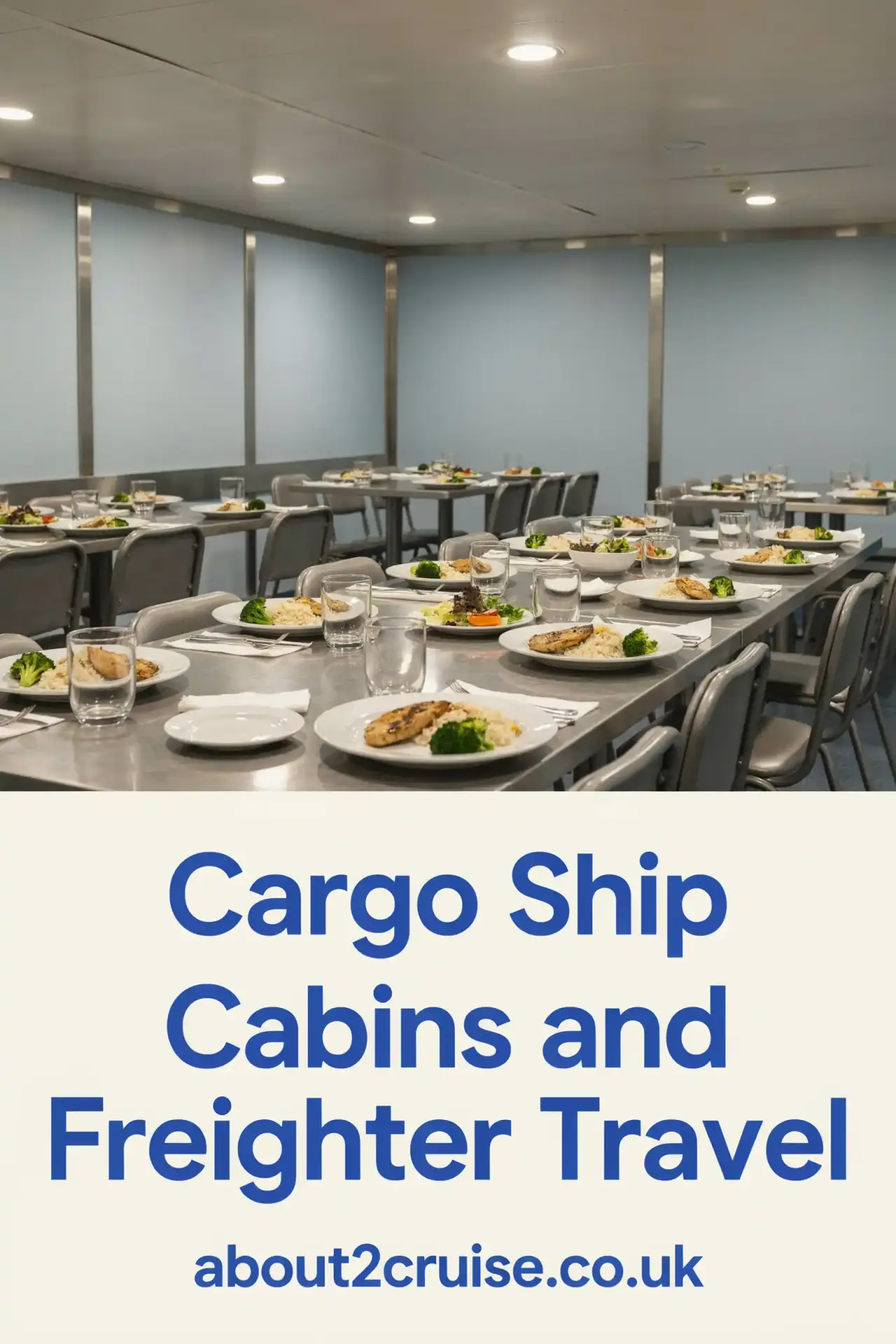
Three meals a day are included in the fare, eaten in the mess hall with the crew. The only fixed times you have to keep are meal times and the time to be back on board in port. On Neoliner Origin the shared dining room is sold as part of the trip, not a compromise.
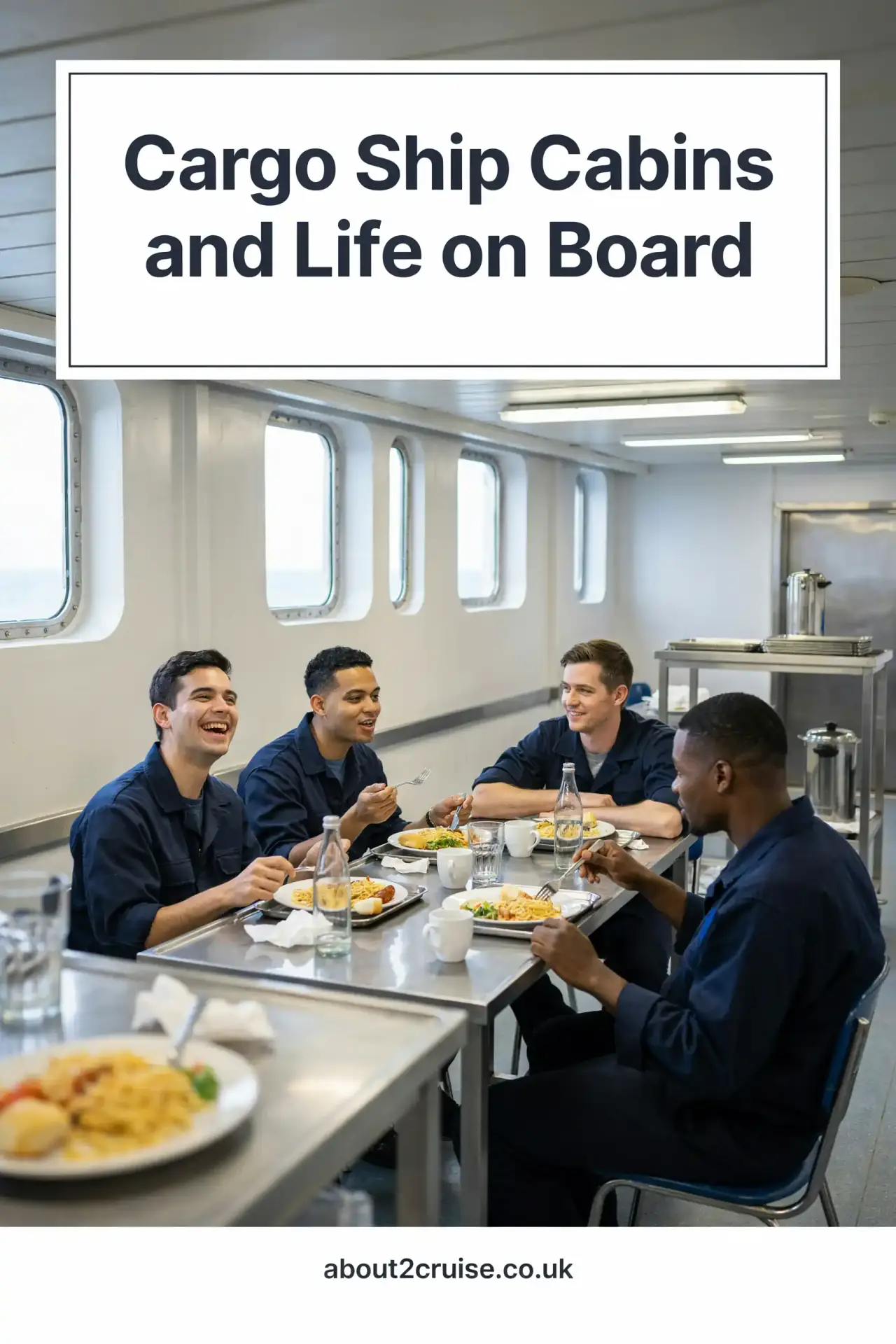
The menu follows the ship’s nationality. Italian officers and Indian engineers on a Grimaldi Mediterranean freighter mean Italian and Indian food, and on French and Italian ships table wine comes with lunch and dinner.
Expect one dinner option rather than a buffet, no all-day snacks and no second kitchen. No operator publishes how it handles vegetarian, diabetic, coeliac or allergy needs, so ask at booking whether the cook can cater for you. Treat a vague answer as a no.
Drinks are charged and usually sold at duty-free prices. Some operators run dry ships, CMA CGM among them, so check before you count on a glass of wine with dinner.
Facilities: a lounge, a small gym and no entertainment programme
A passenger lounge, a small gym or sauna on some ships, and open deck space are what you can count on. Organised entertainment isn’t part of the deal.
- Antwerp to Finland ConRo: air conditioning, fitness room, sauna, a passenger mess and lounge with television and video, 220V Schuko sockets, and euros accepted on board.
- Neoliner Origin: a 75 m² passenger lounge with a panoramic window, a dining room shared with the crew, a fitness room and a sun deck.
- Grimaldi cargo ships: gym, pool, sauna, library, video room and laundry for passengers, with the engine room and the bridge off limits unless the Master gives permission.
Beyond that, you fill the days yourself. Bring books, films and something to study, and pack a loaded e-reader for the quiet hours rather than relying on a ship’s library.
Three weeks with nothing programmed is the part first-time passengers underestimate. The crew are on watch, the deck is a workplace, and the voyage is only as interesting as you make it. That’s why daily routines and activities aboard cargo ships are something to think through before you sail.
Wifi and phone signal at sea
Internet on a freighter is limited, slow and often chargeable, and no operator publishes whether it’s free, metered or priced by the megabyte. Neoliner says passengers can easily access the internet on the Origin, but on most ships you’re sharing a weak signal at best.
Plan to be out of contact for days at a time. A phone with an international calling card will at least let you text home when the ship comes within range of a 3G signal, and most cargo ships don’t carry satellite internet.
If you intend to work, ask two questions before you pay: what the connection is, and what it costs.
What the fare covers, and what a freighter voyage really costs
The fare covers your cabin and three meals a day, and little else is charged once you’re aboard. Drinks, cigarettes and other purchases go on your account, with drinks priced at duty-free levels rather than shore prices.
Some quotes list port charges and deviation insurance as separate lines. Neither is explained in plain terms, so ask what each one covers, particularly what happens if the ship misses a port.
Daily rates look modest next to a cruise, but the voyage runs far longer and the total often comes out higher than a conventional cruise of the same region. Freighter travel isn’t a budget cruise, and the key differences between freighter travel and cruise ships show up most clearly in what you pay for.
The sole-occupancy supplement is where solo travellers get caught. On one new transatlantic service it’s high enough that a single passenger is offered a share of a twin cabin with someone of the same sex instead. Gratuities aren’t run the way they are on a cruise ship, though a tip to the steward at the end is usual on some vessels.
Who is allowed on board
A ship carrying more than twelve passengers counts as a passenger ship under SOLAS. That’s why freighters cap numbers at a handful of berths and why there’s no ship’s doctor aboard. That single rule shapes most of what follows.
Age limits are set by the line. One service states a maximum of 80 with no exceptions, others commonly sit between 70 and 85, and some ask for a medical certificate from 75 upwards. There’s no single industry figure, so check the line before you plan.
A medical certificate is standard, sometimes completed within 30 days of sailing, along with proof of travel insurance and signed release forms. Lines generally won’t accept passengers with severe chronic conditions, and physical fitness is a stated condition because many ships have no lift.
With no doctor aboard, crew are trained in first aid and basic dispensary items are carried, but anything serious means leaving the ship. Carry your own medication and a comprehensive medical travel kit for the things you’d normally treat at home.
Passport validity of at least six months from the voyage start is required on at least one service, and every visa for the intermediate calls has to be in the passport before you sail.
Is freighter travel right for you?
Freighter travel suits independent, patient, mobile travellers who are happy with their own company and a fixed routine. It badly suits anyone who needs entertaining, assistance or privacy from a group of twenty.
The crew are on duty and the day doesn’t revolve around you. You share a small society where everyone depends on everyone else, which is either the point of the voyage or a fortnight of friction.
Stairs are the normal way between decks. Many freighters have no lift at all, and one large multi-purpose ship puts the passenger cabins six flights above the mess room. If stairs are a problem, ask for a vessel with a lift and a cabin near the public rooms.
Rules on board: the bridge, the engine room and dry ships
The engine room is off limits and the bridge is entered only with the Master’s permission, though some lines let passengers visit as a matter of course. Everything else, from the lounge to the deck, is shared with the crew.
Alcohol sits at the Master’s discretion on many ships, and some operators, CMA CGM among them, run a dry ship. Ask before you board if a drink with dinner matters to you.
A working cargo ship can also be diverted to another port at short notice, which changes where you end up. Build slack into the end of the trip rather than booking tight onward flights.
Seasickness, stabilisers and short port calls
Freighters roll more than cruise ships and not all of them are stabilised. One ConRo service carries stabilisers, Neoliner Origin doesn’t, and ships without them move around noticeably more in open water.
Assume you may be seasick and prepare with medication or wristbands rather than hoping. The open deck is usually the best place to be when you feel the motion.
Shore time is short and decided by cargo. Most ships spend 10 to 12 hours in port and you could arrive at 10pm, while cargo operations at an intermediate call can run 12 to 36 hours. Passengers come second to freight.
Terminals are working freight terminals with restricted access. On at least one service you’re handled from the port entrance on departure to the port exit on arrival, and authorised taxi transfers are used where the terminal is restricted.
Booking: berths, deposits and schedules that move
A handful of berths per sailing means you book a specific ship and date, not a route. Neoliner Origin carries 12 passengers in six double cabins, an Antwerp to Finland ConRo takes up to eight in four cabins, and some Grimaldi Mediterranean freighters have two passenger cabins in total.
Grimaldi sells passenger cabins on its freighters directly. On other lines you book through a specialist agent, and it helps to understand how to book freighter travel with agencies or direct before you start comparing dates.
A deposit secures the cabin with the balance due around 60 days before departure, and popular routes and dates can be booked a year or more ahead. A good rule of thumb is to accept three days of delay for every week of travelling.
Boarding instructions can be confirmed only at the last minute, and you may disembark at a different port from the one on the itinerary. Some ports can’t be used for joining or leaving the ship at all, including Sines in Portugal and Panamanian ports except for touring.
One worked example: Neoliner Origin runs Saint-Nazaire to Saint-Pierre-et-Miquelon, Baltimore and Halifax on a 28-day round rotation, with one departure a month and crossings from Saint-Nazaire of 13 days to Baltimore, 11 to Halifax and 8 to Saint-Pierre-et-Miquelon. Plan the trip around the ship rather than the calendar, and look at popular freighter travel routes and destinations with that in mind.
Cargo ship accommodation FAQs
Do all cargo ships take passengers?
Not all cargo ships take passengers. Tankers, colliers and ore carriers don’t carry passengers, while container ships, reefers, multipurpose vessels, ro-ros and bulk carriers can. Numbers stay tiny, from two cabins on some Grimaldi freighters to twelve passengers on Neoliner Origin.
How many crew members are on a cargo ship?
Expect a small ship’s company, often around twenty. Neoliner Origin sails with 13 crew and two cadets looking after 12 passengers, which is enough to make the ship feel like a village.
Can you book a passage directly with a shipping line?
Booking direct with a shipping line is rare. Grimaldi sells passenger cabins on its freighters directly, but on almost every other line you book through a specialist agent. The specific ship and sailing date, not the route, is what you book.
What plugs and currency should you take?
Take a European adapter and a little cash, and check the socket type for your own ship. One Antwerp to Finland ConRo provides 220V Schuko sockets and takes euros on board.
Can you leave luggage at the terminal before boarding?
You can’t leave luggage at the terminal before boarding. Container terminals are working freight terminals with restricted access and no left luggage, so arrive with everything you need and go straight from the port entrance to the ship.
Last Updated: 1 November 2026
One Response
The cargo ship cruising sounds like something that I, my brother and my older cousin, a retired naval commander, would enjoy.