
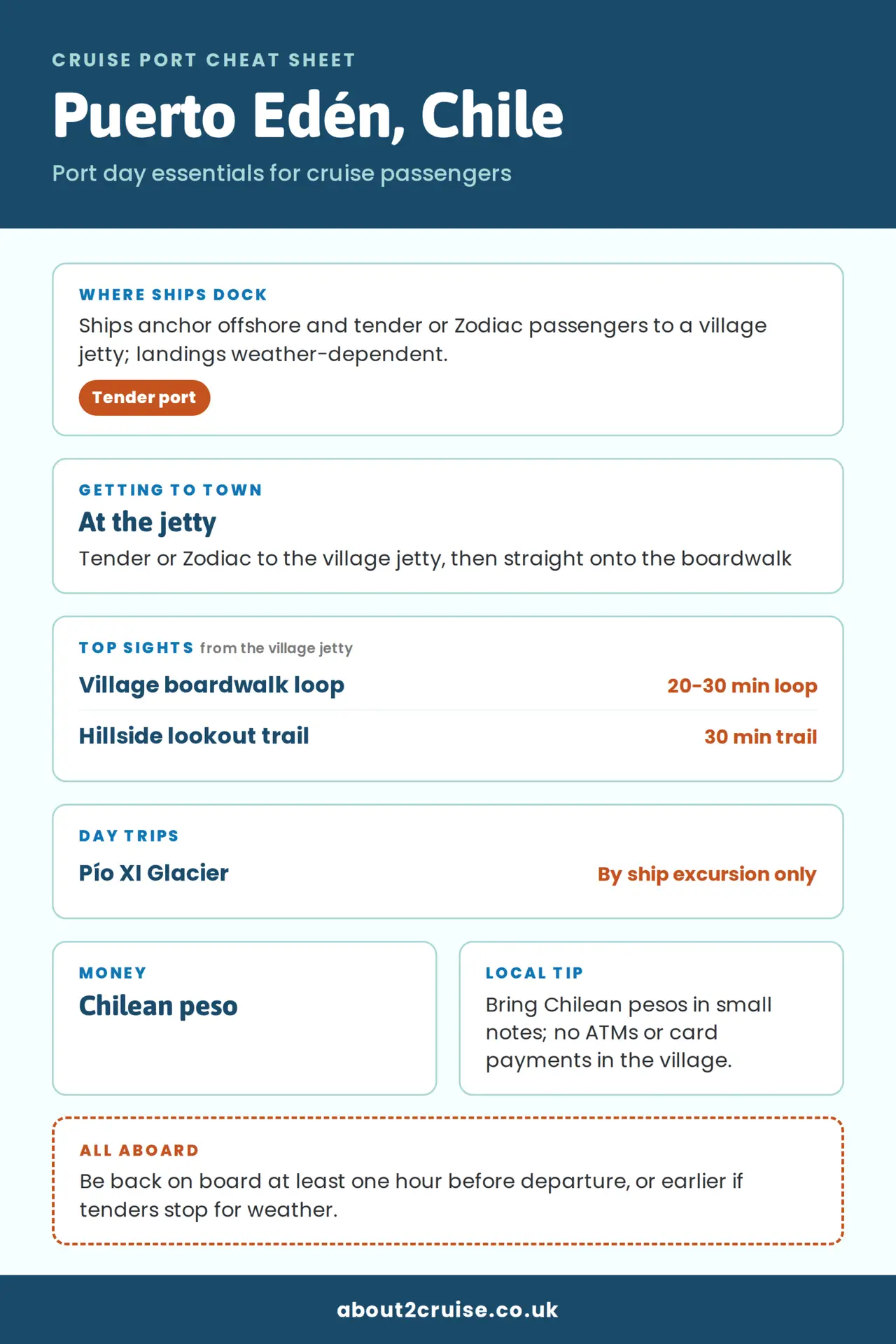
Puerto Edén is a roadless Kawésqar village on Wellington Island in Chilean Patagonia, deep inside the remote fjords of Bernardo O’Higgins National Park. Expedition ships anchor offshore and send passengers ashore by tender or Zodiac to a small jetty. You can usually walk the village boardwalks without buying an excursion, but landings are weather-dependent, facilities are minimal, and the village itself is the sight.

Where is Puerto Edén?
Puerto Edén sits on the eastern shore of Wellington Island in Chilean Patagonia, on the western side of Paso del Indio. It’s part of Natales commune in Última Esperanza Province, Magallanes Region, at roughly 49.13°S, 74.41°W. By sea, it’s about 400 km from Puerto Natales.
There are no roads in or out, no airstrip, and no land connection to the rest of Chile. People get around by wooden boardwalk, private boat, or the occasional ferry.
It’s also the only populated place inside Bernardo O’Higgins National Park, Chile’s largest national park at more than 3.5 million hectares. That protected-area setting is why the scenery feels so huge, and why facilities are so minimal.
Puerto Edén cruise port map
Tenders bring you ashore at Village jetty. From the village jetty, Hillside lookout is about a 5-minute walk. Tap a pin for directions.
- Village jettyWhere tenders land
- Retén de Carabineros Puerto EdénPolice post · About 3 min walk from Village jetty
- Hillside lookoutViewpoint · About 5 min walk from the village jetty
- Cementerio de Puerto EdénCemetery · About 14 min walk from Village jetty
- Glaciar Pío XIGlacier · About 66 km from Village jetty
Why do cruise ships call here?
Puerto Edén is known as one of Chile’s most remote inhabited places: a roadless Kawésqar settlement in the Patagonian fjords, and a regular expedition-cruise tender stop rather than a conventional cruise port. Its Kawésqar name is Jetarktétqal. The community includes some of the last remaining Kawésqar people, and life has long centred on small-scale fishing and drying smoked cholga mussels.
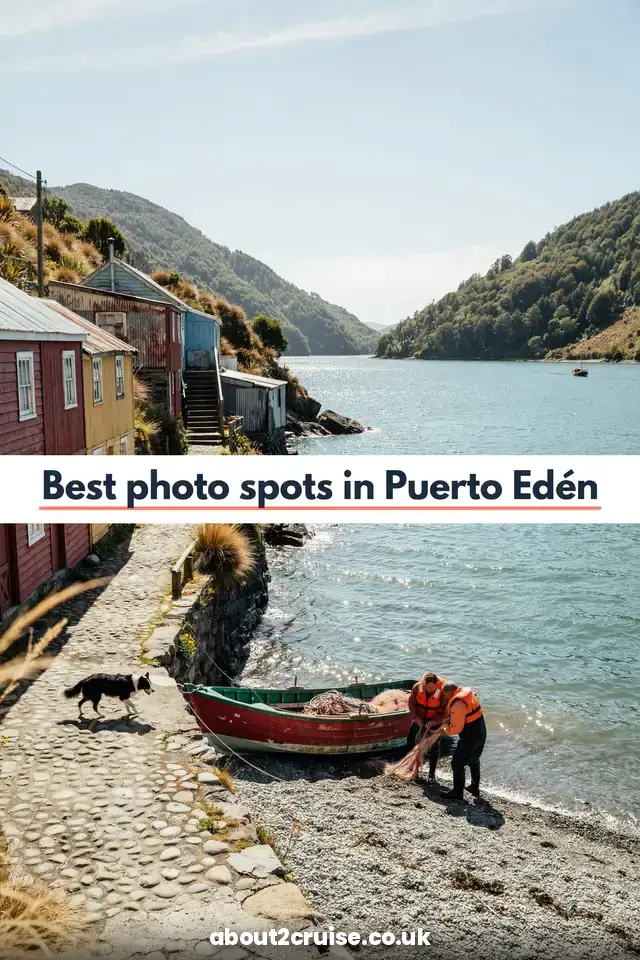
For cruise passengers, there’s no big monument or museum. The draw is the place itself: stilt houses, boardwalks, fishing boats, and national park wilderness in every direction. The nearby Pío XI Glacier, the largest glacier in the Southern Hemisphere outside Antarctica, is part of the wider story, though you can only reach it by boat.
Which expedition cruises visit Puerto Edén?
Puerto Edén shows up mainly on expedition cruise itineraries between October and April. HX Expeditions includes it on voyages with MS Fridtjof Nansen and MS Roald Amundsen. Silversea has called with Silver Cloud Expedition, and Scenic with Scenic Eclipse and Scenic Eclipse II. Large mainstream resort ships don’t stop here.
There’s no cruise berth and no terminal. Some lines package the stop as part of a wider “Puerto Edén / Pío XI Glacier (Inner Fjords)” experience. The Navimag ferry is the one vessel that regularly ties up at the village jetty rather than anchoring offshore.
Arriving by tender: what the landing is actually like
Puerto Edén has no conventional pier, no cruise terminal, and no welcome pavilion. Ships anchor offshore in the fjord or bay in front of the village. You’ll go ashore by ship’s tender or Zodiac, usually a 10–15 minute ride, though wind or swell can make it feel longer.
The landing point is a modest village jetty. In calm conditions there are stairs and handrails. In less friendly weather, some landings are wet Zodiac landings. The anchorage used by small ships and yachts is around 49°07.8S, 074°25.5W in the bay in front of town.
There’s no terminal building, no waiting lounge, no taxis, no luggage handling, and no sheltered assembly area ashore. The expedition briefing will cover the exact plan, and it can change during the day.
Can you go ashore independently?
Yes. You don’t need to buy a shore excursion to visit Puerto Edén. HX runs its village visit as an included, at-leisure excursion on many voyages, but independent walking is possible. From the landing point, the boardwalk network leads straight into the settlement, and the whole village is walkable in 20–30 minutes.
The real gatekeeper is weather. Planned landings depend on tides, wind, and visibility. If the captain or expedition leader decides it isn’t safe, nobody goes ashore. The fallback is usually a day of scenic fjord cruising.
Walking through Puerto Edén: boardwalks, layout and lookout
Think of Puerto Edén as a boardwalk village. Wooden pasarelas run between colourful stilt houses, passing a small church, a couple of basic shops, and several viewpoints over the bay. The main loop is roughly 1 km and takes 20–30 minutes at a gentle pace.
There’s also a hillside lookout trail that adds about 30 minutes. It’s often wet, mossy, and uneven. Some boardwalk sections have steps and can be slippery after rain. Stick to marked paths and avoid private jetties, boat landings, and residents’ staircases. The village has two muelles and many small private landing stages; they aren’t public walkways.
How to spend a few hours ashore
Most people walk the boardwalks, watch fishing boats, and photograph the stilt houses and drying rows of mussels. You may also see wildlife from the tender or shore: South American sea lions, Chilean dolphins, marine otters (chungungo), Andean condors, and seabirds.
Before you sail
- Check the expedition briefing for tender and landing rules.
- Bring Chilean pesos in small notes; no ATMs or cards in the village.
- Pack waterproof layers and non-slip shoes for wet boardwalks.
Port day: about 4 hours ashore
- On dockingTake the tender to the village jettyWeather dependentAttend the expedition briefing first. The transfer takes 10-15 minutes and may be a wet Zodiac landing.
- +20 minWalk the boardwalk village loopA 1 km loop takes 20-30 minutes past stilt houses, the small church and lookout points over the bay.
- +1 hrLunch: smoked cholga musselsCash pesosFamilies sell smoked mussels and king crab along the boardwalk. There are no restaurants, so bring Chilean pesos in small notes.
- +1 hr 30 minClimb to the hillside lookoutThe mossy 30-minute trail looks over the bay and Messier Channel. Wear non-slip shoes.
- +2 hr 15 minWildlife watch from the shoreLook for Chilean dolphins and marine otters. Keep at least 50 m from all marine mammals.
- All-aboard minus 1 hrQueue at the village jettyTender queues build near all-aboard. Treat all-aboard as the last tender, not the time to leave the village.
The time on the map is the whole walk, every stop added together.
Open this walking route in Google Maps
If plans change: If the landing is cancelled, the day becomes scenic fjord cruising; there is no substitute port or independent way off the ship.
Keep legal distances: at least 50 m from dolphins, sea lions, marine otters, and penguins; 100 m from most whales; 300 m from blue whales. Southern right whales may only be watched from land.
Local specialities worth trying or buying include smoked dried cholga mussels, king crab (centolla), sea urchin (erizo), and luche seaweed. Handicrafts include woven junco baskets, bark canoe models, and beadwork.
Pío XI Glacier is about 32 km from the village in a straight line. You can’t walk there; it’s reached only by boat as a ship excursion.

Shops, food, cash and limited facilities
Puerto Edén is not a tourist town. There are a handful of informal shops and two hostales, but no restaurants, no café strip, no bank, and no ATM. Card payments are generally not accepted. Bring Chilean pesos in small notes. US dollars and euros won’t get you far.

Some families sell shellfish, dried mussels, and crafts along the boardwalk, but hours are informal. Electricity is not 24-hour: diesel generation usually runs from 08:00–15:00 and 17:00–24:00, which can affect freezers, lighting, and any card terminal.
There are no reliable public toilets, so use the ship before you go. There’s no waste-management infrastructure, so carry all rubbish back with you. Don’t take fresh fruit, seeds, or food ashore.
Weather, clothing and the real chance of cancellation
Puerto Edén is extremely wet by most standards. Even in February, the mildest month, the mean temperature is only about 9°C, with an average high of 12°C and low of 6.6°C. February averages around 362 mm of rain over roughly 16 rain days. December and January are wetter.
Humidity sits around 85–92% year-round, and summer sunshine averages only 2–3 hours a day. Summer days are long, with sunrise around 06:12 and sunset around 21:10, but the actual sun can stay hidden behind rain and cloud.
Dress in layers, wear a proper waterproof jacket and trousers, and choose sturdy non-slip shoes or boots. A dry bag for phones, cameras, and spare layers is a good idea. Because wind and rain can build quickly, the decision to run tenders can be made at short notice.
Etiquette, photography, drones and protected-area rules
Puerto Edén is a working Kawésqar community, not an open-air museum. Ask before photographing residents, especially children. The boardwalk passes close to people’s front doors, so treat homes, jetties, boats, and drying racks as private.
Don’t handle or buy items that appear to be from prohibited wildlife, and don’t leave anything behind. Drones are banned for recreational or tourist use throughout Chilean protected areas, including Bernardo O’Higgins National Park, so leave the drone on the ship.
Open fires are illegal outside authorised camping areas, and all rubbish must go back with you. Access to the wider national park is restricted and normally coordinated in advance with CONAF. A cruise shore visit to the village is not a permit to roam into the backcountry.
Accessibility and mobility: the tender challenge
This is not a wheelchair-accessible port. Before you reach the village, you must step between a moving ship and a tender or Zodiac, often in swell or rain. The jetty may have stairs, and sections of boardwalk include steps. The ground can be wet, mossy, or uneven.
HX grades its community visit as moderate, covering 2–3 km over wooden boardwalk and unpaved ground, and says it is not wheelchair accessible. If you use a walking aid, have balance concerns, or can’t manage steps, talk to the expedition team before deciding to go ashore. There’s no private wheelchair-accessible tender service or ramped alternative in the village.
Staying connected: phone signal and Wi-Fi
Spanish is the local language, and some residents speak at least some English. Mobile phone signal is limited: the village has a single Entel antenna with very low capacity. Voice calls may work, but data can be poor.
A free community Wi-Fi network based on Starlink has been installed in some public areas, but coverage and speed are not guaranteed. Don’t plan video calls, large uploads, or digital payments ashore.
Your ship is your main communication link. If the ship is out of sight and you need help, head back to the landing point or ask a resident to help you contact the harbour captain or expedition team.
Medical, safety and emergency realities
Puerto Edén has a rural health post, but it’s not an emergency department. It’s normally staffed by a nurse and a paramedic-level TENS. Specialist doctors visit only occasionally, and there’s no fast medical evacuation service, no ambulance boat standing by, and no local airstrip.
In a serious emergency, the Maritime Authority coordinates response from afar, which can take time. Bring all personal medications ashore, travel with comprehensive cruise or expedition insurance, and follow the expedition team’s safety briefings.
There’s also a small Carabineros post and a harbour captain’s office, but they aren’t a substitute for your ship’s medical team.
Timing, all-aboard and tender queues
Exact time ashore is decided on the day by the captain and expedition leader. A general rule for this region is to be back on board at least one hour before scheduled departure, but follow the ship’s announcements because weather can compress the window.
At the end of a call, many passengers return around the same time, so expect a queue at the landing point. If the sea is building, the ship may suspend tender operations earlier than planned. Treat the all-aboard time as the latest possible tender departure, not the time you should be leaving the village.
Getting to Puerto Edén independently: ferry, flights and gateways
Puerto Edén has no airport and no road. The only public transport is by sea. Navimag’s ferry runs between Puerto Natales and Puerto Edén, taking about 27 hours on the direct leg, with limited sailings each month. The ferry Esperanza on the longer Puerto Montt–Puerto Natales route also makes a short stop here. The nearest airport is Cochrane, roughly 249 km in a straight line, but it’s not a practical transfer point.
Most cruise passengers arrive as part of a Chilean fjords itinerary that links Puerto Edén with Puerto Montt, Puerto Chacabuco, or Puerto Natales. For the wider sailing region, see our Chile cruise ports guide.
Puerto Edén vs Eden: don’t mix them up
If you’ve searched for a Mediterranean Puerto Edén cruise port, you’re not alone, but it doesn’t exist. The cruise port commonly called simply “Eden” is Eden in New South Wales, Australia, which has a purpose-built wharf at Snug Cove and an Eden Welcome Centre. Puerto Edén is completely different: a remote Chilean Patagonian tender stop on Wellington Island, facing the Pacific fjords, not the Mediterranean or the Australian coast.
Frequently asked questions
What happens if my tender is delayed or the landing is cancelled at Puerto Edén?
If the landing is delayed, the ship may adjust time ashore or wait for a better weather window. If it’s cancelled, the day usually becomes scenic fjord cruising, sometimes with extra expedition activities on board. There’s no substitute port and no independent way off the ship.
Can I eat the local smoked mussels and shellfish safely?
Many visitors try smoked cholga mussels, king crab, or sea urchin from local families. Use common sense: choose food that is freshly prepared or dried/smoked in front of you, avoid anything that smells off, and be careful if you have a shellfish allergy. When in doubt, ask the expedition team or eat on the ship.
Do I need a permit just to walk around the village?
No. The normal cruise shore visit to the village boardwalks doesn’t require you to buy a separate park ticket or apply for a CONAF permit on the day. But the village sits inside a national park, so follow protected-area rules, stay on the usual boardwalk route, and don’t treat the stop as permission to head into the backcountry.
Will the ship wait if I’m late returning to the landing point?
Don’t count on it. Expedition ships work to tight weather and daylight windows, especially in the Chilean fjords. If you’re late, the ship may not be able to wait, and the next practical onward journey could involve the Navimag ferry or assistance from local authorities. Build in extra time for the tender queue and slow boardwalk conditions.
Is Puerto Edén worth visiting if the weather is bad?
If the tender runs, yes, because the village loop is short and the atmosphere is often at its most dramatic in low cloud and rain. But it will be wet, boardwalks will be slippery, and photography can be difficult. If you dislike rain or have mobility concerns, stay on board and watch from a dry observation lounge.
Last Updated: 20 November 2026