
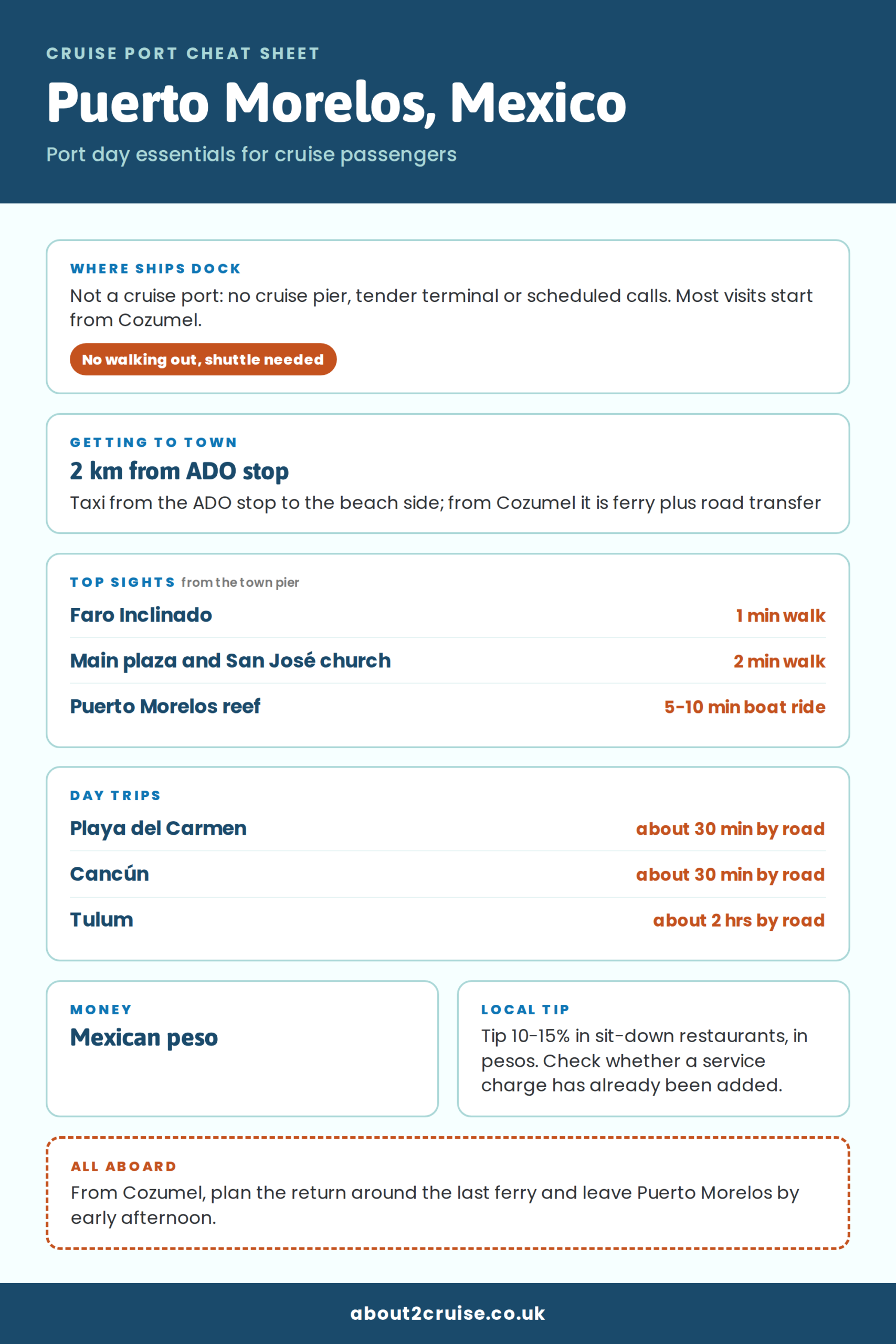
Puerto Morelos is not a cruise ship port: there is no cruise pier, no tender terminal and no scheduled ship calls. It is a small Riviera Maya fishing town famous for the Mesoamerican Barrier Reef, the leaning lighthouse and cenotes. From a Cozumel cruise call you can reach it via the Playa del Carmen ferry, but the transfer takes most of a port day.
Puerto Morelos Is Not a Cruise Port: What That Means
Let’s start with the part people get wrong. Puerto Morelos has no cruise terminal. The only commercial maritime facility in the municipality is a cargo dock with three berths and a roll-on/roll-off ramp. It isn’t set up for passenger ships, and there’s no cruise schedule for the town. The state port authority says there isn’t even a preliminary project for a cruise pier here, because the water is only about 4 metres deep and the protected reef biosphere makes large-ship access difficult.
That pretty pier you see in photos, right by the leaning lighthouse, is a working fishing and snorkel-boat pier. That’s where reef boats leave from, not where cruise ships dock. If a guide or tour seller tells you boutique ships tie up in the town centre, they’re describing something that doesn’t exist.
For an actual cruise call, the nearest practical port is Cozumel. A few ships also use the industrial Calica/Punta Venado facility south of Playa del Carmen, but regular large-ship calls don’t go to Puerto Morelos.
Puerto Morelos cruise port map
Ships dock at Puerto Morelos cargo terminal. From there, Dr. Alfredo Barrera Marín botanical garden is about a 21-minute walk. Tap a pin for directions.
- Puerto Morelos cargo terminalWhere ships dock
- Dr. Alfredo Barrera Marín botanical gardenBotanical garden · About 21 min walk from Puerto Morelos cargo terminal
- Ventana al MarBeach park · About 3 km from Puerto Morelos cargo terminal
- Unico BeachBeach club · About 3 km from Puerto Morelos cargo terminal
- Croco Cun ZooZoo · About 3 km from Puerto Morelos cargo terminal
- International PierPier · About 43 km from Puerto Morelos cargo terminal
- Puerto Morelos Reef National ParkMarine national park · About 9 km from Puerto Morelos cargo terminal
- Cenote La NoriaNatural sinkhole · About 24 km from Puerto Morelos cargo terminal
- Cenote Siete BocasNatural sinkhole · About 15 km from Puerto Morelos cargo terminal
- Jungle SpaSpa · About 22 min walk from Puerto Morelos cargo terminal
- Alma Libre BookstoreBookshop · About 3 km from Puerto Morelos cargo terminal
- El Rey Archaeological ZoneArchaeological site · About 26 km from Puerto Morelos cargo terminal
What Makes Puerto Morelos Worth Knowing About
Puerto Morelos is best known for the Mesoamerican Barrier Reef, the second-largest barrier reef system on Earth. The reef here sits about 400 to 500 metres off the beach in shallow water, so boats reach it in five to ten minutes. Because this stretch is a protected national park, it has avoided much of the damage that busier parts of the Riviera Maya coast have seen. Many divers consider it one of the most pristine reefs on this side of the Yucatán Peninsula.
The town itself is known for its low-rise fishing-village atmosphere, a compact central plaza, the Faro Inclinado leaning lighthouse, and easy access to the Ruta de los Cenotes inland. That combination of reef, village, and cenotes is exactly why travellers ask about visiting on a cruise.
Snorkelling and Diving at the Puerto Morelos Reef
The protected marine area covers 9,066 hectares and is a Ramsar site. Visibility is best from November to April, often quoted at 20 to 30 metres. You can’t swim out to the reef from shore. Access is by authorised boat with a licensed local guide, in small groups, and life jackets are mandatory.
The national-park access fee is MX$125 per person per day, usually collected through your operator. Under-12s are generally exempt. Town-based snorkel tours cost roughly US$38 to US$45 per person for a two-hour, two-stop trip. The local fishing cooperative at the foot of the town pier runs similar two-stop reef trips for about MX$350, Monday to Saturday, roughly 9am to 3pm, leaving every half hour. Dive shops charge around US$50 to US$75 for a one-tank dive and around US$285 to US$300 for a two-day PADI course.
Spear guns and nets are banned inside the park, and trips are cancelled when the harbour master closes the port. If the sea is rough or a cold front passes through, don’t expect the operator to override a port closure.
The Leaning Lighthouse: Puerto Morelos’ Best-Known Landmark
The leaning lighthouse stands on the beach next to the town pier and Ventana al Mar park, a couple of minutes from the main square. It’s about 10 metres tall, white with blue trim, and it leans because Hurricane Beulah damaged its foundations long ago. It was built partly from stone taken from two Maya structures, and it survived hurricanes Gilbert and Wilma. A replacement working lighthouse stands alongside it; the tilted one is disused but remains the symbol of the town and appears on the municipal coat of arms.
You can see it at any time from the beach, free. Most visitors photograph it from the sand or boardwalk, then walk north a few paces to the fishing boats.
Walking Around Town: Plaza, Boardwalk, and Daily Pace
Puerto Morelos is small enough to cross on foot. The central plaza is the social centre, with the San José parish church, artisan shops, and small tour desks for reef and cenote trips. In the evening there are elote and marquesita vendors, and bars around the centre sometimes have live music or salsa.
The beachfront strip along Avenida Rafael E. Melgar is effectively the malecón, lined with seafood restaurants and low-rise hotels. Sunday bazaars fill the downtown core with local makers. The town quietens down early by resort standards, with most activity winding down by about 11pm. The beach side and the inland colonia are separated by about two kilometres of mangrove, so if you plan to leave the beach area you’ll need a taxi, colectivo, or your own wheels.
Beaches and Beach Clubs: Where to Settle In
Two public beaches hold Blue Flag certification: Ventana al Mar and Playa Sol. The main public beach is steps from the plaza and free, with calm shallow water behind the reef.
For a more comfortable port-day visit, the central beach options are:
- Unico Beach: free to enter with no minimum spend, with sun loungers, a pool, and ceviches.
- Ojo de Agua: a beachfront hotel and beach club fed by a freshwater spring, with a pool, restaurant, and day access usually on a minimum spend or day pass.
- My Paradise and Muelle Once: central alternatives. Muelle Once generally lets you use chairs and umbrellas against restaurant consumption.
The more polished beach clubs sit north of town near The Fives and need a taxi. If your port day is short, pick one of the central options and walk to everything else.
Cenotes, Mangroves, and Jungle Day Trips
The Ruta de los Cenotes runs about 17 kilometres inland from Highway 307, opposite the botanical garden, to the village of Central Vallarta. It’s paved and signposted, but it isn’t a quick add-on. Properly seeing a cenote or two takes at least three to four hours.
Published prices include Selvática from about US$99 adult and US$49 child, Boca del Puma from about US$75 adult and US$39 child, and Cenote Las Mojarras at about MX$150 for a half day or MX$300 for a full day. Less-developed cenotes such as Siete Bocas and Verde Lucero feel wilder. Verde Lucero has a roughly 100-foot crater and a zip line.
The Dr. Alfredo Barrera Marín botanical garden is about 3.8 kilometres from the square, with jungle trails, monkeys, iguanas, and birds. It’s open Monday to Friday from 8am to 4pm and closed at weekends, which catches out visitors. The protected-areas page lists MX$120 for foreign visitors, but recent local reports quote around MX$220, so budget higher and confirm before heading out. Use insect repellent if you go.
Side Trips to Cancún, Playa del Carmen, and Maya Ruins
Puerto Morelos sits about 36 kilometres south of Cancún and about 30 kilometres north of Playa del Carmen, so the two big resort hubs are easy road trips if you’re staying overnight. ADO buses run frequently along the corridor, and colectivos take cash in pesos only. Tulum is about two hours away, and Chichén Itzá is a full-day trip from this coast.
If you want to compare the bigger destinations from a cruise perspective, see our guides to Cancún and Playa del Carmen.
Getting to Puerto Morelos from a Cozumel Cruise
This is the realistic route for most cruise passengers, and it isn’t a short hop. You need a taxi from your Cozumel pier to the ferry terminal in San Miguel, a 35-to-45-minute passenger ferry to Playa del Carmen, then a 30-to-45-minute road transfer to Puerto Morelos. Door to door, budget about two hours each way.
Ferries run roughly 6am or 7am to 9pm or 10pm, with hourly departures through the middle of the day. The operator can alternate by odd and even days, so the timetable you checked may not be the one running. The hard deadline is the last ferry back to Cozumel, not the theoretical time on your tour ticket.
From the ferry dock in Playa del Carmen, the ADO bus station is about a five-minute walk. ADO buses cover the 32-to-35-kilometre road leg in about 30 to 45 minutes, but they drop at the highway junction about two kilometres from the beach, so you then need a short taxi. A direct taxi or pre-booked transfer removes the highway junction and takes roughly 35 to 40 minutes.
There is no passenger ferry from Puerto Morelos to Cozumel. The car ferry that once left from Puerto Morelos now uses Calica/Punta Venado. Cruise lines treat independent mainland days from Cozumel as whole-day, highest-risk outings for a reason. Book conservatively and plan the return backwards from the ferry, not forwards from the reef.
Costa Maya to Puerto Morelos: Not a Port-Day Option
This is not a practical cruise stop. Costa Maya, at Mahahual, is about 318 kilometres by road from Puerto Morelos. Depending on traffic and stops, that’s roughly four to five hours each way. A private transfer would need most of a day and leave no meaningful time in town. Costa Maya’s own excursion market is built around Mahahual, Chacchoben, and the southern coast, not the Riviera Maya towns far north.
Cancún Airport and Pre-Cruise Transfers
If you’re flying into Cancún before or after a cruise, Puerto Morelos is close. The airport is about 20 to 26 kilometres away, or 25 to 30 minutes by road. A taxi is typically quoted at MX$500 to MX$700, roughly US$29 to US$40. Pre-booked private transfers start around US$52 per vehicle. ADO from the airport costs about US$12, but only a handful of buses stop at Puerto Morelos, and the stop is on the highway about two kilometres from the beach.
There is also a Tren Maya station at Puerto Morelos, about 20 to 30 minutes by taxi from the beach centre. It’s useful for inland travel, but not for a tight cruise turnaround.
Timing Your Return to the Ship
The time that matters isn’t the ship’s departure printed on your cruise card. It’s the all-aboard time, minus ferry queues, coach delays, taxi waits, and terminal security. Independent operators often promise to return you before the ship leaves without accounting for the intermediate ferry leg. Ask them to repeat the exact terminal and required arrival time.
Build the return backwards from the last ferry, not forwards from the time you hope to leave Puerto Morelos. Morning is usually calmest for the reef. If the sea is rough, have a beach-club or town fallback ready.
Taxis, Buses, Transfers, and Car Hire
Town taxis in Puerto Morelos don’t use meters. Short rides inside the beach area run about MX$50 to MX$80, but agree the fare before getting in. Colectivos don’t enter the beach zone; they stop on Highway 307, leaving a walk or a short taxi. A taxi to the cenote route is roughly US$20 to US$30.
Bicycles are a practical way around the flat beach side of town, and many hotels lend them. If you hire a car, the easiest place is Cancún airport. Highway 307 is fast and well maintained, but watch for heavy speed bumps, known as topes, near town and on the cenote road. A UK photocard licence is accepted for driving in Mexico.
Passport, Visa, and Entry Rules for UK Visitors
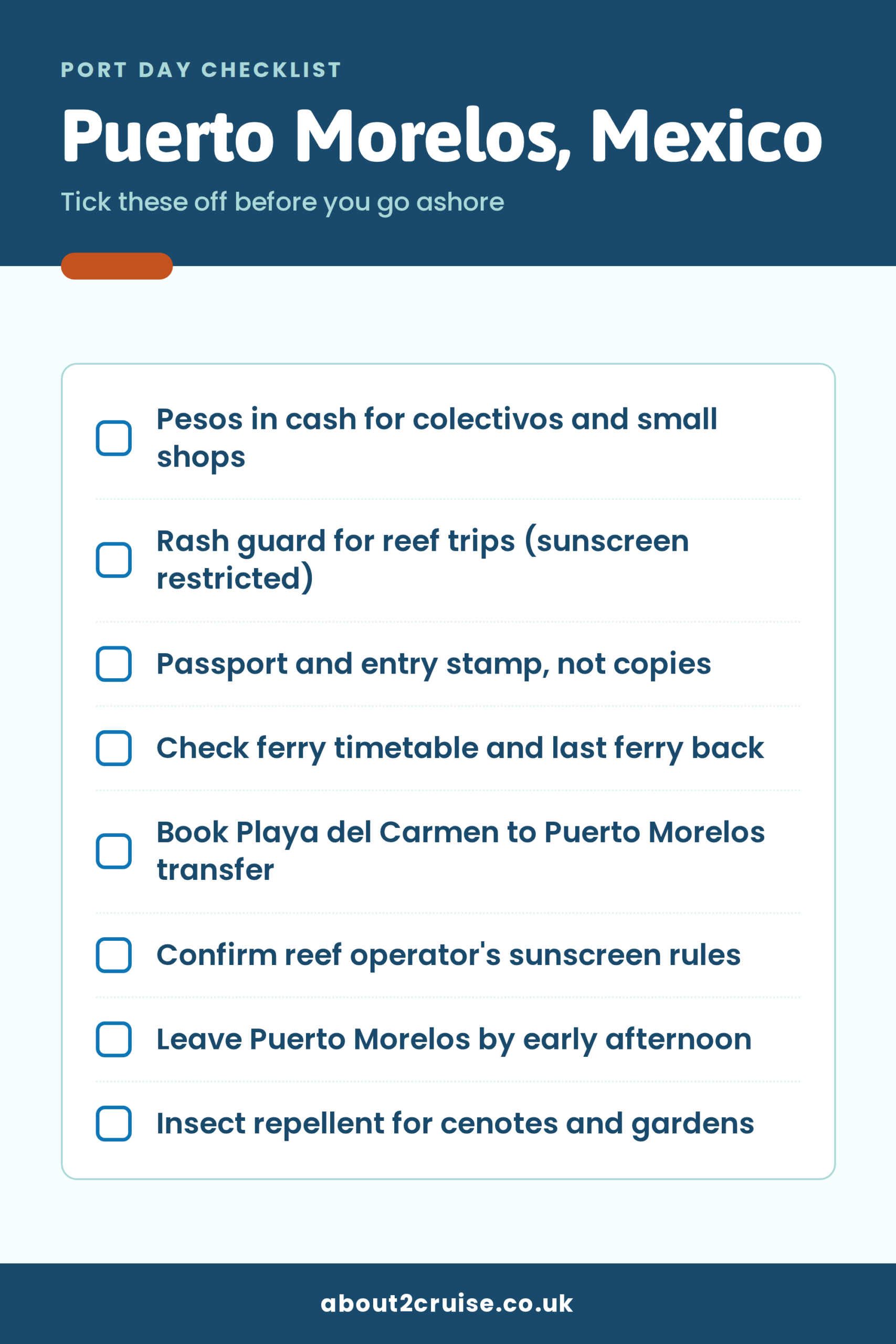
British citizens don’t need a visa for tourism in Mexico. Your passport should be valid for the duration of your stay, and the Mexican Embassy recommends at least 180 days of validity. Border staff may ask for a return ticket, proof of accommodation, and evidence of funds. Carry your passport and entry stamp, not copies, because authorities can ask to see them.
Quintana Roo charges a state entry tax called Visitax. It’s generally collected online before leaving Mexico, with an official rate around MX$285 per foreign visitor. Cruise passengers who have paid the state’s separate cruise-passenger charge are exempt from Visitax under the state law.
Cruise passengers also pay Mexico’s federal non-resident duty, currently US$10 per passenger per itinerary, collected by the cruise line, and Quintana Roo collects a separate US$5 per passenger state cruise charge. You’ll usually see these added to your cruise fare or onboard account rather than paid at Puerto Morelos.
Money, Cards, and Tipping
The currency is the Mexican peso, and paying in pesos is almost always cheaper than paying in dollars. US dollars and major cards are accepted in many tourist businesses, but small shops and market stalls often take cash only. Puerto Morelos has limited banking infrastructure, so bring enough cash or use ATMs during daylight.
The Banorte machines outside Chedraui tend to have lower fees, around MX$38. BBVA machines are pricier. Exchange houses include San Jorge on Rafael E. Melgar and counters in the Chedraui and Super Aki strip malls, but take your passport.
Tipping in sit-down restaurants is usually 10 to 15 percent, in pesos, and a bit more in beach-club settings. Check whether a service charge has already been added before tipping on top.
Weather, Hurricane Season, and Sea Conditions
Puerto Morelos is hot and humid all year. Monthly mean temperatures run from about 24.6°C in January to 29.2°C in July. Rain falls throughout the year, heaviest from August to October, with March and April the driest months.
Hurricane season runs from June to November, with August and September the peak. Cold fronts called nortes arrive from October to May and can produce strong gusts and marine closures. The harbour master decides whether reef boats can operate, not the tour seller.
Sargassum and Beach Conditions
Sargassum arrives on this coast in variable waves, usually heaviest in spring and summer, but amounts change day to day. Puerto Morelos has a three-kilometre anti-sargassum barrier and daily beach cleaning. The state publishes a beach-by-beach traffic-light update for sargassum, though it isn’t predictive.
The reef-protected shore is less exposed than the open beaches, but seaweed still strands here in heavy weeks. If a particular beach looks rough on the day, try another stretch or move to a beach club with a pool.
Reef-Safe Sunscreen and Marine-Park Rules
This isn’t just eco advice; it’s enforced in the protected area. Information boards at Playa Sol, Ventana al Mar, and the beach access points tell visitors not to apply sun creams or oils before entering the water in the marine park. Some operators state that all sunscreen is prohibited in the protected area, while others allow only oxybenzone-free and octinoxate-free products. Check with the operator you book.
Don’t touch coral, don’t stand on it, and stay inside the marked buoy areas. Spear guns and nets are banned. Some reef tours also prohibit cameras and phones in the water under federal environmental rules.
Swimming Safety, Lifeguards, and Beach Flags
The Mexican navy runs a summer lifeguard operation that covers Puerto Morelos beaches, using green, yellow, and red flags. Green means safe, yellow means caution for currents, and red means no swimming. Outside that seasonal operation, local reporting has highlighted the absence of permanent lifeguards and consistent warning signage. Don’t assume a designated swimming area is being watched.
Be careful near the pier, where fishing and snorkel boats move in and out. Crocodiles live in lagoons and coastal areas on this coast, so respect warning signs and stay back from lagoon water.
What to Eat and Drink in Puerto Morelos
The town eats from the sea. Expect ceviche, fish tacos, seafood cocktails, whole fried fish, and lobster, plus Yucatecan dishes such as tikin xic, panuchos, and cochinita pibil on family-restaurant menus. Look for dessert stands serving coconut flan, tres leches, and tropical fruit ice creams. Plaza vendors sell elote and marquesitas.
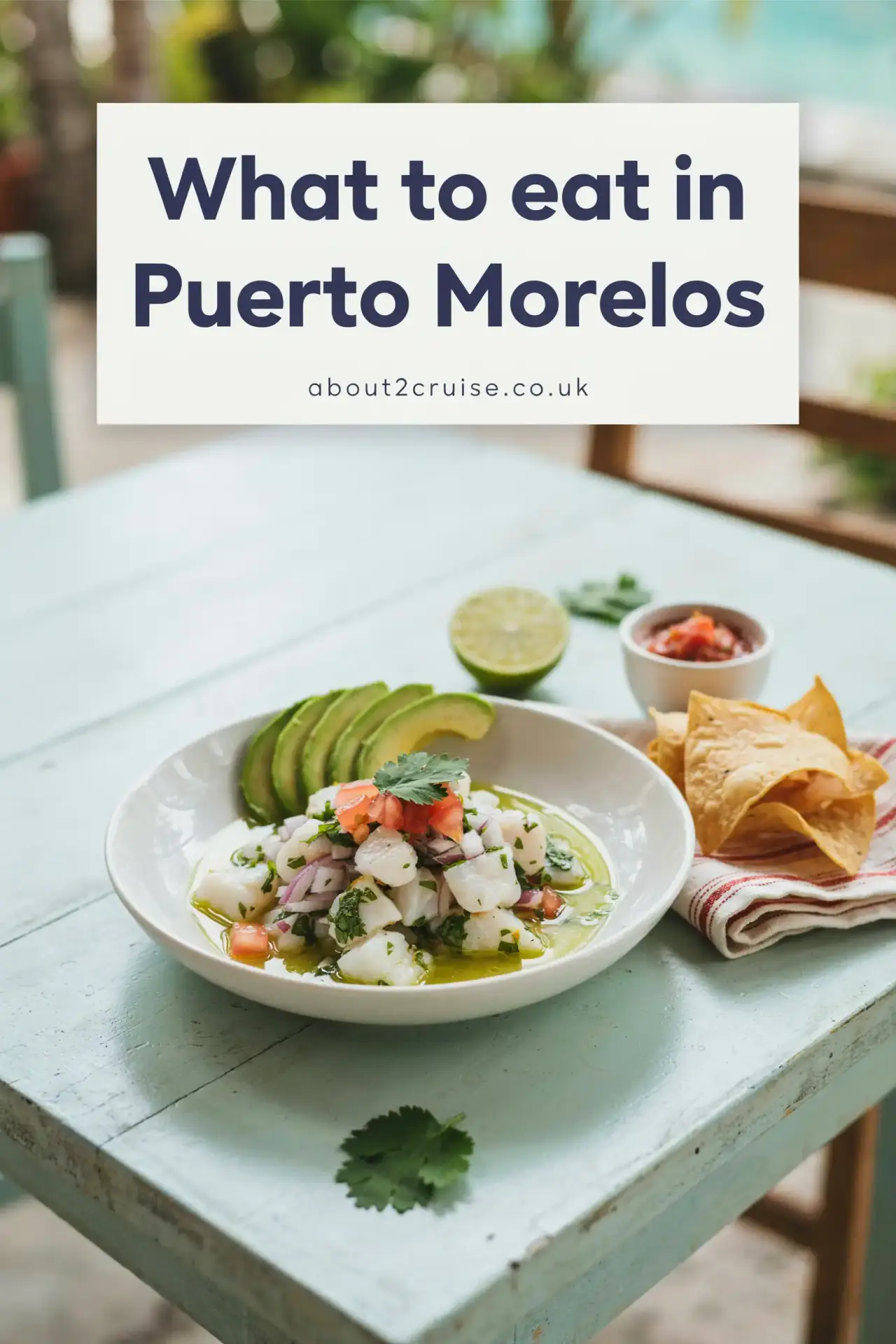
For a short visit, choose a beachfront restaurant within a few blocks of the lighthouse or around the main plaza. Seafood prices are modest by Riviera Maya resort standards, with a lobster plate quoted around MX$450 at local spots.
Shopping, Local Crafts, and Alma Libre Bookstore
Alma Libre Bookstore sits on the south side of the main square, at Javier Rojo Gómez 1270. It sells new and used English-language books, plus local art and crafts, and takes trade-ins. It’s open daily from about 10am to 6pm or 7pm and accepts cards. The artisan market just south of the square is good for jewellery, pottery, hammocks, textiles, vanilla, honey, and chocolate. Sunday bazaars bring more local makers into the centre.
Safety, Health, and Travel Insurance
The UK Foreign Office doesn’t advise against travel to Quintana Roo, but it warns that street crime is a serious issue in tourist areas. Criminals have assaulted British travellers in Cancún, Tulum, Cozumel, and Playa del Carmen, in some cases involving hotel staff, taxi drivers, and security personnel. Use ATMs in daylight inside shops or malls, avoid carrying large amounts of cash, and watch bags on buses and in bus stations.
Use authorised sitio taxi ranks or have your hotel call a taxi. Unlicensed drivers have robbed and assaulted passengers. Tainted and methanol-adulterated alcohol has caused illness and deaths in Mexico, so don’t leave drinks unattended.
Adventure sports equipment may not meet UK safety or insurance standards. Check your travel insurance covers snorkelling, diving, cenote swimming, and ATV activities before you book.
Mobility, Accessibility, and Getting Around
The old town beach side is flat and walkable. Several beach access points have been rebuilt with marked ramps for universal access, and the Blue Flag access was widened so wheelchair users can reach the washbasins and toilets. That said, streets mix paving and cobbles, with uneven sand at beach entrances.
Hotels in town commonly have stairs only and no lifts, so ask before booking if mobility is limited. Reef boats require stepping down into small launches from the beach or pier; confirm transfer arrangements with the operator in advance.
Traveling with Kids and Wildlife Stops
The reef lagoon’s calm, shallow water makes the town beach one of the easier swimming beaches on this coast for young children. Reef snorkel trips often have a minimum age of 6.
Croco Cun Zoo is on the Cancún-to-Tulum highway at about kilometre 31, roughly four kilometres from town. It runs a guided interactive visit lasting 60 to 75 minutes, typically from 9:30am to 4:30pm. Prices are around US$32 for adults and US$22 for children aged 6 to 12, with under-5s free. The botanical garden has a self-guided jungle trail with monkeys, iguanas, and birds, but bring insect repellent and remember it’s closed at weekends.
Cenotes, Jungle Spa, Garden, and Cooking Class
Ixchel Jungle Spa is on Calle de las Reinas, offers Mayan massage, and runs as a non-profit supporting Maya women. It takes bookings Tuesday to Saturday at set times. Reviewers quote about US$50 for an hour, with longer treatments around US$60 to US$80, far below hotel-spa rates.
The Little Mexican Cooking School has been a popular option on Avenida Javier Rojo Gómez, but one directory now lists it as permanently closed. Verify directly before planning a class around it. The botanical garden is open Monday to Friday only and needs insect repellent.
Is Puerto Morelos Worth Visiting on a Cruise?
If your cruise calls at Cozumel and you want a quiet reef village, a cenote, or a seafood lunch without the big-resort feel, Puerto Morelos is genuinely attractive. The reef is a five-to-ten-minute boat ride from the beach, the lighthouse is free and photogenic, and the town is walkable.
The problem is time. From Cozumel the transfer alone is about four hours return, which is most of a normal port day. If you’re already in the Riviera Maya for a land stay, it’s an easy yes. If you only have a standard cruise call, treat it as a full-day, high-risk independent outing, not a casual beach stop.
Best Things to Do in a Few Hours
If you arrive with limited time, prioritise in this order:
Before you sail
- Check the Cozumel to Playa del Carmen ferry timetable; operators alternate by odd and even days.
- Book a private transfer or ADO bus for Playa del Carmen to Puerto Morelos; the highway drop needs a taxi.
- Confirm marine-park sunscreen rules with your snorkel operator before booking.
Long port day via Cozumel ferry
- On dockingTaxi to San Miguel ferry terminal and boardFixed fareLeave your Cozumel pier and take an authorised taxi to the San Miguel ferry terminal, about 10 to 15 minutes.
- +1 hr 15 minRoad transfer to Puerto MorelosADO drop needs a taxiFerry to Playa del Carmen takes 35 to 45 minutes. Then take a pre-booked taxi or ADO. ADO stops on the highway about 2 km from the beach, so take a short taxi into town.
- +2 hrs 30 minReef snorkel with the pier cooperativeLicensed boats onlyJoin a two-hour, two-stop reef trip at the town pier. Access is by authorised boat inside the marine park and life jackets are mandatory.
- +4 hrs 30 minSeafood lunch on the malecónTry cevicheEat ceviche, fish tacos or seafood cocktails at a beachfront place along Avenida Rafael E. Melgar near the lighthouse.
- +5 hrs 30 minFaro Inclinado and Ventana al MarWalk a couple of minutes from the pier to the leaning lighthouse and the beach park. It is free to visit and the town's most photographed spot.
- +6 hrs 30 minPlaza, then start back to Playa del CarmenStroll the main square, the San José parish church and Alma Libre Bookstore, then take a taxi or ADO to Playa del Carmen.
- All-aboard minus 90 minBack at your Cozumel pierTake the ferry back to Cozumel and a taxi to your ship. If you miss the last ferry, the ship will not wait.
The times on the map are for the whole journey there by train and bus.
Get train and bus times in Google Maps
If plans change: If the Playa del Carmen ferry is cancelled or the marine park is closed, stay on Cozumel: its own reef and San Miguel are a shorter, lower-risk port day.
- A two-hour, two-stop reef snorkel with the pier cooperative or a dive shop.
- Ceviche, fish tacos, or seafood cocktails on the malecón.
- The leaning lighthouse and Ventana al Mar park.
- A stroll through the square, the church, and the artisan market.
- A central beach-club break at Unico or Ojo de Agua if the sea is rough or you want shade.
The cenote route isn’t a short add-on. Keep it for a land-based day or skip it on a cruise port call.
A Realistic Cozumel-to-Puerto Morelos Day Plan
Assuming a Cozumel call with a normal all-aboard time:
- Leave the pier by 8am and taxi to the San Miguel ferry terminal.
- Take a ferry to Playa del Carmen, then a pre-booked taxi or ADO plus short taxi to the Puerto Morelos beach side.
- Arrive around 10:30am and do a morning reef snorkel or walk the beach and lighthouse first.
- Have an early seafood lunch by 12:30pm.
- Leave town no later than 2pm to allow for the road leg, ferry queues, and the taxi back to your Cozumel pier.
That gives you about three hours in town. It can be lovely, but it isn’t a lazy beach day.
Common Mistakes to Avoid
- Believing there’s a small cruise pier in the town centre. There isn’t.
- Assuming a ferry runs from Puerto Morelos to Cozumel. It doesn’t.
- Expecting to reach it from Costa Maya on a port day. The road is around five hours each way.
- Turning up at the botanical garden on a weekend, when it’s closed.
- Booking a reef trip assuming sunscreen is fine. The marine park restricts or bans it.
- Planning your return from the time you’d like to leave town instead of the last ferry back.
Where to Stay If You’re Staying on Land
If you’re not tied to a cruise schedule, base yourself on the beach side near the plaza, pier, and lighthouse. Hacienda Morelos Beach Front Hotel is a beachfront option two to three minutes from the square, with a restaurant, bar, luggage storage, and free parking, but upper floors are stairs only. Hotel Arrecifes Suites is at the north end of the beach, about a ten-minute walk from the square, with a pool and free parking but no lift. Hotel and Beach Club Ojo de Agua is central, beachfront, and home to the Ojo de Agua pool and restaurant.
Cruise passengers with a sailing to catch generally do better staying in Cancún, about 20 to 30 minutes from the airport, or San Miguel in Cozumel.
Photo Spots
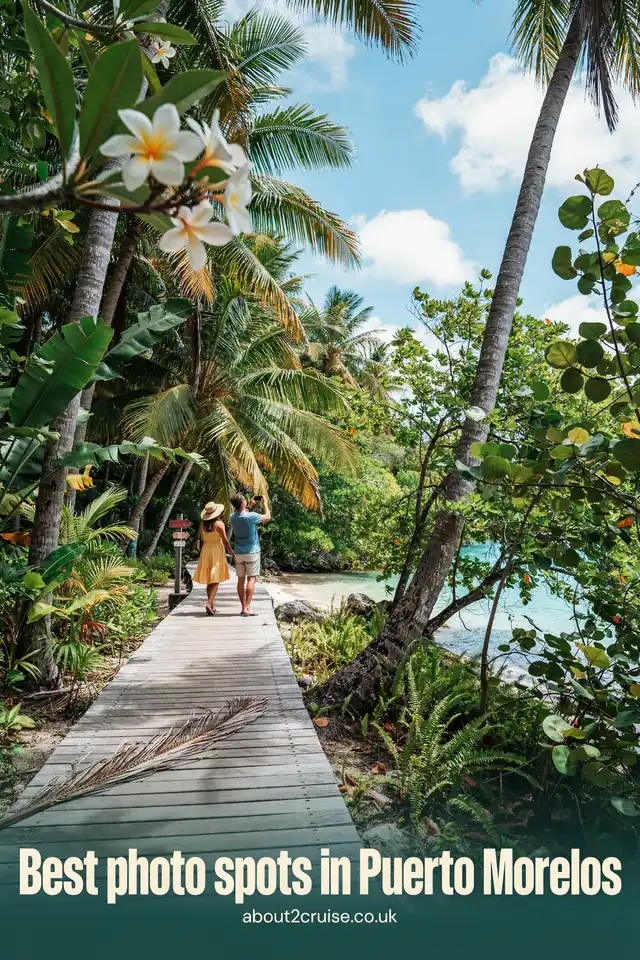
- The leaning lighthouse beside the pier and Ventana al Mar is the classic shot.
- Ventana al Mar park and the beach just north of the pier, where fishing boats rest on the sand.
- The plaza around San José parish church, especially in the evening.
- Cenote Verde Lucero inland, where light shafts hit the water most dramatically around midday.
What to Wear
This is a beach town: shorts, sandals, and a sun hat work for the town and shore. For reef trips, wear swimwear under a rash guard or long-sleeved top, because sun creams are restricted or banned in the marine park. For cenotes and the botanical garden, take insect repellent, long trousers for mosquitoes, and shoes with grip for wet stairs. If you enter the parish church, cover shoulders and knees.


This is one of Mexico’s Caribbean cruise ports. Our Mexico cruise ports guide covers the others on the Caribbean and the Pacific.
Frequently Asked Questions
Which cruise port do I need to visit Puerto Morelos?
Cozumel is the nearest practical cruise port. From there you take a ferry to Playa del Carmen and continue by road. A handful of ships use the industrial Calica/Punta Venado area south of Playa del Carmen, but regular cruise passengers should plan from Cozumel.
Can I get from Costa Maya to Puerto Morelos?
Not realistically on a port day. It’s around 318 kilometres by road, roughly four to five hours each way.
Is there a ferry from Puerto Morelos to Cozumel?
No passenger ferry operates from Puerto Morelos to Cozumel. The car ferry in this part of the corridor uses Calica/Punta Venado, not the town pier.
Can you walk around Cozumel from the cruise port?
If your ship docks at Punta Langosta in downtown San Miguel, yes, the plaza is a short walk. From the International Pier or Puerta Maya, which are four to five kilometres south of town, take a taxi. There’s no Uber or Lyft on Cozumel, and taxis use fixed zone fares.
What are Mexico’s main cruise ports, and why isn’t Cancún one?
Mexico’s main cruise ports include Cozumel, Costa Maya, Progreso, Puerto Vallarta, Ensenada, Cabo San Lucas, Mazatlán, Manzanillo, and Puerto Chiapas. Cancún has no large-ship cruise terminal; Puerto Juárez is primarily a ferry dock for Isla Mujeres that can only take low-draft vessels. Large ships use Cozumel instead. Puerto Morelos has no passenger terminal at all. For the wider region, see our Western Caribbean cruise ship ports guide.
Does Puerto Morelos have luggage storage?
No left-luggage office exists in Puerto Morelos. Hotels sometimes offer luggage storage to guests. Cancún airport doesn’t currently provide lockers, though paid bag storage exists near the ADO station in downtown Cancún. Cozumel’s town pier has luggage storage for a small daily fee.
When is the best time for reef snorkelling?
Visibility is generally best from November to April. Morning is usually calmest, but some local guides claim afternoon light gives better underwater colour. For cruise passengers, the ship’s schedule matters more than the ideal dive hour.
Is it safe to visit Puerto Morelos from a cruise?
The biggest risk is missing the ship because of the ferry and road transfer. The UK Foreign Office doesn’t advise against travel to Quintana Roo, but you should use authorised taxis, avoid walking alone in unfamiliar areas after dark, watch drinks, and use ATMs in daylight.
Last Updated: 19 November 2026