
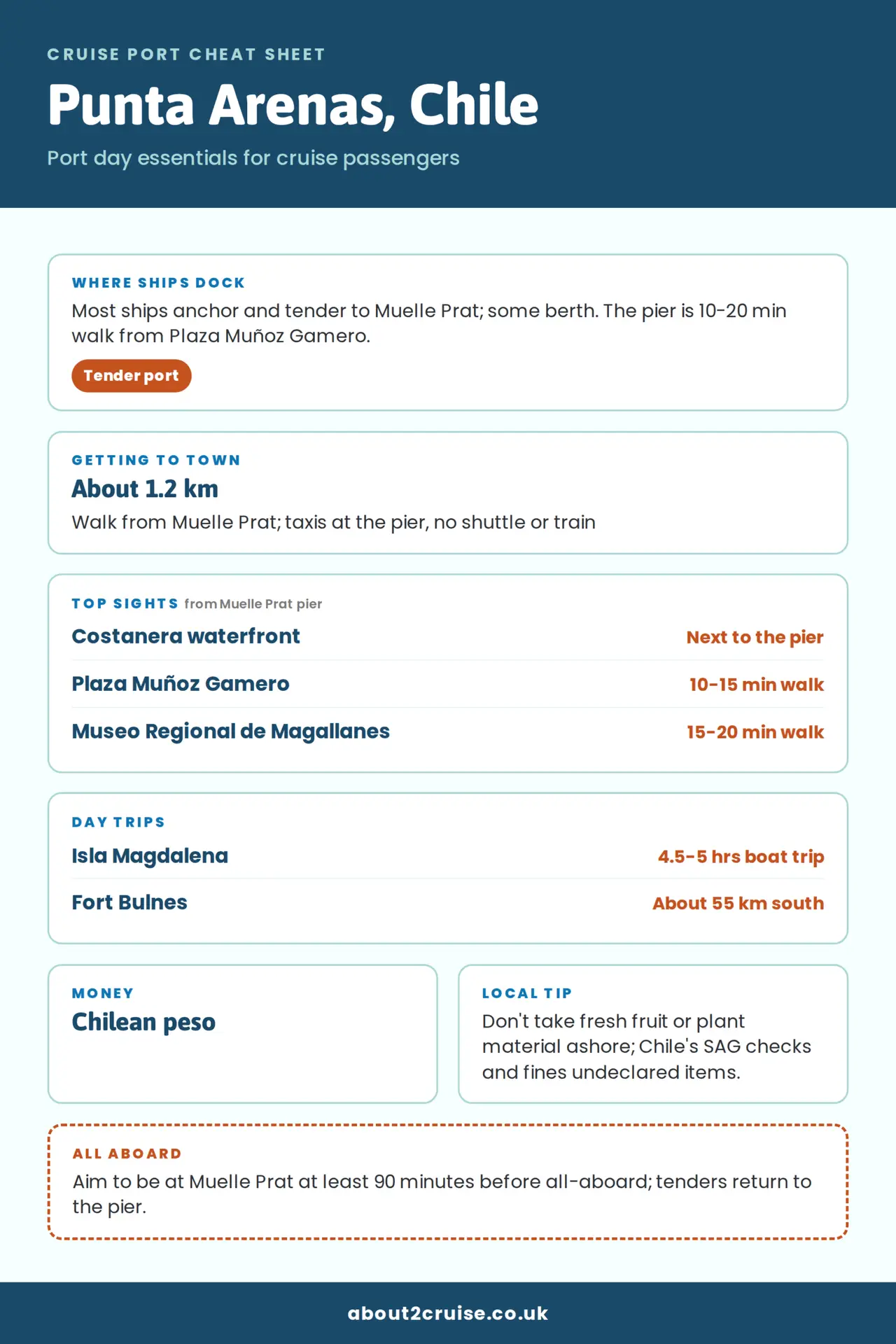
Punta Arenas is a working Strait of Magellan port where cruise ships tender or berth at Muelle Prat on the downtown waterfront. The central square is a flat 10–20 minute walk, the Isla Magdalena penguin boats leave from the same pier, and the city packs Antarctic gateway logistics, wool-boom history and Patagonian seafood into one compact day.
Why Punta Arenas earns a stop on your cruise
A Patagonian city on the Strait of Magellan
Punta Arenas sits on the Brunswick Peninsula, facing the Strait of Magellan with Tierra del Fuego on the horizon. It’s the largest city south of 46°S, a free port, and the busiest cruise destination in Chile. Ships call here because the pier is basically inside the city, the penguin island is close enough for a half-day boat trip, and the town is an unusual mix of Patagonian remoteness and walkable urban comfort.
Chile’s gateway to Antarctica
Punta Arenas lies roughly 1,419 km from the Antarctic coast and is one of Chile’s main Antarctic gateways. On a normal cruise day, that’s mostly interesting background rather than something you’ll see, but the city is also the starting point for fly-cruise charters to King George Island and for expedition ships heading through the Strait of Magellan toward the Drake. If your cruise also calls at Ushuaia, the two cities feel different: Ushuaia is the classic expedition embarkation port, while Punta Arenas is Chile’s fly-cruise and logistics hub.
Penguins close enough for a half-day trip
The headline excursion is Isla Magdalena, part of the Los Pingüinos Natural Monument, about 35 km north-east of Punta Arenas in the strait. Around 7,000 breeding pairs of Magellanic penguins live there, and the island is open from October to March. A boat trip takes about four and a half to five hours return, with around one hour ashore on a managed trail.
Wool-boom history with a frontier feel
Punta Arenas grew wealthy on sheep estancias, shipping, and the Strait of Magellan trade before the Panama Canal changed the route. That wool-boom money built the mansions, cemetery mausoleums, and confident public buildings around Plaza Muñoz Gamero. Today the city still feels like a small regional capital rather than a remote tourist stop, and its southernmost-city identity is part of the appeal.
Where your ship docks in Punta Arenas and how tendering works
Cruise ships use Muelle Arturo Prat, the passenger pier on Avenida Costanera del Estrecho de Magallanes 1398. The terminal has two berth faces, four berthing positions, and two platforms for tender passengers. The passenger hall is around 1,000 m² and houses tourist information, security checks, craft sellers, souvenirs, and basic services.
About 20% of cruises berth directly. Strengthening work means the south face can now take ships up to 300 m, and smaller ships of 181–240 m have tied up alongside. Larger vessels, including a 317 m Celebrity Equinox on a recent call, anchor in the strait and send passengers by tender. Tender runs take about 10 minutes and land at the same pier, so your day starts in town whether you berth or tender.
A second terminal, José de los Santos Mardones, sits about 5 km north of the centre and is occasionally used for cruise berths. If you’re allocated there, don’t assume a walk. Treat it as a shuttle or taxi day and confirm the ship’s transfer arrangements on board before going ashore.
Punta Arenas cruise port map
Tenders bring you ashore at Muelle Prat. From there, Mercado Municipal is about a 6-minute walk, Plaza Muñoz Gamero about 11 minutes and Costanera del Estrecho about 12 minutes. Tap a pin for directions.
- Muelle PratWhere tenders land
- José de los Santos Mardones terminalWhere tenders land
- Mercado MunicipalMarket · About 6 min walk from Muelle Prat
- Plaza Muñoz GameroCentral square · About 11 min walk from Muelle Prat
- Costanera del EstrechoWaterfront promenade · About 12 min walk from Muelle Prat
- Museo Regional de MagallanesHistoric mansion museum · About 13 min walk from Muelle Prat
- Cerro de la CruzHilltop viewpoint · About 20 min walk from Muelle Prat
- Cementerio Municipal Sara BraunCemetery · About 2 km from Muelle Prat
- Museo Nao VictoriaOpen-air ship museum · About 7 km from Muelle Prat
- Isla MagdalenaPenguin island · About 36 km from Muelle Prat
Getting from the cruise port to the city centre
From Muelle Prat there’s no shuttle needed. Plaza Muñoz Gamero is about 1.2 km from the pier, a flat 10–20 minute walk along a paved waterfront and city-centre route. There’s no train service in Magallanes. Public transport is city buses, shared taxis called colectivos, taxis, and ferries, but for most cruise passengers the centre is walkable.
Taxi ranks are available at the pier. A taxi up to the Cerro de la Cruz viewpoint costs roughly CLP 2,000–3,000. Unlike Puerto Montt, where the commercial dock can leave you needing a transfer, Punta Arenas’s main cruise pier puts you in the centre.
Terminal facilities, Wi-Fi, and practical services
The Muelle Prat terminal has a café, restrooms, Wi-Fi, ATMs, local vendors, and a craft fair on cruise days. Sernatur tourist information is usually present during calls. There’s no official left-luggage service at the pier. If you need to store bags, the Bus-Sur and Buses Fernández terminals in the city centre offer luggage custody, but confirm hours and price on the day.
No official cruise-passenger car park is published at Muelle Prat. Hotels used by cruise passengers tend to offer guest parking instead. Hotel Dreams del Estrecho is less than five minutes’ walk from the pier; Hotel José Nogueira and Hotel Cabo de Hornos sit on or near Plaza Muñoz Gamero, handy for pre-cruise or post-cruise stays.
Passport, immigration, and Chilean entry rules
British citizens can visit Chile for up to 90 days without a visa and are issued a tourist card on arrival. Keep that card for departure. Your passport must be valid beyond your planned departure. On a standard cruise call the ship handles much of the arrival formalities, but you should still carry a printed copy of your passport photo page and leave the original in a safe if you prefer.
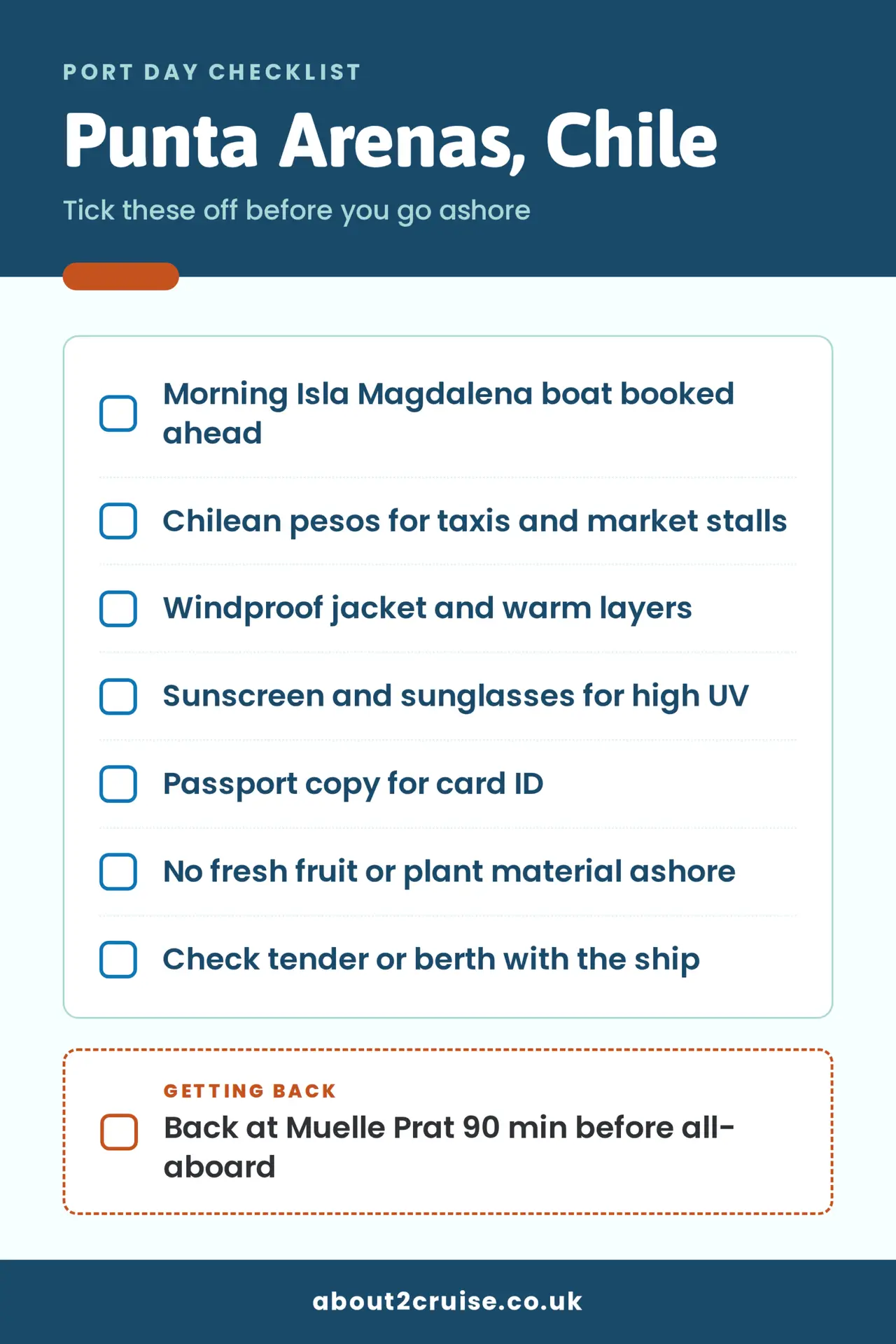
Chile enforces agricultural and plant-product declarations. Every traveller must follow SAG rules, and all transport arriving in Chilean waters is inspected after immigration and customs. Don’t take fresh fruit or plant material ashore, even as part of a packed meal. Undeclared risk products can be seized and fined.
Money, cards, and using pesos
Chile’s currency is the peso. Cards are widely accepted in established shops, hotels, and restaurants, but cash is still useful for small traders, craft stalls, taxis, and some entrance fees. ATMs are available at the cruise terminal and around the central plaza, though foreign cards often attract a fee.
If an ATM or card machine offers dynamic currency conversion, choose to pay in CLP rather than your home currency to avoid a poor exchange rate. Restaurants typically add a suggested 10% tip, and the card machine may offer it automatically. Drinking alcohol in public places, including streets, squares, and promenades, is illegal.
Language and local etiquette
Spanish is the official language. You’ll get by with simple greetings and numbers in tourist-facing places, but away from the pier and major sights English isn’t guaranteed. A few words of Spanish go a long way. Merchants sometimes ask for identification when paying by card, so have a passport copy or driver’s licence with you.
Staying safe and getting your bearings
Punta Arenas is compact, and the pier, plaza, market, cemetery, and viewpoint are all within a few kilometres. That said, pickpocketing, bag snatching, and theft from vehicles are common throughout Chile, including at transport hubs, viewpoints, and busy tourist spots. Keep bags closed, don’t hang phones or bags on the back of chairs, and book taxis in advance rather than hailing them late at night.
For rural excursions, obey warning signs and stick to marked roads. The Magallanes region has rural landmine signage in some border areas, so never wander off tracks into unmarked terrain.
Weather, wind, and how to dress
Summer in Punta Arenas is cool, bright, and often windy. The January mean maximum is about 16.3°C and mean minimum 5.9°C. Annual precipitation is around 390 mm, spread across the year, and summer winds average 30–40 km/h. Gusts can be much stronger, occasionally reaching 130 km/h.
Pack layers, a waterproof and windproof jacket, hat, gloves, scarf, sturdy shoes, sunglasses, and sunscreen. UV can be high even under cloud. Ground underfoot in town is flat pavement, but the climb to Cerro de la Cruz ends in steep stairs and the island penguin trail is exposed to the wind.
Best months and daylight hours
Penguin visits run from October to March. January and February are the busiest months on Isla Magdalena, with chicks visible and the colony at its most active. The Antarctic air-cruise season runs from late November to March. For general outdoor sightseeing, late December to mid-February gives the most settled weather.
Mid-December daylight is about 16 hours 50 minutes, which gives long shore days. That’s useful if you’re trying to combine a morning penguin trip with an afternoon town walk.
What to do in Punta Arenas during a port day
Before you sail
- Book the Isla Magdalena fast boat ahead. Morning slots sell out and are calmer.
- Carry small pesos for taxis, market meals and craft stalls; ATMs charge foreign-card fees.
- Pack windproof layers, sunscreen and sunglasses for strong winds and high UV.
Short port day: under 6 hours
- On dockingTender to Muelle Prat10 min runIf at anchor, tenders land at the same pier. If alongside, walk straight off into the city.
- +15 minPlaza Muñoz GameroWalk 10-15 min from the pier. Touch the polished toe on the Magellan monument.
- +45 minMuseo Regional de MagallanesFree entryHalf a block from the square, in the Palacio Braun-Menéndez. Closed Tuesdays.
- +2 hrsLunch at Mercado MunicipalTry chupe de centollaWalk back towards the waterfront for king-crab soup upstairs at the market.
- +3 hrsCerro de la Cruz viewpointA 10-15 min climb up from the square, with steep stairs at the end. Best view of the strait and rooftops.
- All-aboard minus 1 hrBack at Muelle PratWalk down the hill to the pier. Tenders can be busy, so leave a buffer.
The time on the map is the whole walk, every stop added together.
Open this walking route in Google Maps
If plans change: If the museum is closed, continue to the waterfront and the craft fair at the pier; the square and viewpoint stay impressive without entry.
Penguin Island + town: 8+ hrs
- On dockingTender to Muelle Prat10 min runTenders from the anchorage land at the same pier. If alongside, walk straight off.
- +15 minPlaza Muñoz GameroWalk 10-15 min from the pier. Touch the polished toe on the Magellan monument.
- +45 minMuseo Regional de MagallanesFree entryHalf a block from the square, in the Palacio Braun-Menéndez. Closed Tuesdays.
- +1 hr 30 minCerro de la Cruz viewpointA 10-15 min climb up from the square, with steep stairs at the end. Best view of the strait and rooftops.
- +2 hrs 30 minLunch at Mercado MunicipalTry chupe de centollaWalk back towards the waterfront for king-crab soup upstairs at the market.
- +4 hrsIsla Magdalena fast boat and penguin trailCheck in at Muelle Prat, then board. Crossing 1 hr 30 min each way; one hour ashore on the 850 m trail. Stay 2 m from penguins.
- All-aboard minus 90 minBack at Muelle PratWalk back to the ship from the pier or tender. Tenders run from Muelle Prat; leave a buffer.
The time on the map is the whole walk, every stop added together.
Open this walking route in Google Maps
If plans change: If the fast boat is cancelled or full, switch to the town day: plaza, museum, cemetery and viewpoint. If the return is late, head back to the pier.
Plaza Muñoz Gamero and the Magellan statue
The city’s central square is a National Monument and the natural orientation point. Its centrepiece is the bronze Magellan monument, with a polished toe on the figure of a Tehuelche. Local legend says touching or kissing the toe brings you back to Punta Arenas. The surrounding buildings, many from the wool-boom years, are worth a slow circuit.
Museo Regional de Magallanes
The Palacio Braun-Menéndez houses the regional museum half a block from the square. It’s free and open Wednesday to Monday from 10:30 to 17:00 during the October–April season. The house itself is the star: a wealthy wool-era mansion with intact interiors and a reminder of how Punta Arenas made its money.
Cementerio Municipal Sara Braun
The cemetery on Avenida Bulnes is one of the most atmospheric stops in Patagonia. Foreign tourists pay about CLP 5,000, Chileans CLP 3,000. It’s a 20-minute walk from the square or a short taxi ride, and a visit can take anywhere from 30 minutes to an hour and a half. The cypress avenues and family mausoleums are the most photographed subjects.
Cerro de la Cruz viewpoint
The free viewpoint is open 24 hours and gives the best city-wide perspective. It’s about 800 m and 10–15 minutes up from the square, with steep stairs at the end. You can also drive up Calle Señoret to a flat platform. Late afternoon is the best light, with the strait and Tierra del Fuego behind the rooftops. There are no toilets or shops at the top.
Waterfront and Costanera
The Costanera looks directly across the Strait of Magellan toward Tierra del Fuego. It’s an easy walk from the pier to the plaza, with the market and seafood restaurants nearby. On a clear day the coastline is huge and empty, which is exactly the point.
Museo Nao Victoria
About 7.5 km north of the centre, this open-air museum holds full-scale replicas of Magellan’s Victoria, Shackleton’s James Caird, and the Beagle. It’s open daily, 09:00–19:00 from October to March and 10:00–17:30 from April to September, with adult entry around CLP 9,500. This is a good add-on if you have a long port day and don’t mind taking a taxi.
Zona Franca duty-free
Punta Arenas is one of Chile’s two free ports. The Zona Franca on Avenida Manuel Bulnes at the northern edge of town opens Monday–Saturday 10:00–20:00 and Sunday 10:00–18:00. It’s more practical for locals and long-stay visitors than a must-see for cruise passengers, but it exists if you need electronics, clothing, or duty-free goods.
Fort Bulnes and Parque del Estrecho
South of the city, Fort Bulnes reconstructs the first Chilean settlement on the strait, and Puerto del Hambre nearby is historically tied to early Spanish attempts at settlement. It’s a longer excursion, so check your ship’s departure time before committing.

The Isla Magdalena penguin excursion: what to know before you book
Isla Magdalena is the excursion most people ask about. The island is part of Los Pingüinos Natural Monument, about 35 km north-east of Punta Arenas, and is open to visitors from October to March. The colony numbers roughly 7,000 breeding pairs, and the lighthouse is the postcard shot.
There are two main ways to do it. The classic TABSA ferry leaves from the Tres Puentes terminal and takes about two hours each way, plus one hour ashore. Prices have been around CLP 96,000 per adult and CLP 48,000 for children aged 5–13, but always confirm current pricing when booking. A fast-boat option leaves directly from Muelle Prat itself: morning check-in around 07:00, sail around 08:00, back at the pier around 12:00; afternoon check-in around 13:30, sail 14:30, back around 18:30. The total trip is roughly four and a half to five hours.
On the island you follow an 850 m trail. The first 250 m are adapted for wheelchairs, and landing time is capped at one hour by CONAF. Stay on the path, keep at least 2 m from penguins, and don’t use flash, drones, or selfie sticks. No eating or littering is allowed. If weather prevents landing after you’ve sailed, operators usually refund 50%. If the trip is cancelled before departure, you get a full refund. The Chilean Navy can close the port for wind, so treat the trip as weather-dependent.
Book the morning slot if you can. It’s usually calmer at sea, quieter on the trail, and it leaves your afternoon free for the town. The last fast boat reaches the pier around 18:30, so an afternoon penguin trip only works if your ship departs late enough to leave a safe buffer. If your South America itinerary also has Puerto Madryn, the wildlife day there is a different Peninsula Valdés-based excursion; at Punta Arenas the penguins are a compact island landing.
Other day trips and excursion ideas
Marta Island, next to Isla Magdalena, has no landing. Boats usually pass it to show sea lions and cormorants from a distance. The King Penguin Reserve on Tierra del Fuego is a different and much longer trip: roughly a two-hour ferry to Porvenir plus 115 km by road, open October to May. That is not a realistic cruise-day excursion unless your ship has an unusually long call.
City shore excursions often combine the plaza, museum, cemetery, and viewpoint. They can be useful if you want seamless transport and commentary. Independent exploring is straightforward because the centre is walkable, the pier is in town, and taxis are available.
What to eat and drink
Centolla, or king crab, is the local speciality. The Mercado Municipal on Avenida Costanera has fishmongers downstairs and small upstairs kitchens serving chupe de centolla, a rich crab soup, for around CLP 5,000 a plate. Magellan lamb is the other staple, grilled or stewed. Hake, salmon, sea bass, clams, oysters, and snails appear on many menus.
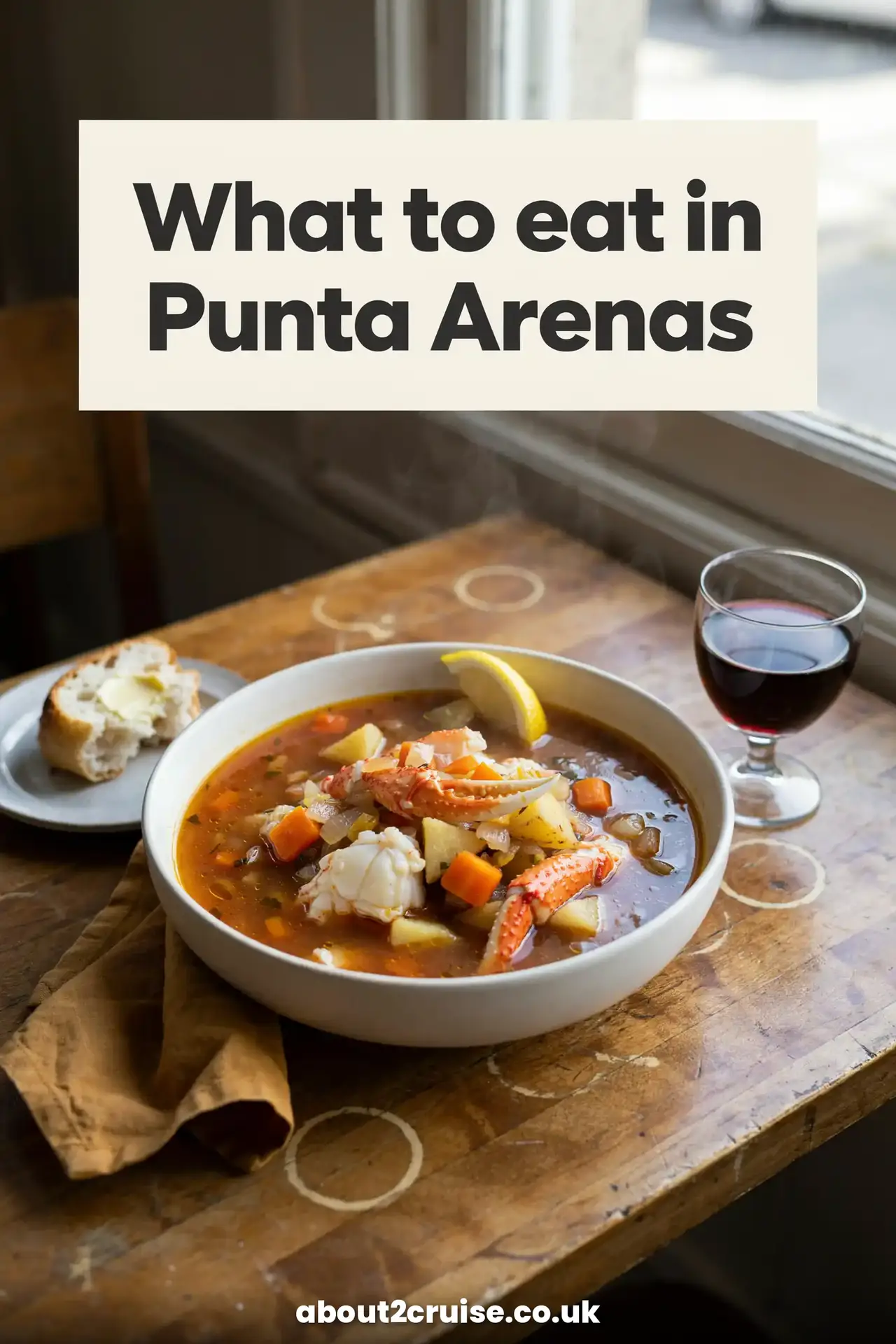
Look for calafate berry jam, tarts, ice cream, and calafate sour. Croatian-descended bakeries north of Avenida España sell strudel and kringle-style pastries. Pisco sour is the national drink served in city bars. Downtown around the plaza has the biggest concentration of street food, including empanadas and sopaipillas.
How much you can fit into one port day
A direct berth can give you up to 12 hours ashore, but many calls are shorter. A sample 285 m ship has called from 06:00 to 18:00, while a 317 m ship at anchor had a 06:00–16:00 window. That’s enough for either a town-focused day or a morning penguin trip plus a couple of town sights, but not everything.
For a first visit, prioritise the penguin island if the season and timing allow. Then fill the remaining hours with the plaza, museum, or viewpoint. If you skip penguins, a full town day can comfortably include the square, the Braun-Menéndez mansion, the cemetery, the Costanera, and a seafood lunch.
Mistakes to avoid on a Punta Arenas cruise stop
- Assuming you will berth. Many ships tender. The ride is short and lands at the same pier, but dress for wind and allow slightly more time for disembarkation.
- Leaving penguin tickets to the last minute. Peak-season boats sell out. Book ahead, and pick the morning departure to reduce weather risk.
- Planning an afternoon penguin trip on an earlier departure. If your ship leaves before roughly 19:00, the afternoon boat returning around 18:30 is too tight.
- Forgetting pesos. Cards work in many places, but cash helps with small stalls, taxes, and tips.
- Underestimating wind and UV. The temperature can feel much colder on the water or at the viewpoint, and sunburn can happen even under cloud.
- Trying to reach Puerto Natales or Torres del Paine. Puerto Natales is about three hours by bus each way, and Torres del Paine is beyond that. It doesn’t fit a standard port call.
- Taking fruit or plant material ashore. Chilean agricultural rules are strict and can result in fines even for a packed snack.
Accessibility and reduced mobility
Direct berthing helps passengers with reduced mobility because it removes the tender transfer. If your ship is at anchor, the tender pontoon and steps may be challenging; ask the crew about conditions before attempting it. The Isla Magdalena trail’s first 250 m are adapted for wheelchairs, but the island remains remote and weather-exposed.
Cerro de la Cruz has no confirmed step-free pedestrian route. The alternative is a vehicle up Calle Señoret to the flat top platform. Some city shore excursions state they are not suitable for wheelchair users or people with mobility impairments, so check the specific tour rather than assuming.
Punta Arenas as part of a bigger Chile cruise
Punta Arenas is usually paired with other Patagonian or Chilean calls on a South America run. It’s one of the main ports in our Chile cruise ports guide. The day feels different from a fjord call or a commercial port stop, because the ship puts you straight into a real city with a waterfront, a plaza, and a wildlife island on the doorstep.
Frequently asked questions
Can I visit Torres del Paine or Puerto Natales from a cruise ship?
No. Puerto Natales is about three hours by bus from Punta Arenas, and Torres del Paine is beyond that. It’s not a realistic day trip from a cruise call. You need a land-based stay or an expedition itinerary.
Can I see Antarctica on a day trip from Punta Arenas?
Not on an ordinary port day. Antarctica is roughly 1,419 km away. The closest you can get is a weather-dependent two-hour charter flight to King George Island as part of a multi-day fly-cruise expedition, not a shore excursion.
Is it better to book Isla Magdalena through the cruise line or independently?
The experience is similar once you reach the island. A ship excursion coordinates your tender and timing, which is useful on a short call. Independent fast boats from Muelle Prat are convenient and can be cheaper, but you take responsibility for the weather window and return time. Either way, book ahead.
Do I need cash in Punta Arenas?
Cards are widely accepted, but carry some Chilean pesos for taxis, small stalls, market meals, and tips. ATMs are available at the terminal and around the plaza, though foreign-card fees are common.
Is Punta Arenas safe to walk from the pier to the square?
Yes, the route is flat, central, and well used. Use normal city precautions: keep your bag closed, don’t leave valuables on outdoor tables, and stay aware around transport hubs and viewpoints.
Will my phone get a signal or can I use Wi-Fi?
The cruise terminal has Wi-Fi, and many cafés around the plaza offer it. Mobile coverage is decent in the city but can drop on the penguin boat crossing and in more remote sections of excursions.
Last Updated: 21 November 2026