
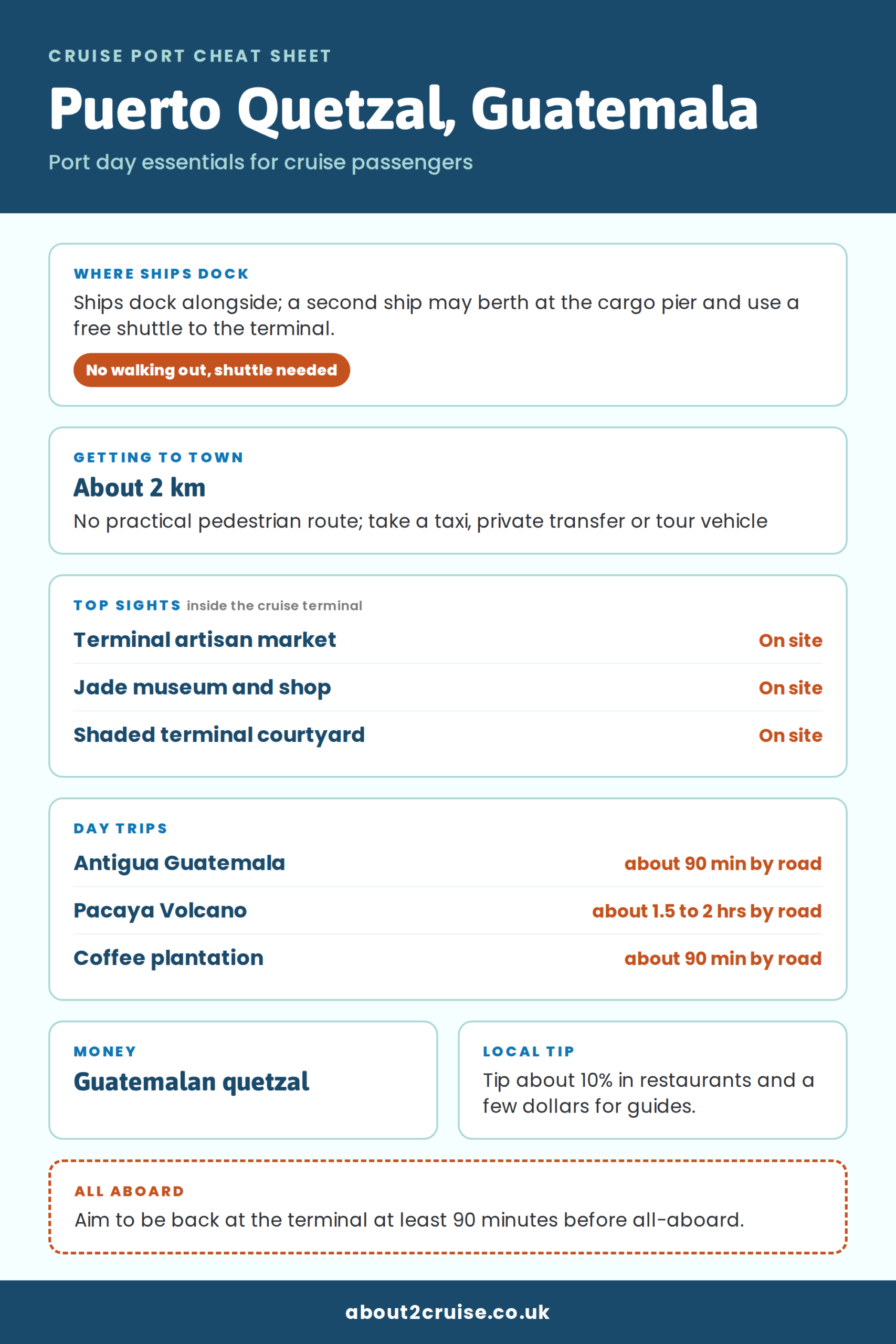
Puerto Quetzal is a working Pacific container port and Guatemala’s main cruise gateway. Most cruisers use it as the launch pad for the colonial city of Antigua Guatemala, Pacaya volcano or a coffee estate. Ships dock alongside, but you cannot walk to the town; you either join an organised excursion or enjoy the terminal’s market, jade museum and shaded courtyard.
Arriving at Puerto Quetzal Cruise Terminal: Berths, First Impressions & What to Expect
Puerto Quetzal is Guatemala’s largest Pacific port, and the cruise terminal sits inside an industrial container and fuel area. The official passenger terminal is called Terminal de Cruceros Marina Pez Vela. You normally dock alongside; there’s no tender transfer. If two ships are in port, one may be assigned to the cargo pier instead of the cruise berth. From the cargo pier a free courtesy shuttle runs about every 10 minutes, taking roughly 10 minutes to reach the passenger terminal.
From the ship, you cross a walkway into a visitors’ centre with tourist information, tour desks, a small post office, an ATM and local musicians. Outside there’s shaded seating, trees and iguanas. The terminal has an artisan market, a free jade museum and shop, café bars and a restaurant. Several bars give a free Wi-Fi code if you buy a drink. It’s calm and manageable if you simply want a short port day.
The nearest town, Puerto San José, is about 2 km west, but there is no practical pedestrian route out of the industrial port. Don’t expect to walk from the gangway into town; you need a taxi, private transfer or tour vehicle.
If your cruise also calls in Costa Rica, our Puerto Caldera cruise port guide covers the shuttle, taxis and trips to Carara and Jacó.
Puerto Quetzal cruise port map
Ships dock at Puerto Quetzal cruise port. Tap a pin for directions.
- Puerto Quetzal cruise portWhere ships dock
- Puerto San JoséBeach town · About 3 km from Puerto Quetzal cruise port
- Pacaya Volcano National ParkVolcano national park · About 55 km from Puerto Quetzal cruise port
- Finca San CayetanoCoffee estate · About 57 km from Puerto Quetzal cruise port
- Biotopo Monterrico-HawaiiNature reserve · About 35 km from Puerto Quetzal cruise port
- Auto Safari ChapínDrive-through zoo · About 25 km from Puerto Quetzal cruise port
- Terminal de Buses de Antigua GuatemalaBus terminal · About 70 km from Puerto Quetzal cruise port
- Parque CentralCentral park · About 70 km from Puerto Quetzal cruise port
- Catedral de San JoséCathedral ruins · About 70 km from Puerto Quetzal cruise port
- Arco de Santa CatalinaArch · About 70 km from Puerto Quetzal cruise port
- Convento de las CapuchinasConvent · About 70 km from Puerto Quetzal cruise port
- Iglesia de La MercedChurch · About 70 km from Puerto Quetzal cruise port
- Cerro de la CruzHilltop viewpoint · About 71 km from Puerto Quetzal cruise port
- Casa Santo DomingoAbout 70 km from Puerto Quetzal cruise port
- Mercado de Artesanías de AntiguaCraft market · About 70 km from Puerto Quetzal cruise port
- Playa MonterricoBeach · About 34 km from Puerto Quetzal cruise port
What Can You Do at Puerto Quetzal Without an Excursion?
- Browse the terminal artisan market. Weavers often sell their own textiles, and you can buy jade, wooden masks, leather goods, coffee and rum. Bargain politely; this is expected at stalls.
- Visit the free jade museum and shop inside the terminal.
- Sit in the shaded courtyard with a coffee or beer, use the Wi-Fi code from a bar, and listen to the local musicians.
- Buy Guatemalan coffee beans from kiosks near the ship. If you don’t plan to visit a plantation, this is the easiest bean purchase.
The terminal isn’t a substitute for Antigua or a volcano tour, but it’s a perfectly acceptable short day if you’re tired or want a gentle call. Quality and variety of crafts are better in Antigua.

Antigua Guatemala from Puerto Quetzal: The Main Day Trip Worth Taking
Antigua Guatemala is the reason most ships call. It’s roughly 85–90 km, about 55 miles, from the pier and usually takes about 90 minutes each way in ordinary traffic. Roadworks can stretch the drive to two hours each way. The colonial city sits at about 1,500 m above sea level, so it’s cooler than the coast.
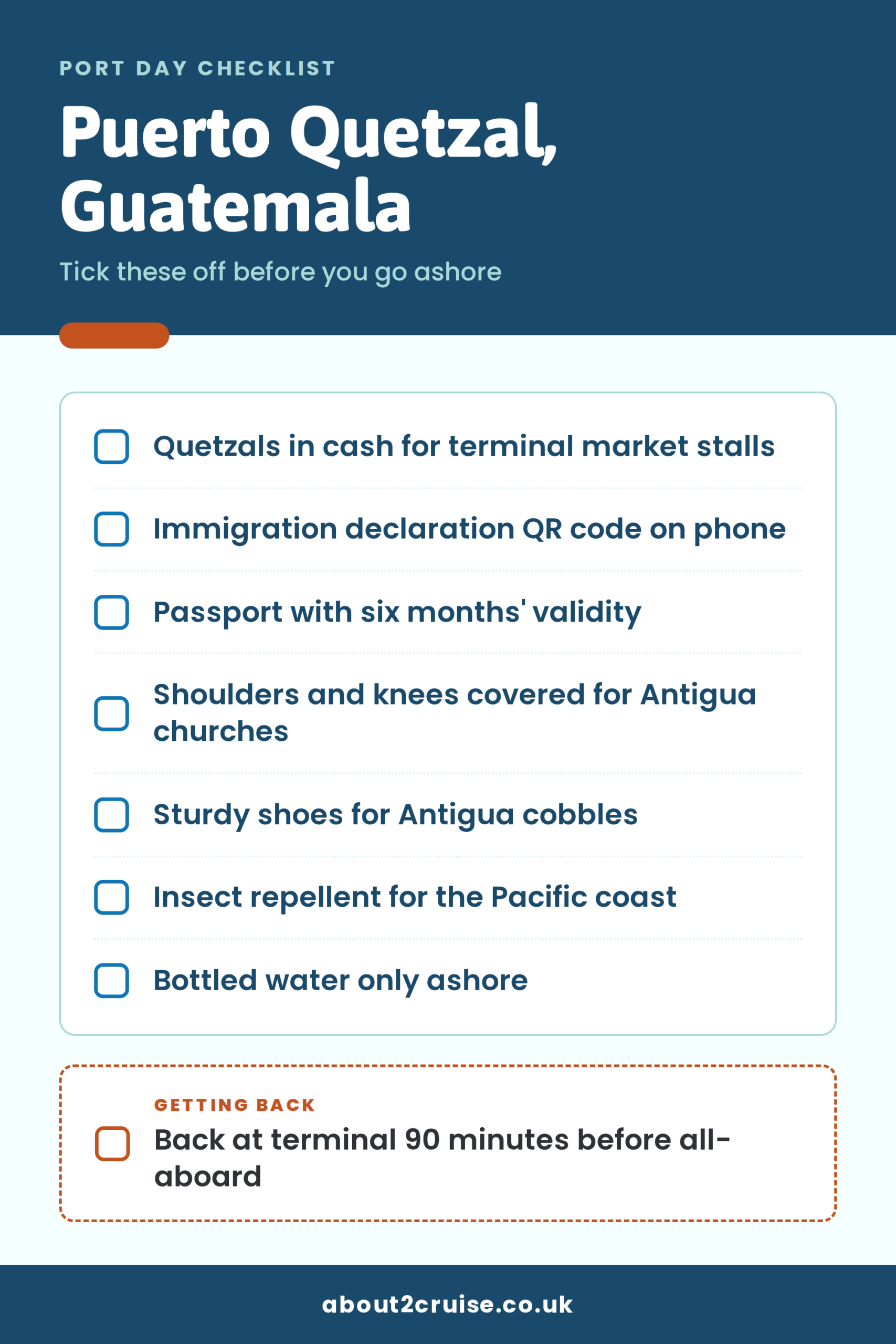
Antigua was the old colonial capital, heavily damaged by the 1773 Santa Marta earthquakes, and its ruined monuments are now a UNESCO World Heritage Site. The typical tour takes in Casa Santo Domingo, Parque Central, the cathedral ruins, the Palace of the Captains General, La Merced and the Santa Catalina Arch. The streets are cobbled and uneven, so sturdy shoes matter. Some private tours include cathedral and La Merced admissions, but Casa Santo Domingo entrance is often extra.
For photographers, Cerro de la Cruz, the hilltop viewpoint above town, is free and open from 07:00 to 18:00. It’s a 15–20 minute walk from Parque Central. The volcano outline behind Antigua is sharpest before 9am, and the Santa Catalina Arch photographs best very early, often around 6am. If your ship arrival gives you a later start, lower your expectations for the classic clear-volcano photograph. A typical cruise arrival puts you in Antigua mid-morning.
First-time visitors should choose Antigua over Lake Atitlán unless they have a particular reason to visit the lake. It delivers a coherent colonial day with architecture, cafés, markets and manageable walking.
How the Antigua Transfer Works (And Why Timing Matters)
Most cruise lines sell an Antigua on your own transfer as well as guided tours. The transport-only version often gives you roughly three and a half hours in Antigua, while a full guided tour may run around six hours. Private Antigua tours from the terminal are commonly sold around $80 per person for about six hours, with lunch and some admissions extra. The drive from the coast climbs past the Agua, Fuego and Acatenango volcanoes, visible on clear mornings.
Don’t underestimate the return leg. Antigua is a long way from the ship on a road that can clog after an accident or protest. Many experienced operators plan to leave Antigua about three hours before all-aboard. If you travel independently, keep the same buffer. A one-way emergency taxi back from Antigua is often quoted at around GTQ 645, roughly $80.
Pacaya Volcano Excursion from Puerto Quetzal: What to Know Before You Hike
Pacaya is one of Guatemala’s three highly active volcanoes and is about 1.5–2 hours’ drive from the cruise terminal. The full excursion, including the approach, guided walk and return, runs 7–8 hours. The climb to the top takes about 1.5 hours. You can hire a horse for around Q250 if you don’t want to walk, but that is arranged at the park entrance.
The Pacaya Volcano National Park charges foreign visitors Q100, payable in cash; there are no ATMs or card readers at the park. Local guides are compulsory and cost roughly Q200–Q300 per group of 10–12, usually folded into your tour. Parking is Q30 per vehicle. Tours are sold from about $120, with fuller packages around $195. ATV versions exist, with drivers generally needing to be 18 or over.
Pacaya means an early start, sun protection, sturdy shoes, water and a rain layer. Check weather and volcanic access conditions before you commit. Fuego and Santiaguito are also active, and the advice is always to stay with your guide. If you don’t want a full hike, Fuego’s eruptions can sometimes be watched from Finca San Cayetano, about an hour inland.
Coffee Tours Near Puerto Quetzal: Plantations, Tastings and What to Expect
Guatemalan coffee is one of the best souvenirs from this call, and a plantation visit is a gentle alternative to the long Antigua drive. Some ship-offered plantation tours last about 4.5 hours, with a 90-minute scenic drive each way and a 20-minute walk through the fields and processing plant, ending with a cup of Guatemalan coffee. These tours are typically not wheelchair accessible, and some do not operate on Sundays or Wednesdays.
A more accessible option is Finca San Cayetano, about 1 hour 15 minutes from the terminal. It offers a coffee tour among coffee fields with Agua, Fuego and Acatenango volcano views. The ground is flat, with ramps and adapted bathrooms, and a ramp-equipped vehicle can be requested at booking. San Cayetano tours usually cost about $150–$190 per person for five to five and a half hours, with transport, guide and taxes included but food and drink extra.
If you don’t tour a plantation, buy vacuum-packed beans at the terminal kiosks or in Antigua. Guatemalan coffee from the Antigua region is the protected specialty area you’ll see most often.
Mayan Textiles, Markets and Local Crafts: What to Buy and Where
Handwoven Maya textiles are the most characteristic craft purchase. You’ll see huipiles, colourful blouses, jade jewellery and carvings, wooden masks, leather goods and local rum. In the terminal market, weavers often sell directly, and polite bargaining is normal. In Antigua, the markets and shops have better range and quality, and you can sometimes see textile demonstrations or local cooperatives.
Remember that many vendors in markets may prefer cash in quetzals. Guides on organised excursions normally operate in English and Spanish. Ask before photographing people, especially children. In some areas, people may expect a small payment for a posed photograph. In general, a respectful request goes a long way.
Lake Atitlán from Puerto Quetzal: Is It Possible on a Cruise Day?
Lake Atitlán is beautiful, but it sits roughly 130 km, about 80 miles, inland. Drive times quoted by operators vary from about 2.5 hours each way to three, and some guides put it as high as 3.5–4 hours each way. Boat crossings to villages such as Santiago Atitlán or San Juan La Laguna add another 25–45 minutes each way. You can easily spend five hours or more of an eight-hour call just in road travel.
A Lake Atitlán day typically needs a 7:00am port pickup and a 9–10 hour total day. That only works on a long call. You cannot combine Antigua and Lake Atitlán in one Puerto Quetzal port day; they are roughly two hours apart and each requires the same long transfer from the coast.
For most cruise passengers, Lake Atitlán is too rushed and too vulnerable to traffic. If you have always wanted to see it, book a ship excursion or a private operator with a proven late-return policy.
Chichicastenango Market from a Cruise Ship: Only on Market Days
Chichicastenango’s famous market runs on Thursdays and Sundays only. It’s roughly 185 km from Puerto Quetzal, and independent day trips are not realistic from a cruise call. If your ship happens to be in port on a Thursday or Sunday and offers a Chichicastenango excursion, it will be a long road day with more transfer time than market time. Treat this as a niche option, not a first choice.
Beaches and Nature Near Puerto Quetzal: Monterrico, Mangroves and More
There are no swimming beaches directly at the cruise port. The nearest beach town, Puerto San José, is about 2 km away but not a practical walk, and its black-sand beach is not the main reason to go there. Better beach and nature options are further along the coast.
Monterrico lies about 37 km, roughly 45 minutes, from the port. The Biotopo Monterrico-Hawaii is a 20 km reserve of coast and mangrove swamp with lagoons linked by mangrove canals. Boat tours of the canals take 1.5–2 hours and cost roughly Q75–Q100 per person. Sunrise is the best time for wildlife, and January–February are the best months for birding. The reserve is known for leatherback and ridley turtles that nest on the beach.
A Monterrico day tour from the port tends to run about six hours with a mangrove boat ride and village time. You can also find oceanfront resorts with pools a short vehicle ride away, but you need to arrange transport or a day pass in advance.
Another nature option is Auto Safari Chapín, a drive-through zoo about 1 hour 15 minutes from the port. It sells as a 4.5-hour excursion at roughly $80–$90. Note that you stay inside the vehicle, and the windows do not open.
If your cruise also calls at Cabo San Lucas, our Cabo San Lucas cruise port guide covers tendering ashore, the El Arco water taxi and Médano Beach.
If you want another Pacific call where the ship docks beside a beach, our Huatulco cruise port guide covers bay boat trips and lunch in La Crucecita.
Cruise Line vs Independent Shore Excursions in Puerto Quetzal
The central rule is simple: if you book through the cruise line, the ship waits if the excursion is delayed, and the line arranges transport to the next port if waiting is impossible. If you travel independently, the ship will not wait. Some third-party sellers offer their own late-return cover, arranging onward transport if a covered tour returns late. Always check that policy before paying.
In Puerto Quetzal, many operators and guides suggest booking shore excursions through the ship for security and reliability. The port is in an industrial area, traffic can be unpredictable, and Antigua is far. Independent tours are often cheaper than cruise-line excursions, but you trade away the guarantee. If you do go independent, choose an operator with strong local reviews, a clear itinerary, and a planned buffer of at least 90 minutes back at the terminal.
Safety, Money, Health and Local Etiquette for Puerto Quetzal Visitors
Puerto Quetzal and Antigua are not inside the areas of Guatemala where the UK advises against all but essential travel. That warning applies to the Mexican border zone and several named towns in Huehuetenango, not to this cruise route. However, Guatemala has high violent crime rates, and crime can happen in tourist areas. The safest approach is to stay with a group, use a prearranged tour vehicle, and avoid street-hailed taxis. In Guatemala City and other cities, use radio-dispatched taxis or Uber where available. Avoid public buses, including the repainted US school buses.
The terminal itself feels calm and safe, with polite vendors and a controlled entrance. The bigger risks on a port day are road delays, not the terminal. Demonstrations and protests can occur with little notice and may block roads, so leave buffer time on the return. Emergency numbers are 110 for police and 122 for ambulance and fire.
The currency is the Guatemalan quetzal. US dollars are widely accepted in tourist areas, but many smaller vendors take neither cards nor dollars, so carry some quetzals. An ATM is available in the terminal welcome centre. Check for tampering and shield your PIN. It is often not possible to exchange British pounds in Guatemala; US dollars and cards are the practical backup. At restaurants, 10% tipping is customary. Guides are usually tipped separately, a few dollars minimum.
Tap water is not safe to drink. Use bottled water and avoid ice unless you trust the source. Hepatitis A, hepatitis B and typhoid vaccinations are recommended for most unvaccinated travellers. Dengue, Zika and chikungunya are present, so wear insect repellent. If you plan to swim, avoid fresh unchlorinated water because of leptospirosis risk. Medical facilities outside Guatemala City are limited.
Weather, What to Wear, and Accessibility at Puerto Quetzal
Puerto Quetzal is hot and muggy. Daytime highs run 29–32°C all year, with March and April the warmest. The dry season is January–March. The rainy season runs May to November, with very wet conditions from May to October and a high daily chance of rain. Antigua is cooler because it sits at altitude, and its volcano views are clearest from November to April. In the rainy season, mornings are often clear before afternoon downpours.


Dress for the coast with light clothing, but carry a rain layer and sun protection. If you visit churches, they expect shoulders, knees and ankles covered; shorts and sleeveless tops may mean refused entry. Antigua’s cobbles require solid shoes. Volcano climbs need warmer layers and waterproofs because some cones are high with freezing nights.
Accessibility varies. The alongside berth removes a tender transfer, but the day can still involve gangway slopes, a short shuttle step if docked at the cargo pier, vehicle transfers, cobbles, curbs and steps at heritage sites. The San Cayetano farm is the standout accessible excursion: flat, no steps, ramps, adapted bathrooms and a ramp-equipped vehicle on request. The coffee plantation tours and Antigua-on-your-own transfers are not listed as wheelchair accessible. If you use a wheelchair or have limited mobility, contact the cruise line or private operator before booking to confirm the vehicle and stops.
Passports, Entry Forms, SIM Cards and Connectivity in Guatemala
Your passport should have at least six months’ validity beyond arrival and at least two blank pages. British visitors can stay 90 days visa-free. Guatemala requires an online immigration declaration form before entering or leaving; keep the confirmation email printed or a QR code screenshot available. Make sure your passport is stamped on entry if required, as missing stamps cause fines and delays. A yellow fever certificate is needed only if you are arriving from a country listed as a transmission risk.
For connectivity, the terminal bars may offer Wi-Fi with a drink purchase. If you want mobile data, Tigo and Claro are the two main networks, with 4G nationally. Tourist SIM or eSIM packs are cheap, around Q99–Q100 for 10 GB, but evaluate whether a single port day justifies the setup time.
Best Souvenirs and What to Buy at Puerto Quetzal
The strong purchases are Guatemalan coffee, jade, handwoven textiles, wooden masks, leather goods and local rum. Coffee beans are sold at kiosks close to the ship and at the terminal market. Jade quality and story are better explained at the terminal’s jade museum and shop. If you want the best textile range, buy in Antigua if your itinerary takes you there.
Bargain politely at market stalls, but don’t expect huge reductions in shops with fixed prices. Use quetzals for small purchases. If a vendor says US dollars are fine, check the exchange rate you’re being offered.
Getting Around Puerto Quetzal: Taxis, Private Transfers and Timing
You can’t walk out of the port into town. The realistic independent options are a private transfer, a pre-booked taxi at the terminal, or a tour vehicle. Private transfers between Puerto Quetzal and Antigua are commonly booked in advance and take about 1 hour 40 minutes to 1 hour 50 minutes. Some platforms sell a private vehicle from about $183, with per-person shared transfer rates from around $24. To Monterrico, taxis or private transport are commonly arranged by tour operators, with journey times around 45 minutes.
Taxi fares from the port are not published as a fixed official table, so agree the price before getting in and pay in quetzals if you can. US dollars are often accepted but may not receive a good rate. If you travel independently, leave Antigua no later than three hours before all-aboard and aim to be back at the terminal at least 90 minutes before departure. The nearest international airport, if everything goes wrong, is Guatemala City, about two hours away.
If your cruise also calls at Puerto Vallarta, our Puerto Vallarta cruise port guide compares taxi, bus and rideshare into town.
How to spend a port day in Puerto Quetzal
A port day in Puerto Quetzal works best if you pick one: a long colonial day in Antigua, or a short terminal-and-beach day.
Before you sail
- Book Antigua or Pacaya excursions before the cruise; popular options sell out.
- Complete Guatemala's online immigration declaration and screenshot the QR code.
- Carry quetzal cash; many smaller vendors take neither cards nor dollars.
Short port day: under 6 hours
- On dockingWalk into the cruise terminalFrom the ship, cross the walkway into Terminal de Cruceros Marina Pez Vela. No tender, and no walking route out of the port.
- +15 minBrowse the artisan marketBargain politelyWeavers often sell their own textiles; jade, masks, leather, coffee and rum are the main buys.
- +1 hrVisit the jade museumThe free jade museum and shop inside the terminal explains the jade on sale at the stalls.
- +1 hr 45 minTaxi to Puerto San JoséAgree the fare firstAbout 2 km west. There is no practical pedestrian route, so take a taxi from the terminal.
- +1 hr 55 minBlack-sand beach and sea breezePuerto San José has a black-sand beach, though it is not the main reason to visit. Stretch your legs by the Pacific.
- +2 hrs 45 minReturn taxi and lunch at the terminalTry pepián if offeredBack at Terminal de Cruceros Marina Pez Vela. The terminal cafés and restaurant are the food options; ask if they have pepián or kak'ik.
- All-aboard minus 1 hrBack on boardThe terminal is steps from the ship. Leave time to re-board before the gangway closes.
This map shows the taxi ride from the ship. The time is the drive only, not your time ashore.
Open the taxi route in Google Maps
If plans change: If you cannot get a taxi or prefer not to leave the terminal, spend the whole call in the market, jade museum and shaded courtyard.
Long port day: 8 hours or more
- On dockingMeet your Antigua transportAntigua is about 90 minutes each way by road. Private transfers and ship excursions leave from the terminal.
- +30 minDrive towards AntiguaYou climb past Agua, Fuego and Acatenango volcanoes to about 1,500 m. Roadworks can stretch the drive to two hours.
- +2 hrsParque Central and cathedral ruinsStart in Antigua's central square, then walk to the cathedral ruins. The streets are cobbled, so wear solid shoes.
- +3 hrsSanta Catalina Arch and La MercedWalk to the yellow arch and the baroque church. This is the classic photo stop and easy to cover on foot.
- +3 hrs 45 minLunch near the marketTry pepiánComedores in and beside the Mercado Municipal serve plate-of-the-day pepián or kak'ik.
- +5 hrs 30 minCerro de la CruzA 15 to 20 minute walk uphill from Parque Central. Views over Antigua with Volcán de Agua behind; free and open until early evening.
- +6 hrs 30 minDrive back to Puerto QuetzalReturn down the CA-9 to the port. Keep the all-aboard time in view; experienced operators leave Antigua about 3 hours before sailing.
This map shows the taxi ride from the ship. The time is the drive only, not your time ashore.
Open the taxi route in Google Maps
If plans change: If road protests or a crash block the CA-9 to Antigua, switch to a Pacaya or coffee excursion if space remains, or stay in the terminal.
If you are weighing this stop against other calls in the region, our Central America cruise ports guide compares where ships dock.
Puerto Quetzal FAQ: Common Cruise Passenger Questions
Do I need to complete an immigration form for a cruise stop?
Yes. Guatemala uses an online immigration declaration form before entering and leaving. Keep the printed confirmation or a QR code screenshot with you. Cruise passengers are usually processed through the terminal, but the requirement still applies.
Is there left luggage at the cruise terminal?
No left-luggage facility is documented at Puerto Quetzal cruise terminal. The nearest storage is in Guatemala City, about two hours away. Assume you will carry everything or leave it on the ship.
Can I swim or find a beach near the port?
Not within walking distance. The nearest town, Puerto San José, is about 2 km away but the port is industrial. For a beach or pool, arrange a Monterrico tour or a resort day pass with transport.
Is Puerto Quetzal worth visiting or just a transit stop?
Puerto Quetzal itself is a transit stop. It’s worth visiting for the excursions: Antigua, Pacaya, coffee country, mangroves and culture. If you stay only at the terminal, you’ll have a pleasant couple of hours but not a full destination day.
What happens if an independent tour returns late?
The ship will not wait for independent travellers. You would need to arrange and pay for transport to the next port. Some third-party tour operators have their own guarantee covering onward transport; check before booking. Otherwise, the nearest international airport is Guatemala City, about two hours away.
Are local tours cheaper than cruise-line excursions?
Yes, they often are, sometimes significantly. The trade-off is the guaranteed return to the ship and the simplicity of the cruise-line excursion. In Puerto Quetzal, where Antigua is far and road delays are possible, many cruisers value that guarantee.
Last Updated: 23 November 2026