
Bimini’s best cruise weather runs from December to April: warm, low-humidity days, the least rain, and sea temperatures around 24–26°C. You can swim year-round, but September and October carry the highest hurricane risk. February to April is the sweet spot for a beach or snorkel call; May and November are quieter value months.
Why Bimini Weather Matters More Than Other Ports
Bimini is the closest Bahamas island to Florida, sitting about 50 miles east of Miami across the Gulf Stream. Because it is so exposed to the Atlantic and only a short hop from the US mainland, a small change in wind direction can turn a flat crossing into a bouncy one. The good news for cruise passengers is that ships berth at Resorts World Bimini Cruise Port rather than tendering, so a windy day doesn’t necessarily mean a missed port. Read the Bimini port guide for how the terminal works.
Most passengers come for the water: turquoise shallows, sandbars and west-facing beaches. Weather therefore shapes everything from whether you can snorkel comfortably to whether the beach club feels like a postcard or a steam room.
Bimini Weather at a Glance
Best overall months: February to April. Driest months: February to April and December. Warmest water: August. Rainiest and highest hurricane risk: August to October. Most comfortable heat: December to April. Best value with good odds: May and late November.
| Window | Weather | Sea | Cruise-call verdict |
|---|---|---|---|
| Dec–Apr | Warm, lower humidity, driest | Can be breezy, esp Dec and Mar | Best for reliable beach and snorkel |
| May–Jun | Hotter, wet-season showers | Often calm and very warm | Good but humid; storms build later |
| Jul–Sep | Very hot, humid, afternoon storms | Warmest; hurricane season risk | Most unreliable for weather |
| Oct–Nov | Easing heat, drier late | Risk early Oct, settling Nov | Good from mid-November |
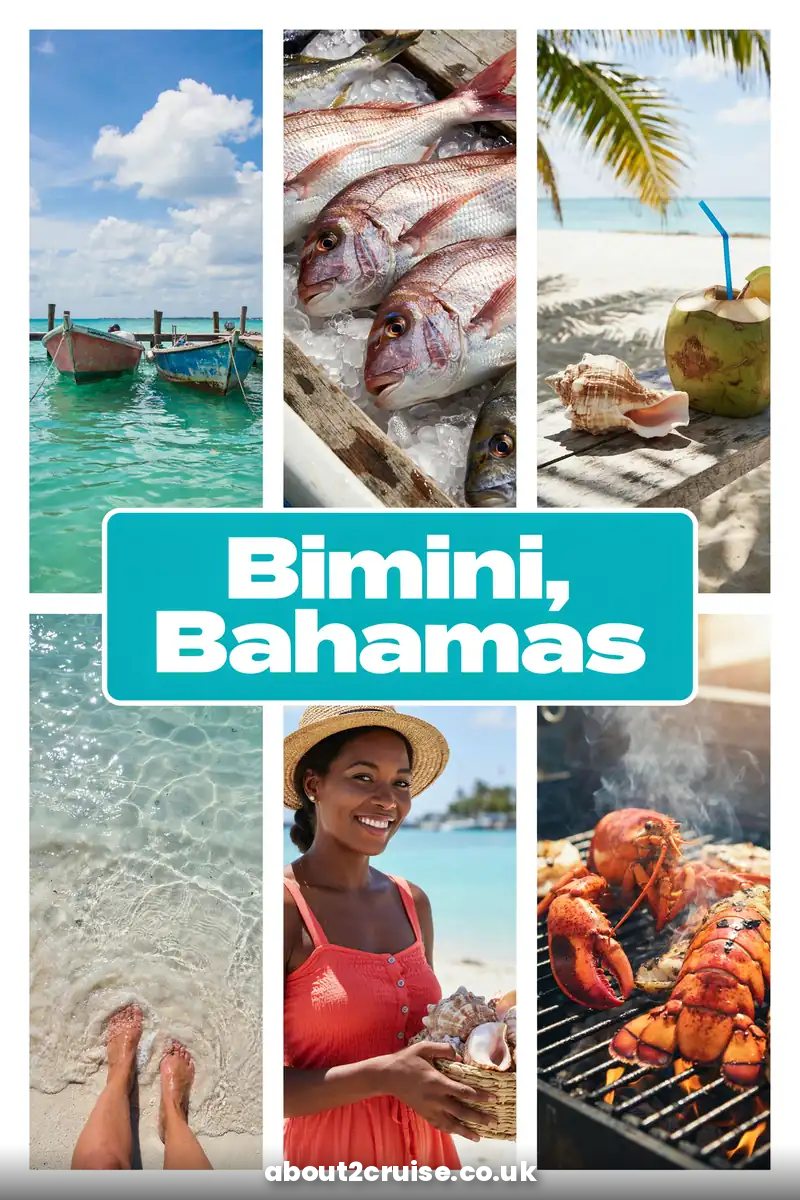
Bimini Weather by Month
The numbers below are averages. A cruise day can always surprise you, but this is the pattern.
| Month | Air max | Night min | Sea temp | Rain days | Best for |
|---|---|---|---|---|---|
| Jan | 24°C | 15°C | 24–25°C | 7 | Sun, walks, hammerhead diving |
| Feb | 25°C | 16°C | 24–25°C | 7 | Dry skies, diving |
| Mar | 26°C | 18°C | 24–25°C | 7 | Beach, but windy |
| Apr | 28°C | 20°C | 25–26°C | 6 | Best all-round |
| May | 30°C | 22°C | 27°C | 9 | Warm sea, fewer crowds |
| Jun | 31°C | 24°C | 28°C | 11 | Water, morning outings |
| Jul | 32°C | 24°C | 29°C | 12 | Warm water, early starts |
| Aug | 32°C | 25°C | 30°C | 14 | Warmest sea, highest storm risk |
| Sep | 31°C | 24°C | 29°C | 13 | Value, but hurricane gamble |
| Oct | 29°C | 22°C | 28°C | 10 | Late-month improvement |
| Nov | 27°C | 19°C | 26–27°C | 8 | Quiet, warmer than UK, drier later |
| Dec | 25°C | 16°C | 25°C | 7 | Festive winter sun, breezy seas |
January
Dry, bright and relatively cool. A north wind against the Gulf Stream can make the crossing lumpy, so take seasickness medication if you are on a small-boat excursion. Shore snorkelling is possible but feels fresh; a rash guard helps. Hammerhead divers are in their element.
February
The driest, clearest stretch for many visitors. It can still be breezy early on. The water is the coolest of the year but still swimmable, especially at midday. If you are coming for a reliable beach call, February is one of the safest bets outside hurricane season.
March
Sunny and dry, but the windiest month. That takes the edge off the heat, yet it can make small-boat snorkel runs and the Fort Lauderdale ferry crossing bouncy. UV is high, so do not mistake the breeze for safety.
April
The best all-round choice for most cruisers. Rain is low, the sea is warm enough for long swims, and the brutal summer humidity has not arrived. The UV index is already extreme, so sun protection is essential.
May
Warmer and wetter, but afternoon showers usually pass quickly. The ocean is properly warm and the hurricane season is only just beginning. Expect fewer crowds than the winter highs and a slightly slower, locals’ shoulder-season feel.
June
Hot, humid and showery. The water is a delight, but midday can feel heavy. Treat the afternoon as a bonus because storms often build then. Hurricane risk is present but historically lower than August to October.
July
Peak summer heat. Morning is your friend: calm, bright and ideal for water sports. Afternoon storms are common and the humidity is high. The sea is very warm, which is great for swimming but less refreshing when the air is already hot.
August
The warmest sea of the year, but also the stickiest and one of the wettest months. It sits in the fast lane of the Atlantic hurricane season. If Bimini is on your itinerary, book flexible excursions and watch the marine forecast.
September
The biggest weather gamble. September is statistically the wettest and most hurricane-prone month. Cruise lines may reroute. If your heart is set on Bimini specifically, choose another month. If you are relaxed about ports, this can be a cheap sailing.
October
Still hot and wet, with meaningful hurricane risk early in the month. The back half is often much more settled. A late-October cruise can feel like a bargain version of winter season, but it is not a month for fixed plans.
November
A transition month. Early November still technically falls inside hurricane season, but by mid-month the trade winds return, rain drops and heat eases. It is a good window if you want quieter beaches and do not need bath-warm water.
December
One of the driest months and a classic winter-sun call. Daytime highs are pleasant rather than scorching. Christmas north winds can make the crossing choppy and leave the water feeling cool, but for beach lounging and exploring Alice Town it is excellent.
Water Temperature and Swimming Comfort
Bimini’s water never drops below about 68°F (20°C), so swimming is possible all year. For snorkelling, December to April feels fresher, while May to October feels properly warm. August is the warmest, often around 30°C (86°F).
Divers should plan by season: December to April is wetsuit territory, with a 5mm suit, hood and gloves recommended for longer dives. May to July typically has the best visibility and more comfortable temperatures. Great hammerhead sharks gather off Bimini roughly January to March, with February usually the peak.
Wind, Waves and the Bimini–Miami Crossing
The single most important local rule is wind against current. The Gulf Stream runs north through the Straits of Florida at 2–4.5 knots. If a north wind blows against that flow, the crossing builds steep, square waves in a hurry. That is why a forecast of 10–15 knots from the north can feel worse than a stronger wind from a more helpful direction.
For cruise passengers, the port call itself is stable because ships berth. But small-boat snorkel trips, fishing charters and the Fort Lauderdale ferry can be uncomfortable on those days. If you are prone to seasickness, avoid long open-boat excursions when the forecast has any north component in winter. Check the Bahamas Department of Meteorology marine forecast before booking. See our water sports activities guide for what to book when conditions are calm.
Hurricane Season in Bimini: What Cruisers Should Know
The Atlantic hurricane season runs 1 June to 30 November. Bimini’s real-risk window is August to October, which contains the majority of hurricane and major-hurricane days. The Bahamas is more exposed to Atlantic hurricanes than the far southern Caribbean, so a September storm near the Bahamas is not unusual.
Cruise lines monitor storms and may swap ports, change itineraries or skip calls. Under standard cruise contracts, the line can usually change the itinerary without compensation. You will normally get port fees back and any shore excursions bought through the line refunded if a port is missed, but extra onboard credit or future-cruise credit is goodwill rather than guaranteed. Carnival’s stated policy is no compensation for missed ports beyond port taxes and pre-purchased excursions. Royal Caribbean also reserves broad itinerary-change rights. UK cruise booking terms may give more protection for significant pre-departure changes, so check before final payment.
If visiting Bimini on a specific date is the point of the trip, book January to May. If you are happy with a warm cruise and do not mind a substitute Bahamas or Caribbean port, late August to October often has the lowest fares.
How Far Ahead Can You Trust a Bimini Forecast?
Short-range forecasts are reliable: two to three days out is usually accurate enough for a port-day decision. From three to ten days you can see broad patterns, but daily rainfall and sea-state detail fades. Beyond five days, forecasts are national-scale, and at 14 or 15 days you are seeing probability, not a promise.
The official Bahamas meteorology service publishes a public forecast and marine forecast plus a six- to seven-day outlook. There is no official Bimini 14-day product worth treating as gospel. For cruise planning, check the Bahamas Met marine forecast and your cruise line’s weather updates. The same principle applies to La Spezia weather patterns: local detail is only really trustworthy close to the date.
What to Do When the Weather Cooperates
Bimini is a water-first port. Start with the beach: the free public beach at the end of the pier is the simplest option. Radio Beach is about 1.5 miles long, west-facing and protected by an offshore reef, so the shallows are usually gentle. For more facilities, Resorts World Bimini’s beach is a short tram ride and sells day passes. Read our Bimini’s best beaches guide and the Virgin Voyages Beach Club guide if your ship is a Virgin sailing.
If you want more than a lounger, book a snorkel trip to Bimini’s water sports and marine life. The Bimini Road and Three Sisters reef are the signature snorkel, and the SS Sapona wreck is one of the best shallow wrecks in the Bahamas. Dolphin excursions, Honeymoon Harbour stingrays and kayaking to the Healing Hole are all weather-dependent, so book them early in the day when conditions tend to be calmest. If you want dolphins, book a wild spotted-dolphin excursion or visit the Dolphin House cultural stop; do not expect a commercial dolphin-pen park. For the full menu, see our Bimini shore excursions guide.
Beaches, Sandbars and That Turquoise-Water Moment
The water colour is the reason most people step off the ship. Bimini’s west-facing beaches are shallow, sandy and buffered by a reef, so they photograph well and suit weak swimmers and children. Radio Beach is the busiest, Blister Beach the quiet end, and Spook Hill links them. There is no lifeguard, but the water remains largely wave-free in the shallows.
Resorts World Bimini’s beach is more polished, with lagoon pools, waterslides, bars and cabanas. The trade-off is cost and, on Virgin days, access rules. The free pier-side beach is fine for a no-spend swim, but offers little shade and no facilities beyond rental loungers.
For morning calm and fewer people, go early. For sunsets, Radio Beach faces west and delivers the golden-hour end of the day. If you plan your port day around light, the same logic applies as chasing Cinque Terre golden hour: know where the sun sets and arrive before it does.
Bimini Road, Atlantis and the Dive-Site Reputation
Bimini’s other claim to fame is the Bimini Road: a linear formation of square limestone blocks in about 5–7m of water, often tied to Atlantis legends. The scientific consensus is that it is naturally fractured beachrock, but it remains an eerie and very popular shallow dive and snorkel site. Nurse sharks often rest under the slabs.
Divers also come for the Gulf Stream drift, reefs, the SS Sapona and, in winter, great hammerhead shark encounters. The clearest months for visibility are typically May to July. If you are a certified diver, treat the weather and sea state as the deciding factor: winter can be bouncy, but it is the only time to see the hammerheads.
Sportfishing, Hemingway and Old-Bahamas Mood
Bimini’s deep water lies just offshore, which made it a big-game fishing ground for Hemingway, Zane Grey and Michael Lerner. More than 50 record catches have come from these waters, and the only grander blue marlin recorded in The Bahamas was caught here. Bluewater fishing is best March to early July; wahoo run November to March; bonefish are on the flats year-round.
Ashore, Alice Town still feels like an old Out Islands settlement rather than a cruise mall. The Dolphin House, built from sea glass and ocean debris, is the cultural stop. Hemingway’s spirit survives at the Bimini Big Game Club’s rum bar and in the island’s low-key atmosphere. For a deeper look, see how to experience authentic Bahamian culture.
Port-Day Logistics: Walkability, Trams, Taxis and Beach Passes
Bimini is not a tender port, but it is not a step-off-and-walk port either. The pier is long, flat, unshaded and has no seating. A free tram runs from the ship to the Resorts World complex every 10–15 minutes, but it stops at the resort; it does not go to Alice Town. Alice Town is about two miles away, roughly a 45-minute walk with little shade.
To get around, use the free tram for the resort side or take a cash taxi for Alice Town and Radio Beach. Taxis are cash-only, there is no Uber or Lyft, and a ride to Radio Beach costs about $5 per person. A golf-cart rental runs around $90–100 a day and can work if you want freedom, but driving is on the left and many roads are rough. For full details, read the Bimini transportation guide.
Resort beach passes start around $40, and buying through the cruise line in advance is often the reliable option. On Virgin Voyages sailings, the Beach Club at Bimini is private to Virgin guests and included in some access arrangements. If you are comparing lines, see Celebrity vs Virgin Voyages at Bimini.
Bimini vs Nassau and Other Bahamas Ports
When weather is good, Bimini beats Nassau for a simple beach and water day: one ship at a time, no tender, less crowded sand, and a small-town feel. Nassau has more history, shopping, restaurants and bigger resort infrastructure, but it can be busy and commercial. Compare Bimini vs Nassau in more detail.
If you want an even quieter Out Islands stop, Great Exuma and Freeport have different trade-offs, but Bimini is the closest and usually the most reliable for a short Florida-Bahamas sailing. Also see our Nassau cruise port guide if your itinerary includes both.
Is Bimini Expensive? A Realistic Cruise-Day Budget
It can be cheap or mid-range depending on choices. The free beach and free tram cost nothing. A taxi to Radio Beach is about $5 per person, two loungers and an umbrella around $60, and a resort beach pass from about $40. A golf cart runs about $90–100 a day. Conch salad from a roadside stand is roughly $15, cash-only.
The island is not a shopping destination, and some goods are not shelf-priced. Carry US dollars, which are accepted equally with Bahamian dollars, and take cash for taxis and small vendors. If you want a controlled spend, pre-book the beach club or an excursion through the line, then add $30–50 per person for food, taxis and a tip.
Where to Stay in Bimini if You Add Days Around a Florida Cruise
Most cruise passengers only visit for the day, but a pre- or post-cruise stay is possible via the Fort Lauderdale ferry or a short flight. The Hilton at Resorts World Bimini is the closest resort to the cruise port and uses the same tram. Bimini Big Game Club Resort & Marina in Alice Town has an old-school marina feel, a dive shop and Hemingway’s rum bar. Bimini Sands Resort & Marina sits on South Bimini near the airport.
Remember that North and South Bimini are not connected by road; a short ferry links them. The Baleària fast ferry from Fort Lauderdale takes about two hours and runs several day-trip departures a week. Day trips from Florida are possible, but the same sea-state warnings apply: a rough Gulf Stream day can be punishing on a small fast ferry.
What to Pack for a Bimini Port Day
Think sun, salt and cash. The pier has almost no shade, so wear a hat from the moment you step off. Use reef-safe sunscreen and reapply often; the UV index reaches 11 from April to August. A long-sleeve rash guard helps on boats and in the water. Bring a towel, water shoes for rocky patches near Radio Beach, and cash for taxis and snacks.
Pack a light layer for winter sailings and boat trips, particularly December to March. If you are on a small boat in winter, a dry bag and motion-sickness medication are worth their weight. There is no left-luggage facility that cruise lines advertise at the Bimini port, so carry only what you need.
Safety and Practicalities for a Bimini Beach Day
Bimini is generally safe and low-stress for cruise passengers. The main risks are environmental: strong sun, heat, boat traffic and occasional rough water. The FCDO notes that the Out Islands, including Bimini, have lower crime rates than Nassau or Grand Bahama, but standard precautions still apply: do not walk alone in unlit areas, and use licensed operators for excursions.
Watch for jet skis near swimming areas, stay out of the water around marinas and avoid swimming in the evening when shark activity is higher. Some excursions use bait, which can increase shark risk. Water sports are not tightly regulated in the Bahamas, so choose excursions through your cruise line or established operators. The emergency number is 911 or 919.
Food and Drink Worth Trying Ashore
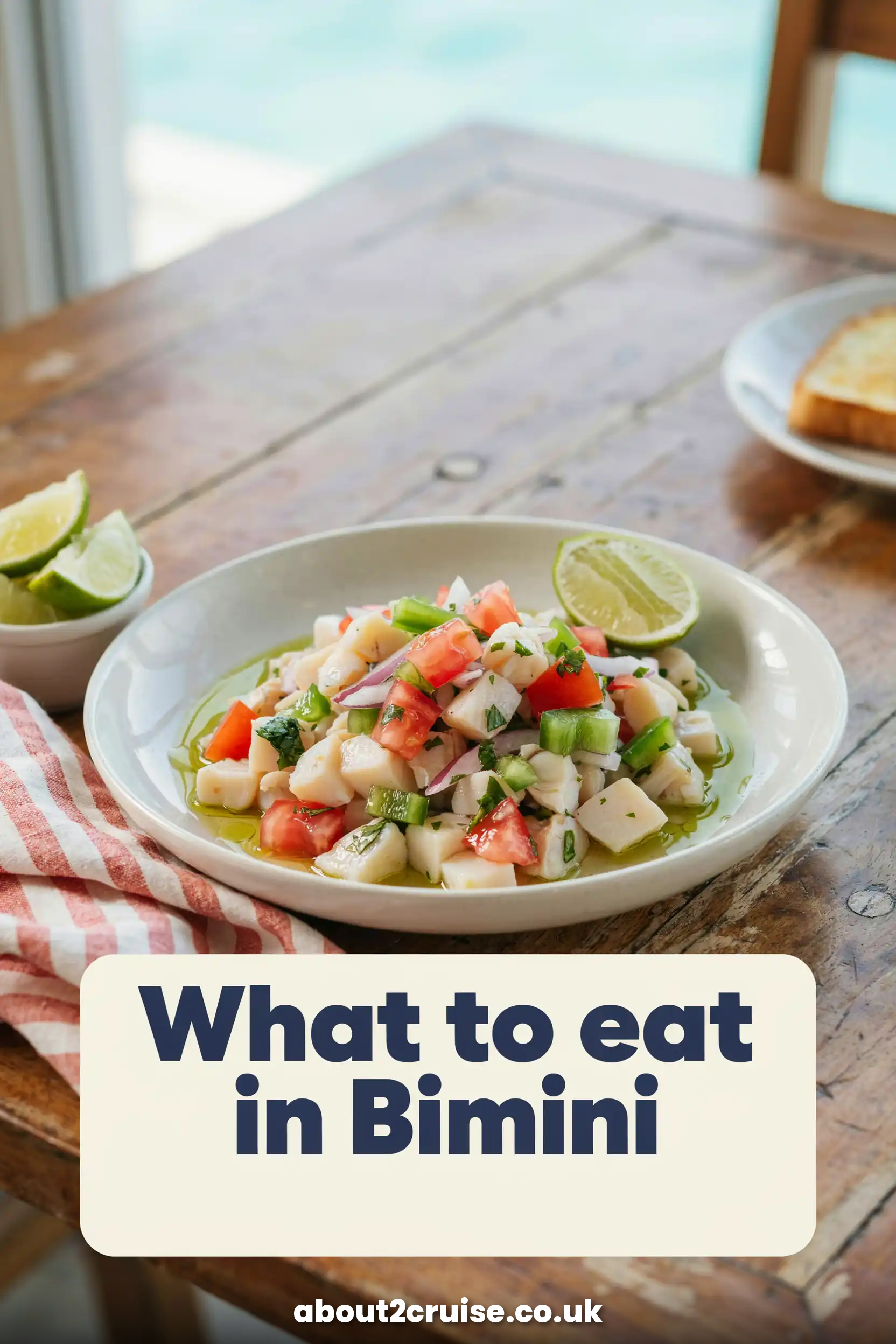
The must-eat is conch salad: raw conch chopped with tomato, onion, pepper, garlic and citrus. Joe’s Conch Shack and Stuart’s Conch Stand are the two roadside institutions. Conch fritters, cracked conch, Kalik beer and sweet Bimini bread round out the shortlist. Stuart’s tropical conch salad with mango and pineapple is a favourite if you like a sweeter cut.
For a sit-down meal, the Bimini Big Game Club’s seafood company and conch bar overlooks the marina and bonefish flats. Fisherman’s Village at Resorts World has air-conditioned spots if you need a break from the beach. Check restaurant reservations and local food in Bimini before you sail, because opening hours shift seasonally.
FAQs
Need quick, bottom-line answers? These are the ones cruise passengers ask most before booking.
Is Bimini walkable from the cruise port?
No. The pier is long and unshaded, and Alice Town is about a 45-minute walk from the ship. Use the free tram for the resort area or a taxi for Alice Town and Radio Beach. The tram does not run to Alice Town.
Do cruise ships tender in Bimini?
No. Ships dock at Resorts World Bimini Cruise Port’s single berth. There is no tender, which makes the port call more reliable in wind than many Bahamian anchorages.
What is the best month for warm water and low hurricane risk?
May and June usually give you very warm water before the hurricane season peaks. February to April is slightly cooler but has the lowest rain and best all-round comfort. The true sweet spot is April.
Can you do Bimini as a day trip from Florida?
Yes. The Baleària Caribbean ferry runs Fort Lauderdale–Alice Town in about two hours, and seaplane flights take around 35 minutes. The same weather rule applies: check the marine forecast, because a north wind against the Gulf Stream can make the crossing rough.
What happens if a hurricane is forecast for my Bimini cruise?
The line may swap Bimini for another port, reorder the itinerary, or add extra sea days. You will normally get port fees and line-booked excursions refunded if Bimini is skipped, but fare compensation is not automatic. Check your booking terms and consider travel insurance that covers itinerary changes.
Is Bimini expensive for a cruise day?
Only if you want the full resort beach and cabana setup. You can do a free beach and tram day, spend around $5 per person on taxis and $15 on conch salad, and keep costs very low. A resort day pass, golf cart and drinks push the day past $100 per person.
More Cruise Weather and Port-Planning Guides
If you are weighing up weather windows elsewhere, La Spezia weather patterns and Portofino cruise port guide cover Mediterranean conditions. For Bimini logistics, start with the Bimini port guide for first-time visitors and the transportation guide once you have picked your month.
Last Updated: 18 November 2026